By Lieutenant Colonel Pete Combe, USMC
The goal of this article is to articulate one past commander’s approach to discipline, with a focus on improving operational readiness. The author does not mean to imply that other O5 and O6 commanders pursue discipline for solely punitive reasons. Rather, this is an attempt to articulate an approach built on rehabilitative potential and getting Marines “back in the fight.” The framework discussed will rely largely on a “utilitarian” theory of discipline – one in which each decision a commander makes, and each punishment imposed on a Marine serves some larger purpose.1
In this framework punishment does not exist for punishment’s sake, but serves some goal. The article will proceed in four parts. First, a description of the purpose and theory of discipline under the Uniform Code of Military Justice (UCMJ). Second, a discussion of military theories of sentencing and their utilitarian value. Next, outlines a utilitarian framework and potentially useful rules of thumb in applying that framework using non-judicial punishment (NJP) as a demonstrative.2 Finally, a brief discussion of how to connect punishments to utilitarian principles.
1. Nature and Purpose of Military Law
The statutory mission of the United States Marine Corps is “… to provide fleet marine forces of combined arms, together with supporting air components, for service with the fleet in the seizure or defense of advanced naval bases and for the conduct of such land operations as may be essential to the prosecution of the naval campaign.”3 In short, the mission of the Marine Corps is to provide ready forces which are organized, trained, equipped, and staffed to conduct operations.4 With this larger mission in mind, the goal of any subordinate commander is to conduct operations as directed, and necessary to that end to maintain her unit at the peak of operational readiness.
One responsibility of commanders that is relevant to ensuring operational readiness is the use of measures to impose appropriate administrative or disciplinary sanctions in response to substandard performance or misconduct. These can range from purely administrative measures such as written counseling5 or extra-military instruction,6 through courts-martial. Regardless of the tool employed, the purpose of military law is to “promote justice, deter misconduct, facilitate appropriate accountability, assist in maintaining good order and discipline, promote efficiency and effectiveness, and thereby strengthen the national security of the United States.”7 This broad statement of purpose encompasses a number of goals, both utilitarian and retributive, in order to serve the broader “strengthen[ed]…national security purpose” which exist exists outside any perceived need to punish the accused for the sake of punishment.8
There are other offices within the military disciplinary system that exist to deal with offenses of such heightened severity that punishment for the sake of punishment could be the most appropriate theory of discipline.9 The Offices of Special Trial Counsel come readily to mind, as they are tasked with making referral decisions and prosecuting the most serious offenses such as homicide, sex offenses, crimes involving harm to minor children and domestic partner abuse.10 For these types of serious offenses, retributive justice is a more viable theory than utilitarian for reasons beyond the scope of this piece.11
However, for many of the less serious offenses, I offer that retributive theories of punishment should not weigh in a commander’s calculus. Non-Judicial Punishment (NJP) in particular is a commander’s tool, and one exercised solely within the discretion of the commander.12 Non-Judicial Punishment provides a commander with a broad range of disciplinary approaches to address minor offenses for which court-martial is not necessary to meet the needs of justice.13 NJP is intended to maintain good order and discipline, and promote positive behavior changes14 without the stigma of a court-martial conviction.15 It is this commander’s opinion that NJP is appropriate where the “needs of justice,” do not require punishment of the accused for the sake of punishment alone. Rather, NJP is an appropriate tool where the circumstances of the offense and offender favor the primary goal of achieving positive change.16
II. Military Theories of Sentencing
The military justice system recognizes five theories of sentencing or punishment:17
- Rehabilitation of the accused.
- Incapacitation of the accused to further offend, sometimes couched as protection of society.
- Maintenance of good order and discipline.
- General18 and specific.19
- Punishment of the accused.
Of these theories, the first four are primarily or solely utilitarian in nature – they serve a larger, if somewhat abstract or intangible, purpose aside from the imposition of punishment itself.20 The last is expressly retributive.
I argue that a purely retributive approach for cases of less serious offenses is both unnecessary and inconsistent with the policies governing NJP. As previously expressed, NJP is intended to address minor misconduct for which permanent incapacitation is not required. The purpose of NJP is to bolster military efficiency and good order and discipline, while returning Marines who have demonstrated rehabilitative potential “to the fight.” With that in mind, how then to apply a framework focused on achieving positive goals on behalf of both the individual Marine and the unit?
III. The Framework
I argue that the commander should ask three questions in assessing potential courses of disciplinary action, and that the first question embraces a theory of sentencing other than punishment. Rehabilitation.
A. Determining an Appropriate Forum
The three questions I ask of my staff and subordinates, are as follows:
- Does the accused have potential for further useful service in his current assignment?
- Does the accused have potential for further useful service in the Marine Corps, but in a different assignment?
- If the answer to either question above is “no,” how do I go about creating a vacancy so that my unit can obtain another willing and motivated Marine?
Once those three questions are answered, the appropriate disciplinary forum is readily apparent. If a Marine has the potential for further useful service in a special duty assignment, then administrative counseling alone may be sufficient. If a Marine has the potential for further useful service in the Marine Corps, but not in a special duty assignment then relief for cause may be sufficient.21 Even if a Marine has potential for further useful service, NJP may still be appropriate. The goal is simple. So long as the Marine has the potential for further useful service, how do we go about realizing that potential?
However, I contend that only by considering rehabilitative potential at the outset can a commander determine the appropriate course of action.22 Imagine a commander neglecting to consider rehabilitative potential, and referring a Marine to a special court-martial at which the Marine is sentenced to a punitive discharge. Even if the commander believes the Marine has rehabilitative potential, and would welcome the Marine back into her unit, she has lost that decision space. The commander should also consider the “demand for court-martial,” should a Marine exercise their right to refuse NJP.23 In the event the accused refuses NJP, the commander must consider what actions to take. Is court-martial appropriate, though not required? Could the commander proceed with purely administrative actions such as relief for cause or administrative separation?
B. Assessing Rehabilitative Potential
How then to assess a Marine’s ability to return to productive service in either the unit, or the Marine Corps? One needn’t start from zero – as there are a number of rehabilitative factors described in law and policy.24 These factors bearing on rehabilitative potential can generally be grouped into three categories: offender specific, offense specific, and unit impact related factors.
Offender specific factors relate to the accused’s past performance and future potential. These can include individual character observed over time, the accused’s performance of duty, the accused’s moral fiber,25 the willingness or determination of the individual Marine to be rehabilitated; past instances of misconduct by the accused26 the impact of NJP on the Marine, and whether the accused has accepted responsibility for his actions.27
Offense specific factors include the nature and severity of the offense, which is a particularly relevant factor when determining appropriate forum. Other offense related factors should include the accused’s role in the offense – was the Marine the principal offender, or did he aid or abet another? Was the accused somehow induced to commit the offense by another more culpable person, or was the Marine naturally predisposed?28 In addition to taking corrective action at an organizational level, if the commander cannot put in place appropriate guardrails to mitigate against the same offense by another then a punishment consideration based upon the goal of general deterrence may be appropriate.29
Finally, unit wide considerations should also inform the appropriate punishment. Perhaps the accused cooperated with the commander or law enforcement in investigating and addressing other offenses within the unit.30 While less concrete, there may be instances in which a certain disciplinary measure is appropriate to enhance good order and discipline within the unit.
In many cases this concept of rehabilitation is procedurally “built in.” In many instances a Marine must be counseled concerning shortcomings, provided an adequate time to rehabilitate, and then only if failing to do so can the Marine be processed for separation.31 Once the commander determines on a course of action – in our case, NJP – then I argue that the commander should focus on the four utilitarian theories of punishment discussed above: rehabilitation of the accused, incapacitation of the accused to reoffend, preservation of good order and discipline, and general and specific deterrence.
C. Nature of Punishments and Connection to Utilitarian Principles
Once the commander has assessed that the accused Marine has the potential for further useful service, but that imposition of NJP is still appropriate then she should consider what form of punishment is appropriate. Punishment should be aimed towards the four utilitarian principles. While the range of punishments available to the commander at NJP are not particularly severe, most utilitarian sentencing theorists argue that punishment should be no more severe than necessary to achieve the goals (deterrence, rehabilitation of the accused, or incapacitation of the accused) the sentencing authority seeks.32 Furthermore, while concepts of restorative justice aimed at restoring victims to a status quo ante have gained traction in civilian systems and certain administrative proceedings, the NJP process provides no function to achieve restorative justice.33
In crafting an appropriate sentence, it may help to consider which forms of theories best support a particular utilitarian theory of sentencing. An admonition or reprimand may best support specific deterrence. Restraints on liberty may best support general deterrence, and incapacitation of the accused from offending in the near future. Reduction in grade is a visible action that may contribute to general deterrence, as well as preservation of good order and discipline. The commander imposing NJP should carefully consider what forms of punishment will best achieve her goals. This framework and concepts hold true for other administrative and disciplinary matters within the scope of the commander’s discretionary authority.
IV. Connecting Punishments to Utility
Assume at this point, following the rubric above, the commander has assessed the Marine’s rehabilitative potential, and whether to proceed with some form of discharge or administrative reassignment. However, NJP does have lasting consequences and will remain in a Marine’s record for the remainder of their career.34 This is likely to have significant impacts on a Marine’s future opportunities for promotion or special duty / screenable assignments.35 Accordingly, the commander should carefully weigh the appropriate punishments, and give consideration to suspension, mitigation or remission and set-aside.
A commander may suspend part of a sentence at NJP, declining to impose that sentence at the current time but retaining the option to impose any suspended portion of the sentence at a later date if the Marine commits further misconduct. The impact of a suspended punishment which is not later imposed is effectively no punishment – the suspended portion ceases to exist if the Marine stays out of trouble for an appropriate length of time (ordinarily 6 months). The same is true if a punishment is remitted or set aside after imposition.36 Similarly, just because a commander considers a Marines case at NJP, does not mean that the commander must impose any punishment. The commander may determine after hearing the evidence, that the Marine did not commit the charged offense(s), or that the misconduct is so minor as to warrant no imposition of punishment.
These concepts can seem amorphous or difficult to pin down in the abstract. Accordingly, a series of hypothetical examples which emphasize different theories of sentencing as appropriate to each individual case may be illustrative. Each hypothetical case below is intended to highlight how a different theory of sentencing may appropriately contribute to utilitarian goals, getting Marines back into the fight, and ultimately bolstering readiness.
A. Staff Non-Commissioned Officer Fraternization
Hypothetical: A Staff Non-Commissioned Officer (SNCO) assigned as an instructor at a formal school is suspected of violating a lawful general order which prohibits unduly familiar relationships with student personnel. The SNCO has been counseled previously for non-sexual instances of unprofessional conduct with students, across several classes / school years.
What punishment is appropriate from a deterrent standpoint? In terms of specific deterrence, a verbal or written reprimand appears unlikely to deter the SNCO from offending further. He’s already on notice that his conduct is unacceptable. Thus, the commander should consider what punishment is apt to have a deterrent effect. Restraints on liberty and forfeiture of pay are both available options. However, their deterrent effect on the SNCO is not entirely clear.
In this case the interests of good order and discipline are directly impacted by the accused’s position. Removing the SNCO from his position, including any direct contact with students is likely an appropriate administrative measure. Administrative removal and punishing the SNCO to restriction – including twice-daily check-ins with all other Marines on restriction – will send a powerful message to the unit. All are subject to discipline, regardless of their grade or position.37
Restraints on liberty, coupled with administrative reassignment may also work to incapacitate the SNCO from offending in the future – at least in the short term. By restricting the SNCO to locations in which students are not likely to be, along with administratively reassigning him to a role that has no contact with students, his access to students will be curtailed.
If the commander determines that the SNCO lacks rehabilitative potential in the school environment, then a range of options including removing the Marine from the particular school either for the Good of the Service (GOS) or Relief For Cause (RFC) may be appropriate.38
B. Non-Commissioned Officer DUI
Hypothetical: A Non-Commissioned Officer (NCO) with a history of alcohol related incidents is ticketed, but not yet convicted, for driving under the influence of alcohol (DUI) out in town. The NCO has no prior history of DUI, nor do prior alcohol related incidents involve violence. After initial actions including Substance Abuse Counseling Center assessment and treatment, the command must assess whether to proceed with NJP.39
Is an admonition or reprimand formally imposed at NJP likely to deter the NCO from further DUI or other alcohol related incidents? As a threshold matter, it would appear not. Aside from the imposition of NJP itself, there is no directly foreseeable link to remaining available punishments (restraints on liberty, reduction in grade, forfeiture of pay) and specific deterrence.
The interests of good order and discipline may also require that this NCO be removed from his position administratively. In particular, if the NCO has a security clearance, his repeated irresponsible consumption of alcohol may impact his eligibility for access to classified information.40 However, from a disciplinary standpoint the visibility of the NCO’s conduct will likely be an important factor to consider. If he is an NCO In Charge (NCOIC), then removal from his position or reduction in grade may be appropriate.
The NCO here may be rendered incapable of further abusing alcohol either by restriction, or by limiting his disposable income by forfeiture of pay. In conjunction, this may work to limit the NCO’s ability to commit the same or similar misconduct in the future.
Should the commander decide that the NCO does not have rehabilitative potential, then the commander may choose to recommend separation of the Marine for failure of alcohol rehabilitation.41
C. Non-Commissioned Officer on Barracks Duty
Hypothetical: An NCO assigned overnight barracks duty falsifies logbook entries indicating that she made her required rounds. The greater weight of evidence indicates that not only did she fail to make her rounds, but that she left her post without authorization. Her whereabouts during this time are unknown.
Whether an admonition or reprimand is likely to deter the NCO from similarly offending in the future may depend on the circumstances of her absence from post. For example, assume she is a single mother, who during the course of questioning freely admitted her misconduct, and explained that she left because pre-arranged childcare fell through.
This case on its surface has a direct connection with good order and discipline, through the regular maintenance and accurate logging of security posture in the barracks. However, in the circumstances described involving childcare, there are likely better ways to reinforce good order and discipline than through severe punishment.
D. Thoughts on General Deterrence
In theory, any sufficiently visible form of punishment serves general deterrence. The concept of general deterrence is also closely related to the preservation of good order and discipline. If Marines are aware of their fellow service member’s misconduct, and there is a visible consequence for that misconduct, this serves general deterrence. If Marines are sufficiently deterred, this bolsters good order and discipline.
Commanders may also maximize the effect of the NJP proceeding itself. This may include “command observers” during the NJP, to demonstrate to Marines that the commander is fair, impartial, and approaches the proceedings with integrity.42 If the accused requests witnesses be present, then the commander may permit those witnesses to remain in the room while the commander considers the evidence and makes a final decision.43 The commander may also provide the unit senior enlisted advisor a chance to address those present. However, if deviating from the NJP guide in the JAGMAN,44 the commander should closely coordinate with the senior enlisted advisor and servicing Staff Judge Advocate to avoid any impermissible actions.45
Commanders should consider publication of the results of NJP to their units.46 The intent is not to embarrass the accused, but to show all Marines how the commander addresses misconduct. Publication can also be used as a teaching tool for other Marines, and highlight where even “good” Marines may succumb to outside pressures. Publication should be anonymized by removing the name of the Marine and the specific subordinate unit or section. However, the publication should provide sufficient facts so that unit members can understand the misconduct and any mitigating factors.
V. Conclusion
Ultimately, this framework is about accomplishing one overarching goal – bolstering operational efficiency through exercise of the tools at a battalion or regimental commander’s discretion. However, I argue that below the level of a court-martial punishment alone as a theory of sentencing has no place.47
At the root of this approach is a simple question, that should be foundational to formulating an appropriate punishment: does the accused have the potential for further useful service? With this question as a basis, commanders can craft appropriate punishments at NJP, and either return good Marines to the fight, or create a vacancy for another willing volunteer.
Lieutenant Colonel Pete Combe is currently assigned as the Staff Judge Advocate, Marine Forces Reserve / South. This article is informed by his career as a Marine Judge Advocate, and his experience as the Commanding Officer, Region 5, Marine Corps Embassy Security Group from 2024 to 2026.
The views expressed here are those of the author and are not intended to reflect or convey any official policy of the Department of the Navy, the Department of Defense, or the U.S. Government.
References
1. While this article uses the term “Marine,” one may well substitute the Service neutral term “servicemember,” or for that matter Sailor, Soldier, Airman, Guardian, or Guardsman.
2. Why non-judicial punishment (NJP) pursuant to Article 15 of the U.C.M.J.? Because, when accepted by the Marine it is truly the only form of statutory punishment under the U.C.M.J. which is wholly within the discretion of the Commander.
3. 10 U.S.C. § 8063.
4. 10 U.S.C. §§ 161, 162.
5. Marine Corps Order 1900.16 w/CH-2, ¶ 6105.
6. JAGINST 5800.7G w/CH-2, ¶0103.
7. Manual for Courts-Martial (2024 ed.), I-1 (emphasis added).
8. See, e.g., Charles L. Pritchard, Jr., Punished as a Court-Martial May Direct, The Army Lawyer, 33 (December 2015).
9. One viable theory where the other four theories of sentencing may also play a role in crafting an appropriate sentence.
10. 10 U.S.C. 824a; 10 U.S.C. 1044f.
11. Pritchard, Punished as a Court-Martial May Direct, 35.
12. This in contrast to Administrative Separation Boards which include members, and generally an outside “separations authority.” See. MCO 1900.16 w/CH-2, ¶1603. Also, for courts-martial in which counsel, military judges, and panel members will play significant roles – and in which the commander must abandon desire for a specific result, and instead work to ensure the integrity of the process.
13. MCM, V-1.
14. I would argue that the use of the plural “servicemembers” here indicates the intent to effect positive behavior changes on the part of the accused, and others.
15. Id.
16. Pritchard, Punished as a Court-Martial May Direct, 35.
17. Pritchard; DA PAM 27-9.
18. Deterrence of others from committing the same or similar offense(s) in the future.
19. Deterrence of the accused from committing the same or similar offense(s) in the future.
20. Pritchard.
21. Relief for Cause (RFC) is a term of art used in Marine Corps screenable billets, and encompasses removal from a “screenable” billet prior to the expected / designated end of tour. RFC is ordinarily used when a Marine’s conduct falls below that expected of a Marine in a high visibility assignment, and can either follow or be independent of NJP. See, generally MCO 1326.6 w/CH-1, and MCO 1300.8 Chapter 3.
22. Obviously other factors will weigh in, such as the severity of the offense, impact to the unit, etc. There are clearly offenses of such seriousness than rehabilitative potential should not be a consideration in determining an appropriate forum.
23. MCM, V-2.
24. See, for instance, MCM II-148 (RCM 1001(b)(5)); MCM V-1; DA PAM 27-9, pp. 116, 2051; MCO 1900.16 w/CH-2, ¶ 6309.
25. Though not entirely clear from the DA PAM 27-9 paragraph what this entails, perhaps it includes rescuing multiple students from grindylows in the Black Lake a la, Harry Potter.
26. MCM, V-1 (para. 1.d).
27. DA PAM 27-9, p. 2051.
28. Id.
29. A particularly useful tool for general deterrence, and one used by the author, is to publish the results of performance and misconduct proceedings (sufficiently anonymized to avoid the potential for embarrassment or humiliation) as a means to bolster the general deterrent effect. See., e.g., JAGINST 5800.7G w/CH-2, ¶ 0115.
30. DA PAM 27-9, p. 2051.
31. MCO 1900.16 w/CH-2, ¶6105. See, e.g., MCO 1900.16 w/CH-2, ¶¶ 6205 (Entry-Level Performance and Conduct), 6210.2 (Minor Disciplinary Infractions), 6210.3 (Pattern of Misconduct) – all of which require counseling and consideration of the rehabilitative guidelines discussed in ¶6105. Contrast, for example, with ¶¶ 6210.4 (Sexual Misconduct), 6210.5 (Drug Abuse), 6210.6 (Commission of a Serious Offense), or 6210.8 (Sexual Harassment) – none of which require said counseling and consideration, and for some of which processing for separation is mandatory upon substantiating the conduct.
32. Bentham, supra, CH XIV, pt. XIII, “punishment ought [not] be more than what is necessary.”
33. See, e.g., MCO 5354.1G, Chapt. 7 and the discussion of informal resolution through conflict management (mediation) between a victim and accused in instances of sexual harassment.
34. MCO 5800.16, Vol. 14.
35. MCO 1326.6 w/CH-1.
36. MCM, V-7,8.
37. Though speculative, a SNCO in a special duty assignment may find acceptance of NJP preferable to either risking a court-martial, or being relieved for cause from that special duty assignment.
38. See, generally, MCO 1000.6 and MCO 1326.6 w/CH-1.
39. See, MCO 5300.17A. The command will also potentially be required to initiate separation proceedings pursuant to MCO 1900.16 w/CH-2, ¶ 6209 – thought the commander may recommend retention if assessing the Marine has rehabilitative potential.
40. 32 C.F.R. 147.2.
41. MCO 1900.16 w/CH-2, ¶ 6209. Separation processing may be mandatory at this point, but the commander may still recommend that the Marine be retained.
42. JAGINST 5800.7G w/CH-2, ¶ 0110.c.
43. MCM, V-3.
44. JAGINST 5800.7G w/CH-2, App. A-1-f
45. See, e.g., 10 U.S.C. § 837.
46. JAGINST 5800.7G w/CH-2, ¶0115.
47. And perhaps even at any level below a general court-martial.
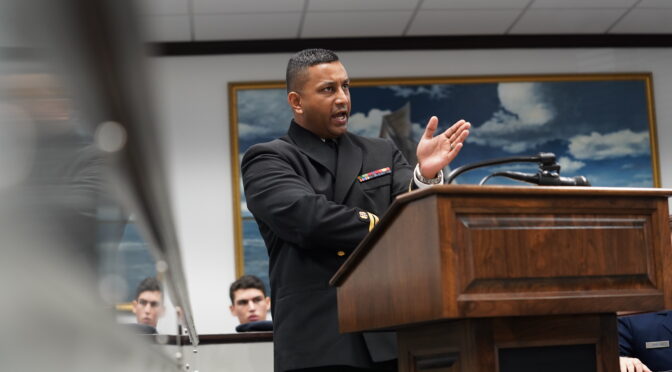
Featured image: A U.S. Navy staff judge advocate questions a witness in a mock trial. (U.S. Air Force photo by Airman 1st Class Elizabeth Davis)