Category Archives: History

Naval and maritime history section.

President Charles Stewart and the Making of American Naval Power

Alternate History Topic Week

By Claude Berube

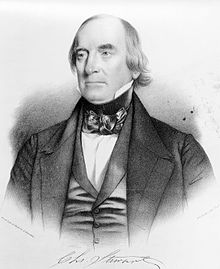
Having just completed his latest assignment as Commodore of the Home Squadron, Charles Stewart had returned to his intermittent business interests that had afforded opportunities to officers without orders.  He had seen the flyers, his stately image emblazoned above the appeals for him to run for president of the United States.  At the behest of fellow Philadelphian merchants, he agreed to join them in Baltimore where both the Whigs and Democrats held their conventions.  Henry Clay was already certain to be the Whig nominee; the fight for the Democratic nomination was far more complex.

Martin van Buren’s lock began to falter based on his position on slavery and opposition to the annexation of Texas.  War of 1812 hero Lewis Cass supported annexation.  There were other contenders: James Buchanan, John C. Calhoun, and Silas Wright.  In the background was the decidedly non-political hero of the War with the French in 1798, the Barbary War, and the War of 1812.  Van Buren was gone by the seventh ballot.  Massachusetts delegate George Bancroft offered Speaker of the House James Knox Polk as a running mate for Van Buren or Stewart.  Polk’s supporters vowed to endorse Stewart if he selected Polk as his vice president.

The matter was offered to Stewart at a dinner.  He said nothing, appearing unusually nervous and fidgety.  This was the moment of decision.  If he turned them away, there would never be another opportunity and he would return to his estate in Bordentown to live out his days as the chance for another sea command – particularly as he had already been commodore of the Mediterranean, Pacific and Home Squadrons – was unlikely. 

“If nominated,” he finally said, “I will accept.” His nomination was immediately reported by Samuel Morse’s new telegraph.

With Jackson’s protégé, Polk, by his side, and the delegates from Pennsylvania and New York committing to the ticket, the northern and western states soon followed suit.  The sixty-six year old Stewart provided a heroic narrative for the newspapers, much as Jackson’s army experience had vaulted him into the presidency.  In the general election, Polk’s Tennessee roots offset Clay’s enough for Stewart to be elected president.

Though his vice president kept pushing an agenda to annex Texas and secure the northwestern territories, Stewart was resistant to fighting on too many fronts for a nation with a small army and navy. He named his friend and navalist James Fenimore Cooper Secretary of the Navy, a move not unprecedented since another of the literary Knickerbocker Group James Kirke Paulding, had held the same position under Van Buren.  Cooper’s extensive non-fiction writing in the previous decade about building up the fleet convinced Stewart that he was the right man for his administration. Stewart focused his administration on building and modernizing the navy and providing new markets for the merchant fleet.  Westward expansion held no interest to the sailor-president. 

Naming Matthew Perry America’s first admiral, Stewart had read his 1839 report on the navies of Europe.  A young French ship designer had also come to his attention.  The days of wooden frigates and ships of the line designed by Stewart’s former colleagues, the Humphreys, were passing.  Stewart realized that the country had to make a leap forward if it was to become a great power.  He hired Henri Dupuy de Lome, a French ship designer proposing an iron-hulled-screw-driven frigate.  Together with Commodore James Barron, who had designed a steam-powered tri-hulled ram ship in the 1830s, and a young engineer Charles Ellet proposing his own ram ship, the team built a new naval force.

In late 1845, Stewart sent his Secretary of State Richard Rush, a former Minister to Great Britain, to issue demands of the British Empire including accepting U.S. terms on the Oregon Territory.  Rush and Stewart alone remained from their Philadelphia schoolyard from where two other friends perished – first Richard Somers at Tripoli and then Stephen Decatur in a duel.  Stewart built a coalition of those defeated by the Royal Navy that had allowed it to rule the seas.  Spain had a small navy with some ships that remained in harbor since the days of Trafalgar.  But France offered Stewart more hope.

In 1836, Louis-Napoleon, the nephew of Bonaparte, had attempted a coup.  Failing that, he sailed for the United States.  He met in New York with the elite including generals and naval officers.  He vowed to poet Fitz-Greene Halleck – one of the Knickerbockers – that he would become Emperor.  He was welcomed at the Naval Lyceum at the Brooklyn Navy Yard then he traveled to Bordentown where his uncle Joseph – the dethroned King of Spain – had exiled himself.   Here Louis-Napoleon became acquainted with Stewart and his family.  Stewart funded Napoleon in 1845 to overthrow the government then sent his own son, Charles Tudor Stewart, as emissary to the throne of Napoleon III.

England rebuked Rush and when he returned, Stewart asked for a declaration of war.

Queen Victoria, Prime Minister Robert Peel by her side, sent the British Fleet under the aged Admiral of the Fleet James Hawkins-Whitshed off to the Americas to put the upstart nation down quickly, lest other nations be inspired by their defiance.  The Royal Navy hadn’t been defeated in forty years and its wooden walls would not fail now.  Its objective was the Chesapeake Bay where transport ships would land in Norfolk, Baltimore, and up the Potomac River to Washington.

A recognized Constitutionalist, Stewart had averted a war with Algiers in 1805 when he pointed out to the squadron’s Commodore that only Congress could declare war and again in 1815 when notified that the Treaty of Ghent had been signed pressed the crew of the Constitution to continue its wartime footing since only the Senate could ratify a treaty – and there had been no such news.   It allowed him just a few weeks later his greatest victory of the USS Constitution over the HMS Cyane and HMS Levant. Now, he followed the Constitution again while anti-British fervor in Congress overwhelmingly supported a third war for American independence and reduce England’s control of the oceans and the trade it dominated.  He also knew Article II, Section 2 of the Constitution which stated that the President shall be Commander in Chief of the Army and Navy.  He would lead the fleet.
pic 2

Perry objected as the honor should have been his as Admiral until Stewart divided the fleet.  One squadron under Perry steamed south from Baltimore toward Norfolk.  The English fleet of nearly one hundred ships sailed slowly into the mouth of the Chesapeake toward the unmistakable plumes steamships to the north.  Stewart’s fleet waited in Gosport.  Thirty years before, Stewart was in command of USS Constellation and was prevented from getting underway because of Admiral Sir John Warren’s squadron.  This new British fleet had several steamships, but no ironclads.  Unfortunately the British, who had always been prone to overpowering their ships at the risk of maneuverability, sent their expedited screw-propelled ships-of-the-line like the QUEEN and ALBION classes at the head of the fleet.

Perry’s squadron was the first to fire upon the fleet while Stewart’s squadron of iron-clad ram ships steamed east into the heart of British fleet.  Ships of the line and frigates were holed one after the other while others fell to Perry’s barrage.  A quarter of the fleet, including most of the transports, tried to escape to the Atlantic, but soon encountered a joint French-Spanish fleet at the mouth of the Chesapeake.  The remaining ships surrendered without firing a shot.  In just a few hours with the Battle of the Chesapeake, Stewart had achieved the greatest maritime victory since Trafalgar.

England soon sent diplomats to negotiate a peace.   During negotiations, Stewart provided aid to his son-in-law, John Parnell, to foster a rebellion in Ireland as Napoleon III became more active in the English Channel.  The Peel government acquiesced to Stewart’s primary demand and lost not only claims to the Oregon territory but all of Canada.  Stewart had doubled the size of the country in a short war, secured a western coast for the country with additional ports, increased the number of free states, and assured additional pro-Stewart members of Congress in the 1846 election. 

Stewart was able to turn to domestic issues, particularly that of slavery which continued to politically divide the country.  With the addition of the new northern states, Stewart had enough support in Congress to outlaw slavery, fomenting revolt in the South.  Stewart averted a civil war by listening to his vice president who for years had been advocating Texas annexation and a war with Mexico.

Encouraged by Stewart’s stance, Napoleon III launched an invasion of Mexico claiming the right of free trade was being denied by President Farias and then Santa Anna.  Stewart announced support for France as he ordered squadrons to support US operations in Texas and California.  After a long-standing feud with General Winfield Scott (Stewart’s marriage of proposal to Maria Mayo, Scott’s eventual wife, was rebuked,) Stewart appointed General Zachary Taylor to command the Army.

Within two months, the US controlled all of Mexico’s territory north of the Rio Grande while France controlled all territories to the south.  The final battle occurred outside Mexico City where the French defeated and killed Santa Anna on the fifth of May, 1847, a day still celebrated in 21st century France as “Cinque de Mai.”  With this war concluded, Stewart dispatched a squadron under Commodore John Aulick to open trade with Japan and expand trade with China.

After the First Franco-American Coalition War, Stewart knew he could not avert a civil war with pro-slavery and states’ rights forces demanding that Texas and the new territories become slave-holding states.  While Congress debated the Great Compromise of 1848, Stewart took preemptive action and sent the fleet under Commodore David Conner to secure southern ports and Admiral Perry into New Orleans to take the Mississippi River.  Taylor took his army and advanced them on all federal arsenals and depots before the southern states could organize. 

The south began a guerilla campaign led by a young hero of the Coalition War, Robert E. Lee.  But Lee, an engineer accustomed to large troop operations was either by temperament or experience unable to conduct the only warfare option available to the south.  Within four months, Lee’s Raiders and their associated militias were captured with the loss of nearly one thousand Union troops.  Stewart was criticized for such a costly operation but soon found favor from both the north and south with the Stewart Proviso.  A delegation composed of Stewart, Henry Clay, John C. Calhoun, Lewis Cass, Stephen Douglas, and Nicholas Trist, agreed that: 1) slavery would be abolished in the United States, 2) any freed slaves would be offered five acres of land in the new Canadian states, 3) federal occupation of the port cities would end, and 4) the former slave states would receive exclusive trade rights due to the recent agreements in southeast Asia.

Having gained control of most of North America fulfilling his party’s dreams of Manifest Destiny, diminishing the role of the world’s superpower, increased America’s geopolitical position, and enriching the country – particularly the South which enjoyed unprecedented riches, enabled Stewart to easily defeat his opponent in the 1848 election, the Whig nominee Winfield Scott.  The Free Soil Party dissolved before the election because of the resolution of slavery.

His first term marked by rapid military operations and overtures to both Europe and Asia, Stewart’s second term soon took advantage of the European Revolutions of 1848.  Stewart’s son-in-law John Parnell took control of an independent Ireland as his wife gave birth to their son, Charles Stewart Parnell.  Stewart formed global squadrons to secure America’s interests and expand commerce in South America and Africa as European powers yielded what little control they had in the wake of the revolutions.

In 1852, the seventy-four year old chose to run for a final, third term.  James Fenimore Cooper remained one of his closest cabinet members and penned a major treatise on the American navy’s global imperative.  The tome was advanced by Stewart in his third inaugural address and embraced by Congress which supported the Naval Expansion Act of 1853 assuring construction of the largest fleet in the world and ensuring global security for nearly sixty years.

Claude Berube is the co-author of A Call to the Sea: Captain Charles Stewart of the USS Constitution” and has taught in the Political Science and History Departments since 2005.  His latest novel, “SYREN’S SONG,” will be published in November by Naval Institute Press.
Protraction: A 21st Century Flavor of Deterrence

This interview originally appeared on the Small Wars Journal website and was republished with permission. You may find the interview in its original form here

Interview with Jim Thomas (CSBA) conducted by Octavian Manea

Jim Thomas is Vice President and Director of Studies at the Center for Strategic and Budgetary Assessments (CSBA). He served for thirteen years in a variety of policy, planning and resource analysis posts in the Department of Defense, culminating in his dual appointment as Deputy Assistant Secretary of Defense for Resources and Plans and Acting Deputy Assistant Secretary of Defense for Strategy. In these capacities, he was responsible for the development of defense strategy, conventional force planning, resource assessment, and the oversight of war plans. He spearheaded the 2005-2006 Quadrennial Defense Review (QDR), and was the principal author of the QDR report to Congress.

During the last sequences of the Cold War, the US and NATO emphasized new capabilities and new operational concepts – Assault Breaker, Air Land Battle, Follow-On Forces Attack. What role did these elements have in changing Soviet perceptions about the military balance, including restoring a credible deterrence on the NATO’s Central Front?

Four things stand out as contributing to allied success in influencing the military balance in the early 1980s.

The first and probably the most important was political: allied solidarity. The Alliance successfully deployed highly controversial systems like Pershing 2 to force the Soviet Union back to the negotiating table on intermediate nuclear forces. Showing the alliance solidarity surprised the Soviet leaders and made the situation more difficult for them. Soviet leaders had high hopes that peace movements in Western Europe would scuttle any such deal and they were dead wrong.

The second is financial: beginning in the last year of the Carter Administration and continuing into, and intensifying during the Reagan Administration, decisions were taken to increase military spending. The so-called Reagan rearmament began and continued throughout the 1980s as an effort to outspend the Warsaw Pact forces.

The third is the development of new operational concepts, the American Air Land Battle concept and NATO’s complementary Follow-On Forces Attack, which emphasized being able to hold at risk second echelon forces, to “look deep and shoot deep.”

And that leads to the fourth element: technology. A DARPA initiative called Assault Breaker that was designed to harness advanced technologies that would allow for the implementation of Air Land Battle. It was the R&D centerpiece of a new technological investment strategy and the second offset strategy launched by Harold Brown and Bill Perry during the Carter Administration focusing on three technological areas: precision warfare, low observable aircraft, and the ability to use micro-processors to create the datalinks between sensors, controllers and shooters. Assault Breaker helped to spur development of new airborne sensors, networking, stealthy strike aircraft, and precision guided munitions.

All these trends were observed in Moscow. In 1984, Marshal Ogarkov, the chief of the Soviet General Staff, acknowledged that the so-called reconnaissance strike complex was emerging and that it offered a new revolution in military affairs beyond the nuclear revolution in which conventional weaponry with precision guidance could assume some roles that were previously monopolized by nuclear forces. He was also very pessimistic about the ability of the Soviet military and its defense industry to keep pace with these developments. This military pessimism converged with also changing political currents in Moscow. It wasn’t a decisive factor, but I think it contributed to the decisions made by the Soviet political leadership in the late 1980s to seek a better relationship with the West and try to reduce military competition, which increasingly was seen as a losing proposition.

How do Russia’s contemporary A2/AD capabilities change the security landscape in Europe?

First, Russia has some very capable air and sea denial systems. Russia’s ability not only to protect its own airspace but also to deny the use of airspace over the territory of NATO frontline states in a crisis or conflict has improved dramatically. This poses real problems to the Alliance especially if NATO continues to maintain a defense in depth posture with only lightly defended frontline states.

Second, since the end of the Cold War and especially since the NATO-Russia Founding Act and the adoption of the so called 3 No’s [“no intention, no plan and no reason to deploy nuclear weapons on the territory of new members”], the alliance relied on expeditionary, so-called rapid reaction forces that in a crisis or conflict would be dispatched from the more Western countries of NATO to reinforce the Eastern frontline states. But in the presence of advanced Russian air and sea denial systems this may be very difficult. In a crisis it may be in fact destabilizing to deploy NATO forces eastwards and in conflict it could be even suicidal as transport aircraft and ships, not to mention receiving ports and airbases would be vulnerable to Russian surface-to-air, anti-ship and land-attack missiles.

Third, there is this intermingling of anti-access/area denial capabilities that can essentially check conventional power-projection by other traditional militaries to reinforce frontline allies and at the same time this greater emphasis on non-linear/sub-conventional operations as emphasized by Valery Gerasimov, chief of the Russian general staff. These two types of endeavors really work hand in glove. It is this non-linear warfare area where NATO has been quite slow in terms of both defense (how it addresses these threats) as well as how it too might opportunistically exploit these similar approaches. The same can be said when it comes to A2/AD: how can the frontline states emulate or mimic some of the A2/AD approaches others are adopting to create an effective bear trap. And NATO countries also need to rethink the so called 3 NOs. It may be past time to return to a forward defense posture and permanently station US and other allied forces on the territory of the frontline states. We shouldn’t wait until the next crisis to move in this direction.

Is it accidental that revisionist powers in the Middle East, Far East and Europe are projecting their anti-status-quo interests at a time when they are feeling more confident in their own A2/AD capabilities and their ability to keep at bay traditional power projection?

Definitionally, the intention of a revisionist power is to challenge the status-quo and try to maximize its power and expand its sphere of influence. The character of revisionism is different across the three regions. Many in Europe were surprised by Putin’s annexation of Crimea because they took for granted the borders that were established at the end of the Cold War and that were perceived as indisputable as opposed to the situations in Middle East or maritime Asia.

All these revisionist powers appear less hesitant about employing irregular operations as a surrogate or as a complement to traditional military power projection. Especially when confronting other great powers, the ambiguous nature of irregular actions undertaken not by uniform soldiers, but by fishermen, by civilian protesters or by “little green men” offers a more insidious form of power projection.

Is this an incentivize for a revisionist power that had the intent, and now increasingly the capabilities and the ability, to wage low cost irregular warfare campaigns under an A2/AD umbrella?

Yes, that appears to be the case. Anti-access/area denial at the conventional level buys time and space for revisionist powers to conduct salami-slicing creeping aggression or coercion underneath whether it is in Crimea, in East China Sea, or in the future in the Middle East. Anti-access capabilities can enable conventional or unconventional forms of power projection by providing the umbrella to protect them from conventional counter-attacks especially during movements.

Rather than seeing the irregular gambit as a form of warfare distinct from conventional warfare, the revisionist powers appear to integrate these concepts in ways that combine different approaches. They are able to combine anti-access and area-denial, conventional capabilities with these irregular and sub-conventional capabilities in very effective combinations. These combinations could be differentially applied depending on the circumstances and their specific objectives at any time whether it is in Georgia, Ukraine or perhaps the Baltics or Moldova in the future. The anti-access/area-denial capabilities allow them to hold off conventional military forces and create an umbrella underneath which they can use their sub-conventional capabilities.

Do nuclear weapons have an A2/AD role? Can a nuclear umbrella play the role of an A2/AD umbrella underneath which a revisionist power can employ conventional or sub-conventional forces?

Nuclear weapons are sort of the original A2/AD threat. States that have them tend to be far more effective in dissuading others not to get too close or to think twice before attacking. Coupled with conventional A2/AD capabilities, Russia’s posture poses a vexing problem for allied planners. The range of Russia’s conventional air defense, anti-ship, and land-attack missiles blankets large portions of some frontline allies like the Baltics. Russia has declared that any attack against its territory could invite nuclear retaliation. Thus, its nuclear forces may be perceived as providing some form of sanctuary for its western conventional A2/AD capabilities.

Does NATO need a new updated 21st century Air Land Battle doctrine? How should NATO be re-postured for a security environment where parts of its territories are covered by the competitor’s A2/AD umbrella?

For NATO, the highest priority should be improving local defense of the countries on the frontline. I like Wess Mitchell and Jakub Grygiel’s proposal to establish a preclusive defense posture. Frontline states with assistance from their allies need to develop their own air, sea, land denial capabilities to negate and reduce the risks posed by the Russian conventional force aggression.

At the same time, NATO needs to develop an irregular dimension or irregular characteristics to Alliance deterrence to complement the conventional and nuclear forces. We need to expand the capacity of all NATO frontline states to conduct popular resistance, a defense that is highly irregular in its characteristics and holds out in particular a much greater risk of protracted warfare, denying quick wins for potential adversaries. We want to raise the costs dramatically for any potential aggression against NATO states and hold out the prospect of conflict widening while buying time for allies to respond and avoiding any fait-accompli on the ground. The emphasis should be put on the small highly distributed irregular resistance forces, prepositioned concealed weapons and clandestine support networks and auxiliaries. Modern guerilla forces armed with short-range man and truck portable guided rockets, guided artillery, guided mortars can conduct very rapid and very lethal maneuvers, ambushes and sabotages. We talk a lot about deterrence by denial and deterrence by punishment, but I think increasingly in the 21st century we must talk in terms of deterrence via protraction.

Should NATO have the ability to put in danger the Russian anti-access/area-denial capabilities more along the lines of the Air-Sea battle concept articulated in East Asia?

In Europe, the frontline states should make themselves indigestible and at the same time, NATO should expand its conventional strike capabilities, kinetic and non-kinetic, while preserving its nuclear options for escalation control. We want to demonstrate that there can be no possibility of aggression against NATO frontline states whether that would be classic armed conflict or would be subtle, insidious forms of subversion. We have to demonstrate unquestionable intolerance for the full range of threats that could be posed.

How should emphasis on defense modernization look like for a country like Romania exposed to the Russian A2/AD capabilities and in a time when the Black Sea is rapidly becoming a Russian A2/AD lake?

The sine-qua-non should probably be land, air, sea denial capabilities with greater emphasis on ground based air and coastal defenses, as well as distributed anti-tank weapons and mines. Romania has to return to its history and reintroduce its unique concept of popular resistance. In the long term, it may be an option to build a small fleet of coastal submarines as an asymmetric sea denial force.

This interview was published in the context of the Romania Energy Center project “Black Sea in Access Denial Age”, a project co-financed by the North Atlantic Treaty Organization (NATO). To read more, go to http://www.roec.biz/bsad/

The Hohenzollern Chinese Navy? Part Two

The High Seas Fleet and the PLAN: Striking Similarities in Strategy, Force Structure and Deployment

The first part of this series examined the nearly identical origins, and dismal, early combat histories. This second installment compares the equally similar strategy, operational art, and force structure, and concludes with observations on the PLAN can avoid the fate of the High Seas Fleet. Read Part One here.

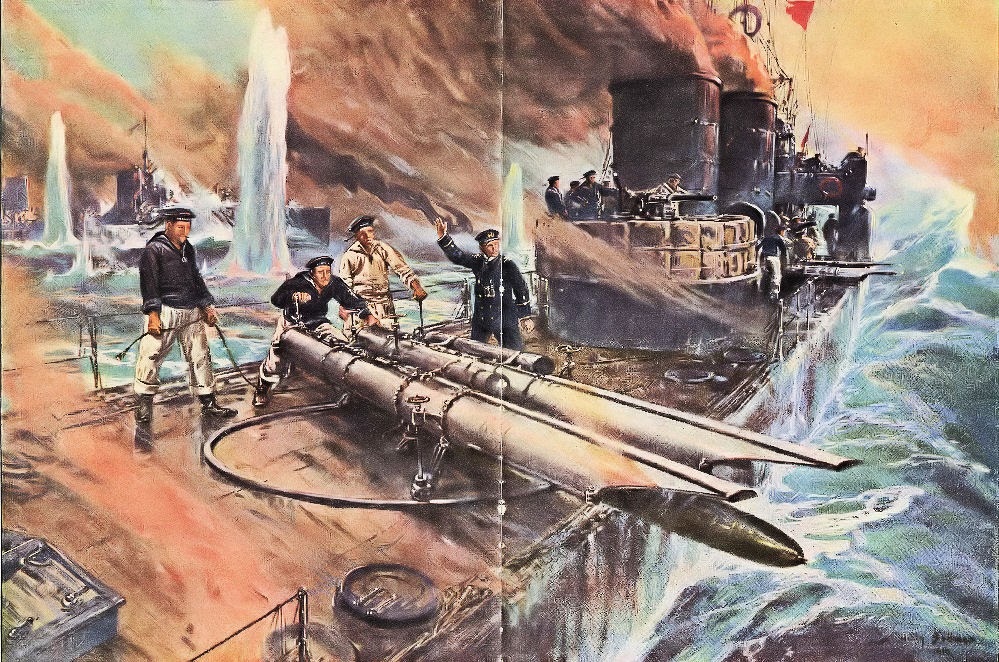
Both new fleets entered their identifiable “blue water” eras with similar strategies, operational concepts and tactics. The German High Seas Fleet retained robust coastal defense force structures even as its focus moved to the maritime space outside its own near abroad. This dual aspect of coastal and blue water operations was a key element in German strategy that was designed to defeat Great Britain’s Royal Navy (RN). High Seas Fleet architect Admiral von Tirpitz believed that a German Navy 2/3 the strength of the RN would be sufficient to defeat the British Navy in a battle if waged in German terms. Tirpitz envisioned drawing a portion of the RN into battle in the North Sea, but reasonably coast to German bases where torpedo craft (surface and subsurface), minefields and even shore batteries on advanced locations such as Heligoland Island might support the High Seas Fleet. German naval historian Holger Herwig suspects that Tirpitz never intended to attack Britain, but hoped that “British recognition of the danger posed by the German Fleet concentrated in the North Sea”, would “Allow the Emperor to conduct a greater overseas policy.”[1] The possibility would always exist that if Great Britain still defeated the German Navy in battle that it would be too damaged and perhaps, “Find itself at the mercy of a third strong naval power or a coalition (France and Russia).[2] Herwig also suggests that other would-be maritime powers might be inspired by Germany’s example and perhaps convince those nations to seek Germany as an ally. To achieve these ends, Tirpitz in effect attempted to create the early 1900’s equivalent of an Anti-Access/Area Denial (A2/AD) zone in the Heligoland Bight of the North Sea.

Artwork featuring German coastal defense torpedo craft.

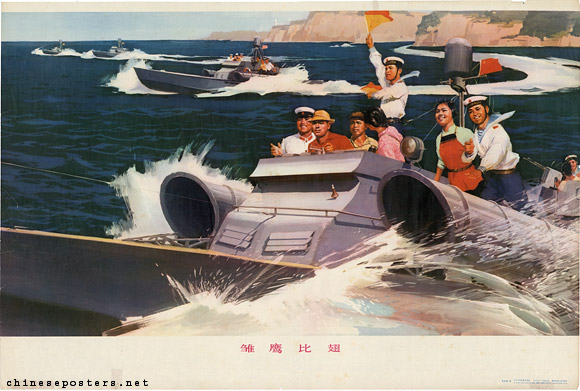
Evidence suggests that the PLAN is following a similar strategy. The Chinese are well on their way to building a very credible, regional naval capability.[3] The PLAN’s emphasis on operations within the Chinese defined “first island chain” seems to mirror Tirpitz’s focus on decisive battle in the North Sea. There is no evidence to suggest the Chinese are planning to launch an aggressive naval war against the United States, but are building naval forces sufficient to convince the United States and other would be opponents that the risk involved in combating such a force will entail significant naval losses. As Germany acquired the island of Heligoland in 1890 in order to secure the naval approaches to its significant ports from blockade, China is seeking to control and expand islets in the South China Sea in order to create a buffer zone around its sea lines of communication with its primary hydrocarbons supply sources in the Persian Gulf. Control of the South China Sea would also support potential military operations to place Taiwan under Communist Chinese control. Tirpitz thought his fleet would prevent Britain from considering a preemptive attack on Germany, as it had done on a nascent Danish Navy at Copenhagen in 1805. China appears to be creating its own A2/AD network to similarly deter U.S. action against the People’s Republic in the event of conflict over Taiwan, or contested islands in the South and East China Seas. Like Great Britain a century ago, the U.S. today must consider, “whether the U.S. Navy in coming years will be large and capable enough to adequately counter improved Chinese maritime forces while also adequately performing other missions around the world.”[4]

PLAN torpedo boat
Artwork featuring PLAN coastal defense torpedo craft.

Although it is clearly building a “blue water” fleet that includes aircraft carriers, capable surface ships and submarines, the PLAN also maintains large forces of missile-armed littoral combatants analogous to the large German light forces of the early 20th century. China also has a much more powerful equivalent to the German shore batteries in the form of the Anti-ship Ballistic Missile, but this weapon does not yet appear to have been successfully tested against a moving target at sea.[5] With the bulk of its blue water fleet concentrated in home waters, and supported by similarly-based aircraft, submarines, land-based missiles and light naval forces, China has deployed a naval force structure remarkably similar to that of Imperial Germany. It appears focused on the control of its immediate sea zone and intended to deter the maritime hegemon from interference in its growing global economic, political and possible military activity.

There are some trends to suggest some of the new blue water PLAN units will deploy beyond the first island chain and operate in regular deployments abroad as the U.S. Navy has done since 1948.[6] Such deployments are fraught with peril if unsupported by a large global naval support structure and close allies. Admiral Graf von Spee’s crack cruiser squadron was deployed overseas at the German Pacific colony of Tsingtao (now the Chinese city and naval base of Qingdao) in 1914, but Tirpitz otherwise kept the heavy units of the High Seas fleet almost entirely in home waters for deterrence and potential combat against the Royal Navy. A future Chinese von Spee might wreak havoc on shipping and naval forces in the Indian Ocean or Red Sea, but would also be, “a cut flower in a vase, fair to see, yet bound to die” as Churchill said of the German commander.[7]

A Similar Potential for Catastrophic Failure

Both navies also share similar traits that eventually led to catastrophic failure in war for the High Seas Fleet. Admiral von Tirpitz based his strategy for victory against the Royal Navy on superior technology and highly trained personnel as well as specific numbers of capital ships. German warships were slower, had smaller guns and more austere in accommodation than their British counterparts, but had better gunnery optics, had thicker armor, and would prove more survivable in combat thanks to superior internal subdivision. German naval personnel were also expected to be more technically expert and better disciplined than their RN equivalents. This entailed adopting some of the harsher attributes of the Prussian Army to the naval service rather than forging a unique German naval culture to compete with that of the RN, who was the “motherhouse” for a multitude of world navies including those of the United States and Imperial Japan. Looking back in 1929, Germany’s official naval historian Admiral Eberhard von Mantley described the German naval culture of the Hohenzollern period as, “A Prussian Army Corps transplanted on to iron barracks.”[8]

The PLAN is likewise inured with the culture of a non-naval organization. The Communist Party of China plays a role in the Chinese navy similar to that played by the Imperial hierarchy in Hohenzollern Germany. The political work within the Chinese navy was once described as the “lifeline” of the service and essential to its support from the Chinese Communist Party.[9] The current commander of the PLAN, Admiral Wu Shengli, has long had close ties to the Communist Party through his father who was a Red Army political officer and governor of Zhejiang. Admiral Wu may also have had close ties to future Chinese President Jiang Zemin, who served as Shanghi Party Secretary when Wu was Deputy Chief of Staff for the Shanghai naval Base in the 1970’s and 1980’s. Like the support from the Chinese Communist Party, the Kaiser’s patronage, support and favor toward the Hohenzollern German Navy was that force’s connection to the German ruling elite and they budgetary support that connection supported.

Naval historian Norman Friedman has suggested that one of the great flaws of the Hohenzollern fleet is that it was built without a clear strategic objective in Germany’s overall national military strategy.[10] Admiral von Tirpitz was very effective in assembling political and public support for a large fleet of capital ships, but when war did occur he did not have a defined plan as to how this very expensive fleet would be used. Friedman also points out that the German General Staff also no idea of what to do with the High Seas Fleet and that neither naval nor military leadership ever exploited its potential until late in the war with the U-boat campaign, which did not involve Tirpitz’ heavy surface units. German naval officers, especially those of senior rank also had little or no combat experience in 1914 against which to measure their operational performance at the outset of war.

While the Chinese have long planned on using naval forces to support the potential reclamation of Taiwan, and to protect vulnerable littoral areas bordering the Chinese state, their construction of larger warships such as carriers and large surface combatants has wider and more uncertain strategic ends. The PLAN and Chinese Army/Air Force elements can certainly dominate the South China Sea and its immediate surroundings in the event of a major Pacific War for a significant period of time. Would it be possible, however, for the PLAN alone to venture further afield to break likely distant blockades of Chinese hydrocarbon supplies and trade with a core fleet of “two aircraft carriers, 20-22 AEGIS like destroyers and 6-7 nuclear attack submarines?”[11] Like Tirpitz fleet of a century ago, an enlarged PLAN is strong enough in its own backyard, but risks considerable losses if it ventures away from bases and meets the combined strength of US and allied joint forces. This “prestige” element of the PLAN, like the High Seas Fleet, may be equally lacking in full strategic assessment as was its German counterpart. In addition, senior PLAN officers, like their High Seas Fleet counterparts from 1914, lack combat experience in war at sea.

Dr. Friedman suggest one other potentially chilling possibility when he references German historian Volker Berghahn’s claim that the German General Staff and aristocratic establishment may have seen war as a means of preventing the rise of a Center left Reichstag as a political check against traditional Prussian authority.[12] A war was seen by military and Prussian establishment leaders as a means of rallying the increasing working class around national objectives and recreating the unifying environment that produced the German Empire at the conclusion of the Franco-Prussian War.

China’s stagnating economy, which slowed to 7.4% in 2014, a low figure not seen in 25 years, and the results of that change on the average Chinese citizen, has the potential to cause similar global unrest.[13] The Communist Chinese essentially made a bargain with Chinese citizens in the wake of the 1989 Tiananmen Square riots. It would “deliver stability and prosperity” in return for continued loyalty and support of the Communist Party. The party has kept that promise for the last quarter century and delivered a 20 fold increase in the average income.[14] With this economic tide now cresting and perhaps beginning to recede, might Communist leaders seek to rally the Chinese public to international and security issues in order to distract from a looming economic downturn and maintain its control over the Chinese state? It is interesting to note that belligerent Chinese rhetoric on its South and East China Seas claims, and associated land reclamation efforts accelerated as economic advances waned. Could Communist leaders resort to more aggressive international efforts in order to preserve their rule as some historians have suggested Hohenzollern Germany did in 1914?

U.S. writer Mark Twain is reputed to have said, “History dos not repeat itself, but it sometimes rhymes.” The development of the PLAN over the course of the Cold War and especially the last twenty five years seems to rhyme very closely with that of the Hohenzollern High Seas Fleet. There are, however, some comforting differences. China is not nominally ruled by a mercurial Kaiser and has no Admiral von Tirptiz that is fully disconnected from other state organs of national security planning. It is not likely planning actual war with the United States or its close Pacific allies. That said, whether in mitigation of internal economic issues or paranoia over its seaborne hydrocarbon supply routes, China has engaged in a direct challenge to U.S. maritime superiority not seen since the Soviet Union created a global navy in the early 1970’s. While the Soviet effort was in the context of a wider Cold War, the Chinese maritime buildup has taken place in what has been a zone of relative peace since the end of the 1970’s.

No nation, or group of nations has denied China’s rise to the very top of world economic indicators, or its right to build whatever military establishment it desires. The crux of the problem is China’s aggressive bid to use elements of maritime power to close off sections of heretofore international waters. It is similar to the Communist state’s past land-based activities such as seizing Tibet and engaging in punitive expeditions against Vietnam. Like Hohenzollern Germany, another land-based power looking to move seaward, China fails to comprehend the dangers in aggression directed toward powers dependent on the free flow maritime trade. China would be well served to turn its naval expansion program toward less provocative ends.

Steve Wills is a retired surface warfare officer and a PhD candidate in military history at Ohio University. His focus areas are modern U.S. naval and military reorganization efforts and British naval strategy and policy from 1889-1941. 

[1] Holger Herwig. The Luxury Fleet, The Imperial German Navy, 1888-1918, Abington/Oxon, UK and New York, Routledge Library Editions (reprint), The First World War, 2014, p. 36.

[2] Ibid.

[3] http://thediplomat.com/2015/07/will-china-have-a-mini-us-navy-by-2020/

[4] Ronald O’Rourke. China Naval Modernization: Implications for U.S. Navy Capabilities—Background and Issues for Congress”, Congressional Research Service, Washington D.C., 01 June 2015, p. ii.

[5] Ibid, p. 6.

[6] http://inss.ndu.edu/Portals/68/Documents/stratperspective/china/ChinaPerspectives-9.pdf, p. 3.

[7] Winston S. Churchill, The World Crisis, 1911-1918, New York, Free Press/Simon and Schuster, 2005 edition, p. 177.

[8] Herwig, p.120.

[9] http://www.idsa-india.org/an-jan00-7.html

[10] Norman Freidman, Fighting the Great War at Sea, Strategy, Tactics and Technology, Annapolis, Md, Naval Institute Press, 2014, p. 22.

[11] http://thediplomat.com/2015/07/will-china-have-a-mini-us-navy-by-2020/

[12] Friedman, p. 21.

[13] http://www.wsj.com/articles/china-gdp-growth-is-slowest-in-24-years-1421719453

[14] http://www.institutionalinvestor.com/blogarticle/3347789/blog/a-generation-after-tiananmen-china-blends-amnesia-and-assertiveness.html#.Vbrq9PbbLIU

The Hohenzollern Chinese Navy? Part One

The Hohenzollern High Seas Fleet

Recent Chinese pronouncements regarding the shift of their Navy from defensive to potential offensive operations contain a refrain with which naval historians are most familiar. It is a song once sung by another continental military power newly flush with a successful and expanding international economy.

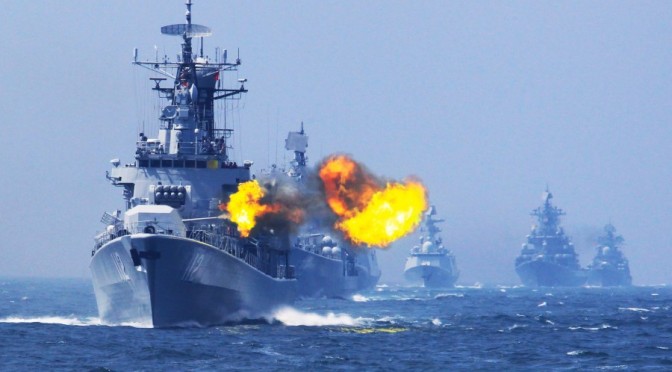
South China Sea fleet vessels.

China’s shift toward an offensive naval capability sounds very similar to the formation of the Imperial German High Seas Fleet (Hochseeflotte) in 1907. The Chinese and Hohenzollern navies have many commonalities in origin, training and choice of force structure. Their strategy, operational art and tactics are also remarkably similar to Kaiser Wilhelm’s fleet of the late 19th and early 20th century. The Chinese Navy may have also replicated the fatal flaw that left the High Seas Fleet incapable of achieving the victory it came so close to achieving in late 1917. Like the German imperial elite of the late 19th century, the Chinese Communist Party is now also seeking “a place in the sun” through President Hu Jinatao’s “new historic missions” assignment of 2004. China may too think that “its future is on the water” as did the Kaiser’s navy over a century ago. Such visions, however, for a fleet that has not seen battle against a peer opponent since 1894, can be dangerous.

Similar National Origins and Early Dismal Performance

Like Imperial Germany, the People’s Republic of China (PRC) is a continental land power that must look far into its past to find naval virtue. The Kaiser had to search back to the fifteenth century Hanseatic League in order to find heroic German maritime exploits that might be emulated by his own 20th century sailors. The PRC must equally rely on the historically remote Islamic Admiral Zheng He, who served the Ming Dynasty Yongle Emperor in the early 15th century as both a land and ocean-going commander. Both fleets were traditionally led by army officers and designed for coastal or at best littoral operations.

Both the German and Chinese fleets suffered from timid national leadership, and a paucity of training and operations that led to enforced idleness or defeat as late as the 19th century. Other Baltic powers often made short work of the Prussian Navy in war. The Swedes completely annihilated a Prussian fleet at the Battle of Frisches Haff in 1759. The Prussian Navy played practically no role in the three 19th century conflicts precipitated by Chancellor Otto von Bismarck that led to German unification. Its Danish, Austrian and French opponents either ignored, blockaded, or chased the small Prussian Navy from the seas. The Imperial Chinese Navy also suffered from neglect and poor performance from the Early Modern Period into the 20th century. The forces of the East India Company and the British Empire made short work of primitive Chinese warships in the two Opium wars of the mid 19th century. The French Navy destroyed the Chinese Fujian Fleet at the Battle of Fuzhou in 1884 and the Imperial Japanese Navy decisively defeated the Chinese Beiyang Fleet at the Battle of the Yalu River in 1894. The post-1949 People’s Liberation Army Navy (PLAN) has fought minor skirmishes against the Vietnamese, but has yet to engage anything approaching a regional, nor peer opponent in naval combat.

SMS Rheinland-focsle1914.
SMS Rheinland participates in a gunnery exercise, 1914.

The German High Seas Fleet and the PLAN both had to be “reborn” in new political and economic environments of their respective nations.  The united German state surged to new economic power between 1871 and 1906 and surpassed the British in steel production halfway into the first decade of the 20th century.[1] Germany also came close to equally British world trade and coal production by 1914.[2] Great Britain continued to prosper as both Germany and the United States surpassed Britain in key economic indicators and Britain’s Gross National Product grew from 1.32 billion to 2.1 billion Pounds over the period from 1870-1900.[3] Despite these changes, the British Empire did not regard either Germany of the U.S. as a potential enemy, and Canada’s shared border with the U.S. caused more concern to the British in 1900 than did Germany’s economic growth.[4] Germany, however, despite its unchallenged economic success decided to engage the British Empire in a naval building race that the British did nothing to instigate. Some historians have said the British detainment of several German ships transporting relief supplies to Dutch Boers during the Second Boer War (1899-1902), served as a catalyst for the passage of the German Second Naval Law which was much more provocative and aimed at Great Britain than its predecessor.[5] Emboldened by economic success and military strength, and baited into action by its inability to influence sea lines of communication outside its sphere of influence, Germany embarked on a risky warship building competition with the established naval hegemon at the time and made that challenge right on that naval power’s home doorstep.

China has had an equally meteoric economic rise since the time it also changed political organization by throwing off its Maoist past and embracing state-sponsored capitalism. Like Imperial Germany, post Mao China has combined pride in economic growth with its aggressive continental past. The People’s Republic appears to have had the same sort of decisive “maritime moment” as Imperial Germany when the U.S. deployed two aircraft carriers to the Taiwan Strait in 1996 as a response to simmering tensions between the PRC and Taiwan. There appears to have been a similar rage amongst the Chinese Communist Party and military leadership over the 1996 US deployment, as there was from German Aristocrats, businessmen and military leaders over the seizure of German relief ships off South Africa in 1900. It is this kind of significant public support that allowed for the growth in the German Navy of the early 20th century and may play a role in public support for an expanded PLAN.

Both fleets also began as coast defense organizations led by Army officers and dependent on inexpensive denial capabilities. The early German Imperial Navy was first led by infantry General Albrecht von Stosch and General (and later Imperial Chancellor) Leo von Caprivi. It had few large ships and invested much of its effort in the development of torpedo craft and mine warfare. The architect of the High Seas battlefleet, Admiral von Tirpitz, and many of the Imperial Navy’s future senior officers came out of the German Navy’s torpedo boat arm. While Kaiser Wilhelm II played a very public advocacy role for larger and more capable surface ships, such expansion would not have been possible in the absence of strong support from the German business and political community. While perhaps not fervent navalists like the Kaiser, they certainly thought that having a Navy to protect emerging commercial interests was a good investment, and were willing to invest in Germany’s new naval effort. The spirit of American navalist Alfred Thayer Mahan’s writings on the importance of a battle fleet to a nation’s political and global economic health found as many adherents in Germany as it did in Great Britain, the United States, and Japan.

The early PLAN was also led by Army Generals. The most prominent advocate of improving Chinese naval capabilities was General Liu Huaqing, who served as PLAN commander from 1982-1987.[6] China’s naval strategy from 1949 through the 1980’s was also remarkably similar to Germany’s in that it was focused on coastal defense and emphasized missiles, torpedoes and mines deployed from small, coastal combatants. China appears to have also embraced the theories of Alfred Thayer Mahan as Germany did a century ago and added the study of the American navalist’s works to the curriculum of its advanced naval education courses.[7] 

Part two of this article will examine how Hohenzollern Germany and the People’s Republic of China developed striking similarities in force structure, naval strategy, and deployment of their naval forces.

Read Part Two here.

Steve Wills is a retired surface warfare officer and a PhD candidate in military history at Ohio University. His focus areas are modern U.S. naval and military reorganization efforts and British naval strategy and policy from 1889-1941. 

[1] Aaron Friedberg, The Weary Titan; Britain and the Experience of Relative Decline, 1895-1905, Princeton, NJ, Princeton University Press, 1988, p. 25.

[2] Ibid, pp. 24-25.

[3] Ibid, p. 24.

[4] Ibid, pp 185-186.

[5] Keith Wilson, editor, The International Impact of the Boer War, Abingdon Oxon, UK, Routledge, 2014, pp. 36-38.

[6] https://cimsec.org/father-modern-chinese-navy-liu-huaqing/13291, last assessed 16 June 2015.

[7] Howard J. Dooley, “The Great Leap Outward: China’s Maritime Renaissance”, The Journal of East Asian Affairs, 01 March 2012, p. 69.