Category Archives: History

Naval and maritime history section.

Plaster The Ship With Paint – Dazzle & Deception in War

James Taylor, Dazzle: Disguise and Deception in War and Art. Naval Institute Press, 2016. 128 pages, $38.00/hardcover.
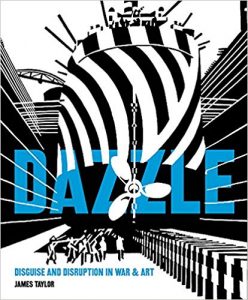
By Christopher Nelson

There is a fun little ditty in the last page of James Taylor’s book, Dazzle: Disguise and Deception in War and Art. It goes like this:

Captain Schmidt at his periscope,
You need not fall and faint,
For it’s not the vision of drug or dope,
But only the dazzle-paint.
And you’re done, you’re done, my pretty Hun.
You’re done in the big blue eye,
By painter-men with a sense of fun,
And their work has just gone by.
Cheero! A convoy safely by.

British composer George Frederic Norton wrote the tune for a close friend and fellow artist. The friend? His name was Norman Wilkinson. And more than anyone, he was responsible for one of the most iconic painting schemes on ships at sea. Known simply as “Dazzle,” or “Dazzle paint,”  it was a mixture of different shapes and colors covering the hull and superstructure of merchants and combatants, primarily in World War I, intended to deceive German submarine captains about a ship’s heading and speed.     

Yet years before World War I, Wilkinson established himself as a talented artist. Born into a large family in the late 19th century, in Cambridge, England, he moved to the southern part of the country as a young boy. It was there, in Southsea, England, that his artistic talents flourished. And like many artists, he benefited from the good graces of a well-connected benefactor. In Wilkinson’s case, it was his doctor. But not just any doctor. His doctor was the creator of  Sherlock Holmes –Arthur Conan Doyle. The famous author and physician introduced Wilkinson to the publisher of The Idler, a popular British magazine at the time. Wilkinson would go on to create some illustrations for The Idler and Today magazine. These illustrations were the first of many commissioned paintings, drawings, and posters to come. Landscapes, maritime themes, planes and trains, Norman Wilkinson would end up painting them all.
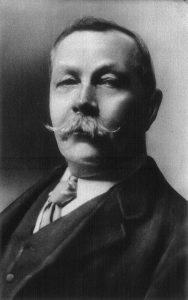
Author and Physician, Sherlock Holmes supported Norman Wilkinson’s early entry into English periodicals

In fact, military naval enthusiasts – and more than a few naval intelligence officers – might be surprised to learn that Wilkinson was later responsible for the World War II poster that depicted a sinking ship with the disclaimer: “A few careless words may end in this.” The poster is obviously a close cousin to the popular American military idiom, “Loose Lips Might Sink Ships,” a piece of operations security art by Seymour R. Goff (who had the interesting nom de guerre “Ess-ar-gee”) that was created for the American War Advertising Council in World War II. Prints of Goff’s work still cover the walls and passageways of U.S. naval shore facilities and ships today.
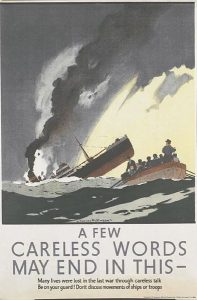
A Few Careless Words May End in This, by Norman Wilkinson/Wikipedia

When World War I began, Wilkinson, like thousands of British men, wanted to join up and, as the saying goes, “do his bit.” Eventually, he was assigned as a naval pay clerk and deployed to the Mediterranean theater in 1915. But by 1917 he was back in Britain, and Germany had resumed unrestricted submarine warfare. It was around this time that Wilkinson had an idea to protect merchant shipping. And as with so many great ideas, often hatched during the quiet, daily moments of life, Dazzle was born, not in a boardroom or on a chalkboard, but in a “cold carriage” following a fishing trip in southern England.  

Here Taylor quotes Wilkinson:

“On my way back to Devonport in the early morning, in an extremely cold carriage, I suddenly got the idea that since it was impossible to paint a ship so that she could not be seen by a submarine, the extreme opposite was the answer – in other words, to paint her, not for low visibility, but in such a way as to break up her form and thus confuse a submarine officer as to the course which she was heading.”

A few months later, with support from the Royal Academy of Arts, a friend in the Ministry of Shipping, and a few others, the “Dazzle Section” was created. Staffed with artists and modelers (many of them women), they were responsible for paint schemes that covered over 4,000 merchant ships and 400 combatants by the end of the war.  

Taylor does a fantastic job at detailing the personalities and the process that got Dazzle from Wilkinson’s mind onto the hulls of so many ships. Taylor discusses the numerous other artists that helped bring Wilkinson’s idea to fruition, the introduction of Dazzle to the U.S. Navy, and its brief return in World War II. He also highlights the dispute between Wilkinson and Sir John Graham Kerr, a professor of zoology at the University of Glasgow who for years claimed that he, not Wilkinson, should deserve credit for the creation of the dazzle concept. Taylor notes that Kerr “relentlessly campaigned to advance his claim that his scheme was in principle one and the same as Wilkinsons.”   

Camouflage pattern for Benson class destroyer in WWII/Wikipedia

Taylor’s Dazzle, besides succeeding in substance, also succeeds in style. About the size of a composition notebook, Dazzle is large enough to show illustrations of the paint scheme on merchant ships and combatants in clear detail, while it also includes photographs of the artists in the Dazzle sections at work. Hunched over large tables holding small models in their hands, artists carefully painted various Dazzle schemes on each model. Once the model ship was painted they placed it in what they called the “theatre.” This was no more than a room with a table and periscope. The model was placed a circular table and rotated, while another person looked through a periscope that was about seven feet away. “In this way, one could judge the maximum distortion one was trying to achieve in order to upset a submarine Commander’s idea on which the ship was moving.”  The colors that covered the model were then meticulously copied onto a color chart that was provided to the contractors who covered the ships in dazzle designs.

Yet the question still remains: Did Dazzle paint work? Did it deceive U-boat commanders? A small painted model in a theatre is one thing, but out at sea is something entirely different. 

Unfortunately, as Taylor says, we really don’t know. Dazzle painting was introduced late in the war. Naval critic Archibald Hurd noted that there was not “enough evidence” to determine its “efficiency.” Nor, as Taylor notes, did any captured German submarine captains say that Dazzle confounded their targeting of enemy vessels. A single sentence in a submarine log or captain’s diary –Verdammt die Tarnfarbe! – would be an indictment, but if it exists, it has yet to be discovered by naval historians.
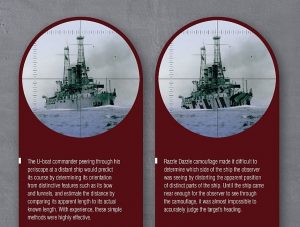
Dazzle was intended to deceive U-boats about the ship’s speed and course/U.S. Navy File Image

Taylor, the former curator of paintings, drawings, prints and exhibition organizer at the National Maritime Museum, Greenwich, has written a book that does justice to Wilkinson’s work. The talented Dazzle artists would probably be amazed to see how far his paint scheme has come – as Taylor includes an entire chapter about Dazzle painting’s influence on modern art and how the big blocks of paint now cover cars and even Nike footwear.

My only critique is a request really, that the publishers make this book available in an e-book format for people who prefer the work on an electronic reader.

Regardless, Taylor’s detailed account of Dazzle, his careful selection of photographs, illustrations, and paintings, all printed and bound in a beautiful book is essential for anyone interested in the history of naval deception, World War I navies, or the rare but respected breed who enjoys the intersection of war and art. 

Lieutenant Commander Christopher Nelson, USN, is stationed at the U.S. Pacific Fleet headquarters in Pearl Harbor, Hawaii. He is a graduate of the U.S. Naval War College and the Navy’s operational planning school, the Maritime Advanced Warfighting School in Newport, Rhode Island. He is a regular contributor to CIMSEC. The opinions here are his own.

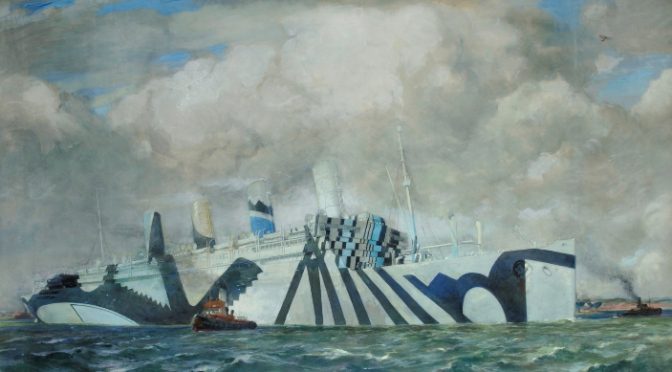
Featured Image: Aquitania in Dazzle Paint/Wikipedia Commons
By More Than Providence: Grand Strategy and American Power in the Asia Pacific Since 1783

Green, Michael. By More Than Providence: Grand Strategy and American Power in the Asia Pacific Since 1783. New York City: Columbia University Press, 2017, 760pp. $45.00

By Mina Pollmann

Introduction

Michael Green’s latest contribution to the field of strategic studies is, first and foremost, a history. By More Than Providence (Columbia University Press, 2017), the first comprehensive history of U.S. statecraft in the Asia-Pacific since Tyler Dennett’s Americans in Eastern Asia (1922), is a much-needed attempt to answer the question: can the U.S. have a grand strategy in the Asia-Pacific? Green does this by asking whether the U.S. has ever had a grand strategy in this region.

Green concludes that U.S. grand strategy may have been “episodic and inefficient,” but not only does it exist, “in the aggregate[,] it has been effective.” Furthermore, he argues, whether or not the U.S. was able to “[muster] the willpower, focus, and resources to prevail when access to an open order in the region [had] been fundamentally challenged” depended not on the U.S.’s “preponderance of power,” but on “[U.S.] leaders’ clarity of purpose and deliberate identification of ends, ways, and means.” He reaches this conclusion through 15 superbly well-researched chapters.

American Strategy In Asia

Beginning from the 1780s to the present day, each chapter is similarly structured, opening with the introduction of the main cast of characters in the administration under study. Green tastefully offers vignettes of each individual, covering a range of information that shaped the individual’s worldview in policy-relevant ways, whether it is where the statesman grew up, what schools the statesman attended, or what religion they practiced. Each chapter also delivers solid overviews of the interpersonal and interagency dynamics that facilitated – or hindered – the administration’s ability to craft and implement a coherent grand strategy.

From there, Green delves into the narrative of events, interspersed with surveys of what other historians have had to say on the subject, sharing insights from classics, such as David Halberstam’s The Best and Brightest on the Vietnam War, to the most cutting-edge research, including Rana Mitter’s Forgotten Ally on the Sino-Japanese War.

But the book’s real strength is in each chapter’s concluding evaluation of the effectiveness of the administration under study’s grand strategy. 548 pages of this sweeping history is thematically tied together by the five “tensions” that Green identifies and traces over time.

The five tensions in U.S. grand strategy are: Europe versus Asia; continental (China) versus maritime (Japan); forward defense versus Pacific depth; self-determination versus universal values; and protectionism versus free trade. Green does not leave readers guessing how these tensions ought to be resolved – he forcefully advocates for a U.S. grand strategy that appreciates the preeminence of Asia in world affairs, elevates the importance of the U.S. relationship with Japan, does not allow for any retreat, loudly proclaims the ultimate triumph of democratic values, and vigorously pursues an open trading order.

Though unapologetically realist while critiquing administrations that failed to understand the hard logic of balance of power, Green also brings a nuanced appreciation of the importance of ideas to the table.

For example, while Green praises Theodore Roosevelt for “[achieving] an effective balance of realism and idealism,” he faults the “blatant hypocrisy” of the U.S.’s position in Asia during Roosevelt and William McKinley’s administration. McKinley annexed Hawaii over the opposition of native Hawaiians, and Guam and Samoa went decades without self-government. The U.S.’s repression of Filipinos fighting for independence also hurt the U.S.’s image as a democracy promoter. As such, “the anti-imperialist tradition in American political culture created a vulnerable center of gravity that could be targeted by insurgents – as Ho Chi Minh did to great effect six decades later.”

Green credits Woodrow Wilson for being on the “right side of history” for recognizing the Republic of China and setting the Philippines on course for independence, noting that the problem was not with Wilson’s push for such ideals, but pushing for such ideals in a unilateral and piecemeal manner that left Asian leaders ranging from Yoshinda Shigeru to Ho Chi Minh disillusioned with “American moral leadership.”

The U.S. fared less well under Dwight Eisenhower, when the U.S. could only be “reactive and ineffective” due to a failure to understand the power of ideas – of the nationalist and anti-colonial sentiment sweeping the region. A division soon emerged in Japan policy, between those policymakers who wanted a Japan that was “liberal but neutral” and those who saw Japan as “a critical asset in the struggle against the Soviet Union.” Though the immediate postwar era saw the first group ascendant, the priority gradually shifted towards fostering Japan’s economic growth to bolster Japan’s own defense. While the U.S. never gave up its goal of remaking Japan as a democracy, and in this, achieved some success, the U.S.’s Japan policy during this period was characterized by the sobering recognition that Japan’s security was tied to access to its former imperial spaces in Korea and Southeast Asia.

In his effusive praise for Reagan, Green highlights Reagan’s ability to “fuse interests and ideals; to focus on strengthening the institutions of freedom rather than just weakening the hold of authoritarian leaders; to ensure that allies were better governed at home so that they would be more resilient against imperialism from abroad; and to stay on the right side of history.” While Reagan had come into office a critic of Jimmy Carter’s human rights-focused approach, at least in Asia, Reagan found himself increasingly supporting democratization of key allies – such as South Korea and the Philippines.

Speaking of the George W. Bush administration, in which Green served on the National Security Council (2001-05), he raises the examples of the U.S. response to crises in Nepal, Vietnam, and Burma to argue that “We saw no contradiction between American idealism and self-interest.” He is harsh, but articulately so, on the Obama administration for signaling that violations of human rights and democratic principles would not impose costs on the violator’s relationship with the U.S. And this, perhaps, ought to concern us most about the current U.S. administration’s Asia policy (or more accurately, lack thereof).

Strategic Themes from the Current Administration

Donald Trump dismayed human rights advocates when a leaked transcript of his call with Philippine President Rodrigo Duterte showed that he had made remarks praising Duterte’s controversial and violent war on drugs, which has killed more than 7,000 Filipinos. Trump said to Duterte: “I just wanted to congratulate you because I am hearing of the unbelievable job on the drug problem. Many countries have the problem, we have a problem, but what a great job you are doing and I just wanted to call and tell you that.” The call ended with an open-ended invitation to the Oval Office.

Similarly, Trump’s invitation to Thai Prime Minister General Prayuth Chan-ocha, who came to a power in a military coup, is causing consternation. Though Prayuth had initially promised elections in late 2014, they are unlikely to be held until 2018 at the earliest. Even when the elections are held, democratic government will be diminished as the new constitution provides a role for the junta in the unelected upper house, investing it with authority to invoke emergency powers, and restricts the power of the elected lower house. Politicians and activists have been detained, and Amnesty International scrapped a planned report on torture after receiving threats from the police.

The lack of contact between Trump and Myanmar’s de facto leader Aung San Suu Kyi is unsettling for the opposite reason – because Myanmar has been taking steps towards democratization. While concerns about Aung San Suu Kyi’s silence on the abuses and atrocities directed against Rohingya Muslims in the Rakhine State are valid, Myanmar is a successful case of U.S. engagement encouraging democratization. If Trump does not reach out to Aung San Suu Kyi, offering continued U.S. support despite the bumps on the road toward democratization, we could easily see Myanmar falling back into Beijing’s orbit. The pattern that emerges under the new administration is not a pretty one.

This is not to say that the U.S. had a perfect, or even remotely perfect, track record on the issue before Donald Trump. Historically, the U.S. has condoned extrajudicial killings and violations of democratic principles when it meant advancing U.S. security interests. Morally, the U.S. is reaching bankruptcy – both abroad and domestically. But that is no excuse to stop pushing for the democratic ideals that the U.S. professes.

Conclusion

Balance of power is the hard logic that has most often led to success in crafting U.S. grand strategy in the region. It disciplined resource allocation, and focused U.S. leaders on the appropriate opportunities. The U.S. doesn’t have a perfect track record when it comes to upholding ideals, and its credibility is declining in the region. However, in the present day, as the U.S. becomes stretched thinner, it must consider how it can best utilize non-material sources of power – such as ideals and principles – to pursue its objectives as well.

In the coming decades, our alliances will only become more important to dissuade a challenge by the rising hegemon. Japan, South Korea, Australia – all our allies and partners want the U.S. to stay engaged not only because of the U.S.’s capabilities to balance China, but also because they inherently prefer the U.S. as a partner because of what the U.S. has stood for as the world’s first democracy. If the U.S. wants to remain the preferred partner of states that will help us balance against China, the U.S. also needs to take a position in the balance of ideas shaping Asia today.

Mina Pollmann’s research interests focus on Japan’s security and diplomacy, U.S. foreign policy in East Asia, and international relations in the Asia-Pacific. She received her Bachelor’s from Georgetown University’s School of Foreign Service, and will be beginning her PhD studies at MIT’s Department of Political Science this fall. She also writes for The Diplomat’s Tokyo Report. Follow her on Twitter @MinaPollmann. 

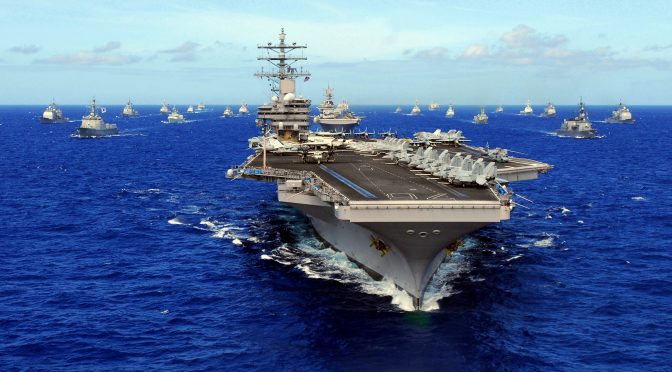
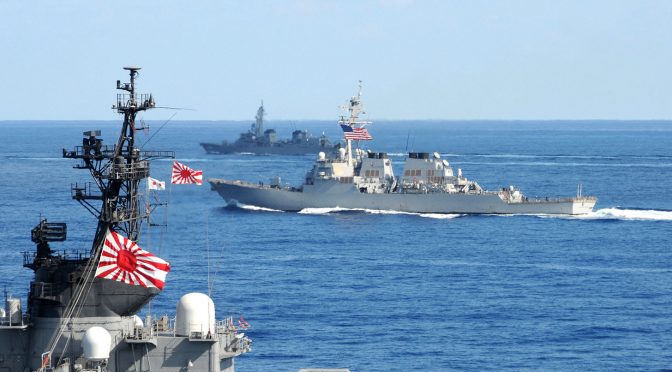
Featured Image: PACIFIC OCEAN (Dec. 10, 2010) U.S. Navy and Japan Maritime Self-Defense Force (JMSDF) ships underway in formation as part of a photo exercise on the final day of Keen Sword 2011. The exercise enhances the Japan-U.S. alliance which remains a key strategic relationship in the Northeast Asia Pacific region. Keen Sword caps the 50th anniversary of the Japan-U.S. alliance as an “alliance of equals.” (U.S. Navy photo by Mass Communication Specialist 3rd Class Jacob D. Moore/Released)

Why Does the United States of America Need a Strong Navy?

The following essay is the winning entry of the CIMSEC 2017 Commodore John Barry Maritime Security Scholarship Contest.

By Patrick C. Lanham

The United States of America was, is, and will remain a maritime nation. Flanked by vast oceans, covered from the north by Canadian arctic and the south by Mexican desert, the United States occupies one of the strongest strategic positions of any nation in history. This, however, comes at a cost: to trade and interact with most of the world, America must cross the Atlantic and Pacific Oceans. This exposes American trade to hostile nations, even relatively weak ones. This is not a new concept for American strategic planners. The United States’ first overseas conflict, the Barbary Wars, stemmed from this exact vulnerability. That struggle continues to this day, with the most recent example being U.S. Navy intervention in the Maersk Alabama hijacking by pirates off Somalia in 2009. Therefore, it has always been in the vital interest of this country to maintain a strong, well-resourced, and well-led navy. Without one, there is no conceivable way the United States could continue to maintain the world’s greatest economy in today’s globalized world.

Whenever America was most threatened or imperiled by conflict, the United States Navy has always stepped up to meet the challenge. From sparring with the great powers of Europe, to constricting the Confederacy, decisively defeating the Imperial Japanese Navy, and deterring the Soviet Union, the U.S. Navy has a proven track record of keeping America safe. By projecting outwards, the United States has kept war and devastation away from American shores. This is a solid policy, but it is one that requires a strong navy to pursue in any meaningful manner. This is further enhanced by a robust network of allies which the United States currently enjoys, but these nations will not sit on the frontlines without clear evidence of credible and capable American commitment to their own security. In this regard, what better signal of commitment is there than the strongest Navy in the world off their coast?

A strong navy, used in concert with allied nations and backed up by a vigorous economy, is a potent deterrent to conflict and enables diplomacy. It convinces adversaries that war is either unwinnable or too costly to wage. This helps the United States negotiate favorable outcomes through diplomacy, which will always be preferable to war. Some might argue that by building a strong navy or military in general, it promotes jingoism and can escalate tensions between rivals. While this is certainly true in some historical instances, I would argue that in America’s case it has prevented conflict much more than it has incited it. For example, during the Cold War, the U.S. Navy integrated with the rest of the North Atlantic Treaty Organization (NATO), and played a crucial role in containing the Soviet Navy in the North Atlantic. If not for their strong presence, any effort to reinforce NATO forces at the inner German border, in the event of a war with the Warsaw Pact, would have been spoiled by Soviet submarines. As we know, that war never happened and that is due in no small part to the U.S. Navy, which was both large and technologically advanced during that time period.

Yet again the United States stands at another crossroads in history. The post-Cold War peace is slowly eroding as revisionist powers seek to alter, through coercion, the international order to their benefit. Some nations, considered “near-peer” competitors, boast strong naval capabilities of their own. China is in the midst of a particularly large naval buildup using their extensive industrial base and newfound wealth to rapidly increase the quality and quantity of their naval forces. The U.S. Navy once again finds itself center stage in a great power rivalry after a nearly three-decade hiatus. The conflicts are dynamic, the competition is intense, and the advantages are fleeting. This is the new reality that we face today as a nation returning to competition with near-peer states. A strong United States Navy brings with it many tools that are useful to strategically outmaneuver these competitors. Chief among these tools is flexibility. In a world diseased with uncertainty, flexibility is the cure. It is not only critical to warfighting, but critical to avoiding conflict. A strong, well-trained, flexible navy is able to respond and adapt to new situations to maintain escalation control, but also fight to win if things go south. More on the warfighting side of the house, flexibility better enables U.S. forces in key regions to counter asymmetric threats or weapons – a favorite among some of the more prominent American adversaries. Another key tool is presence. A bigger, stronger navy is able to be deployed to build partnerships, deter potential enemies, and quickly respond to threats in more places across the globe. One only has to look at the recent chemical weapons use in Syria and the subsequent American response to realize that this not an abstract theory, but a proven concept.

For the United States, a strong navy is not a “want” but a “need.” Historically, it has been extremely effective at advancing U.S. national interests.  It is critical to deterring foreign adversaries and maintaining prosperity, not just for the U.S., but for all nations. Nations that have free and unrestricted access to global sea lanes for trade are more likely to grow and prosper which reduces the chance of conflict inside and outside its own borders. Throughout history, a strong navy has been a source of national pride and the United States is no exception. It gives us confidence and optimism as a society, and allows us to sleep at night knowing that someone has our backs.

Patrick C. Lanham graduated from Cocoa Beach High School and will be attending the University of Central Florida to study International and Global Studies. He may be reached on Twitter @p_lanham or via e-mail at pclanham@cfl.rr.com.

Featured Image: USS Ronald Reagan (CVN 76) transits the Pacific Ocean with ships participating in the RIMPAC 2010 combined task force. (U.S. Navy/MC3 Dylan McCord)

Power to the Polymath: Why Defense Engineers Should Know the Classics

By Mark Vandroff

Introduction

Engineers and scientists are under ever expanding influences to obtain expertise in continually narrowing fields of study. At the University of Michigan, one of the largest and most respected schools of naval architecture in the world, graduate students may specialize in a variety of concentrations including: hydrodynamics; marine and offshore structures; marine system integration; marine robotics; marine design, production, and management; marine renewable energy; and structural and hydro-acoustics. Naval architecture is itself a specialized form of the engineering discipline, so mastery in any one of the concentrations involves a great deal of learning about a relatively few things. 

At one level, this is good. As the sum of human knowledge continues to expand, no one can be a true Polymath; a person knowing a great deal about all the fields of academic study. There is simply too much information to be learned. A scientist or engineer who wishes to make significant contributions to his or her field of study will have to concentrate on some specialty narrow enough to be mastered and relevant enough to produce useful knowledge. However, I would entreat scientists and engineers to take at least a brief side trip through an academic field apart from their own. I would make this plead especially to those in technical fields whose work impacts national defense. Those professionals whose life’s work takes the needs of the warriors who defend our way of live and turns those needs into the products placed back into the warrior’s hands would do well to study classic literature.

What do I mean by “classic literature”? I refer to those texts foundational to Western Civilization. The holy scriptures of Judaism and Christianity. The historical, poetical, mythological, philosophical and scientific writings of Greek and Roman civilization. I do not offer this suggestion for solely aesthetic reasons. While it is a fine thing in the middle of a cocktail party in your neighbor’s house to look around the room and utter Cicero’s quote “a room without books is like a body without a soul,” it will not improve the design of the ship, tank or fighter jet that is the object of your labor. Knowledge of the classics helps practitioners be better program managers, technical directors, and requirements setters. Here are three reasons why.

Human Factors as Design’s Purpose

 A study of classic literature yields insights into human nature. This is important because all engineering is ultimately “human factors” engineering. Human factors engineering as a unique discipline is a relatively recent phenomenon, with professional societies devoted to its study appearing in the middle part of the 20th century. At its core, human factors engineering seeks to optimize the interaction of an engineered system with the people with which the system is designed to interface. Examples range from designing the driver’s seat of a car to be comfortable to designing a website interface to be intuitive to use. In our specialized world, human factors engineering is thought of separately from fields such as aeronautics, electrical engineering, or material science. However, everything an engineer does ultimately aims to have at least some effect on people.

As Aristotle begins the Nicomachean Ethics, “Every art and inquiry, and likewise every action and pursuit, is thought to aim at some good.” The Greek word translated as “pursuit” is techne, from which we get the English word “technology.” Even 2500 years ago, Aristotle understood that technology did not exist for its own purpose but had to serve some purpose that a person had identified as good. Engineers need to appreciate what constitutes “the good” for the people their systems serve and a study of the classics is the best way to understand what is fundamentally good for people. 

An example I like to cite in the discipline of warship design is the concept of balance. Just as Aristotle observed that virtue is often the midpoint between two vices, a good ship design must reach a balanced point between multiple competing priorities. If a ship is designed to be heavily armored, with very low vulnerability to gun or missile attack, it will by necessity be much harder to remove outdated equipment during its service life. In this example, a balance point must be found between survivability and reconfigurability. The whole point of Nicomachean Ethics is to inquire what is good, primarily for people; however, the concept of “the good” extends into the designed systems which serve people as well. Plato’s Republic, the Bible’s Book of Micah, Cicero’s  De Re Publica, and Marcus Aurelius’ Meditations all offer different yet complementary insights on what is good for people. A modern engineer, schooled in works such as these, will bring a basic wisdom concerning human nature and the process for balancing competing demands to the task of designing systems to meet human needs.

Enduring Narratives and Human Traits

A study of classic literature yields insights into the societies in which an engineer operates. Imagine living in a society that is the exception for its times; a society that is both a democracy and a maritime power. Imagine further that this society depended upon freedom of and access to sea lines of communication in order to maintain its security and its economic prosperity. Picture such a society threatened by adversaries that are either dictatorships maintaining large standing armies or malevolent forces originating from Persia with religious beliefs so different from those of the society as to seem fanatic and bizarre. Aristotle’s Athens was just such a society. Any similarities between ancient Athens and modern states such as the U.S., UK, or Japan, should give one pause to contemplate how geography and human nature are eternal. While simple engineers see strategy as something that provides an input to their efforts, wise engineers knows that an understanding of the world and the society in which they life have a profound impact on the ultimate trade space available to them. A society that values human dignity and autonomy will constrain acceptable designs in the areas of safety and survivability in a way that would not be constrained by other societies. A wise engineer, tuned to the values of the society, takes this into account.

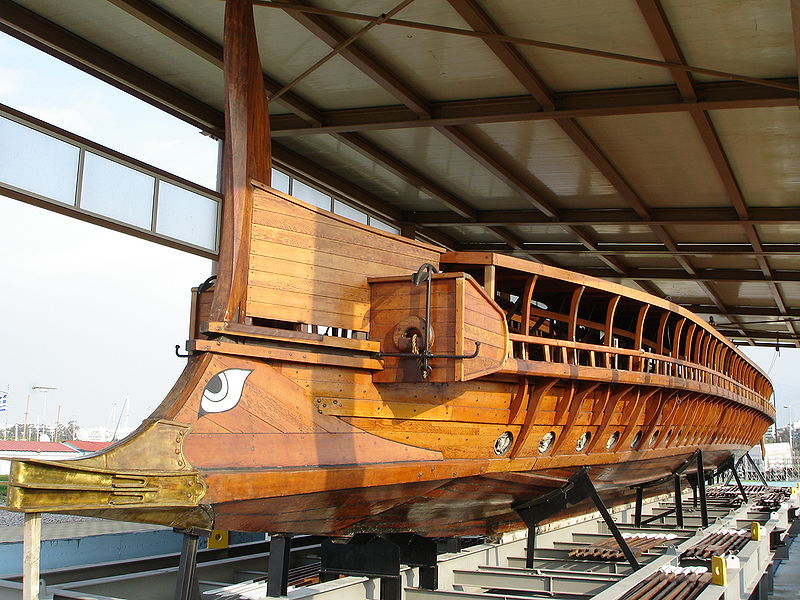
Trireme Olympias of the Hellenic Navy (Wikimedia Commons)

When Plutarch wrote Parallel Lives, he sought to show how the human virtues and failings had manifested their consequences for both good and evil in the great leaders of Greece and Rome. Contemporary readers of Parallel Lives have the benefit of another 2000 years of human history with which to view these classical figures, yet, human nature continues to produce the same combination of achievements and failures as it did in the leaders of old. Pitfalls such as pride and anger still plague leaders gifted with extraordinary ability and awareness of our limitations is still a vital precaution several centuries after Plutarch. For engineers, the vice of pride could be especially deadly. The design of any complex system, especially a ship or aircraft, is the result of a great deal of teamwork and will require input from dozens of experts. An engineer that believes that only his or her way is right and is uninterested in listening to dissenting views is an engineer whose project is doomed from the start. Because collaborative design is a human activity, the other human vices; anger, sloth, envy, etc, all constitute real risk to a project’s success. Those involved in engineering the common defense in a representative democracy would be especially well served equipped with the understanding of humanity, especially their own humanity, which classic literature can provide.

The Basic Nature of Problems and Problem Solving

A study of classic literature yields insights into overcoming challenges. At the heart of the engineering discipline is solving problems. A customer needs the ability to do or have something and the engineer provides the capability or product. In the Bible’s Book of Ezekiel, there is a famous passage known as the prophecy of the valley of dry bones. In this story, God commands Ezekiel to raise an army from a valley full of dead, dry bones. However one views this passage theologically, from a practical standpoint Ezekiel shows tremendous engineering discipline. He started to sort and attach “bone to its like bone.” After the bones were attached, there came sinew and after the sinew came flesh. Like any good systems engineer today, Ezekiel started to solve a big problem by breaking it down into its component parts.

The Book of John begins with the statement “In the beginning was the word.” The Greek word in the original writing that is usually translated as “word” is “logos,” from which we get “logic” which can also be translated as “information” or “plan.” One of the clear implications of the Book of John is no great feat can be accomplished without a plan. From the Bible’s telling of Nehemiah building walls around Jerusalem to the Augustan History tales of Hadrian’s Wall across northern England, classical antiquity abounds with difficult problems being solved with ingenuity, prudence, and courage. Here are three examples of how these ancient ancient virtues translate directly to the practice of modern engineering.

First, as the modern management expert Steven Covey would say, “Begin with the End in Mind.” In two of the Biblical examples above, the Divine customer communicated a clear requirement. The course of actions in the stories that followed all flowed from that clear requirement. In all the most successful defense acquisition programs, from nuclear power, to the F-16 Falcon, to AEGIS, there was a wide and well-documented consensus on what was to be achieved. Those trusted to manage the design and procurement of these capabilities had those clear requirements to guide them as they made programmatic and technical decisions. 

Second, success depends on solid system engineering.  Ezekiel did not try to build an army all at once. AEGIS BMD, once of the most complex systems in the DoD inventory, takes a page from Ezekiel. Every part of the chain that results in destroying a missile flying through outer space is a part of the greater whole. From the radar that detects, to the combat direction system that evaluates, to the missile that impacts the target, to the ship that maneuvers the whole system into place, a complex task is accomplished by breaking it down into smaller, achievable tasks.  \As Ezekiel says, “bone to bone.”

Third, personal leadership is as much a part of an engineering accomplishment as technical excellence. The story of Nehemiah’s rebuilding of the walls of Jerusalem contains a fair amount of technical information about how high the walls were built and what material was used. Just as fascinating was Nehemiah’s story of bringing together the different talents and resources of the citizens of Jerusalem in order to get the job done. Today, we remember Admiral Hyman Rickover as a great engineer. That is true, but the management system and the different talent sets he brought together to make Naval Reactors a longstanding historic success is a legacy at least as worthy of study as the technical achievement of naval nuclear power.          

Conclusion

To my fellow engineers and scientists who work in the defense of our nation, I ask you take at least a brief periodic break from your computers and calculators. Pick up a good translation of Plato or Vergil as you read at the end of your day. You may grow to like the wisdom they offer into the human condition. In the end you will be far the better for it. You will have the power of the Polymath. 

Captain Mark Vandroff is a 1989 graduate of the United States Naval Academy. His 28 years of commissioned service include duty as both a Surface Warfare and Engineering Duty Officer. He was formerly the Major Program Manager for the DDG 51 program and is currently the Commanding Officer of Naval Surface Warfare Center, Carderock. The views expressed in this article are the author’s personal views and do not reflect the official position of the Department of Defense or Department of the Navy.

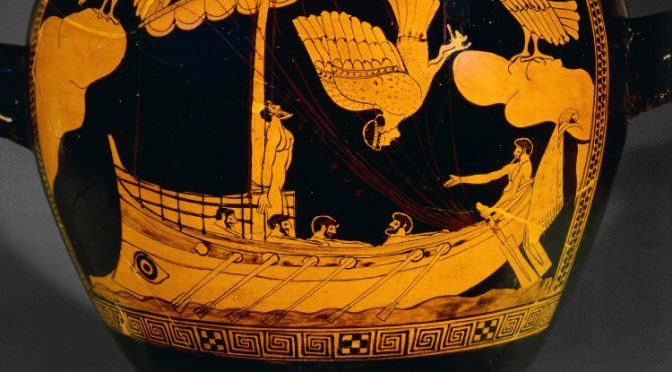
Featured Image: Odysseus bound to the ship’s mast is attacked by the Sirens. Red-figure pit of Sirens Zografos, 480-470 BC Source: www.lifo.gr