Category Archives: Global Analysis

A Geographical Breakdown of What’s Going on in the World

On The Decline of European Naval Power: A Conversation with Jeremy Stöhs, Pt. 2

Read Part One here.

By Roger Hilton

RH: You state that after the end of the Cold War many states had been able to consolidate their militaries despite fiscal restrictions. This all changed in 2007-2008, this groundswell of financial issues, tanking economies, and soaring national debt. You argue that even previous levels of defense spending and the corresponding force structures were unsustainable in many cases. It is evident that we have fairly polarizing periods here. On the one hand we have the reduced defense spending period of the immediate post-Cold War, and then the high defense spending in the latter 2000s, immediate post 9/11 era. Can you help us understand the short and long-term impact that the global financial crisis had on naval procurement?

JS: In the 1990s a lot of states still invested heavily in modernizing their militaries, and you see a real strengthening of naval forces. Just take a look at the Greek Navy; also the French are still spending quite a lot on national defense. The real problem really starts in the 2000s. Purely from a platform-centric point of view, much of the damage to European navies began in the 2000s I would say. You see the decommissioning of numerous vessels and platforms without replacements – the Danish submarine flotilla for example or large parts of the Dutch escort fleet. You have problems with procurement processes, you see this with the German and Spanish submarine programs. This was really exacerbated by the financial crisis, putting procurement projects on hold or canceling them outright. My British colleagues will attest to this, most infamously the cancellation of the British Nimrod maritime patrol aircraft, which left the Brits without any dedicated fixed wing maritime surveillance platform. But that’s just one of many examples.

RH: When it comes to specific examples in your book you describe a bleak picture that in the decline of the 2000s, on top of the financial crisis, it essentially removed some features of European navies, possibly for good. You cite the devastating example of the Dutch, who went from having one of the most capable Cold War fleets to what some observers describe today as a second-rate Navy. Could you elaborate a bit on this example?

JS: I think this is one of the best examples of the decline of European naval power. This also happened before the financial crisis. The Dutch defense studies postulated in 2003 and 2005, they spelled out that the Navy had to find a new balance, and this meant selling six of their frigate to Belgium, Chile, and Portugal. This would leave them with a fleet escort of a total of six frigates. And instead of buying new frigates, they would receive Holland-class OPVs, which while being the “Rolls Royce” of OPVs, don’t have the fighting power of a frigate of course.

And then you have at the same time the earlier 2000s, the fleet of Orion maritime patrol aircraft being sold to Germany, and all that happens prior to the crisis. I think what the crisis then did, including for the Netherlands, is that it significantly impacted training and readiness, and that definitely had long-term effects on naval forces. Another example is the new submarine that should be commissioned will probably be introduced sometime in 2028 or 2030, something like that, and the current submarines will have reached 40 years by then, which is quite a long period of time. So that just shows these long procurement processes and the problems they suffered.

RH: To shift to some encouraging news, despite the tight national purses that affected procurement, what are your thoughts on the FREMM project between France and Italy that was designed to build a multi-purpose frigate? In the book you said the project was deemed as a success, but is still subject to economic limitations. Today with more appetite for spending, is this a concept that can be recreated with success today?

JS:  I like the FREMM frigates not only because they are beautiful ships, both the French and Italian version, and they might also be the U.S. Navy’s next frigate, so that this is a first…but what I find interesting is that this Franco-Italian cooperation project worked relatively well. They included lessons learned from the previous cooperation which was the Horizon project, an air defense destroyer, a trilateral cooperation between the British, the French and the Italians. It ultimately produced only two destroyers for France and Italy, and the British went on to produce their own destroyer, the Daring-class. What they learned is that you don’t have to build an identical ship, but actually can have some similarities and at the end of the day you have ships that are cousins. That really is an example of how corporations in the defense sector can work. But of course the French aren’t procuring nearly as many as they initially planned, and now they’re selling some to Morocco and Egypt. There are other examples but that is one.

RH: On Greek and Turkish maritime capabilities, you established that unlike most European nations, the Hellenic Navy had seen the fewest doctrinal changes. It remained focused on defending its adjacent waters and fulfilling its NATO obligations. At the same time you assert that the naval balance of power in the region had shifted to its traditional regional competitor, Turkey. How do you forecast the competition in the maritime domain playing out between these two ‘allied’ powers?

JS: This was the most interesting case study to me because those were two countries that in the 1990s and 2000s adhered to traditional national defense strategies and did not jump on the power projection bandwagon. You only see a little bit of it in Turkey’s force structure and operations, but Greece is really still adhering to territorial defense, SLOC protection, and it has the fleet for that.

You see a similar trajectory in recent years, both have had shed unnecessary addendums and allowed the older combatants and ships to be decommissioned to more effectively modernize their fleets through this period of the 1990s and 2000s. Both of them actually have larger fleets now than they had in the 1990s, not only in regard to the order of battle, but also more capable fleets relative to other powers.

Greece was of course hit very hard economically and put a number of programs on hold such as its fast attack craft and German submarines. Turkey on the other hand has incrementally been creating a capable domestic defense sector, despite setbacks. They’re really trying to create their own capability in terms of being able to build their own weapon systems, everything from tanks, UAVs, and now up to frigates. They started building licensed, state-of-the-art German submarines. Now they are also building the Spanish-designed TCG Andalou aircraft carrier which is a very interesting development of course for power projection.

But on the other hand, two caveats I want to add here, both of them have challenges they face, and one is of course fiscal for the Greeks. For the Turks, I believe it’s hard to imagine after two consecutive purges in the military so I’m told, that that has not had a negative effect on the Navy. While the current naval officers are loyal to President Erdogan, I would be looking over my shoulder if I were them.

The Turkish Navy also has to keep a close eye on the Russian fleet, which unlike the Baltic in my opinion, is considerably more powerful than it was a couple years ago. It’s a development that is evolutionary rather than revolutionary as long as Turkey remains in NATO.

RH: For the third period you cover, 2014 to the present, post Crimea annexation, we arrive at a juncture for European navies. The annexation of Crimea set off waves of reverberations that are still being felt today. Russia’s annexation caught policymakers by surprise, and in response to bolster their defense, actions taken by NATO and the EU have attempted to address this previous complacency. Compounding matters, as you state, is the proliferation of terrorist attacks in Europe, creating a permanent sense of insecurity. Then enter a wild card – President Trump’s America First nationalist policy and Washington’s rebalancing toward the Indo-Pacific region. When taken together these events have only amplified the sense of uncertainty. Is it a little too late for European naval forces to defend themselves without the full support of the U.S.?

JS: Does the U.S. have an interest in staying engaged in Europe? There is no doubt about it. I think for the foreseeable future, it’s a pipe dream to believe Europeans will gain full strategic autonomy from the U.S. I think that is a buzzword that is being spread in Brussels and throughout Europe. There are several areas in which the European Union wants to become truly autonomous. This includes politically, operationally, and also industrially and technologically autonomous.

And while there is a sense in the globalized world that there is such a sense of technological autonomy, I find it really difficult to believe that there will be operational autonomy, in terms if when push comes to shove and European states are engaged or see a necessity to engage in high-intensity warfare or a military campaign, they will not only need the U.S. they will need other European countries to support them in some way. I don’t see any scenario where that need will be lessened at the operational level, or at the political level. What they need is as much independence as possible, but that does not mean autonomy.

RH: As a product of this tumult you state how closer cooperation between Europe’s armed forces has emerged. Can you discuss some of the future and completed programs, and if this cooperative model is sustainable in the long-term when it comes to naval forces?

JS: What I think is important is that with respect to fiscal austerity, there is a very interesting idea on how European naval forces can deal with times of fiscal austerity. It provides four possibilities on fiscal austerity. First, shortcuts, or settling for less. Next, jointness and working with other military services. Then, multilateral and combined operations in cooperating with other states. And the fourth is leap-frogging or offsetting and using asymmetric technologies. European navies have been doing a bit everything, but their governments have been choosing number one too much, namely settling for less.

They are closing their interoperability gaps, which is an obvious problem of course.  I have to say, we complain a lot, but no alliance has had better interoperability than NATO. There’s been discussion of including Japan and Germany in the Five Eyes agreement. We have a multitude of bilateral and multinational naval cooperation: the Swedish-Finnish efforts, the German-Dutch amphibious forces, the Belgian-Dutch BeNeSam; I could go on. What I would like to see is an equivalent of a NATO AWACS, or an equivalent to the aerial tanker and transport fleet. I thought when the deal didn’t go through with the Mistral-class amphibious assault ships the French were building for the Russians, that could have helped trailblaze this idea of having a ship under the NATO flag with different countries providing the crews and aviation platforms. But from what I heard it was  discussed for about ten minutes and then the idea was laid to rest. But maybe ten years from now we’ll actually see something like that happen.

At the beginning I pointed out that even a land-locked country like Austria can have agency at sea, and Austrian Special Forces were deployed and embarked on a German vessel in an EU operation at sea. If 20 years ago you had suggested that the EU would be conducting naval operations in the Med, and there would be Austrian Special Forces embarked on that vessel, they would have probably thought you were crazy. But that just goes to show what naval forces can do, and that we all can contribute and that sea power is shared.

RH: Coming to the last point here in the third period, in parallel to this cooperation theme, you stress the need for nations to strike a capabilities balance. In search of harmony, how do European navies reconcile investing resources in high-intensity capabilities aimed at deterring conflict with other navies rather than in investing in low-intensity capabilities designed for the maintenance of maritime order?

JS: In general, what I currently see, at least in some circles, is that the pendulum has swung too far in one direction. Yes, I believe naval forces are built for warfighting, that’s their primary mission and function. But people are readily forgetting about all the other things naval forces can do, from constabulary duties, the diplomatic roles, that’s often brushed aside because it’s not as glamorous. I think we have to be careful that we don’t only emphasize that because for the first time naval forces will have to do really everything because the challenges are so great. The range of missions runs the gamut of the intensity spectrum and we can’t just say, well, we’ll do collective defense or anti-submarine warfare and we won’t worry about migration, for example.

What I argued for is that niche specialization is important. It provides small countries that have very limited budgets the ability to add something to the greater whole, to NATO or the EU for example. But that can be taken too far as well or not suffice. What I argue for are baseline capabilities. Rich states such as Germany and the Netherlands can invest in having balanced navies that can conduct a wide range of missions not specialize in niches. However, I think for smaller states that specialization can be dangerous because it can limit possibilities and can make you very dependent on others for aid.

The limit of course is GDP, and whether there is funding for naval forces. For a Latvia or a Slovenia that will be difficult. But what is necessary is prudent thinking about contributing to naval operations. I mentioned earlier Austrian boarding teams that can be deployed on EU missions or the possibility of a small Swedish warship operating off the Horn of Africa.

I would also argue to not make the mistakes of the past. Perhaps as a scholar that didn’t live through the Cold War, it seems to me I see people reverting to an older, more comfortable view. Kaliningrad Oblast is often described by NATO zealots as a seemingly impenetrable fortress that renders all NATO and partner navies in that area sitting ducks. A scholar at the Center for Naval Analyses in Virginia, Steven Wills, who has a piece on CIMSEC, discussed how the West got Soviet naval strategy entirely wrong in the 1960s and 1970s. I wonder today if we’re prudent enough to get our analysis right.

RH: Let’s return to our initial question. Are European naval forces doomed to impotency, or is reform and renewed power projection possible? How do you rate their chances for success?

JS: I wrote an article recently for The Naval War College Review titled “Into the Abyss” where I argued that by 2014 the situation was quite bleak. The decline was so pronounced in many of the navies and their capabilities were so atrophied that this really called into question their ability to provide credible deterrence. And they were smaller than any time in recent history, they lost capability, and the idea of deploying them in contested environments had almost been forgotten. There was a preoccupation with low-intensity operations, counter-piracy operations, but the basic function of warfighting had been forgotten to a certain extent.

But, at the same time, I see light at the end of the tunnel. I know for a lot of people who want to see change happen quickly and see budgets rise very quickly. It bears remembering that in the 1990s they were using vessels designed in the 80s and 70s, so it will take time for the changes to take place and we have to be very smart in the risks we assume in defense spending. But I do see light at the end of the tunnel what European naval forces are concerned.

RH: This positivity you’re sharing with us is certainly an exercise in patience and prudent decision-making in defense spending. Looking to the future, do you have any last strategic takeaways that we should be conscious of?

JS: For anyone who is interested in European naval matters it is important to scale down your expectations. European navies and their militaries are sometimes seen as collectively powerful because Europe as a whole is more populous than the United States and its cumulative GDP is also higher. The United States and Europe are similar, so it seems. And that’s a very inviting idea, but it just does not work because Europe has different states with very different interests.

It’s important to remember that the individual defense budgets of the respective states are but a fraction of that of the United States. But what is more important for the smallish navies is that they still play an important role in the freedom of the seas and good order at seas, and also in military operations. There is a necessity for far greater research on European naval forces, especially of their development over the past decades. There is very little comprehensive research on what they have been doing, what their policies were, what they changed what the force structures were, and so on. So, I am just trying to contribute to that a bit.

Finally, as a strategic takeaway, without giving away too much of what’s in my book, I believe that in an age of great power competition it is very likely that the 21st century will be one of continued American naval power despite all the naysayers. I believe it will also be an era of rising (or already risen) Asian naval power. The question is really to what degree it will involve European sea power and naval power.
I encourage readers to reach out to us at ISPK and the Center for Maritime Strategy and Security to discuss these pressing questions. We believe shared knowledge is empowerment.

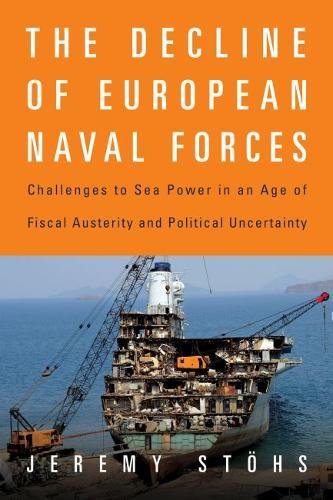
RH: On that note Jeremy, thank you for taking the time for helping us to discuss this pressing but under-the-radar issue. If our readers would like to follow up on Jeremy’s work, please check out his book The Decline of European Naval Forces. You can also look for the Routledge handbook of Naval Strategy and Forces, edited by Sebastian Bruns and Joachim Krause, which is an indispensible resource. For more info on the book and other podcasts, don’t forget to visit https://www.kielseapowerseries.com/en/ and follow us on Twitter at @SeapowerSeries for more updates.

Jeremy Stöhs is a security and defense analyst at the Institute for Security Policy at Kiel University (ISPK) and its adjunct Center for Maritime Strategy & Security as well as a fellow at the Austrian Center for Intelligence, Propaganda & Security Studies (ACIPSS).

Roger Hilton is the defence and Security stream manager at GLOBSEC, a global think-tank based in Bratislava, Slovakia  as well as a research fellow at the Canadian Global Affairs Institute (CGAI).

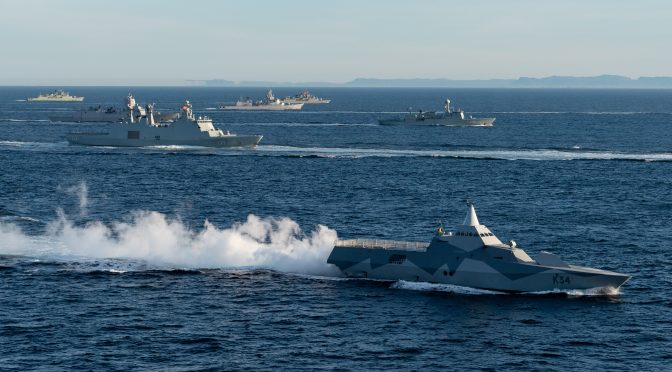
Featured Image: Norwegian Sea, Nov 7. 2018. TRIDENT JUNCTURE 18 PHOTEX. (NATO Photo by Wo Fran C. Valverde)
On The Decline of European Naval Power: A Conversation with Jeremy Stöhs, Pt. 1

By Roger Hilton

The intensifying competition between the United States, Russia, and China for control of strategic spaces has brought with it a slew of challenges and a lowered threshold for potential confrontation. Consequently this new security dynamic has forced national policymakers to reconsider the importance of the maritime domain when it comes to global statecraft. Consequently, this new security dynamic has forced national policy makers to reconsider the importance of the maritime domain when it comes to global statecraft. On quick observation the situation does not inspire much confidence. Years of neglected force structure investment by European nations coupled with shifting American presence to Asia suggest a distressing situation. Consequently, based on these factors it is only natural to ponder if Europe’s naval forces are doomed to impotency for the foreseeable future, or if reform if possible.

Here to help us navigate these questions is Jeremy Stöhs, an Austrian-American defense analyst at the Institute for Security Policy at Kiel University and its adjunct Center for Strategy and Security. In addition, he is also a fellow at the Austrian Center for Intelligence, Propaganda, and Security Studies. His current research and teaching focuses on transatlantic relations, maritime security, and European naval power. He has written various articles and chapters on the matter and is the author of the recent book, The Decline of European Naval Forces, Challenges to Sea Power in an Age of Fiscal Austerity and Political Uncertainty.

The decline of European naval power can provide insight into the evolution of Europe’s naval forces since the end of the Cold War. To illuminate the drastic changes many European navies have undergone in the past 25 years, we turn to Jeremy who has analyzed the defense policies and naval strategies of 11 European states, as well as the evolution in deployments and capabilities of their respective forces.

JS: Thank you for having me Roger, it’s always a pleasure talking to you.

RH: Before we dive in, it might be helpful if we structure the conversation. We will cover three distinct periods as they relate to the decline of European naval forces. The first period reaches from 1990-2001, and encompasses the post-Cold War peace dividend. The second period, from 2001-2014, covers land wars in the age of global terrorism after 9/11. Period three, 2014 to the present, begins with the annexation of Crimea. 

In your book you describe both the concept of sea power and naval power, can you explain each concept and explain what distinguishes them?

JS: Thank you very much for the question. There is, as you infer, significant semantic awkwardness regarding these terms and their numerous definitions for seapower, for maritime power, for naval power. I like to paraphrase retired British Admiral Chris Parry who argues that sea power is the combined investments of various resources of the state or enterprises in the pursuit of favorable outcomes at sea. I happen to focus on states despite non-state actors gaining power in the world.

But it’s not only about investments or what Geoffrey Till calls the inputs. Sea power is also about the outputs, or in other words, what capacity states have to influence human behavior by what they do at sea. The state is one basic unit for the measurement of power distribution so sea power broadly speaking would include all investment of the state, such as cultural, commercial, military in the maritime domain. Naval power is but one part of sea power, it’s the military investment.

RH: Can you provide some contemporary examples of each?

JS: The concepts are linked, so I would not say there is one example for one or the other. In order to have sea power in my opinion, you need to have a degree of naval power. Some states may have some significant maritime commercial interests but relatively little means for similarly large investments in naval power. But I refer again to Geoffrey Till who refers to that as the virtuous circle, so one investment in one area is mutually beneficial, and a decline in one area can affect decline in another. I believe this is something we have seen in the past, it is important to remember that most every state –  or rather every state – has some interest in the sea, and they enjoy different forms of agency at sea. Even landlocked countries like my home Austria has a part to play within the global trade regime and therefore also has stakes at sea.

Sea power and naval power are linked, and it’s a different concept than how it was understood maybe 200 years ago, but today they are inextricably linked. 

RH: We have the post-Cold War peace dividend, from 1990-2001. You describe in detail how this period started the initial erosion of naval capabilities and strategies. With the end of the Cold War, yourself like many experts declared that the existential threat of the USSR disappeared and by extension led to the abandonment of traditional naval doctrine. As this was a period of transition from sea control, sea denial, and territorial defense operations to power projection and operations in the littorals. How would you describe this transition, and was this shifting of capabilities for nations smooth or for others was it a regrettable experience?

JS: Well now we have the benefit of hindsight and hindsight is always 20/20. But generally speaking you are correct, although I would say that this process was much more nuanced depending on the respective state and more nuanced than it might seem today.

Two broad trends that are discernable during this period of time are states either adhering to traditional strategies of territorial defense, or seeking greater power projection in all its forms, not only military but also in terms of economics and so on. Those are the two opposing trends. But as always I think it’s important to keep in mind it was not black and white but a continuum of change. States might have had a government that emphasized one area over others, and because sea power is an enduring element many of the developments were gradual. So I try to refrain from revolutionary language, I think it was very incremental. Ships cannot be built overnight, naval and maritime proficiencies cannot be gained overnight, and the capabilities in existence in the 1990s were very much the same as the 1980s. It was the same or similar platforms, systems, and people, largely working in unfamiliar waters maybe, and often in unfamiliar ways.

It’s important to note that some navies in some states welcomed these new missions whereas others were reluctant to join in the post-Cold War euphoria. And this is of course related to geostrategic freedom of action. You look at a state like Norway with its proximity to a historical antagonistic, Russia, and other states with very limited financial means it’s difficult to change its naval policy. Therefore I don’t think there is a clear answer to your question.

RH: Against the backdrop of this maritime landscape that deemphasizes traditional doctrine, how are navies in this time justifying their existence and budgets?

JS: A difficult question to generalize and, again, it depends a lot on each Navy, and there should be much more research of each Navy in terms of how the defense policies have changed. But broadly speaking already during the 1980s in the period of easing tensions between East and West, the German reunification, the maintenance of previous spending levels on defense was not possible. You see this already in British defense studies such as the Options for Change white paper of 1990 that clearly describes how previous defense spending was no longer feasible. So how do they actually justify their existence?

It depends. You have the Scandinavian states, with the exception of Denmark, justifying their existence through a continued threat to their territory, with Russia still being the most powerful military power on the continent. The need to protect their Exclusive Economic Zones was also a core argument, and it’s important to remember that provisions of UNCLOS came into force in 1994, elevating the importance of the EEZs even more so.

In the south you have Greece and Turkey which lived through a period of increased tension during the 1990s. This necessitated hikes in defense spending. And for the rest of Europe, many countries placed great emphasis on projecting power, interventions, peace support operations and such. These took navies outside of the NATO’s traditional areas of operation, ‘out-of-area,’ and naval forces were uniquely suited in this role because of their three basic functions, including: the military, the diplomatic, and the constabulary function.

In this period of fiscal austerity, defense planners used every opportunity they had, but it differed from country to country.

RH: You make the observation that green and brown-water navies evolved into blue water navies. Was this a matter of survival, or was this repurposing utility?

JS: There are only a couple of examples where that actually occurred and that has something to do with this aforementioned trend toward power projection. During the Cold War, European navies were assigned specific duties within their areas of responsibility, such as anti-submarine warfare, mine warfare, escort duties, amphibious assault, and so they were quite limited by the bipolar world order.

Once these restrictions ended then states that enjoyed strategic freedom of action sought to use naval forces to project power. And an interesting point, those examples that stick out are the Germany Navy or the Danish Navy, to the less extent the Belgian and Spanish navies, they really saw power projection in different forms. But these navies, mainly the German and the Danish navies, were mainly green water navies, operating close to shore occasionally conducting escort duties, but now they would become blue water navies operating far from home. Now they would go into other littorals at great distances, so they would still act as littoral navies, but at a great distance from home. So that’s an interesting aspect of this whole blue water, green/brown debate.

And of course the repurposing had some utility for those navies. They were able to contribute to increasing number of peacekeeping operations that were emerging in the 1990s, including crisis management which was one of NATO’s main roles, military interventions of course in the Balkans for example, but also further afield. We have numerous operations, including Desert Storm, Yugoslavia, Operation Desert Fox in the late 90s, the intervention in Sierra Leone, also low-key humanitarian assistance and disaster relief efforts after natural catastrophes and so on.

RH: Despite it being a time of economic prosperity and peace, you reference large-scale investments and procurement projects that took place during this period. Can you situate some of the naval hardware being bought and used at the time?

JS: I provide a lot of examples in my book on naval procurement and force structure, and to a certain extent the platforms and their advantages and disadvantages. It’s important to note that European defense industry was of course a powerful actor. It had influence on how naval forces were built and what they looked like, and critical technologies and jobs of course were still main concerns.

It’s important to remember as I mentioned before, navies can’t be built overnight. So, during the 1990s, they were designed for the Cold War, for high intensity warfighting. If you look at the Italian Navy, the German Navy, they were designed for warfighting, a lot of anti-submarine warfare, escort duties, and mine warfare. Now, all of the sudden, you have this need for expeditionary operations and what you need for that, well you need multi-purpose surface combatants, landing platform docks, amphibious assault ships, helicopter carriers and such. So, on one hand, you see this trend that you need larger platforms for low-intensity operations, and at the same time you have all those procurement projects that were developed and designed in the 1980s. There was a divergence between strategic necessities and the security environment for what you need for that and the procurement plans that are already in the pipeline. In the 1990s you see European countries developing air defense capabilities and air defense destroyers and frigates, and those were capable ships that were commissioned at a time where threats of anti-ship missiles in the littorals are not all too great, and where European countries are operating ships with relative impunity.

But of course this had the advantage of supporting important industries and just goes to show that you have to be very prudent about your decision-making and strategic forecasting.

RH: Is there anything else you’d like to add that we should know or that we’ve overlooked?

JS: With respect to downscaling in this period of time, you have fiscal austerity, a peace dividend, so especially maintenance-intensive and manpower-intensive platforms are decommissioned. But it can be considered a period of relative plenty, especially with regard to the threat scenarios at the time. You still have highly capable platforms coming online, you have highly-proficient crews and personnel, so it’s important to note those capabilities that were being developed in Europe. The Horizon-class, the Daring-class, the German air defense frigates, they were state-of-the-art and comparable to the best air defense destroyers in the world. The UK got the Tomahawk land-attack missile for their subs, the French got their Charles De Gaulle carrier. There was also closer cooperation between the states because of the need to streamline and operate together at a tactical level.

The United States still had such great capabilities that they could compensate to some extent for the dwindling numbers among European naval powers. But the 1990s still proved how important naval power was.

RH: Let’s move on to the second period, involving land wars in the period between 2001-2014. This was a seminal moment not just for European navies but also world history. Not only did this period bring two major operations in Iraq and Afghanistan, but also the global financial crisis. How did these developments play a major role in the development of European naval forces?

JS: I would argue not to over-dramatize this period. It is true that the last decade it was very challenging for European naval power and the defense community in general in Europe. But it’s also important to put it into a historic context, for the naval forces of some European states, such as the Spanish armada in the 19th century or the 20th century German or Italian navies, they had endured far greater calamities and declines than what we’ve witnessed recently.

However, if you look at the past 30 years, this last decade had the most significant impact on naval forces. I wouldn’t say that it was mainly the land wars but, more importantly, the decreasing defense spending because that more or less is what shapes your naval forces.

RH: At the time we’re in Afghanistan and Iraq, how did the preoccupation with these land wars recalibrate naval power?

JS: There are a couple points to keep in mind here. First of all these operations, we talk about the war on terrorism, you have military operations on land but naval forces play an important role in contributing to these campaigns from air strikes to cruise missiles to providing close air support and medevac, inserting special forces, logistics, and so on. At the same time you had a broadening of the security agenda in general. That already occurs throughout the 1990s but then picks up speed during the 2000s. 9/11 caused Article V of NATO to be invoked for the first time. A large number of European states contributed to the war in Afghanistan, and then also two years later in Iraq. This changed the security environment in such that you have a broadening security environment, a broadening of the term security, and from the 1990s onward and especially after 9/11 you have the threat of terrorism as one of the challenges the naval forces have to deal with. So you see naval forces being deployed in counter-terrorism, combating illegal trafficking of arms, drugs, people, counter-proliferation against weapons of mass destruction. The concept of maritime security is prevalent at this time and naval forces are assigned with dealing with all kinds of maritime security challenges.

RH: It’s been argued that this period helped assert the dominance of the Army and Air Force, and that it led to the de-prioritization of naval power. Amidst this interservice rivalry, did it force navies to expand their repertoire of functions to become more versatile?

JS: I would have to say that really depends on each individual state. I find it difficult to make general claims here. But one thing that is clear is that air and land forces received the lion’s share of funding during this period of time and usually they got a greater portion of the defense budget. We have similar developments in the U.S. as you see in Europe, in those wars in Afghanistan and Iraq, where you prioritize the capabilities that you need in war. I remember the discussions quite vividly in investing in low-intensity capabilities such as mine resistant ambush protected vehicles. That was the problem, the high-low mix, therefore U.S. Secretary of Defense Robert Gates slashed the F-22 program for instance. You have a similar problem in Europe.

What this period of time does, I believe, is it changes the perception of the functions of the navies and the understandings of navies in what their constabulary and diplomatic roles are. This is reflected in concepts such as the 1,000-ship Navy, the U.S. maritime strategy A Cooperative Strategy for 21st Century Seapower, and the European effort for capacity building on the low-end of the intensity spectrum together with partners, and it’s easier to build partnerships at the lower-level compared to the high-end.

So you see this growing cooperation and this cooperative approach toward maritime missions, and of course what happens is that this comes at the expense of warfighting capabilities. Especially anti-submarine warfare wasn’t really practiced, offensive mining was relinquished, anti-surface warfare is difficult to do when you lack surveillance assets like maritime patrol aircraft. So the focus is shifted perhaps too much toward the low-end, it really changed the perception of what navies can do. But I think that is being forgotten again.

Read Part Two Here.

Jeremy Stöhs is a security and defense analyst at the Institute for Security Policy at Kiel University (ISPK) and its adjunct Center for Maritime Strategy & Security as well as a fellow at the Austrian Center for Intelligence, Propaganda & Security Studies (ACIPSS).

Roger Hilton is the defence and Security stream manager at GLOBSEC, a global think-tank based in Bratislava, Slovakia  as well as a research fellow at the Canadian Global Affairs Institute (CGAI).

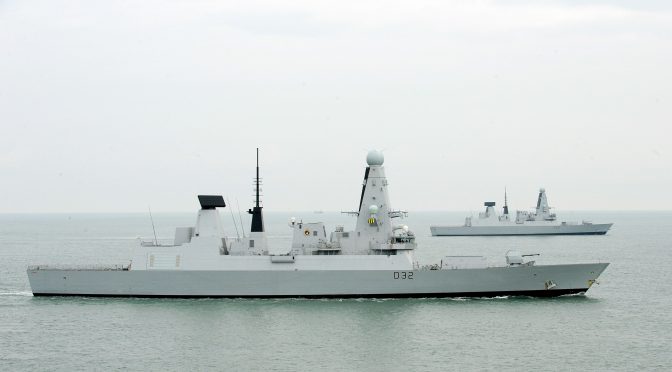
Featured Image: British Royal Navy air defense destroyers HMS Daring (front) and HMS Dauntless operate, February 2010. (Wikimedia Commons/UK Ministry of Defence)

Arab Allies Must Step Up To Defend Freedom of Navigation in the Gulf

Securing the Gulf Topic Week

By Andrea Daolio

The Persian Gulf recently made headlines across the world due to clashes between Iran, the U.S., the U.K., and regional Arab states. Of grave concern, the Strait of Hormuz in the Persian Gulf is a chokepoint for global shipping routes where much of the world’s energy supply passes. While tensions have remained high in the region for quite some time, every incident bears some consequence for global stability.

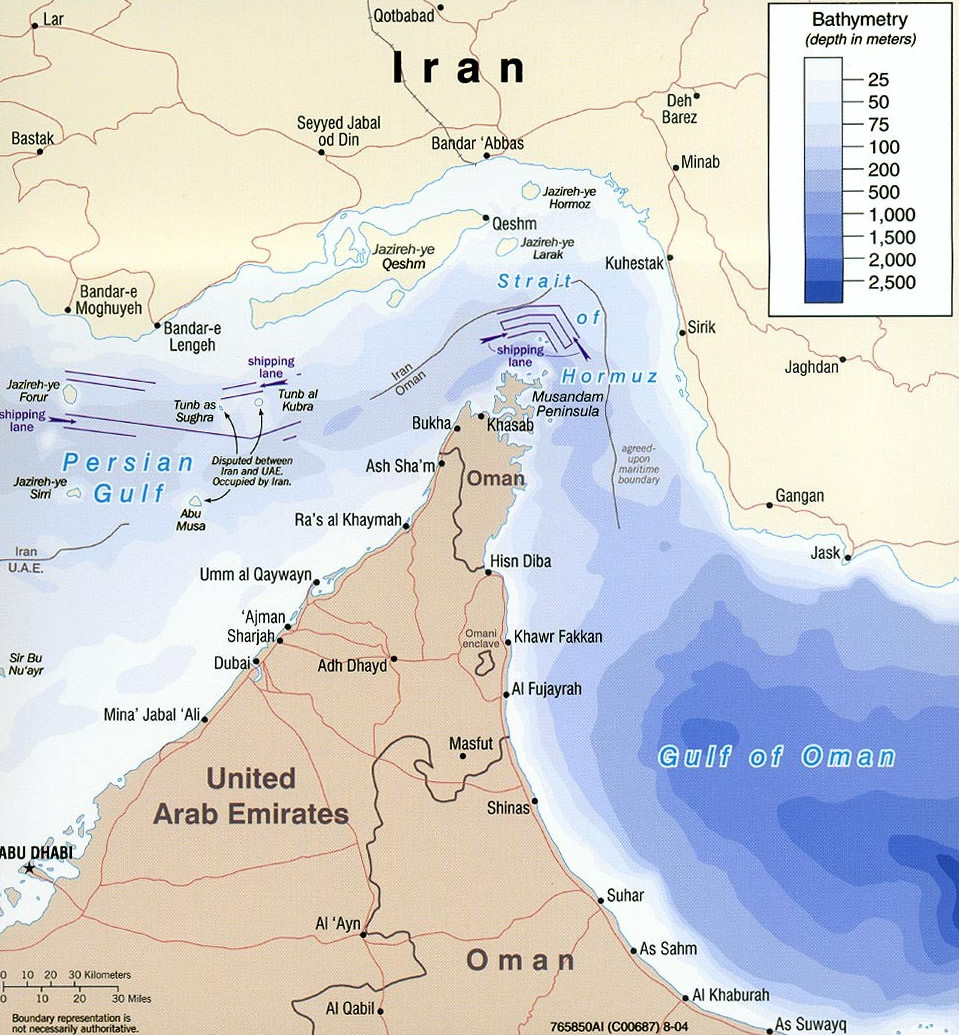
The Persian Gulf (or Arabian Gulf according to some Arab countries, showing how the rivalry also extends to the very name of the sea) is an inland sea that is connected to the Gulf of Oman and the Indian Ocean through the Strait of Hormuz, a feature that is only 21 miles wide at its narrowest point. With its powerful littoral navy homeported in bases all around the Strait, from the main base at Bandar Abbas to smaller ports at Jask, Qeshm and Abu Musa, Iran is clearly very well-positioned to attempt a closure of the Strait.

A map of the Strait of Hormuz and key shipping lanes. (Wikimedia Commons/Perry Castaneda Online Library, University of Texas)

Freedom of navigation has been long guaranteed by the United States Navy and its allies, but today this is increasingly challenged, from China in the South China Sea to Iran in the Persian Gulf. With respect to Iran the U.S. Navy already dealt a strong blow to the Iranian fleet in 1988 with Operation Praying Mantis, but the situation has radically changed since.1 In 1988 Iran was locked in a protracted bloody war with Iraq, and its forces were still trying to recover from the purges of the Islamic Revolution. Iran was also faced with a lack of supplies and spare parts for its largely American or European-built arsenal. It is no surprise then that American naval forces were able to sink or severely damage half of Iran’s operational fleet in a single day.

The Iranian Navy has changed plenty in the past three decades. Now the IRIN (Islamic Republic of Iran Navy) can field three Russian-built Kilo-class diesel-electric submarines and a vast array of small but deadly midget submarines that could prove extremely dangerous in the shallow waters of the Persian Gulf (that has an average depth of only 160 ft and a maximum depth of 300 ft). The Iranian surface fleet is still greatly inferior to the U.S. Navy and can only rely on a few small frigates. But it also includes a great number of small combatants, often of no more than 200 tons but armed with 2-4 modern anti-ship missiles with a range sufficient enough to hit almost any area on the opposite side of the Gulf from their home bases. But even the boats without ASMs can be a great threat in the confined waters of the Persian Gulf and attack enemy ships with surprise attacks and swarm tactics that could overwhelm even better armed American ships.2 To add to the threat, a large number of land-based anti-ship missiles and ballistic missiles are now in the inventory of the Iranian Armed Forces. These not only endanger ships in the Persian Gulf, but bases and infrastructure across the Arabian Peninsula are under threat.3

Moreover, Iran has maintained a mining capability that has already proven deadly for commercial ships and for the U.S. Navy back in the ‘80s. Since World War II, of the 19 U.S. ships sunk or seriously damaged by attack, mines were responsible for 15. Even old mines can pose a great threat to ships and will require extensive operations to clear them. Mines dropped from innocent-looking fishing boats can block shipping lanes, deter transits, all while giving the aggressor some cloak of deniability.

While these weapons are extremely dangerous for American forces in the area and Iran could carry out a deadly first strike against the U.S. and its allies, the Iranian regime is well aware that an American counter-attack could destroy their military. But if Iranian forces limit themselves to small-scale attacks that help maintain a semblance of deniability, then Iran can still cause havoc to shipping4 and destabilize the global economy as even small incidents can make oil prices and shipping insurance increase considerably.5

Expanding the Roles of Arab Allies

In order to reduce their dependence on the United States Navy, which is no longer looking to maintain a carrier strike group in the Gulf on a full-time basis, Arab Allies should concentrate more on fielding small and agile ships armed with ASMs missiles on the model of the Iranian Navy. But the trend for Gulf States in recent years has been to upgrade their navies with larger and more capable surface combatants,6 but while Saudi Arabia can base its more powerful ships in the Red Sea, Bahrain, Qatar and the United Arab Emirates can only place their ships a few miles from numerous Iranian missiles ready to strike them. If Arab states instead build a fleet of more numerous small and fast surface combatants they can hope to escape any first strike by Iran by distributing their forces and then countering Iran with reciprocal small-boat missile attacks. They must also look to expand their mine countermeasure forces to keep up with the platform-intensive activity of minesweeping.

While America and its Arab Allies can greatly contribute (and already are greatly contributing) to maintaining security in the Strait of Hormuz, Asian countries that are the main importers of Gulf oil should do their part. More than 75 percent of these crude oil exports are destined for Asian markets, with Japan, India, South Korea and China the largest importers. Moreover, Iranian actions are angering even those countries that showed support in the past to Iran or that refused to follow the American “maximum pressure” campaign of Sanctions. European countries that tried to save the Iran deal are now reconsidering their stance as Iran looks to continue enriching uranium and attack civilian shipping.7

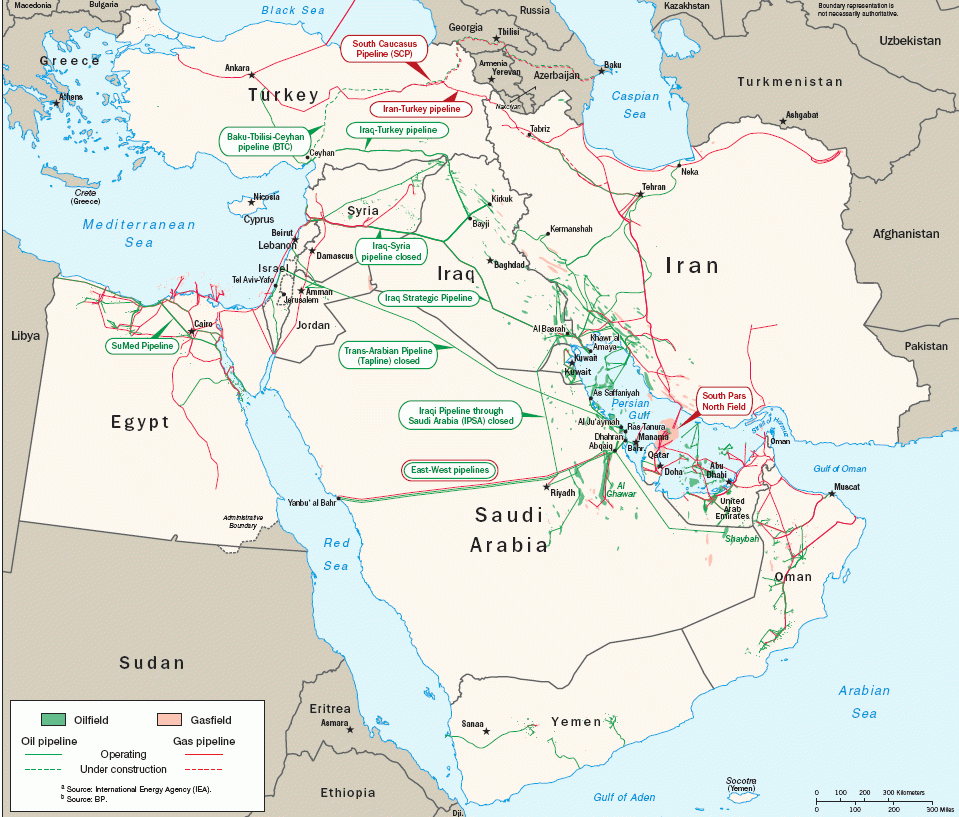
Iranian threats can be mitigated through innovating in energy infrastructure. Saudi Arabia already has a long East-West pipeline, connecting the oil fields near the Persian Gulf to the port of Yanbu on the Red Sea opposite Egypt. If more pipelines are built toward the port of Yanbu, and other ports on the Red Sea are adapted to service tankers, a large portion of Saudi Arabia’s oil and gas can be exported from this area, safe from Iranian naval threats. As the Saudi monarchy has close ties with many neighboring Arab countries, regional states could develop a joint plan to export their oil and gas from the Red Sea, in this way reducing their dependence on the Strait of Hormuz. Moreover, if Arab States export more oil and gas from the Red Sea, then Iran will increasingly become the only state that is truly dependent on the Strait of Hormuz.

Oil and gas pipelines in the Middle-East (Wikimedia Commons/Energy Information Agency) Click to expand. 

Conclusion

While the Iranian Armed Forces have greatly improved in recent decades and can be a serious threat to commercial and military assets transiting the Strait of Hormuz, there are many ways to counter these forces and maintain freedom of navigation. Since Iran has developed many asymmetric tactics to counter the U.S. and its allies, the best way to respond is to develop opposing asymmetric tactics and unconventional means, both military and political, to throw Iran off balance.

Andrea Daolio, from Italy, has an engineering background and a long-standing passion for wargaming and for geopolitical, historical and military topics. He has been a finalist in New York’s MTA Genius Transit Challenge. He is currently collaborating with video game developer Slitherine on the popular wargame Command: Modern Air/Naval Operations. His views are his own.

References

1. David B. Crist, “Gulf of Conflict: A History of U.S.-Iranian Confrontation at Sea,” June 2009, The Washington Institute. https://www.washingtoninstitute.org/uploads/Documents/pubs/PolicyFocus95.pdf.

2. Sune Engel Rsmussen, “Iran’s Fast Boats and Mines Bring Guerilla Tactics to Persian Gulf,” The Wall Street Journal, May 30, 2019. https://www.wsj.com/articles/irans-fast-boats-and-mines-bring-guerrilla-tactics-to-persian-gulf-11559208602

3. Anthony H. Cordesman and Abdullah Toukan, Iran and the Gulf Military Balance, Center for Strategic and International Studies, October 3, 2016. https://csis-prod.s3.amazonaws.com/s3fs-public/publication/161004_Iran_Gulf_Military_Balance.pdf

4. Vivian Yee, “Claim of Attacks on 4 Oil Vessels Raises Tensions in Middle East, The New York Times, May 13, 2019. https://www.nytimes.com/2019/05/13/world/middleeast/saudi-arabia-oil-tanker-sabotage.html

5. Jonathan Saul, “Ship Insurance Costs Soar After Middle East Tanker Attacks,” Reuters, June 14, 2019. https://www.reuters.com/article/mideast-attacks-insurance/ship-insurance-costs-soar-after-middle-east-tanker-attacks-idUSL8N23L2ND

6. Chuck Hill, “Saudi Navy Expansion Program,” Center for International Maritime Security, December 9, 2015. https://cimsec.org/saudi-navy-expansion-program/18474

7. Alexandra Ma, “Europe Reportedly Threatens to Activate Nuclear-Deal Clause that COULD Reimpose Sanctions and push Iran into China and Russia’s Arms,” Business Insider, July 5, 2019. https://www.businessinsider.com/iran-nuclear-deal-europe-could-activate-dispute-resolution-sanctions-report-2019-7?IR=T

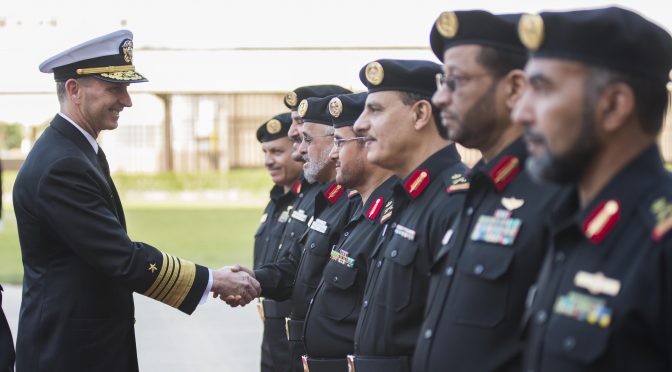
Featured Image: RIYADH, Kingdom of Saudi Arabia (Feb. 10, 2013) Chief of Naval Operations (CNO) Adm. Jonathan Greenert meets with heads of the Royal Saudi Naval Forces (RSNF) program at the RSNF head quarters building. (U.S. Navy photo by Mass Communication Specialist 1st Class Peter D. Lawlor/Released)

Will The Sentinel Program Work? Understanding Iranian Aggression and U.S. Mixed Signals

Securing the Gulf Topic Week

By Irina Tsukerman

The Immediate Context for Sentinel

In the wake of growing tensions with Iran in the Gulf and around the Strait of Hormuz, the United States announced a push for an international coalition that would monitor activity in the area and guard against maritime security breaches. The coalition would be known as “Sentinel.” Although it is unclear as of yet which countries will make up this alliance, over 20 states are in consideration. The name and concept may be derived from “Sentinel Asia,” a coalition designed to counter and mitigate issues stemming from natural disasters, and which includes eight international organizations, and 51 organizations from 20 participating countries.

U.S. Chairman of the Joint Chiefs General Dunford explained that the U.S. is engaged in the process of identifying which countries have the “political will” to be involved. The second phase of the plan would be to work with the militaries of these countries to identify specific capabilities that would ensure the success of the plan. Finally, the members of the coalition would be charged with escorting vessels, such as oil tankers, made vulnerable to threats by Iran. The U.S., for its part, would be willing to share intelligence with the coalition but would not be involved in escorting vessels. The push comes shortly after President Trump complained repeatedly that the U.S. handles the burden and the costs of securing the Strait of Hormuz and Bab al-Mandeb, whereas its allies, such as Asian countries, are not contributing enough. He repeated these comments during the G20 summit in Osaka, further adding that allies should carry full costs of the presence of U.S. troops on their soil and that Japan would not get involved if the U.S. were to be attacked. He also questioned the need for U.S. protection of international shipping in the Strait of Hormuz. The U.K. joined in the call for internationalizing maritime security in the region with a push for an European maritime mission.

These comments followed Iran’s threat to close off the Strait of Hormuz, which remains an essential route for transporting oil for a number of Gulf States, as well as Japan, South Korea, and other Asian countries, following U.S. designation of the IRGC as a terrorist organization. Exports warned that such a move would imperil international access to oil and cause petroleum prices to skyrocket. In May, Saudi, Emirati, and Norwegian oil tankers were attacked in mysterious incidents which the U.S., UAE, and others attributed to a state actor. That was followed by Houthi attacks against Saudi oil rigs and attacks on Saudi civilian and military sites, as well as U.S. targets in Iraq. In June, the attacks on oil tankers resumed, and a Japanese-flagged ship was attacked while Prime Minister Abe was visiting Iran in an attempt to mediate between Washington and Tehran. As the war of words between the two countries escalated, cyber attacks between the U.S. and Iran also surged.

By July, the U.S. came to the brink of a military strike against Iranian targets after the downing of a U.S. reconnaissance drone that may be worth up to $220 million. The U.S. instead retaliated with a cyber strike against IRGC targets responsible for that act. Tensions continued as the U.S. claims to have down a provocative Iranian drone, which Iran tried to deny. Meanwhile, Chinese vessels smuggling oil from Iran continue to vanish off the radar in an effort to disguise their routes; a Panamanian-flagged tanker reportedly carrying Emirati oli disappeared in Iranian waters (Iran claimed that it had stopped a ship smuggling oil; Panama now claims the ship violated regulations); British forces arrested an Iranian oil smuggling oil to Syria in an attempt to circumvent sanctions.

Iran refused to return the ship home and instead it retaliated by diverting a British tanker to Iran and briefly arresting another British ship. These events transpired amidst an increasing military buildup by the U.S. and the U.K. in the Gulf. The U.S. transferred two naval destroyers to the Gulf, the Patriot air defense system, as well as several B-52s to the Al-Udeid Base in Qatar. The U.S. followed by bringing in additional naval task groups and other military presence to the area. Saudi Arabia recently approved the transfer of 500 U.S. troops to a military base in KSA as part of the 1000-troop buildup U.S. pledged in the face of the rising tensions. 

Nevertheless, none of these developments appeared to have deterred Iran from an increasingly aggressive military stance. In fact, most recently, Iran discussed implementing a “toll system” that would require tankers to pay a contribution to the IRGC boats stationed in the area in order to be able to continue to travel freely. Some have described this attempt to charge foreign ships as a form of extortion or modern day piracy.

Iran’s Strategy and Military Capabilities

Whereas the U.S. has attempted to portray its responses as part of its maximum pressure policy on Iran, the two countries are coming from very different places in this confrontation. What in Washington may appear to be a tough but reasonable position aimed at deterring the possibility of violence while also deescalating tensions, in Tehran this may be seen as mixed signals, and more likely as a sign of weakness and desperation for a new nuclear deal that would make President Trump appear to be more successful than his predecessor.

Iran’s strategy relies on the domination of the “Shi’a crescent” and creating a strong military and political control of the “triangle”: Strait of Hormuz/Bab al-Mandeb, Syria, and Lebanon. It pursues its goal through an advance of strategic land routes that would connect Tehran to Syria through Iraq and allow a line of communication from Lebanon to Syria, all the way to the Jordanian borders, as well as a parallel path of ideological outreach, influence, and recruitment. To that end, Iran has focused on its “ground game” in countries of strategic interest as much as on the show of military capabilities, largely focused on the asymmetrical warfare perfected by its IRGC arsenal of light ships that are small enough to become an active hindrance in the narrow strait.

Militarily, Iran is no match against the vastly superior U.S. or British naval forces, but it does not need to be. Pushing the envelope to normalize its harassment in the wake of the increasingly isolationist position by the U.S., and to see the real extent of the Trump administration’s red lines and commitment to security in the region is likely Tehran’s goal, instead of the full scale conventional war that its proxies and assorted lobbies and propagandists have been warning against in the media.

It is to Iran’s benefit to create a false dichotomy of “full scale conventional confrontation” or “no action at all” in order to deter limited military strikes by the U.S. or other countries that could cripple its limited and strategically necessary capabilities. Any lack of firm position is interpreted by Tehran in its favor, especially if it is merely biding its time until the Trump administration inevitably leaves office, whether in 2020 or four years later. Neither Rome nor the Persian Empire have been built in a day; Tehran, if it wishes for its agenda to come to fruition, has no choice but to think long-term and exercise unrivaled strategic patience while deploying more discrete means.

Mixed Signals from the U.S. government

To that end, the U.S. response so far is showing Iran exactly which buttons it needs to push in order to make incremental progress despite growing pressure from the United States. For instance, when the administration announced a military strike in retaliation for the downing of the drone, and then changed its mind at the 11th hour after the alleged concerns about the number of casualties, while to President Trump’s base that may have signaled a humane and proportionate approach. But to the Iranian leadership it signaled weakness, shiftiness, and unwillingness to make tough or unpopular choices.

Similarly, when Iran faced virtually no consequences for its forceful abductions of tankers or its arming of the Houthi separatists in Yemen, who then proceeded to engage in attempted terrorist attacks against Saudi civilian cites, the message as interpreted by Tehran was that the United States is far less unwilling to intervene in conflicts that do not directly affects its own citizens, even if Houthis consider the United States an adversary. To Tehran, the United States position was clear: there are limits to its support for its allies, even if that support requires merely an imposition of additional sanctions against members of the government responsible for these strategic decisions. The United States, Iran may conclude, is more bark than bite. The U.S. may therefore take virtually no deadly action because in the run-up to an election the concern for keeping promises to the base and not engaging in what may risk a long-term conflict is greater than other policy considerations.

The same signal appears to come from related Congressional decisions, which show that the US public – or at the very least – her representatives  do not have a stomach for further military engagements or even support for regional partner countries, which may engage against Iran with their own measures. Further, bitter political battles, rather than security considerations, appear to be a top priority for political leadership at the moment, which gives Iran plenty of ground to exploit.

These decisions include a bicameral vote to withdraw U.S. forces and logistical assistance to the Arab Coalition in Yemen (vetoed by the president); a more recent decision to block emergency expedition of arms delivery to KSA and UAE; assorted resolutions against Saudi Arabia and its Crown Prince Mohammed bin Salman in connection to the Jamal Khashoggi death, and attempted votes to deny arms sales to Bahrain, a tiny country with a large Shi’a population, that suffered an attempted Iran-backed coup in 2011, which was tolerated as “part of the Arab Spring” by the State Department at the time, but was more likely a test run and a harbinger for things to come.

At the center of most of these votes, was none other than Senator Rand Paul, a staunch isolationist who had advised President Trump against his earlier openness to supporting regime change in Iran and who now apparently seeks to be a sort of an “envoy” to Iran. Therefore, the U.S. policy in Iran involves a maximum pressure campaign geared toward a futile pursuit for a new nuclear deal, while dilly-dallying over campaign promises, all to the effect of lesser involvement and influence in the region. This sends mixed signals on U.S. commitments, reassuring Iran, and undermining confidence in the ability of the U.S. to carry out “maximum pressure” by the allies affected by these decisions.

While the Trump Administration believes American “energy independence” would eliminate dependence on foreign suppliers and lessen the need for a U.S. military guarantee of safe passage through global shipping lanes, energy remains a global market and any disruptions anywhere will impact prices. As approximately a fifth of the world’s oil passes through the Straight of Hormuz, which has historically been a flashpoint for attacks on oil tankers, the U.S. Navy must continue to secure the peace and protect global energy supplies. Threats of withdrawing betray a lack of understanding of the role the U.S. is playing commercially and economically, not just military and politically. Doing so would also mean sacrificing national security interests for domestic political point scoring.

Does The Idea of the Sentinel Program Reflect an Understanding of the Problem?

U.S. Defense Secretary Mark Esper has described Secretary of State Mike Pompeo as being on the “front lines” of the effort as “we’re not trying to put a military coalition as much as a coalition writ large of like-minded allies who share our concerns about freedom of navigation, who share our concerns about Iran’s nuclear pursuits in the past, their missile technologies and, frankly, their malign activities in the region.” This comment reveals a fundamental understanding of the crux of the issue.

First, the administration appears to have failed to define its goal – the lethal failing in the creation of any workable strategy. If Sentinel is not to be an armed coalition, then what is it supposed to be? Without understanding the problem these ships are facing is a military problem, rather than an issue of responding to random distress calls or occasional unpredictable security breaches, there is no progress to be made. It appears that the State Department is driving the strategy, which means that the focus is inherently on the diplomatic and political aspects of the issue; however, political problems that require military solutions need to be coordinated with the Defense Department. Denying that the solution will ultimately be a military one in the instance of putting together this coalition once again is sending the message to both US allies and adversaries that the administration is fundamentally unprepared or not serious to be dealing with either.

Second, from the course of events it appears that the administration has failed to take into account the concerns and limitations of the stakeholders. Without defining this “coalition of the willing” as the “coalition of the stakeholders,” the administration will spend a great deal of time searching for volunteers with the political will to take action. For instance, countries like Japan are reluctant to stretch their limited naval capabilities at a time when they are facing threats with respect to China, North Korea, and a dispute with South Korea (whose current administration is much more dovish towards North Korea and other regional threats). Treating allies as dispensable or unwilling to contribute simply because they are facing additional security threats, which in some case may be priority for them, does nothing to inspire volunteers to join the fray.

Third, there appears to be no defined strategy at the moment. Even provided the administration identifies a number of countries with sufficiently strong navies willing to do the job, it is not yet clear how these countries with divergent interests and perspectives will agree on the best way to handle the situation and who will lead the effort. Admittedly, a lack of a clear vision for deterring or engaging Iranian drones and other military assets, which are increasingly becoming a factor, may create difficulties in finding volunteers as countries may not wish to sign up for an opaque, poorly delineated mission.

Finally, Sentinel may already be on its way in repeating the flaws that doomed MESA, or “the Arab NATO,” a  Trump-backed project that appears to have deflated before ever getting off the ground.

What Went Wrong with MESA

MESA was envisioned as a coalition of Arab states to counter Iran’s regional aggression. MESA was not an altogether hopeless project had it taken into consideration a number of potential conflicts of interest among prospective members, and had taken a more realistic assessment of who should have been involved.

At the same time, in a misguided effort to bridge the differences among the GCC, the Trump administration sought to include both Qatar and the members of the Anti-Terrorism Quartet, which have been boycotting Qatar for the past two years. Qatar has not addressed any of the concerns by these other Gulf States, and in fact, despite claims of feeling threatened by Iran, maintains a growing relationship with Tehran. Likewise, MESA aimed at too broad a goal without any background of joint defense exercises or operations, and with a history of long disputes and differences among Arab States. Sentinel seems to be replicating some of the problems with MESA, in that the coalition is open-ended and the criteria for successful involvement is not defined.

There appears to be no mechanism for addressing potential disputes or other problems. Without taking the lead in identifying desirable actors, the administration can not guarantee that countries will not drop out based on other security considerations, as Egypt resigned from its commitment to MESA due to increased tensions with Turkey,  or because of conflict with other “volunteers.” The administration does seek to identify specific skills that would optimize everyone’s involvement in the coalition, but without knowing what one is looking for, it is hard to get there. When there is no concrete vision of the mission, identifying valuable capabilities suitable to the tasks is not something that can be done. Capabilities should be sought for to be fit within the framework of the mission and minimal expectations, common to all participants.

Iran, a key country in China’s New Silk Road strategy, remains a top oil trading partner (China is also heavily invested in oil fields in Ahwaz) and trade between the two countries has grown in other areas. While the U.S. sanctioned one of the Chinese companies responsible for smuggling Iranian oil, the impact of such measures is proving negligible as sanctioned Chinese entities rebrand, just as with Iranian proxy businesses. Iran’s provocative strategy in the Gulf may be somewhat based on China’s belligerent actions in the South China Sea as well as involving useful, coordinated distractions from Tehran and Beijing’s oil smuggling operations elsewhere.

Will Greater US Presence be a Deterrent?

Whereas Iran has a long-term offensive strategy, increasingly dependent on hybrid tactics, up until this point U.S. responses have been tactical, and often attuned to political interests than to strategic military needs. Furthermore, Sentinel at its core is a narrow defensive project that in no way aims to degrade Iran’s capability to continue wreaking havoc in the region. In reality, a serious and comprehensive strategy to counter Iran would likewise be hybrid and look to disrupt Iran’s information warfare, military, and defense mechanisms just as much as Tehran looks to disrupt those of the Western and Gulf countries.

Preemptive action can be increasingly appropriate as a deterrent as the mere presence of increased forces has not stopped Iran from escalating. Finally, high level Iranian officials, such as Foreign Minister Zarif, should be held personally responsible for past and future security breaches and sanctioned. The IRGC received an award after downing a U.S. drone, yet the role of the government in inciting and allowing such incidents to take place has been downplayed. Their assets in Western countries should be frozen, and no member of Sentinel or any country affected by Iran aggression should host Zarif; he should not have the opportunity to come to the US or other countries only to advance propaganda. Information warfare is central to any successful military strategy; by ceding public affairs ground to Iran and its lobbyists and apologists, the United States showed itself to be trailing behind on this essential front. Finally, Iranian proxy groups and operations should be disrupted officially and unofficially, and disinformation should be sowed among the government ranks until such level of confusion is achieved that the U.S. can make its demands or successfully pursue whatever other goals it defines.

However, all evidence increasingly points to the U.S. interest in negotiating a new deal. If that is the case, in pursuing a path to negotiation, the U.S. once again appears to have forgotten than the best way to get a deal with a rogue regime is to aim for unconditional capitulation of the adversary rather than the kind of compromise than can only boost the morale of the regime.

Irina Tsukerman is a human rights and national security lawyer. After graduating from Fordham University (BA, International/Intercultural Studies and Middle East Studies, 2006) and Fordham University School of Law (JD, 2009), Irina focused on diplomatic outreach and community building, including as a founding board member of Moroccan Americans in New York. A prolific writer, her work appears regularly in domestic, Middle Eastern, and other international publications, including the Morocco World News, Begin-Sadat Center, The National Interest, Jerusalem Post, Algemeiner, The Times of Israel, and American Spectator. She has presented on congressional panels, international conferences, and scholarly conferences. Irina has also appeared as a commentator on Fox Business, i24, and Moroccan Channel 2M.  

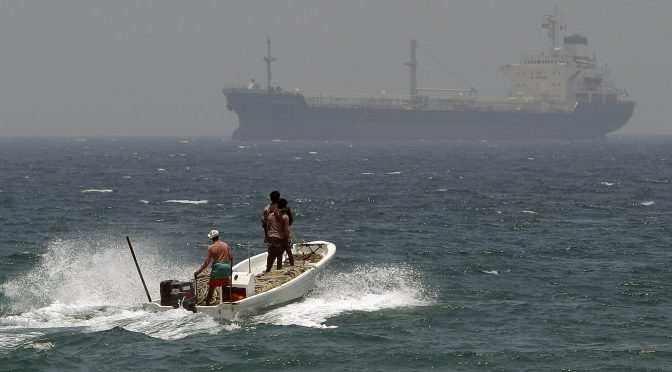
Featured Image: Fishermen in waters off Fujairah, United Arab Emirates, near the Strait of Hormuz, on May 30, 2012. (AP Photo/Kamran Jebreili, File)