If you’re a naval integration fan, this episode is for you! Dr. Bruce Gudmundsson, a military historian with the Military Learning Gateway,* and career Marine infantryman Tim Powledge join Jared to break down Operation Albion. As World War I wound down, the Germans launched an assault on the Baltic Islands in an attempt to knock the Russian Empire from the war. The resulting was the most successful amphibious operation of World War I.
*Correction: An earlier version of this post indicated that Dr. Bruce Gudmundsson was a full-time historian with Marine Corps University, which was no longer the case as of 2017.
Jared Samuelson is the Senior Producer of the Sea Control podcast. Contact him at seacontrol@podcast.org.
Sebastian Bae (@SebastianBae) joins Jared (@jwsc03) to discuss his own development as a wargamer and designer, the genesis for Georgetown University’s new wargaming program, the Georgetown University Wargaming Society, the explosion of wargaming in both the academic world and Department of Defense and what he’s learned in his first year of teaching. One editor’s note: Nick Murray was identified as working for the Naval Postgraduate School during the podcast. He works for the Naval War College.
China’s Maritime Silk Road ambitions suffered a setback after Tanzanian officials refused to budge over stalled negotiations to build what would be the largest deep-water port in Africa. Initially agreed to in 2013, the terms of the agreement remain a point of contention between Tanzanian President John Magufuli and China Merchants Holdings, the Chinese firm slated to construct the port and adjoining infrastructure. Tanzania suspended the project indefinitely in June, and it showed no signs of backing off in follow-up negotiations held in October. Instead, Tanzanian officials offered the Chinese firm a blunt ultimatum: accept our conditions or leave.
Although China and Chinese firms remain the dominant investors in African infrastructure, and especially in ports, the Bagamoyo port dispute demonstrates that African leaders are becoming more demanding that Chinese-funded projects align with African development needs, or at least African political interests. This dispute also raises questions over Chinese business practices and what U.S. officials characterize as China’s “debt trap diplomacy.” And while these are legitimate concerns, the most pressing issue for African leaders is answering increased domestic pressure for these infrastructure projects to deliver local results. Even after protracted negotiations, Tanzanian officials did not feel that the terms of this project would benefit the country. Whether more African leaders will adopt such an approach is uncertain, but similar examples, such as the government of Sierra Leone cancelling the construction of a new airport in 2018, suggest that Chinese investors may face more scrutiny over current and future development projects.
The Bagamoyo Port Project
Tanzania is a key part of China’s Maritime Silk Road project and the broader Belt and Road Initiative. In 2013, China Merchants Holdings, the largest port operator in China, signed a framework agreement to build a massive port in Bagamoyo, a small town about 45 miles north of Dar es Salaam. Dar es Salaam is the country’s largest city and home to an outdated and overwhelmed port that is struggling to modernize. In addition to building what would be the largest port in Africa, China Merchants agreed to construct railways and a special economic zone with the goal of making Tanzania a regional trade and transport center.
If completed as planned, the Bagamoyo port would be considerably larger than the Kenyan port of Mombasa, the largest African port on the Indian Ocean and a key economic driver for East and Central Africa. Only about 175 miles north of Bagamoyo, the Port of Mombasa is also tied to Chinese investment, as a surprise story last December showed that the Kenyan government used the port as collateral to finance a $3.2 billion railway project connecting Mombasa to the capital Nairobi. And while China was unlikely to take control of the port, the story angered many Kenyans and reignited concerns over heavy-handed tactics accompanying Chinese investment.
On October 21, the Tanzanian government issued China Merchants its ultimatum: accept the government’s terms and conditions or leave the project. A few days later, on October 24, Tanzanian officials arrested four Chinese contractorsin Dar es Salaam for making slow progress on state construction projects to “set an example” to other underperforming managers.
This ultimatum is a consequential economic decision, as the $10 billion port project would provide a considerable injection of foreign direct investment into a country where the per capita GDP is less than $1,000 per year and, despite consistent increases in overall GDP, the number of Tanzanians living in poverty remains steady.
Despite this strong financial incentive, the Tanzanian government rejected five demands made by China Merchants claiming they were not beneficial to the country. Instead of a 99-year lease, the government is now willing to issue China Merchants only a 33-year lease. The government also denied the company the tax-free status it requested, making clear that it would be subject to all applicable taxes. Likewise, the government denied the company’s request to receive a special rate for water and electricity, insisting that it would be subject to the market rate like all other investors. The government also denied China Merchants the ability to open and operate other businesses it deemed necessary within the port without government approval. Further, any such business, if approved, would remain subject to government oversight and regulation. Finally, the government stated that it would remain free to develop other ports to compete with Bagamoyo.
After announcing these terms, the Tanzanian government stated that once China Merchants agreed to these conditions, the project could move forward in collaboration with Oman’s State General Reserve Fund, the other commercial entity financing this project.
Chinese officials insist that the Bagamoyo port and other large-scale investment projects are a win-win for China and African countries and polling data shows that the Chinese receive a generally favorable impressionthroughout most countries in Africa, including Tanzania. However, the Tanzanian government, and particularly the current president, has been critical of the Bagamoyo project for years.
The Bulldozer in Chief
The 2013 framework agreement came under former Tanzanian President Jakaya Kikwete. But, only a few months after assuming the presidency in October 2015, Magufuli suspended the project in January 2016. Magufuli has said that the investment conditions set forth by his predecessor were tantamount to selling Tanzania to China. Magufuli, known as the Bulldozer for his less than subtle responses to criticism and hostility toward opposition political parties, has looked to Arab Gulf States and China for foreign aid and investment after his increasingly repressive measures have caused Western donors and investors to reconsider their support. European governments, such as Denmark, and the World Bank have suspended aid and development programsover the government’s homophobic and sexist policies. For his part, Magufuli said that he prefers China’s aid as it is not tied to any conditions.
Magufuli has also made outrageous demands of Western companies. Most notably, in 2017, he demanded that Acacia Mining, the largest mining company in Tanzania and a subsidy of the Canadian company Barrick Gold, pay $193 billion for past taxes and undervaluing gold exports. The company’s gold exports declined sharply and the government arrested several current and former Acacia officials. The case settled in October for $300 million.
Tanzanian officials had hoped that the Bagamoyo port and related infrastructure projects would spur economic activity within Tanzania, while also competing with regional ports, especially those in Kenya. Negotiations stalled in May, with Tanzanian officials accusing China Merchants of proposing investment terms that were commercially unviable and treating them “like schoolchildren.” In June, Magufuli characterized the termsnegotiated by his predecessor Kikwete as “exploitative and awkward.”
Initially expected to open in 2017, investors anticipated that the port could handle 20 million cargo containers a year, which would place it ahead of the busiest port in Europe. Instead, the Tanzanian government failed to raise enough money to compensate landowners displaced by port construction, forcing it to forego its equity stake. The project then stalled until 2018, when the government struck a deal with China Merchants and Oman.
Djibouti as a Cautionary Tale
China Merchants is the same company that asserted control of operations at the Doraleh Container Terminal in Djibouti last February. The terminal sits next to the multipurpose cargo facility constructed by the state-owned China Civil Engineering Construction Corporation and the China State Construction Engineering Corporation. Due to its location, the economic and strategic importance of this port is difficult to overstate.
Although China Merchants currently operates the terminal, the previous operator, Dubai-based DP World, has challenged the legality of this arrangement. DP World won a 25-year concession to operate the Doraleh Container Terminal in 2004, but the Djibouti government unilaterally terminated DP World’s concession in February 2018 after it nationalized the terminal. DP World took the matter to court, and in August 2018, the London Court of International Arbitration ruled that DP World was the legal owner of the concession, which “remained valid and binding.”The next month, the High Court of England and Wales granted DP World an injunction that prohibited Djibouti from terminating the contract, which Djibouti ignored. In turn, in April 2019, a London Court awarded DP World $535 million for Djibouti’s breach of contract.
After the termination of DP World’s concession, China Merchants wasted little time expanding port facilities and seeking to make the port a global logistics hub to complement an envisioned exclusive trade zone. Once complete, Chinese-flagged vessels will benefit from priority handling and lower docking fees, thus giving Chinese companies a considerable commercial advantage. Djibouti accused DP World of “irregularities,” but this claim is seemingly without merit. Instead, it appears that the government made a strategic decision to live with the results of its litigation with DP World in exchange for ensuring good relations with China. Not incidentally, China owns most of the country’s public debt—which amounts to 85 percent of Djibouti’s GDP—and built its first foreign military base in Djibouti, only a few miles from Camp Lemonnier, the only permanent U.S. military base on the continent.
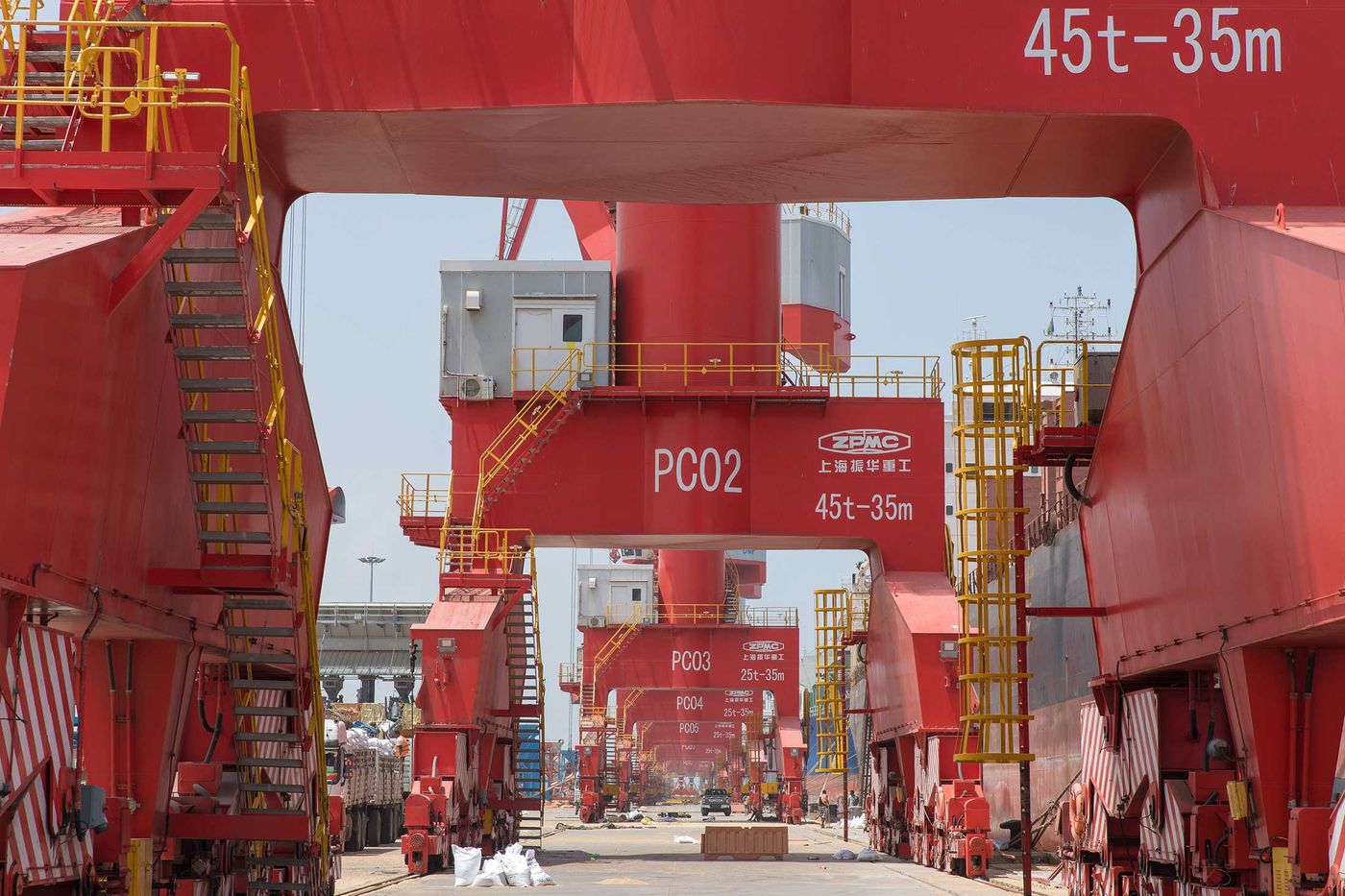
The Doraleh Multi-Purpose Port. (Sarah Waiswa for Bloomberg Markets)
Djibouti officials have repeatedly assured foreign governments, particularly the United States, that it, not China or a Chinese company, controls the Doraleh terminal. Despite these assurances, U.S. officials continue to express concern that at some point, China will gain full control of the terminal. In 2018, USAFRICOM Commander Marine General Thomas Waldhauser testified to Congressof the significant consequences that a Chinese takeover of the port would have on U.S. forces in Africa, including resupplying Camp Lemonnier and refueling U.S. Navy ships. Like Waldhauser, current AFRICOM Commander U.S. Army General Stephen Townsend has stressed the threat China createsto U.S. military objectives in the region, noting the likelihood that China will open additional bases on the continent following its naval base in Djibouti.
Controlling ports is central to this threat. As Judd Devermont, Director of the Africa Program at the Center for Security and International Studies, notes, “Chinese port ownership or operation pose immediate risks to U.S. interests, potentially allowing China to extract intelligence, block the U.S. government from accessing territory or services, and use ports to dock military vessels.” In addition to ports in Tanzania, Kenya, and Djibouti, China Merchants is also a key investor in the West African ports of Lomé, Togo and Lagos, Nigeria.
Further, there are several instances where Chinese naval deployments and strengthened bilateral military agreements quickly followed the completion of port construction projects, including Djibouti and Namibia (Walvis Bay) in Africa, as well as Pakistan (Gwadar), Sri Lanka (Hambantota), and Greece (Piraeus). And as Chinese investment in maritime projects has increased along Africa’s Indian Ocean coast, so too has the People Liberation Army (PLA) Navy’s military posture and force projection.
In Tanzania, China has already built a sprawling training facility for the Tanzanian armed forces, completing a $30 million training centerfor the Tanzanian People’s Defence Force in February 2018. President Magufuli and the Chinese Ambassador to Tanzania attended the opening of the center, which was built in part by the PLA.
Debt Trap Diplomacy?
U.S. officials from across the political spectrum have criticized Chinese aid and investment practices in Africa. Former Secretary of State Hilary Clinton warned that China is embarking on“new colonialism” in Africa, while former Secretary of State Rex Tillerson focused on what he termed China’s “predatory loan practices.” Former National Security Advisor John Bolton echoed Tillerson’s perspective when he unveiled the Trump administration’s Africa strategylast December, where he accused Chinese officials of using bribes, opaque agreements, and strategic debt to achieve political and economic objectives.
Although Chinese officials and companies certainly have a freer hand in some regards, analysts also note that Chinese companies have succeeded by building relationships and giving African business opportunities greater priority than their U.S. counterparts. Further, a considerable amount of research, such as the work completed by the China-Africa Research Initiative at Johns Hopkins, suggests that the debt-trap diplomacy criticism of the Belt and Road Initiative is often misunderstood.
At the very least, the “debt trap” argument is overly simplistic and overlooks the amount of African debt that China has forgiven, as well as its willingness to renegotiate lending terms. High debt levels within African countries raises significant concerns, but it is worth noting that African countries are likely more indebted to Western countries than to China and that poor governance by African leaders, not usurious lending terms, usually leads to negative economic results on the continent. In this sense, many regional analysts believe that African countries can benefit from the Belt and Road Initiative provided their leaders exercise prudent decisionmaking and press Chinese companies for more favorable lending terms and infrastructure projects that will drive local and national economic growth, and not just Chinese interests.
All Politics Is (Still) Local
The dispute over the Bagamoyo port project may not be the best example for extrapolating trends due to the inconsistencies of President Magufuli, who has irked European and African companies, along with Chinese investors. However, for all the criticism that Magufuli received for the lawsuit against Acacia Gold, under his leadership Tanzania still won a $300 million settlement, secured increased royalties, and earned a greater stake in three of the company’s gold mining projects.
In a more fundamental sense, the Bagamoyo port dispute demonstrates the primacy of African politics. As alluring as massive infrastructure projects are to African leaders, recent practice and underwhelming results that do not meet expectations suggests that they will be more cautious to agree to these projects unless they can demonstrate economic gains for their constituents. Perhaps above all, it reaffirms the difficulty in managing the risk and the opportunity that Chinese investment brings. And on this point, and putting aside an otherwise odious approach to governance, African leaders could do worse than follow the example of the Bulldozer by demanding greater transparency in negotiations and more return for their investment as they balance the need to improve infrastructure crucial to trade and economic development while also maintaining control of strategic assets such as ports.
John Hursh is Director of Research at the Stockton Center for International Law and Editor-in-Chief of International Law Studies at the U.S. Naval War College. Previously, he was a Policy Analyst for the Enough Project, where he focused on East Africa and Sudan. The thoughts and opinions expressed are those of the author and not necessarily those of the U.S. government, the U.S. Department of the Navy, or the U.S. Naval War College.
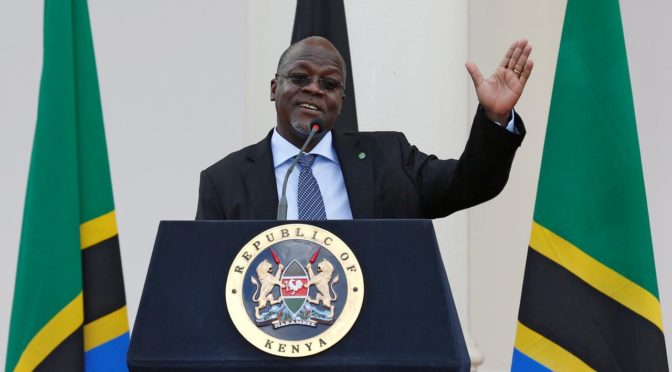
Featured Image:Tanzania’s President John Magufuli addresses a news conference during his official visit to Nairobi, Kenya October 31, 2016. (Reuters/Thomas Mukoya)
The M/T MAXIMUS and the M/T ANUKET AMBER are vessels that have tested the cooperative architecture for maritime security in West and Central Africa. The MAXIMUS is considered a great success story, and the ANUKET AMBER was at least a partial success. Though each involved a different type of maritime crime, a common element between them is that they helped highlight key areas where further effort is needed to achieve the goal of collective and comprehensive maritime security in Atlantic Africa. It is vitally important to celebrate the successes that have occurred in recent years, and there are quite a few. But even in reviewing success stories there is room for teasing out lessons in how to improve. When viewed as a pair of cases, these two distinct matters help point toward how West and Central Africa can proceed to enhance maritime security in the years to come.
The Case of the M/T MAXIMUS
Relative to other piracy cases in the Gulf of Guinea, a lot has been written about the hijacking and successful recovery of the MAXIMUS. One reason for the attention is that, perhaps more than any other incident, this one demonstrated the value of the cooperative architecture set forth in the 2013 Code of Conduct Concerning the Repression of Piracy, Armed Robbery Against Ships, and Illicit Maritime Activity in West and Central Africa (Yaoundé Code of Conduct). In February 2016, the MAXIMUS was overrun by pirates about 60 nautical miles off the coast of Côte d’Ivoire. The maritime law enforcement agencies of Côte d’Ivoire, Ghana, Togo, Benin, Nigeria and São Tomé and Príncipe all cooperated in tracking the vessel across their respective Exclusive Economic Zones (EEZs). Ultimately, the Nigerian Navy performed an opposed boarding, killed one pirate, captured the remainder and freed both the hostages and the vessel. At the time, the incident was heralded as the “coming of age” of navies in the region.
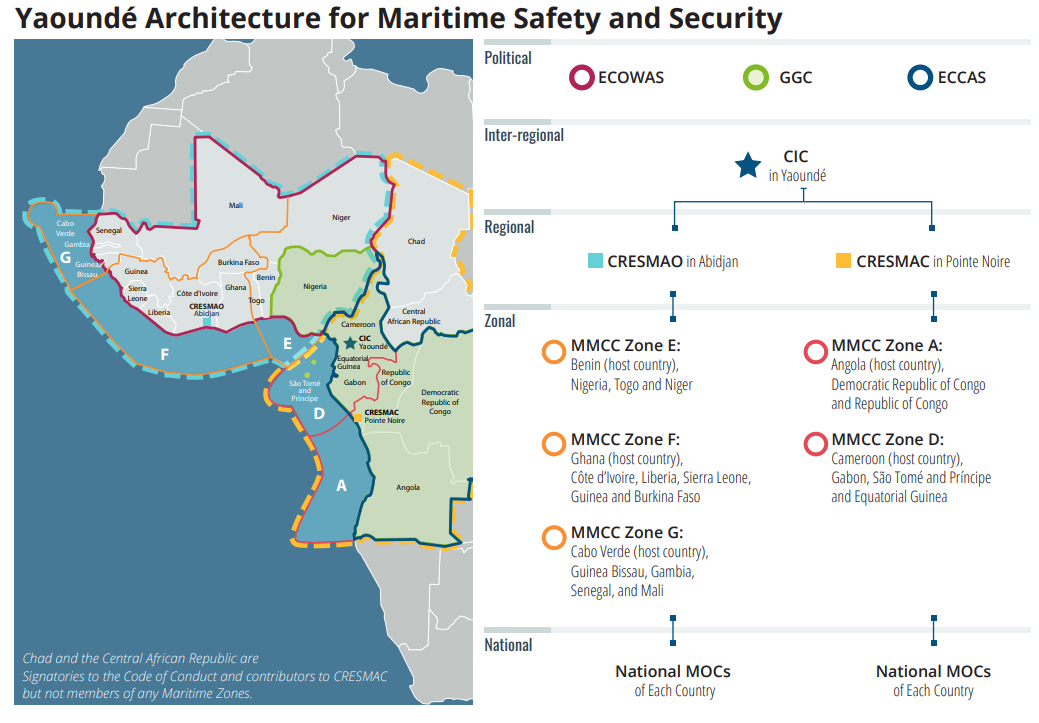
While nothing can detract from the success of the MAXIMUS case, there are some key issues that the incident revealed, several of which remain unaddressed. Perhaps the most prominent is the ongoing challenge of closing the seams between regions. The ultimate interdiction of the MAXIMUS occurred on the fault line between the Economic Community of Western African States (ECOWAS) and the Economic Community of Central African States (ECCAS), and thus on the line between the West African Maritime Security Center (CRESMAO, though not manned until 1 September of that year) and the Central African Maritime Security Center (CRESMAC), as well as between Maritime Zones E and D.
Complicating matters further, the Joint Development Zone between Nigeria and São Tomé, created by treaty in 2003, creates an overlap between those regions and zones. Theoretically, the cooperative mandate of the Yaoundé Code should resolve any tensions arising out of incidents that cross zones and regions, but the practical realities imply challenging issues of command and control. If crossing from Zone E to Zone D, should the chain be from the Nigerian maritime operations center (MOC) to the Zone E Maritime Multinational coordination center (MMCC), to CRESMAO to the Interregional Coordination Center (CIC), to CRESMAC, to the Zone D MMCC, to Cameroon or São Tomé’s MOC?
Zones within the Yaoundé architecture and the associated command and control relationships (Julie Tucker of I.R. Consilium, printed with permission) [Click to expand]This is a highly inefficient and ineffective approach, requiring steps be taken to ensure that the Yaoundé architecture is not breaking down some barriers to cooperation only to create new ones. While matters of trust between neighboring states can mitigate in favor of a more regionally or zonally oriented system of command and control, such a structure must be considered carefully in order to prevent it from becoming a burdensome mechanism that actually hinders the ability to respond in real-time to undesirable events on the ocean.
Additionally, the story of the MAXIMUS is often told as an operational success, despite, in many regards, being a legal failure. When the Nigerian Navy hailed the MAXIMUS, renamed by the pirates the M/T ELVIS 5, the pirates actually challenged the Nigerian officers, claiming they were in international waters and that the Nigerians had no legal authority to act. That baseless legal argument nevertheless slowed the Nigerians’ advance, as it caused them to take several hours to question their legal authority. Furthermore, since the case concluded, debates have continued as to why Nigerian vessels could interdict a pirated vessel in another country’s EEZ.
The legal confidence to recognize that piracy, as a matter of international law, is a crime of universal jurisdiction has been compromised by the painfully slow process of updating national legislation to even outlaw piracy. While the MAXIMUS is one of the region’s most famous piracy cases, it is not a piracy case in the court. Rather, the responsible individuals have been tried for such crimes as conspiracy, firearms violations, and mishandling of petroleum resources. While the long-awaited piracy bill in Nigeria – to outlaw the crime under national law – was finally signed by President Buhari in July 2019, it has yet to be implemented. Work has proceeded since February 2016 to build both Nigeria’s and the wider region’s legal capacity, but more work is needed.
These lessons regarding closing the seams between cooperative mechanisms and enhancing the legal wherewithal of maritime law enforcement agencies were more recently reinforced by the case of the M/T ANUKET AMBER.
The Case of the M/T ANUKET AMBER
There are actually two separate incidents involving the ANUKET AMBER tanker that occurred in the autumn of 2018 – the first has been publicized, but the second has not. On 29 October, while engaged in a ship-to-ship (STS) bunkering operation with an LNG tanker off the Republic of Congo, both the ANUKET AMBER and the ARC TZE, the vessel to which she was coupled, were pirated. In one of the only incidents of double piracy the region has seen, it took several months for the hostages to be released. In the meantime, the ANUKET AMBER itself was abandoned and recovered in Togo’s waters at the beginning of November.
The second incident, however, is the one that bears greater attention. On 17 December the Maritime Multinational Coordination Center (MMCC) for ECOWAS Zone F alerted the states of Ghana and Côte d’Ivoire that the ANUKET AMBER was engaging in systematic STS transfers in the previously disputed area of the EEZ between the two countries. On 18 December, one of the vessels with which it had rendezvoused, the MSC MARIA, actually entered the port of San Pedro in Côte d’Ivoire, where Ivorian authorities detained it. At the same time, Ghanaian and Ivorian naval operators agreed that they needed to arrest the ANUKET AMBER. While operational cooperation existed in so far as there was a good relationship between the two navies, the potential political backlash of crossing the, until recently, disputed maritime boundary rendered them hesitant.
Through activating a network of relationships with international partners and the United States government, coordinated in part by CRESMAO, both countries were able to get the political top cover needed to go and arrest the vessel. On 21 December, both navies sent vessels in pursuit of the ANUKET AMBER. Ghana’s vessel arrived first and brought her back to Tema. If the matter had ended there, this would have been a great success story in regard to the relationships of trust that have been built in the region in recent years. While Ghana later claimed that they fined the ANUKET AMBER for failure to notify them as the coastal state, they did not find the legal means to hold the vessel, and let her go on 23 December without notifying the Ivorians. That, in turn, destroyed the Ivorians’ case against the MSC MARIA, which was then let go as well.
While there are many things to celebrate about this incident – from the interaction and coordination among CRESMAO, the Zone F MMCC, and both countries involved to the immediate ability of both navies to talk with each other and reach out to international partners – this matter ultimately brought out three key issues. First was the lack of an operational memorandum of understanding (MOU) within Zone F to allow for the seamless invocation of hot pursuit, not so much as a legal matter, but as one with political implications for the two countries involved. In other words, there needed to be a standing order for them to be able to exercise the legal right of hot pursuit without fear of political backlash. Second was the lack of legal expertise to be able to at least investigate potential charges for the vessels involved. The final issue was the lack of communication between the states after the operation. While they had coordinated getting the vessels, there was no interaction when the decision was made to release the ANUKET AMBER. This suggests a need for stronger cooperative mechanisms between states during the legal finish phase of an operation.
Learning from Success
In both of these cases, the greatest success may not have been what happened on the water, but what happened in response to the shortcomings identified. On the one hand, the capacity and capability of a number of navies have improved since February 2016, suggesting the MAXIMUS case might have been resolved faster if it had happened now. Additionally, increased focus on legal understanding has improved the resilience of the navies, and new laws, like Nigeria’s long-anticipated piracy bill, serve as key tools in the fight against maritime crime. Furthermore, some of the inter-regional operational concerns that threatened the success of the MAXIMUS interdiction have been resolved. More work is likely needed to ensure smooth command and control and seamless cooperation, but there has been significant improvement in recent years.
The deficiencies recognized in the ANUKET AMBER case, however, were addressed even more swiftly and aggressively. Even during the incident, notes were being taken as to what needed to be improved. In early 2019, Côte d’Ivoire held a national debriefing on the matter and, recognizing the need for stronger laws, began work on improving its legislation regarding STS transfers.
Thereafter a multilateral debriefing involving all the parties – Ghana, Côte d’Ivoire, MMCC Zone F and CRESMAO – on 25 February 2019 identified the key takeaways from the experience. First and foremost was developing an operational MOU for MMCC Zone F to avoid encountering some of the same operational challenges as the states had in December. The speed with which this was addressed – exactly five months after that meeting – is a tremendous credit to the drive of the states involved as well as to the leadership of both the MMCC Zone F and CRESMAO. The MOU was largely drafted in March 2019 and subsequently signed on 25 July.
Lessons on the Horizon
In the spirit of continual improvement, it is worth noting that these structures of security cooperation under the Yaoundé Architecture are going to be challenged time and time again. Notwithstanding the spike in piracy in and around Nigeria, there are plenty of other transnational maritime threats that will likely help to both validate and further refine the architecture. For example, fishing vessels registered in one state that are fishing in the EEZ of a nearby state and then dragging nets on the way home across a third state, or complex networks of offshore transshipments, are the sorts of scenarios that are not yet fully capturing the attention of maritime law enforcement agencies but will likely become a key test of the cooperative mechanisms in the months and years to come. That said, the prompt response of the region to incorporate lessons learned provides cause for optimism that the Yaoundé Architecture will be able to adapt to threats as it matures. While learning from failure is often a necessity, these cases involved learning from what were otherwise important successes, and that is truly something to celebrate.
Dr. Ian Ralby is a recognized expert in maritime law and security and serves as CEO of I.R. Consilium, a family business with leading expertise in maritime and resource security. He is also a Maritime Crime Expert for UNODC’s Global Maritime Crime Program and a Senior Fellow at the Atlantic Council. He previously spent four years as Adjunct Professor of Maritime Law and Security at the United States Department of Defense’s Africa Center for Strategic Studies.
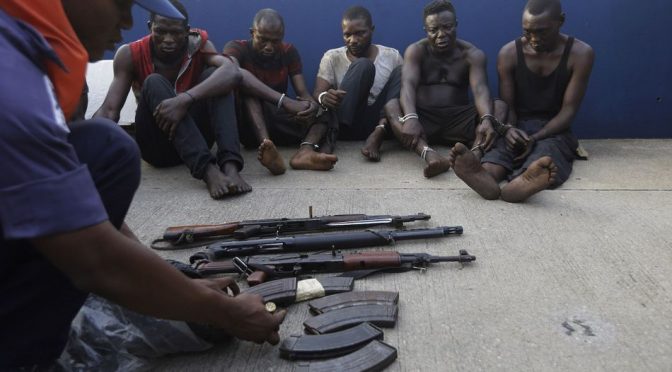
Featured Image: Arrested pirates who hijacked the MT Maximus last month. (Sunday Alamba/AP)