
Category Archives: Future Tech

What is coming down the pipe in naval and maritime technology?

Disrupt the Info Dominance Corps Reserve

110203-N-5328N-140The U.S. Navy’s Information Dominance Corps (IDC) is comprised of four major communities: Information Professional, Information Warfare (including Cyber Warfare Engineers), Intelligence, and Meteorology/Oceanography. Its enlisted members are some of the most well trained members of the military. There have been some efforts made to grow the active duty community into a mature force since its inception in 2009, and as a Naval community it collectively has the greatest understanding of using social media and the internet-although that may be damning with faint praise.

IDC’s reserve component is more interesting. Unencumbered by active duty career paths, the reserve IDC has members with a phenomenal amount of knowledge about network administration, network security, coding, software development, and a lot more areas of expertise that are often missing in our active component.

The reserve IDC should be a lab for innovation and a tremendous opportunity to bring true experts in the industry in for targeted part-time work and help that could keep the Navy at the leading edge of network dominance. Unfortunately, we’ve handcuffed them with bureaucratic nonsense that is sure to drum out the best and leave us with the rest.

I spoke to LTjg Kevin Schmidt last week for the CNO’s Rapid Innovation Cell podcast, and I was both excited and disappointed to hear how the Navy handles this group of experts. Excited because we’re hiring some amazingly talented people in the reserve, disappointed because their drilling weekends comprise of death by powerpoint.

My interviewee is a subject matter expert in Simple Network Management Protocol (SNMP), a network protocol. He’s expert enough to have written a book on it (two if you count the 2nd edition update). He’s had officers with PhD’s in his drilling unit. This is a cadre with deep skills and talents we don’t normally see in the military.

Naturally, we’re feeding them the same admin garbage we feed our 18-year-old new-accession Sailors.

Let me ask the reader this: should we ensure this 37-year-old O-2 gets through his annually required general military training (GMT) on his drilling weekends, or should we be flying him somewhere and giving him the opportunity to put his talents to productive use for the Navy?

Yes, it’s a loaded question. And yet, the IDC is shackled by the same checks in the box required by every community of our military.

Would an expert want to serve our country by applying specialized skills to battlefield situations, or by completing an administrative checklist comprised by somebody who’s forgotten what the point of the military is? Is it any wonder we’re going to lose the best and brightest professionals in the field? It’s time to drop the one size fits all requirements.

Take a look, for a moment, at the CNO’s Sailing Directions. Please click through (pdf alert) and look them over. Warfighting first-it’s a motto a lot of Sailors love, because it’s why a lot of us joined. He also speaks of a force “diverse in experience, background and ideas.” Are we setting up our reserve to be diverse, or simply a mirror (and therefore shadow) of our current active force?

The difficulty happens because military training has historically been specialized in a way that civilian training could not offer. In some communities, this is still the case: an airline pilot’s time spent on a 737 is only going to go so far in training him to fly an F/A-18. The concepts are similar, but the details are very different.

In the internet realm, however, there is a much greater blur between the two areas. As we continue the move into asymmetric warfighting, often against small groups or lone actors, the military will continue to look at the civilian sector for security certifications such as Security +, CISSP and CCNA. An officer can join the IDC reserve and already know more as an ensign than many active lieutenant commanders.

It’s not a knock on active duty folks, but a recognition that specialized training has its place-and the day to day life of a Sailor does not allow for much specialized training. Allowing our reservists to fill that gap would be a tremendous opportunity.

Also, two days a month, two weeks a year may not be the appropriate amount of time for a reservist to work through a project. Are we allowing for flexibility in days/hours served? Would you commission Elon Musk as a Commander if he were willing to work only five days a year? I would-that would be an incredibly productive five days (#draftElon!). To say no to him would be lunacy! How about Gary Vaynerchuk? If you don’t know that name, you’re extremely late to the party on social media and branding-two very important aspects to growing a top notch community of experts. And yet, we insist the system in place should remain in place…because we’re either too lazy, too overworked or too unimaginative to consider an alternative.

If anybody can make the IDC do insanely awesome things, it's #draftElon
If anybody can make the IDC do insanely awesome things, it’s #draftElon

The Information Dominance Corps reserve component could be just as attractive a place to work as Google, Apple or Tesla Motors. And it should be-as its brand grows, the talent attracted to it can only grow and become more competitive. This would be a huge win for the taxpayers.

We don’t need cyber officers who can drive a ship-we’ve got plenty of those already. We need cyber officers who can think outside the box and share their wealth of talent with Uncle Sam…at a deep discount to the usual consulting fees-which generally go to the well connected.

The IDC reserve component has the capability to be an innovation and consultation powerhouse at a fraction of the cost of traditional military contracts, saving the Pentagon hundreds of millions. Maybe that’s why this idea will never happen.

This article appeared in its original form at disruptivethinkers.org

ET1(SW) Jeff Anderson is the host of the CNO’s Rapid Innovation Cell Podcast and military lead for Disruptive Thinkers San Diego. He also daylights as an Electronics Technician onboard USS Independence (LCS-2). 
Iran Claims to Have Reverse-Engineered Amazon Drone

International Maritime Satire Week Warning: The following is a piece of fiction intended to elicit insight through the use of satire and written by those who do not make a living being funny – so it’s not serious and very well might not be funny. See the rest of our IntMarSatWeek offerings here

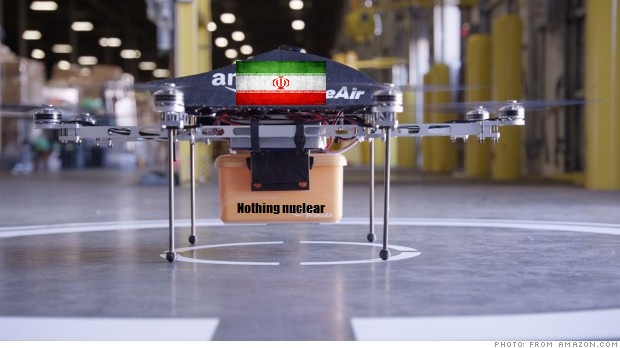
TEHRAN – Iran’s state TV aired footage Wednesday of what it described as a working copy of an Amazon Prime quadrotor helicopter drone that it says it captured while flying over Iranian territorial waters. Iran first claimed in March, 2013, to have brought down the drone that it says was engaged in illegally violating user-privacy agreements.

While Amazon’s Central Delivery Command refuses to confirm or comment on whether Iran is in possession of one of its drones, sources say a drone was lost during an Amazon Prime Obstacle Clearance exercise early last year. “The model matches what went missing, but we’d be truly surprised if the Iranians had the capabilities by themselves to force down and recover the drown in a state that allowed them to reverse engineer a copy,” said a senior Amazon Prime officer.

A still from Iranian state television of a purportedly reverse-engineered Amazon drone

Several independent analysts speculated on the possible involvement of Evil-Bey, or E-Bey, a Turkish front company known for facilitating Iran’s evasion of oil sanctions. E-Bey is considered by many to have the know-how and a large stockpile of cash necessary to pull of such a technical feat. Observers based in the Caucuses reported recently spotting E-Bey drones of a similar design flying oil barrels to refineries in southern Russia. 

Jean Carthwright, a logistics drone expert at the Institute for the Study of Gizmos, pointed to further circumstantial evidence. “At the time Amazon lost contact with its quadrotor it was attempting to delivery a DVD of the second season of BBC’s Sherlock to crew aboard the ASS Express, one of Amazon’s intel-collection ships,” said Carthwright. “In April, a review posted to Amazon’s website by A. Khameni denounced the season as ‘insufficiently respectful to Allah and uneven, particularly in the Hounds of Bakersfield episode – Sherlock is just too petulant at times. But what a cliff-hanger! God willing Season 3 will respect the audiences’ intelligences with a plausible solution to Sherlock’s faked demise. Death to America!'”  


The opinions and views expressed in this post are his alone and are presented in his personal capacity. They do not necessarily represent the views of U.S. Department of Defense or the U.S. Navy.


Sea Control 18 – Naval Corvettes

seacontrolemblem

Chuck Hill joins Matt to talk about design, use, and possibilities of naval corvettes, reflecting on the articles from 2013’s Corvette week. From definitions, to potential employment, to interdiction operations during Vietnam… this podcast runs the gamut. Please enjoy, Sea Control Episode 18: Naval Corvettes (download).

Remember to tell a friend, and subscribe on Itunes and Stitcher Stream Radio.

Innovation Files: eCART – Correspondence Tracker

Within the U.S. Navy, routing up correspondence seems fairly straightforward, but in the execution there always seems to be issues that make it anything but.   In some commands, dozens of pieces of correspondence are routed per day, and in even the best commands, an occasional piece of correspondence tends to either get lost or misplaced.  Conversely, if leaders aren’t accountable, correspondence may be held onto for longer than standard policy, contributing to a negative climate.  Either way, it seems like locating correspondence is always a hot topic.  One thing I’ve noticed, when managing an administrative department at sea, is that most of the e-mails, questions, and drop-ins we received were related to the tracking of correspondence.

There is no standard issued software to administer the routing of correspondence at sea, so we decided to create one with support from other members of the administrative department and the CMC.  The software, called eCART (Electronic Correspondence and Routing Tracker), is used to track all correspondence that goes up through the ship’s office to the XO and/or CO.
eCART_1
Correspondence is still placed in a traditional folder with a routing slip, however, leaders now input the correspondence name into the eCART program for tracking.  When it’s hand carried to the next person that it’s going up to, the user clicks a button in eCART to mark it as being “routed” to that next position in the chop chain.  The program then automatically sends them an e-mail informing them they now have custody of that certain piece of correspondence.  For ease of use, the e-mail contains a link that takes them to the eCART program, where they themselves can continue routing the correspondence up the chain.

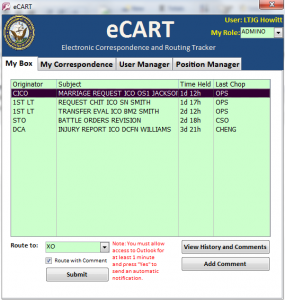
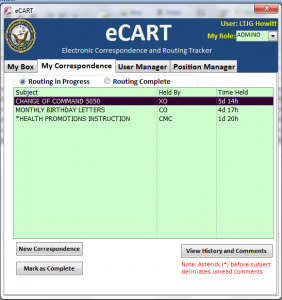
When a user is routing up correspondence via eCART, they can add comments electronically.  These comments, as well as the full chain of custody with dates and times, are seen both up and down the chop chain to increase transparency in the process.  When there are new comments to be read, there will be an asterisk preceding the subject that alerts the user.  The interface is very straightforward and is broken into two tabs – “My box” and “My Correspondence”.
eCART_2
“My box” displays all the pieces of correspondence that the user’s position has custody of.  “My Correspondence” displays all the originating correspondence from that user whose routing is still in progress or marked as completed/returned.  For personnel that wear more than one hat, they could switch back and forth between their positions in the program by selecting their role in a drop-down box (ie: OPS may be the Safety Officer, and STRIKE may be the Legal-O).  This allows any number of authorized users (even a whole office) to control one box and all receive e-mail notifications.  It also allows another authorized user to fill into a position as “acting”.  Thus, the routing process can still function when someone goes on leave or TAD.  Since having several users control a box could create a problem with accountability, the program always logs the specific person that takes any action.

eCART_3
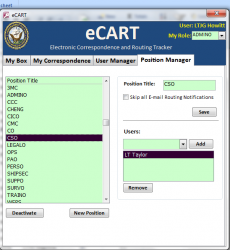
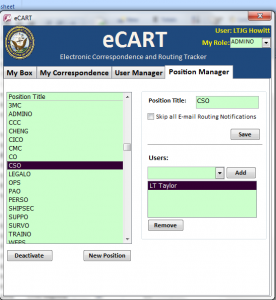
Included is a complete administrator interface, which allows designated managers to add, modify, and deactivate users and positions.  There is also an option that allows the user to skip all e-mail routing notifications, which may be useful for VIP positions like the XO and CO that receive many pieces of correspondence.   However, for the XO and CO, who may not want to be bothered to use the program themselves, it is more likely for designated authorized users, such as members of the ship’s office, to go in and record a change every time correspondence is transferred in or out of their boxes.

The program is built entirely on Microsoft Access.  One Access file (acting as the database) is put onto a hidden directory on the ship’s shared drive or exchange server.  A second Access file containing the user interface on top of 850 lines of VBA scripting acts as the client and is also put on the shared drive or exchange server as read-only and distributed to users.  The client calls and communicates with the Access database on the network, which allows it to serve as a de facto software and database package, supporting up to 50 users accessing it simultaneously.  The database file can easily be saved, backed up, and even transferred between LANs by simply compressing it into a zip file.  The program calls and interacts with Outlook e-mail through an appropriate reference, and automatically detects the Windows’ user and alias information, so it automatically logs in the appropriate user when opening the program.

eCART is a finished product that can be deployed at any command, but is specifically intended for commands at-sea.  Initially, it may be hard for all leaders in a command to adopt this new process, but with proper training, and even the implementation of policies such as one that rejects any correspondence not logged in eCART, it can easily become second nature.

Zachary Howitt is a proud American, Naval Officer, and Tech Entrepreneur. He is a designated operations analysis subspecialist and has served in two warships forward-deployed to Yokosuka, Japan. His opinions and views expressed in this post are his alone and are presented in his personal capacity. They do not necessarily represent the views of U.S. Department of Defense, the U.S. Navy, or any command.