Category Archives: Current Operations

On-going Naval Ops or Maritime Current Events

Has an Unsolved Mystery Almost (But Not Quite) Been Solved?

Alleged U.S. Navy Involvement in the 1973 Chile Coup

Costa-Gavras' film "Missing" portrayed the execution of Charles Horman and Frank Teruggi
Costa-Gavras’ film “Missing” portrayed the execution of Charles Horman and Frank Teruggi

An old mystery has come back into the limelight following the recent revelation that a retired U.S. Navy officer, accused of being complicit in the murder of two U.S. citizens in the immediate aftermath of Augusto Pinochet’s 1973 coup in Chile, had died in Chile months ago, ironically at the same time as Chilean authorities were seeking his extradition from the U.S.

Retired Captain Ray Davis had been the Commander of the U.S. Military Group in Chile at the time of the coup.  He “was thought to be living in Florida and Chile’s Supreme Court had approved his extradition request last October,” however, he apparently had actually been living in Santiago until his death in April.

Davis had long been accused of being  involved in the execution of Americans Charles Horman and Frank Teruggi by the forces of Pinochet’s junta.  The story of Horman’s death and the quest of his wife and father for justice was chronicled first in a book by Thomas Hauser and the 1982 film Missing, directed by Greek filmaker Costa-Gavras and starring Jack Lemmon.  The film implies that Horman and Teruggi had stumbled onto a substantial U.S. military presence in Chile on the eve of and during the revolt, with a fictional portrayal of a Davis-like character as the main American who stood by while they were killed by Chilean authorities, presumably because they knew too much about U.S. involvement in the coup.

Horman’s wife claims that during a ride that Davis had given to Horman in the days after the coup, Davis determined Horman possessed information that “would have risked derailing the recognition of Chile’s junta by the US government,” transforming him “from an American citizen who was entitled to protection, to a vulnerable and disposable threat to powerful forces.”

The Chilean judge seeking Davis’ extradition claimed that Horman had been identified as a “subversive” by “U.S. agents,” directly leading to his execution.  John Dinges, whose book The Condor Years detailed how Chile organized South American-wide repression in the 1970s, argues that it was likely that the U.S. did not just “tacitly tolerate” Horman’s killing, but rather that Ray Davis “produced the information that led to his death and when Chileans consulted about it, he decided not to oppose it.”  Davis’ supporters and family members have claimed instead that he was simply “a liaison between the U.S. and Chilean militaries” who had nothing to hide.

The National Security Archive has collected several declassified documents related to the Horman/Teruggi murders.  In possibly the most damning piece of correspondence, State Department officials in 1976 admitted that there was “some circumstantial evidence to suggest” that

“U.S. intelligence may have played an unfortunate part in Horman’s death.  At best, it was limited to providing or confirming information that helped motivate his murder by the GOC.  At worst, U.S. intelligence was aware the GOC saw Horman in a rather serious light and U.S. officials did nothing to discourage the logical outcome of GOC paranoia.”

Perhaps the most bizarre twist to this story is that while authorities in Chile were attempting to bring Davis back there in order to face trial after his 2011 indictment, he was apparently “right under their noses all along, living in a nursing home in an upscale part of the Chilean capital.”  The U.S. embassy there claims that they “were unaware that Mr. Davis was living in Santiago until early this past May, when they were informed of his death a few days before.”  No press reports about Davis’ death so far have identified why he was living in Chile while simultaneously trying to avoid trial there.  Horman’s wife is asking for proof of Davis’ death, not yet convinced that the Ray Davis who died in Chile earlier this year was the one she believes caused the death of her husband.

Lieutenant Commander Mark Munson is a Naval Intelligence officer currently serving on the OPNAV staff. He has previously served at Naval Special Warfare Group FOUR, the Office of Naval Intelligence, and onboard USS ESSEX (LHD 2).  The views expressed are solely those of the author and do not reflect the official viewpoints or policies of the Department of Defense or the US Government.
Catch and Release

Teknik Perdana
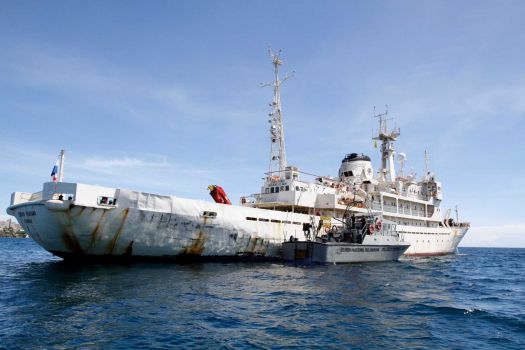
          Not as tasty as it sounds: At anchor off Margarita Island.

On Thursday Venezuelan officers boarded the U.S.-operated, Malaysia-owned survey vessel Teknik Perdana for “carrying out illegal activities.” The Venezuelan navy escorted the vessel into port on Margarita Island, where the ship and crew were told they would remain detained pending an investigation. The ship ran afoul of a dispute between Venezuela it’s smaller neighbor Guyana over waters off the coast of an area known as Esequiba. According to the BBC, Venezuela has claimed the Esequiba region (and about 2/3rds of the whole of Guyana) since Guyana was a British colony in the 19th Century. UNCLOS, the United Nations Convention on the Law of the Sea, to which the U.S. is not a signatory but follows due to its force as accepted customary law, formalizes Exclusive Economic Zones (EEZs) that regulates most economic activity, typically drawn out 200nm from the coastal baseline of a nation’s territory, as well as the rights to resources further out in the continental shelf’s seabed. Thus as far as the law is usually* concerned, who owns the land owns the sea, and therefore much of the interest over otherwise marginal islands elsewhere. Fortunately for the owners and crew of the Teknik Perdana, Venezuela released vessel on Tuesday.

If this story has a happy ending it is that Venezuela and Guyana said in August that they would seek help from the UN to solve their squabble, and this incident may act as further impetus. This doesn’t mean claimants always abide by the rulings (see neighboring Colombia’s reaction over its dispute with Nicaragua), but they at least tend to keep things peaceful.

*History can also play a large role.

LT Scott Cheney-Peters is a surface warfare officer in the U.S. Navy Reserve and the former editor of Surface Warfare magazine. He is the founding director of the Center for International Maritime Security and holds a master’s degree in National Security and Strategic Studies from the U.S. Naval War College.

The opinions and views expressed in this post are his alone and are presented in his personal capacity. They do not necessarily represent the views of U.S. Department of Defense or the U.S. Navy. 

East Africa: A Historical Lack of Navies

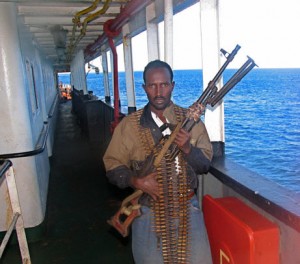
PiratesChances are that, for all except the most wonky observers and those stationed at Camp Lemonnier in Djibouti, the issue of African naval affairs only came into popular consciousness alongside media-saturating images of Somali pirates menacing international freighters with rocket-propelled grenade launches from their little fishing dhows. To anyone who’s spent time in any Somali regions, there’s more than a little irony in this renewed interest, as up until the conception of Somali naval responses and responsibilities to the dangers in their sovereign waters conjured one into existence, the Horn of Africa proper had no navy to speak of.

The lack of naval forces in the Somali regions pre-piracy could easily be explained away by the anarchy into which Somalia descended in the late 1980s. But it’s actually more complicated than all that, since even after independence, while Djibouti and Ethiopia-then-Eritrea developed formidable naval forces to police the waters of the Red Sea, despite the size of its population and its massive coastline, post-colonial Somalia at its height boasted a navy of only about 20 ships, almost entirely small Soviet vessels put on patrol duties to police the waters against illegal fishing.

And even in the aftermath of the Civil War of the late ‘80s and early ‘90s, despite the development of regional pockets of stability like Somaliland and Puntland, new navies, even patrols in dinghies, did not develop. That’d be less surprising if securing borders, establishing monopolies of violence, and creating formidable land forces to insulate the regions from the ravages befalling the rest of Somalia hadn’t been central to the rhetoric of Somaliland and Puntland for fifteen and ten years (respectively) before the advent of mass piracy.

It’d actually be fair to say (and here’s the meat of the irony) that the lack of a navy was directly complicit in the emergence of the piracy that’s refocused the world and local de facto governments onto naval affairs as an anti-piracy remedy. The absence of even a tiny naval presence on the Horn removed the last barrier to now-well-documented illegal fishing and waste dumping in coastal waters. In conversations with locals in coastal towns and with some individuals who seem to have credible ties to piracy themselves, it’s become clear that one of the major draws into piracy for many is the justification of a national vigilantism, in which despairing fishermen are told that they have the opportunity to harass foreign powers violating their sovereign waters, drive out the individuals who are degrading the viability of the traditional livelihoods, and make a fat stack of cash in the process. Those associated with piracy say that even when this self-justification quickly loses its validity as civilian and merchant ships are targeted, the economic needs of shattered communities and sense of hopelessness and insecurity along the coast drives people to continue their activities.

It’s hard to imagine that the development of Somali navies (the plural will be explained momentarily) will lessen this sense of insecurity, as the timing of their emergence and their provenance can send a conflicting message on the priorities of the state. Although the navy is popular with the clans in power in port cities like Bosaso and Berbera, the fact that maritime troops developed only in response to the demands and through the financial initiative of foreign powers can give off the sense that the navy exists primarily as a service provided for and to limited segments of society, and not necessarily to the bulk of the populations that rely on the sea for a livelihood. Reports that Somali navies encountering illegal fishers from Yemen have released the offenders so as not to damage relations between the two countries are feeding this image of a “national” army more focused on international pressures than on duties to all residents of the Somali state(s).

That holds true throughout “Somalia” despite the fact that multiple navies have developed piecemeal across the various de facto independent entities that make up Somalia on the map. The first force formed in 2009 in Somaliland, based in the port of Berbera and stocked with speed boats and radios by the British. This force consists of 600 men split across 12 bases (usually little more than a tent on the coast near a village) patrolling 530 miles of coastline and operating on (at most) $200,000 per year. Soon after, the government of Puntland started a partnership with the Saracen International and later received funding from the United Arab Emirates to train a 500-man force patrolling an even greater 1,000 miles of coastline. Mogadishu has made forays into the development of a navy as well, but the status of any such projects is opaque, as Puntland (which considers itself an autonomous federal state of the Somali government based in Baidoa/Mogadishu) is often lumped into considerations of military developments in Somalia as a whole.

While it would be fair to say that there is some difference between the Somaliland and Puntland forces, with Puntland engaging in more raids on what Somalis describe as “pirate bases” and Somaliland leading more constant patrols to deter activities within range of the ports and shipping lanes, it is fair to say that all Somali naval forces derive their deterrent capabilities and effectiveness at capturing pirates on a budget primarily from local intelligence gather. Behind every reported attack on a pirate base or capture of a pirate boat (although it is always highly questionable whether the “pirates” captured were actually just quasi-legal or illegal fishermen) is a tip-off from a local, making use of the exceptional telecoms coverage and penetration and low call rates in Somalia, notifying officials of strange boats plying the town’s waters.

More ships, more money, more men is the current cry and hue from officials in Somaliland and Puntland. But the lessons of the Somali navies thus far have been that the effectiveness of Somali naval forces derives not from manpower and equipment (as creating a sufficient naval force to cover Somalia’s massive coastline is impractical for the nation at present) but from intelligence gathering and the cascading effects of the economic benefits of re-securing of sovereign waters and subsequent decline in the justifications for and incentives to join in piracy. Thus the future of naval affairs in Somalia practically lies primarily in the development of local outreach along the coast, systematic and reliable reporting mechanisms, the disruption of lines of communication between those who plan and commission pirate strikes and those individuals on the coast who carry them out, and the investment of national resources in redeveloping fisheries and port resources in coastal towns. Perhaps that solution’s none to exciting to the officers in the Somali navies or to the wonks watching them, but it’s an efficient solution for a region with limited resources and an almost limitless coast—which may explain why it bares such a potential similarity to the barebones but sufficient naval forces and strategy of the post-colonial, pre-collapse Somali navy.”

Mark E. Hay is a sometimes-freelance writer, sometimes-blogger, and sometimes-graduate student at the University of Oxford. Academically, he focuses upon the history and theory of Islam in the Indian Ocean world. Outside of the academy, he writes more broadly about anything under the big tent of culture, faith, identity politics, and sexuality—basically anything human beings will fight over.

Balanced Public/Private Effort for West African Maritime Security

By Emil Maine and Charlotte Florance

Shifting Hot Spots

Over the past decade piracy off the coast of Somalia dominated the focus of international maritime security efforts. Recently, however, the frequency of pirate attacks in the region has dropped off—reaching their lowest point since 2006 according to the International Maritime Bureau (IMB)’s global piracy report. Although attacks continue, no large commercial vessel has been seized in the region since 2012. Meanwhile piracy in the Gulf of Guinea is surging, threatening a vital shipping lifeline for a dozen countries and targeting vessels that carry nearly 30% of all U.S. oil imports. Given the Gulf of Guinea’s strategic value, it is little surprise that concerns over the region’s growing insecurity has quickly overshadowed international interest in piracy elsewhere.

International anxieties over piracy stem from: (1) national security implications, (2) structural threat to international trade, and (3) threat to local and regional stability.

West African Militants

Apples and Oranges

Despite parallels to Somali piracy, attacks in the Gulf of Guinea take place within a different operational and political context. Piracy counter-measures are not one-size fits all. Understanding these differences is critical when exploring policy prescriptions.

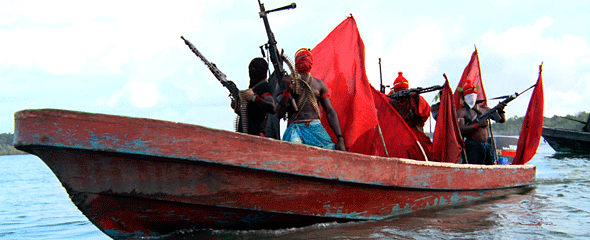
Pirate attacks originating off Somalia tend to be strategic, and involve seizing ships in passage and holding their crews for high ransom. In contrast, West Africans pirates primarily focus on stealing cargo and siphoning oil. This behavioral divergence allows West African pirates to operate in the littoral, making them less vulnerable to the navy-heavy strategy credited with stemming the tide of piracy in Somalia.

Pirates in West Africa are able to take advantage of a well-established illicit political economy.  They enjoy access to pre-existing international criminal networks and close ties to the shipping industries. These benefits, accompanied by lax maritime security in the area, create an ideal environment for piracy.

Many studies note four broad factors led to piracy reductions in Somalia, and recommend the same approach in West Africa. According to a July 2013 Chatham House report, the factors are:

  1. The presence of international naval patrols in the Gulf of Aden and the Indian Ocean, with the remit to disrupt and deter pirate activity.
  2. The implementation of best management practices (BMP) by the majority of commercial ship-owners with vessels passing through the high-risk area of the Indian Ocean.
  3. The presence of private armed security personnel aboard commercial ships.
  4. Regional capacity-building, particularly international support for improvements to the legal systems and prison capacities in east and southern Africa’s littoral states, allowing for increased prosecution and imprisonment of convicted pirates.

After all, these measures led to extraordinary reductions in attempted or actual hijackings in the Horn of Africa. However, distinct differences in West African political, legal, and criminal structure present new challenges that will require an adaptive approach to implementation.

Changing the Channel

In Somalia, piracy sprung from anarchy; in West Africa, it resulted from intentional efforts to expand criminal operations. Consequently, attacks are better coordinated, executed with precision, and oftentimes impossible to trace. West Africa contains several sophisticated criminal organizations with deep international ties. These networks provide pirates access to extensive intelligence–including ship schedules, cargo, and crew capability–and allows for the storage and black-market sales of pirated goods. Additionally, due to drug sales and trafficking, criminal networks wield financial leverage with local governments and militaries—undermining the rule of law. For example, earlier this year the Royal United Services Institute (RUSI) reported that:

“In early April, Rear-Admiral Jose Americo Bubo Na Tchuto, a former Chief of the Guinea-Bissau navy was caught in a Drug Enforcement Agency (DEA) sting on board a yacht in international waters in the Atlantic. According to prosecutors, he planned to bring 3.5 tonnes of Colombian cocaine to the African country inside a shipment of military uniforms and then smuggle weapons, including surface-to-air missiles, back to Colombia’s FARC rebels.”

Rear-Admiral Tchuto was not the only example of criminal ties to West African governments. The RUSI report also notes trafficking-related charges brought against a Malian police commissioner, the former caretaker-president of Guinea Bissau, and other high-level officials.

There are certainly benefits to maritime security efforts, including the presence of private armed security personnel aboard ship, increased international naval patrols, and the implementation of BMP. These efforts are likely to reduce hijackings and attacks, and should be employed. However, in the long term effectively safeguarding maritime traffic requires a balanced public/private effort with the use of force limited to protecting commerce and maintaining freedom of the seas. Also required is an effective strategy to resolve West Africa’s troubles and establish and bolster the rule of law.

Emil Maine is a National Security Research Assistant at the Heritage Foundation, where he conducts independent research on U.S. defense posture. The views and opinions expressed in this article are his own.

Charlotte Florance is a research associate at Heritage Foundation.  She studies U.S. policy toward Africa and the Middle East, concentrating on economic freedom, democratic institutions, development and security cooperation. The views and opinions expressed in this article are her own.