The world is increasingly urban and littoral. This convergence between urbanization and the littoral, or littoralization, can lead to “the worst of both worlds” and may remake the littorals into hotspots of instability and conflict. At the same time, the U.S. Marine Corps is shifting its focus away from decades of counterinsurgency and irregular warfare in the Middle East. In 2017, the Marine Corps published a new operating concept focused on the littorals called Littoral Operations in a Contested Environment (LOCE). LOCE emphasized “fighting for and gaining sea control, to include employing sea-based and land-based Marine Corps capabilities to support the sea control fight,” but at the same time cautioned that “major combat operations (MCO) and campaigns versus peer competitors are beyond the scope of this concept.” A more recent and still not publicly released operating concept, Expeditionary Advanced Base Operations (EABO), expanded on LOCE to cover major combat operations and campaigns against a peer competitor – most likely China.
EABO and a growing focus on great power competition promises to be the future of the Marine Corps and is the basis for the new Commandant’s Force Design 2030effort. The Commandant of the Marine Corps has asserted that the Corps is “the preeminent littoral warfare and expeditionary warfare service.” And littorals are unquestioningly where the Marine Corps is most needed and can be the most effective. But this pivot to the littoral does not necessarily mean the Marine Corps can leave irregular warfare and lower-intensity conflicts behind. History and current trends make clear the global littorals are a haven of irregular warfare, and always have been for millennia.
In a recent interview the Marine Commandant expressed his view that a force optimized for major combat operations against a highly capable adversary can easily adapt to operate effectively across the range of military operations:
“We’re building a force that, in terms of capability, is matched up against a high-end capability. The premise is that if you do that, if you build that kind of a force, then you can use that force anywhere in the world, in any scenario; you can adapt it.”
He cautioned, “But the inverse is not true.” The Commandant is correct, a well-trained and highly capable force can adapt to new threats. But the question is how long does that take? The U.S. experience in Iraq and Afghanistan shows that adapting to a low-end fight can take years, including changes to strategy, acquiring the right equipment, and writing and training to the relevant doctrine. Clearly the Marine Corps needs to prioritize and adapt to meet the challenges posed by China, a highly capable competitor and potential adversary. However, as the Marine Corps looks beyond the irregular threats of the Middle East, it cannot afford to abandon those hard-won lessons. Irregular warfare and asymmetric threats can and likely will follow the Marine Corps to the littorals. In many cases, they are already there.
Irregular Warfare in the Littorals
The threat of non-state actors and irregular warfare in the littorals is not new. Even the rebellious 13 American colonies leveraged maritime irregular warfare to support their bid for independence, employing a mix of littoral raiding forces and state-sponsored privateers to target British shipping at sea and in their home waters. Criminal and entrepreneurial activity has deep roots at sea with a long history of pirates taking vessels and raiding lucrative targets ashore. This type of amphibious raiding has taken place in nearly every global littoral region at some time or other. Some of the earliest recorded history is accounts of “the Sea Peoples”attacking the Egyptian kingdom of Ramesses II in the Bronze Age. In 793 AD, Vikings from Scandinavia raided the monastery at Lindisfarne, kicking off the Viking Age. Piracy was rampant in the colonial Caribbean, both by pirates operating independently and by privateers, which were pirates operating as proxies with the official sanction of European kingdoms to raid vessels and settlements.
Today pirates continue to operate. They concentrate their operations in the littorals and near international chokepoints such as the Gulf of Guinea and the Bab al-Mandeb Strait, often taking advantage of the seams between different law enforcement regimes ashore and offshore. Pirates operating from bases in Somalia became famous after they hijacked the Maersk Alabama, and where the subsequent rescue operation by the U.S. Navy SEALs was made into the blockbuster Captain Phillips.
But pirates are now more prevalent elsewhere, especially in the Asian littoral. A plurality of total piracy now occurs in the Straits of Malacca and near Singapore. The Bay of Bengal is another piracy hotspot. The threat of piracy has also fueled the rise of a dark economy of mercenaries for hire that live and work in the littorals on commercial ships and floating armories, a potential spark for even more instability.
Effective counterpiracy efforts require a naval force supplemented with the capability to conduct visit, board, search, and seizure (VBSS) operations as well as operations against pirate bases ashore. It requires a force comfortable operating on land, at sea, and in the spaces in between. It is exactly the type of operations that Marines need to be prepared for as they shift their focus to the littorals.
Mines
Mines have long been a critical weapon in irregular warfare, whether military-grade or improvised. Sea mines – especially when deployed in maritime straits or chokepoints – are highly effective weapons and are inexpensive. During the Korean War, mines were deployed to block the approach to Wonsan Harbor by rolling them off the back of local fishing boats. Despite this crude method of employment, they were effective in sinking multiple U.S. warships. Sea mines have also notably accounted for 14 of the 18 U.S. warshipsdamaged or sunk by hostile action since the end of the Second World War and “over the last 125 years mines have damaged or sunk more ships than all other weapon systems combined.” They were responsible for damaging three U.S. warships during the Tanker War in the Persian Gulf despite American awareness of the mine threat.
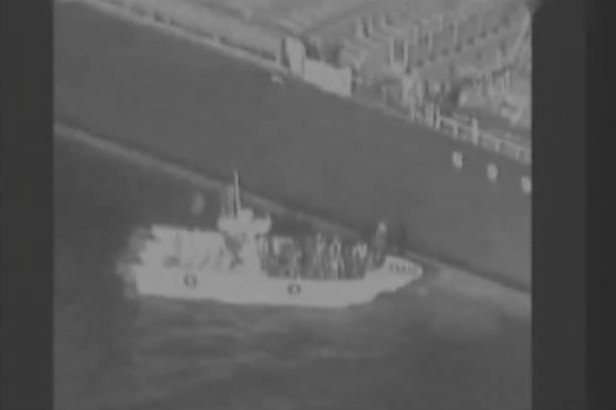
An image taken from video released by United States Central Command in June 2019 shows a smaller boat near what appears to be the vessel Kokuka Courageous, in the Gulf of Oman. The military said the video shows the crew of an Iranian Gashti Class patrol boat removing an unexploded limpet mine from the tanker’s hull. (Photo Via U.S. Central Command)
Sea mines are yet another threat to the security of U.S. and allied vessels in the littorals that the Marine Corps may find itself dealing with. In his 2019 Planning Guidance, the Commandant of the Marine Corps mused whether or not it would be “prudent to absorb” some traditionally naval functions like mine countermeasures. It is even easier to imagine Marines being charged with raiding networks engaged in the manufacture and employment of sea mines, much like how they operated against insurgent bombmakers in Iraq and Afghanistan.
Improvised Explosive Attacks
Improvised anti-ship weapons are also a threat to U.S. and allied naval vessels and merchant shipping. In the 1990s, the Tamil Sea Tigers, the naval arm of an insurgent group in Sri Lanka, made a staple out of vehicle-borne improvised explosive device (VBIED) attacks at sea. They attacked dozens of international vessels in the waters around Sri Lanka with a range of tactics. Not even warships are immune to this type of attack. In 2000, Al-Qaeda attacked the USS Cole in a suicide attack with a speedboat packed with explosives, killing 17 sailors. Captain Wayne Hughes (ret.) had also argued that ships in port are increasingly vulnerable to attack.
Ships and maritime infrastructure itself can even be repurposed as a weapon. While there is no evidence that the recent explosion in Beirut was intentional, it revealed a critical vulnerability in port security. In his 2006 novel, The Afghan, Frederick Forsyth imagined a crew of terrorists seizing a liquid natural gas (LNG) tanker to use as a massive suicide bomb. Used in such a way, a hijacked LNG tanker would have explosive power similar to a small nuclear warhead. But an oil tanker or even a stationary drilling platform could still unleash an environmental and economic catastrophe if it was damaged or sunk. The 1989 Exxon Valdez oil spill released nearly 11 million barrels of oil and ultimately affected over a thousand miles of coastline. The disaster cost Exxon nearly $7 billion. Recent reports of dozens of full and stationary oil tankers anchored off the U.S. coastpresent a significant economic and environmental vulnerability to any group willing to take advantage of it. Today, acrippled tanker full of crude rides at anchor off the coast of rebel-controlled Yemen where it is a potential target and ecological disaster waiting to happen.
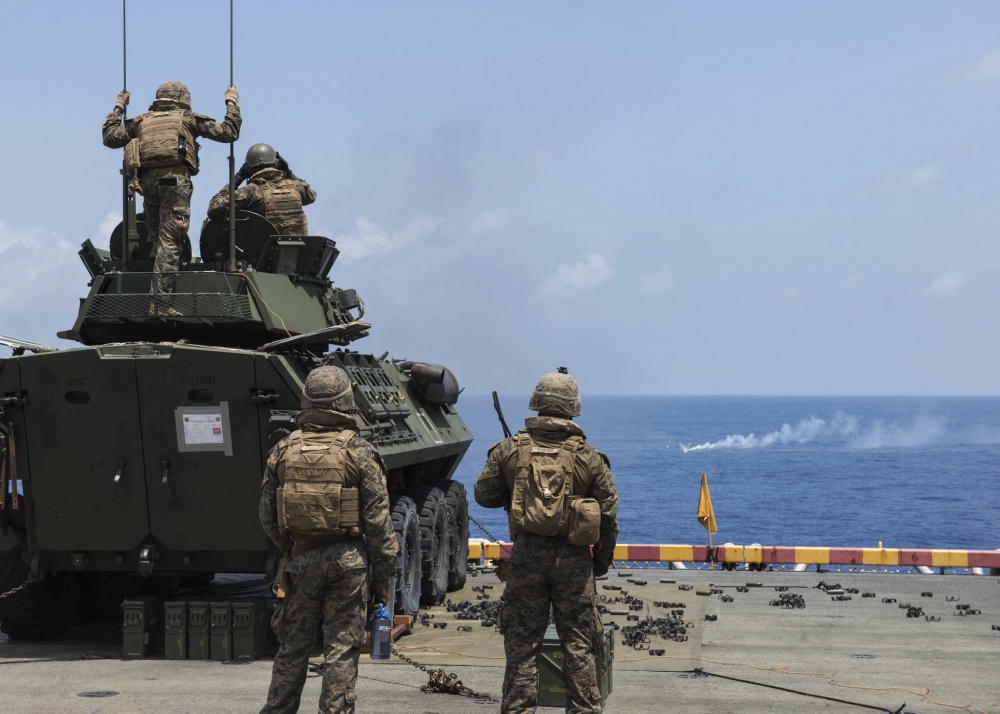
Marines have already helped to protect U.S. warships from VBIEDs by strapping light-armored vehicles with 25 millimeter cannons to the deck of the USS Boxer, an amphibious assault ship. This innovative yet extremely inefficient point defense solution may foreshadow how Marines may be forced to apply high-end capabilities like light armored reconnaissance assets to address irregular maritime threats. Marines may soon find themselves required to habitually defend fixed installations and ships at sea against attack with makeshift solutions.
SOUTH CHINA SEA (Sept. 27, 2018) – Marines, assigned to the 31st Marine Expeditionary Unit (MEU), fire a Light Armored Vehicle’s M242 Bushmaster 25 mm chain gun at a target during a Defense of the Amphibious Task Force (DATF) drill aboard the amphibious assault ship USS Wasp (LHD 1). (U.S. Navy photo by Mass Communication Specialist 3rd Class Sean Galbreath)
Semi-submersible vessels, often dubbed “narco submarines,” have become a key means of transporting cocaine out of South America for drug cartels and pose a persistent problem for drug enforcement agencies. Most of the narcosubs leave from the Pacific coast of Colombia or Ecuador and are bound for Mexico, where their cargoes will often be transshipped to the U.S. overland. These vessels are often built deep in the jungle and once at sea can be incredibly difficult to locate. Analysts estimate that as much as 80 percent of Colombia’s cocaine leaves the country by sea. Fully submersible vessels have been found with dimensions up to 100-feet long and capable of carrying nine tons of cocaine from Colombia to Mexico in a single trip. Started in Colombia, the trend has now globalized and narco-submarines are now being used to infiltrate Europe. It should not be a surprise in the future if these improvised, but increasingly sophisticated and capable vessels are eventually used to smuggle terrorists, weapons, or explosives, or are employed as vehicle-borne improvised explosive devices.
Conclusion
It is clear the littorals will continue to provide opportunities for terrorists and non-state actors to threaten the United States and its allies. Yet the post-9/11 fight against terrorism and other security initiatives have largely ignored the maritime space. A recent report by Stable Seasfound that while “Global powers have spent billions over the last few decades in the fight against [violent non-state actors]…[they] have mostly overlooked their activities in the maritime domain” and argues that an effective approach to maritime security has to integrate onshore and offshore operations – an ideal role for the U.S. Marine Corps.
Simple yet effective weapons and tactics will continue to be a threat, and these groups may also acquire more advanced weaponry like the anti-ship missiles that have been employed by the Houthis and Hezbollah.Technological innovation and proliferation will allow land-based groups to continue threatening high-value targets at sea like cruise ships, tankers, offshore platforms, and naval vessels and especially in key straits, maritime chokepoints, and ports. At the same time, low-tech and improvised threats will remain, like narco-submarines and explosive-laden speedboats. Capt. Hughes argued in Fleet Tactics: “Often the second best weapon performs better because the enemy, at great cost in offensive effectiveness, takes extraordinary measures to survive the best weapon.”
As the Navy and Marine Corps increasingly focus on the threat from high-end weapons like Chinese supersonic anti-ship missiles and the DF-26 “Carrier Killer” ballistic missilethey cannot forget about the low-end threats and “second best weapons.” The Marine Corps’ own concept for using small units, distributed among key maritime terrain to hold ocean-going targets at risk, is proof that non-state actors and rogue states may be able to do the same and achieve outsized effects because of the unique vulnerabilities and tactical geography presented by the littorals.
The Marine Corps needs to be fully cognizant of not just the potential for high-end, major combat operations in the littorals, but also of the irregular threats it may be called to address at any time. The Marine Corps needs to make sure that as it shifts its focus to major combat operations against a peer or near-peer adversary it maintains the capability to counter irregular and asymmetric threats against U.S. interests and allied in the littorals.
Walker D. Mills is a Marine Corps infantry officer currently serving as an exchange instructor at the Colombian naval academy in Cartagena.
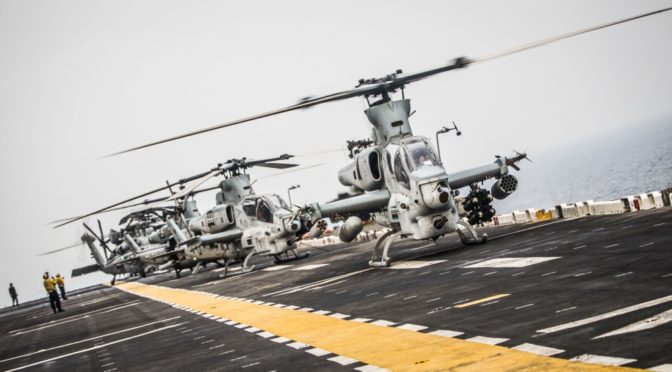
Featured Image: STRAIT OF HORMUZ (Aug. 12, 2019) An AH-1Z Viper attached to Marine Medium Tiltrotor Squadron (VMM) 163 (Reinforced), 11th Marine Expeditionary Unit (MEU) prepares for take-off during a strait transit aboard the amphibious assault ship USS Boxer (LHD 4). (U.S. Marine Corps photo by Lance Cpl. Dalton S. Swanbeck/Released)
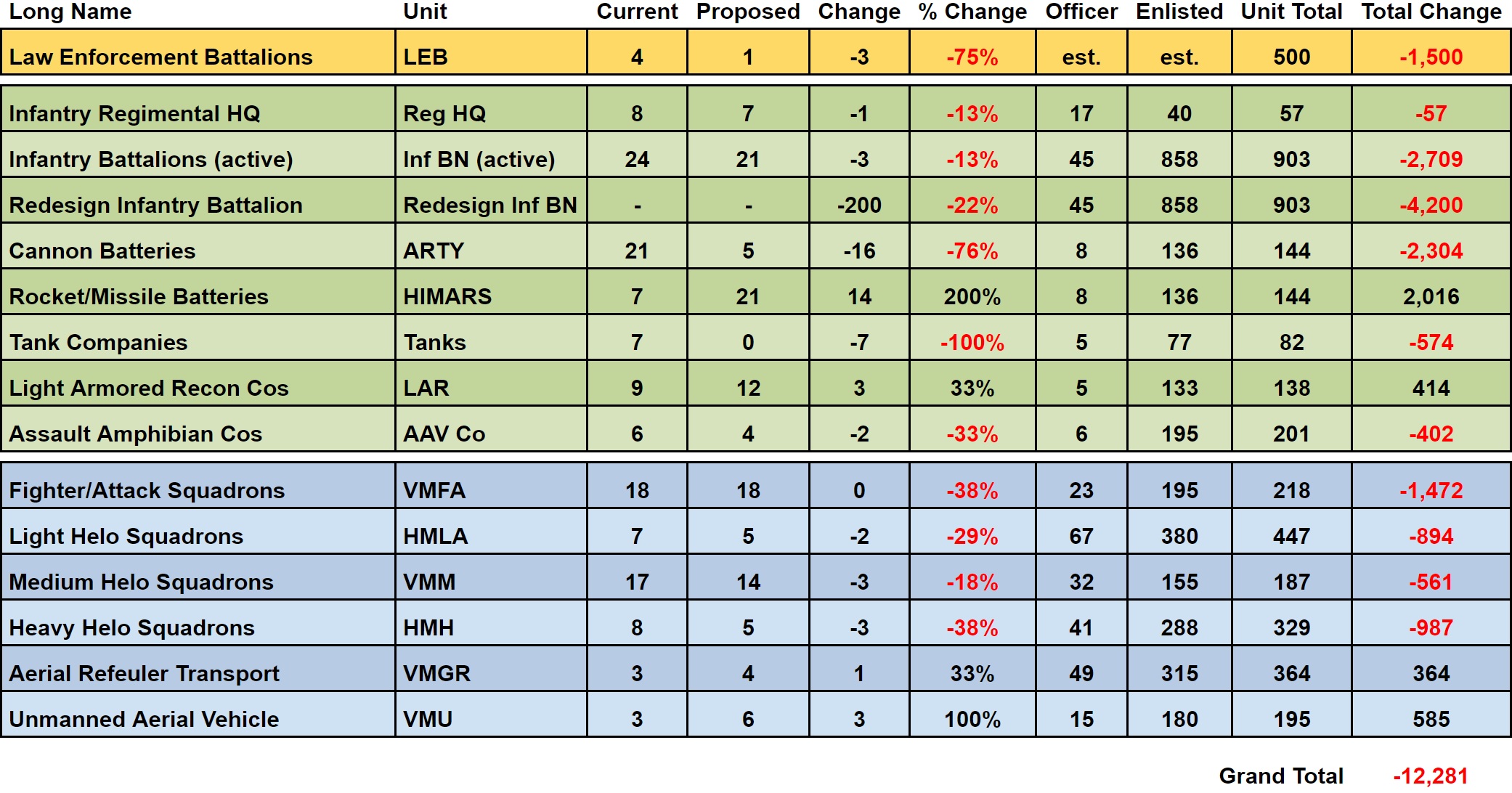
The Commandant of the Marine Corps (CMC), General David H. Berger has recently updated his guidance with “Force Design 2030.” The plan calls for major changes, including a reduction of 12,000 active-duty Marines, significant reductions in manned aviation, and a suggested reallocation of $12 billion (presumably over 10 years) to implement force design changes. The impetus behind Force Design 2030 is the 2018 National Defense Strategy, which states “new concepts of warfare and competition that span the entire spectrum of conflict require a Joint Force structure to match this reality.” Figure 1 below shows the CMC’s planned reduction in force levels.
Figure 1: Suggested personnel change from Force Design 2030 update, figures from MCRP 5-12. VMFA personnel reductions are the author’s estimate, based on a reduction of 16 to 10 aircraft per squadron. (Author’s graphic)
Col. T. X. Hammes(USMC, ret.) and LtCol. Frank Hoffman (USMC, ret.) offer different versions of this chart, but their analysis is incomplete without arriving at the reduction of 12,000 Marines that CMC suggests. The proposed changes remove about 30 percent of infantry billets, but there appears to have been an absence of analysis to this divestment because the number was not well-known or understood. Hoffman states: “Ultimately, this is not a radical shift of force capabilities or capacity.” Limiting some F-35 squadrons to 10 aircraft (in transitioning from F/A-18 squadrons with 16 aircraft) was baked in already, but the numbers also suggest divesting roughly 22 percent of all Marine manned aviation. Dropping a quarter of Marine infantry and manned aviation capability is a radical shift. As CMC states in his planning guidance, “Significant change is required to ensure we are aligned with the 2018 National Defense Strategy (NDS).” A reduction of 12,000 Marines may underestimate the total force structure changes since we do not yet know what changes come with new Marine Littoral Regiments other additions such as “coastal/riverine forces, naval construction forces, and mine countermeasure forces.”
General Berger had a goodhead start thinking about NDS requirements before becoming Commandant.CMC’s ascension is reminiscent of another service chief who entered the job with a head start for effecting significant change, Admiral Elmo R. Zumwalt. Admiral Zumwalt anticipated severe criticism from Congress, from other services, and even from within the Navy for the changes he planned to make. The new CNO’s Navy redesign, Project Sixty, started with rapid, yet deliberate analysis. Zumwalt briefed that analysis to the Secretary of Defense only 72 days after taking over as CNO, and to all Navy flag officers and Marine generals a week later.
When Zumwalt stepped into the job as the youngest CNO ever, major decisions were made in the shadow of Admiral Hyman Rickover, father of the nuclear Navy. Rickover had been on active duty since before Zumwalt was born, had personal influence in the Navy, the Senate, and the Atomic Energy Commission, and would serve for eight more years after Zumwalt retired. While General Berger has no modern equivalent of Admiral Rickover to scrutinize his every move, unfortunately, the mechanisms for change within the Department of Defense churn more slowly than they did for Admiral Zumwalt and Force Design 2030.
There are three ways that Marines can help the Commandant reduce the inevitable friction associated with changing the Marine Corps to match emerging operational realities: creativity, concepts, and communications.
Creativity
The Commandant needs our help in developing creative solutions to the shortfalls in the analysis and existing capability gaps. From the outset he has asked for input, stating in his Commandant’s Planning Guidance (CPG): “I expect Marines to be prepared to provide their leaders – me included – with critical feedback, ideas, and perspective.” There are multipleonlineforums where Marines have developed serious feedback for the Commandant. Additionally, the Marine Corps Gazette established a Call to Actionsection dedicated to Force Design 2030. However, these articles and the discussion forums tend to focus on strategy, concepts, and other commentary instead of the more specific actionable recommendations the Commandant needs. Still, some actionable items already exist within these forums. Some focus on the exact gaps that the Commandant has listed, such as how to absorb new expeditionary capabilities, how to fight in a degraded command and control environment, and field affordable and plentifulcapabilities for the future amphibious portion of the fleet.
But to properly harness this creative feedback, the Marine Corps needs an official forum to capture, review, board, and take action on this input. The Commandant needs a forum where – after rigorous analysis and appropriate staffing – short, single-issue position papers can reach him and his staff directly. Force Design 2030 lists 12 Integrated Planning Teams (IPTs) established to assess changes in the future force. But General Berger is still unconvinced that these IPTs are meeting the need for output. Single issue position papers from the force can help the IPTs focus on the most relevant issues in these gaps: logistics, infantry battalion reorganization, ARG/MEU redesign, and light armored reconnaissance analysis. These papers should include recommended solutions in terms of the design leverssuggested in Force Design 2030. Standing and future IPTs should be able to consolidate the best submissions, conduct a meta-study of the reviews, and determine which ideas deserve a formal approval board or the Commandant’s attention.
This idea is based on recent history. General Robert B. Neller, the previous Commandant, actively solicited such ideas through quarterly innovation challenges in FY18and FY19. An open forum would support a broad review process, which Marines and civilians would provide. Once a forum was established, General Berger could ensure rapid engagement by requiring Marines to submit papers as part of professional military education (PME) or training requirements. Past Commandants have taken somewhat similar actions, such as General James T. Conway when he required all Marines (twice) to read Lieutenant General Victor H. Krulak’s First to Fight. A more extreme precedent comes from the 1930s when Brigadier General James C. Breckinridge suspended some courses at what is now known as Marine Corps War College, “… so that staff and students could devote their full attention to developing …” new amphibious doctrine. Another recent example of soliciting such input comes from the founding of the Department of Defense’s Joint Artificial Intelligence Center in 2018. It took a year, but DoD also established an independent commission (four working groups and three special projects) to help the government determine requirements for AI. To help move the conversation forward, the commission’s co-chairs, former Deputy Secretary of Defense Robert Work and former Google and Alphabet CEO Eric Schmidt, immediately put out a call for articles.
These types of position papers could come from observations during exercises, from experiments, from wargames, and from detailed budgetary planning. Some of this input will need to be resubmitted or rediscovered. Input should come from analysts and operators, civilians and Marines, operations officers and chief warrant officers, and from students at all six schools under Marine Corps University. It should be objective, evidence-based, and brief; analysis not advocacy.
The Commandant needs our help in completing the new concepts called for in Force Design 2030. With the EABO concept as of yet unsigned and further specifics behind “Stand-in Forces” as of yet unwritten, a lot of analysis remains to validate future Marine Corps employment.
The concepts supporting Force Design 2030 must be complete before they can be explained to Congress in order to get budgeting approved. These concepts must be complete before we can explain USMC force integration to other services and component commanders. Most critically, the functional concepts must be complete before we can develop concepts of operation and employment for Marines to execute and train for. When Zumwalt redesigned the Navy, he had “the assistance of a number of commanders to do some of the spadework and research involved” to complete the concepts. The bar has been raised for modern concept development. To complete the concepts, first, we need a successful strategy built on an “independently verifiable analytic foundation.” Based on CMC’s recent comments about the results of recent wargames, and recent intervention by the Office of the Secretary of Defense in the Integrated Naval Force Structure Assessment, we are not there yet.
Above all, Marines writing official (and unofficial) concepts need to help the Commandant explain the numbers. The CPG makes note of only one weapon range: “We must possess the ability to turn maritime spaces into barriers…This goal requires ground-based [long range precision fires] LRPF with no less than 350NM ranges – with greater ranges desired.” When the CPG was published in July 2019, this would have been illegal, as the U.S. still adhered to the Intermediate-range Nuclear Forces (INF) Treaty. Two weeks later, the U.S. formally withdrew from the INF, and now for the first time in over 30 years, American long-range land-based cruise missiles are permitted. This one development alone has opening up a significant array of tactical and operational possibilities.
In order to aid the Commandant in maintaining momentum, we need to better understand, generate, and communicate emerging concepts, capabilities, and conditions.
Communicating
The Commandant needs our help in communicating Force Design 2030. He is already an able communicator – since the day he took the job, the Commandant has made frequent, public statements that Force Design 2030 is his top priority. On day one he published his planning guidance.In October 2019, he spoke at length with the Heritage Foundation at their signature annual lecture. In December, he shared his notesin War on the Rocks and chatted with the publication’s founder in the following April. In March 2020, the Commandant published his updateto Phase I and Phase II of Force Design 2030. In mid-May, he published the aforementioned update in the Marine Corps Gazette. CMC also appears to be taking pages out of Zumwalt’s playbook, laying out a list of items for immediate action.
But the Commandant can’t communicate every critical aspect of EABO and Stand-in Forces until the concepts are finished, and some of his latest communications still have room for improvement. His June Gazette article cites only one source, a regrettable quote from Alfred Thayer Mahan: “Much is written of courage in the fleet or in the field; but there is a courage of the closet that is no less praiseworthy and fully as rare, and this is the courage to do battle for a new or unpopular idea.” In yet another similarity to Zumwalt, CMC’s closet courage is indeed praiseworthy. In regard to contemporary strategy, however, invoking Mahan is problematic. Mahan advocated for large surface fleets, focusing on capital ships that would win decisive surface battles and establish persistent “control of the seas.” The construction of large fleets of capital ships is diametrically opposed to the principle of Distributed Maritime Operations (DMO), littoral operations in a contested environment (LOCE), and EABO. Mahan and his adherents focused on “War fleets, bases, concentration of force, and decisive battle.” Our modern concepts suggest that these old focal points are our new liabilities. Mahan’s strategies have been attributed by some historians as contributing directly to World War I and the rise of Europe and America as imperial powers during the period characterized by the Chinese as a century of humiliation (1839-1949).
In order to deter current Chinese military ambition, if there is one name that we should avoid repeating, it is Mahan. Admiral Stansfield Turner, who Zumwalt directed to “write a strategy for the Navy” for Project Sixty, would later deliberately contradict Mahan when he invoked the new term, “sea control” to “connote more realistic control in limited areas and for limited periods of time.” 50 years later, the concept of sea control continues to be “the essence of seapower and is a necessary ingredient in the successful accomplishment of all naval missions.” Our ability to deny adversaries access to the sea from expeditionary advance bases will also be of limited scope in time and space, rather than the more longstanding and unassailable command of the seas Mahan envisioned.
When CMC states that we require “an independently verifiable analytic foundation to our program” he means being able to explain and justify the foundation of our concepts to other services, the Pentagon bureaucracy, and Congress. When CMC explains the analytic foundations for his reasoning, such as when he lays out the results of 18-months of recent wargames, it is easier to build consensus and provide feedback. But when he does not discuss the experimentation and simulation taking place, it makes it much harder to understand the force design process, much less communicate the changes to external audiences.
The Commandant could have easily quoted Haddick, Hammes, or Hoffman(who worked on the 2018 NDS), who have laid the intellectualfoundation for Force Design 2030’s reasoning. Perhaps CMC was opting for simpler, more direct message appealing to all Marine audiences. But we need to offer a more in-depth explanation, if not the concept of employment, for asking Marines to live and operate within a peer adversary’s weapon engagement zone.
Early criticism, most of which has been highly constructive, is already incorporated into Force Design 2030. Col. Mark Cancian (USMCR, ret.) whose critique of the product already states that the Commandant’s insistence on building a “single purpose-built future force will be applied against other challenges across the globe,” is misplaced. Active-duty Marines have pointed out that the omission of “maneuver warfare” from Force Design 2030 invites criticism of the process or the Marine Corps’ understanding of its own warfighting principles. The most critical response to date has come from former Secretary of the Navy (and Senator) James Webb. Secretary Webb has a negative impression so far but especially took great exception to the choice of the introductory quote to Force Design 2030. “The giants of the past…were passed over, in favor of a quote from a professor at the Harvard Business School who never served. Many Marines, past and present, view this gesture as a symbolic putdown…” Given the rancor reflected in some remarks like Secretary Webb’s, we should not always expect the Commandant to dignify criticism with comment. However, we should be prepared to publicly address faircriticism that has a negative perspective on the current process.
CMC must be clearer in his communication going forward. The Force Design 2030 update states that the Marine Corps will conduct a “Divestment of Marine Wing Support Groups.” This single sentence could imply a reduction of 8,000 MWSG Marines – a divestment likely designed to create space for these undetermined additions. Or it could mean only the headquarters of these groups, a significantly smaller manpower offset. Right now, it is unclear.
CMC should communicate more about modernthreatenvironments by updating the professional reading list. The list should have many more article-length entries, readings that Marines can read in minutes, not days or weeks. Quarterly updates to the list may be more appropriate than annual changes to keep current and relevant subjects in Marines’ thoughts. The reading list should also be partiality populated by the very best of the previously suggested position papers, after IPT review and CMC approval. And some of these readings should be recommended with an eye toward the average Marine’s role in future fights. It is much more critical and accessible for most Marines to understand China’s and Russia’s operational capabilities and tactics than it is for them to internalize (or defend) broader organizational reforms.
Conclusion
Creativity is required to provide CMC with the input he has requested to complete the Marine Corps’ Force Design 2030. This creativity needs to be crowd-sourced throughout the Marine Corps, such as with a call for focused, single-issue position papers. The papers need to be published in a dedicated forum, where CMC’s IPTs can easily digest and analyze the merits of each. This will capitalize on current experiments, ongoing exercises, and the past 20 years of hard-earned Marine Corps operational experience. The concepts must be integrated with the Navy and built on an independently verifiable analytic foundation. While MCCDC and MCWL have the lead on concepts, their foundational work should be expandedby Marines and activities able to contribute to wargaming and analysis, or else the concepts are likely to resemble the “advocacy” that CMC has warned against and not be “independently verifiable.”
The message needs to be clearer. This includes setting the agenda to address expected political and budgetary opposition. This includes properly preparing Marines by educating them on ever more threatening operating environments and adversary capabilities. We should be thankful for the Commandant’s leadership on this and other issues. But it will take more than just a top-down approach to implement the change we need to become ready for the new operational environment. The Commandant needs our help.
LtCol Cannon is a reservist with the MAGTF Staff Training Program and as a contractor supports AI/Machine Learning (ML) projects sponsored by the Office of Naval Research. The content of this article does not necessarily reflect the position or policy of the U.S. government and no official endorsement should be inferred.
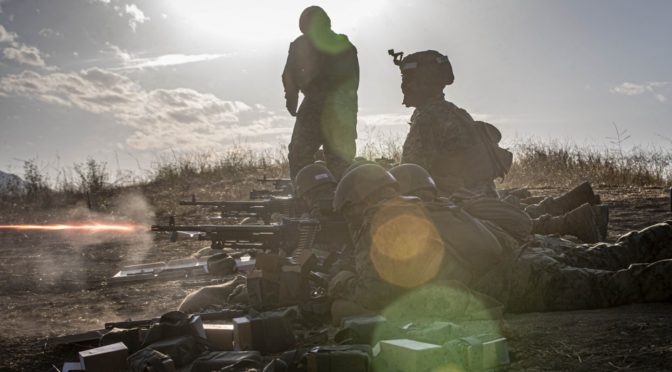
Featured Image: U.S. Marines with Kilo Company, Marine Combat Training Battalion, School of Infantry – West, fire M240 medium machine guns during live-fire training at Range 218A on Marine Corps Base Camp Pendleton, California, Aug. 18, 2020. (U.S. Marine Corps photo by Lance Cpl. Drake Nickels)
As the U.S. Navy moves into the unmanned age and implements Distributed Maritime Operations (DMO), there is a need for small, lightly manned warships to streamline that transition and fill roles which require a human crew. Congress has expressed concerns about unmanned vessels on a number of fronts and highlighted the need for a class of ships to bridge the gap. The Naval Postgraduate School’s Lightly Manned Autonomous Combat Capability program (LMACC) has designed a warship to meet this need.
The need for these small, heavily armed warships has also been well established, and is based on extensive analysis and wargaming across the Navy’s innovation centers. These ships will provide distributed forward forces capable of conducting surface warfare and striking missile sites from within the weapons engagement zone of a hostile A2/AD system. They will be commanded by human tactical experts and operate in packs with supporting unmanned vessels, like the Sea Hunter MDUSV, to distribute capabilities and minimize the impact of combat losses.
Our intent with this article is to publicly lay out the engineering dimension of the LMACC program. Since the United States does not have a small warship to use as a baseline, it is necessary to first establish what our requirements should be based on our unique needs. Fortunately, this can be accomplished in a relatively straightforward manner by broadly analyzing how foreign ships are designed to meet their nation’s needs, and using that understanding to establish our own requirements. As such, we will start by examining the choices faced by other nations, use that to develop a core of minimum requirements for an American warship, examine its shortcomings when compared with other budget options, and finally discuss how to affordably expand on that to deliver a capability set the Navy will be happy with. Once we have established our requirements and overall configuration, we will conclude with a discussion of our approach to automation, manning, concepts of operations, future special mission variants, and current status.
(The scope of this article has been deliberately limited to the engineering side of the LMACC program. Our acquisition approach will be discussed in an upcoming issue of the Naval Engineers Journal. Fleet and budget integration was discussed in a previous article on USNI blog, “Beyond High-Low: The Lethal and Affordable Three-Tier Fleet.”)
Examination of Foreign Designs
Due to our relative lack of practical domestic experience in the field of small warship development, we will start with an examination of foreign designs to build a transferable understanding of their capabilities, limitations, and design tradeoffs. Since there are many ship classes used worldwide, it is impractical to discuss every example individually. We will instead discuss mission areas and compromises in generic terms and leave it to the reader to consider how specific foreign designs were built to meet their nation’s needs. Areas of design interest include anti-ship missiles, survivability, anti-submarine warfare (ASW), and launch facilities. The first three subsections divide the discussion between large and small nations, while the final subsection is split by type of launch facility. Each subsection then concludes with a discussion of how this translates to the United States’ unique situation. This will then set us up for the subsequent discussion of the basic preliminary requirements for a generic small American warship.
Anti-Ship Missiles
Small warships are frequently given labels like “missile boat” or “corvette” based on their primary armament of anti-ship missiles with little further thought. However, not all missiles are created equal. The choice of missile is driven by the platform’s intended use.
Small nations (e.g. Norway) attempting to defend themselves on a limited budget typically prioritize lethality with a highly capable missile designed for sinking major warships. However, because they often face limitations in offboard sensors, strategic depth, and force structure to absorb combat losses, they tend to sacrifice range and networking capability to control missile cost and weight.
Large nations prioritizing coastal defense against a more powerful opponent (e.g. Russia and China’s A2/AD systems) tend to view their small warships as part of a larger system. These ships are intended as much to complicate enemy targeting and defensive formations as they are to sink ships. As a consequence of this, they are more likely to invest in range and networking since they can reasonably expect to take advantage of it, but may be willing to save money by arming these ships with less expensive, and therefore typically less lethal, weapons.
Due to the nature of the U.S. Navy’s highly networked, forward deployed forces, we cannot accept these compromises and must arm our small warships with highly lethal, long-range, networked weapons.
Survivability
A major concern with all warships is survivability. One of the key distinguishing features of small warships is how they address this problem. Rather than rely on a large, expensive missile system to destroy threats at long range, these small warships instead rely primarily on avoiding attack and feature only limited point defense weapons. This is achieved through a combination of small size, signature reduction, electronic warfare, and tactics.
It is important to remember other nations are frequently focused primarily on pre-launch survivability rather than a counterattack based on the missiles’ signature. This lack of focus on post-launch survivability is generally based on the assumption that the cost ratio of the exchange will generally be in their favor even if they lose the ship. Another important consideration, especially for smaller nations, is that their ports are usually very vulnerable to a standoff strike, so surviving ships may not be able to rearm or refuel and are therefore effectively out of action even if they do survive. For large nations with sophisticated A2/AD systems, protecting these ships is usually primarily the responsibility of other platforms, allowing significant savings by reducing survivability-related costs.
Smaller nations usually invest more in survivability features and trade endurance for extremely high speed to improve their odds of getting into attack position before they are sunk. They also commonly employ tactics to make their ships difficult to track in peacetime by exploiting maritime geography and blending into commercial traffic to avoid a preemptive strike.
The United States can count on having a safe port to rearm somewhere, even if it requires withdrawing all the way to CONUS, so we would need to further emphasize evasion since these ships would have to persist within hostile A2/AD networks even after launching missiles. This means it would be essential for a small American warship to use a stealthy, networked missile capable of flying deceptive routes to mask the launch point, as well as the best electronic warfare equipment, passive sensors, and acoustic signature reduction we can afford. Other forms of signature reduction are an interesting question because there is a risk of standing out from civilian traffic if the warship’s signature is significantly different from those around it. After all, a Chinese maritime patrol aircraft could easily recognize that a “buoy” making an open-ocean transit is actually a small warship. On the flipside, we have no need for the high speed favored by many foreign nations, especially since blending in with slow-moving civilian traffic will be a critical aspect of survivability. Therefore, we should trade speed for range to control cost and project power from our generally safe but distant ports.
One final U.S.-specific feature which could greatly enhance survivability inside A2/AD networks, reduce range requirements, and reduce the logistical burden is the exclusion of gas turbines in favor of diesel engines. This will allow these ships to stop at any commercial port to take on diesel fuel, and possibly food, while further enhancing the illusion that they are small commercial vessels. With some imaginative leadership, this will provide virtually unlimited in-theater range and loiter time with minimal logistical support, simplifying our operations and complicating the situation for the enemy.
ASW
While many small warships include ASW capability, they are usually intended to operate as coastal area denial platforms rather than oceangoing escorts or sub-hunters. For nations worried about hostile submarines, this area denial provides essential protection to ports and other coastal facilities which would otherwise be extremely vulnerable. In contrast, performing the latter high-end missions requires the large aviation facilities and expensive sonars of a frigate or destroyer.
Thanks to our large nuclear-powered attack submarine fleet and the remoteness of hostile submarine forces, we don’t need a small surface ship to defend our ports from submarines, so this ASW equipment is generally best omitted. The U.S. only needs the ship to have a reasonable chance of surviving in a theater with hostile submarines, and this can be most economically provided by acoustic signature reduction and appropriate tactics. In fact, the active sonar systems used for area denial by other nations would be detrimental in American service since they let hostile submarines detect the ship from much further away.
Launch Facilities
Many small warships include launch facilities of some form for boats, helicopters, small unmanned aerial vehicles (UAV), and underwater vehicles (UUV).
A boat launch facility is very important for a variety of maritime security operations and general utility tasks including allowing access to unimproved coastlines. Thanks to this utility and their modest space and weight impact, they are found on many small warships. It is also important to note that a boat launch facility can generally launch USVs of similar size if desired to perform a variety of functions including acting as offboard sensors and decoys.
While the utility of naval helicopters is well established, they are relatively uncommon on small warships. Adding full aviation facilities requires a major increase in ship size, crew, and cost. Even a simple helipad for vertical replenishment has a major impact on topside configuration. Furthermore, helicopters are relatively visible and can thus make it much easier for an adversary to distinguish the warship from civilian traffic.
A much more common way of providing aerial surveillance for small warships is small UAVs. Because they can easily be added to existing ships, they have become common additions to small military and coast guard vessels worldwide. These aircraft provide many of the benefits of a helicopter with a much lower signature and little to no design impact on the ship. Furthermore, considering their proliferation in the civil sector, launching a small UAV is no longer a recognizably military activity. It is reasonable to assume all future designs will at least consider the operation of hand-launched drones, and it is highly likely many will also integrate launch systems for larger assets as well.
While UUV launch facilities are currently relatively rare outside dedicated MCM platforms, the maturation of this technology makes it worthy of more general consideration. UUVs could perform a range of other missions including undersea search and interacting with undersea cables without the need to specialize the ship itself. Furthermore, the launch facilities could also be used to transport additional MCM UUVs for use by other ships. As such, it seems likely this capability will proliferate since the launch facilities aren’t especially large, although it is still too early to say for certain exactly how useful it will actually be.
For the U.S. Navy, the only truly critical launch capability is small UAVs to enable over-the-horizon surveillance and targeting. Our enduring presence requirement means we will almost certainly want some form of boat launch capability to support those missions. We may want UUV launch capability as well, but it likely does not meet the bar to be a minimum requirement.
Minimum Requirements for a Small American Warship
Based on the above discussion and a few common practices, the list below provides a reasonable set of approximate minimum requirements for any small American warship. Note that this is not our final design, but a simplified interpretation using current technology and standard design practices:
Eight LRASMs
SeaRAM
Latest generation full-sized AN/SLQ-32 electronic warfare suite
Standard decoy launchers
Excellent optical sensor suite:
Visible Distributed Aperture System (DAS)
IR DAS
Visible/IR camera turret
Maximum affordable acoustic signature reduction
Appropriate reduction of other signatures to blend into civilian traffic
COTS navigation radar
Low probability of detection/intercept datalinks
30-knot speed (approx.)
7500+ nautical mile range
One 7m RHIB
Small UAV storage and launch accommodations
Traditional light gun armament
One 30mm autocannon
Two M2 Browning heavy machine guns
It has been assumed that the likely boat launch facility is included while the more tentative UUV launch facility has been omitted. The range was selected to allow the ship to sortie from one island chain to the next and back (e.g. Guam to the Philippines) on internal fuel, and it also makes it relatively easy to operate over even longer distances using extra fuel bladders and/or limited refueling. Speed is not exact since small changes wouldn’t have a major impact, and no attempt was made to identify a displacement or crew complement because it is not immediately relevant to this example.
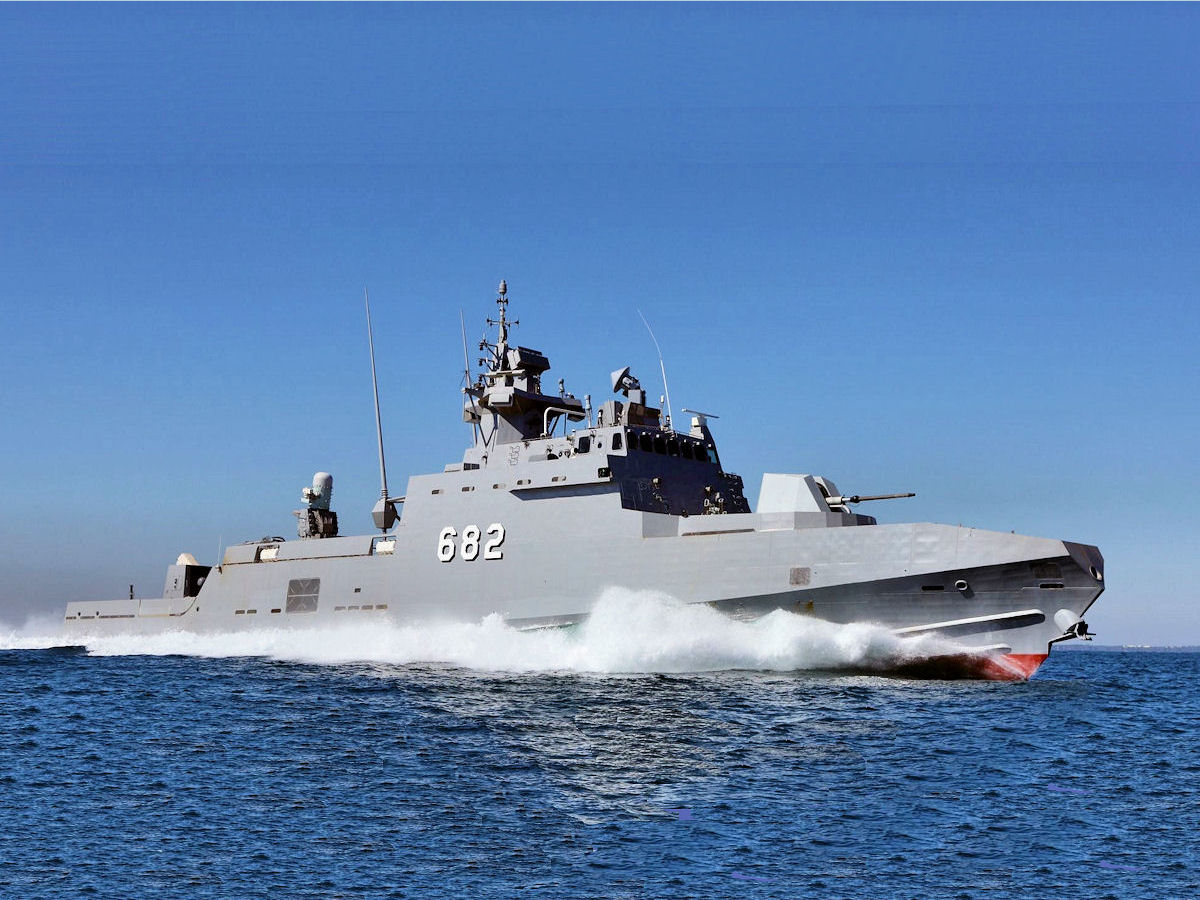
Ambassador Mk III missile boat (Navalanalyses.com)
While the above requirements are obviously distinct from any current design, they should be immediately recognizable as the rough outline for a fairly conventional small warship tailored to the needs of the United States Navy. More work would obviously need to be done to refine this into a finalized set of requirements, but it is close enough to analyze how this conventional design compares to other hypothetical budget priorities and show why we did not simply settle for this minimum configuration.
‘Adequate’ is Not Enough
In any discussion of hypothetical designs, it is critical to keep key alternatives and counterarguments in mind. In the case of small warships, the most relevant argument that might be presented is that aircraft can do the job better. This can take many forms of varying strength, but attacking a weaker form undermines the discussion. Thus, a hypothetical, purpose-built, bomber-like anti-ship aircraft will be considered here. The comparison with the aircraft described in this section will be used to demonstrate the shortcomings of the ‘adequate’ warship described above and set up a discussion of how to make it worthwhile.
This hypothetical aircraft would be a large, stealthy flying wing built using technology from the F-35. Using these electronics eliminates much of the cost of new development and eases maintenance by sharing logistics between this hypothetical anti-ship aircraft and the F-35. In addition, the new low-maintenance stealth coatings will eliminate the headaches of older designs like the B-2, and the design would be further simplified since its mission doesn’t require extreme stealth. It only needs to be able to attack hostile warships before they can detect it, which is not particularly challenging given the range of LRASM and the sensor performance inherited from the F-35. Thus, the cost should be relatively low.
For the sake of argument, it will be assumed this aircraft costs $300 million and carries 24 LRASMs, although better numbers may be possible. This compares cleanly with the small warship which would cost a little under $100 million and carry 8 LRASMs, so the cost per missile carried is approximately the same and we can focus on other performance parameters.
The ship has three key advantages: persistence, presence, and attritability. The first two stem from the obvious fact that a ship can loiter much longer than an aircraft, which makes it better for keeping weapons on-station in wartime or demonstrating American interest by performing a variety of low-end missions in peacetime. The third stems from the fact that we can afford three ships for the price of one aircraft, so an equal investment will provide more ships and losing one costs less, assuming the crew is recovered. While attritability is a benefit in a high-end war, the peacetime flexibility provided by the enhanced persistence and presence is less of a concern in the current geopolitical environment. Finally, this ship may be able to provide some amphibious lift for small USMC units operating under their Expeditionary Advanced Base Operations (EABO) concept, although its inability to provide meaningful fire support will limit its utility if an island is contested.
In contrast, the aircraft has numerous wartime advantages. The obvious speed advantage means the aircraft can respond to a developing situation and rearm much faster than ships. This further combines with its altitude to allow a single aircraft to survey a much wider area than the three ships can in spite of their persistence advantage. Furthermore, its combination of long detection range and stealthy airframe means the aircraft is more likely to see hostile warships before they see it, providing a major advantage over ships with respect to survivability and firing effectively first. Finally, thanks to its F-35 architecture, the aircraft will be compatible with a wide range of standard ordinance like the AGM-158 JASSM, AIM-120 AMRAAM, AGM-88 HARM, GBU-39 SDB, and so on, allowing it to perform other missions.
From this comparison, it is clear that those deciding which program to fund will not choose the ‘adequate’ small warship because other programs like the aircraft described above offer a greater return on investment. More capability is clearly needed to make the ship worthwhile.
Going From Viable to Worthwhile
The challenge with solving this problem is that it must be done without compromising the cost and size of these ships. The addition of desirable features led to the size and cost growth of LCS out of the original Streetfighter concept. Subsequent additions to fit into the traditional concept of a frigate with the FFG(X) program have produced a vessel with capabilities, and by extension costs, approaching that of the Arleigh Burke-class destroyer.
To retain the advantages of a small warship and keep it from growing into another Burke, two fundamental options are available: enhanced launch/support facilities, and secondary armament reconfigurations.
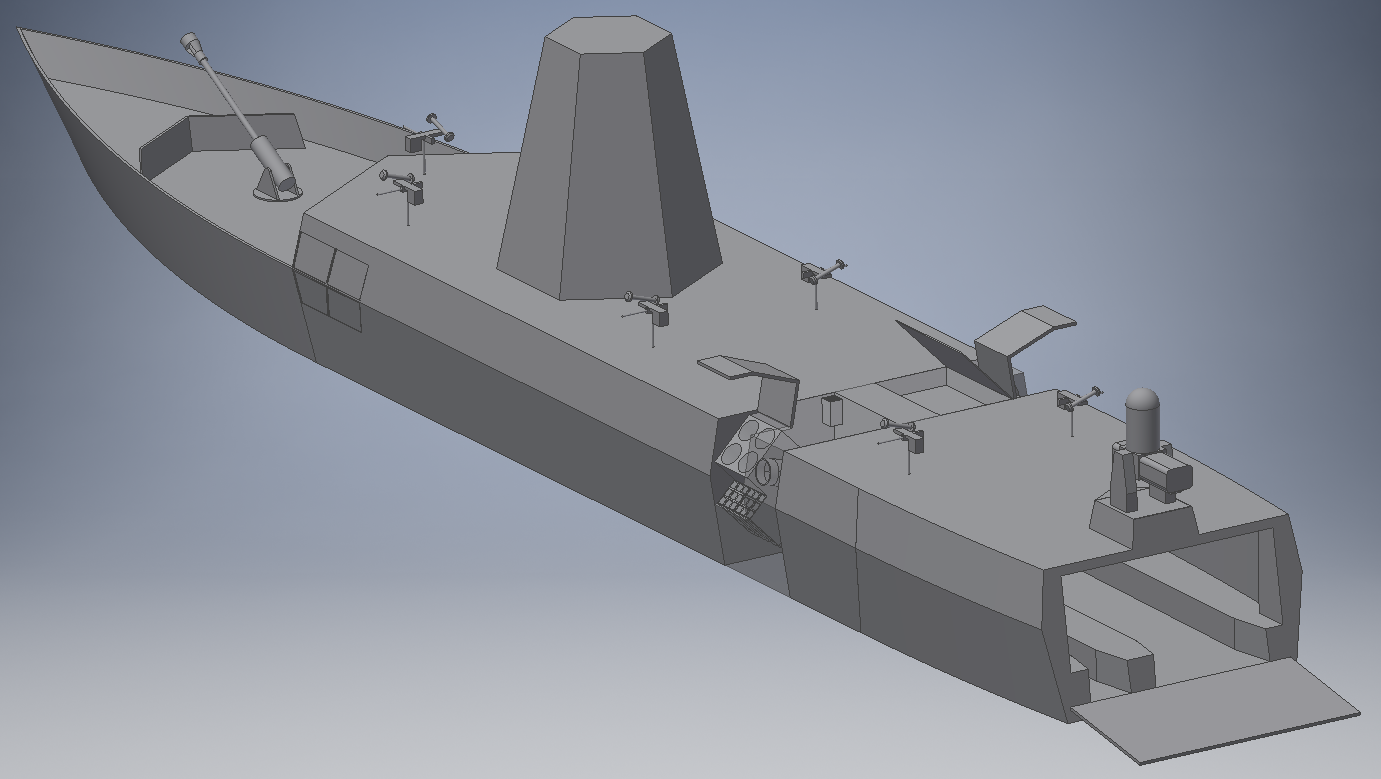
This section will explain how the LMACC program addresses this problem and provide the full design details for our baseline configuration. We have made significant enhancements to our launch and support facilities to improve overall utility, and have detailed plans for providing sealift support to the USMC during distributed operations. For the secondary armament, we took advantage of the interactions between technologies to provide much greater lethality against smaller surface threats and to restore the ability to provide robust fire support for Marines ashore at comparable cost.
Launch and Support Facilities
Before diving into how this ship will integrate with the Marines’ EABO concept, we will briefly circle back to the previously discussed launch facilities. UUV launch facilities, while not essential, have been included to provide additional flexibility at low cost, and are designed to benefit from the stern launch ramp required to support EABO. Furthermore, thanks to the small crew and wide beam, we were also able to fit an 11m RHIB to provide additional utility and transport capacity. Helicopter accommodations on the other hand have a major design impact even for a relatively minimal landing pad, especially in terms of manning for maintenance and support, so it has been omitted in favor of a topside UAV locker.
While the Marines are correct to pursue dedicated transports to implement EABO, the surface combatant fleet can also provide limited sealift support. A DDG-51destroyer would have to provide this support on a not-to-interfere basis, but our ship will be an integral part of the mission. The normal wartime employment of these ships will see pairs sortie into the same contested littorals the Marines intend to operate in, so they will supplement the dedicated transport fleet by carrying light units and supplies. LMACC has two empty six-person cabins, plus four extra beds in the crew cabins, so a tactical pair can easily carry a Marine platoon between them with hot racking. These cabins will also provide space for detachments, and one will be equipped to serve as a brig in support of peacetime patrol and partnership missions.
The other half of providing sealift support is delivering the embarked Marines ashore. Features such as shallow draft, pumpjet propulsion, and COTS navigation sonars will allow these ships to get very close to shore to facilitate rapid transfer, possibly even including swimming. Readily accessible stowage spaces at the forward end of the launch bay support rapid transfer of equipment and support use of the inflatable Combat Rubber Raiding Craft (CRRC), while oversized lower-deck cargo bays provide ample storage space. Finally, small boat operations have been greatly enhanced by combining a fully enclosed bay with a stern launch ramp to facilitate rapid Marine deployment, especially in inclement weather or at night.
It should also be noted that the attributes which make it well-suited to supporting the Marines also make it well-suited to supporting Special Forces.
Rethinking the Secondary Armament
For secondary armament, we took the overall configuration back to its fundamental requirements: short-range small boat defense, long-range small boat defense, area land attack, precision land attack, and limited air defense. This allowed us to rethink our approach to those requirements and take advantage of the interactions between modern weapon systems to get better results than a traditional deck gun.
The key technology that enables our layout is the unassuming Javelin Launch Tray. This adds a Javelin missile launcher to a standard pintle mounted weapon, and allows a loader/gunner team to outperform a 30mm autocannon with greater range and comparable engagement rate at greatly reduced weight and installation cost. While this is a useful supplementary defense on existing ships, the large number of installations makes LMACC an excellent escort against small swarming threats and, more importantly, amply satisfies the short-range small boat defense requirement without a deck gun. This may seem less important at first glance since these types of threats are typically associated with Iran, but China has already developed a small USV to perform a similar mission, making this threat relevant to the high-end fight. Javelin also provides a limited anti-aircraft capability since it was designed to destroy helicopters as well as tanks.
Since there is no need for a traditional multi-million dollar deck gun, LMACC instead mounts a 105mm howitzer. The cased ammunition of this weapon makes it suitable for sea service, unlike the larger, separately-loaded 155mm version. As a traditionally towed artillery piece, it is a lightweight, low cost weapon ideally suited to land attack. This of course addresses longstanding concerns about naval gunfire, and is directly relevant to supporting the Marines.
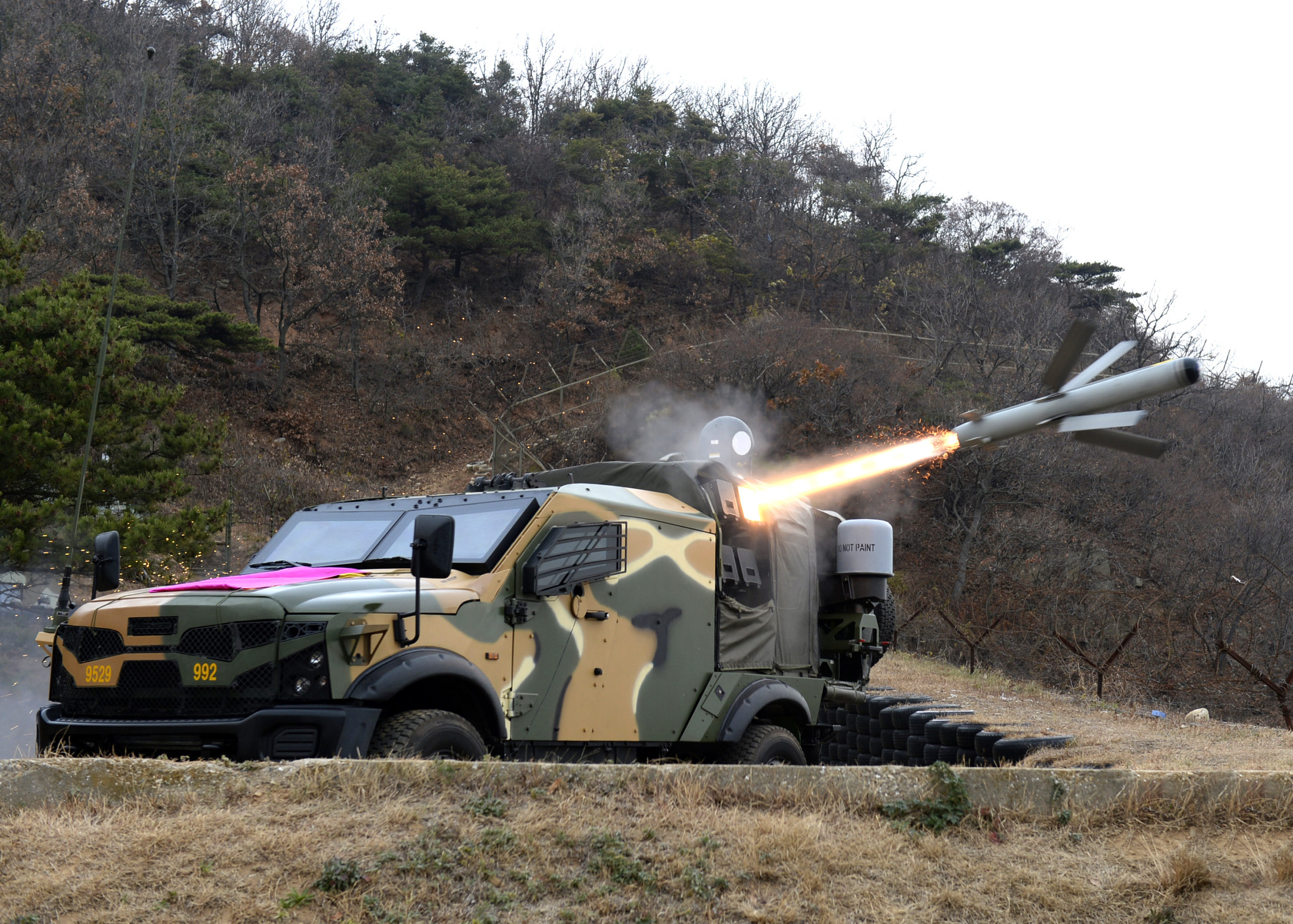
These two weapons fill the short-range small boat defense, area land attack, and limited air defense requirements, leaving long-range small boat defense and precision land attack. These two remaining requirements are both addressed through the addition of Spike NLOS missiles. This allows small surface threats to be safely engaged from over the horizon, and allows armored vehicles and other point targets to be precisely eliminated as well. This complements the howitzer and Javelin to provide excellent anti-boat capabilities and robust fire support for Marines ashore.
Spike-NLOS being fired from a Plasan Sand Cat (Republic of Korea Armed Forces/Wikimedia Commons)
The final weapon system is the Miniature Hit-To-Kill (MHTK) missile, which provides additional defense against low-end aerial threats like small UAVs and rockets. This further improves survivability, especially against swarming threats, and ensures the air defense capabilities of a deck gun are fully replicated.
The result of this is a much more flexible and lethal armament with relatively low installation weight and cost. This makes our armament unequivocally superior to the conventional autocannon configuration established previously without significant design growth, and even provides major advantages over a larger deck gun.
The LMACC Design
Now that we have walked through the requirements and logic of our design, we will take a moment to provide a design summary of our baseline configuration:
Name: USS Shrike
Type: Patrol Ship, Guided missile (PCG)
Cost: $96.6 million
Displacement: 600 tons
Length: 214 feet
Beam: 29 feet (waterline)
Draft: 6.5 feet
Range: 7500+ nautical miles
Speed: 30 knots
two steerable, reversible pumpjets with intake screen
Integrated electric propulsion
Diesel engines
Crew: 15 (31 beds)
Armament:
Eight LRASMs
SeaRAM
Seven Javelin pintle mounts
One Javelin launch tray per mount
Ten stored missiles per mount
Either a M2 Browning or Mk 47 AGL per mount
105mm howitzer
36 Spike NLOS missiles
64 Miniature Hit-To-Kill Missiles
COMBATSS-21 combat management system
Latest generation full-sized AN/SLQ-32 electronic warfare suite
Standard decoy launchers
Excellent optical sensor suite:
Visible Distributed Aperture System (DAS)
IR DAS
Visible/IR camera turret
COTS navigation sonar
Maximum affordable acoustic signature reduction
Appropriate reduction of other signatures to blend into civilian traffic
COTS navigation radar
L3Harris Falcon III® RF-7800W non-line of sight radio
Multifunction Advanced Datalink (MADL)
Aft launch bay
One 11m RHIB
One 11m long UUV slot (multiple UUV transportation possible)
Bay door doubles as launch ramp
Small topside UAV storage and launch accommodations
This maintains the previously established minimum requirements while integrating the additional features discussed.
Circling back to the comparison with the hypothetical anti-ship aircraft, these low cost enhancements have added numerous advantages over the ‘adequate’ design. In addition to the previous advantages of persistence, presence, and attritability, it can now operate UUVs, transport Marines, provide surface fire support, and destroy small boat swarms. This makes the ship a much more useful platform with the flexibility to adapt to an uncertain future, and gives procurement officials a good reason to select it over the aircraft. This clear utility and economic viability is the hallmark of well-thought-out requirements, and makes this design, in our opinion, viable for American service.
It should be remembered that this information is only applicable to the baseline configuration. The other variants add a ten-foot hull segment to add special mission capabilities and will have increased costs as a result.
Automation and Manning
From a systems perspective, the core concept for this ship is that it will be built like a large USV. Since the automated systems can notify the crew when action is needed, traditional watches are unnecessary and significant crew reductions are possible. Furthermore, since the ship’s systems will be designed to operate with minimal intervention as expected of a USV, there will, in theory, be very little need for maintenance. However, there will be people on hand to correct any problems that do occur, unlike a full USV. Thus, from a systems perspective, this will allow LMACC to bridge the gap to autonomy because it keeps people on board while operating like an autonomous vessel. As such, a fleet of these ships will allow us to safely build a large body of operational knowledge and inform our approach to future USVs and human-machine teaming.
We intend to man these ships with a 15-person crew lead by a Warfare Tactics Instructor (WTI). These tactical experts will be ideally suited to lead their ships and attendant packs of unmanned vessels to victory in the most challenging circumstances, and take the initiative when cut off from external command. They will lay traps, strike targets ashore, and hunt down hostile warships while confounding the enemy’s ability to respond by vanishing into civilian traffic.
While our work indicates a crew of 15 is appropriate to manage the weapons, sensors, and drones, we are acutely aware of the uncertainty associated with this novel manning concept and the need to bring aboard additional personnel for special missions. As such, the ship has been designed with five, six-person cabins, plus a single cabin for the commanding officer, to provide ample berthing. Two of those cabins are notionally intended to be used for non-crew personnel such as Marines conducting EABO deployments, Coast Guard law enforcement detachments, or brig space. That leaves free beds for four more crewmembers with no meaningful impact, and the crew could be further enlarged by using one or both of those cabins if needed. Even in the worst-case scenario, 31 beds allow for three more crew than the existing Cyclone-class patrol ship, without hot racking. This effectively eliminates the risks associated with a smaller crew by allowing the ship to comfortably carry a traditional full complement if required.
Concepts of Operation
These ships are intended to fight forward to defend or retake island chains. The design emphasizes fighting in complex environments by disappearing into civilian traffic and littoral clutter. These ships will rely on passive sensors to complicate the enemy’s target identification problem and maximize the chance of achieving tactical surprise. The basic wartime operational unit will be a tactical pair, consisting of either two of the basic short-hull ships, or one basic design and one specialized variant. These pairs will work closely with unmanned vessels and Marines ashore to deny the area to the enemy, degrade hostile defenses, and clear the way for heavier units. They will also provide light sealift and logistics support to small, lightly equipped Marine units. Note that while we have done extensive work on tactics, deployment strategies, and cooperation with the existing leviathan navy, much of that material is not publicly releasable and will not be further discussed here. That said, much of this is built on the work of our colleague, the late Capt. Wayne Hughes, so members of the public interested in learning more are encouraged to read his work.
In peacetime, these ships will provide a cost effective asset for patrol, partnership, and deterrence missions. Since these ships are much cheaper than even frigates, they will be a better choice for countering piracy, smuggling, human trafficking, illegal fishing, and other illicit activity, allowing more expensive ships to focus on missions and training which fully exploit their capabilities. They will also enable more effective joint training with our smaller partners whose fleets are closely matched to these ships. This is particularly relevant in the South China Sea and Western Pacific where there is a need to carry foreign coast guard detachments for joint patrols and visit many small, primitive ports to reassure our friends and deter China. This will also substantially improve the readiness and performance of our fleet by reducing the workload on high-end assets, and offering early command billets to help develop young officers.
Finally, fleet integration is greatly simplified by the operational similarity of this PCG to the Cyclone-class PC. LMACC can serve as a drop-in replacement for the Cyclone at similar cost, so there is no operational risk. We could hand one of these ships to the fleet today and they’d be able to put it to work immediately by treating it like a Cyclone while the Surface Development Squadron refines the more advanced tactics developed by the Naval Postgraduate School. This makes it possible to jump immediately to serial production if desired, although building a prototype first would reduce risk at the cost of delaying its entry into service.
Ship Variants
We have plans for several special mission variants. In keeping with the Navy’s historical tradition of naming small ships after birds, they have all been given bird names. The baseline LMACC variant, the Shrike, has already been discussed, and two additional variants have been fleshed out, the anti-aircraft Falcon and the anti-submarine Osprey, both of which add new capabilities with a ten-foot hull extension.
It is difficult to discuss the details of the Falcon’s operation publicly, but it adds a new sensor and a tactical-length Mk 41 VLS module to destroy hostile maritime patrol aircraft before they can distinguish it from civilian traffic. This will protect these ships from the single greatest threat to them, hostile aircraft, and substantially improve their ability to operate within hostile A2/AD systems.
The Osprey variant, on the other hand, is relatively simple and is built to maximize the impact of USV-mounted sensors. The primary addition is eight new angled launch cells for Tomahawk cruise missiles modified to carry a lightweight torpedo. This allows a very small number of these ships to greatly improve our ability to deter and defeat submarines, since they can quickly strike targets detected by offboard sensors from hundreds of miles away. Furthermore, since Tomahawk is a well-established weapon fielded across the fleet, this will allow us to add this capability across our surface combatant fleet, and provide a way to recycle obsolete Tomahawks when we inevitably move on to other weapons. Finally, this variant is rounded out by a hull-mounted passive sonar and four fixed torpedo tubes for self-defense, since it is expected to operate in areas with elevated submarine risk.
Two additional variants have been considered. The first is a drone mothership which adds a UUV handling module to field large numbers of UUVs, and may also modify the aft launch bay to carry two boats or USVs. The second is a coast guard variant which replaces most of the missiles with a dedicated sickbay, brig, and secure contraband storage to turn it into a bigger, more capable version of the Sentinel-class cutter, although these capabilities could also be added in a hull segment if an export customer wants to retain the missiles.
Program Status
Our requirements and top-level engineering are complete. The only major task remaining is to finalize our hullform, and we can do that in parallel with shipyard and supplier selection. Almost all the technology we have selected is fielded. The remaining technologies are closely based on fielded systems, and the baseline Shrike will still be combat effective if delays force it to deploy before these technologies are ready. Since the Naval Postgraduate School is outside the traditional shipbuilding bureaucracy, we have significant flexibility in our path forward to production. We could do anything from traditional acquisition to building this under the umbrella of a research project outside all existing acquisition structures, as was done with TACPOD, so we can take whatever approach is most acceptable to Congress and the Navy.
Mr. DiDonato is a volunteer member of the NRP-funded LMACC team lead by Dr. Shelley Gallup. He originally created what would become the armament for LMACC’s baseline Shrike variant in collaboration with the Naval Postgraduate School in a prior role as a contract engineer for Lockheed Martin Missiles and Fire Control. He has provided systems and mechanical engineering support to organizations across the defense industry from the U.S. Army Communications-Electronics Research, Development and Engineering Center (CERDEC) to Spirit Aerosystems, working on projects for all branches of the armed forces.
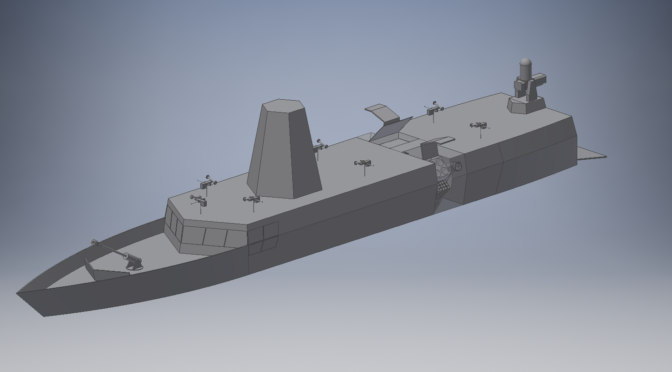
Featured Image: LMACC design screenshot courtesy of Ben DiDonato
A major reversal of fortunes at sea has gone largely unnoticed. Over the past decade, the Chinese Navy sped past the Japanese maritime service across key measures of material prowess. The trendlines suggest that China will soon permanently displace Japan as the leading regional naval power in Asia. This historic power transition will have repercussions across the Indo-Pacific in the years to come. It behooves policymakers to pay attention to this overlooked but consequential shift in the naval balance between two great seafaring nations.
The Power Transition at Sea
The growing power gap between the People’s Liberation Army Navy (PLAN) and the Japan Maritime Self-Defense Force (JMSDF) is stark and will widen at an accelerated pace. China already boasts the largest navy in the world with more than 300 ships and submarines. By comparison, the JMSDF’s naval strength in 2019 included four light helicopter carriers, two cruisers, 34 destroyers, 11 frigates, three amphibious assault ships, six fast-attack missile boats, and 21 submarines. By 2030, the PLAN could have more than 450 ships and close to 110 submarines while the JMSDF will likely not be much larger than it is today.1
In aggregate tonnage for principal surface combatants, a rough measure of latent capacity and capability, China surpassed Japan in 2013. By 2020, the PLAN exceeded the JMSDF in total tonnage by about 40 percent. By average tonnage per combatant, a more precise measure of capacity and capability, the Japanese fleet continues to maintain a comfortable lead of about 45 percent over its Chinese counterpart. Japan’s position, however, may not hold for long as China puts to sea more carriers, cruisers, and destroyers.
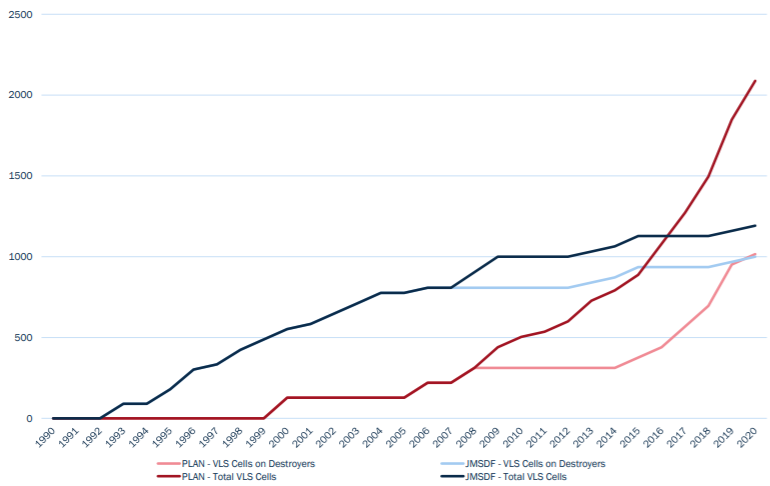
In terms of firepower, the vertical launch system (VLS)—a grouping of silos that holds and fires shipborne missiles—furnishes a useful proxy for a fleet’s lethality. In this category of naval power, China’s catchup story is stunning. The JMSDF introduced VLS a decade earlier than the PLAN in the early 1990s. Yet, the Chinese quickly caught up and zoomed past the Japanese in 2017. By 2020, the PLAN had 75 percent more VLS cells than the JMSDF.
Number of VLS cells on JMSDF and PLAN destroyers and in the total surface fleets (CSBA)
More troubling still, China’s large arsenal of anti-ship cruise missiles (ASCMs) outranges that of the JMSDF by considerable distances. In a hypothetical fleet-on-fleet engagement, the PLAN could launch large salvoes of ASCMs that could reach its opponent’s warships well before the Japanese side could get within range to hit back, conferring a significant first-strike advantage to China. It remains to be seen whether Japan will introduce enough long-range ship-killing missiles, including the repurposed Standard Missile 6 air-defense interceptors, to close the range gap.
China’s air force and rocket force further tip the scales in its favor. Chinese airpower and missiles ashore would almost certainly join the fray in any conceivable conflict. The JMSDF’s surface fleet would have to fend off volleys of air-launched ASCMs and land-based anti-ship ballistic and cruise missiles as well as missiles fired from ships and submarines. Japan’s maritime service thus inhabits a vexing and inhospitable operational environment.
Beyond Bean Counting
Fleet size, tonnage, and firepower do not provide a full measure of a navy’s combat power. Operational proficiency, tactical elan, regular and extended deployments in blue-water environments, and real combat experience are equally critical, if not more so, when evaluating a navy’s prospects for fighting and winning a war at sea. Even in this qualitative area, however, it is no longer axiomatic that Japan holds a decisive advantage over China.
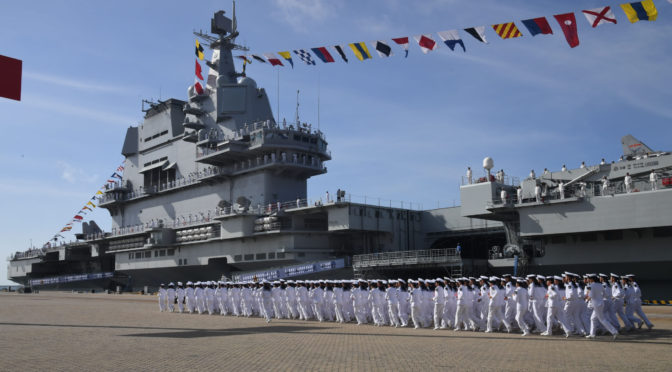
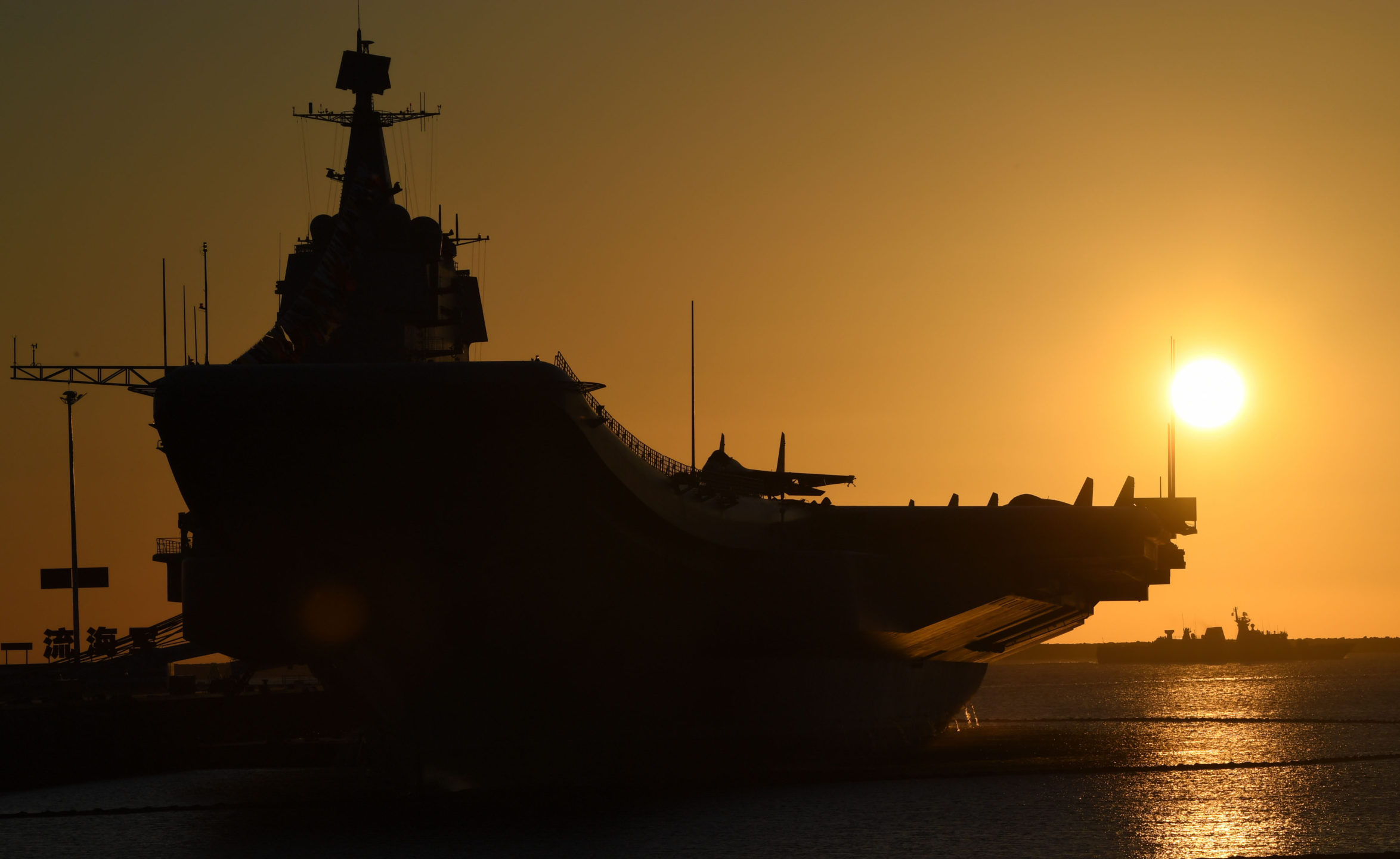
PLA Navy aircraft carrier Shandong berthed at a naval port in Sanya (eng.chinamil.com.cn/Photo by Feng Kaixuan)
Over the past decade, the Chinese Navy has proven itself a capable expeditionary service. The PLAN’s various open ocean activities suggest that it has accumulated substantial at-sea experience. Notably, the Chinese Navy has sustained a continuous rotation of anti-piracy patrols in the Indian Ocean since 2009, an impressive feat by any measure. The PLAN has also dispatched flotillas for long-distance transits throughout the Western Pacific and beyond.
Peacetime exercises and constabulary operations may not be reliable indicators of how the Chinese Navy will perform in combat. The well-worn remark that China has not fought a war since 1979 remains valid. Of course, neither has Japan since 1945. The reality is that no one knows for certain how each side will fare until the shooting starts.
It remains unclear how the economic contraction following the COVID-19 crisis will impact China’s investment in its navy. What is certain, however, is that Japan will not escape the economic fallout from the global pandemic and the attending fiscal pressures on defense spending. The momentum behind the Chinese naval buildup, moreover, will likely not slow down enough to reverse the tilting naval balance in Beijing’s favor.
Why the Naval Imbalance Matters
Japan’s eroding naval position not only reduces its ability to defend the liberal international order, but it also weakens the deterrent posture of the U.S.-Japan alliance and, in the process, undercuts American strategy in Asia. Consider the centrality of Japanese seapower to the regional security architecture.
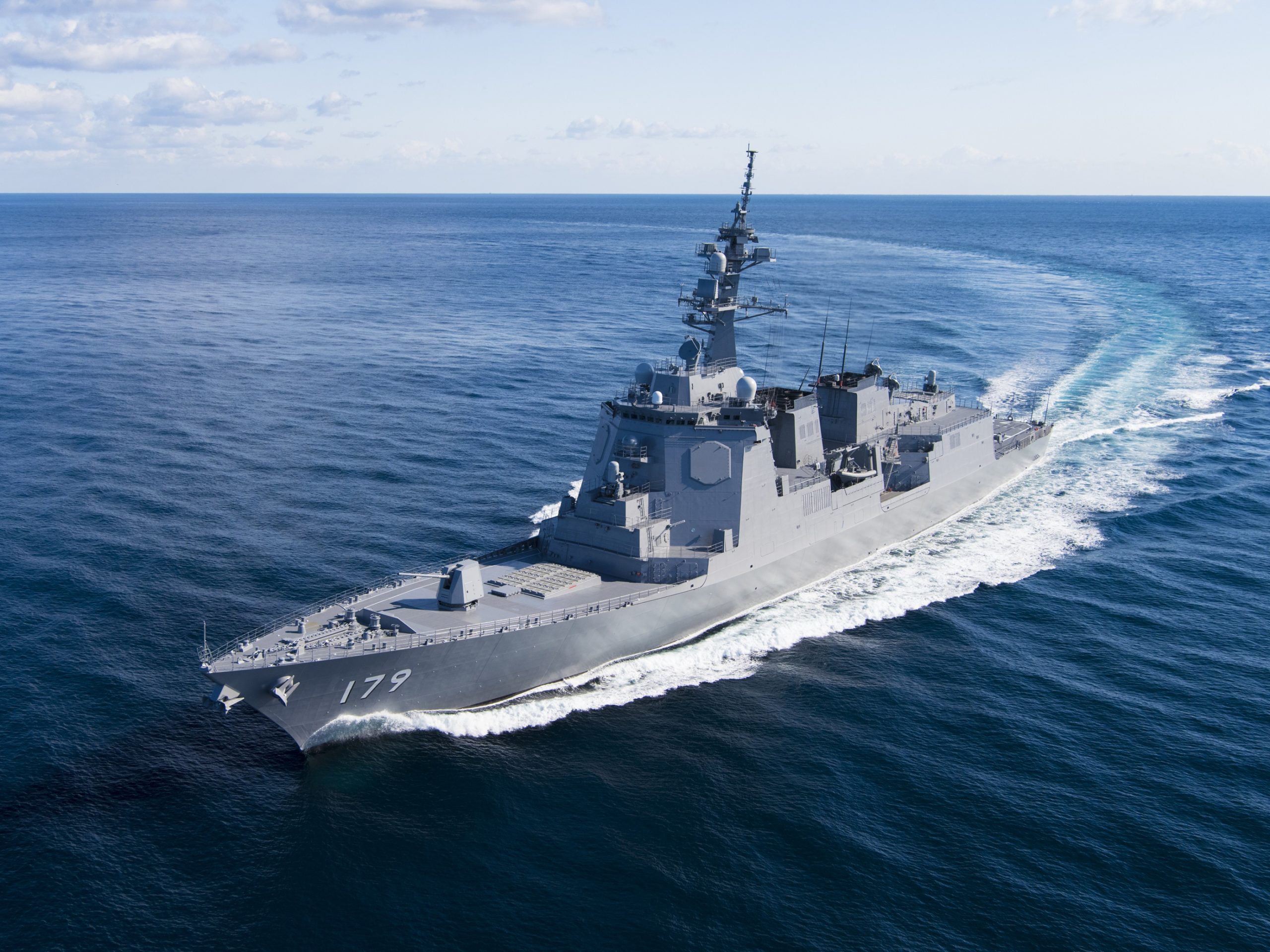
Japanese Navy destroyer Maya (DDG-179) (Japanese Ministry of Defense photo)
In peacetime, Japan’s maritime service helps deter aggression and keep the seas open to all, an essential condition for free trade and global prosperity. Should deterrence fail, the JMSDF would sweep clear the major maritime approaches to the theater of operations along the Asian littorals and conduct operations to obtain and exercise sea control alongside the U.S. Navy. Moreover, the sea service complements U.S. naval strengths, including undersea warfare, while making up for American capability gaps in such areas as minesweeping.
A revisionist China must carefully consider Japan’s still-formidable maritime service when calculating its options vis-à-vis the United States. Beijing would likely think twice about coercion or aggression if it believed that the alliance possessed overwhelming military superiority. Conversely, if Beijing concluded that Tokyo was becoming a crack in the armor, then it might be tempted to gamble.
The bottom line is that it is the combined power of the U.S. Navy’s forward-deployed naval forces and the JMSDF that helps to keep the peace in Asia. It is thus imperative that U.S. policymakers perceive the relative decline of Japanese seapower as a proxy for the corrosion of American power in the Indo-Pacific.
If past is prologue, China’s rapid accumulation of naval power—and Japan’s inability to keep up—portends unwelcome great power relations. The most striking historical parallel is Britain’s naval decline during the Cold War. In the late 1970s, the Soviets had far outstripped the British across major measures of naval power just as the PLAN is eclipsing the JMSDF today. By the early 1980s, it became increasingly doubtful whether Britain could defend its own backyard against Soviet designs.
Britain’s relative decline posed global dilemmas for the United States. If the U.S. Navy were tied down in an emergency elsewhere, there was concern that the Soviets might seize the occasion to test European resolve in the North Atlantic. It was feared then that the Royal Navy’s impotence in the face of a Soviet naval challenge would severely undermine stability, deterrence, and allied cohesion while opening the way for Moscow to advance its aims in Europe.
It does not stretch the imagination to foresee a similar risk today. American global commitments, particularly in Europe and the Middle East, could draw Washington’s attention to faraway theaters. In such circumstances, the United States would likely expect Japan to do much more to deter, if not oppose, Chinese opportunism. The extent to which the JMSDF upholds its end of the bargain would be a major test for the alliance.
Allied Implications
To be sure, any assessment of the Indo-Pacific strategic balance would be incomplete without accounting for the U.S. military, including its forward-deployed assets and its surge forces around the world. The combined naval power of the United States and Japan still outweighs that of China. But that margin of superiority is diminishing as China continues its ascent at sea, pulling even farther ahead of Japan.
Consequently, the security partnership’s capacity to deter aggression is likely to come under more strain. Equally worrisome, the PLAN and its sister services are already able to project power across and well beyond the first island chain, deliver ample firepower over long distances, and impose heavy costs on U.S. and Japanese forces. These developments are likely to challenge, if not upend, longstanding allied assumptions about escalation dominance and warfighting.
Allied policymakers must recognize that a historic power shift has already taken place in maritime Asia. For too long, defense planners and the broader strategic community have focused exclusively on the bilateral Sino-U.S. naval rivalry while slighting the local balance between China and Japan. In the past, when allied superiority and the JMSDF’s qualitative advances appeared insuperable, it was safe to take Japan’s role for granted.
Yet, today, as the balance tilts increasingly in China’s favor, Japan’s relative decline could emerge as a weak link in the alliance’s deterrent posture. Understanding the extent to which Japan has fallen behind, to include how the Chinese perceive the local imbalance, should assume a far more prominent place in allied decision-making. Such a comprehensive estimate must be integral to the allied calculus about strategy, posture, operations, and competitiveness.
Toshi Yoshihara is senior fellow at the Center for Strategic and Budgetary Assessments (CSBA). His latest book, co-authored with James R. Holmes, is the second edition of Red Star over the Pacific: China’s Rise and the Challenge to U.S. Maritime Strategy (Naval Institute Press, 2019).
Featured Image: The picture shows aircraft carrier Shandong berths at a naval port in Sanya. China’s first domestically-made aircraft carrier Shandong (Hull 17) was officially commissioned to the PLA Navy at a military port in Sanya, South China’s Hainan Province, on the afternoon of December 17, 2019. (eng.chinamil.com.cn/Photo by Feng Kaixuan)