All posts by Dmitry Filipoff

Barry Posen on Risking Escalation and Scrutinizing Plans

1980s Maritime Strategy Series

By Dmitry Filipoff

CIMSEC discussed the 1980s Maritime Strategy with Professor Barry Posen of MIT, who at the time emerged as a challenger of some of the strategy’s precepts. In this discussion, Posen discusses the possibly escalatory nature of the strategy, the nuclear risks involved, and how operational war plans deserve to be scrutinized by civilian policymakers.

What were your thoughts on the Maritime Strategy when it published during the 1980s?

I had two views because it was both a surface and air warfare strategy, and an undersea warfare strategy. The surface warfare aspects, especially the plan to move aircraft carriers north to strike the Kola Peninsula, seemed absurdly risky to the ships given the minor gains to be had from those airstrikes. The forward anti-submarine warfare (ASW) operations against Soviet ballistic missile submarines (SSBNs) struck me as needlessly escalatory. The purpose of “Flexible Response” was to prolong the conventional phase of the war. Conventional strikes on Soviet SSBNs turned the conventional phase into the first phase of a counterforce nuclear attack. I was concerned that the Russians might see it that way, and perhaps use nuclear weapons to warn the U.S. to back off. No nuclear-armed country likes losing its secure second-strike capability.

Did the offensive spirit of the Maritime Strategy adversely affect deterrence and escalation dynamics?

It is hard to know what were the effects on deterrence. The advocates thought the threat helped deter by increasing the risks the Soviet would run in a large-scale conventional attack on the West. I am unaware of any deep dive into Russia’s (Soviet) archives that would answer the question of whether it worked that way. I feared that it would intensify escalation dynamics in many ways. Fortunately we never ran the experiment.

How do you think the Maritime Strategy was received by allies and the Soviet Union, and how would you explain their reactions?

I think the Soviets knew exactly what the U.S. Navy was going to do. That is why they planned to turn the Barents Sea into a defended bastion. (They probably also had pretty good naval intelligence during that period through the Walker spy ring.) I don’t know what most U.S. allies thought about the strategy. Insofar as they were always worrying about nuclear decoupling, they probably liked the U.S. threat and thought it enhanced deterrence. Whether they would have questioned going through with it in the event deterrence failed is another question. I do remember the Norwegians were so happy to hear that the U.S. was coming that they did not wish to ask too many questions about why.

What alternative would you have advocated for in terms of strategy and how American naval power might be applied?

The U.S. and its allies had a very effective system of ASW barriers between the Soviet bases in the Kola Peninsula and the Atlantic sea lines of communication. One argument for threatening Soviet SSBNs was that it tied down their attack submarines defending the bastion. My view was that the very existence of U.S. SSNs created a contingent threat to the bastion no matter what we did. Therefore the Soviets would not risk their best submarines running the barriers off the North Cape and the GIUK gap, or even the convoy escorts to try to sink resupply shipping. I would have relied more on those barriers and held the SSN offensive in reserve. My estimate at the time, however, was that the Navy was so invested in the offensive that they would not hold back. Indeed, because finding Soviet SSBNs was much easier if you could trail them as they deployed, my fear was that the U.S. Navy’s search for tactical leverage would lead them to advocate a crisis surge of SSNs into the Barents. This would have accelerated the pace of any crisis and might have produced an entirely unnecessary war.

What lessons from those strategy debates best apply to understanding modern great power competition today?

I am unaware that the debate at the time had much impact. The one positive aspect of it was that it illuminated for civilian policymakers that to manage or avoid escalation in anything as large and complicated as a NATO–Warsaw Pact War, that they should look at the operational plans for themselves. This was not done much in those days and probably isn’t now. But I do know that some in the policy community were at least prompted to think about this. It is known that civilians have had a very hard time over the years even getting good access to the nuclear war plans. So this is a hard organizational politics problem. That said, the debate has had legs. Scholars of the emerging competition in Asia are also asking some of these questions.

One is always tempted to look at the past through rose-colored lenses. But it is increasingly my view that attentive civilians, even those without clearances, somehow had more visibility into fundamental military issues during the Cold War than they do now. Everyone involved took the Cold War very seriously, and the U.S. government and the military had to explain themselves. This surfaced a lot of useful information.

By comparison the Global War on Terror has produced a very strong penchant for secrecy. I am not convinced that we have as much visibility into military issues now as we did then. In part this is also due to the Congress relinquishing its oversight role and to the growth of the prestige of the U.S. military in society. Too few people are asking hard questions, and the military has an easy time waving them off. This may all be set to change, if and as the competition with China grows more serious.

Barry R. Posen is Ford International Professor of Political Science at MIT, Director Emeritus of the MIT Security Studies Program, and serves on the Executive Committee of Seminar XXI. He is the author of, Restraint: A New Foundation for U.S. Grand Strategy, (Cornell University Press 2014), Inadvertent Escalation: Conventional War and Nuclear Risks (Cornell University Press 1991), and The Sources of Military Doctrine (Cornell University Press 1984 ). The latter won two awards: The American Political Science Association’s Woodrow Wilson Foundation Book Award, and Ohio State University’s Edward J. Furniss Jr. Book Award. He is also the author of numerous articles, including “The Rise of Illiberal Hegemony—Trump’s Surprising Grand Strategy,” Foreign Affairs, March/April 2018, “It’s Time to Make Afghanistan Someone Else’s Problem,” The Atlantic, 2017, “Contain ISIS,” The Atlantic, 2015, “Pull Back: The Case for a Less Activist Foreign Policy,” Foreign Affairs, January/February 2013, and “Command of the Commons: The Military Foundation of U.S. Hegemony,” International Security, (Summer, 2003.) He is a Fellow of the American Academy of Arts and Sciences. In 2016 he was appointed Henry A. Kissinger Chair (visiting) in Foreign Policy and International Relations at the Library of Congress, John W. Kluge Center. He is the 2017 recipient of the International Security Studies Section (ISSS), International Studies Association, Distinguished Scholar Award. He has been a Council on Foreign Relations International Affairs Fellow; Rockefeller Foundation International Affairs Fellow; Guest Scholar at the Center for Strategic and International Studies; Woodrow Wilson Center Fellow, Smithsonian Institution; Transatlantic Fellow of the German Marshall Fund of the United States; and a Visiting Fellow at the John Sloan Dickey Center at Dartmouth College.

Dmitry Filipoff is CIMSEC’s Director of Online Content. Contact him at Content@cimsec.org.

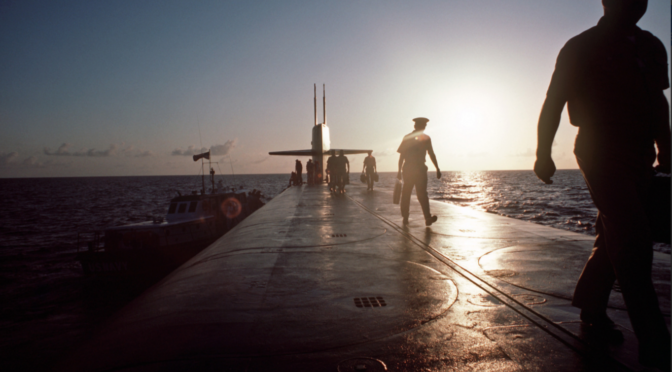
Featured Image: September 30, 1987 – Crew members prepare to go ashore from an Ohio class nuclear-powered ballistic missile submarine (National Archive photo by PH1 Harold J. Gerwien)
Brad Dismukes on the Soviet Navy and Attacking Ballistic Missile Nuclear Submarines

1980s Maritime Strategy Series

By Dmitry Filipoff

CIMSEC discussed the 1980s Maritime Strategy and its relation to the Soviet Navy with Brad Dismukes, who served at the Center for Naval Analyses at the time. In this discussion, Dismukes discusses concepts of Soviet naval operations, whether the Maritime Strategy was a reaction to Soviet naval activity, and the follies of engaging in anti-submarine warfare against nuclear missile-carrying platforms.

How would you describe the overall capability and combat credibility of the Soviet Navy at the beginning of the 1980s? Was Soviet naval capability trending toward becoming a more challenging threat?

The Soviet Navy was getting steadily more capable—but at unpredictable rates across its many platforms and systems. A key dimension of improvement was submarine sound levels. In the period from 1983 to 1986, the Akula-class SSN was just entering service. It proved to be nearly as quiet and undetectable as its U.S. counterparts.

In terms of timing it is perhaps ironic that in January 1986 the U.S. Navy was just making public the Maritime Strategy. Its most important innovation was adoption of the strategic anti-submarine warfare (SASW) mission. That mission aimed to send U.S. SSNs under ice in the Arctic and the Sea of Okhotsk to kill Soviet SSBNs. The latter were being protected by the Soviet general-purpose-force navy—under ice, by their SSNs. The super-quiet Akula made accomplishing SASW much more difficult if not, as the Akula force grew in numbers, perhaps strategically out of reach.

How would you describe Soviet naval strategy during this period, and how did the Soviets plan to employ their fleet if major conflict broke out with NATO?

The fundamental stance of the Soviet Navy across the 70 years of its existence was defensive. Its strategic tasks were to defend the homeland, defend the seaward flanks of the Red Army against attack from the sea, and (after 1973) to defend sea-based intercontinental ballistic missiles (ICBMs) aboard SSBNs. These three functions were to be performed in a layered, seamless, land-sea defense in depth scheme.

The ICBMs aboard Soviet SSBNs formed the nation’s strategic reserve—the ultimate assurance of national survival and the durability of such victories the Army might achieve. Sea-based missiles fell under the aegis of the Defense Council, the nation’s highest politico-strategic body (the equivalent of our National Security Council). The land-based ICBMs of the Strategic Rocket Forces (SRF) were the provenance of the General Staff (the equivalent of our Joint Chiefs of Staff). The SRF’s missiles were assigned a military task—to destroy the enemy and produce victory. The avy’s missiles had a political task—to underwrite the durability of that victory, to deter further or potential nuclear strikes on Soviet territory, and to guarantee the survival of the Soviet state.

In 1973 the navy took on a strategic role it never had before, justifying the huge investments made in the production of the SSBN force and the general-purpose navy to protect it. As far as I know, no one has been able to explain why for the strategic reserve function the Soviets did not instead choose to rely on their large force of road- and rail-mobile ICBMs—a question Michael Kofman has raised recently, as did Michael McGwire back in the mid-1980s. Whatever the answer, the fact is that the Soviets did buy expensive ballistic missile submarines—as their Russian successors continue to do.

The defensive orientation of the Soviet Navy and the importance of the national-level tasks it was assigned meant that the Soviets did not intend to use the navy offensively to attack Western sea lines of communication (SLOCs) on the high seas—to refight the WWI and WWII Battles of the Atlantic. Obviously you cannot send your SSNs forward to attack the SLOCs in force and also hold them back for defense in depth.

Were there “Western-preferred” concepts of wartime Soviet naval operations? Did understandings of wartime Soviet naval strategy evolve and encourage a subsequent shift in U.S. naval operations and strategy?

Understanding did evolve, but fitfully and involving two remarkable strategic errors. The first has been well-recognized since the early 2000s. For nearly 30 years, after the beginning of the Cold War, the Office of Naval Intelligence imputed to the Soviet Navy the intention to fight a third Battle of the Atlantic. This estimate was based mainly on theories held by intel specialists and by planners. Intel extrapolated from the experience of WWII and the well-recognized propensity of the Red Army for offense. It concluded that the huge size of the Soviet submarine force (approaching 400 platforms at one point) could only be explained by an intention, not to defend, but to attack. Planners, following the maxim that the planner’s first obligation is to defend his own vulnerabilities, concluded that the Soviets intended to attack the SLOCs (as they would do if they were sitting at a planner’s desk in Moscow). In effect, the planner’s worst-case scenario merged with intel’s most likely: Western SLOCs were the Soviets’ strategic target.

However, concrete facts showed this was simply wrong. The Soviet Navy never planned to attack Western SLOCs. It did not seriously contemplate the mission; it did not buy the platforms or logistics force implied; it never trained against defended, maneuvering convoys; it never mounted a major anti-SLOC exercise in the North Atlantic (or anywhere else); and it was likely not up to the anti-SLOC task if somehow it had been ordered to execute it.

Unfortunately, the Navy’s 30-year misreading of the Soviet Navy’s strategic intentions led it to adopt war plans contrived to fight shadows and to acquire ships and weapons optimized for battles that were never to be fought.

This initial failure of strategic intelligence was followed by a less-recognized second failure. In the case of the SSBN strategic reserve and the assignment of the Soviet general-purpose navy to defend it, intel’s recognition of change lagged reality by about eight years. The strategic reserve mission commenced in 1973 when the first SS-N-8-armed Delta-I became operational. At that very time the Soviets “announced,” in their veiled, byzantine language (in the so-called Gorshkov series in morskoy sbornik, 1972-73) the existence and the importance of their strategic reserve. Understanding of this was publicly recognized, but that recognition was ignored by the intel community. It was not until 1980-1981 that Navy special compartmented intelligence (SCI) sources confirmed the existence of the Soviet strategic reserve at sea and the general-purpose navy’s assigned mission of defending it.

The result was revolutionary. Finally in possession of a valid understanding of their Soviet competitor, the Navy quickly developed the Maritime Strategy with its mission of attacking the reserves in their bastions. It is not only a philosophical question to reckon the consequences of this eight-year delay in terms of forgone opportunities and misdirected efforts. If the Navy had recognized the Soviet strategic reserve in 1973, near the time that it came into existence, the Navy of 1986 and thereafter would likely have had a different composition and its operations and exercises would have taken a different shape.

Accurate strategic intelligence is obviously essential. Even the most talented strategic planner’s effort is wasted if based on a spurious understanding of the world.

How did the Soviets publicly react to the Maritime Strategy, such as when it published? And how did the Soviets react to the exercises the strategy encouraged? Or were these U.S. naval operations a reaction to prior Soviet naval activity?

This involved an action-reaction sequence. The first thing to say is that Soviet action initiated the sequence. The Maritime Strategy was a reaction. The Soviets, fundamentally defensive-minded at sea, almost certainly anticipated a need to defend their SSBNs and planned accordingly from the earliest days of SSBN development. (I have no direct evidence on this point, but I do have a professional admiration for the thoroughness and foresight of the planning of the Soviet General Staff, as does everyone else familiar with it.)

So in 1973 the Soviet strategic reserve went to sea. In 1986 the Maritime Strategy appeared in unclassified form. After 13 years, the Americans were finally preparing to do what the Soviets had long been preparing to counter. From this perspective one would hardly expect a “reaction” on the part of the Soviets. At the strategic level, the Maritime Strategy produced not a response but the continuation of business as usual.

Whatever the Soviets may have said in public about the Maritime Strategy was in a strategic sense ephemeral. Far more eloquent and strategically meaningful was a Soviet demonstration in the language of action: One way to defeat U.S. SASW—or at least, render it nugatory, pointless—was to show that if a unit were under attack, it could fire its nuclear missiles in a very short period of time. Reportedly, on August 6, 1991, a Northern Fleet Delta-IV submarine performed a full salvo underwater launch of all 16 of its SS-N-23 missiles in less than four minutes.

A general statement about the action-reaction phenomenon between the navies of the great powers seems in order. The Soviets were (and their Russian successors likely are) attentive to changes in public expressions of U.S. intentions. They are far more concerned, however, with U.S. capabilities (for example, the ice-hardened features of the Seawolf class and later SSNs, and the capabilities displayed by U.S. actions at sea like ICEX 2020 and its predecessors). Changes in U.S. capabilities might lead to changes in our competitor’s thinking, but such changes are unlikely to affect his defensive proclivities nor alter his fundamental force employment intentions.

What lessons could be learned from engaging in great power competition with the Soviet Union at sea?

As mentioned, one aspect of Soviet naval strategy during the Cold War that proved particularly difficult for Westerners to understand was the Soviets’ decision not to attack the SLOCs—not to attack its Western adversary’s greatest vulnerability. But this was not a historic anomaly. No, today the U.S. Navy is doing exactly the same thing in planning versus China. Everyone knows that China’s greatest (self-acknowledged) maritime vulnerability is its dependence on seaborne commerce and other uses of the sea. China (and to a lesser degree, Russia) has become vulnerable to coercion by sea denial and vulnerable to global strategic blockade. Yet the U.S. Navy gives no sign whatsoever of planning to attack that vulnerability in war. It does not explain why. It simply ignores blockade. As a result, the Navy casts itself in an ancillary, fundamentally defensive role with no offensive use except strikes ashore, and national-level strategy documents provide no place for the use of the nation’s sea power and exploitation of its geopolitical advantages.

However, the most important lesson concerns strategic ASW (SASW). It is a negative one. The logic of SASW during the Cold War cannot be extrapolated to today’s era of great power competition. Quite the contrary. SASW should be eschewed under all foreseeable circumstances. (“All” is used advisedly here.)

This is not a theoretical issue. In 2018, a Navy spokesman let it be known that in a war with Russia the Navy intends to use its submarines “to deny bastions to the Russians,” on behalf of “defending the homeland.” The homeland defense objective was repeated in March 2020. An SSN exercise in the Arctic was described as needed “to maintain readiness and capability to defend the homeland when called upon,” according to Rear Admiral Butch Dollaga, Commander, Undersea Warfighting Development Center. Rear Admiral Dollaga was speaking officially to the Russians and to the world via the Navy’s Office of Public Affairs.

What threat to the U.S. homeland might emerge from the Arctic was left unnamed. Russian submarine-launched intercontinental ballistic missiles, deployed in the Arctic (and Sea of Okhotsk) are the only plausible candidates. The idea that one could “defend the homeland,” presumably by reducing the damage the United States would suffer from a Russian intercontinental nuclear attack, is simply contrary to obvious fact and logic. Even if SASW killed every Russian SSBN before it launched its missiles, just a small fraction of remaining Russian missiles ashore would be more than capable of utterly destroying the nation.

This reality was fully recognized by the Maritime Strategy—which never named “defending the homeland” (then called “damage limitation”) as it objective. The Maritime Strategy sought instead to use SASW as leverage for “war termination”—meaning to end combat ashore with Western Europe more or less intact and still under control of the NATO alliance. This last point was what the war was about. It is the crucial difference why SASW made some sense during the Cold War but not today.

During the Cold War, the Soviet Union posed a highly credible threat with conventional arms to Western Europe. The U.S. viewed Europe’s integrity as so vital to its own security that it threatened to fire nuclear weapons as far up the escalation ladder as necessary on behalf of Europe’s defense. The U.S. implicitly was willing to put its own territory at nuclear risk.

A lively public debate surrounded SASW. Advocates saw it as a possible way for the West to avoid initiating even tactical nuclear war or add to the effects of nuclear escalation on Soviet behavior. Opponents of SASW saw that it put U.S. territory at grave risk (as did SASW’s advocates), questioned whether its execution was operationally feasible, and held serious doubts that SASW could produce satisfactory war termination. SASW was formally adopted as part of the National Security Strategy of 1986.

Today the strategic situation is radically different. Russia holds local conventional superiority on its immediate periphery. But Russia poses no threat to Western Europe or to anything else the U.S. regards as vital to its security. Today it is the West that has general superiority at the conventional level—especially at sea. Today, SASW could have no war termination objective because there is no big “World War III” to be fought, and lesser wars, as in the defense of NATO members on Russia’s borders, can be deterred or, if necessary, fought successfully at the conventional level. In sum, SASW would put the nation at risk on behalf of no identifiable vital interest. Vast risk, negligible reward.

Most important to remember, “defending the homeland” through SASW remains today just what it was during the Cold War: a highly dangerous objective that is clearly impossible to achieve. It is a chimera. Rather than “defending,” it would lead to the homeland’s destruction.

Even before the SASW mission could lead to that catastrophe, simply prosecuting it would likely produce two lesser but still dire consequences. First, no one has asked the Navy what would happen if a pair of its 3,000-pound torpedoes struck a Russian SSBN. What happens to the hundreds of multi-megaton nuclear warheads carried by the missiles on board? How much radioactive material would likely be dispersed in oceanic waters and on the seafloor? How widespread might it be immediately and in subsequent months and years? Might one or more warheads detonate? Do Navy plans mean the Arctic Ocean may glow in the dark? U.S. citizens in Alaska and those of allies in the UK, Norway, and Japan would be curious about the matter. Indeed, so should U.S. planners. Would modern SASW operations result in a new 21st-century definition of pyrrhic victory: gaining sea control of waters that humans can no longer use?

It would be foolhardy beyond belief to execute SASW without knowing the answers.

Second, success in the SASW mission would very likely trigger a Russian response with tactical nuclear anti-submarine warfare weapons. Russia inherited many of these from its Soviet predecessors, and it has made clear it will not hesitate to answer Western conventional superiority with nukes. The U.S. cannot answer in kind (even if it wished to) because it no longer possesses such weapons. Therefore SASW could push the Russians across the nuclear threshold at sea with unforeseeable consequences.

Indeed, if Russia starts losing to SASW or anywhere else at the conventional level, it may choose to fire its nuclear weapons first at sea for both military and political effect. At sea immediate collateral damage is minimal, there would be no comparable Russian targets afloat against which the U.S. could respond in kind, and the Russians could calculate that crossing the nuclear threshold at sea in response to U.S. SASW could fracture the NATO alliance by driving some members out of the war, if not out of the alliance itself.

Deterring Russia’s use of nuclear weapons is the greatest challenge the U.S. and its allies would face in a war with Russia. Doing so at sea while executing SASW is the worst possible test case.

Today strategic ASW is one those rarest of missions where failure is a better outcome than success.

Bradford Dismukes is a political scientist who worked with (1969–1999) and directed (1974–1989) a group at the Center for Naval Analyses that supported and critiqued ONI and Navy Staff planners in what was then OP-06. He is coeditor of Soviet Naval Diplomacy. He is a retired captain, USNR, with service in naval intelligence.

Dmitry Filipoff is CIMSEC’s Director of Online Content. Contact him at Content@cimsec.org.

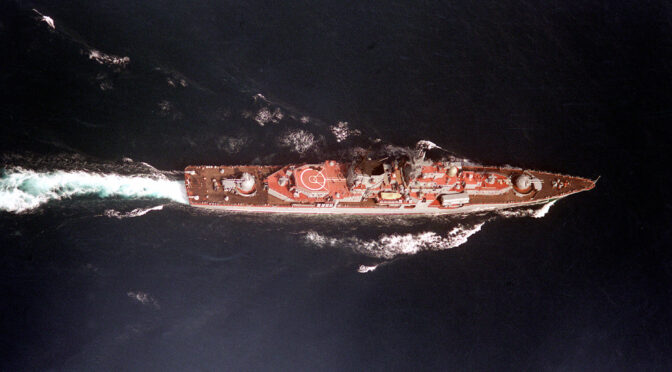
Featured Image: January 1, 1987 – An overhead view of the Soviet Sovremenny class destroyer Stoykiy (DDG-645) underway. (U.S. National Archive photo)

Robby Harris on Writing Strategy and Steady State Competition

1980s Maritime Strategy Series

By Dmitry Filipoff

CIMSEC discussed the 1980s Maritime Strategy with Capt. Robby Harris (ret.), who helped draft the 1986 unclassified version of the strategy that published in Proceedings. In this discussion, Harris discusses how the unclassified version was initiated, how steady state competition and crisis response figured into the strategy, and how bold leadership at the highest levels of Navy leadership elevated the importance of maritime strategy.

What was your personal role and relationship with the Maritime Strategy?

In September 1982 as a brand-new Navy commander I reported for duty to the Navy’s Long Range Planning staff (OP-00X) under then-Rear Admiral Chuck Larson (later CINCPACFLT and CINCPAC). I already had higher education credentials and experience in the strategy and policy world, like many of my peers who worked on the strategy at that time. OP-00X was personal staff to CNO Admiral James Watkins. Soon after I reported for duty Admiral Larson was transferred and the OP-00X staff was combined with the staff of the CNO Executive Panel (OP-00K). OP-00K also was personal staff to the CNO responsible for providing staff support to the civilian members of the CNO Executive Panel (CEP). OP-00K provided strategic advice directly to the CNO with zero intermediaries, i.e., we did not report via the Vice CNO. The CNO Executive Panel (CEP) was a Federal Advisory Committee and the CNO was the only service chief with his own Federal Advisory Committee. Members of the CEP included some of the Cold War’s most noted strategists, including Albert and Roberta Wohlstetter, James Woolsey, Helmut (Hal) Sonnenfeldt, Henry (Harry) Rowen, Andrew Marshall, and others.

Because of the prominence of the CEP membership, CNO Watkins directed that the Maritime Strategy be briefed and discussed with the CEP several times. As a CEP staff officer, I sat in the room and observed the briefings and discussions on numerous occasions. By late 1983 I had heard the strategy briefed and discussed many times at a very high level. By early 1984 after listening to the strategy so many times it occurred to me that the strategy should be declassified and printed in USNI Proceedings. Because of my position on the CNO’s personal staff I was able to make the recommendation to CNO Watkins. CNO Watkins approved my recommendation and I was sent off to Annapolis to meet with Fred Rainbow, the editor-in-chief of Proceedings, to deliver the CNO’s decision. In late 1985 before I detached from the OP-00K staff Captain Linton Brooks and I wrote the first draft of the CNO’s Proceedings article. There were many more drafts after that initial one. The rest is history.

I should point out that I felt that the Maritime Strategy as often briefed in DC in the early 1980s over-emphasized the role of the U.S. Navy in a conflict with the Soviets and did not sufficiently emphasize the day-to-day operations of the U. S. Navy in fostering the country’s economic standing and the post-WWII order (we didn’t call it the Liberal Order then!). My colleague Captain Peter Swartz informed me that I was not alone in my belief. Peter reported that “RADM Ron Kurth felt strongly about this as well, and pushed back at me hard in front of a room full of more senior flags that I was briefing. ‘Peter, we’re never going to fight the Russians! We’re going to continue to put out fires and deploy all over the world in lesser contingencies. That’s what the strategy should be about, because that’s what it is about, in the real world.’” Peter explains further that the strategy’s emphasis on fighting the Soviets was necessary to gain leverage with the Office of the Secretary of Defense (OSD) and the Joint Staff. Nevertheless, I thought that the strategy should place greater emphasis on the Navy’s role in ensuring conventional deterrence, crisis management, and tamping down localized conflicts and crises. 

Although I certainly am not solely responsible, the final version of CNO Watkins’ Proceedings article reflects several of my recommendations and areas of emphasis. Examples include:

“…our Navy devotes much of its effort to maintaining this stability. Potential crises and the aftermath of crises have increasingly defined the location and character of our forward deployments.” 

“Since 1948, the Third World has been the most common arena for United States-Soviet competition, and this pattern will continue.” 

“Among the greatest services we can provide the nation is to operate in peacetime and in crises in a way that deter War.”

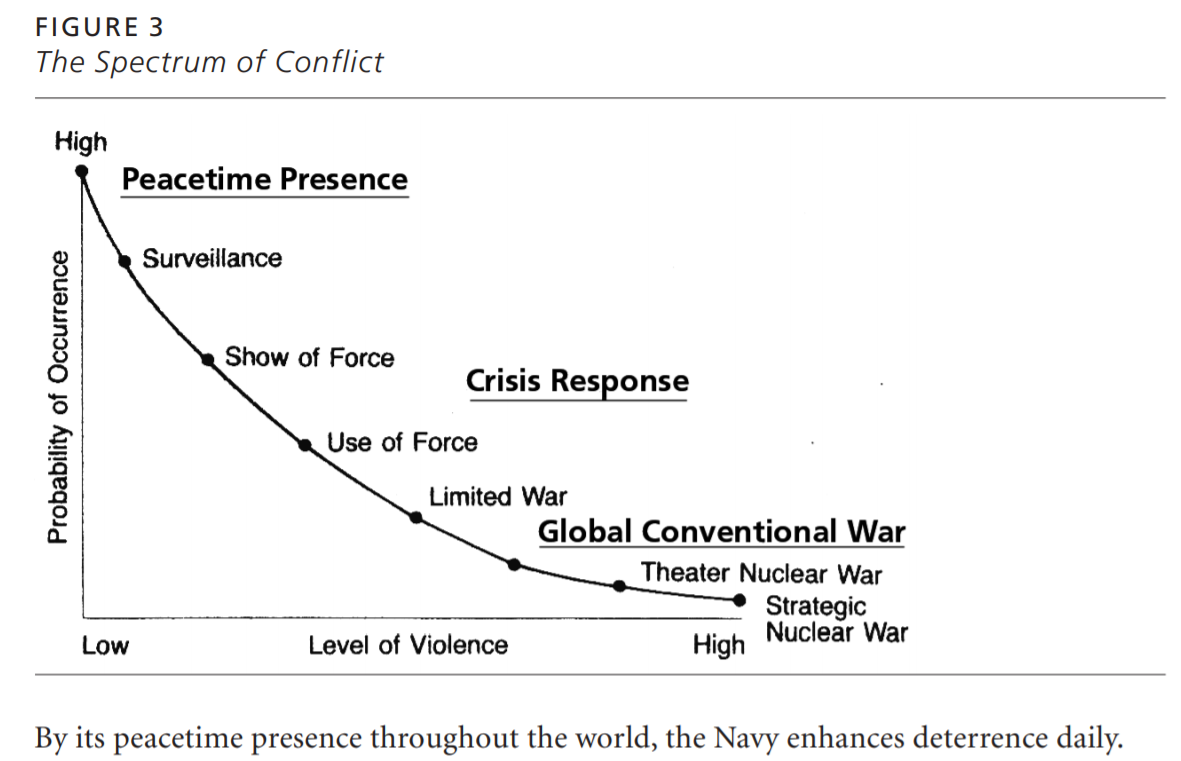
“Figure 3 which illustrates the spectrum of conflict draws attention to the importance of the lower levels of violence where Navies are most often the key actors…”

“By its peacetime presence throughout the world, the Navy enhances deterrence daily.”

 “The heart of our evolving Maritime Strategy is crisis response…our ability to contain and control crises is an important factor in our ability to prevent global conflict.” 

“Crisis response has long been the business of the Navy and Marine Corps.”

“…our peacetime strategy must support U. S. alliances and friendships. We accomplish this through a variety of peacetime operations including ships visits to foreign ports and training exercises with foreign naval forces.”

“Although deterrence is most often associated with strategic nuclear warfare, it is a much broader concept…we must deter threats ranging from terrorism to nuclear war.”

“Through early, worldwide decisive use of sea power we—along with sister services and allies as appropriate—would seek to win the crisis, to control escalation, and by the global nature of our operations, to make clear our intention to cede no area to the Soviets…”

“Through worldwide peacetime operation and the ability to react in crisis, maritime forces play a major role in binding together alliances in preventing escalation.”

What was the impact of that Proceedings article on the debate surrounding maritime strategy? 

The Proceedings article made it possible for the deckplate Navy to become aware of the strategy. When the article was published in Proceedings in January 1986 I was in the Navy command pipeline schools prior to taking command of a destroyer. Most of my classmates (commanders and captains) were completely unaware of the strategy before it was published in Proceedings.

How did the Maritime Strategy describe the balance between operations for steady state competition and operations for high-end warfighting contingencies? 

Although I cannot take full credit for it, the article provides a nice balance between forward presence, crisis response, conventual deterrence on the one hand and strategic deterrence and warfighting with the Soviets on the other hand. (See Figure 3 from the strategy below). The fiscal largesse begun in the final years of the Carter Administration and the Reagan largesse made it feasible to do both: rigorous day to day ops for reinforcing the liberal rules-based regime and preparations for a big fight with the Soviets. Since the end of the Cold War we have not seen sufficient resources to do both well.

Why did the Maritime Strategy “work,” if it did, and what about its strategy development process has been challenging to replicate since then? 

My colleague Dr. Steve Wills would probably say the difference between the 1980s and today is the Goldwater Nichols Act (GNA), and there is merit to such an argument. But even before GNA, primacy for strategy development lay outside the services and was invested in the regional commanders and the Secretary of Defense (per the Eisenhower reforms of 1953 and 1958 which had already transferred control to the CINC’s for strategy planning). As my colleague Captain Robert (Barney) Rubel has written, even before GNA the CNO Watkins/SECNAV Lehman team was “coloring outside the lines.” That to the aside, because SECNAV Lehman was such a strong leader and had the firm support of President Ronald Reagan the Navy was able to move forward with the strategy. That condition does not exist today.

What lessons can be taken from the Maritime Strategy for engaging in modern great power competition? 

Strong advocacy of maritime strategy at the highest levels of government is essential.

Captain Harris commanded USS Conolly (DD-979) and Destroyer Squadron 32. Ashore he served as Executive Director of the CNO Executive Panel. He was a CNO Fellow in CNO Strategic Studies Group XII.

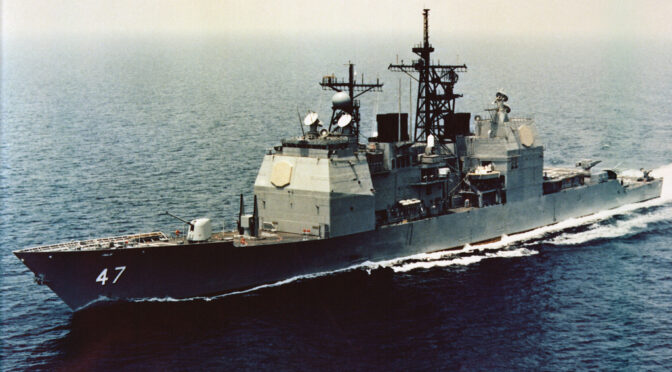
Featured Image: May 6, 1982 – An aerial port bow view of the Aegis guided missile cruiser USS TICONDEROGA (CG-47) underway during sea trials (U.S. National Archives photo)

Secretary John Lehman on Strategic Credibility and Leveraging Command of the Seas

1980s Maritime Strategy Series

By Dmitry Filipoff

CIMSEC discussed the 1980s Maritime Strategy with Secretary John Lehman, who served as the 65th Secretary of the Navy in the Reagan Administration from 1981-1987. In this discussion, Secretary Lehman looks at how the Navy tied the Maritime Strategy to force structure goals, how it built credibility with Congress, and how the Navy could offensively leverage command of the seas in a major conflict today.

How would you describe the Maritime Strategy and how was it a shift from 1970s concepts and plans?

First, the Maritime Strategy was global, not driven by NATO. It was geopolitical and based on a recognition that in the Cold War geography was a huge advantage to the U.S. and its allies. The Soviet Union was a relatively land-locked power and the U.S. and its allies were capable of easily establishing command of the seas. It was part of a three-dimensional national strategy: to maintain nuclear parity with the Soviets, to recognize that the Warsaw Pact had clear superiority in land forces, but to neutralize that advantage with overwhelming naval supremacy. President Reagan believed that the West could win the Cold War without armed conflict and that it was time to move from containment and détente to a forward strategy to demonstrate that if the East attacked NATO they would be defeated. An offensive U.S. Navy could not only protect the sea lanes, but could surround Soviet power, sink the Soviet fleet, and use the seas to blockade, mine, and strike deep into the Soviet heartland.

Navy concepts and plans in the 1970s were driven by post-Vietnam naval deterioration, exhaustion, and underfunding compounded by the almost desperate search for détente by Presidents Ford and Carter. Under Carter, the national strategy focused almost entirely on the central front in Europe, assigning only a supportive and defensive role to the Navy, with budgets reduced accordingly.

To many of us veterans of the Kissinger National Security Council and the realist academic world, this “swing strategy” was absurd. Dick Allen, Sam Huntington, Bing West, Fred Ikle, myself, and others began to meet irregularly for lunch and dinner to discuss strategy, often with active duty sailors like Jim Holloway, Ace Lyons, and Peter Swartz, who were then engaged in the mortal combat of PRM 10. It was in those informal gatherings that the Maritime Strategy first began to take shape.

In your book Command of the Seas, you said “Many retired admirals believe that the secretary of the navy should stick to administration…and leave strategy and requirements to the admirals. It never occurred to me as secretary that strategy was none of my business. In fact, it had to be my business.” How did you wield the office of the Secretary of the Navy with respect to developing and advocating for the Maritime Strategy? How should Navy Secretaries view their role on crafting strategy?

Under Title X, the SECNAV is responsible for the personnel, equipping, training, and readiness of the Navy and Marine Corps to carry out the missions assigned to them by the national strategy. Effective naval strategy is what integrates and determines the kinds of personnel policies, ships, aircraft, weapons, and training that are needed for the naval services. Hence ensuring that naval strategy is sound should be seen as the first priority of the SECNAV.

This was especially true when I was sworn in on February 5, 1981, because the new president inaugurated two weeks earlier had changed national strategy and the role that naval strategy must play, a shift in effect from a defensive to offensive posture. I had been selected because my education and experience was in geopolitics, strategy, and military affairs. I therefore had to take the lead in changing the strategy and its doctrine, concepts, and plans. My handpicked SECNAV staff included proven strategic thinkers and operators with experience in walking the walk as well as talking the talk. My immediate successors’ role in strategy was not to be a change agent but to understand the strategy and to see that it was being carried out. When the Cold War ended in victory some years later however it was time again for a new strategy.

My task as SECNAV was made easier because the CNO, Admiral Tom Hayward, was a natural strategist and had already implemented a forward strategy in the Pacific when he was Commander of the Pacific Fleet before becoming CNO.

In the future, SECNAVs must always understand naval strategy and its concepts, implementation, and its role in procurement and training.

How did the Maritime Strategy manifest in real-world fleet operations and exercises? What was the significance of these exercises?

The Maritime Strategy led immediately to dramatic changes in Navy pronouncements in Congressional testimony, beginning with my strategy testimony at the Senate Armed Services Committee the day after I was sworn in, and in public speeches, articles, and press and TV appearances by senior flag officers and civilians. A full-scale effort was immediately begun to change training syllabi, doctrine, concepts and plans, and wargames. Exercises took a little longer to modify, with the first being Ocean Venture ’81, in the North Atlantic, Norwegian, and Barents Seas. RIMPAC and other exercises in the Pacific and Mediterranean soon followed. In each, offensive mirror-image strike raids were practiced along with the usual anti-air warfare, anti-submarine warfare, and other training. In addition to the traditional training the exercises now had two additional important purposes, one was to develop new tactics using the new technology coming into the fleet, while testing real world effectiveness under the beady eyes of embarked teams of Center for Naval Analyses (CNA) operations analysts. The other prime purpose was to demonstrate to Soviet tattletales and observers how good we were and how they could not beat us.

These exercises went on in all theaters and every year. After each one there was thorough analysis of what worked and what didn’t, changing and refining tactics, improving weapons and getting better. By the late 1980s both U.S. and Soviet sailors and leaders believed that we would defeat the Soviets handily. That is of course real deterrence. The proof of its success was demonstrated not only by sensitive intelligence, but also by the now famous “Akhromeyev Map” and Gorbachev’s now public complaints about being “surrounded” by the U.S. Navy.

How did the Maritime Strategy interface with the POM process? What were the budgetary and programmatic influences of the Maritime Strategy?

In some previous and current periods, naval strategy (if you could call it that) has been derived from predicted budgets. During the 1980s, the process was reversed: first strategy, then requirements, then the POM, then budget. This was possible because the president, SecDef, SecNav, CNO/CMC, and the comptroller were all aligned on policy.

Because of that alignment and the unified message, and the simple logic of the strategy and the programs derived from it, plus the strong congressional relations and public affairs campaigns, we were able to get congressional support for the whole of the program throughout the 1980s, even two two-carrier buys. Without the strategy that could not have happened.

What was the relationship between the drive toward a 600-ship fleet and the Maritime Strategy? How did you tie force structure goals to strategy?

In all intra-DoD and interagency meetings, all classified and unclassified pubs, all congressional testimony, and public affairs, there was a disciplined message: first strategy with a global map, from strategy came five theaters of vital interest, from those theaters came the Soviet threat in being, from the threat in each theater came Navy force levels, along with allies and our Air Force and Army partners, force levels which were necessary to defeat that threat. The numbers needed to prevail in each theater were tested every year in the exercises and in the wargames at Newport. From those five totals came: 15 carriers, 100 SSNs, 140 cruisers and destroyers, 100 frigates, and the rest, adding up to 600. The logic was simple and compelling, and we never wavered year to year. More importantly, we delivered what we said we would: ships and jets on time, and on and under budget; an affordable fleet.

How did the Maritime Strategy enhance the Navy’s ability to tell its story to outside audiences, such as Congress, the other services, and allies? How was it received and challenged by these outside audiences?

The easily understood simplicity and logic of the Maritime Strategy was a great advantage, as was its unchanging consistency year after year. Unlike some prior periods, there were no significant disagreeing leaks from within the Navy or Marines. Truth to be told, there were some admirals who had drunk the kool-aid in the previous administration and made it known to friends in Congress and the press that they did not like the new strategy, but they soon retired. (Stansfield Turner would always turn up on Sunday talk shows and tell people like Sam Donaldson that the Maritime Strategy was “dangerous” and that the 600-ship navy was “too expensive.”)

What lessons can be taken from the Maritime Strategy for engaging in modern great power competition?

History does not repeat itself, but it often rhymes. It is rhyming today. Once again we face a hostile world power, accompanied by an axis of lesser powers, including Russia, Iran, and North Korea, whose only common bond is hostility to the U.S.

We need a new Maritime Strategy. We need to think as a naval power and not as a land power. Naval powers use geography to their advantage. Land powers feel imprisoned by geography. It must start as always with a contemplation of the world map. Once again we find that geography and geopolitics favors us and our allies. Our principal competitor, China, is far more dependent on unfettered use of sea routes for trade and resources than was the Soviet Union. China is threatened by limited access to those vital routes, which are surrounded by American friends and allies, and beset by straits and chokepoints that can be easily interdicted. These are severe vulnerabilities to China’s economy.

To our strategic benefit, the continuing Chinese military buildup seems to be modeled on their study of Western Cold War victory and Alfred Thayer Mahan. The force they are building is not being optimized to deal with the strategy that will best serve U.S. and allied deterrence.

In the Cold War, Soviet strategy and posture was organized around the confrontation of huge armies massed in Central Europe. China’s strategy seems to be building toward a capability in the shorter term to deter U.S. forces from interfering with a military takeover of Taiwan, or if deterrence were to fail, to attack and defeat American forces at sea. For the longer term they seem to be building toward an unquestioned capability to command the Western Pacific and additional sea-lanes crucial to their economy. Such a strategy would include the Mahanian capability of destroying the American Pacific Fleet in a grand fleet battle. They have been turning the South and East China Seas into a maritime fortress in the expectation of an American Normandy-style invasion. They are making a great mistake.

American naval strategy should be quite different than the strategies that won WWII or the Cold War. Like the Maritime Strategy of the 1980s, it should be focused on the adversaries’ vulnerabilities, which in the case of China are completely different than those of the Soviet Union. China’s economy will always be dependent on uninterrupted sea-lanes spread all over the world.

The U.S. strategy to deter China should of course include the targeting of crucial mainland nodes through cyber and kinetic means, but it should be built primarily on the unquestionable capability to strangle China’s economy through closing chokepoints and straits, mining harbors, and sanctuaries. It is much, much easier to interdict such worldwide arteries than to protect them. The U.S. capability should be agile and unpredictable. Our combined forces should be designed and exercised to be rapidly configurable while moving between specific tasks and objectives. There are 50,000 islands in the Pacific, the majority well-suited for temporary offensive bases targeted on Chinese vulnerabilities. Horizontal escalation across the seas can roll up the center of gravity of China’s great power status: its global trade economy.

Without compromising some secret capabilities, the strategy should be advertised and exercised regularly as was done with the 1980s Maritime Strategy.

Such a strategy will require a larger fleet, with some different characteristics enhancing agility, flexibility, and rapidly evolving technologies, but not one materially larger than the 350- to 500-ship fleet already in planning.

A critical lesson from the Maritime Strategy is that the Navy must restore credibility with Congress and the public that it knows what kinds of ships, aircraft, and technologies are needed. And perhaps more importantly, it must know which platforms it will be able to procure at far lower cost than the recent examples of Ford, Zumwalt, and LCS.

To win back that credibility the Navy must find a way to escape the paralyzing shackles of the vast joint bureaucracy. The Navy’s leaders must restore their former iron grip on procurement, end the culture of change orders during production, and restore annual competition. Thanks to authorities enacted during Senator McCain’s tenure at the Senate Armed Services Committee, the Navy can reclaim the necessary authority, but it will take a strong SecNav and CNO to wield it effectively. Fortunately, the Marine Commandant is already in the lead with the right strategic vision.

The Hon. John F. Lehman Jr. is Chairman of J.F. Lehman & Company, a private equity investment firm. Dr. Lehman was formerly an investment banker with PaineWebber Inc. Prior to joining PaineWebber, he served for six years as Secretary of the Navy. He was President of Abington Corporation between 1977 and 1981. He served 25 years in the naval reserve. He has served as staff member to Dr. Henry Kissinger on the National Security Council, as delegate to the Force Reductions Negotiations in Vienna and as Deputy Director of the U.S. Arms Control and Disarmament Agency. Dr. Lehman served as a member of the 9/11 Commission, and the National Defense Commission. Dr. Lehman holds a B.S. from St. Joseph’s University, a B.A. and M.A. from Cambridge University and a Ph.D. from the University of Pennsylvania. He is currently an Hon. Fellow of Gonville and Caius College, Cambridge University. Dr. Lehman has written numerous books, including On Seas of Glory, Command of the Seas, Making War, and Oceans Ventured: Winning the Cold War at Sea. He is Chairman of the Princess Grace Foundation USA and is a member of the Board of Overseers of the School of Engineering at the University of Pennsylvania.

Dmitry Filipoff is CIMSEC’s Director of Online Content. Contact him at Content@cimsec.org.

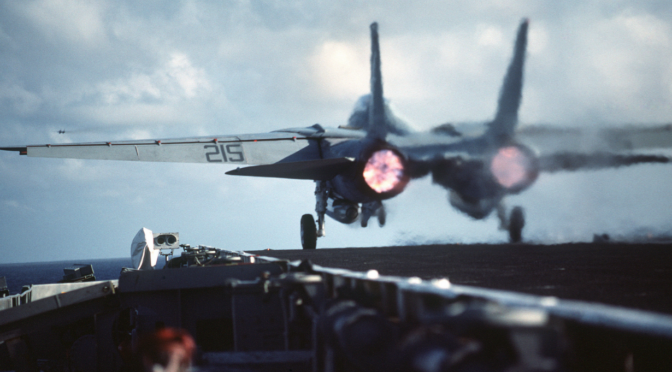
Featured Image: March 12, 1986 – An F-14A Tomcat aircraft is launched from the aircraft carrier USS JOHN F. KENNEDY (CV 67) (National Archive photo by PH1 Phil Wiggins)