All posts by Guest Author

B-1s Continue to Prove Worth Over Iraq

By Patrick Megahan
Research Associate, Military Affairs
Foundation For Defense of Democracies

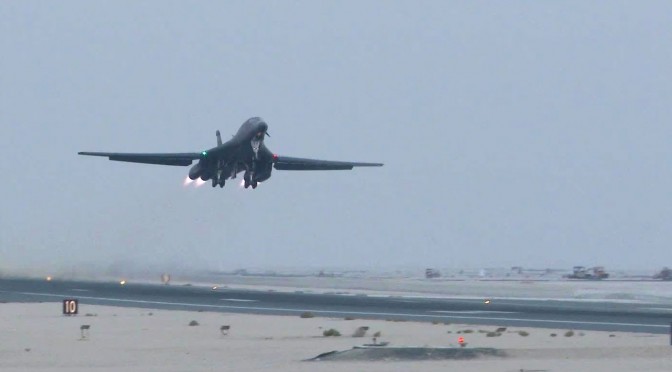
As the air war over northern Iraq expanded over the last week, Pentagon officials for first time acknowledged that land-based bombers have begun conducting strikes against the Islamic State, or ISIS, as it is formerly known. Though the specific bomber type was not named, B-1B Lancers are widely believed to be the bombers providing much needed air support to Kurdish forces who retook the Mosul Dam. The appearance of the B-1 in Iraq should come as no surprise, as its long-range, all-weather, day or night, and low- or high-altitude capabilities have made it one of the most heavily used strike aircraft in America’s air armada.

B-1s of the 7th Bomb Wing from Dyess Air Force Base in Abilene, Texas, had deployed to Al Udeid Air Base in Qatar earlier this month. The 350 service members and their B-1s replaced members of the 28th Bomb Wing, which also flies the B-1, as part of a routine six-month rotation, which both units have shared since the opening of the Afghan War in late 2001. With the U.S. still in Afghanistan and now returning to Iraq, the 7th will take on a challenge that only long-range bombers like the B-1 can meet: be on call to support operations in two different theaters while still based in Qatar.

Despite this unique ability, the B-1 has repeatedly been the target of budget hawks. Most recently, it was named as potential collateral damage in the effort to save the A-10 ‘Warthog.’ But its current deployment and continued development demonstrate how profound a mistake it would have been to discontinue the B-1

Originally developed as a nuclear bomber at the height of the Cold War, the B-1 has been continually updated to adapt to ever-changing threats the U.S. faces abroad. The B-1A variant was designed to replace the cumbersome B-52 with an agile supersonic bomber that could penetrate Soviet airspace at low level and drop nuclear weapons. But before it could ever enter service, B-1 was cancelled by the Carter administration, which cited its price tag, while arguing that air-launched cruise missiles (ALCMs) fired from the B-52 could do the same job. Four years later, President Ronald Reagan touted the B-1 as an example of Carter’s weakness on defense and revived the plane as part of the Long Range Combat Aircraft (LRCA) program.

LRCA arose because of the belief that by 1990 the B-52, even with ALCMs, would be increasingly vulnerable to improving enemy air defense systems. The updated B-1B variant promised a faster, more versatile bomber to fill the B-52’s role while augmenting the capabilities of the B-2 stealth bomber, which, at that time, was secretly still in development.

The collapse of the Soviet Union raised new questions, however. Without a nuclear-armed adversary, there seemed to be no need for a fleet of aircraft to drop nuclear bombs on distant continents. But with the rise of new conflicts, a need for long-range conventional strike capability endured. Following multiple updates, both the B-1 and the aircraft it was meant to replace, the B-52, were adapted to carry multiple types of precision-guided bombs and standoff weapons. Plus, in accordance with the START treaty, the B-1 was altered so it could no longer serve as a nuclear bomber. This allowed it to avoid the political stigma of stationing a nuclear capable bomber overseas. (Imagine the uproar from parking nuclear bombers across the Persian Gulf from Iran.)

Aside from its less controversial presence, the B-1 has a number of other advantages over its B-2 and B-52 counterparts. Its internal payload capacity is the highest at 75,000 pounds, which is 5,000 more than the B-52 and 25,000 more than the B-2. Reaching Mach 1.2, it is the only supersonic heavy bomber the U.S. possesses. It is also the cheapest to fly at $63,000 per hour of flight, compared with $72,000 for the B-52 and $135,000 for the B-2. Furthermore, as a testament to its preference among U.S. commanders, from October 2001 to September 2012 the B-1 flew 10,940 combat sorties over Iraq and Afghanistan versus the B-52’s 2,891 and the B-2’s 69. In fact, the B-1 dropped 40 percent of the bomb tonnage in the first six months of the war in Afghanistan, and, by 2012, had released 60 percent of the weapons overall. Now, it is carrying out a similar mission in Iraq.

Moreover, if, for example, the United States were to find itself in conflict in Asia, shorter-range aircraft fighters stationed at bases in Japan and South Korea would be vulnerable on the ground to long-range missile strikes. While the B-1, with its longer-range and ability to carry 24 Joint Air-to-Surface Standoff Missiles (JASSMs), could operate from far-off bases and beyond the limits of advanced air defense systems.

The B-1 could also play an important maritime role armed with the Navy’s forthcoming Long Range Anti-Ship Missile (LRASM). Paired with unmanned aircraft operating close to enemy shores, commanders will be able to direct LRASMs fired from B-1s to sink advancing warships without having to put pilots in danger. Additionally, this will complement the Navy’s own efforts over a wide battle-space, like the Pacific, providing a rapid strike capability where a limited number of friendly ships may not be able to cover.

Arguably, the one quality the B-1 does not have which critics claim will be vital in this kind of high-end conflict is stealth. But expanding evidence suggests modern stealth may soon be negated in a conflict with a sophisticated adversary.

Had the latest defense appropriation bill canned the B-1, much of this capability would have been lost until the next-generation bomber came online. Which, given that the Pentagon only just released the request for proposals and that the procurement process today is extremely sluggish, the next bomber will likely not be available for nearly a decade.

The Kurds at Mosul Dam are surely glad this did not happen.

Hampton Roads September Social

The Hampton Roads chapter is proud to announce the September meet-up, which will kick off at 6:30pm on Tuesday, September 9th and will be held in the Elizabeth River Room at Town Point Club in downtown Norfolk.

Butch Bracknell, CIMSEC member and author of the recent op-ed “Trimming Presidential War Powers,” will be addressing members on recent events in Iraq and Syria with an eye to their strategic and maritime implications.

All are welcome, but RSVPs are required (RSVP Here), as it will determine how much food is ordered for everyone. Please also note the dress code of business casual. Hope to see you for an evening of maritime discussion!

Town-Point-Club-Norfolk-VA-bar-grill-560x310_singleImage

Sea Control 50 – Japan’s Defense Policy

seacontrol2Get ready to hear two Asia Pacific analysts share their views on Japan’s remilitarisation and its implications for regional security. Natalie Sambhi, of the Australian Strategic Policy Institute, interviews Dr Tomohiko Satake, a fellow at the National Institute for Defense Studies in Tokyo and visiting fellow at ASPI, and Dr Benjamin Schreer, a senior analyst in defence strategy at ASPI. Both analysts discuss the drivers behind the recent decision to reinterpret Japan’s constitution, the implications of Japan’s new white paper, and relations with China and Australia.

DOWNLOAD: Sea Control 50 – Japan’s Defense Policy

We are available on Itunes, Stitcher Stream Radio, etc… Remeber to subscribe, leave a comment and a 5-star rating.

Developing a Strategic Cadre in the Information Dominance Corps

“The EM-cyber environment is now so fundamental to military operations and so critical to our national interests that we must start treating it as a warfighting domain on par with – or perhaps even more important than – land, sea, air, and space.”

-Admiral Jonathan W. Greenert
Chief of Naval Operations
Proceedings Magazine, December 2012 (Vol 138/12)

EM War

The U.S. Navy has embraced the electromagnetic (EM)-cyber domain as a core warfighting domain, combining critical Navy communities in Information Warfare, Intelligence, Information Professional, Meteorology, Oceanography and Space Operations into an “Information Dominance” Corps. A series of policy statements and guiding documents have been recently published governing how the Navy will approach this domain, including the Information Dominance Roadmap (2013-2028), the Navy Information Dominance Corps Human Capital Strategy (2012-2017), and the Navy Strategy for Achieving Information Dominance (2013-2017). [1] These have been followed by the CNO’s Navigation Plan (2015-2019)  [2], which identifies combat maneuver capabilities in the EM-cyber domain as critical to the operating tenants of warfighting first, forward operating and readiness.

These all represent important steps in addressing the critical challenges we face globally as a Navy, especially from state and non-state actors who can complicate the ability of naval forces to move into a theater (anti-access) and maneuver within the theater (area-denial). We no longer occupy the “information high ground” in the EM-cyber domain, and our most advanced forces and weapons systems are held at risk not only by technologically advanced anti-ship missiles but also by inexpensive and readily available A2/AD strategies.

What is missing, however, from this plan of action is the development of a “strategic cadre” within the Information Dominance Corps, who can meet the CNO’s vision. The Human Capital Strategy identifies as its fourth goal “Create a Warfighting Culture,” which is certainly admirable and necessary. This goal is supported by two objectives: orient the “total Navy workforce to the IDC mission” and “leverage kill chain concepts (integrated fires) to depict and communicate the process through which the ID discipline contributes to the delivery of warfighting effects.” This implies an ID corps which is tactically proficient and the need for the Navy to recognize how it fits within warfighting. But it seems to skirt too close to suggesting the ID corps – and EM-cyber – enables the delivery of warfighting effects rather than delivering those effects itself. Weaponized cyber code is no different than a Tomahawk fired from a ship or submarine or a JDAM dropped from an F/A-18.

But to truly develop a warfighting culture, the IDC must have a strategic cadre within its community that develops tactics, operational concepts and strategies that blend kinetic and non-kinetic effects meeting combatant commander objectives. Surface warfare officers learn first how to “fight the ship,” and later how to “fight the Fleet.” The Information Dominance corps must learn to do the same.

maori-warriors
To become a strategic thinker, one must practice the art of strategy. Traditionally, this does not become a focus in the Navy until the more senior officer and enlisted ranks. Recently, I had the opportunity to discuss the state of Navy strategic thinking with other junior officers in the unrestricted line and land warfare communities. These brilliant young Navy and Marine Corps officers made a number of key points that apply as much to the nascent Information Dominance Corps as they do to traditional Navy warfighting domains:

• We are a Navy that emphasizes training over education. Training teaches you to fight the expected fight, but education teaches you to fight the unexpected fight.

• Administrative competency cannot replace the Clausewitzian “Genius for War” – the coup d’oeil that embodies the natural strategist. Mastering the endless checklists and standard operating procedures, while necessary, are the beginning of the journey to strategic thinking, not the culmination.

• We cannot “surge” strategic literacy, or even operational level thinking. If the talent is not there beforehand, it will not be there when we need it.

The Information Dominance Corps must take these lessons to heart and incorporate the development of a strategic cadre within the IDC. Currently the IDC emphasizes the technical skills and systems understanding to perform the individual tasks necessary to meet mission requirements. We must go a step further, cultivating the knowledge to not only operate the equipment but understand how to employ it to attack critical adversary vulnerabilities as part of the Joint Force.

Some items for consideration might be:

• Development of an Advanced Maritime EM-Cyber Operations Course, designed for junior officers who have completed their first tactical operations tour. By this point in his/her career, the young officer has qualified in their respective designator, qualified as an Information Dominance Warfare Officer and completed a forward, tactical operations tour (PCS Afloat, Direct Support, etc.). This course should provide the JO with an advanced understanding of the electromagnetic environment and how use it in various tactical and operational situations in wartime scenarios. The emphasis here, however, it not on the technical or scientific knowledge, but the employment of EM-cyber weapons during conflict. This perhaps could be the EM-cyber equivalent of a “Top Gun” school.

• Integration of EM-cyber warfare as a core component of Joint Professional Military Education (JPME) Phase I and the Naval War College / Naval Post-Graduate School programs.

• The Navy is considering the establishment of a formal Naval Strategic Enterprise to develop a cadre of naval strategic thinkers. At present, this program is only open to unrestricted line officers. Members of the Information Dominance Corps still remain restricted line officers and are ineligible to participate. The Navy Strategic Enterprise should be opened up to members of the IDC.

• Traditionally under the Composite Warfare Concept, the role Information Warfare Commander has been filled by an individual ship commanding officer. [3] This role should be redefined with an IDC officer principally assuming the IWC role.

To fully adopt a warfighting culture and treat the EM-cyber environment as a warfighting domain equivalent to, or more important than land, sea, air and space, the Information Dominance Corps must do more than develop tactical expertise in the use of specialized equipment. It must cultivate a new crop of strategic thinkers who are experts in the creative exploitation of the electromagnetic environment and blending of kinetic and non-kinetic fires to achieve warfighting effects. These new strategists must be grounded both in traditional military theory and history as well as the emerging operational concepts of fighting across the entire EM spectrum, in space and in cyberspace. Without strategic thinking, information dominance becomes impossible.

Author

LT Robert “Jake” Bebber USN is an Information Warfare officer assigned to the staff of Commander, U.S. Cyber Command. He holds a Ph.D. in Public Policy from the University of Central Florida. He is supported by his wife Dana and their son, Vincent. The views expressed here do not represent those of the U.S. Navy, U.S. Cyber Command or the Department of Defense. He welcomes your comments at jbebber@gmail.com.

References

[1] All of these documents are available at: http://www.idcsync.org/documents.

[1] http://www.navy.mil/submit/display.asp?story_id=82851

[1] The Free Library. S.v. Developing a new model for maritime tactical information dominance..” Retrieved Aug 23 2014 from http://www.thefreelibrary.com/Developing+a+new+model+for+maritime+tactical+information+dominance.-a0273903363