
By Dr. John P. Cordle, Captain, USN (Ret).
The first week of June 2026 marked a seminal event in the history of sleep and fatigue in the military. The Department of War (DOW) Fatigue Related Management Working Group hosted the first ever Sleep and Fatigue Summit with over 130 experts in the field from all military services, providing a huge burst of momentum in the area of fatigue management as an operational imperative for our warfighters. For the first time in years, there is hope that the military, and especially the Navy, is finally turning a corner in this critical arena. But there remains much work to be done.
My relationship with fatigue is a long and storied one. I joined the Navy in 1984 and grew up as a Surface Warfare Officer at a time when fatigue was seen as a badge of honor. Later serving as a Human Factors Engineer, I studied its impact on individual readiness as well as mental health and advocated for changes to Navy policy. As a veteran, I live with the effects of a lifetime of sleep deprivation and non-circadian watch rotations, hooking up to my Continuous Positive Airway Pressure (CPAP) machine every evening and dealing with obstructive sleep apnea and the onset of heart disease caused by atrial fibrillation (AFib). This is all tied to a Navy lifestyle and culture that ignored the known effects of fatigue, to the detriment of its sailors.
I am gratified that there has been solid progress in the understanding and application of fatigue mitigation policies in various parts of the Navy. However, despite both DOD direction and concrete recommendations from many authoritative bodies, including the Government Accountability Office (GAO), National Transportation Safety Board (NTSB), and Department of War (DoW), the Navy has still failed to implement an overarching fatigue management program to include education, research, and policy.
One of the last projects that I worked on as a Government Service (GS) Human Factors Engineer prior to retirement last year was trying to define the Navy’s Fatigue Management program in a single document. As with any large organization, a change like this is likely to meet bureaucratic obstacles, obfuscation, and outright obstruction… and it did. The main challenge to this effort was that no one in the Navy felt compelled to step up and say “I own this problem,” an obstacle that has now been overcome with the designation of the Office of Warfighting Advantage (OWA) as the process owner. It would be a shame to unlearn the lessons of the ship collisions of the USS McCain and USS Fitzgerald, both of which occurred in 2017. The investigations for these separate incidents identified fatigue as a significant factor in the death of 17 Sailors.
Unfortunately, this was not the last collision for which sleep was a contributing factor. In 2025 the USS Harry S. Truman suffered a collision during her deployment to the Middle East. The investigation results cited fatigue as a major factor in the collision. While no one was killed, several sailors came within inches and seconds of losing their lives. The below figures from the Navy investigation tell the story:
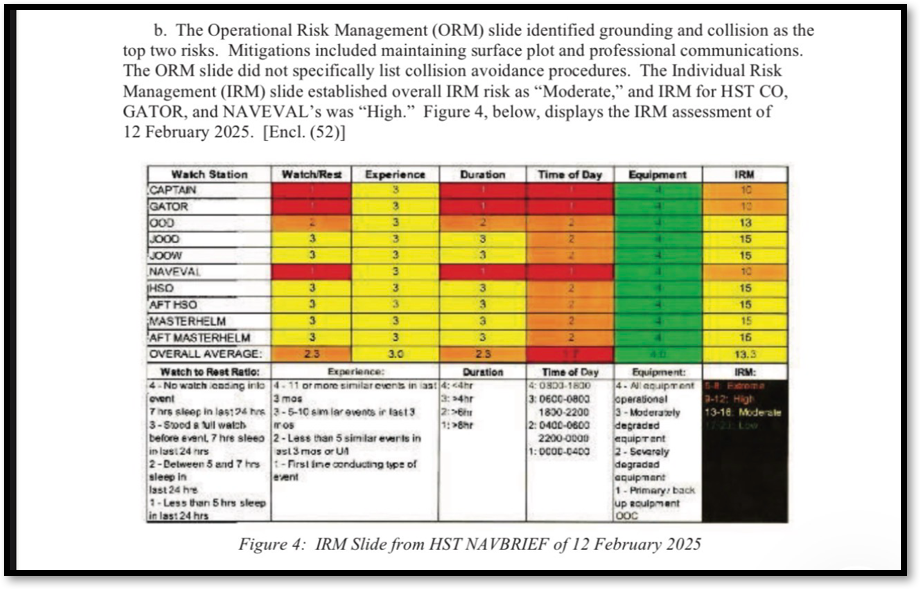
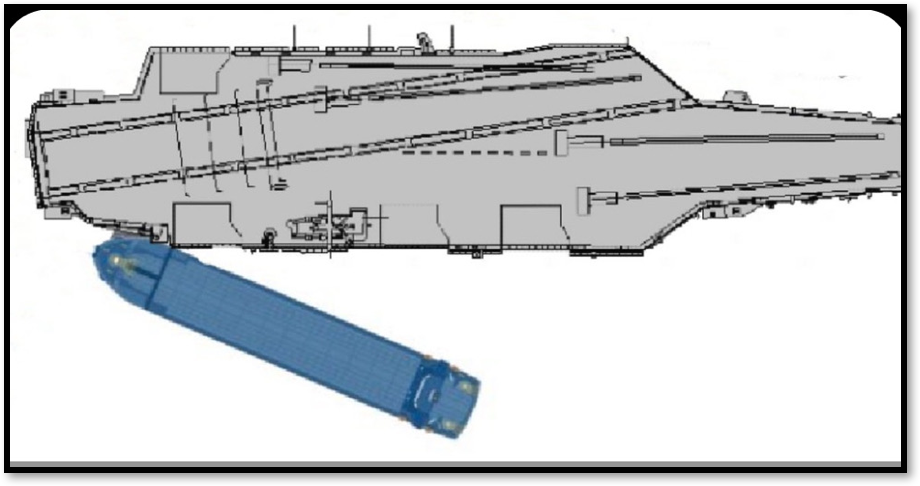
Figure 1. The Risk Management Brief specifically identified fatigue as a risk factor for senior leadership. They would not have been allowed to fly a plane in this condition but can drive a ship. The second figure shows the result. Source: Navy Investigation of USS Harry S. Truman Collision.
Eerily, (Admiral) Whalen’s investigation stated that, “… fatigue as a human factor in the collision and cited department heads who described a ‘just get it done’ atmosphere aboard the carrier. Both sailors’ lack of sleep and pressure to perform tasks regardless of risk were crucial themes in the 2017 collisions.” The similarities with the 2017 collisions are impossible to miss. And yet, eight years later, little has changed within the U.S. Navy.
To be fair, there are policies in place in most of the major warfare areas, and the last two Carrier Strike Groups deployed with sleep monitoring devices on most sailors and a program to provide sleep data to inform individual Sailors, shipboard leaders, and Navy research efforts. Specifically, the Command Readiness, Endurance and Watchstanding (CREW) program shows huge promise in collecting sleep and other biometric data and providing feedback to individuals and leadership to inform operational decision making. There is ongoing research to design more comfortable mattresses that meet material condition and fire safety requirements on board ships. My former colleagues continue to push hard for improvement in this area, but it is still largely a “bottom up” effort – they deserve full policy and financial support.
To that end, I offer here the below document as a proposed road map, including the key references and directives that should drive two significant outcomes:
First, the designation of a single entity, responsible for fatigue management in the Navy, to include resource sponsorship (funding) for research and technology. Of note, since the drafting of this article, this recommendation has occurred. The Office of Warfighting Advantage (OWA) has been designated to do just this.
Second, a formal policy for fatigue management, which includes research, education, and operational guidance for commanders.
I present the below draft document for consideration by the U.S. Navy to address this critical problem. It was the result of over one year’s collaborative effort between the Navy Sleep expert team, many of whom have moved on or retired without replacement, leaving many key billets that support sleep research and policy unfilled.
The below document represents an 80 percent solution and would provide a starting point. It is ready to download, print, and sign. But who will take that important step? I hope it does not take another deadly collision, with fatigue as a major factor, for someone in Navy leadership to stand up and say, “I will!”
OPNAVINST XXXX
Subj: United States Navy Crew Endurance and Fatigue Management Program
Ref: (a) Department of Defense Instruction 1010.10, Health Promotion and Disease Prevention (Apr. 28, 2014) (incorporating change 3, effective May 16, 2022).
(b) Department of Defense, Report to Congressional Armed Services Committees, Study on Effects of Sleep Deprivation on Readiness of Members of the Armed Forces, March 2021
(c) Secretary of Defense Memorandum, Next Steps on Suicide Prevention in the Military, March 2023
(d) GAO 24-105917 Military Readiness: Comprehensive Measures needed to Address Service Member Fatigue and Related Efforts.
(e) USFF Comprehensive Review of Surface Incidents, October 2019.
Encl. (1) Tables of Requirements and Recommendations
1. This instruction establishes overarching guidance IAW references (a) through (e) for the implementation of Crew Endurance and Fatigue Management practices to improve warfighting effectiveness across the Navy operational domain. It is intended as a framework based on scientific and operational principles to be tailored by instruction for individual communities based on specific needs of their operators.
2. Background. As described in reference (a) and (b), sleep is considered a protective factor against combat operational stress, and sleep restriction is considered a risk factor for symptoms of combat operational stress. The DOD requires that all commanders consider circadian rhythm—the body’s internal resting or wakefulness schedule over the course of a day—when creating policy related to sleep. For example, watchbills are schedules for when Sailors stand watch for fixed periods of time. Circadian rhythm watchbills are designed so that Sailors stand watch and sleep at the same time each day, allowing the body to follow its natural biological processes on a 24-hour cycle. The Suicide Prevention and Response Independent Review Committee (ref c) also made recommendations related to sleep. For example, it recommended that duty schedules allow for eight hours of sleep and minimize the frequency of shift changes, and that the department provide education in healthy sleep habits during training and unit formations. The report clearly shows the connection between sleep deprivation and fatigue as contributing factors to stress, anxiety, and even suicidal thoughts and actions.
3. Extensive research over the past decade has shown the importance of crew endurance and fatigue management to individual readiness and war fighting capability. Research has shown that cognitive ability degrades at a consistent rate as sleep deprivation progresses, with a major impact on decision making, which can prove fatal in battle. Performance starts to degrade after as little as 18 hours of wakefulness, and 24 hours without sleep can have similar impacts on performance to a blood alcohol level of 0.08 percent. While operational commitments and manning shortages may challenge leaders to provide their crew with sufficient sleep, every effort must be made through planning, education, and risk management to plan for, account for, and mitigate excessive fatigue in the fleet. This policy supports Operation Total Force and is foundational to Warrior Toughness, Operational Stress Control, and other Culture of Excellence initiatives.
4. Enclosure (1) Tables 1-3 provide a summary of DOD requirements and recommendations. They were used to produce the required actions in this instruction and are provided here for easy reference.
5. Action. This instruction does not dictate a particular watchbill or schedule but is designed to provide a set of guiding principles upon which to build a policy and tailored instruction at the Echelon III level. Collaboration is encouraged. While primarily applicable to ships, aircraft carriers, and submarines, the basic tenets apply to other teams such as staffs, guard forces and watch floors. The following precepts will be incorporation into each Type Commander’s instructions:
a. Focus on alert watch standers.
b. Implement a circadian watchbill based on a 24-hour schedule (i.e., watch, work and sleep periods occur at the same time each day).
c. Promote a sleep environment that considers complete darkness, good ventilation, ambient temperature control, and low noise levels.
d. Adjust working hours, meal hours, and daily routines to support watch standers and maintenance personnel at sea and ashore.
e. Establish periods of protected sleep to equal at least eight hours in every 24.
f. Consider individual fatigue as a risk factor for all evolutions, including go/no-go criteria for both operations and maintenance.
g. Allow additional sleep during ramp up to mission and recovery times following periods of extreme sleep deprivation or during period of high operational tempo.
h. Establish metrics and measures to track implementation of this policy at the unit level. Wearable technology is encouraged to support this effort.
i. Establish go/no-go criteria to stop or delay evolutions when fatigue poses an unacceptable risk.
j. Implement sleep and crew endurance education and training in all levels of officer and enlisted pipeline training for each community.
k. Assign one individual per unit as a sleep expert for training and support of sleep-related policies.
l. Promote good nutrition and moderation in caffeine and energy drinks into programs like Warrior Toughness, Basic Training, and command training programs.
m. Establish policies and procedures to incorporate wearable sleep monitoring technology, data collection, analysis and display commensurate with security requirements.
n. Develop guidelines for training programs which may include periods of intentional sleep deprivation to prevent inflicting harm on personnel in a training environment.
o. Develop and maintain an online repository of sleep related research and best practices.
p. One size does not fit all – Commanders should obtain analysis of watch rotations and schedules from experts such as the Naval Postgraduate School and Naval Health Research Laboratory.
6. Nothing in this instruction precludes a Commander from executing the mission assigned. Conflict with a peer competitor may be characterized by a long duration of high stress operations; the ability of Sailors and Marines to continue to operate at peak performance over long periods is critical. It is imperative that everyone from the Commanding Officer to the most junior watch stander be capable of sustaining peak performance, and sleep is a necessary prerequisite for that requirement.
Enclosure (1) Tables of DOD Requirements and Recommendations
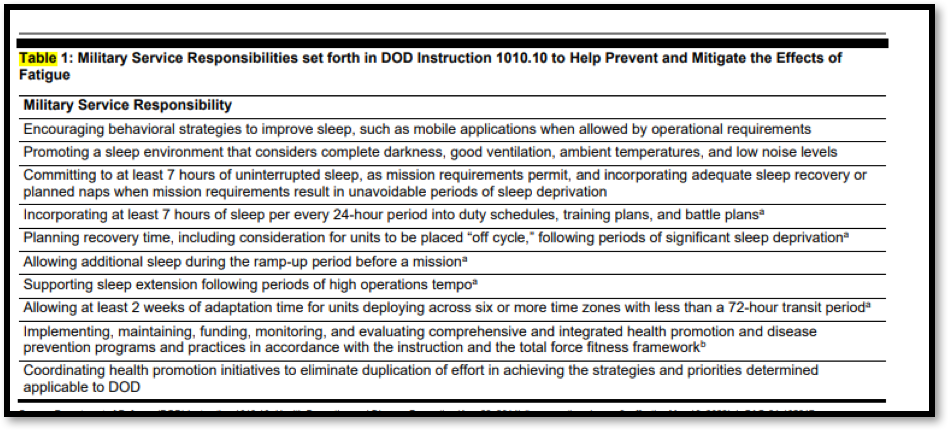 Table 1. Military Service Responsibilities set forth in ref (a), DOD Instruction 1010.10
 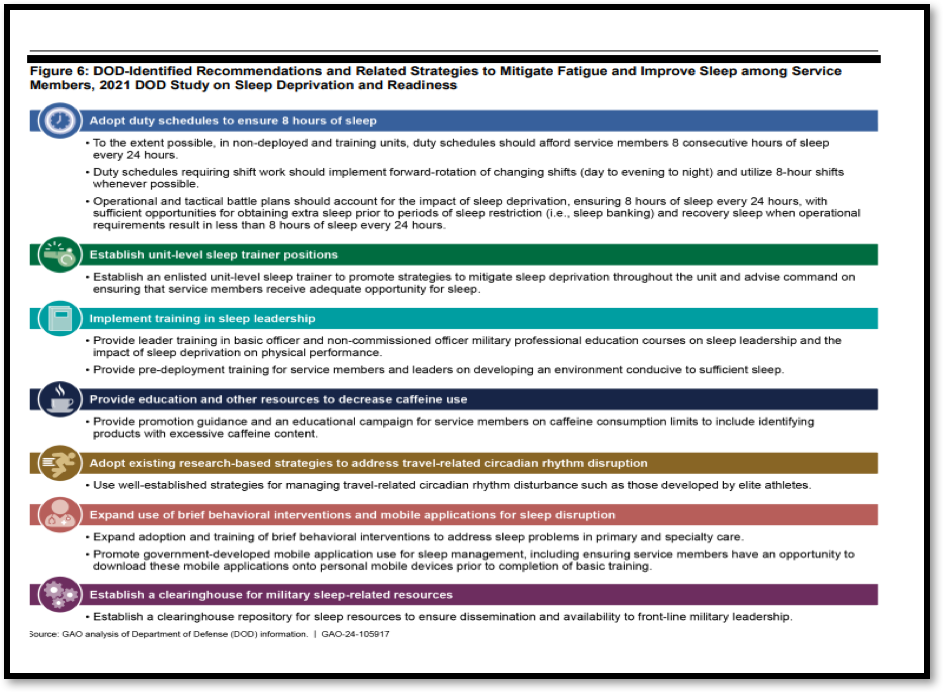 Table 2. Recommendations from Reference (b), DOD Study of Fatigue in the Military.
Table 3. Sleep Policy Recommendations from the DOD Suicide Prevention and Response Review Committee Report (2022).
The recommendations in the above instruction are grounded in existing documents; they are clear, actionable, and they will save lives. Most can be implemented with minimal cost. All it needs is a signature. But whose?
We now have an answer. The Office of Warfighting Advantage has been designated as the process owner for Fatigue Management in the Navy. They can now take ownership of the process from policy, instructions (like the above) to research and (importantly) as a budget priority. The current CNO and VCNO have well-established records of advocacy for Sailor Wellness and of recognizing the importance of sleep to mental health, physical fitness, and warfighter readiness. CNO Caudle even added Dr. Matthew Walker’s excellent book Why We Sleep to his 2026 Reading List! This is a perfect opportunity for the CNO to put his “stamp” on this service-wide safety and performance issue by demanding action – and accountability – across the force with a formal policy; maybe even a “CNOte” titled “Sleep as a Weapon!”
Certainly there are obstacles to implementing such an instruction, such as manning shortages and excessive OPTEMPO. But like rust, fatigue doesn’t care how important or busy you are; it eats away at the foundation of readiness and, if unchecked, will eventually lead to failure. The instruction above must be accompanied by strong institutional resolve; it must come with education, funding, and a culture of learning to address the “get ‘er done” and excessive “can do” attitude that contributed to both the 2017 and 2024 collisions. This instruction must be more than “checking a block”; it needs to come with a strong commitment to drive real change.
Dr. John Cordle is a retired Navy surface warfare officer (nuclear). He commanded the destroyer USS Oscar Austin and the cruiser USS San Jacinto during his 30-year military career and was recognized with the U.S. Navy League John Paul Jones Award for Inspirational Leadership.
References
1. Captain John Cordle, U.S. Navy and Dr. Nita Shattuck, “A Sea Change in Standing Watch,” USNI Proceedings, January 2013, https://www.usni.org/magazines/proceedings/2013/january/sea-change-standing-watch
2. Captain John P. Cordle, U.S. Navy (ret.), “Fatigue is the Navy’s Black Lung Disease,” USNI Proceedings, January 2020, https://www.usni.org/magazines/proceedings/2020/january/fatigue-navys-black-lung-disease
3. Captain John P. Cordle, U.S. Navy (ret.), “Go Circadian Now!”, USNI Blog, September 2017, https://blog.usni.org/posts/2017/09/22/go-circadian-now
4. Captain John P. Cordle, U.S. Navy (ret.), “Improve Sleep-Disorder Treatment for Service Members and Veterans,” USNI Proceedings, September 2022, https://www.usni.org/magazines/proceedings/2022/september/improve-sleep-disorder-treatment-service-members-and-veterans
5. Captain John P. Cordle, U.S. Navy (ret.), “Make Crew Endurance an Operational Warfighting Imperative,” CIMSEC, 23 September 2019, https://cimsec.org/make-crew-endurance-an-operational-warfighting-imperative/
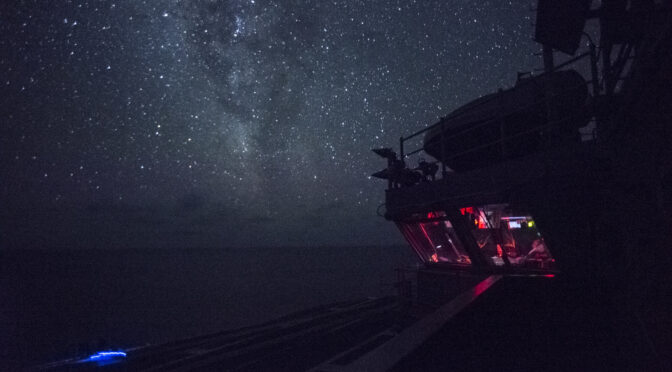
Featured image: Red lights glow from the primary flight control room aboard the USS Ronald Reagan during a darken ship period. (U.S. Navy photo by Mass Communication Specialist 3rd Class Ryan McFarlane)
Discover more from Center for International Maritime Security
Subscribe to get the latest posts sent to your email.
Suggest you study for comparison the workloads and fatigue potential for merchant marine officers. Especially Chief Officers and Masters. As a former Ch/Off and Master, I can attest to putting in longer hours for days on end than most Naval officers. Cat-naps, cigs and coffee diet. Then a good 6 or 8 hours when you could depending on conditions.
RJ
Great point! I have seen similar studies across the maritime domain. Until fatigue is taken seriously and mariners adopt similar policies and culture as aviation, such accidents will continue to occur.