
By George Galdorisi
Perspective
Military leaders often use military-industry conferences to unveil new strategies. Coming on the heels of a new National Security Strategy (NSS) issued in December 2025 and a National Defense Strategy (NDS) issued in January 2026, the U.S. Chief of Naval Operations, Admiral Daryl Caudle, revealed the Navy’s strategy designed to support the NSS and NDS, the U.S. Navy Fighting Instructions in February 2026.
The venue for unveiling this document was The Armed Forces Communications and Electronics Association (AFCEA)/U.S. Naval Institute (USNI) “West” symposium, the largest military/industry symposium on the West Coast with over 10,000 registered attendees. Admiral Caudle was the keynote speaker on day one of this event, and he provided a briefing on the U.S. Navy Fighting Instructions.
One of the key points the CNO made during this keynote, as well as during a subsequent Service Chiefs panel, was that the U.S. Navy is a differentiator. Here is how he described it in the Fighting Instructions:
“Winners set themselves apart by excelling in difficult endeavors. It is what separates successful businesses or world-class athletes from the competition. Doing difficult things well means identifying and delivering differentiated value. For the United States Navy, prioritizing what the Navy does better than anyone else—any other Service, any other Nation—is central to ensuring that the Chief of Naval Operations designs and resources a strategy that ruthlessly prioritizes the Sailors, Foundry, Fleet, and Fight needed to execute our essential global missions. We provide differentiated value to two primary stakeholders: the Nation and the Joint Force.”
The CNO’s emphasis on the U.S. Navy as a differentiator comes at a time when there is intense discussion regarding the different options for what the Navy-After-Next will look like. The discussions within the Navy, the Department of Defense, the Executive Branch, the U.S. Congress, think tanks and a plethora of other stakeholders and influencers and others have never been more varied or intense, and much of that discussion occurred during the “West” symposium.
Which Fleet?
Four options for fleet composition have gained purchase within the U.S. Navy.
The first is the Navy’s current shipbuilding plan as reported by the Congressional Research Service. This includes 381 crewed ships and a number of uncrewed surface vessels. This number comports with the recently released Navy Shipbuilding Plan which envisions a battle force inventory reaching 382 crewed ships in 2056.
The second option that has gained traction is called the “hybrid fleet.” This concept was unveiled by then-Chief of Naval Operations, Admiral Michael Gilday, and endorsed by his successors. This envisions a Navy of 350 crewed ships and 150 uncrewed surface vessels. The idea of a hybrid fleet evolved due the U.S. Navy’s ongoing challenge of building enough crewed ships to adequately meet the Navy’s global commitments.
The next option is called the “hedge fleet.” This envisions a forward-deployed force of robotic autonomous systems and crewed ships to be employed quickly in any crisis. Of the four options, the CNO spoke most extensively about the hedge fleet, explaining the rationale this way: “We need ‘tailored forces’ and a Navy that has other battle formations beyond carrier strike groups. Tailored offsets include capabilities such as attritable and easily replenishable unmanned surface vessels, unmanned undersea systems, mine warfare and cost-effective counter drone defense. The hedge fleet avoids a brittle single-purpose force.”
The final option is the “golden fleet,” a recent initiative announced by President Trump in late 2025 to rapidly expand and modernize the fleet. This plan focuses heavily on battleships alongside frigates and uncrewed surface vessels. While media reporting regarding the golden fleet centers primarily on large ships, knowledgeable observers have suggested that the small- and medium-sized uncrewed surface vessels armed with long range strike and missile defense systems will be the most strategically impactful in the near term.
One common feature among these four options is the inclusion of uncrewed surface vessels as vital assets within a future fleet. There are two reasons for this sea change.
The first is that ships are expensive to build and operate. The cost of Ford-class aircraft carrier is $13B and an Arleigh Burke destroyer is $2.2B. The new Columbia-class ballistic missile submarine approaches $10B. However, those procurement costs only represent the tip of the iceberg. Populating those vessels with sailors is also increasingly expensive, given that seventy percent of the total operating cost (TOC) of a ship over its lifespan is providing a crew year-over-year.
The second is that after over a decade of development the Navy has confidence that uncrewed surface vessels have reached a point in their development that they are no longer prototypes, but production-ready vessels (some are commercial-off-the-shelf or COTS). that are ready to deploy with their crewed counterparts.
As evidence of this technological maturity, the CNO noted how Navy and Marine Corps exercises, experiments, and demonstrations such as the those conducted by Fifth Fleet/CTF-59, Fourth Fleet and a series of uncrewed surface vessel-focused events with NATO allies have accelerated the development of these craft. As just one of many examples of this testing in recent years, MARTAC, a U.S. uncrewed surface vessel designer/builder, has frequently been invited to showcase its MANTAS T12, Devil Ray T24 and Devil Ray T38 unmanned surface vessels (USV) to a wide range of Navy and Marine Corps at-sea events.
These events have included the U.S. Pacific Fleet-led Integrated Battle Problem series of exercises, the Integrated Maritime Exercise series held under the auspices of U.S. Naval Forces Central Command/Commander Task Force 59 in the Arabian Gulf, NATO exercises BALTOPS, REPMUS, and the follow-on Dynamic Messenger, Australian Defence Force Exercise Autonomous Warrior, among others.
The Navy Shipbuilding Plan reveals how this confidence in the technical maturity of uncrewed surface vehicles has given the Navy confidence to provide funding for USVs to: “serve as a direct, dual-use supplement to existing ready forces, providing a flexible “tailored force” to enhance the nation’s maritime posture.”
The number of medium uncrewed surface vessels (MUSVs) projected in the Shipbuilding Plan are substantial, growing from 39 in FY27 to 83 in FY31 when MUSVs will comprise 18% of the Navy’s fleet. As the Plan explains, MUSV integration will unburden higher-value assets, such as Arleigh Burke-class destroyers, as the autonomous fleet can take up long endurance maritime domain awareness missions.
The Road Ahead
Regardless of which design for the Navy-After-Next prevails in the coming years – be it one of the existing conceptual designs, a hybrid design drawing elements from among these options, or a completely different design – a future U.S. Navy comprised of formations of integrated crewed ships and uncrewed surface vessels represents a once-in-a-generation sea change for the U.S. Navy.
While deciding on the composition of the Navy-After-Next is a necessary first step it is not a sufficient one. The U.S. Congress has been reluctant to authorize the Navy’s planned investment of billions of dollars in USVs until the Service can come up with a concept-of-operations (CONOPS) for using them. Congress has a point.
Via the Navy Shipbuilding Plan, the Navy has announced plans to procure large numbers of uncrewed systems—especially medium uncrewed surface vessels—but a CONOPS, in even the most basic form, has not yet emerged. Such a CONOPS must be thoughtfully conceived, analyzed, vetted through stakeholders, war-gamed and widely distributed. Only through this disciplined process can the Navy-After-Next be the strongest Navy the nation can field.
Captain George Galdorisi, USN (Ret.) is a career naval aviator and national security professional. During his 30-year career he had four tours in command and served as a carrier strike group chief of staff. Additionally, he led the U.S. delegation for military-to-military talks with the Chinese Navy. He is the Emeritus Director of Strategic Assessments and Technical Futures at the Naval Information Warfare Center Pacific. He is the author of seventeen books, including four consecutive New York Times bestsellers. His most recent novel, Fire and Ice, is eerily prescient, as it foresaw Russia’s invasion of Ukraine.
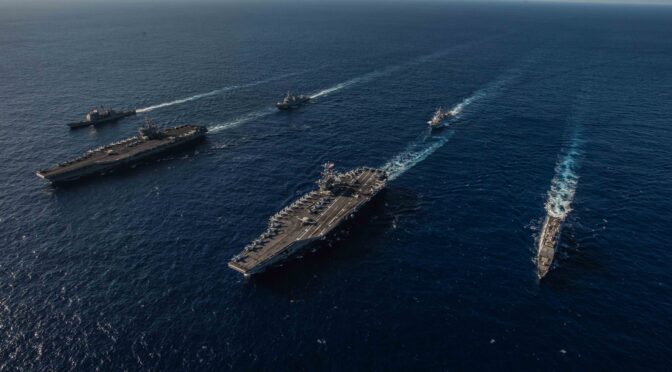
Featured Image: PHILIPPINE SEA (Nov. 16, 2018) Ships with the Ronald Reagan Carrier Strike Group and John C. Stennis Carrier Strike Group transit the Philippine Sea during dual carrier operations. (U.S. Navy photo)
Discover more from Center for International Maritime Security
Subscribe to get the latest posts sent to your email.
The article effectively highlights a pivotal shift in U.S. naval strategy, emphasizing the Navy’s role as a “differentiator” while grappling with competing visions for its future force structure. It underscores how rising costs and evolving technology are driving the integration of uncrewed surface vessels across all proposed fleet models, marking a significant transformation in maritime operations. However, the piece also raises a critical concern: while the Navy appears confident in the maturity and value of these systems, it has yet to clearly articulate a comprehensive concept of operations, which is essential for securing congressional support and ensuring effective deployment. Ultimately, the article persuasively argues that the success of the Navy-After-Next will depend not just on choosing the right mix of platforms, but on developing a coherent strategy that fully integrates these capabilities into future naval warfare.
Capt George Galdorisi has, in the past 10 years, published a number of Uncrewed Surface Vehicle (USV) articles and is knowledgeable of the growth of this community. This article is timely and right on target for where the Navy needs to proceed. Many of these USV have already been designed, built and tested at private expense. They are already commercially available and ready to support the Navy mission. It is up to the Navy, and its acquisition community, to start a more “sincere effort” to get these under contract, into production and start fielding them to work with the fleet units on specific mission. The industry has already spent much of its own funding and is on track to make that happen. Now the U.S. Govt needs to support their effort without any reliance on what has been a traditionally slow acquisition process. If the design is complete and the USV craft is built and tested, then the Govt needs to go the next step of “operationally acceptable”. We need these craft to augment our manned ships in a hedge or hybrid environment. The technology is there now and it needs to be implemented soonest.
It’s really something to see how rapidly militaries are shifting towards drones. It seems inevitable that hybrid navies will become the standard in the next few years.
It also makes so much sense from a functional standpoint. Taking these big expensive ships and offloading some of the equipment and function into smaller modular boats that act as a single unit seems like it would reduce both cost and risk.