Tag Archives: US Navy

Where is the U.S. Navy Going To Put Them All? (Part Three)

Where is the U.S. Navy Going To Put Them All?

Part 3: Two New Ship Classes.
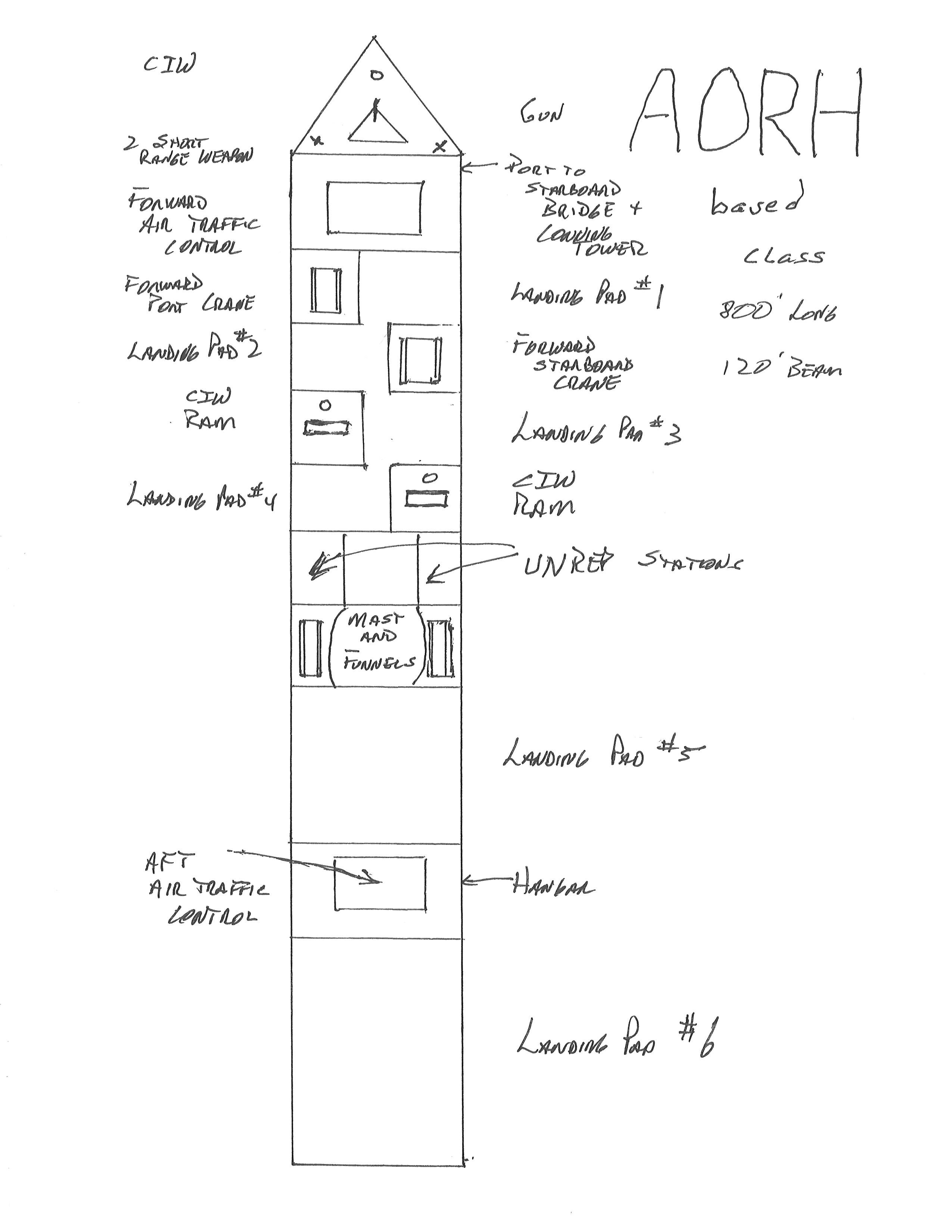
Sketch by Jan Musil. Hand drawn on quarter-inch graph paper. Each square equals twenty by twenty feet.

This article, the third of the series, presents two ship classes that can be used to take to sea the various UAVs, UUVs and buoys suggested in the previous two articles. These ships can provide the space needed to operate, maintain and hangar the equipment as well as house the necessary sailors. Read Part One, Part Two.

The first class, the CVLN (carrier aviation light, nuclear powered), is intended to operate with the two main carrier task forces, providing a home for the many ISR drones, UUVs, UAVs and buoys needed in the increasingly dangerous A2AD environment and to prosecute ASW. The second suggested class, the AORH (auxiliary oiler replenishment helicopter), is intentionally designed to routinely operate far from a CSG, frequently in association with either allied or local navies. The AORH is expressly designed to carry out a wide variety of missions with substantially lower initial construction costs and lower lifetime operating costs.

CVLN class

The intent of the CVLN class is to provide a deep blue sea platform that can operate, in fact come to be seen as needed to operate, with the two primary carrier task forces the U.S. Navy operates. Currently these task forces are almost always on station in the Western Pacific or the Gulf region. Adding a CVLN to the task force provides a home for the ISR drones, so useful in a contested A2AD environment as well as a home for the additional ASW assets the UUVs and Fire Scouts bring to the fleet.

By making the new platform nuclear powered the ship will be able to keep up with the CVNs, in both a strategic as well as a tactical sense. If the President suddenly needs a carrier strike group hundreds or thousands of miles away from their current position, the CVLN will be a fast complement to the CSG. A CVLN that can keep up with the CSGs affords the task force some very useful ASW protection both in transit and upon arrival. In addition, it will provide a permanent arc of ISR drones on the search, locate, transmit and target mission.

As for the tactical use of speed, in naval combat close almost always doesn’t count, and being able to accelerate over a 5-15 minute period at nuclear powered speeds can be just enough to survive an incoming strike. And once more, it allows the CVLN to keep up with the CVNs.

While building a nuclear powered CVLN is of course more expensive initially, once lifetime construction, operating and maintenance costs are considered, it should be notably less costly than an oil powered ship. Installing two of the existing nuclear reactors in use with the new CVNs aboard should provide plenty of power to move 45k tons around effectively and efficiently.

An obvious existing ship class to consider as a starting point for the new CVLN is the existing LHA/LHD design, but tweaked to accommodate nuclear power. If a canted flight deck and catapult were deemed necessary another alternative would be to revisit the old Midway class for design ideas.

CVLN Equipment

So how should the CVLN be equipped? A ski jump or canted flight deck should certainly be considered, although even if the ISR drone is fixed wing it should be small enough to launch off an LHD-style ship. If some of the modified S-3 Vikings or new refueling drones are going to be carried, then the extra expense of a canted flight deck will have to be incurred. Either way, the following, rather basic list of desired equipment should provide the reader with a good idea of what the CVLN will be accomplishing.

The navy should investigate whether it is practical to install one railgun, probably on the fight deck just before the island, aboard a CVLN. Obvious problems to be solved include insuring enough power is available, providing the space for the needed large capacitor just below the railgun and meeting the usual cost-to-benefit analysis applied to any new feature sent to sea.

2 CIWS mounted fore and aft and at least one RAM missile launcher for anti-missile defense are necessities.

15+ ISR drones with traditional jet engines or upgraded Osprey tilt-rotors are needed to execute the search, locate, network and target mission.

4+ UUVs plus the needed docking/launching buoys needed to get them in and out of the water.

15+ Fire Scouts and around 75 ASW oriented TIF Buoys.

4+ Seahawks

1 SAR team with associated equipment.

AORH class

The second suggested choice for the U.S. Navy to add is a ship class based on a modified AOR sized and double hulled design without a full flight deck, approximately 25k tons and oil powered. This class is intended to provide very substantial helicopter and VTOL launching and servicing capabilities, for ASW, amphibious, special-ops or other missions and then executing these missions over the years alongside a large variety of allied nation navies; hence the built in patrol boat capabilities as well as at least one UNREP station port and starboard.

The AORH is a solution to use, at a much lower cost than a CVLN in locations where a carrier task force is not present across the globe, especially in the Arctic, South China Sea, Gulf region and perhaps Northeastern Asia. These are obvious locations to homeport one of each of these ships permanently, but a standard rotation of three ships, perhaps only two ice-strengthened ones are needed for the Arctic, should be built for each requirement.

Reading the list of suggested equipment and capabilities below should provide a good grasp of the variety of missions, and not just ASW or amphibious, this class of ships will be capable of. The abilities this class will provide will substantially augment the small surface force combatants nations in the area already possess.

There has not been a great deal published on what the newly designated Arctic Command is going to deploy. Or do. As far as the U.S. Navy is concerned, my suggestion is to use ice-strengthened versions of what we already have and focus on the only realistic threat, submarines, that the fleet is likely to encounter up there. Let the Air Force provide air cover and if it comes to it, aerial strike capabilities out of Alaska or Greenland. As for ASW or ASuW capabilities, a task force composed of an AORH serving as flagship, 2-3 of the new ASW frigates, a Los Angeles class SSN and a Coast Guard icebreaker on an as needed basis should be ample to meet the nations needs up there.

As for more substantial portions of the fleet, there simply are not enough targets to justify the routine presence of a CCG or DDG. As for an amphibious ship, the American taxpayer as well as our Arctic neighbors should be asking just who we intend to invade up there. There simply is no need for these kinds of assets.

Operating in the Arctic is a new reality that the U.S. Navy has to add to its long list missions to accomplish. But a very limited list of ice-strengthened surface assets concentrating on the ASW mission, a SSN and Air Force provided top cover should handily do the job.

AORH equipment

Once more the following, rather basic list, of desired equipment should provide the reader with a good idea of what the double hulled, AORH should be equipped with.

A gun of some sort and since we have lots of 5-inch guns available one of these will probably be installed. One of the OTO-Melara 76mm family would also function well, possibly even be preferable over the 5-inch gun.

4 CIWS and at least 2 RAM missile launchers, and room for more should be considered if feasible. These are not going to be stealthy ships; they will be sailing in harm’s way, often in littoral waters and WILL be considered high value targets.

4+ ISR drones IF fitted with the new engine upgrade for the Osprey, allowing them to function as a VTOL capable airframe. Without VTOL capabilities the AORH will operate with the ScanEagle like the rest of the fleet.

4+ UUV drones plus the needed docking/launching buoys needed to get them in and out of the water.

15+ Fire Scouts and around 75 ASW oriented TIF Buoys.

4+ Seahawks

Flagship capable in the sense of having both working as well as berthing space aboard for a small task force commander’s team, which will occasionally be multinational.

1 SAR team with associated equipment.

This class will almost certainly be tasked from time to time with hosting Seals and Special Operations teams and their equipment as they come and go on their missions. Ample berthing, operating and maintenance spaces need to be designed into the class. In addition, room for the necessary crane capacity should be available to handle:

2 25’ Mark V.1 Patrol Boats and 2 Mark VI 85’ Patrol Boats

OR

4-6+ Mark V.1 Patrol Boats

The ability to berth and support a company of Marines.

The ability to support the operations of 2-4 of the Marines CH-53E/K helicopters.

Plus the ability to berth and operate on a add something, drop something off basis, whatever additional helicopters or small amphibs the Marine Corp might want to bring aboard.

Summation

The new abilities unmanned flight brings to the fleet are potentially very useful. But as discussed above, achieving the benefits frequently requires the use of the new drones in quantity. The suggested ship classes are two possible ways to get the needed UAVs, UUVs and buoys into the fleet. Another choice is certainly possible though and now is a good time to start discussing the topic.

In the next article we will examine how the Navy can add the railgun to the fleet in quantity and make use of its distinctive qualities in an effective manner. Read Part Four here.

Jan Musil is a Vietnam era Navy veteran, disenchanted ex-corporate middle manager and long time entrepreneur currently working as an author of science fiction novels. He is also a long-standing student of navies in general, post-1930 ship construction thinking, design hopes versus actual results and fleet composition debates of the twentieth century.
CIMSEC content is and always will be free; consider a voluntary monthly donation to offset our operational costs. As always, it is your support and patronage that have allowed us to build this community – and we are incredibly grateful.

Select a Donation Option (USD)

Enter Donation Amount (USD)

Call for Articles: Future of Naval Aviation Week, Sep 14-18

Week Dates: 14-18 Sept 15
Articles Due: 9 Sept 15
Article Length: 500-1500 Words
Submit to: nextwar(at)cimsec(dot)org

Back in January, CAPT Jerry Hendrix (USN, Ret) and CDR Bryan McGrath (USN, Ret) had a stirring debate on the future of Aircraft Carriers. However, the debate quickly shifted from the carrier itself to the nature of the airwing it carried. Indeed, the carrier is nothing more than a host for the platforms provided by naval aviation – and only one of many ships that can carry aviation assets.

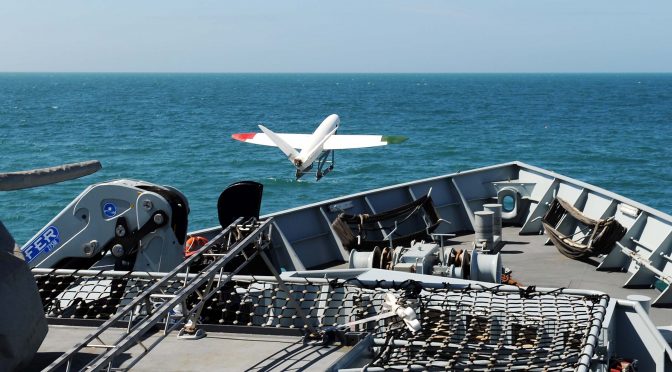
That discussion, driving into the world of the carrier air wing, was the inspiration for this week of discussion on naval aviation in general. From the maritime patrol aircraft deployed from the reclaimed Chinese reefs in the South China Sea, to US Army Apaches operating from amphibious assault ships, to 3-D printed drones flown off a Royal Navy offshore patrol vessel, to manned and unmanned ideas for the carrier air wing as carriers proliferate around the Pacific  -we want your ideas and observations on where global naval aviation will and can go next.

How will the littoral navies of the world change with new, lower-cost unmanned aviation assets? Are carriers armed with legions of long-range unmanned drones the future for global powers – will these technologies exponentially increase the importance of smaller carriers – or is unmanned technology a limited path that may be resisted (rightfully?) by pilots and their communities? Will surface fleets embrace the potential from easily produced drone swarms deployed from ships of the line… should they? What is the future of land-based naval aviation? What innovations will be ignored, what will be embraced, and what will the air assets of future fleets around the world look like? What will the institutions, the leadership, and C2 structures that support all these assets of their varied nations look like? The topic is purposefully broad to bring forward a myriad of topics and inspire future topic weeks on more specific subjects.

Contributions should be between 500 and 1500 words in length and submitted no later than 9 September 2015. Publication reviews will also be accepted. This project will be co-edited by LT Wick Hobson (USN) and, as always, Sally DeBoer from our editorial pool.

Matthew Hipple, President of CIMSEC, is a US Navy Surface Wafare Officer and graduate of Georgetown’s School of Foreign Service. He hosts the Sea Control podcast and regularly jumps the fence to write for USNI and War on the Rocks.

Where is the U.S. Navy Going To Put Them All? (Part Two)

Where is the U.S. Navy Going To Put Them All?

Part 2: UUVs, Fire Scouts and buoys and why the Navy needs lot’s of them.

AORH class jpeg

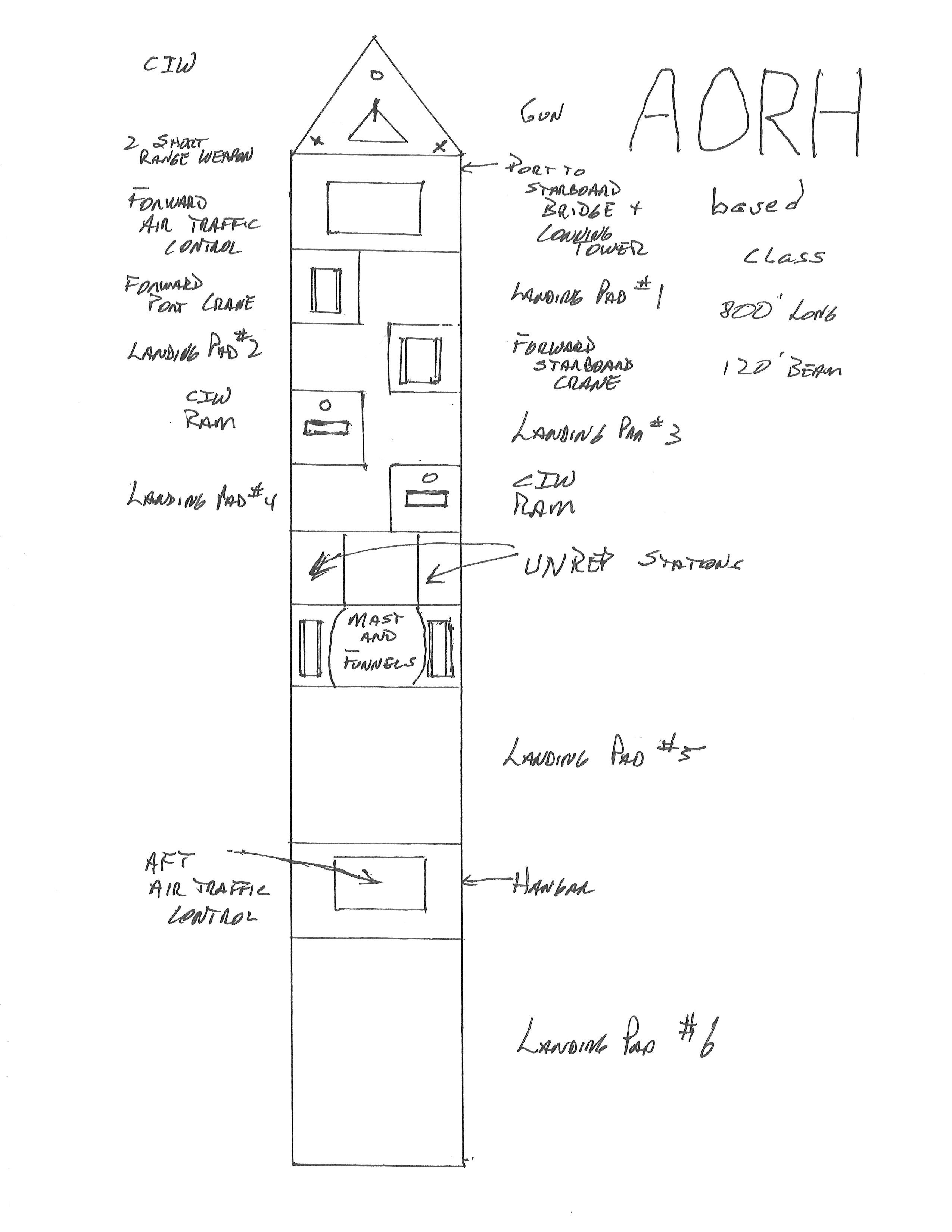
Sketch by Jan Musil. Hand drawn on quarter-inch graph paper. Each square equals twenty by twenty feet.

This article, the second of the series, lays out a suggested doctrine for the use of a UUV or dipping sonar installed on a ten foot square buoy deployed and maneuvered by Fire Scout helicopters. It is an incremental strategy, primarily using what the Navy already has in hand, but adding the use of a new buoy design, in quantity, combined with appropriate doctrinal changes and vigorously applying the result to the ASW mission. Read Part One here

In getting this program underway the U.S. Navy can utilize existing sensors, primarily for prosecuting ASW, but also for mapping the bottom, underwater reconnaissance or other yet-to-be-envisioned missions. In practice, generating useful results is far easier to accomplish if the UUV or dipping sonar is routinely, though not exclusively, used with a tether so the data generated can easily be transmitted back to its mothership for analysis and use.

Ten-Foot Square Buoy (TFS Buoy)

At this point a brief description of the buoy noted above, to be deployed in scores at any given time, is in order. A set of eight hollow, segmented and honey-combed for strength where necessary tubes, say one foot in diameter, made of a 21st century version of fiberglass can be configured in a square. Stacking the ends of the tubes on each other log cabin style, but deliberately leaving the space between each pair of tubes empty creates as much buoyancy as possible, but very deliberately reduces freeboard. Whether the resulting buoy is equipped with a dipping sonar or UUV, both the sensors and the equipment needed to operate the tether, reel for the line and so forth are going to get soaked anyway. Simultaneously, we want a minimum of tossing about in various sea states as the sonar or UUV does its job or as a helicopter drops down to utilize a hook to grab the buoy and gently lift it clear of the water. Therefore, if the waves are moving between the pairs of tubes, this will substantially reduce the buoys unavoidable movement in the water, vastly easing the helicopters task in relifting it for redeployment.

A pyramid shaped area should be installed above the tubes to provide a double sealed compartment for the motor driving the reel and its power source. Another much smaller, triple sealed compartment for the necessary electronics, radar lure and antenna is needed just above it. At this point all that is needed is to add an appropriately sized steel ring at the top for the helicopter to snag each time it moves the buoy and we have an extremely practical piece of equipment to deploy, in large numbers and at a rather low price, across the fleet.

In the years to come, the Navy can incrementally add the ability to transmit and receive on different frequencies to measure the difference in time back to the emitting sensors thereby creating additional ways to monitor the underwater environment, detect targets and potentially be less intrusive when operating amongst our cetacean neighbors. By doing so we can build a much more sophisticated picture of surrounding water conditions such as local currents, variations in thermocline depth, salinity, water temperature at varying depths and so forth as well. A good computerized analysis of these data points and a doctrine of best practices to utilize this knowledge of water conditions will leave the mission commander in a position to make much better informed decisions on where to deploy his search assets next.

Utilizing tethered UUVs and dipping sonar with a suite of frequencies to listen and broadcast on opens up interesting opportunities for the ASW mission. By significantly expanding outward the range of ocean area being searched, the Navy can realistically anticipate creating the possibility of being able to establish a rough range estimate for a detected target. Spread the sonar emitters out far enough and the use of parallax kicks in. If there is just a little difference in vector to the target from two widely separated hunters they now have a working range number. This range estimate will almost certainly be nothing close to accurate enough to fire on, but it will certainly indicate a distinct patch of ocean to direct any orbiting P-8s or other fleet elements toward. Finding a needle in haystacks is a lot easier if you have a solid clue as to which haystack you should be searching. If Fire Scouts simultaneously drop dipping sonar equipped buoys around the area in conjunction with the UUV equipped buoys, then it will be even easier to find the metaphorical needle. For discussion purposes let’s say a Fire Scout starts its day by moving one UUV equipped and four dipping sonar equipped buoys, all transmitting locally to an ISR drone or ScanEagle just overhead, in relays, across the ocean. As the hours pass an enormous amount of ocean can be searched, further and further out from the task force, yet the buoys will be able to keep up with the task force as it travels, even in dash mode. With only one buoy being moved at a time, each one briefly out of the water as it is transported hundreds or a few thousands of yards, there will be a constant stream of much better data generated for the ASW team than the existing use of sonobuoys can provide. And the deployed equipment will be able to reliably function on station for many more hours than a manned helicopter team can provide.

Perhaps not at a 24/7 rate nor for days and days on end, but a task force with 15 Fire Scouts and 75 buoys deployed, potentially separated by many miles, has added multiple alternatives to the ASW teams.

It is suggested above that 15 Fire Scouts dynamically rotate 75 UUV or dipping sonar equipped buoys across the ocean. 15 and 75 are merely suggestions though. The real point is that to derive the greatest value from the newly developed UUVs and Fire Scouts the Navy needs to be thinking in terms of a dozen plus helicopters and scores of buoys at a time, regardless of the particular mix of equipment and sensors dangling beneath them. Again, think and operate in quantity.

Nevertheless there is always a problem or three lurking around that need to be dealt with. For now we have reached the point where we need to consider the question used as the title for the article – “Where is the Navy going to put them all?”

In the next article we will examine two new ship classes that can be used by the fleet to go to sea with the various types of drones, UUVs, Fire Scouts and buoys suggested, in quantity. Read Part Three.

Jan Musil is a Vietnam era Navy veteran, disenchanted ex-corporate middle manager and long time entrepreneur currently working as an author of science fiction novels. He is also a long-standing student of navies in general, post-1930 ship construction thinking, design hopes versus actual results and fleet composition debates of the twentieth century.
CIMSEC content is and always will be free; consider a voluntary monthly donation to offset our operational costs. As always, it is your support and patronage that have allowed us to build this community – and we are incredibly grateful.

Select a Donation Option (USD)

Enter Donation Amount (USD)

LCS: The Distributed Lethality Flotilla Combatant


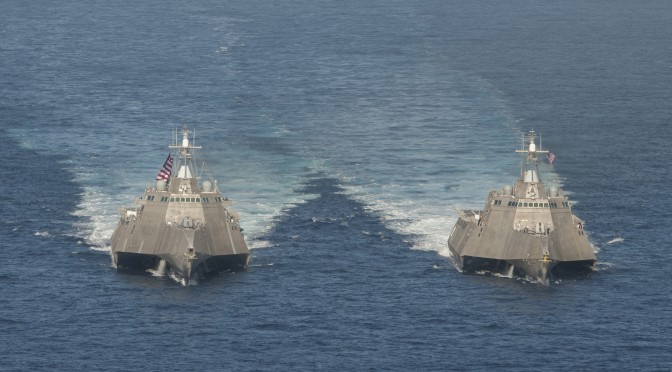
140423-N-VD564-016  PACIFIC OCEAN (April 23, 2014)  The littoral combat ships USS Independence (LCS 2), left, and USS Coronado (LCS 4) are underway in the Pacific Ocean. (U.S. Navy photo by Chief Mass Communication Specialist Keith DeVinney/Released)
PACIFIC OCEAN (April 23, 2014) The littoral combat ships USS Independence (LCS 2), left, and USS Coronado (LCS 4) are underway in the Pacific Ocean. (U.S. Navy photo by Chief Mass Communication Specialist Keith DeVinney/Released)

The Littoral Combat Ship (LCS) is the ideal platform to host a significant amount of offensive firepower in support of the emerging concept of distributive lethality. It is large enough have greater endurance and to support capabilities beyond that of the average missile combatant. Its modular approach to embarked capabilities allows for more potential offensive systems to be employed aboard than in similar ships. Deployed as a dispersed flotilla of networked combatants with other organic means of communication, it has the potential to deliver significant amounts of ordnance against a variety of targets. The dispersal of the LCS flotilla complicates and dissipates enemy counter-targeting abilities. LCS is the ideal combatant to carry forward the concept of distributed lethality into the next decade.

LCS’ Size and Modularity Brings Advantages

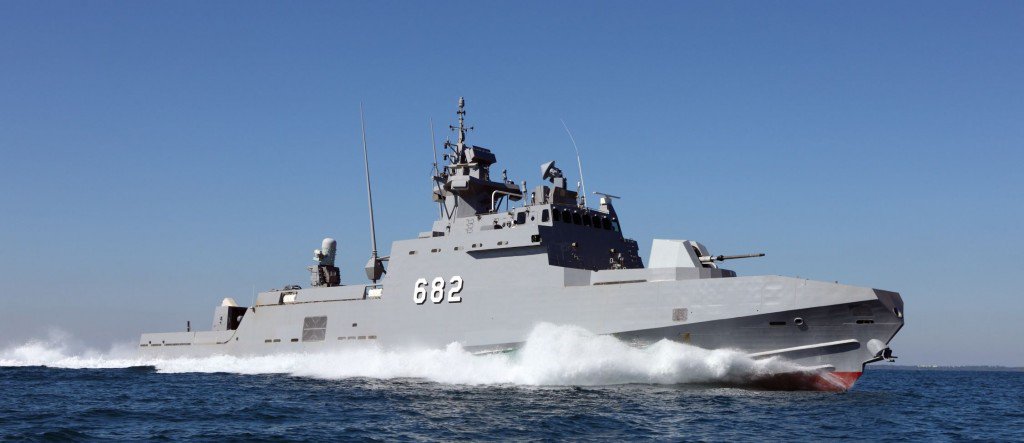
Ambassador
Ambassador class missile combatant
MH 60R on LCS
MH60R on USS Fort Worth, 2014

As described by Deputy Defense Secretary Bob Work in his 2013 history of the LCS program, the ship was always designed as a compromise between smaller, but less capable and globally deployable small combatants, and the larger, and more capable, but more expensive FFG-7 class frigate.1 Compared to smaller designs such as the Ambassador III or dedicated surface warfare corvettes like the Israeli Sa ar V, the LCS’ size and modularity offers advantages above those conventional small combatants. LCS’ has greater endurance then smaller missile combatants like the Ambassador (21 days verses 8) which enables it to remain at sea longer in support of surface warfare missions. The Saar V is more heavily armed then the baseline LCS seaframe, but supports only one rotary wing asset, and lacks the modularity to accommodate future sensors, weapons, and associated systems.
Both LCS seaframes, in contrast support two rotary wing assets (one MH-60R and one Firescout Unmanned Air Vehicle). The MH-60R in particular supports anti-surface and anti-submarine warfare missions, as well as extending the host ship’s sensors, weapons and communications capability far beyond those of a conventional missile combatant like the Ambassador.
The modularity of LCS also supports the embarkation of a more diverse set of capabilities than those hosted by mission-specific platforms like the Ambassador and the Saar V. An LCS might support a number of unmanned surface or subsurface vehicles separate from its Fire Scout UAV. Mines, additional munitions, and additional command and control equipment could also be supported depending on the desired mission. As the Spruance class destroyers later hosted Tomahawk cruise missiles, LCS’ modularity could support an array of heretofore undetermined systems and new capabilities in the future.

Keeping LCS Simple, but Lethal

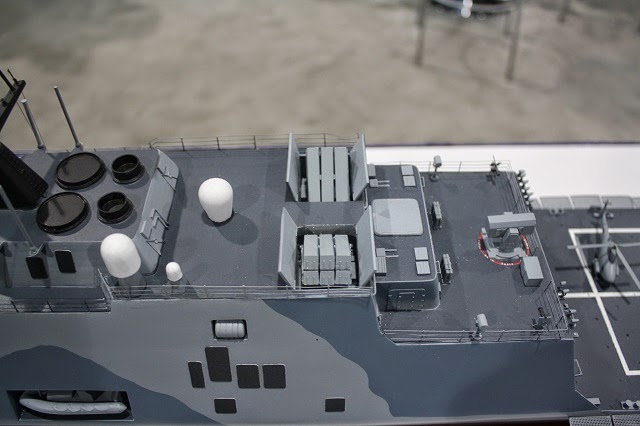
LCS 1 ASCM
Possible cruise missile arrangement in LCS-1 variant
LCS mission bay
Expansive LCS-2 mission bay

Although not presently suited to the Distributive Lethality mission, the LCS could be modified into a potent surface warfare platform with the addition of cruise missiles such as the Kongsburg/Ratheyon Naval Strike Missile. Both LCS producers (Lockheed Martin Corporation and Austal USA) have also said their respective ships could be outfitted with larger 76mm guns in place of the present 57mm weapons. While cruise missiles are a requirement for the Distributive Lethality mission, further weapons, sensors, armor and armament add little to that mission capability and increase costs which the Navy estimated to be from $60 to $75 million dollars per ship.2 This money might be better spent in additional LCS platforms as the original aim of the LCS program was to increase the size of the U.S. surface combatant fleet.
Application of additional weight for armor and warfare capabilities not related to Distributed Lethality limits the opportunity for mission package improvements in the future and could limit the number of offensive weapons the LCS can support in its current length and displacement. As reported by the GAO, LCS already has relatively tight weight ratios for further additions to the sea frames outside mission module improvements.3 Every warship is a compromise of virtues, where armament, fuel capacity, speed, survivability and other factors must be carefully balanced to achieve desired operational goals for the class. An appropriate balancing of such issues for LCS should be in favor of offensive capability to avoid the need for a costly redesign of the sea frame to support significant additions. The cost of the LCS sea frame has steadily decreased from nearly $700 million to approximately $440 million.4 Three can now be built for the cost of one DDG. This is not the time to increase the cost by redesigning the ship to fit an expanded armament. Such a process defeats the concept for making the LCS the “low” component of a new high/low mix of surface combatants.

Distribution plus Speed Equals Survival

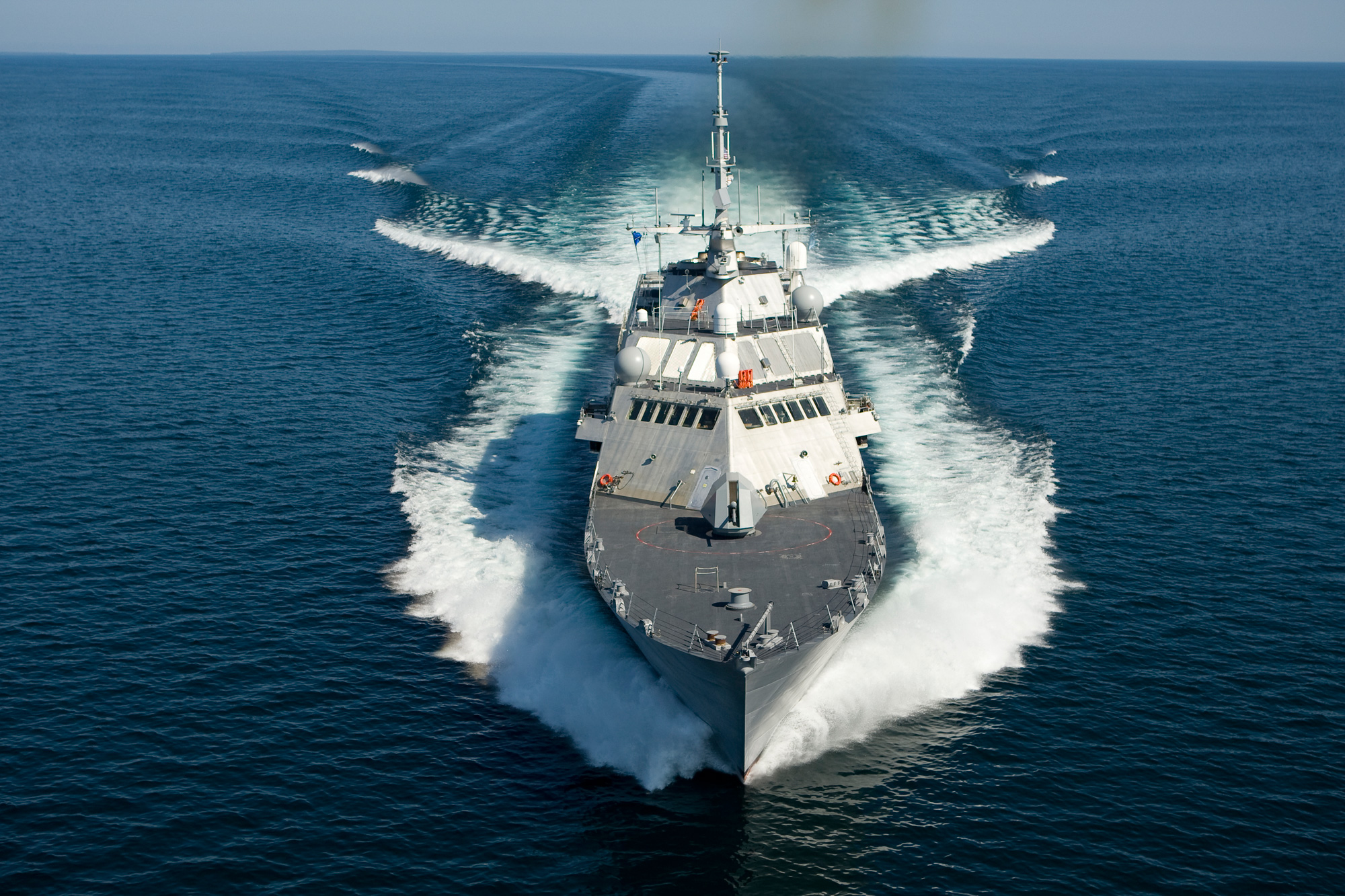
LCS at speed
Speed equals life

A squadron of LCS employed as part of a Distributive Lethality scheme will rely on their dispersed deployment pattern to reduce susceptibility to opponent targeting. The ships’ high speed, although often derided by critics is also a useful means of escaping enemy detection. An LCS capable of 40 knots can move away from a missile launch point faster than other U.S. combatants and potentially increase the area of uncertainty an opponent must consider in launching weapons down a return bearing.
An enemy would be forced to weigh significant risks in confronting such a force. An opponent might detect and attempt to eliminate one element of a distributive LCS force, but the remaining units might launch a devastating counter-salvo against therm. Such a response could cause significant harm to an unprepared, massed adversary force.
A basic LCS sea frame equipped with a moderate surface to surface missile capability could be a potent addition to the distributive lethality concept. Using means from fleet-wide networks to bring your own networks (BYON’s) created by groups of ships, a distributed LCS squadron operating as an anti-surface warfare (ASUW) formation could be a significant threat to opponent surface formations. The LCS’ larger size and rotary wing capabilities allow them to spend more time at sea, and see further beyond their own sensor horizon than smaller, dedicated missile combatants. LCS’s modularity allows the ships to bring additional weapons and capabilities to the fight beyond those of even heavily-armed corvettes and light frigates. These advantages suggest that LCS squadrons should be in the vanguard of the future distributed fleet.

Steve Wills is a retired surface warfare officer and a PhD student in military history at Ohio University. His focus areas are modern U.S. naval and military reorganization efforts and British naval strategy and policy from 1889-1941. 

1. http://awin.aviationweek.com/Portals/AWeek/Ares/work%20white%20paper.PDF, p. 13.

2.  http://www.defenseone.com/technology/2014/12/upgrades-will-let-navys-lcs-operate-more-dangerous-waters/101172/

3. http://www.gao.gov/assets/670/665114.pdf, p. 29.

4.  http://news.usni.org/2015/04/01/navy-awards-2-lcss-to-austal-1-and-advance-procurement-funding-to-lockheed-martin

CIMSEC content is and always will be free; consider a voluntary monthly donation to offset our operational costs. As always, it is your support and patronage that have allowed us to build this community – and we are incredibly grateful.

Select a Donation Option (USD)

Enter Donation Amount (USD)