This week CIMSEC is publishing articles submitted to the CIMSEC & Atlantic Council Fiction Contest on Autonomy and Future War. The authors explore the various challenges and nuances of unmanned systems through their creative writing. We appreciate their submissions. The contest announcement may be read here.
Due to the higher-than-expected response at fifteen submissions, several changes were made. First, the judging was done in two rounds. The first round judges included Sally DeBoer, President of CIMSEC, James Hasik, a nonresident Senior Fellow at the Atlantic Council, and Claude Berube, an instructor at the U.S. Naval Academy and author of the Connor Stark series of novels. Submissions were evenly split between the judges who advanced their top two choices for the final round of judging by August Cole, Peter Singer, and Larry Bond. The results of the final round of judging and the winners of the contest will be announced on November 7. To ensure fair judging, bylines were removed prior to being forwarded to the judges by the CIMSEC editorial team. Second, instead of publishing only finalist entries as originally intended, it was decided that all articles submitted in response to the call for articles would be published.
Below is a list of articles that will publish during the week. The order of publication is random and in no way reflective of judging results.
At CIMSEC, we are committed to the great maritime discussions. We believe that the best way to protect the seas is to enlist more young men and women to write and debate. The maritime dialogue that you see on our pages is written by committed men and women around the world, and has had an impact everywhere from small ships in the South China Sea to wood-paneled conference rooms in the Pentagon and other maritime nations.
In our increasingly global world, the issue of maritime security becomes more important each day. More than 80 percent of global trade travels by sea, rising powers are still attempting to exert their interests on the water, and legislative bodies and armed forces around the world are debating what their future fleets will be capable of.
In order to keep these debates lively and strong for the future, we are launching our annual CIMSEC Outreach drive on Kickstarter. This winter, we will be announcing the topic for our annual CIMSEC High School Scholarship, to be awarded in May 2017. This scholarship will be presented to one rising or graduating high school senior in the United States on a topic pertinent to maritime security.
Your contribution will help us bring our great maritime debates to as wide an audience as possible. It is in all of our best interests to encourage a thoroughly naval education for the next generation of maritime leaders.
This year, our Kickstarter goal is a modest $750. Your contributions are entirely tax deductible. As you consider how to make a lasting impact on our world, I hope you will donate what you can to strengthening our maritime dialogue, and bringing more young men and women into the debate.
RogerMisso is the Vice President of CIMSEC. He is a naval officer and student at the Harvard Kennedy School of Government.
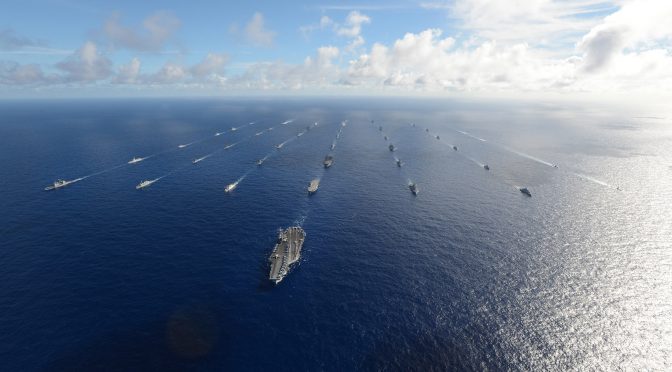
Featured Image: 42 ships and submarines representing 15 international partner nations steam in close formation during RIMPAC 2014. (U.S. Navy/MC1 Shannon Renfroe)
Beginning on 9 October, several missiles were fired at the Arleigh Burke-class guided missile destroyer USS Mason (DDG-87)in the Red Sea from Houthi-controlled territory in war-torn Yemen. Iran supports the Houthis with arms, training, and money. The United States responded by launching several land-attack missiles from the guided missile destroyer USS Nitze (DDG-94) against radar installations and other Houthi targets in Yemen. In response, Iran has deployed a pair of warships to Houthi waters, ostensibly to “protect trade vessels and oil tankers.”
Concurrently, Turkey continues its operations against Syria’s Kurds, using its rapprochement with Russia to give it political cover for more assertive military activity. As he continues tightening his grip on Turkey after the aborted coup attempt in July, President Erdogan’s venture could signal a major divergence between American and Turkish strategic goals.
Meanwhile, the Syrian ceasefire brokered by the U.S. and Russia has all but evaporated. Moscow and Washington have ceased discussions, especially after Russian airstrikes destroyed a UN aid convoy in late September.
The Middle East, never an oasis of tranquility, has reverted to its traditional template of tension and violence. Both Syria and Iraq are now failed states—targets of opportunity—for terrorist groups that burn their victims alive, and dictators that massacre their own people. The region is also home to a major portion of the world’s energy resources, and a large portion of global maritime trade passes through the various chokepoints that surround and suffuse it.
Disengagement is always tempting for great powers. The “Weary Titans” of international politics have an ear for their politicians’ rhetoric of exhaustion and weariness. This encourages isolationism, the cutting of “entanglements,” and the desire to define “national interest” as purely homeland defense. But laying down our burdens rarely works. Enemies’ animosity and ambition is spurred, not deflected if states that benefit from the international order look the other way.
This is the first conclusion of the University of Haifa and Hudson Institute Commission report on the Eastern Mediterranean released last month. Commission members included American and Israeli political and military leaders from both sides of the partisan aisle. The report reflects their agreement that disengagement is not an option. The economic relevance of the Middle East as a whole, combined with its chronic instability, the pervasiveness of terrorism and radicalism, and the power plays of larger states, will make the region strategically relevant to the U.S. for decades to come.
The authors of this report all agree that American and Israeli interests remain in alignment and that increased engagement will advance the shared interests. Both the Jewish state and the world’s greatest democracy have a critical interest in keeping the seas free for navigation, preventing hegemony on land in the Middle East, and countering both regional and global jihadist movements. The present Middle Eastern strategic situation makes this relationship more important than at any point in the past 30 years, or, arguably, at any point in history.
Israeli seapower is a large and increasing strategic concern for the Jewish state. Ringed by hostile countries, Israel relies on maritime transport for 99% of its trade. Additionally, since the early 2000s, Israel has discovered massive oil and gas reserves in its offshore Exclusive Economic Zone. These reserves are large enough to make Israel a player in the global energy market. Finally, nearly all of Israel’s major population centers lie on its coast. Israel’s economy, resources, and very survival are aided immeasurably by the strength of whatever power controls the Eastern Mediterranean. From 1973 onward, Israel could rely on a robust U.S. Sixth Fleet, complete with at least one aircraft carrier, to secure the seas and preserve its lines of communication. In return, the U.S. could rely on Israel to counterbalance regional threats, and advance its general strategic interests.
Today’s Sixth Fleet is comprised of four guided missile destroyers and a command ship. This is supplemented on occasion by U.S. surface forces that are diverted from their passage through the Mediterranean to the Persian Gulf, or from the Gulf itself, to strike land targets in Syria. Only four American fighting ships are tasked with controlling one of the world’s most critical maritime hubs. This leaves the U.S. and its allies vulnerable.
The report recommends several solutions, including greater cooperation between U.S. and Israeli naval forces, and the involvement of potential regional partners. However, there is no substitute for American and Israeli seapower. Future administrations and governments in both countries should expand their naval forces, with an eye toward establishing sea control in a contested environment, deterring mischief, and fighting, if necessary.
The Hudson-Haifa report offers future administrations a template for discussing security issues that are critical to two of the world’s most important democracies. Based on sound strategic thinking, rather than ideological biases, it avoids typical Washington political bickering, and analyzes what is in American and Israeli interests. Disengaging from the region, a frequent refrain used by both Democrats and Republicans over the last decade, only makes America weaker at the same time disregarding policy options to the point where no reasonable ones are left. Only through careful analysis and planning can the U.S. and Israel develop proper joint policies to safeguard their joint security and interest.
Seth Cropsey is a Senior Fellow at Hudson Institute, and director of Hudson’s Center for American Seapower. He is a member of the Commission on the Eastern Mediterranean Report sponsored by the University of Haifa and Hudson Institute. Dr. Cropsey served as a naval officer and as deputy Undersecretary of the Navy in the Reagan and George H. W. Bush administrations.
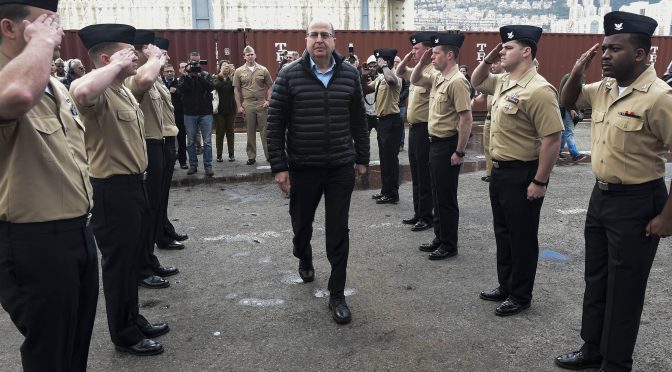
Featured Image: HAIFA, Israel (Feb. 22, 2016) Sailors render honors to Israeli Minister of Defense Moshe Ya’alon during a tour of USS Carney (DDG 64) while in port Haifa, Israel. Carney, an Arleigh Burke-class guided-missile destroyer, forward deployed to Rota, Spain, is conducting a routine patrol in the U. S. 6th Fleet area of operations in support of U.S. national security interests in Europe. (U.S. Navy photo by Ensign David Nelson/Released)
Vice Admiral Tom Rowden, Commander, Naval Surface Forces, spoke with CIMSEC about the future of surface warfare and how the surface fleet is supporting the Chief of Naval Operations’ Design for Maintaining Maritime Superiority. In particular, he discussed the ongoing development of the distributed lethality concept, how the surface warfare enterprise is evolving, and what the recently commissioned USS Zumwalt means for the future of the surface navy. This interview has been edited for length and clarity.
You are leading an effort to turn the surface navy into a more distributed force. What efforts have to be synchronized across the surface warfare enterprise to foment this transformation?
As we focus on distributed lethality I think the Distributed Lethality Task Force (DLTF) has done a phenomenal job of directing us in four areas. The first is tactics, and those tactics are focused on winning and sustaining sea control. The second is talent, and I think that is all about attracting and retaining our very best and raising the quality of performance across the force. The third is training. That’s really advanced tactical training and the development of this warrior ethos through a number of centers of excellence that we have in integrated air and missile defense, antisurface warfare, antisubmarine warfare, and antimine warfare. Finally, there’s tools, which entails offensive lethality across the board in the ships that we operate and defensive resiliency in those same ships. Tactics, talent, training, and tools, that’s really what we are focused on.
This year, three destroyers deployed as a Pacific Surface Action Group as a part of the distributed lethality concept’s development. What was learned from this deployment and what further plans do you have for refining and testing the concept?
The deployment is ongoing and we are still assessing the lessons learned. We certainly are in the process of learning about operations in the western pacific and what it means for distributed lethality and sea control. The thing I keep in mind is that when you have the opportunity to combine the lethality of three ships operating in a surface action group, the whole becomes much greater than the sum of the parts. As we look to send a PACSAG across the ocean, how do we think differently about the command and control of those ships and the utilization of their capabilities? What do we project for future surface action groups?
One of the things we are looking into is what we refer to as an upgunned ESG, which is taking a surface action group and putting it under the tactical control of an Expeditionary Strike Group that is operating forward, perhaps one with joint strike fighters. How does that tool look in the commander’s toolbox and how can we utilize that? There are a lot of opportunities to learn from the PACSAG. But as we deploy our forces, can we think differently about our independent deployers and moving them into surface action groups, providing them with a command element, and then issuing specific tasking or things to learn about how to operate those ships in a group. I think this holds great promise for the future.
What institutions are playing a key role in the development of distributed lethality and how are they contributing?
There’s a lot going on across the force. It comes back to Tactics, Talent, Training, and Tools. The Naval Surface and Mine Warfare Development Center (SMWDC) plays a big role in a lot of things we are working on. They are singled up on not only our tactics, but our training and talent as well with some influence in our tools piece, but really those three areas. On the training side of the house, I would also say the numbered fleets and certainly the Afloat Training Groups are helping with their ability to get the ships trained up.
Other folks that are contributing significantly to the development of our tactics are the numbered fleets with the large exercises we are executing such as RIMPAC. On the talent side of the house, in addition to SMWDC and the warfare tactics instructors they are developing, we are working closely with PERS41 in order to make sure from a leadership perspective that we are taking care of and properly progressing the young men and women that are coming into the surface force.
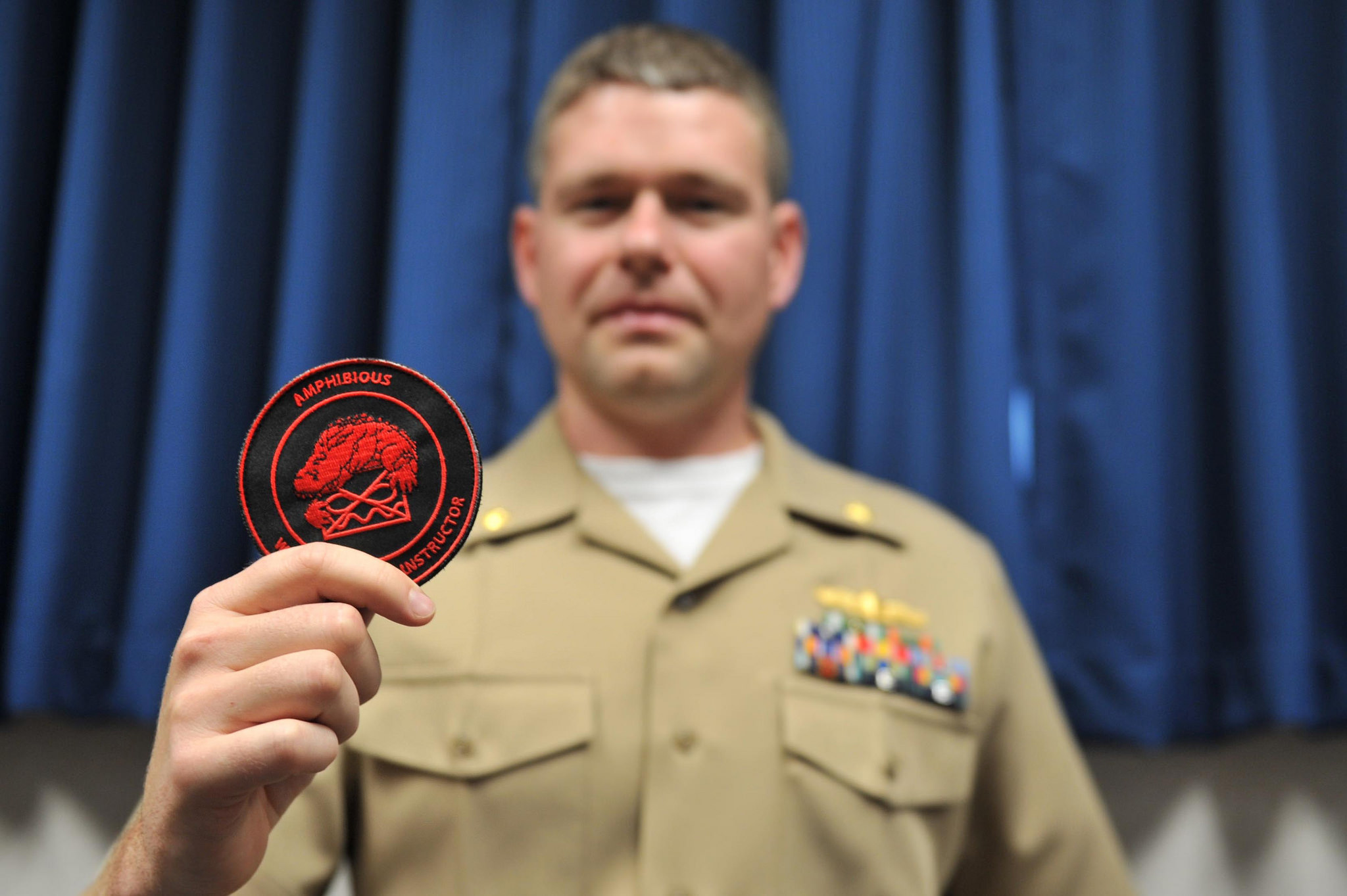
VIRGINIA BEACH, Va. (May 26, 2016) Lt. Cmdr. Dirk Sonnenberg, a graduate of Naval Surface and Mine Warfighting Development Center’s (SMWDC) Amphibious Warfare Tactics Instructor (WTI) course and winner of the course’s Iwo Jima Leadership Award, showcases the patch he and his classmates received upon graduating from the 14-week course. (U.S. Navy photo by Mass Communication Specialist 2nd Class Jamie V)
Finally, the OPNAV staff N96 and the requirements and resource folks working for RADM Boxall, Naval Research Labs, NAVSEA, and NAVAIR are contributing greatly to the “tools” concept.
With respect to the analysis we are executing, there are several significant organizations within the Naval Postgraduate School and the Naval War College that are helping us.
How do communities outside of the surface warfare enterprise such as submarines, aviation, information warfare, and others fit into distributed lethality?
The term was kind of born with the surface force and in some of the conversations we were having back in Washington D.C. when I was working the resource side for the CNO. The concepts applied not only to other communities but across the naval force and the joint force.
Truth be told we are already moving in this direction. The retirement of the SSGNs led the submariners to develop the Virginia payload module, and I think it is going to be a significant asset as we bring it online. The networking capabilities of the F35 creates airborne distributed target networks, and with the F35B coming to our bigdeck amphibs, that’s a tremendous asset we can leverage for sea control and also bring the Marine Corps in on executing the sea control mission.
We certainly are hearing more and more about operating in a more distributed manner with it being referred to as “distributed maritime operations,” which I think is an offshoot of the concept and organizing principle of distributed lethality. I think it stretches across the fleet and the joint force as well.
CIMSEC has launched several topic weeks on distributed lethality, and two in partnership with the Distributed Lethality Task Force. How have these writings contributed to the concept’s development?
We really appreciate all of CIMSEC’s efforts to raise awareness on distributed lethality and to encourage a broad spectrum of people to think about how best to improve our Navy. I think that’s critically important. It is also important to think about how we advance the distributed lethality concept from the conceptual phase into the operational phase. I think the intellectual opportunities CIMSEC provides for a larger group of thinkers is vital, and especially for our junior officers. The JOs I get to interact with on the waterfront– what a talented and excited group of young folks. Any opportunity that we can take to leverage their thoughts, enthusiasm, and professionalism seriously raises the level of discourse and can only add to the discussion.
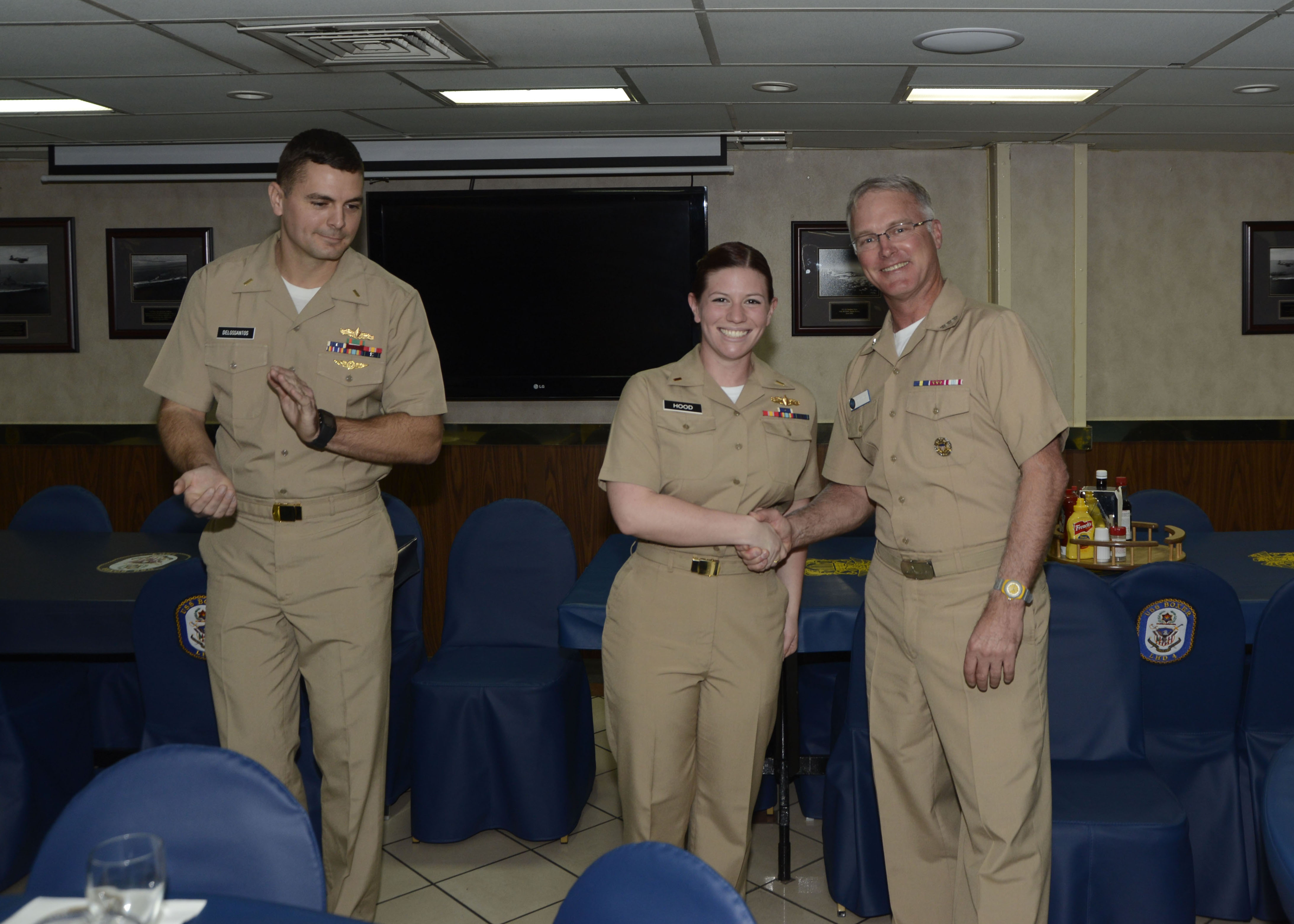
SAN DIEGO (Feb. 9, 2015) – Ens. Lauren Hood, Operations Intelligence Division Officer for the amphibious assault ship USS Boxer (LHD 4) is awarded her Surface Warfare Officer pin by Vice Adm. Thomas S. Rowden, Commander, Naval Surface Forces, in Boxer’s wardroom. (U.S. Navy photo by Mass Communication Specialist 2nd Class Briana Taylor/Released)
Where we are deriving a ton of benefit is from thinking about some of the enablers for distributed lethality. Command and Control, electronic warfare, cryptologic operations, and unmanned vehicle integration are things that are not necessarily touched by surface warfare, but we have the opportunity to reach across a broader spectrum and bring them in. I think that’s vital, and I appreciate CIMSEC’s efforts there.
Distributed lethality is not just about offensive weapons. It is about presenting an adversary with a difficult set of operational problems. Our robust C2, the facets of electronic maneuver warfare, distributed agile logistics, all of that is necessary. All of that has been featured in your forums, and that’s really important for us.
Glad to hear it, sir, thank you. Many have raised the point that more authority should be delegated to more junior commanders in order to truly enable distributed lethality. What is your vision for the command and control of a distributed force?
I envision a scalable C2 structure, and starting with a theoretical limit of perfect sensing and perfect networking. A fleet maritime operations center is capable of centralized planning and decentralized executing of fleet operations, which certainly we’ve seen before. On the other end of the scale, I see distributed operations in a mission command, comms-denied environment. One in which our commanding officers have already practiced, and where they feel confident in the employment of their weapons systems in the pursuit of the last order they received from their commander, all the while exercising the initiative required to exploit the tactical advantage wherever it is presented. That’s really what it is all about.
A week and a half ago you spoke at the USS Zumwalt commissioning ceremony, and in your remarks you stated “She builds upon more than two centuries of fighting spirit and innovation.” What will be your immediate priorities for the Zumwalt when she arrives in San Diego, and what does the Zumwalt tell us about the future of the surface navy?
I often think about what an exciting time it is not only to be a part of our Navy, but especially a part of our surface navy. We’ve got new ships, new classes of ships, and new concepts. We are working hard to recruit and retain the most talented men and women this nation has to offer, and we are working hard to improve our tactics, our training, and our procedures.
With that as a backdrop, we are really looking forward to getting her out here. We’ve got to get her through post delivery availability, through combat systems activation and testing, and to an initial operational capability. The priority is to do everything I can to give Captain Kirk the time to train his crew across the broad spectrum with which we will be able to apply this ship.
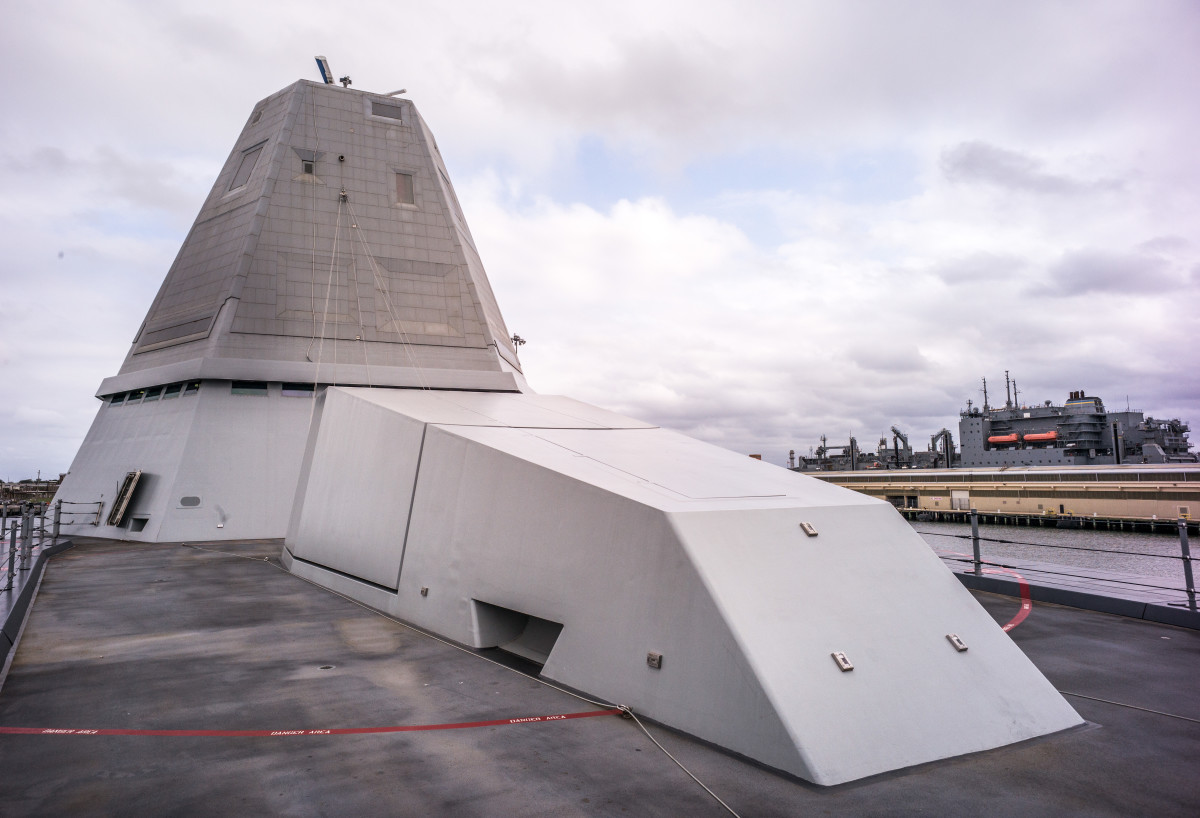
For the future of our Navy, I think Zumwalt points to some very meaningful directions. The first I think of is stealth. We specifically designed that ship to significantly reduce its radar cross-section. How can we utilize that in future operations, how we can think differently about the utility of the ship in those operations, and how might we take that knowledge and leverage that into future ship classes that we build?
On size, she is certainly larger than a DDG, but with that increased size comes increased opportunity. Just look at the vertical launch system alone. She has the ability to take much larger missiles into her MK57 VLS than we have in the MK41 VLS. Her computing power, firepower, that huge flight deck, the new undersea warfare systems, we are going to leverage all of that. The power that ship generates — 78 megawatts of power — is more power than we have generated on any other surface ship. How do we utilize and leverage that power for future weapons systems, perhaps directed energy or railguns?
Norfolk Naval Station, VA. (Sept. 16, 2016) The land attack capabilities for Zumwalt comes from the ship’s two 155m m Advanced Gun System that can toss the lethal Long Range Land Attack Projectile nearly 60 miles at a rate of 10 per minute. (Mark D. Faram/Navy Times staff)
From the computing perspective we are looking to understand the ship’s total computing environment and how that impacts our ability to fight the ship. On the survivability piece, she has something called integrated fight-through power, which allows the ship to stay up and operational even if she sustains battle damage.
Those are some of the things that we have put on the ship, and we are gonna get her out, get her operating, get her in the hands of the sailors and Captain Kirk, and have them come back and tell us how we can leverage all of these capabilities to the maximum benefit of the fleet going forward.
Any closing thoughts?
I see excitement in the fleet on a daily basis. I have the great privilege of being able to go out and spend time on our ships and spend time with our sailors. I was recently on the Makin Island for the penning of the new Chief Petty Officers. There’s a lot of excitement, professionalism, and enthusiasm out there. Not that we haven’t had all of those in the past, but I’ve got to tell you, when I go on board the ships today it is palpable.
I think it is a great time to be serving our country and a great time to be serving on our surface ships. I could not be prouder of all the young men and women that are serving on our ships and all the great folks on the acquisition side, requirements side, and support side that are making these ships great. We will continue to do the best we can for them, and I know they will continue to do their best for us back here at home.
Vice Admiral Thomas S. Rowden is Commander, Naval Surface Forces. A native of Washington, D.C., and a 1982 graduate of the United States Naval Academy, VADM Rowden has served in a diverse range of sea and shore assignments.
Dmitry Filipoff is CIMSEC’s Director of Online Content. Contact him at Nextwar@cimsec.org.
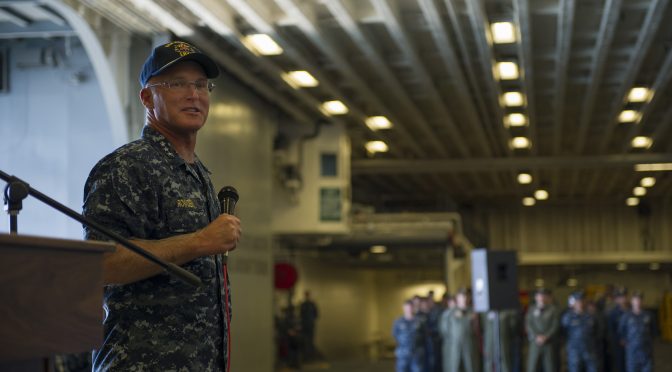
Featured Image: (November 6, 2014) Vice Adm. Thomas S. Rowden, commander, Naval Surface Forces and Naval Surface Force, U.S. Pacific Fleet, speaks to the crew on board amphibious assault ship USS America (LHA 6) during an all-hands call. (U.S. Navy photo by Mass Communication Specialist 1st Class Demetrius Kennon/Released)