The following republication is adapted from a chapter from The Politics of Naval Innovation, a paper sponsored by the Office of Net Assessment and conducted by the Strategic Research Department of the U.S. Naval War College’s Center for Naval Warfare Studies. Read it in its original form here.
By CDR Gregory A. Engel
This chapter explores the origins of the modern cruise missile and the ultimate development of the Tomahawk cruise missile, particularly the conventional variant. In keeping with the theme of the study, it focuses on the politics of cruise missile development and the implications as they relate to a Revolution in Military Affairs. The full history of cruise missiles can be traced to the development of the V-1 “buzz bomb” used in the Second World War. Since this history is available in many publications, it will not be discussed here nor is it especially pertinent to modern cruise missile development. Worth noting, however, is that the enthusiasm of many early Harpoon and Tomahawk advocates can be linked to the Regulus and other unmanned aircraft programs of the 1950s and 1960s.
What this chapter will show is that although air- and sea-launched cruise missiles (ALCM/SLCM) began along different paths neither would have come to full production and operation had it not been for intervention from the highest civilian levels. Having support from the top, however, did not mean there were not currents, crosscurrents, and eddies below the surface (i.e., at the senior and middle military levels) stirring up the political waters. Studying the challenges faced by cruise missile advocates and how they were overcome can provide valuable lessons for those tasked with developing tomorrow’s technological innovations.
The development of the modern cruise missile spanned nearly fifteen years from conception to initial operational capability (IOC). To those introduced to the cruise missile on CNN during the Gulf crisis in 1991, however, the modern cruise missile seemed more like an overnight leap from science fiction to reality. But as this chapter will show, both cruise missile technology and doctrinal adaptations were slow to be accepted.
The political and bureaucratic roads to acceptance of the sea-launched cruise missile were never smooth. As Ronald Huisken noted, “The weapons acquisition process is a most complex amalgam of political, military, technological, economic, and bureaucratic considerations …. Rational behavior in this field is particularly hard to define and even harder to enforce.”1 Since they first became feasible, the Navy demonstrated an interest in cruise missiles. But finding a champion for them among the Navy’s three primary warfighting “unions” (associated with carrier aviation, submarines and surface warfare) proved difficult. Despite the cancellation of the Regulus program in the 1960s, some surface warfighters aspired to develop an antiship cruise missile which could compete with evolving Soviet technologies. But carrier aviation was the centerpiece of naval war at sea, so initially little support could be garnered for a new variety of surface-to-surface missile. As the requirement for an antiship missile became more evident following the 1962 Cuban Missile Crisis, surface-to-air missiles (SAMs) were given some surface-to-surface capability.2
However, following the 1967 sinking of the Israeli destroyer Eilat by an Egyptian SSN-2 Styx missile, Admiral Elmo “Bud” Zumwalt, Jr., then a Rear Admiral and head of the Systems Analysis Division, was directed by Paul Nitze, the Secretary of the Navy, via Admiral Thomas Moorer, the Chief of Naval Operations, to initiate a study on cruise missiles that eventually led to the Harpoon.
When Nitze directed the Navy to undertake the study on surface-to-surface missiles, there were two prevailing military requirements. The first was that the US needed such a capability to counter the growing strategic potential of the Soviets. The second was to improve the US’s strategic balance. During this period, there was growing alarm over the rapidly expanding Soviet nuclear missile arsenal and the naval shipbuilding race which (to some) the Soviets appeared to be winning. Admiral Zumwalt was one of those concerned individuals and saw the cruise missile as a required capability. He brought this conviction with him when he became the Chief of Naval Operations in July 1970.3
Naval doctrine at this time held that US surface vessels did not need long-range surface-to-surface capabilities as long as carrier aviation could provide them.4 Many in Congress shared this view. Against this backdrop, Zumwalt and other likeminded advocates of cruise missiles began their efforts to gain acceptance of cruise missiles within the Navy and on the Hill.
Following over two years of study and tests, a November 1970 meeting of the Defense Select Acquisition Review Council (DSARC) approved the development of the AGM-84 Harpoon missile. By this time, the Harpoon had both sea- and air-launched variants. Within the Navy, the Harpoon had been bureaucratically opposed by the carrier community because it posed a threat to naval aviation missions. During the Vietnam War period, the carrier union was a major benefactor of naval defense funding and it did not want to support any weapons system which could hinder or compete with aircraft or carrier acquisition programs. In order to gain their support, the Harpoon was technologically limited in range.5
The Harpoon project had been under the direction of Navy Captain Claude P. “Bud” Ekas with Commander Walter Locke serving as his guidance project officer. Both officers were later promoted to Rear Admiral. In 1971, the Navy began studying a third Harpoon variant, one which could be launched from submarine torpedo tubes. Concurrently, the Navy began a program to study the Advanced Cruise Missile (ACM). This advanced model was to have an extended range of over 300 miles and to be launched from vertical launch tubes.6 This proposal was generally supported by the submarine community (the criticality of this support will be discussed later).
With the advent of the ACM, it was decided to create the advanced cruise missile project office with Locke as director. The Naval Ordnance Systems Command (NAVORD) wanted control of the ACM project and argued that it was the appropriate parent organization for submarine-launched missiles. Admiral Hyman Rickover and other OPNAV submarine admirals opposed this believing that Naval Air Systems Command (NAVAIR) was more imaginative and efficient than NAVORD. The earlier assignment of the ship- and air-launched Harpoon to NAVAIR had effectively co-opted the technical leadership of naval aviation. As a result, the ACM program remained under NAVAIR where work proceeded rapidly….7
….The ACM program of 1971, which barely lasted two years, was significant in that it formed the political, fiscal, and technological connection between the Harpoon and the Tomahawk. Long-range cruise missile advocates within the Navy were having difficulty promoting the larger submarine-launched cruise missile because of the ACM’s need for a new submarine. In 1973, they admitted they had no urgent military requirement for a long-range tactical (anti-ship) variant of the SLCM, but they justified it as a bargain with small added cost to strategic cruise missile development. SLCM represented a technological advancement of untold potential that begged for a home. Congressional and OSD acceptance of the ACM paid the bulk of the development costs of a tactical (anti-ship) variant of the SLCM.19 This all fit fortuitously into the timeframe when SALT I negotiators were searching for strategic options.
By mid-1972, there was little support for the tactical nuclear variant of the ACM and the critics within the Navy were powerful. Thus Ekas and Locke worked to link the ACM development team with OSD strategic advocates. Funding and advocacy remained available within OSD for strategic versions of the SLCM. “It was thus only sensible to arrange a marriage of convenience. With Zumwalt’s manipulation, Laird’s intervention thus set the Navy on a nearly irreversible course. By 6 November 1972 – the date of the consolidation order – surface fleet proponents of a new surface-to-surface missile had effectively won their battle, even if they did not realize it at the time.”20 In December 1972, a new program office, PMA-263, was established and Captain Locke was transferred from the Harpoon Program Office to become the Program Manager.21
Admiral Locke has noted that others in the Navy Department did not believe in the cruise missile. He received a telephone call in June 1972 from an OPNAV staff Captain directing him to “do the right thing” with the recently allocated project funding, i.e., get the money “assigned to things doing work that we can use afterward.” The implication was that the Pentagon had decided it was going to be a one-year program and then was going away. Cruise missiles were seen as a SALT I bargaining chip that made Congressional hawks feel good.22 Not even all submariners were infatuated with the idea; but two submariners who did support it were Admiral Robert Long and Vice Admiral Joe Williams. Admiral Long, who was OP-02 (Deputy Chief of Naval Operations, Undersea Warfare), believed cruise missiles would do more than take up space for torpedoes – the most common complaint heard from submariners – and was its most influential advocate.23 He was supported by Vice Admiral Williams, who was noted by Locke as also being important to the cruise missile program in the early 1970s….24
….Initial technical studies indicated that desired cruise missile ranges could not be obtained from a weapon designed to fit in a 21-inch torpedo tube; thus, the missile necessitated development of a new submarine fitted with 40-inch vertical launch tubes. Zumwalt, who understood this relationship, directed his Systems Analyses staff, OP-96, to argue against the submarine and criticize the cruise missile.27 A curious position to be in as cruise missile advocates.28 ADM Zumwalt was not prepared to concede the 60,000 SHP submarine to ADM Rickover for a variety of reasons, but primarily because it would decrement funding for other Project 60 items. Submariners believed that getting approval for installing the newly envisioned encapsulated Harpoon would eventually lead to a newer, increased capability torpedo. Without ADM Zumwalt’s knowledge, Joe Williams and Bud Ekas received approval from the Vice CNO, Admiral Cousins, to discretely prototype and test the encapsulated Harpoon. When advised of the results, ADM Zumwalt was chagrined that there was a possible submarine conspiracy underfoot but was eventually persuaded that the funding for further testing would be minimal (mainly for the canisters, tail sections, and the test missiles). There was also the possibility of SSNs carrying later versions of the Harpoon with greatly extended ranges which would allow strikes on the Soviet Navy when weather might preclude carrier aviation strikes in the northern latitudes.29
Although ADM Zumwalt had relented, he remained wary of the submarine community’s desire for a new, larger submarine. As program manager for SLCM, Admiral Locke found himself allied with the submariners in order to garner funding support for his missile. Zumwalt threatened to end procurement of the 688-class SSN if Rickover continued to pursue the 60,000 SHP submarine.30 When wind tunnel tests, which had been directed by Locke, indicated that the required range could be obtained from a cruise missile which could fit in the 21-inch torpedo tube, Rickover and other submariners agreed to halt their quest for a larger attack submarine in exchange for continued procurement of the 688-class and continued development of the cruise missile soon to be known as the Tomahawk.31 Thus, the ACM project was quietly dropped in 1972, but the research on anti-ship cruise missiles continued as part of the SLCM program at Zumwalt’s personal insistence.32 Following a January 1972 memo from the Secretary of Defense to the DDR&E which started a Strategic Cruise Missile program using FY 72 supplemental funds that were never appropriated, the CNO ordered that priority be given to the encapsulated Harpoon.33
A fifth option eventually evolved and, as a result to Locke’s persistent effort with the OSD and OPNAV staffs, was accepted. That option was to proceed with the development of a cruise missile with both strategic and tactical nuclear applications that would be compatible with all existing potential launch platforms. What this fifth option really did was detach the missile’s technical challenges from a specific launch platform so that missile development could progress independently of the submarine issue.34
In 1973, Defense Secretary Laird was replaced by Eliot Richardson. Although Richardson stated he supported Laird’s views on SLCM, his endorsement was neither as enthusiastic nor emphatic. He merely indicated that the United States should give some attention to this particular area of technology, for both strategic and tactical nuclear roles. Support from OSD did not wane, however, and was kicked into high gear by William P. Clements, the Deputy Secretary of Defense. President Nixon had handpicked Clements to assemble a team of acquisition experts from civilian industries to fill the OSD Under Secretaries positions.35 Clements coordinated his efforts with Dr. Foster, who was still Director Defense Engineering and Research. All major defense projects were evaluated and those with the most promise were maintained or strengthened; those lacking promise were decreased or cancelled. He was also looking for programs that would give the US leverage, and when he learned about cruise missiles, he became a super advocate.36 The cruise missile represented the cutting edge of new technology and held promise of a high payoff for low relative cost. It’s fair to say that the US “wouldn’t have had a cruise missile without Bill Clements grasping, conceptually, the idea and pushing the hell out it.'”37
… Despite these technological breakthroughs, by 1974, missions for the cruise missile were still vague. Congress wanted to know why the Navy would be putting a 1,400 NM missile on submarines when, for years, they had been working to increase the distance from which they could launch attacks against the Soviet Union. They also wanted to know whether it was to be a strategic or tactical nuclear missile. The Air Force was still wary of a strategic SLCM because they didn’t want further Navy encroachment on their strategic missions.45 Congress had additional misgivings about what effect the cruise missile would have on strategic stability since the strategic and tactical variants were virtually indistinguishable. No one denied that the cruise missile exhibited great promise, but it lacked a specified mission…
… This indistinct mission for the SLCM proved politically useful within the Navy (even though some in Congress believed it was strategic nonsense). Conceptual flexibility offered naval innovators the means of overcoming significant obstacles in their quest for a long-range surface-to-surface missile. It also offered Defense Department officials the opportunity to urge the Air Force to work on the ALCM. And because it was ambiguous, the new SLCM mission did not raise undue suspicion in the carrier community. As long as a strategic cruise missile appeared to be the goal, the tactical anti-ship version could be treated as a fortuitous spinoff. So, although the Navy drafted a requirement for an anti-ship version of the cruise missile in November 1974, it purposely paced its progress behind the strategic version.48
This strategic rationale may have pacified Congress, but not Zumwalt. As early as 1974, Navy studies had specified the SSN as the launch platform for the SLCM even though that mission would require diverting them from their primary role, anti-submarine warfare (ASW). Zumwalt wanted cruise missiles on surface platforms as anti-ship weapons. Before he left office as CNO in 1974, he designated all cruisers as platforms for the SLCM, particularly the newly proposed nuclear-powered strike cruiser. This particular proposal was not well-received because some thought it would violate the requirement of minimizing the vulnerability of these platforms. Zumwalt received support from Clements who wouldn’t approve another new shipbuilding program unless Tomahawk cruise missiles were included. As a result, Zumwalt got what he wanted from the beginning – a capable anti-ship missile for the surface navy…49
… Pursuit of a conventional land-attack variant was a watershed for the Tomahawk. By placing a land-attack missile on a variety of surface combatants, the Navy’s firepower was dramatically increased as was the Soviet’s targeting problem. But the real doctrinal breakthrough was that surface combatants could now mount land-attack operations independently of the Carrier Battle Group in situations where only a limited air threat existed. The Tomahawk Anti-ship Missile (TASM) was the only version that any subgroup within the Services even lukewarmly desired, but the Navy surface fleet had to proceed cautiously and indirectly to get it.53 Furthermore, the Assistant Secretary of the Navy for Research and Development, Tyler Marcy, stressed before procurement hearings in early 1977 that the Navy’s primary interest in the Tomahawk was the conventionally-armed anti-ship variant….
…Presidents facing a crisis are now just as likely to ask “where are the Tomahawks” as they are “where are the carriers?” Conventional Tomahawks are now considered one of the weapons of choice to make political statements against rogue states. When the Soviet Union crumbled and the Russian submarine threat diminished, conventional Tomahawks assured that submarines and surface combatants still had a role and were capable of meeting the new security challenges. In fact, this dispersed firepower was a primary reason the Naval Services were able to contemplate the new littoral warfare strategic vision detailed in …From the Sea….54
OSD Assumes Control
…Finally on 30 September 1977, Dr. William Perry, the new Director of Defense Research and Engineering, issued a memorandum to the Secretaries of the Air Force and Navy stating that because the ALCM flyoff was elevated to a matter “of highest national priority,” OSD would not allow the Air Force to continue to impede the creation of the Joint Cruise Missile Project Office (JCMPO) or its subsequent operation.85 Perry directed that the present project management team be retained, that all Deputy Program Managers were to be collocated with the JCMPO, and that the JCMPO was a Chief of Naval Materiel Command-level designated project office. He once again directed the Air Force and Navy to allocate their entire cruise missile program funds directly to the JCMPO. In addition, Perry established an Executive Committee (EXCOM) to provide programmatic and fiscal direction with himself as chairman.86 The original purpose of the EXCOM was to provide a forum for rapid review and discussion of problem areas and to build consensus concerning solutions. Dr. Perry, as the EXCOM chairman and now the Under Secretary of Defense for Research and Engineering (USDR&E; DDR&E’s new title), acted as the senior authority whenever it became necessary to resolve disputes between the Services. It was probably the only way to force Service acceptance of a truly joint program in the 1970s.87
Thus within a span of a few months, management of cruise missile development evolved from one of Pentagon hindrance to one where the Under Secretary of Defense fostered rapid problem resolution. This probably wouldn’t have happened had not the ALCM emerged as a high national priority.88 …Without Dr. Perry’s direct intervention, expeditious and fiscally efficient development of the cruise missile would not have occurred.
Final Political Notes
Like any other organizational endeavor, military activity is fraught with political machinations. In this case, segments of the military Services did not want cruise missiles because they threatened their missions and doctrine, as well as competed for scarce funding. “The long-range air-launched cruise missile (ALCM) was rammed down the throat of the Air Force. The Army refused to accept development responsibility for the ground-launched cruise missile (GLCM). The Navy – specifically the carrier Admirals – did not want the Tomahawk Anti-ship Missile because it represented a clear and present danger to the mission of the carrier-based aircraft.”89 There was a “not invented here” mentality that was almost insurmountable among the Services.90
Furthermore, the Air Force and Navy objected to a project manager who seemed to have been removed from their control. In order to streamline the cruise missile program, he was given direct communication links to the Under Secretary of Defense. This greatly facilitated program direction and allowed for rapid assimilation of technological breakthroughs.91 However, the JCMPO also aggravated and alienated the Services which had now effectively lost control of both their funds and their programs. The program director immediately became an outsider.92 The fact that the Navy and Air Force had completely different objectives also led to problems. “Anytime there’s not a consensus, the budgeteers, or budget analysts, will bore right in until they get two sides,” can demonstrate policy inconsistencies and then use them as justification to cut the budget.93 Perry’s Executive Committee was established to ensure inconsistencies did not develop, but was not designed to be a rubber stamp group where Locke could go and receive approval by fiat. The EXCOM was a vehicle where concerned parties could come together and quickly get a decision on important issues.94
Cruise missile development would not have proceeded as fast or gone as far had it not been for senior-level, civilian intervention bolstering the strong leadership provided by the Program Director.95 Technological innovation abetted the development process, but by itself would not have created a self-sustaining momentum.
“At every crucial stage in the development of each type of cruise missile, high level political intervention was necessary either to start it or to sustain it,” particularly during the period from 1973 to 1977 when SALT II forced cruise missile advocates to bargain hard for systems which many in the military did not want….96
….Service mavericks and zealots were required as well. Admiral Locke was certainly one, and as director of the JCMPO, he became a strong advocate who was able to professionally guide cruise missile development. He was replaced in August 1982 by Admiral Stephen Hostettler. The Navy insisted the change was necessary because of poor missile reliability and schedule delays.98 Naval leadership also wanted “their own man” in charge of the process. Because Admiral Locke had effectively bypassed naval leadership to overcome numerous problems, he was considered an outsider. In fact, Locke had been appointed because he was a good program manager and somebody whom OSD could trust. His unique power base automatically placed him at odds with the Navy.99 On several occasions, Clements intervened to save Locke’s career because the Navy was trying to get rid of him. Locke was working on a program that wasn’t in the Navy mainstream and they feared the emergence of another Rickover.100 Nevertheless, without Admiral Locke’s leadership, cruise missiles would not have been developed when they were.
References
1. Ronald Huisken, The Origin of the Strategic Cruise Missile (New York: Praeger Publishers, 1981), p. xiii.
2. Interview with RearAdmiral Walter M. Locke, USN, (Ret.), McLean, VA, 5 May 1993.
3. Interview with Admiral Elmo R. Zumwalt, Jr., USN (Ret.), former Chief of Naval Operations, Washington, D.C., 28 May 1993.
4. Richard K. Betts, ed., Cruise Missiles: Technology, Strategy, Politics (Washington, D.C.: The Brookings Institution, 1981), p. 380. ADM Zumwalt’s predecessor, ADM Moorer, chose to respond to the Eilat incident by enhancing the capabilities of the carrier fleet, not those of the surface fleet. (Ibid., p. 384).
5. Zumwalt interview, 28 May 1993.
6. Betts, op. cit. in note 4, p. 84.
7. Locke interview, 5 May 1993.
19. Ibid., p. 30.
20. Kenneth P. Werrell, The Evolution of the Cruise Missile (Maxwell Air Force Base, AL: Air University Press, 1985), p. 387.
21. Ross R. Hatch, Joseph L. Luber andJames W. Walker, “Fifty Years of Strike Warfare Research at the Applied Physics Laboratory,” Johns Hopkins APL Technical Digest, Vol. 13, No. 1 (1992), p. 117.
22. Locke interview, 5 May 1993.
23. Interview with Vice Admiral James Doyle, USN, (Ret.), Bethesda, MD, 11 August 1993.
24. Admiral Locke greatly credits their vision and assistance during the early formation years of the cruise missile. Locke interview, 14 July 1993.
27. Ibid.
28. Ibid.
29. Interview with Vice AdmiralJoc Williams, USN, (Ret.), Groton, CT, 26 August 1993. The majority of the information in this paragraph is from this interview.
30. Ibid.
31. Admiral Zumwalt acknowledged in his book that Rickover and carrier aviation were impediments to his Project 60 plan throughout his tenure as CNO. [Elmo R. Zumwalt, Jr., On Watch: A Memoir (New York: Quadrangle, 1976)] His apparent lack of advocacy for cruise missiles should not be misinterpreted. He used cruise missiles as a bargaining chip to obtain his higher goal of a balanced Navy which he felt was necessary to counter the Soviet threat. His threats to prevent Harpoon/cruise missile employment was merely a counter to Rickover’s “shenanigans,” as he referred to them.
32. Betts, op. cit. in note 4, p. 386. The Soviets eventually fielded their own large cruise missile submarine, the Oscar-class.
33. Werrell, op. cit. in note 20, p. 151 and Locke interview, 28 August 1994.
34. Locke interview, 5 May 1993. (Emphasis added).
35. Interview with the Honorable William P. Clements, former Deputy Secretary of Defense, Taos, NM, 16 June 1993.
36. Locke interview, 5 May 1993.
37. Interview with Dr. Malcolm Currie, former Director of Defense Research and Engineering, Van Nuys, CA, 21 September 1993.
45. Interview with Bob Holsapple, former Public Affairs and Congressional Relations Officer for the Tomahawk program, Alexandria, VA, 27 May 1993.
48. Rear Admiral Walter Locke’s testimony in Fiscal Year 1975 Authorization Hearings, pt. 7, pp. 3665-7.
49. ADM Zumwalt also saw the inclusion of SLCMs aboard surface ships as one final triumph over Rickover.
53. Betts, op. cit. in note 4, p. 406.
54. … From the Sea: Preparing the Naval Service for the 21st Century (Washington, DC: Department of the Navy, September 1992).
85. Conrow, op. cit. in note 83, p. 6
86. Members of the EXCOM included DDR&E (chairman), the Assistant Secretary of the Navy (RE&S), the Assistant Secretary of the Air Force (RD&L), the Vice Chief of Naval Operations, the Air Force Vice Chief of Staff, the Assistant Secretary of Defense (PA&E), and the Assistant Secretary of Defense (Comptroller). After the first meeting, the Chief of Naval Operations, and the Commander Air Force Systems Command were added as permanent members. [Conrow, op. cit. in note 83, p. 14.]
87. Interview with Dr. William Perry, Secretary of Defense and former Director of Defense Research and Engineering, Newport, RI, 23 June 1993.
88. Conrow, op. cit. in note 83, p. 63.
89. Betts, op. cit. in note 4, p. 360.
90. Clements interview, 16June 1993. The Navy Secretariat’s reasonable belief was that OSD was using the Navy to develop an Air Force missile. This contributed to its “not invented here” attitude. [Locke interview, 28 August 1994].
91. Wohlstetter interview, 18 September 1993.
92. Naval personnel, such as Vice Admiral Ken Carr, who held positions outside of the Navy’s organization, were critical. Carr was Clements’ Executive Assistant and helped maintain backdoor channels for Locke that were as important, if not more important, than formal chains of command. Interview with Vice Admiral Ken Carr, USN, (Ret.), former Executive Assistant for William Clements, Groton Long Point, CT, 24 August 1993.
93. Interview with Mr. Al Best, SAIC, Alexandria, VA, 14 July 1993.
94. Perry interview, 23 June 1993.
95. Betts, op. cit. in note 4, p. 361.
96. Werrell, op. cit. in note 20, p. 361.
98. Werrell, op. cit. in note 20, p. 2 1 1 .
99. Currie interview, 21 September 1993.
100. Parker interview, 22 September 1993.
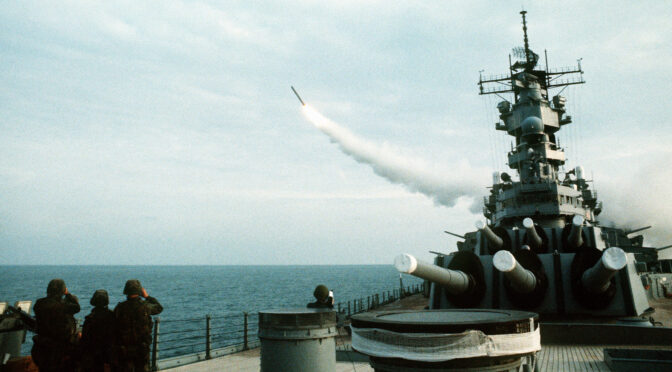
Featured Image: The battleship USS WISCONSIN (BB-64) launches a BGM-109 Tomahawk missile against a target in Iraq during Operation Desert Storm.