Category Archives: Strategic Outlook

Predictions and forecasting.

Budget Spin for Dummies

Not that we’re calling you a dummy…

0In his talk at the U.S. Naval Warfare Development Command last Friday, CDR Bryan McGrath (ret.) made some important assertions about the affordability of our Navy in the context of the Federal Budget. At about the five minute point, he describes what he envisions as the ideal Navy to meet the United States’ security needs and proposes that it would cost about $25 Billion more than what we currently spend. He then goes on to place $25 Billion in context:

$25 Billion Dollars is:

  • 4.6% of the base Defense budget
  • 1.9% of the National budget
  • 0.16% of projected GDP

“…so don’t tell me we can’t afford a bigger Navy,” commands McGrath. “We can afford it. We choose not to have a bigger Navy.”

If we’re going to talk about government spending, it is important to make sure we’re all reading from the same sheet of music. DoD advocates like CDR McGrath assert that the portion of national treasure we’re willing to invest in Defense is approaching record lows. Defense spending critics suggest that even in spite of cuts, we are throwing more money at DoD than at almost any point in history, to include the heights of the Cold War arms races. They are all correct; whether we are at a low point or a high point in defense spending is entirely subject to the frame of reference. Which reference we choose will invariably be determined by our motives.

Discussions of Defense spending are generally framed in one of three ways:

1. Defense Spending as a Function of Dollars Spent

It’s hard to argue with cold hard cash. The money we spend on Defense has grown at an accelerating rate over the last century:
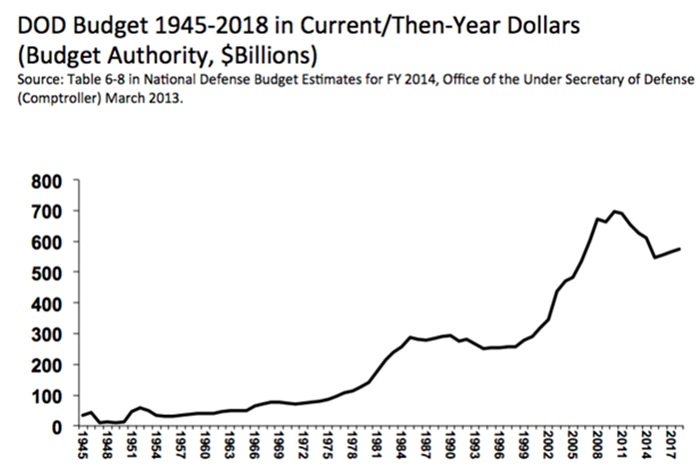
1

However convincing this graph is at first glance, you’ll find that only the most hyperbolic of critics of Defense spending will rest their argument on it. It is based on nominal or “actual” dollars spent, which do not account for the erosion of purchasing power that is inflation. We can correct for inflation by selecting a “base year” and then adjusting the dollar amounts at every other point to the purchasing power of an equivalent sum of money in the base year. Using 2014 as the base year, our corrected graph of defense spending looks more like this:
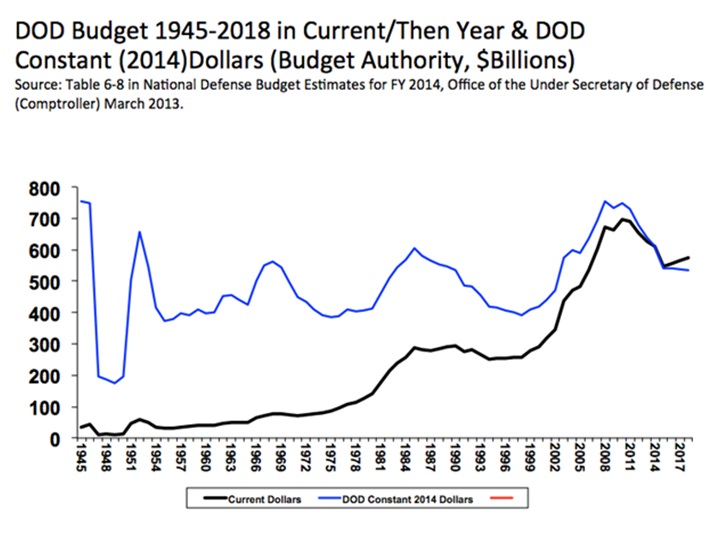
2

The blue line indicates what Defense spending would have been if the purchasing power of a dollar had always been equal to its 2014 value. While spending has oscillated pretty widely, the overall trend is positive: the price, presumably, of steady growth in things like technological complexity, personnel benefits, veteran health care, and administrative overhead. One major source of contention when framing arguments around inflation-adjusted dollars is exactly which rate of inflation is correct. Economists do not all agree, and DoD claims yet another rate of inflation from the economy at large due to a variety of factors.

2. Defense Spending as a Function of Resource Allocation

We’ve all seen a graph like this:
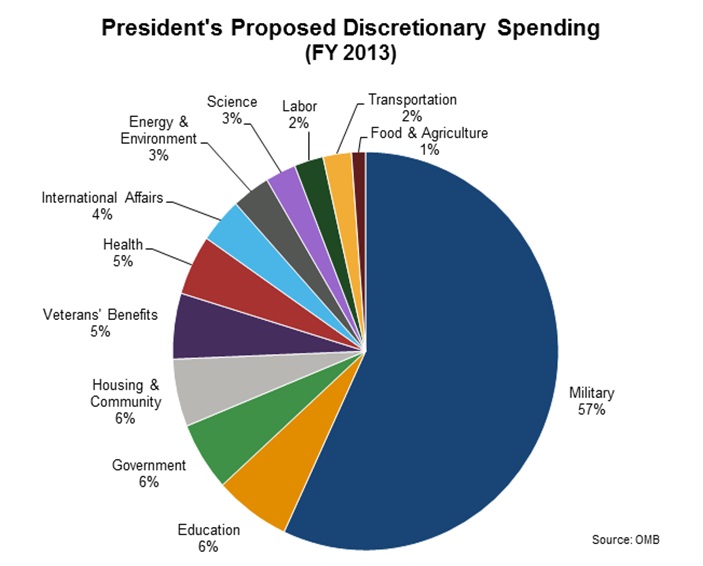
3

We can’t even balance the budget, and we’re spending over half of it on the military!? Preposterous!

Are we really, though? Pay attention to the title: this graph shows “Discretionary Spending,” which is that portion of the federal budget that is determined by Congress through an appropriations bill. This is opposed to “Mandatory Spending,” which is the outlay of government funds required by law. If we include Mandatory Spending, allocation of federal spending will look more like this:
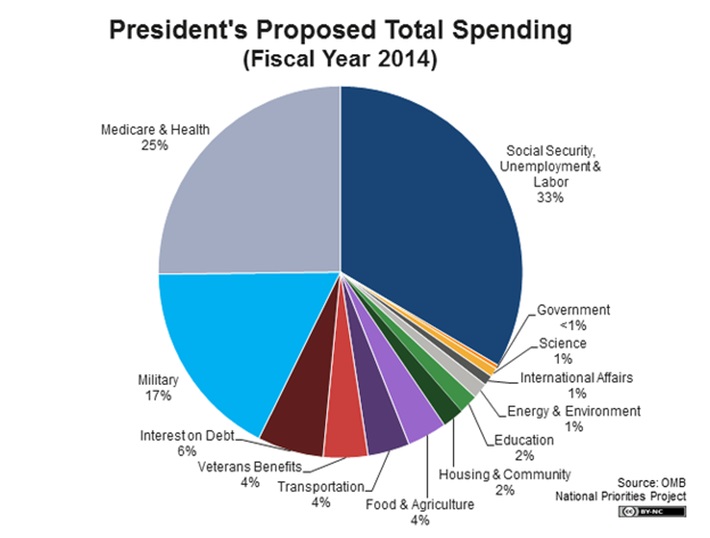
4

Mandatory Spending is effectively made up of entitlement programs. It is important to point out that in the fiscal sense, “entitlement” is not the sense of privilege attributed to Millennials by the previous generations. Entitlement is a technical term which describes expenditures which are not limited by any budget, but instead are a function of the number of people who qualify for them and the expenses incurred by the services promised. Because they don’t need to be re-approved every year, unlike discretionary spending, most entitlement expenditures will grow uncontrollably without a change in the law.

3. Defense Spending as a Function of Economic Output

Described in terms of Gross Domestic Product, or the total economic output of the United States, Defense spending looks something like this:
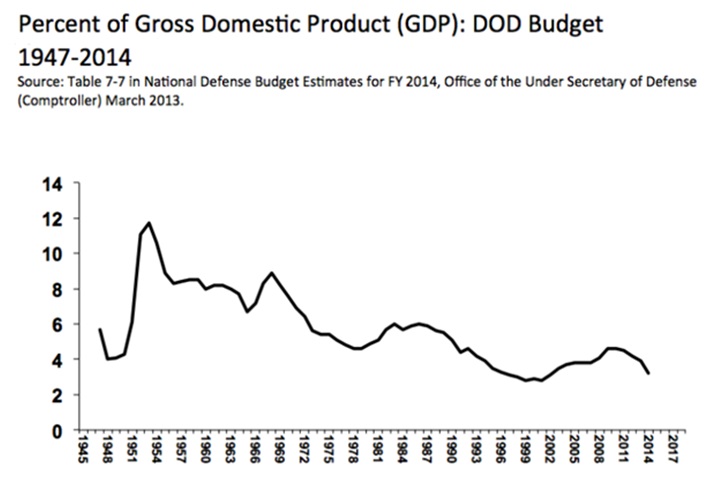
5

The graph illustrates a downward trend in economic capacity committed to the military. Most DoD budget people will describe Defense spending in terms of GDP, ostensibly because it most accurately conveys economic burden. Bryan McGrath described his ideal Navy in terms of dollars, and then convincingly justified his position in terms of GDP.

Critics argue that using GDP as a yardstick merely serves the purposes of those who would seek more money by obfuscating actual dollar costs. Making sense of what is spent is made even more difficult by fluctuations in the denominator: GDP can vary wildly from year to year, which would appear on this graph as drastic changes to Defense spending.  Yet another argument against measuring spending by GDP is that GDP is an estimate at best, and there is much disagreement between economists as to how it should be measured.

Bringing it All Together

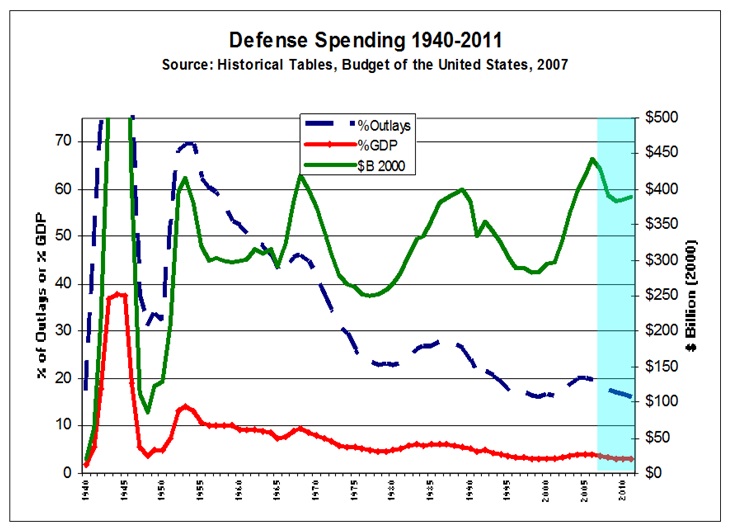
If we lay out the various methods of describing Defense spending on the same graph, we get something like this:
6

As you can see, Defense spending can look completely different depending on how it is framed.  It can be described as a dollar cost, a portion of federal spending, or a portion of economic output.  Each perspective illustrates important information that the others fail to address, and each one can be abused to promote an agenda.

LT Will Spears, USN, is an Active duty submariner; post-JO shore duty type. His last tour was aboard a WESTPAC Fast-Attack; he is now at NPS focusing on family and personal development. He is the author of the leadership blog JO Rules.

Note: The views expressed above are solely those of the author and do not necessarily represent those of the U.S. Navy, the Department of Defense, or the Center for International Maritime Security.

What NATO Must Do After ISAF

While some question NATO’s relevance, and even its need to exist after Afghanistan, there are, in fact, many jobs left to be done.

Deterrence and Defense 

In Germany, few people understand that defense and deterrence are still tasks for NATO. We are surrounded by friends. But talk to our allies from Norway, Eastern Europe, and Turkey and you find their feelings are quite different. Norwegians and Eastern Europeans fear Russia. The Turks have worried about Iran and are now concerned about Syria. NATO’s Patriot deployment to the Turkish-Syrian border proves wrong all who argued that the era of collective defense and deterrence is over.

In addition, “nuclear sharing” is still appropriate, even if Germans with their excessive desire for disarmament do not like it. If some of our allies sleep better due to U.S. tactical nukes based on our soil this is a price we have to pay. In an alliance based on the all-for-one principle, nuclear sharing is necessary as long as a single ally considers it important for his security.

 Range of Saudi CSS 2 missiles (Source)

Deterrence by denial will provide NATO more workload. The latter means to prevent an adversary from acting aggressive by making his means useless through one’s own capabilities. In particular, this applies to missile defense, but not only with regard to Iran. Saudi Arabia also has sophisticated medium-range missiles. If Saudi Arabia falls apart and “turns Egypt,” it can hardly be guaranteed that Saudi MRBMs will not fall into a bad guy’s hands. Moreover, Russia’s fears about missile defense are nonsense. U.S. missile defense’s final phase in Europe has just been cancelled. In addition, the U.S. is almost broke, and it is unclear how much new government revenue the “Shale Gas revolution” actually brings. It is therefore very unlikely that Congress would approve a new budgetary disaster.

Nordic Air Policing

The Baltic countries lack their own air forces. Thus, NATO is providing security for their airspaces. Moreover, Russia is increasing its number of assertive air patrols in the Baltic and the Arctic, while all NATO/EU countries in the High North have budgetary problems to sustain numbers and operational readiness of their fighter aircraft.

Hence, it would make sense for operational and for strategic reasons to establish a Nordic Air Policing mission from the Baltic over Denmark, Norway, and Iceland to Greenland, maybe even including the UK as lead nation. Non-NATO-members Sweden and Finland should receive an offer to join. Moreover, the positive side effect would be the outward-drifting UK could be linked to European security.

Special Operations Forces

Due to the political hazard of Iraq and Afghanistan, along with austerity, the era of major NATO land campaigns is over. Syria tells us that Western decision makers will try to avoid at any cost sending combat troops to foreign ground. Training and support missions, as the EU is doing in Mali and Somalia, will be the West’s approach, at least until the end of the decade. While the EU is doing well with training missions, it lacks experience with special operation forces (SOF). However, NATO’s SOF headquarter is running very well. Therefore, there is considerable potential for NATO-EU work-sharing. The Union could do basic military training, while the Alliance focuses on SOF training including partnerships with Non-NATO-countries.

Future Western land campaigns – if ever given a go by decision-makers – will follow a “light footprint” approach, which perfectly suits SOF. They will mainly carry the operational burdens. It is in all member states’ interest that NATO provides the framework for interoperable SOF.

Maritime Security and Naval Operations

The Standing NATO Maritime Groups are an unparalleled, but unnoticed success story. Since their creation beginning with SNMG 1 in 1968, the two SNMGs and two Standing NATO Mine Countermeasures Groups (SNMCMGs) have done their job without causing any political tensions. Instead, they were ready to go when called, like the 1999 Allied Harvest mine-clearance effort in the Adriatic Sea after the Yugoslav bombing campaign, or in front of Libya during Operation Unified Protector in 2011.

Naval operations are a niche where NATO is preeminent, due to operational experience and U.S. assets as a backup. However, the EU could try to seek a way into this niche by playing on the lessons learned from Operation Atalanta. Plagued by failures in security policy (e.g. Mali and its battlegroups), some EU fans may conclude that naval operations are a sector where the EU could better play of its success. But the EU does not have such operational experience in maritime affairs as NATO does, nor has it any access to U.S. assets. If things go wrong, NATO would receive a U.S. military bailout, the EU would not. Thus, naval operations should be left to NATO, while the EU focuses on the civilian side. In times of austerity, we do not need two organizations competing in the same field. Operation Unified Protector showed the enduring worth of the capability for rapid maritime crisis response. With a look on the instability in Tunisia, Libya, and Egypt, scenarios for new maritime operations in front of North African shores cannot be ruled out. Hence, SNMGs and SNMCGs should be excluded from defense spending cuts. Beside the Strait of Gibraltar, the focus of NATO’s maritime presence should be the Eastern Mediterranean. Trouble is likely due to the civil war in Syria and tensions between Turkey, Lebanon, Cyprus, and Israel about offshore gas. Russia is seeking to implement an anti-access/area-denial strategy by its largest naval expeditionary operation since the USSR’s collapse. Thus, a show of force and demonstration of political will by NATO is a necessity. After 2014, the Eastern Mediterranean is going to be the operational area for NATO’s seaborne missile defense on U.S. Aegis-destroyers.

We are right at the beginning of an Indo-Pacific-Century. Thus, when it comes to maritime security – I am explicitly not talking about air and ground forces – NATO should look more East-of-Suez. The Alliance has been present at the Horn of Africa since 2008 to protect the World Food program’s vessels and to fight piracy. NATO outreach to Asian navies, in particular China, has already begun. It would not make sense to cut these tiny, but very important strategic ties by ending NATO’s navel presence at the Horn of Africa.

British warships East of Suez in 2012 (Source)

Right now, Britain and France are pursuing their own track in the Indo-Pacific, while the EU is not taken seriously there in terms of security issues. However, as NATO’s present Maritime Groups will busier in the Mediterranean, a considerable option is to base a new third SNMG in Djibouti. The strategic values would be; permanent protection of vital sea-lanes; ability of rapid power projection and crisis response towards the Persian Gulf; quickly available means for disaster relief; mutual trust building by naval diplomacy with emerging maritime powers like China or India; a virtual capacity to reach out east of Malacca.

Of course, in many member states, especially Germany, such ideas about new NATO forward presence would be extremely out-of-favor. Thus, a more realistic approach is just to never end Ocean Shield. Open discussions about the operation should be avoided. While little attention is given, the mission can evolve in the ways mentioned and, hence, create irreversible facts.

The Arctic, however, should not be subject to military considerations other than Air Policing. Engaging Russia and new Asian stakeholders in the High North is a political question. The worst possible mistake would be to militarize and thereby to complicate Arctic politics.

Export and Guarantee Stability in Europe

After the Cold War’s end, the export of stability to Eastern Europe and the Balkans has been an outstanding success. While the Nobel Peace Prize has been given to the EU for incomprehensible reasons, it was NATO that connected past adversaries into its framework of peace, stability, and security. Macedonia and Montenegro should join NATO, once all membership criteria are met. In the medium term, the door should also be open to Bosnia, Serbia, and Kosovo. The more Balkan countries in NATO, the better, because it significantly decreases the likelihood of conflict in the region.

Georgia and Ukraine are not yet close to NATO membership, but the door should not be closed. The Georgians have a pretty tough road ahead. They will never join NATO as long as there are Russian troops on Georgian territory. Thus, either they find a way for the Russians to leave (which Moscow will not do) or they have to give up Abkhazia and South Ossetia as a prize for their way into NATO and EU (which Tibilisi will reject).

With regard to Russia’s resurgence and emerging assertiveness, Sweden and Finland should be offered closer partnerships or full memberships, if they so choose. To prevent Cyprus from becoming a Russian proxy, it would be a great idea to bring them into NATO. Unfortunately, Turkey would not let that happen. If they really go for independence, membership for Greenland, Scotland and Catalonia in NATO should be granted. (Although the Spanish stance on Catalan NATO/EU-membership after a succession would be quite interesting to watch).

EU youth unemployment 2013 (Source)

Europe’s crisis has been managed, but is far from being solved. In 2009/10 – surprise, surprise – the trouble in Greece occurred a few weeks after the German elections. We will see what happens after Merkel has been re-elected on September 22 or after the elections to the European Parliament in May 2014. It is an open secret in Berlin that Greece needs a second haircut. New bailouts for Cyprus, Portugal, Spain, and Italy are still on the table, but before September 22 nobody wants to talk about such issues. The fatal consequences of the huge youth unemployment have not occurred much yet, but they will eventually. Last but not least, when the United States is back on track with an economy running “full steam ahead,” France will still be discussing retirement in the age of 62. After ISAF’s end, one of NATO’s main missions is to be a backup for stability in Europe, if turmoil in the Euro Zone or even EU takes charge.

Keep the Russians and Chinese Out

There are these debates about Chinese bases in the Atlantic – which the author has been part of – and a new Russian naval presence in the Mediterranean including a base in Cyprus. There are reasonable arguments for the position that these debates are not kind of close to reality. However, the fact that such debates are now possible, which they would never have been ten years ago, should raise one’s attention.

Except the Soviet/Russian Westgroup from 1990-94 in Germany, a Non-NATO/EU-country has never had a permanent military presence in a NATO/EU-country. If Russia, China or someone else finds a way to set up a permanent military presence in a NATO or EU country, it would a dramatic signal for Western decline. NATO’s decision makers and strategists are tasked to prevent that from happening at any cost.

Felix Seidler is a PhD candidate at the Institute for Security Policy, University of Kiel, Germany, and a German security affairs writer. This article appeared in original form at his website, Seidlers Sicherheitspolitik.


Speak Softly and Carry a Big Stick When Dealing With Future North Korean and Iranian Threats

iran_2586247b

In the wake of Hassan Rowhani’s landslide victory as Iran’s new president, some foreign policy mavens now believe that Rowhani’s presidency may augur a positive shift in Iran’s hitherto hostile policy towards the West. However, despite a glimmer of hope that Rowhani’s election may translate into moderate policies towards the West, others have “adopted a cautious ‘wait-and-see’ posture,” citing Rowhani’s past affiliation with the Ayatollah.

For East Asian experts, Rowhani’s election warrants attention because it remains to be seen whether Iran will retain its current alliance with Kim Jŏng-ŭn even if it chooses to reconcile with the West. After all, some have alleged that Iran has played a major role in the DPRK’s successful testing of its Ŭnha-3 rocket last December. More importantly, Rowhani’s future stance towards the West deserves attention because it may determine whether or not the United States must revise its strategy to adapt to new geostrategic realities. Indeed, it can be argued that the aforementioned factors are not mutually exclusive but intricately intertwined.

Some foreign policy mavens have construed recent events in the Korean peninsula and Iran as encouraging “game-changers.” After all, both Koreas have begun talks to ratchet down the ongoing tension. Furthermore, experts on Iran agree that Rowhani’s victory was prompted by a universal desire for positive change after years of economic hardships and political repression under Ahmedinejad.

However, geostrategic realities on the Korean peninsula and in the Persian Gulf might be more complex than they appear. On the peninsula, the two Korean states evinced deep-seated rancor and mutual distrust in their latest talk held at P’anmunjŏm despite having reached an agreement to reopen the Kaesŏng Industrial Complex. As Miha Hribernik and I wrote previously, “Should miscommunication problems and distrust persist, the consequences for the Korean Peninsula and the regional security environment may be dire.” As for Iran, it recently claimed to have improved the accuracy of its anti-ship ballistic missile, the Khalij-e Fars (Persian Gulf). Further, Rowhani’s election may have little effect on Iran’s existing nuclear policy because ultimately, “it is Khamenei who will make the final decision on the nuclear program.” In other words, both the DPRK and Iran may continue their existing partnership, or even lash out against the United States, if they believe that their collective interests are threatened.

So how can the United States successfully recalibrate its existing strategy in ways that reflect current geostrategic realities in the Persian Gulf and on the Korean peninsula? Dealing with the DPRK and Iran may require a flexible combination of deft diplomacy on one hand, and a show of strength on the other. In simple terms, the United States should “speak softly and carry a big stick” when dealing with future threats posed by the DPRK-Iran alliance.

theodore-roosevelt-cartoon

Diplomacy may be the best option that the Obama Administration has to proactively deter the two “outlier” states from coalescing. Indeed, Vali Nasr recommends offering sanctions relief to Iran so as “to break the logjam over nuclear negotiations.” Even better, the United States can thaw relations with Iran and the DPRK by granting diplomatic recognition to both countries. In addition to “reducing dangers” stemming from miscalculations and enabling the United States to gather intelligence on both countries, normalization may prevent the outbreak of a fratricidal war on the Korean peninsula and may hold Rowhani and Kim Jŏng-ŭn accountable to international norms.

Nevertheless, in order for diplomatic endeavors to be sustainable in the long-run, they must be backed up by a credible threat of coercion. While many defense analysts and strategists remain fixated on countering Iran and China’s A2/AD tactics, the U.S. military can no longer afford to operate alone in the face of drastic sequestration cuts. It can, however, exercise firmness by “leading from behind” in working with allies and proxies. One such example is that of a “proxy strategy” implemented by General James Mattis, whereby Iran’s Sunni neighbors would supposedly vie for influence in the Persian Gulf region to deter, if not contain, Iran’s rise as a regional power. Another option, as I’ve proposed earlier, would be to form a combined fleet composed of the U.S. Pacific Fleet (PACFLT), the ROK Navy, and the Japanese Maritime Self-Defense Force (JMSDF) to proactively deter future DPRK provocations. Third, given that the United States still faces aggression from afar in the face of improved missile capabilities possessed by Iran and the DPRK, the United States must be prepared to defend itself at home by bolstering its missile defense systems. Last, and perhaps most important,  since the world has converged into a smaller community by way of globalization, we must take the fight to our adversaries by “recogniz[ing] that it takes a network to confront another network…[and, therefore, must] follow the money [to upend] threat financing” internationally and at home.

LCDR B. J. Armstrong wrote that there “would be changes to tactics, and the requisite adjustments to operational planning” when dealing with adversaries who threaten America’s strategic dominance abroad. To this, one should add that flexible strategic responses, whereby the United States readily wields a combination of carrots and sticks to deal with refractory pariah states, may be needed to guarantee America’s continued strategic dominance and peace in the Persian Gulf and in East Asia.

(This article was republished by permission of the United States Naval Institute Blog and appeared in its original form on July 18th here.)

Cyprus: The Mediterranean Pivot

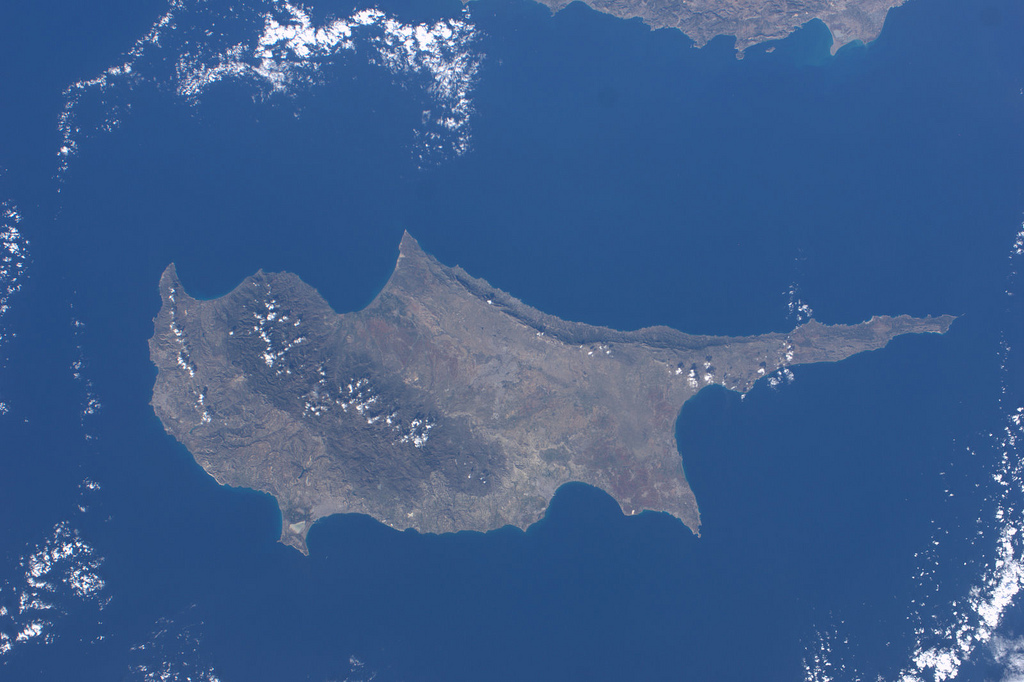
CyprusBy Chiara Proietti Silvestri

In recent years the Eastern Mediterranean has increased its international strategic importance following significant discoveries of hydrocarbons. In this region the recent offshore findings of natural gas are radically changing its geostrategic and economic status. But before achieving the ambitious objective of becoming a net exporter of energy, the countries of the Eastern Mediterranean, and Cyprus in particular, must confront regional challenges and interests of the major powers in the area – be they economic, politico-strategic, or due to the required energy infrastructure.

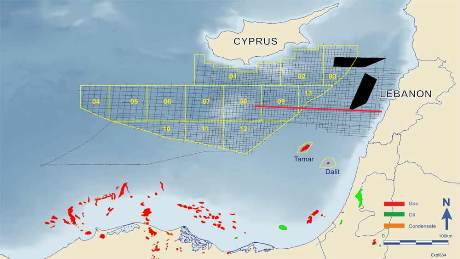
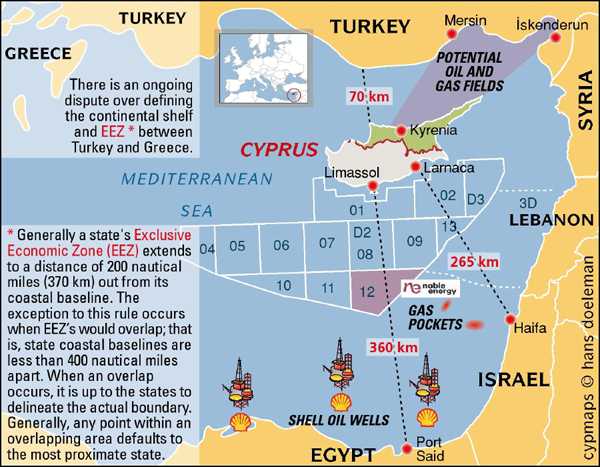
Two years after the great discoveries of the Leviathan and Tamar fields off the Israeli coast in 2009, it was, in December 2011, Cyprus’ turn. The U.S. company Noble Energy reported an initial discovery of offshore gas in block 12 of Aphrodite, with an energy potential estimated at between 5-8 trillion cubic feet (140-230 billion cubic meters). Evidence suggests that this area is an extension of the Levant basin: it is still the subject of an initial exploratory phase, and these initial estimates are considered conservative, with the prospect of rising in the coming years. There is therefore a potential wealth for the island of enormous proportions. According to some experts, Cyprus could potentially be sitting on a goldmine of at least 60 trillion cubic feet (1.7 trillion cubic meters) of gas. Not considering the possibility of petroleum it could generate revenues of up to $400 billion once commercially exploited.

The declared objective of the government of Nicosia is to use the geo-strategic position of Cyprus, between Europe and the Middle East, to make the country a true energy hub, with a central role in commercial transit and in the provision of European energy. This is a perspective, however, that does not consider the tensions and several unresolved questions that could hinder the energy development of the island, essential in reviving an economy itself in deep crisis.

Cyprus oil concessionsFirst, the strong political destabilization resulting from the 1974 Turkish military invasion, which produced a de facto division of the island between the Turkish-Cypriot north and the Greek-Cypriot south. The discovery of energy resources in the southern part of Cyprus, as well as an absence of results from research conducted thus far into the offshore areas of the north, have added a new and relevant source of friction in relations between Nicosia and Ankara. The island’s peculiar political situation could therefore constitute a brake on the development of the country’s economy, capable of affecting decisions regarding investment by foreign companies, especially those who have strong interests in Turkey. The latter, in fact, threatened repercussions for those companies that intend to enter into agreements to exploit resources with the Cypriot government. Such is the case for Eni S.p.A. which has seen the suspension of all projects undertaken with Turkey, due to its exploration agreement signed with Nicosia in January. Ankara, in fact, maintains that such energy resources are located in international waters and that they should benefit all of the island’s inhabitants, and not only Greek-Cypriots. Turkish interests, profoundly connected to energy, therefore emerge. Furthermore, relations between Cyprus and Israel, in particular those relating to a possible project for the liquefaction of gas for export, feed the prospect of an energy partnership. This could provide an alternate route for transporting gas to Europe and Asia, obstructing the great Turkish mission to become a regional energy hub. According to several analysts, this prospect was one of the reasons behind the rapprochement between Turkey and Israel, which enabled the former to maintain its centrality as the country of transit, and the latter to optimize conditions for its gas exports. While in the long-term the economic advantages of cooperation between Nicosia, Tel Aviv, Athens, and Ankara might be more convincing, in the short-term, energy pressures feed tensions in an already established hot spot.

It is probable that Turkey’s firm stance on the Cyprus question is one of the reasons behind the Russian decision not to accept the bailout plan hastily proposed by Nicosia in exchange for licenses for the exploitation of gas fields. To this must be added, among others, the European position and the special relationship between Berlin and Moscow, sealed by the agreement on the Nord Stream gas line, which might have suffered setbacks if Putin had decided to approve a bailout plan for a member country within the EU. Moscow’s position, then, is understandable when considering the multiplicity of interests that the country shares with other regional players, such as Germany, Greece, and Turkey: these can be safeguarded only by a strategy of ambiguous realpolitik. Although the issue of the Cypriot bailout has put pressure on the relationship between Nicosia and Moscow, it is difficult to imagine a rupture of relations between the two countries, instead of a redefinition in the interests that still bind them. Moscow, in fact, has long-standing ties with the island of Aphrodite, ranging from banking and finance to real estate and military strategy. There are strong suspicions, for example, regarding the role played by Cyprus in the trafficking of weapons from Russia to Damascus.

Brussels, for its part, seems determined to impose comprehensive change on the Cypriot business model and on its banking system, thus affecting its status as a tax haven for the offshore investments of Russian magnates. Discoveries of gas in the Cypriot Sea represent a great opportunity for Europe to diversify energy supplies, with respect to Russia’s dominant role. Cyprus’s economic problems, however, which have led to the forced levy on bank deposits, also herald strong domestic discontent: the EU should not exacerbate the economic situation because, as the multiple demonstrations on the island show, anti-European sentiment is particularly widespread among the population and could become a source of political instability. This could obstruct a possible solution to the conflict with Turkey, a central obstacle in Ankara’s access to Brussels.

The framework outlined above seems far from optimistic given that, at least in the short- to medium-term, the European controls on bank accounts, the withdrawal of Russian support, and Turkish pressure all clamp the island in a vice that will only increase internal malaise and aggravate the downturn in the national economy. A situation which seems as if it will not improve until exploitation of the energy resources of the Aphrodite gas field is at full capacity, something that might require several years.

On the contrary, within an extended timescale the need for cooperation between the main players involved only increases due to pressures deriving from the stabilization of the Cypriot economy and the gradual exploitation of the rich intra-European gas fields. Turkey has already signaled to this effect: conscious of its role as transit towards international markets, Ankara has proposed to Nicosia its help in the development of gas, as long as the benefits of such discoveries should, as noted previously, be shared by all the inhabitants of the island. In conclusion, one aspect is more certain than others: without a resolution of the dispute over sovereignty of the island, an issue that has dragged on for 40 years now, eventual regional cooperation seems difficult to envisage.

Chiara holds the position of Junior Analyst in the energy consulting firm RIE (Industrial Research and Energy) of Bologna and collaborates with Energy Magazine. She holds a degree in International and Diplomatic Sciences from the University of Bologna (Forlì campus). Her interests mainly relate to energy issues, including energy policies in the Middle East, nuclear energy, and the processes of public debate and consensus. You can follow her on LinkedIn and Twitter (@ orienta_giovani).

This article was cross-posted by permission and appeared in its original form at TheRiskyShift.com.