Part of our Sacred Cow series, originally posted at USNI Blog.
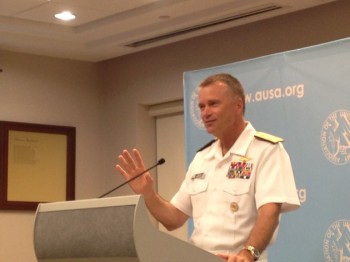
Speaking at the Association of the United States Army on the 12th, Admiral James Winnefeld, the Vice Chairman of the Joint Chiefs of Staff, told the audience that in future ground wars the tempo will be “shorter, faster-paced and much harder” because America’s adversaries will work to create a “fog of war.” Thus, the Admiral suggested that the Army “place more emphasis on the growth industry…of protecting American citizens abroad” in order to adapt to the fluid geostrategic environment.
VCJCS Admiral James Winnefeld speaking at the Association of the United States Army on September 12th.
Indeed, since the sequestration went into effect in March, many defense experts have been debating what the future may hold for the Army, the Marine Corps and the Special Operations Command (SOCOM). Whatever their respective views may be on the utility of landpower in future wars, all seem to agree on one thing: that in the sequestration era, the ground components must fight leaner and smarter.
For John R. Deni, a research professor at the U.S. Army War College’s Strategic Studies Institute, the answer seems to lie in the “Army-led military-to-military activities” which may provide stability in politically volatile regions “if only because most military forces around the globe are army-centric.”
Others beg to differ. Generals James Amos and Raymond Odierno and Admiral William McRaven seem to second Admiral Winnefeld’s claim when they argue that today “the need to conduct large-scale aid and consequence management missions, both within the United States and internationally, is certain to grow.” General James Amos, the Marine Corps Commandant, also recently echoes this view when he advocates a lighter but mobile Marine Corps because he believes tomorrow’s conflicts will likely involve “violent extremism, battles for influence, disruptive societal transitions, natural disaster, extremist messages and manipulative politics.”
However, if the United States Armed Forces is truly concerned about raising a cost-efficient and versatile ground force, it can merge the Army, the SOCOM and the Marine Corps into one unified service branch. This idea is not new. As far back as 1994, the late Colonel David Hackworth advocated the merger of the Army and the Marine Corps because their missions seemed to overlap. He went so far as to claim that the Department of Defense (DoD) could save “around $20 billion a year.” Nevertheless, absent in Hackworth’s column was a coherent blueprint for how the DoD could effectively unify its ground components into a cohesive service because Hackworth did not flesh out his strategic vision for what 21st Century wars may look like.
Which raises a very salient question as to what America’s strategic priorities should be. In a perceptive op-ed, Mark Fitzgerald, David Deptula and Gian P. Gentile aver that the United States must choose to go to “war as a last resort and not a policy option of first choice.” To this must be added another imperative. The United States Armed Forces must prioritize homeland defense as its primary mission and rethink the mistaken belief that the United States can somehow secure its interests through “lengthy military occupations of foreign lands.”
Thus, this newly merged service must redirect its focus towards countering cyber warfare and CBRNe (Chemical, Biological, Radiation, Nuclear and explosives) attacks and should work towards bolstering its counterterrorism (CT) capabilities. This is because, due to the convergence of the global community, the United States may be vulnerable to attacks from within by homegrown terrorists and drug cartels—all of which may wreak havoc and may even cripple America’s domestic infrastructures.
Reorientation of its mission focus may also require that the new service reconfigure its size. After all, as Chairman of the Joint Chiefs of Staff, General Martin Dempsey wrote in Foreign Affairs, “Washington should remember that the size of the armed forces is not the most telling metric of their strength.” One solution is to adopt the so-called “Macgregor Transformation Model (MTM)” centered around the combat group concept which may reduce the strength of the new service “yet in the endproduce a force that has greater combat capability…[and] more sustainable.” This model may provide the United States with a deployable fire brigade in the event of a national emergency or an international crisis. Already, the bases from which to adopt this viable model exist in the form of Army brigade combat teams (BCTs) and Marine Air-Ground Task Forces (MAGTFs) of various sizes.
Should the United States decide that it needs to project its hard power abroad to guard its interests, it could deploy the Special Operations Forces (SOF) components of the new service in tandem with UAV (Unmanned Aerial Vehicles) to selectively target and neutralize potential threats. While the SOF and UAV surgical raids should not be viewed as substitutes for deft diplomacy, they can provide cheaper and selective power projection capabilities. Moreover, doing so could minimize the risks inherent in power projection and anti-access/area denial (A2/AD) missions which may potentially mire the United States in messy and protracted conflicts.
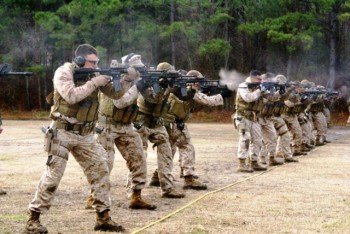
Marines from MARSOC honing their rifle marksmanship skills. Photo by MARSOC Public Affairs
Last but not least, this new service could buttress interoperability and capabilities of allied forces around the globe through military-to-military exchanges. Although Deni was referring specifically to the Army-led initiatives when he suggested this, he may be correct that military-to-military engagements may help to promote America’s image abroad as a trusted guarantor of peace. But even more important, such activities may “mean fewer American boots on the ground.” However, implementing what the retired Marine General James Mattis refers to as the “proxy strategy” may be a better means by which the United States could “lead from behind.” Under this arrangement, while “America’s general visibility would decline,” its allies and proxies would police the trouble spots on its behalf.
Contrary to what many in the defense establishment believe, the austerity measures wrought by the sequestration have not been entirely negative. If anything, this perceived “crisis” has provided the much-needed impetus for innovative approaches to national defense. The proposed merger of the ground forces may provide the United States with most cost-effective and versatile service branch to defend the homeland and safeguard its interests abroad.
The fight over funding the federal government and raising its debt limit may be over for the moment, but other debates rage on. One of the more vexing ones that has been touched upon most recently in the arguments over possible military intervention in Syria is the relationship between America’s defense posture and its role in the world.
Both parties, in fact, seem to be at a loss in grappling with this question. While the Administration has had to walk a fine line regarding appearing weak over threats made with regard to Syria and landing the U.S. in a war it does not want, the Republicans and like-minded conservatives have been debating amongst themselves policies ranging from American retrenchment, advocated by the likes of Rand Paul, and paying the price of continuing and indeed extending American primacy, as advocated by organizations such as the American Enterprise Institute.
Lost in the heated argument, however, are certain immutable facts regarding the situation America is actually in when it comes to defending itself and its allies. The picture that emerges does not look good either for those who want America to come home or for those who favor a more expanded international security role. Looking at it, though, is the first step toward any kind of sane defense policy, one which probably will not resemble that advocated by either camp.
Submitted for consideration, therefore, are eight of these realitiesm:
1. America’s defense posture is driven largely by its expensive and possibly unsustainable counterproliferation policy.
Ever since the fall of the Soviet Union, and to some extent before, U.S. foreign policy has fixated on preventing the horizontal proliferation of nuclear weapons. While the exact number of weapons held by states already recognized as nuclear powers (particularly the five declared nuclear states under the Non-Proliferation Treaty) might be up for negotiation, the U.S. has endeavored with all the means at its disposal to prevent new nuclear powers from emerging. Although a wide variety of policy tools are at the U.S.’ disposal to accomplish this, the most critical ones have involved the U.S.’ overall military posture: the U.S. has sought either to reassure allies that it would come to their aid (with its nuclear arsenal) if they were attacked, or else to use force to prevent hostile states from acquiring nuclear arsenals of their own. The former policy has encompassed the likes of South Korea, which the U.S. is reported to have talked down from building its own nuclear arsenal in the 1970’s. The fact that three key U.S. allies in the Pacific – Japan, South Korea, and Taiwan – could easily go nuclear in a matter of weeks or months if they ever feared for their safety and doubted U.S. resolve reinforces the point: the U.S. has to maintain enough spare military capability to defend these allies if it wants to convince them they do not need nuclear arsenals of their own.
It used to be that the U.S. protected key allies because they could not protect themselves. Increasingly, the U.S. protects its allies because it fears they will protect themselves.
Interestingly, this also has effects when it comes to the U.S.’ management of its nuclear deterrent against larger powers. Since the U.S. military cannot be everywhere at once, a critical component of the U.S. security umbrella is its willingness, if necessary, to use nuclear weapons in a crisis – this being the case, it cannot renounce the first-usage of nuclear weapons as some arms control advocates have suggested. That is, unless, of course, it comes up with far, far more conventional resources, for the problems of which see what follows.
As for preventive warfare, the fact that this policy led to a woefully misguided war in Iraq – in which suspicions of a nascent nuclear arsenal turned out to be completely false – has not prevented two successive U.S. presidents – Bush and Obama – from threatening the use of force to shut down or delay the Iranian nuclear program. (While it is essentially too late to do anything about North Korea’s nuclear program, the latter is almost certainly the exception that proves the rule: the U.S. has done everything it could afford to do, and it remains militarily engaged, even if it has avoided open war.)
There are other reasons why the U.S. maintains so much force projection capability, of course. What cannot be denied, however, is that as long as the U.S. remains committed to preventing a nuclear arms race along the edge of the Eurasian landmass (what the strategist and former U.S. national security adviser Zbigniew Brzezinski called the “arc of crisis”), its military commitments to the world at large cannot be allowed to shrink. Which brings us to…
2. There is no one else who can shoulder or share the burden of enforcing the counterproliferation regime, and a number of powerful states are seeing to it that the U.S. carries great expense from doing so.
By all publicly available accounts, Iran bled the U.S. in Iraq after it invaded to stop a purported Iraqi nuclear arsenal; it then held great influence over, and access to, the new, Shi’ite led government. The next time, wherever it occurs, will be worse. We have only to imagine what China or even Russia might do in the event of a U.S. invasion of Iran.
Conversely, there is literally no great power anywhere – not Europe, not China, not Russia – that can either wage war to stop would-be nuclear proliferators or guarantee the security of smaller states that might otherwise seek arsenals for their own defense – even if any of these states had any inclination to do so. As long as the U.S. remains committed to keeping the nuclear genie in the bottle, it is on its own. And speaking of which…
3. America’s strategic rivals are getting more powerful.
China and Russia are both modernizing their militaries. Russia plans to modernize its military extensively by 2020, with a particular emphasis on new fighters for its air force and submarines for its navy – the projected expenditure by the end of the decade amounts to $650 billion – about a third of Russia’s annual gross domestic product. (For comparison, imagine a U.S. rearmament program that deployed $500 billion a year for ten years on top of current U.S. expenditure.)
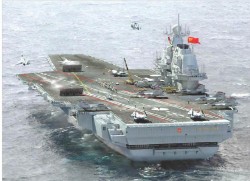
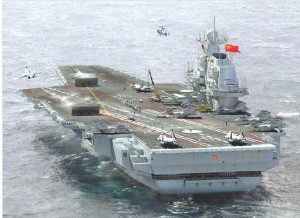
Notional chinese carrier from unclass 2009 ONI report.
China is in the process of acquiring aircraft carriers and long-range precision-strike capabilities that will both expand its military reach and pose a problem for U.S. naval operations in the Pacific. It is in the process of testing missiles that – potentially – could sink U.S. aircraft carriers in a naval confrontation before they were in range to launch their aircraft. Iran has also tested a short-range version of this technology, which could potentially render aircraft carriers – the most lethal and most expensive assets in the U.S. military and the very symbol of American power – as irrelevant as battleships in World War Two.
Defending U.S. allies, in other words, will be more difficult in the next ten years than in the past twenty. Of course, that’s only if the U.S. can even use its military in such a scenario, because…
4. America’s greatest strategic rival is also its greatest foreign creditor.
The U.S.’ ability to defend its allies is in one sense dependent upon the goodwill of the state it might have to defend many of them from, namely, China. Although as of this writing U.S. federal debt is essentially being monetized (at the rate of about $85 billion a month) by the U.S. Federal Reserve, once the long-anticipated “taper” begins, the U.S. will once again be resorting to foreign credit markets. To date, China, with about $1.3 trillion of the $12 trillion of U.S. debt held by the public, is the U.S.’ largest single foreign creditor, narrowly beating Japan’s $1.15 trillion. (In the larger picture, about 47 percent of U.S. federal debt held by the public is owned by foreign governments.)
It is far from clear what might happen to the U.S.-China debtor-creditor relationship – or the U.S.’ relationship with any of its other international creditors – in a crisis. But at the moment, with the U.S. running deficits in excess of $700 billion annually, a situation that, although ameliorated by the sequester, will get worse in this decade as entitlements are strained by an aging population, the U.S. has to tread carefully. We do not know what would happen to the bond markets if the U.S. attempted to fight a war its foreign creditors disapproved of. There are powerful incentives for foreign creditors to say nothing (they obviously do not want their assets to fall in value), but that is not the same thing as saying that there are no risks. Speaking of budgeting…
5. Where the defense budget is concerned, it doesn’t get any better than this.
A less-remarked-upon consequence of the fiscal “sequester” has been a slow erosion of overall U.S. military readiness. On 19 September, the chiefs of staff of the various armed forces testified before the House Armed Services Committee that extension of the current fiscal path prescribed by the Budget Control Act of 2011 – the fiscal compromise that led to the so-called “fiscal cliff” and “sequester” of government spending – would leave U.S. military readiness at an all-time low. Most dramatically, according to Army Chief of Staff Gen. Ray Odierno’s testimony, 85 percent of U.S. Army brigade combat teams would be unready to fulfill their mission requirements. All of the services have already furloughed civilian employees as a result of the sequester, and all of them now face personnel cuts in fiscal year 2014.
The “sequester” was part of a larger effort to control federal spending at a time when deficits had topped $1 trillion a year. Although federal discretionary spending is now being cut in accordance with these measures, little has been done to address the most important long-term drivers of federal debt: Medicare, Medicaid, Social Security, and related entitlement spending, all of which are likely to increase as members of the postwar baby boom generation hit retirement age (the first people generally thought to belong to that demographic began to reach age 65 in 2011). Until these large segments of the federal budget are addressed, even the sequester will not keep deficits down. The latest CBO projection has U.S. federal debt held by the public beginning to climb relative to GDP around the year 2018 after a temporary decline. This, of course, assumes nothing goes seriously wrong with the U.S. economy in the interim.
Not only do deficits remain a long-term problem, but when faced with a choice between their retirement programs and their foreign policy, or between investment capital in an anemic economy and their foreign policy, it is quite likely Americans will choose the former, and there is little that can be done about this for the foreseeable future. It is simply unlikely there will be much more money for anything more than maintaining the status quo in the near future, and even that will be costly and politically divisive.
(It is sometimes claimed either that defense should be excluded from a solution to America’s fiscal problems or that the required increases in defense spending to maintain the status quo are minimal. Neither is persuasive. Political realities dictate that all options remain open for solving America’s fiscal problems, and however small the increases that are asked for may be, the fact remains both that more will ultimately be needed later and that literally nothing is available. It is not possible to discuss spending increases and budget cuts at the same time.)
In the face of rising challenges to its interests and its allies, the U.S. will have to make do with what it has. And it hasn’t been very good about that so far…
6. America’s defense procurement process is hugely wasteful, makes it near-impossible to know how much we “need,” and could cause the U.S. to lose a war.
There is far, far too more that can be said about this than there is space here to write, but, in short, there are serious problems with the way the American military gets its weapons that are rooted in the structure of American governance itself. Put simply, defense projects are local employment programs even when they are national liabilities. Even congressmembers who want to avoid excessive defense spending find it difficult to resist the temptation to vote for programs that route defense money to their districts. In many respects, they would be foolish not to, since, unless a concerted effort is made, the money will likely be spent somewhere regardless, and, from the point of view of their constituents, might as well be spent in their districts so as to recoup tax dollars that would otherwise go elsewhere.
The result is so well-known it has led to its own peculiar slang, documented by defense reform advocates such as Donald Vandergriff, Pierre Sprey, Chuck Spinney, and others. “Front-loading” refers to a contractor offering Congress an overoptimistic cost projection for a weapons system, on the theory that when it costs more, Congress will sink in the requisite extra cash. “Gold-plating” refers to making a weapons system as complex, elaborate, and expensive as possible, the better not only to sell more goods to the federal government, but also to spread the ensuing expenditures among more congressional districts to make a program harder to kill.
The result can be seen in weapons systems like the F-22 and F-35. As a number of defense analysts – notably Pierre Sprey, James Stevenson, and Robert Dilger – have noted, these fighters are larger, more visible, and (certainly in the F-35’s case) less maneuverable than an F-16, have less fuel available for combat, have poor pilot visibility due to the need to maintain “stealth,” probably are not very stealthy since their vaunted targeting radar systems amount to a homing beacon for missiles and since stealth coating is notoriously difficult to maintain, cannot operate at the same operations tempo due to the need for complicated maintenance, and cost several times more than an F-16. The Air Force’s F-16C fighters were obtained in the 1990’s for about $30 million apiece in today’s dollars; the “flyaway” cost (the pricetag for a single new model, without research or maintenance costs) of an F-22, before the program was cancelled, was $137 million. The flyaway cost of an F-35 ($153-199 million, depending on the version) has now exceeded that figure. Ironically, the F-22 was cancelled because the F-35, which was not designed for air combat and has fewer capabilities, was supposed to be cheaper.
(It is often claimed that one advanced “5th generation” fighter such as the F-22 can defeat several F-16’s. This occurs in tests where the F-16’s are not allowed to use radar-seeking technology to target the F-22’s, and in which radar-guided missiles from the F-22’s are assigned unrealistic kill probabilities. In either case, this ignores the fact that one can get several F-16’s and their pilots for the cost of one F-22. It also ignores the historical fact, documented in a 2006 presentation by James Stevenson, that, because of the dynamics of air combat, the more planes that are involved in an engagement, the closer to 50-50 their odds of survival become, regardless of how they are built.)
What this means in practice is that equipment that are too expensive to replace all at once are replaced slowly, resulting in aging. Sometimes this has alarming results: in 2007, older models of the F-15 had to be grounded because they were too old to fly safely; replacements have been slow in coming. Given the costs involved, the F-35 is currently projected to replace all of the Air Force’s F-16 fleet by sometime in the 2030’s.
While this is a particularly egregious example, what is true of the latest fighter weapons systems is true of other systems as well. The piling on of irrelevant and expensive systems and the obsession with high technology over tactical function doomed the Army’s Future Combat System; similar concerns have been voiced regarding the Littoral Combat Ship and other naval vessels.
What all this means is that discussion of how big the defense budget should be becomes meaningless when no one knows how much waste is acceptable. Likewise, it means that the U.S. may soon field weapons systems that are both too few in number and inadequate for the missions they are assigned – a situation that, if push came to shove, could cause America to lose a war.
A concerted effort to resolve this state of affairs in favor of better, cheaper weapons systems that could be delivered on time would require achieving consensus among a large number of lawmakers from both parties in both houses of Congress, in order to overcome the prisoner’s dilemma involved in funding defense programs. The problems involved are obvious to anyone who reads the news.
Supposing that something could be done, advocates of reform of defense procurement often suggest that the defense budget be cut in the hopes that austerity will force sanity on the process. But it is not clear that it would force enough sanity, particularly given that the U.S. is facing rising military challengers, and particularly given that the U.S. faces tough choices about how to deploy its power in the world that it has yet to address. In particular…
7. The U.S. is a sea and air power that has been acting like a land power.
As many, from Alfred Thayer Mahan to scholars such as Karen Rasler and William Thompson, have noted, sea power – the type of power that can be projected globally – is crucial to maintaining supremacy worldwide. (In modern times, airpower also contributes to this capability.) Major world powers maintain their preeminence by their ability to strike anywhere across the globe, as well as their ability to keep sea lanes open to their commerce and keep potential foes at arm’s length. Sea powers are more easily challenged when they become bogged down on land – spending money on large, expensive land wars such as modern “nation-building” means a military top-heavy with land forces that are only deployable in a limited context. (Rasler and Thompson’s book advancing this argument, The Great Powers and Global Struggle, although rather technical, is very much worth a read for those with a serious interest in this subject.)
When resources become scarce and a world power is starved of fiscal oxygen, one would expect blood to concentrate in vital organs: one would expect it to abandon land-based commitments in favor of maintaining its navy and, in the modern era, its air force. Yet the fact is that the U.S. has spent most of the past decade involved in manpower-intensive, land-based police operations that forced it to push all available surplus resources into increasing the size and capabilities of its two land services, a trend that has only recently been reversed and will take time to undo. Since that time, virtually all of the debate surrounding U.S. foreign policy to date has concerned foreign nation-building, rather than the more pressing question of how to maintain naval and aerial preeminence in order to deter potential adversaries from attacking us or our allies and respond quickly in an emergency.
Which brings us to the crux of the matter.
8. Nothing in the foreign policy debate within the U.S. to date has addressed these basic problems.
Those who want America to take a more modest view of its international role must deal with the reality that the nuclear counterproliferation regime – which everyone professes to be concerned about – depends on a large, flexible, and forward deployed U.S. military and a massive alliance network. These concerns cannot simply be wished away; they drive to the very heart of what the U.S. has to fear in the modern world, more so even than great power rivalry in its own right. They determine which allies the U.S. must keep and protect, in which regions American power must be deployed, what type of arms races the U.S. must engage in, who is the enemy, who is a friend, and, in short, who matters. There is no easy way out of this problem. To pursue American retrenchment over the long term is to decide – probably for our lifetimes – that a world full of nuclear armed states would be an acceptable price to pay for whatever benefits are sought by drawing down our forces and our posture.
On the other hand, those who want America to intervene in conflicts such as that in Syria, and believe this type of intervention to be crucial to the national security, must address the fact that there simply isn’t any more money for such activities, and that there are more important things to be worried about. They are, at best, missing the point altogether. At worst, they are wasting valuable resources at a time when no expenditure can be thought unimportant – when the money simply isn’t there.
It would be good if, in the course of our public debate about our role in the world, which, like it or not, we will have, we paid attention to these troublesome facts that do not seem to want to go away.
References:
Cirincione, Joseph. Bomb Scare: The History & Future of Nuclear Weapons. (New York: Columbia University Press, 2007. (For U.S. reassurance of South Korea, see p. 57)
Wheeler, Winslow (ed.). America’s Defense Meltdown: Pentagon Reform for President Obama and the New Congress (in particular, “Reversing the Decay of American Air Power,” the chapter by Pierre Sprey and Robert Dilger on the future of U.S. air superiority). Stanford University Press, 2008.
Rasler, Karen and William Thompson. The Great Powers and Global Struggle. The University Press of Kentucky, 1994.
Martin Skold is currently pursuing his PhD at the University of St. Andrews in Scotland, with a dissertation focused on analyzing long-term security competition between states.
As articles and blog posts often point out, US naval forces have been largely unchallenged at sea since World War II. Today we face the largest danger since 1945, in the form of severe budgetary cutbacks and fiscal austerity that affect our manning and readiness. After nonnegotiable items like paychecks and food supplies, there is little leftover for R&D, systems upgrades, or the planned expansion to 300 vessels in the next decade.
We face a paradox: while the Navy’s budget is downsizing, its mission requirements are expanding. With the rebalance to the Pacific, there is a lot of ocean that the Navy has to cover—64 million square miles in fact. Our forces are occupied daily from maintaining ballistic missile defense off the coast of North Korea to aiding efforts in Japan after the nuclear disaster at Fukushima to monitoring territorial disputes in the East China Sea to conducting counter-piracy operations among the Indonesian archipelagos. In the words of Admiral Greenert, Chief of Naval Operations, “Presence is our mandate. We have to be where it matters. We need to be there when it matters. And we need to be ready when it matters.” How can we be there, from the Strait of Malacca to the Second Thomas Shoal, when we’re $14 billion dollars short?
It requires the reversal of an adage, a sacred value we pride ourselves on and indeed have executed expertly: “Quality over Quantity!” If we are to achieve Forward Presence and Power Projection, we must instead turn to the new values of “Quantity and Distribution.” We are accustomed to having the highest quality maritime assets on the seas. But in the current times, and for the foreseeable future, the US Navy cannot finance these types of assets in the quantity necessary to maintain a presence across the world’s oceans.
Instead we need smaller and simpler vessels that are relatively inexpensive to produce and maintain. What they sacrifice in capability, such ships gain in speed and affordability—speed to respond quickly, affordability to be mass-distributed. Such a fleet would promote regional stability and establish a forward US Navy presence everywhere they are deployed. If a situation requires bigger guns, the Navy’s more capable (and accordingly more expensive) assets can be dispatched as backup. Smaller ships also offer the advantage of reducing vulnerability. Expensive gray-hulls are single high value targets compared to a dispersed group of low-cost vessels.
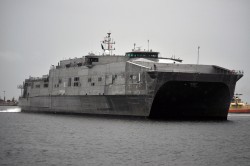
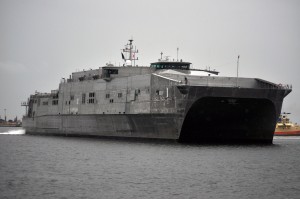
What platform would fill this role exactly? Perhaps a new program is needed, or perhaps an existing program can be adapted such as the Littoral Combat Ship (LCS) or the Joint High Speed Vessel (JHSV). One thing is for sure, it won’t be the DDG1000 or the Gerald R. Ford aircraft carrier. The Mobile Landing Platform (MLP) and its variant, the Afloat Forward Staging Base (AFSB), are promising programs. John Glenn, the second in this line produced by General Dynamics, was just floated in San Diego this past September. Essentially a modified oil tanker, these 840-foot vessels offer a plethora of storage space, a large open deck, and ballast tanks capable of flooding parts of the deck to take on hovercraft. MLPs may not be the quality of technological superiority that we are used to; but at a mere $500 million a copy, they bring capability for a price at which we can afford the quantity.
As the US continues to shift from large-scale conventional wars to geographically diverse low-intensity conflicts, the Navy’s forces must be tailored with the current financial hardships in mind. With changing times come changing values, and it is finally time to shelf the demand for quality and instead favor quantity.
In a 1997 speech to the National Press Club that will be familiar to many Navy and Marine Officers, General Charles Krulak, 31st Commandant of the Marine Corps, told the story of Roman consul Publius Varus. Consul Varus was a once successful general whose legions were decimated by Germanic tribes using what we might refer to as asymmetric tactics that left the Roman’s flummoxed. Varus’ last words were recounted as “Ne Cras, Ne Cras,” or “Not like yesterday.” The story presents a challenge to military leaders in our own generation to refrain from getting complacent in their own capabilities, and to continue to adapt their organizations to meet new and unexpected threats.
General Krulak’s went on to introduce the concept of an urban “three block war,” in which combat forces would simultaneously conduct humanitarian relief, peacekeeping, and high intensity combat operations in the space of three contiguous blocks of a complex urban environment. In many ways General Krulak’s words were more prophetic than he could know, as within six years U.S. forces were engaged against an irregular enemy in complex, densely populated urban terrain in Iraq.
American combat troops out of Iraq and on the cusp of departing Afghanistan. This makes it the perfect opportunity to examine old ideas about urban warfare with fresh eyes and look for both the continuities and the differences resulting from a globally connected world and the proliferation of advanced weapons and technologies down to the sub-state level.
Dr. David Kilcullen, an Australian soldier and counterinsurgency specialist who advised U.S. leadership on strategy in Iraq and Afghanistan, has taken a major step in this direction with his new book Out of the Mountains. Kilcullen’s new work analyses the major trends driving the future of conflict around the world. His findings will indeed have far reaching implications for the U.S. military, which has been focused for years on a rural insurgency based in the mountains and deserts of Afghanistan. Conflict will not be as it was yesterday. It will be fought in major coastal urban centers amidst tens of millions of people, and it will span all domains including land, sea, air, and cyber. These conflicts will be complex and will almost never have a purely or even primarily military solution, but their intensity will at the very least require military force to protect and enable other forms of power and influence as they are applied in support of U.S. strategic goals. The U.S. Navy and Marine Corps will need to be adaptable and flexible in order to remain mission-capable in such an environment.
This article will examine the major trends that Kilcullen identifies, and attempt to delve deploy into their military implications. Dr. Kilcullen identifies four “mega-trends” that are shaping the future of humanity, and with it the future of warfare as a human endeavor. These trends include:
Increasing Population – The U.N. estimates that the global population will continue to increase, especially in developing nations, before leveling off around 9 billion people sometime in the latter half of the century.
Urbanization – For the first time in human history, more than half of the population worldwide lives in cities.
Littoralization – Most cities, and certainly the largest ones, are in coastal zones that provide access to seaborne transportation and thus access to the global economy. Kilcullen usefully defines the littorals as the portion of land and air that can be targeted by weapons from the sea, and likewise that portion of sea and air that can be targeted from land.
Digital Connectedness – Internet and mobile phone access are beginning to saturate markets worldwide, and in some countries access to communications technology outstrips access to sanitation facilities.
The first three of these trends are not news. Kilcullen notes that sociologists have been writing about population and urbanization for decades, and urban conflict was a major focus of military thinking in the 1990s. However, the acceleration of these trends, combined with the burgeoning level of digital connectedness not widely foreseen in the 1990s, means that urban conflicts will take on a new level of violence and intensity that will be broadcast around the world instantaneously. This will provide our adversaries with powerful commercial tools to enable command and control (C2) of independent networked cells in a dynamic battlespace.
At the operational level, planners can expect warfare to range from the multiple-battalion level assault on Fallujah at the high-end to complex “urban seige” attacks such as Mumbai and Nairobi in the mid-range to the persistent urban violence of the drug wars in Rio de Janeiro’s favelas at the low-end. In each instance, the enemy will be a small, networked, and extremely well-armed group. It will reside in a sea of millions of civilians and be able to call upon commercial digital networks from cell phones to Twitter to collect intelligence, post propaganda, and act as ad hoc C2 nodes to coordinate operations. It will also be able to draw on a massive global transportation system to transport people, weapons, and finances around the world in short order.
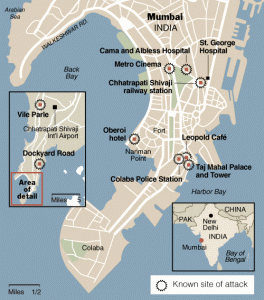
In order to flesh out the capabilities of modern networked urban terrorist groups, Kilcullen analyzes in detail the 2008 Lashkar-e-Taiba (LeT) Mumbai assault. LeT’s ground-breaking tactics, which displayed a level of free-flowing swarming ability that is at the very least rare for a sub-state actor, are worth examining. The attack was carried out by multiple cells of just a few individuals each who had conducted a thorough reconnaissance of their targets for nearly a year. The attackers used maritime ratlines normally employed by smugglers to move from Karachi to the port of Mumbai, making landfall in a slum neighborhood with little police presence. Once the assault began, their actions were coordinated via cell- and satellite-phone by a LeT command team operating their own combat operations center in Pakistan (likely with some support from Pakistani ISI). The team used broadcasts from CNN and other media networks to inform their battle tracking and develop an open-sourced understanding of the Indian police response. This allowed the LeT cells to remain several steps ahead of Indian security forces for several days, killing civilians at several high-profile public locations around Mumbai before they were finally surrounded and neutralized.
Digital connectedness is also allowing insurgent groups to expand their presence into the global information space that was once the sole purview of states and large corporations. Regular readers of this blog will likely remember that al-Shabaab live-tweeted the recent Navy SEAL raid in Barawe, and after the special operators withdrew, were able to claim victory before Western news outlets even knew the operation had taken place. The militants then followed up by posting pictures of equipment that the SEALs had left behind during their extraction from the firefight. While seemingly trivial, this allowed al Shabaab to stake its claim to the information available on the attack, and perhaps shatter some of the aura of invincibility surrounding the SEALs since their assault on Osama bin Laden and rescue of Captain Richard Philips from Somali pirates.
It is beyond the scope of a single blog post to analyze all of the future trends that Kilcullen examines in detail. Indeed, the book itself is likely just the first of a great deal of research that still needs to be done on the future of urban conflict against evolved irregular or hybrid adversaries in mega-slums and other dense and highly complex urban environments. Much of that research will, of necessity, have to focus on non-military aspects of conflict prevention and mitigation, due to the unavoidable fact that future urban conflicts will be driven by sociological factors inherent to the urban systems where they are being fought. Under Kilcullen’s formulation, urban design and development will in many ways become as important to American policy as foreign aid, governance and economic development, and security sector reform.
The implications for military doctrine and organization will be significant as well. It will impact Naval doctrine, organization, and ship-building plans even as Navy leadership seeks to focus its efforts and budgetary priorities towards AirSea Battle. The same is true for the Marine Corps’ efforts to reposition itself as the nation’s amphibious crisis response force following a decade of warfare in landlocked environments. In following articles, we will examine these implications in depth, and attempt to achieve a better degree of resolution on the future of urban littoral combat and the steps that the Navy and Marine Corps will need to take to remain mission-capable in that environment.
Dan Dewit is a researcher with the Arleigh Burke Chair in Strategy at the Center for Strategic and International Studies in Washington. From 2009- September, 2013 he served as an officer in the U.S. Marine Corps.

 What platform would fill this role exactly? Perhaps a new program is needed, or perhaps an existing program can be adapted such as the Littoral Combat Ship (LCS) or the Joint High Speed Vessel (JHSV). One thing is for sure, it won’t be the DDG1000 or the Gerald R. Ford aircraft carrier. The Mobile Landing Platform (MLP) and its variant, the Afloat Forward Staging Base (AFSB), are promising programs. John Glenn, the second in this line produced by General Dynamics, was just floated in San Diego this past September. Essentially a modified oil tanker, these 840-foot vessels offer a plethora of storage space, a large open deck, and ballast tanks capable of flooding parts of the deck to take on hovercraft. MLPs may not be the quality of technological superiority that we are used to; but at a mere $500 million a copy, they bring capability for a price at which we can afford the quantity.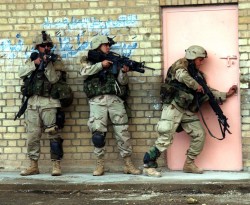
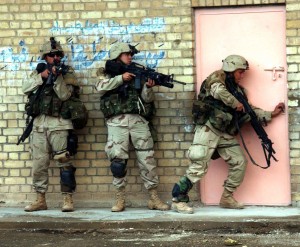 At the operational level, planners can expect warfare to range from the multiple-battalion level assault on