Category Archives: Strategic Outlook

Predictions and forecasting.

The Rise of the Social-State

As the clock struck midnight on December 31, 2000, at the start of a new millennium, there were approximately 360 million unique internet users. Just 1/1000th of the populations in the Middle East and Africa had access to the internet. Facebook was still but a twinkle in Mark Zuckerberg’s eye.

Thirteen years later, this has changed dramatically. At nearly 2.5 billion people, the internet is used by more than 1/3 of the world’s population. More than 15% of Africans now have access to the internet – the majority of them getting it through mobile data via cell phones – while a whopping 40% of Middle Easterners are now online. That represents a growth of over 3000% (that’s three thousand) in just over a decade.

At the same time, social media use has risen exponentially. If all the Facebook users in the world were assembled into one place, they would make up the third-largest country on Earth with over 1.1 billion citizens (behind only China and India). While not nearly as numerous, there are over 500 million users of 140-character Twitter, with over 10% of those people in a single country:  China.

A Different World

You forgot the "@" before Mubarak.
You forgot the “@” before Mubarak.

People are no longer left to rely on the state-sponsored dictation of events, or even a few media outlets reporting what they’ve seen. With Twitter, first-hand accounts and pictures can be passed quickly; with Facebook, users can share and collaborate on growing trends; on YouTube, we can see with our own eyes exactly what is happening in Syria, Egypt, or on the streets outside Washington, DC.

The most enduring reality of the past decade has been the rise of the global individual. In 2006, Time‘s “Person of the Year” was the individual (“You,” to be specific). In response to old, slow, unresponsive regimes in Tunisia, Libya, Egypt, and a host of other countries, leaders were either deposed in a violent way or forced to make significant concessions antithetical to the totalitarian norm.

Global individualism has led to a prioritization of individuals and ideologues over the traditional concept of “nation.” When you can “like” the Syrian Free Army on Facebook or “follow” al-Shabaab on Twitter from the comfort of your own home, it doesn’t matter that you live in the land known as “Pakistan” or “Egypt” or even “the United States of America.” Individuals across the globe are organizing themselves more now by ideas and preferences than by borders or nationality.

This notion is not new in religious lore. In Islam, the organization of Muslims everywhere is known as the “Caliphate.” Before it was a UN-recognized state, Israel was the name of the global community of Jewish people. Today, we might call all fans of the Dallas Cowboys a “Facebook group” and all the internet subscribers of Muqtada al-Sadr his “Twitter followers.” In the 21st century, the diaspora is connected via wi-fi.

The Decline of Nationalism

At a recent gathering of more than 150 American citizens with at least some level of college education, I asked the assembled crowd to identify the corporate logos of Starbucks, Shell, AT&T, McDonald’s, and Fed Ex. 100% of the crowd was able to correctly identify at least 4 of the logos, while around 90% were able to identify all 5.

Immediately afterward, I asked the same 150 people to identify the national flags of Syria, Egypt, Somalia, Libya, and Chad. Approximately 80% could identify 1 flag, 60% could identify 2 flags, 33% could identify 3 flags, 10% could identify 4 flags, and only 1 person (an African studies major in college) could identify all 5 flags.

In an effort to drive the point home, I flashed the flags of five U.S. states: New York, Alabama, Delaware, Indiana, and Massachusetts. If you can believe it, the percentages were actually worse; not a single person was able to correctly identify all five state flags (to be honest, if I hadn’t researched for the event, I doubt I would have been able to guess more than three or four either).

This erudite experiment, though anecdotal and far from scientific, points to a larger global trend:  the decline of nationalism, and the rise of global individualism.

The Ideological Basis of Armies

In light of the recent revolutions that comprised “the Arab Spring,” one must ask:  how are armies fielded? In our textbooks, we are taught that armies are the property of nation-states, who field them in defense of their borders or broader national interests.

But isn’t the original concept of the nation-state simply an ideal? At its basic level, an army is stood by people coming together to protect themselves from harm by a common enemy. It follows, then, that the armies of the 21st century will follow this natural law—that they are fielded to defend ideals—and with that comes a monumental shift in the global political paradigm: the rise of the social-state.

This is not a new idea. In his book Jihad Joe, J.M. Berger estimates that more than 1,400 American citizens have taken part in some form of militant jihad over the past 30 years. As our communication and connectivity brings us closer, our money and internet history drive our future more than the votes we drop in the ballot box.

Yet simple connectivity cannot supplant real action from Internet users. In “Tweeting Toward Freedom,” the Wilson Quarterly noted that, “More than a million people have joined a Facebook page of the Save Darfur Coalition, but few among them have taken any additional action to help those in Sudan.” The most effective ideologues in this century will be those who can turn words on a computer screen into reliable action from their followers.

The Social State

In a Small Wars Journal article, Richard Lindsey wrote, “There comes a point in any insurgency where it must move beyond the reach of social media, and tangible gains must be made on the ground – positions occupied, personalities deposed, systems replaced, logistics realized, and governments overthrown.” Yet if insurgents and individuals can defend themselves from governments while operating within that government’s borders, they have already made “tangible gains…on the ground.” The positions, personalities, systems, logistics, and governance are provided through wireless or ether connections and supported via the “social compact”—namely, some form of user agreement.

If I can get access to the internet, I can pledge to a cause, fund that cause, and become indoctrinated to that cause. We might call this process “assimilation.” My physical location is only important insomuch as I can carry out actions for that cause in my specific locale or travel to a nearby location to do the same. The “social-states” created by this reality are the future of the world, where citizens are arranged by borders of thought, ideology, and preference.

On its face, this may seem like a unique solution to so many conflicts throughout the world. However, the “borders” created by such a reality are much more fluid, volatile, and confusing, and they will drive our concept of conflict. In the book Warrior Politics, visionary author Robert Kaplan surmises that “the spread of information in the coming decades will lead not just to new social compacts, but to new divisions as people discover new and complex issues over which to disagree.”

Rather than access to weapons and land, the ability to control the electromagnetic spectrum and access to the internet will define future battlefields as the “strategic high ground.” Cyber strike and defense will be the most critical mission sets as friend and foe alike use this medium to achieve not only kinetic effects against their enemies–including CBRNE—but important non-kinetic effects as well, especially those encompassed in the concept of Anti-Access/Area Denial (A2AD).

Without respect for nation-state political borders, these effects will be felt indiscriminately by both supporters and opponents of the cause. Therefore, those who can develop the ability to discriminate their effects will find the most success and support.

The Tough Sell

A new global paradigm isn’t limited to the shores of Africa or the Middle East; it can be seen here in America. The government shutdown is a case study in the inability of governments to respond to large-scale discord in a way that maintains credibility – and in this century, credibility and confidence is currency. Those who cannot control the 24/7 opinion and social media reality will quickly cede their control to the growing social-state underneath.

Therefore, it will be in the best interests of major nations like the USA, China, Germany, United Kingdom, and France, among others, to counter these tendencies and find a way to “sell” the nation-state in a 21st century marked by individual power. More than Nazism, fascism, or communism, the synergistic effects of non-state actors, insurgents, and individuals through social media and collaboration will be the greatest existential threat to freedom as we know it—the kind of freedom nation-states enjoy—that the world has ever witnessed.

In his New York Times piece “The End of the Nation-State?” Parag Khanna reminds us that “[t]his isn’t to say that states have disappeared, or will. But they are becoming just one form of governance among many.” In an age where information and products consume our daily routines, nation-states are faced with a very tough sell, indeed. There are many questions that partisans, policy makers, and populations must answer: Is the nation-state worth fighting for, or is the social-state a better alternative? Are the two mutually exclusive? Is the paradigm shift inevitable?

We will shape the answers to these questions over the coming decades. In the meantime, the only certainty seems to be that we will be uncertain.

LT Roger L. Misso is a Naval Flight Officer (NFO) in the E-2C Hawkeye, recent MAWTS-1 WTI graduate, and former director of the Naval Academy Foreign Affairs Conference (NAFAC). The opinions and views expressed in this post are his alone and are presented in his personal capacity. They do not necessarily represent the views of U.S. Department of Defense or the U.S. Navy.

Can South Korea’s Military Successfully Reorient Its Strategic Priorities?

ROK-Navy-2010

A continuation of The Hunt for Strategic September, analysis on the relevance of strategic guidance to today’s maritime strategy(ies). As part of the week we have encouraged our friendly international contributors to provide some perspective on their national and alliance strategic guidance issues.

In an earlier article for CIMSEC, I argued that in order for the U.S.-South Korean alliance to effectively counter threats emanating from North Korea (DPRK), South Korea (ROK) must gradually move away from its Army-centric culture to accommodate jointness among the four services. In particular, as Liam Stoker has noted, naval power may offer the “best possible means of ensuring the region’s safety without triggering any further escalation.”

The appointment last week of former ROK Chief of Naval Operations Admiral Choi Yoon-hee as the new Chairman of the Joint Chiefs of Staff seems to augur a shift in focus in the ROK’s strategic orientation. Given that the ROK’s clashes with the DPRK have occurred near the contested Northern Limit Line throughout the late 1990s and 2000s, President Park Geun-hye’s appointment of Admiral Choi as Chairman of ROK JCS seems to be appropriate. Indeed, during his confirmation hearings two weeks prior, Admiral Choi repeatedly vowed retaliatory measures in the event of another DPRK provocation.

Furthermore, by tapping Admiral Choi to head the ROK JCS, President Park also appeared to signal that she is mindful of the feverish East Asian naval race. The ongoing naval race among three East Asian naval powers (China, Japan, and South Korea) is rooted in historical grievances over Japan’s wartime atrocities and fierce competition for limited energy resources. These two factors may explain the ROK’s increased spending to bolster its naval might.

Indeed, the ROK Navy has become a great regional naval power in the span of a decade. The ROKN fields an amphibious assault ship, the Dokdo, with a 653 feet-long (199 meters) flight deck. The ship, named after disputed islets claimed by both the ROK and Japan, is supposedly capable of deploying a Marine infantry battalion for any contingencies as they arise. Given that aircraft carriers may offer operational and strategic flexibility for the ROK Armed Forces, it is perhaps unsurprising that “funding was restored in 2012” for a second Dokdo-type aircraft carrier and more in 2012 and that Admiral Choi has also expressed interest in aircraft carrier programs. Moreover, the ROKN hassteadily increased its submarine fleet in response to the growing asymmetric threats emanating from North Korea and Japan’s alleged expansionist tendencies. As the Korea Times reported last Wednesday, the ROKN has also requested three Aegis destroyers to be completed between 2020 and 2025 to deal with the DPRK nuclear threats and the naval race with its East Asian neighbors.

Thus, at a glance, it would appear that the ROK has built an impressive navy supposedly capable of offering the Republic with a wide range of options to ensure strategic and operational flexibility. However, this has led some analysts to question the utility and raisons d’être for such maintaining such an expensive force.

Kyle Mizokami, for example, argues South Korea’s navy is impressive, yet pointless. He may be correct to note that the ROK “has prematurely shifted resources from defending against a hostile North Korea to defeating exaggerated sea-based threats from abroad.” After all, at a time when Kim Jŏng-ŭn has repeatedly threatened both the ROK and Japan, it may be far-fetched to assume that Japan may “wrest Dokdo/Takeshima away by force.” It would also make no sense to purchase “inferior version of the Aegis combat system software that is useless against ballistic missiles” which does not necessarily boost its naval might.

roknavydestroyers

However, what Mizokami may not understand is that the seemingly impressive posturing of the ROKN does not necessarily mean the expansion of the Navy at the expense of diminishing Army’s capabilities. As my January piece for the Georgetown Journal of International Affairs and Michael Raska’s East Asia Forum article argue, the greatest barriers to service excellence for the ROKN may be South Korea’s uneven defense spending, and operational and institutional handicaps within the conservative ROK officer corps. One telling indication which bears this out may be the fact that the expansion of the ROKN and Admiral Choi’s chairmanship of the ROK JCS did not lead to the reduction of either the budget allocated for the ROK Army or of the existing 39 ROK Army divisions in place.

Moreover, if, as Mizokami argues, the ROK seems bent on pursuing strategic parity with Japan—and to a lesser extent, China—I should point out that it does not even possess the wherewithal to successfully meet this goal. As I notedin late August, in order for the ROK to achieve regional strategic parity with its powerful neighbors, South Korea must spend at least 90% of what its rivals spend on their national defense. That is, the ROK’s $31.8 billion defense budget is still substantially smaller than Japan’s $46.4 billion. If anything, one could argue that the ROK’s supposedly “questionable” strategic priorities have as much to do with political posturing and show aimed at domestic audience as much as they are reactions to perceived threats posed by its powerful neighbors.

Finally, neither the ROK military planners nor Mizokami seem to take into account the importance of adroit diplomatic maneuvers to offset tension in East Asia. In light of the fact that the United States appears reluctant to reverse its decision to hand over the wartime Operational Control (OPCON) in 2015, the ROK may have no other recourse but to deftly balance its sticks with diplomatic carrots to avert a catastrophic war on the Korean peninsula.

In short, it remains yet to be seen whether the ROK will successfully expand the scope of its strategic focus from its current preoccupation with the Army to include its naval and air capabilities. One cannot assume that this transformation can be made overnight because of an appointment of a Navy admiral to the top military post, or for that matter, because it has sought to gradually bolster its naval capabilities. Nor can one assume that they are misdirected since a service branch must possess versatility to adapt to any contingencies as they arise. Instead, a balanced operational and strategic priority which encompasses the ground, air and maritime domain in tandem with deft diplomacy may be what the ROK truly needs to ensure lasting peace on the Korean peninsula and in East Asia.

Photo credit: U.S. Forces Korea, SinoDefence, ITV

Jeong Lee is a freelance writer and is also a Contributing Analyst for Wikistrat’s Asia-Pacific Desk. Lee’s writings on US defense and foreign policy issues and inter-Korean affairs have appeared on various online publications including East Asia Forum, the Georgetown Journal of International Affairs, the World Outline and CIMSEC’s NextWar blog. This article appeared in its original form at RealClearDefense on October 24th, 2013.

Choosing Sides or Choosing Peace? U.S. Strategy in the South China Sea Dispute

The National Interest on Monday published an intriguing article by Ted Galen Carpenter discussing the potential implications of President Obama’s current South China Sea (SCS) strategy.  During the East Asia Summit, where the President was forced to send Secretary of State Kerry in his place so he could focus on the government shutdown, Secretary Kerry took a supportive (some would say meddling) position in defense of Manila stating that “all claimants have a responsibility to clarify and align their claims with international law. They can engage in arbitration and other means of peaceful negotiations.”

Although many welcome America’s “pivot” to Asia, many more are trying to grasp what that really means. Does it mean greater military presence, more economic influence? Or, as Carpenter’s article suggests, taking sides in the sovereignty disputes in which most of the tension in the region is moored? Before drawing conclusions that Secretary Kerry’s statement provides some sort of clue, it would be prudent to examine what the arbitration filing actually is and what it requests. 

Reefs and LinesFor background, the United Nation Convention on the Law of the Sea (UNCLOS) provides a dispute-settlement regime that requires signatory States, such as China and the Philippines, to resolve their disputes peacefully: first through negotiation, and then if that doesn’t work, States can choose from four options. These options include submission of the dispute to the International Court of Justice, to the International Tribunal for the Law of the Sea, conciliation, or go to an arbitral tribunal.  Without delving into too much procedural detail, the arbitral tribunal is usually the most attractive because it allows the States to choose who their adjudicators will be. 

So what does supporting Manila’s arbitral filing suggest with regard to interpreting the Obama Administration’s position in the dispute? To figure that out comes down to determining what the Philippines is really asking the arbitral tribunal to do. Whereas the underlying tensions of the dispute relate to which State owns what island, Manila has cleverly requested that the tribunal restrict its judgment to something much more precise. Specifically, the arbitration request doesn’t ask the tribunal to determine ownership on a historical basis per se, but that it only clearly establish the sovereignty rights of the Philippines under UNCLOS due to the claimed non-island status of the reefs and shoals. The Philippines have requested the tribunal to:

a. declare that China’s rights in regard to maritime areas in the SCS, like the rights of the Philippines, are those established by UNCLOS;

b. declare that China’s maritime claims in the SCS based on its so-called “nine-dash line” are contrary to UNCLOS and invalid;

c. require China bring its domestic legislation into conformity with its obligations under UNCLOS;

d. declare that Mischief Reef and McKennan Reef are submerged features that form part of the Continental Shelf of the Philippines under Part VI of the Convention, and that China’s occupation of and construction activities on them violate the sovereign rights of the Philippines;

e. require that China end its occupation of and activities on Mischief Reef and McKennan Reef;

f. declare that Gaven Reef and Subi Reef are submerged features that are not above sea level at high tide, not islands under UNCLOS, not located on China’s Continental Shelf, and China’s occupation and construction activities on these features are unlawful;

g. require China to terminate its occupation of and activities on Gaven Reef and Subi Reef;

h. declare that Scarborough Shoal, Johnson Reef, Cuarteron Reef and Fiery Cross Reef are submerged features and are “rocks” under Article 121(3) of UNCLOS;

i. require that China refrain from preventing Philippine vessels from exploiting the living resources in the waters adjacent to Scarborough Shoal and Johnson Reef;

j. declare that the Philippines is entitled under UNCLOS to a 12nm territorial sea, a 200nm Exclusive Economic Zone (EEZ), and a Continental Shelf under UNCLOS, measured from its archipelagic baselines;

k. declare that China has unlawfully claimed, and has unlawfully exploited, the living ad non-living resources in the Philippines’ EEZ and Continental Shelf;

l. declare that China has unlawfully interfered with the exercise by the Philippines of its rights to navigation and other rights provided under UNCLOS;

m. require China desist from these unlawful activities.

Note: China has refused the arbitration request.  Annex VII, Article 9 of UNCLOS, however, provides that “if one of the parties to the dispute does not appear before the arbitral tribunal or fails to defend its case, the other party may request the tribunal to continue the proceedings and to make its award. Absence of a party or failure of a party to defend its case shall not constitute a bar to the proceedings.”

Although the Philippines did not request that the tribunal resolve the sovereignty claims directly, it does ask it to determine a very significant issue: whether the disputed features are rocks or islands. In these instances, the Philippines believes determinations that they are not islands would further its aims. For even if China retained ownership it would minimize the extent of China’s territorial claims under international law. This is because under UNCLOS, rocks only get 12nm of territorial seas. Islands, however, get 12nm of territorial seas AND 200nm of an exclusive economic zone. This is why each and every island/rock matters and why there is so much at stake. It’s critical to remember that the fight is not over what is on the island/rock, but the resources in the water column and shelf surrounding the island/rock.

Turning back to the Obama Administration’s SCS strategy, Secretary Kerry’s statement may be interpreted in at least two-ways. The statement could suggest support of Manila’s sovereignty claims and therefore the U.S. would be taking sides. The statement could also suggest support of Manila’s right to argue their claims under international law and therefore the U.S. would be supporting a peaceful settlement of the dispute in an international forum rather than a regional one. Carpenter’s article does an excellent job of describing the potential implications if the U.S. strategy included choosing sides. On the other hand, if the U.S. is supporting Manila’s right to argue their claims under international law, the implications for the U.S. could be a loss of credibility. It continues to remain harmful for the United States, especially in the SCS context, to keep suggesting that this dispute ought to be settled under UNCLOS because the U.S., due to political reasons in the Senate, has yet to ratify this critical treaty.

LT Dennis Harbin is a qualified surface warfare officer and is currently enrolled at Penn State Law in the Navy’s Law Education Program.  The opinions and views expressed in this post are his alone and are presented in his personal capacity.  They do not necessarily represent the views of U.S. Department of Defense or the U.S. Navy. This article is for informational purposes only and not for the purpose of providing legal advice.
 

Africa: “A Problem As Unique As Each of its Constituent Parts”

Still terrifying, but not as monolithic as some envision.
“Security issues are still terrifying, but not as monolithic as some suggest.”

Regarding Mr. Hipple’s article “African Navies Week: Al Shabaab is Only the Beginning”, he addressed a critical issue which all too often does not receive proper attention.  It is a daunting prospect to try and pull in the disparate threats from across the continent formulating a single threat analysis and, while his conclusion is accurate in that he points out the diverse threats facing the continent, from a purely security-focused perspective, it still lacks some necessary clarity.  The problem is the moment you start looking at how individual factors within a given country are driving conflict/instability, you quickly lose the scent of how it ties into the transnational threat groups.  There is also the problem of how far back you are willing to look, the specter of Colonialism is still present and the post-colonial relationships cannot be entirely discounted.

There are too many fundamentally different factors at play across Africa to compare the potential for total, though not collective chaos that threatens the continent and still have the comparison to Afghanistan be a strong one.  While Afghanistan is easily evoked as a common point of reference and there are elements of similarity that narrowly can be compared, each region of the continent has enough of its own issues to cause the wheels to come off of the Afghan comparison.  Additionally, once you make the comparison to Afghanistan it easily leads to a false equivalency.

The threat from Boko Haram (BH) is real and growing yet the Nigerian Government is wholly unprepared to handle it – their heavy-handed tactics have increased distrust in the government and have not deterred or degraded BH.  More importantly, the growing alignment between Al Qaeda in the Islamic Maghreb (AQIM) and BH marks a significant development in the connectivity of pan-African terrorism.  However, these groups do not monopolize the West African threat.  The spread of BH into Cameroon is tied to their evasion the Nigerian military’s offensive operations.  What is happening in Niger with regards to BH is mostly proximate.  The more apt comparison for the growing instability in Niger is the likeness to Mali where you see disenfranchised Tuaregs of the north returning from service in Libya (Gaddafi’s desert battalions) flush with weapons, training and a desire to have a say in their government.  In both Mali and Niger, the Tuaregs have been persecuted and altogether cut out of the political process by the ethnically separate majority in the southern capitals.

Disenchantment with the government in Bamako and simmering ethnic discord set the stage for French operations in January, however, what caught world attention was the marriage of convenience by the MUJWA and elements of AQIM.  Given the disassociated natures of the AQ franchise, it can be difficult to make sweeping generalities because the various strains (AQIM, AQEA, AQAP, AQI and AQSL) each have their own local idiosyncrasies, but one thing they do have in common is their ability to first bond with a local cause/faction on ideologically tenuous grounds and then quickly alienate themselves from the population with their unique extremist ideology which is often incompatible with local norms – see AQI and the Sunnis, AQAP and the Tribes of south central Yemen or AQIM and the Tuaregs.

My point is, while virulent strains of AQ exist across the corners of the continent and in their own right pose a threat, they have had difficulty building and maintaining strong and enduring relationships with other local movements.  The AQ-BH connection is growing, and AQEA/AS in the past two years “formalized” their relationship, however, when you look at the nature of the threat on the ground in Somalia for example, there is a definite rift.

Continuing in the East, while the threat from AS/AQEA has expanded beyond Somalia, it is worth noting that the focus of their ire has not been indiscriminate but has targeted those countries participating in AMISOM.  With regards to CAR, while Seleka partnership with anyone would only further degrade a poor situation, the nature of the Seleka rebels themselves does not lend itself to partnership with any of the aforementioned groups.  It is also worth noting that within days of capturing the capital, the rebel groups splintered and immediately fell into the same trap as their government predecessors – an inability to exert influence beyond the capital.  What this means in the long term is that the security vacuum is being filled by the rebels with no real solution.

Moving North, there is a fascinating and frightening mélange of issues at play in the Maghreb and the single commonality is that each of the governments in their various degrees of weakness is attempting to quell internal dissent.  Libya is the new frontier since the fall of Gaddafi, and the government has no ability to project power, they cannot control the capital let alone anywhere else are forced to in equal measure threaten and placate the militias within Tripoli.  However, the ungoverned spaces elsewhere have been, at least temporarily ceded, as the government attempts to consolidate power.  Tunisia is still dealing with the fall out of the Arab spring and has been unable to form a coalition government that meets the needs of both Islamic factions and strong secular sentiments/groups.

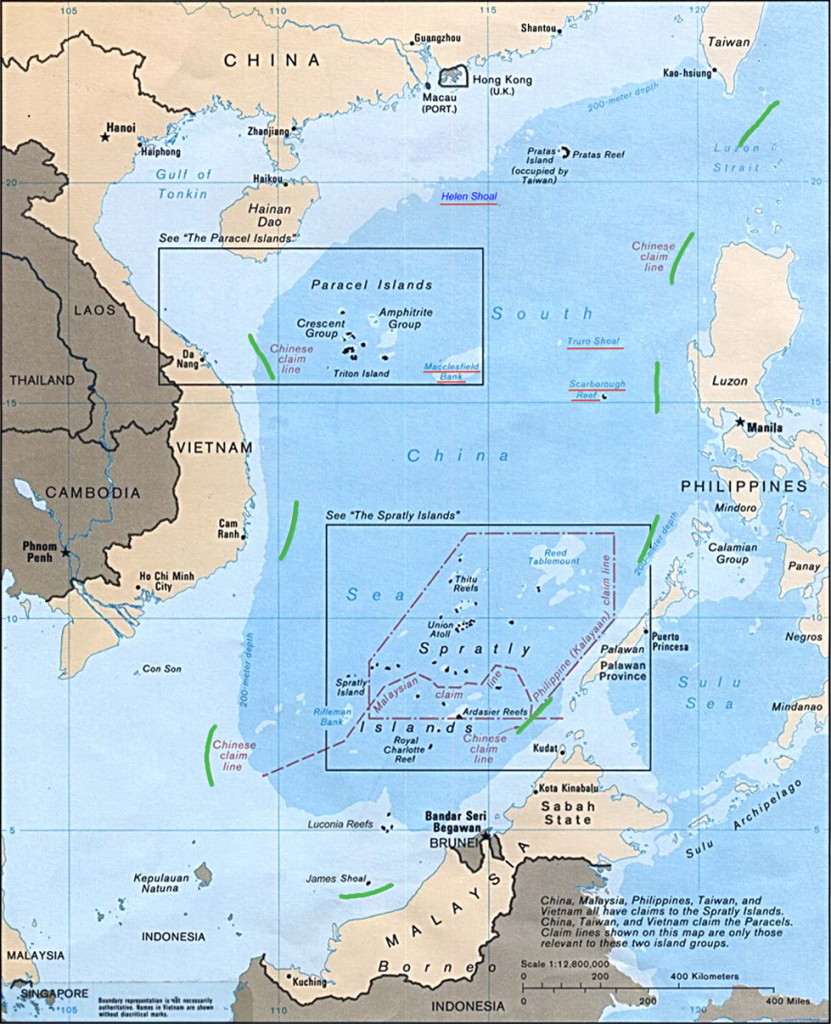
While the graphic paints a fairly grim picture of the continent, the reality is even grimmer yet as it fails to capture one of the longest ongoing conflict in the Kivu region of Eastern DRC.  Furthermore, with regards to the maritime threat, there are fundamentally different factors at play on the East and West Coast; while piracy is the end result, the elements driving them are quite different.  In HOA you have piracy being driven by the fact that Somalia is a failed state and pirates take advantage of their proximity of shipping lanes in the Bab-el-Mandeb.  Along the West coast, the piracy issue is being driven by the desire to exploit components associated with the off-short oil wealth of Nigeria.  The biggest problem as it applies to maritime security is that too many governments across Africa still perceive maritime security to be a luxury they cannot afford.  It is easy to discuss how it Maritime security has a chance to minimize the flow of extremists and the vast potential to make a positive impact, but like so many things, without sufficient local buy-in, the effort is dead on arrival.

It is difficult to address broad security threats across Africa without becoming hopelessly mired in the details; this is why all too often security threats on the continent are looked at in isolation without broader thought given to overarching threats.  This is further complicated by the fact that the commonality of the threats spanning the breadth of the continent, their origins and likely the solutions, exist beyond the security realm.  Uneven and underdevelopment, disenfranchised populations, and natural resource exploitation along often colonial lines drive what has to date been considered an acceptable level of instability.  The various extremist movements are indicative of systemic and structural failures.  Mr. Hipple’s article was a valiant effort at addressing one of these issues, but it is exceptionally difficult to frame the problem appropriately so as to address the relevant factors at appropriate depth while not missing necessary nuance and simultaneously addressing significant transnational factors.  Until the broader issues driving current conflict and instability are addressed, we are likely to see more of the same.

Timothy Baker is Marine Officer in the United States Marine Corps Reserve and a Masters Candidate at Columbia University.  The opinions and views expressed in this post are his alone and are presented in his personal capacity.  They do not necessarily represent the views of Columbia University, U.S. Department of Defense or the United States Marine Corps.

(Editor’s note: Another fine example of my over-simplification is the note that the map also showed “Somalia” as one unit, when in reality it is three distinct organizations each with different problems)