Category Archives: Fiction Week

Scratch One UpDown

Fiction Week

By Chris “Junior” Cannon

D1+[23:59]  Kuma pressed his chin in the dirt, continued fumbling with the downlink hardware, and counted off the last legitimate seconds of sanctuary, his thoughts pregnant with the picture of the system’s origami antenna unfolding into full bloom. Only when he reached 40 did Kuma realize that he had been counting in Hindi. The downlink was not cooperating. Some Marines called it the UpDown, others called it the Burpie. “UpDown” wasn’t what the system did; it was receive only. The Group had other methods to send messages out. Kuma called it the downlink because Staff Sergeant Townes called it the downlink. “UpDown” was what you did with it, set it up and tear it down; every hour, on the hour. Plus or minus 45 seconds. Everything was timing. The S36 promised 2 minutes of sanctuary, via technical means that Kuma wasn’t cleared for but fully understood nonetheless. Thirty seconds to erect the downlink, 90 seconds (max) to have it open, 15 seconds to stow the downlink. The math said that, according to standards, from setup, to receipt of messages, to downlink tear-down, 15 seconds of delay was tolerable before Kuma was in danger of incoming missiles.

“I like math,” Kuma thought. “Just not this math.”

He wriggled slowly onto his side. It was a lumbering endeavor with a good resemblance to a bad roll-over accident, maybe an MRAP on its side in a canal. His backpack shifted and tipped over like a swollen cow. Kuma’s worry increased. An unexpected vocal buzz in his ear amped up the feeling.

“Corporal Rajkumar, what’s the ETA on my downlink?”

Staff Sergeant Townes had broken comm discipline. Staff Sergeant could break a lot of things, but in Kuma’s recollection discipline had never been one of them. Kuma made a visual scan, not of the island scenery, but of the over-sized glasses strapped to his head. Just Glass, was what they called it. The Glass was deceptively clear of text. No news is good news, except when you fall out of the communication laser’s line of sight.

“No ETA at this time, Staff Sergeant,” Kuma said. He heard a wobble in his own voice. He attributed it to a compressed chest, a tricky tripod, and a testy Staff Sergeant. Kuma rolled back on his stomach. The backpack righted itself. Kuma couldn’t see the pencil beam illuminating his back, but when the Glass flashed with a dashboard update, he knew that he was back in the right. Kuma minimized his own bio-metrics with a wink. On the left side of the Glass he saw the familiar return of Staff Sergeant Townes’ direct messages, amber text with a burgundy background. The messages were called toastrs, not exactly because of the fires that Townes lit under the Marines, but that could’ve been the reason.

<Corporal Rajkumar, welcome back to the light.>

At times like these, Kuma was reminded of the saying … “Better to keep your mouth shut and be thought a fool …” He choose not to sub-vocalize any response. The Glass would pick up on his vocal cord vibrations, however silent, and transmit the response. Staff Sergeant’s follow-up came soon enough.

<Corporal Rajkumar, in what manner is my downlink currently kicking your ass?>

Some Marines would engage the Staff Sergeant in toastr sparring, but Kuma saw no value in it. The statement suggested additional downlink-ass-kickings either previously occurring in the past or good prospects of them happening in the future. The Group had been on island 48 hours and the S26 section attempted 48 message retrievals via the downlink. Kuma had been responsible for successful downlink erection in exactly half of those. Zero failures. There had been two communications windows missed, but neither on his watch. There had been two failed downlink set ups. There had also been two Marines fired.

“Corporal Rajkumar, what can I not do while my downlink remains down?” No toastr this time, but an actual audible. Staff Sergeant had chosen to force audio to Kuma’s headset. This was another break in protocol, another out of character event from Staff Sergeant Townes. The voice was not directly over Kuma. It was not seething heavy, hot oppression straight into his ear. It only felt that way. The immediate answer to the question was that with the downlink down, the Group couldn’t receive the broadcast when the communications munition, called the Overhead, was shot. That was the obvious answer, but the Staff Sergeant liked to be called Staff Sergeant Townes, not Staff Sergeant Obvious.

“Eat, Staff Sergeant,” Kuma mouthed with his lips.

<Corporal Rajkumar, that is correct. No downlink, no food.>

It was symbolic. If the section failed to erect the downlink, then nobody ate until the next success. The next opportunity to excel was always just one hour away, but it was a reminder of the consequences. If the S26 did not receive the overhead, then The Group might miss the next resupply. Or the next rendezvous with augments. Or worse, a relocate order may go unheeded. In that case, higher would send an urgent relocate message, but maybe they were unable. That would mean The Group would start eating missiles. If there was one thing that annoyed the Staff Sergeant, apart from missing Overhead VULS, it was the possibility of eating missiles. If the downlink stayed down, then nobody in the section ate. The next thing that you might eat just might be an MRE made of missiles.

<Corporal Rajkumar, have I disrespected you?> Back to toastrs.

“Rajkumar,” Kuma whispered his own name aloud “is not my last name, Staff Sergeant.”

<Corporal Rajkumar …>

Kuma read the ellipsis and imagined the Staff Sergeant intoning mock weariness. By Kuma’s count, he’d just entered into the “plus” side of the expected time window. The Overhead could come any moment now and the downlink was not yet up.

<The Group calls you Raj-KUMA-r, I’ma call you Rajkumar.>

“Yes, Staff Sergeant.” Kuma’s hands had not been idle while the burgundy toastr stacked up along the left side of the Glass. Gone were the delicate attempts to coax the tripod legs into place. Now Kuma banged on them with aggressive alacrity.

<Corporal Rajkumar, what is the exact problem?>

“Can’t convince the telescoping rods to telescope, Staff Sergeant.” There was no immediate reply. Kuma checked his positioning, to see if he had inadvertently rolled his pack off again. Nope, seems like the Staff Sergeant did not have a reflexive response. Staff Sergeant was thinking. A thing happened and Staff Sergeant did not know immediately what to do. Kuma’s internal worry meter did a half-needle deflection.

<Corporal Rajkumar, splay the base and raise the antenna as is.>

Kuma rose to a kneel, spread out the tripod legs and flipping the switch that actuated the antenna expansion. This mechanism started a faint whirring that would have easily pleased a sound effects editor. The reflective material spread in a choreographed sequence that was at once reminiscent of a slow-motion capture of a lotus blossom and the wing folding mechanics of fighter aircraft too expensive to operate with the Group or any of the other stand-in forces. Kuma saw the solid propellant missile – the Overhead – begin its long arc toward him before he heard the antenna expansion’s soft whirring sound die. The Overhead passed by obliquely and the down-link’s sole annunciator light illuminated a deep blue. Kuma began breaking down the downlink, methodically counting the number of seconds that sanctuary had been exceeded, his eyes not scanning the sky for a missile that would come in too fast for him to see.

************

D2+[02:37]  “Why me, Staff Sergeant?”  Kuma sub-vocalized the speech and saw his own words appear on the Glass. There had been two VULs since Kuma’s issue with the down-link’s base. Both were successes and both had been done without him. He’d been recalled by a bike messenger. She was a typical messenger Marine, uncommonly small with Olympic thighs. The bike arrived fully charged and she handed it off to him. Kuma pedaled back himself, determined to keep the charge at 100. Dripping in sweat, he stood focused on the short, slight, figure of Staff Sergeant Townes. He waited for a response, which was not immediately forthcoming. Kuma looked in the scene, looking for changes.

The call up to the Distributed Command Post was his first face-time with Townes since the Group had landed on the island. The concept called for the DCP to direct a breadth of operations across the battlespace. Marines in the Group knew that the D in the DCP represented the physical spread of personnel on the post. They were positioned such that no more than two nodes were within the kill radius of a ballistic missile. At least for the conventional warhead radius.

As they spoke silently only two small groups were within earshot. One Marine was giving a period of instruction by showing, not telling, two others how to operate the F-Tool, a 3-wheeled vehicle with four digging arms. This instructor clearly had a gift for American Sign Language, including a broad vocabulary for obscenities. Kuma had not previously associated the F-tool’s excavating functions with human reproductive functions, at least until today he hadn’t. The other group was two Marines whispering loudly to a third who had just disembarked from a category IV UAV. Shortly after the UAV lifted off, whisper quiet for such a large piece of gear, they transitioned into ASL. Kuma disagreed with the idea of landing UAVs at the DCP, let alone a cat IV, but exactly nobody had asked him. Some Marines didn’t like to bike. Their signing was accompanied by the aggressive percussion from the slapping of hands, mistakes that all but negated the supposed silence.

Kuma focused on the task at hand, he had been reassigned from Lead UpDown Technician. Marines had a special name for Staff NCOs who held that position. He was once again glad that he wasn’t one. Kuma didn’t think that he had been fired, but he wasn’t sure. The downlink had received all messages, but Staff Sergeant never allowed you to fail twice at something, she fired you after the first time. Sometimes she wouldn’t even allow you to fail once.

His new position was Special Projects NCO. In garrison, “Special Projects” meant do whatever the Lieutenant told you to do. Deployed, this invariably involved escorting an augment to the unit and schooling them in all things advanced and expeditionary about basing. The augment was typically a Captain who, despite never observing a single downlink erection, had been selected to command a future Group. It was from these facts that the Marines termed the duty and the “Special Projects” NCO as the C2B2 – Crappy Captain Body-guarding and Babysitting. Kuma’s virtual silence was broken by Staff Sergeant’s toastrs filling his Glass.

<Corporal Rajkumar, perhaps I’m putting you on C2B2 because I just don’t like you very much.> 

As Kuma read, he watched the Staff Sergeant’s fingers, typing rapidly on virtual keyboards at her side. He could never get over how archaic that seemed. Deployable Marines were supposed to pick up ASL. Anyone of the Glass Class quickly learned sub-vocalization. Only Marines of a certain age resorted to the full typing method. Keyboard Turners the Marines like to call them. Townes typed on.

<Or maybe, just possibly because you’re the best that I’ve got. Which do you think it is?>  Kuma knew the Staff Sergeant. Staff Sergeant Townes did not partake in rhetorical questions. She wanted answers. Everything was always being evaluated.

“I’d say both parts in equal measure, Staff Sergeant,” Kuma sub-vocalized.

<Corporal Rajkumar do you ever wonder why, an individual as intelligent as yourself, remains in the IRR after their commitment is up?>

“No, Staff Sergeant.”

<Neither does the Lieutenant. But I do Corporal Rajkumar. I do. Have the Captain back in 12 hours, mark it now.>

“Aye, Staff Sergeant.”

This heart-to-heart broke up abruptly with a healthy slap that landed center square on the Corporal’s back. Kuma spun around and saw the new Marine, freshly delivered via UAV. The newcomer spoke, not with signs or signals that showed up in Kuma’s Glass, but in actual words said aloud.

“Corporal, it’s good to meet you,” the Marine said in a half-hearted attempt to whisper. Kuma imagined eyebrows raising all around the DCP node. “I’m Captain Holcomb. I hear you’re my C2B2.”

Kuma immediately lead Captain Holcomb away from the DCP. He took a direct route down a draw that disappeared underneath canopy, not bothering to zig zag at all. After about a quarter mile, the Captain caught Kuma by the shoulder.

“Shouldn’t we have normally zig zagged twice by now?”  Holcomb asked. Kuma signed an answer. The Captain made no signal of understanding. Kuma repeated the sign and received the same response. Kuma made a sign that might charitably have been considered as an invitation for the Captain to evacuate his cranial unit from his rear unit. The Captain just shrugged. Kuma couldn’t tell if it was ignorance or apathy at work.

“Normally we would have represented silence too, sir,” Kuma said in the slightest of audible tones. He walked past the Captain and made a follow me gesture. Kuma had taken a few steps and soon found himself overtaken by the Captain, who marched past in the general course Kuma was following.

“Where we going Corporal?” Holcomb asked.

“FOB Village, sir,” Kuma said again, barely aloud. “Plenty of sloppy talkers there anyway.”

************

D2+[04:55] “Kuma!”  A young, weathered Marine shouted. He was naked to the waist, but hastily pulled on a FROG shirt as he caught sight of the newcomers. “Heard you made a miracle of an UpDown happen today.”

“Not me,” Kuma said in a hushed tone. He removed his Glass, which had gone inactive anyway about a kilometer away from the DCP. “Just got fired.” Captain Holcomb continued to march down the slope. Kuma had to grab him by the arm. “Sir, where are you headed?”

“You can stay here and do Corporal-chat,” Holcomb said. “I’m going to FOB Village.”

“Sir, this is FOB Village,” Kuma said. “Captain Holcomb, allow me to introduce Sergeant Alba, camp commandant of FOB village.”  Sergeant Alba snapped his heels together, rolled his eyes as if contemplating rendering a more formal greeting, and simply finished tucking in his shirt instead.

“Corporal,” Holcomb said. “You weren’t off your training wheels when we furled the flag at Leatherneck, but every Marine knows what a FOB looks like. This ain’t a FOB.”

“Kuma,” Alba said. “Does Townes know you’re on C2B2?”

“Put me on this herself,” Kuma said.

“Corporal, FOBs have control points,” Holcomb said. “FOBs have security, ECPs for protection, HESCO. You can finish your little game and take me to FOB.”

“You’re right sir, follow me,” Alba said and started marching down the path. Holcomb followed, speeding up to overtake him, while looking back at Kuma with disdain. Alba marched five steps and stopped abruptly. Holcomb ran into his back and stumbled.

“Alright sir,” Alba said. “Here we are, FOB Village.”  They had not moved far at all, but Alba has positioned them in the terrain to where they could see about 25 meters in any direction. Spread out along a draw were two-person holes that had been hastily dug. Alba extended his arm and wept it across the scene, pointing at each position.

“This here is FOB Hades, just like any other FOB in the Village, it’s home to two Marines, one Greek and one non-Greek,” Alba said. “Over here we have FOB Citadel, apropos of both its occupants spending a year at the Citadel. Then we have FOB Mystery.”

“Let me guess,” Holcomb said, “the name is a mystery?”

“No sir,” Alba said. “Twins from California live in there. They wanted FOB Winchester, but EAB 72 beat us to the name. At the TS level sir, they’re out of missiles already.”

“We’re shooting?” Holcomb said. “That’s outstanding, any hits?”

“No shooting, sir,” Kuma said. “They’re just out of action.”

“I don’t understand,” Holcomb said. “If they’re not shooting, then how are they out of missiles?”

“That’s above TS,” Alba said. “With respect, sir.”

“Well how come you know why and I don’t?” Holcomb asked.

“Sir, because he’s staying and you’re not,” Kuma said.

“Just out of sight from Mystery we have FOB Yinzer,” Alba continued. “Marines from the ‘burgh. Past Yinzer, kind of on point is FOB Albuquerque. Marine there, her dad was from Albuquerque. Next one over is FOB TexMex–”

“I know, I know,” Holcomb said, “because those Marines are from Mexico and Texic-, uh Texas.”  

“No, sir,” Alba said. “Our Army augment and the Corpsman. The Specialist is from Virginia and Doc’s Italian, but he can make any MRE taste like TexMex. Except the ham-slice. Back where we came from is FOB Angel. That’s my FOB with Kuma. Next to that is FOB Vegas–”

“Because what happens in Vegas,” Holcomb said.

“Good one, sir,” Alba said. “Up the terrain and securing the other side is Yale and H-”

“Harvard and Yale?” Holcomb said. “You have some enlisted Ivy League Marines, Sergeant?”

“No sir,” Alba said. “That’s FOB Haerter next to FOB Yale.”

Kuma and Alba glanced at Holcomb. The look of recognition did not cross the Captain’s face. Sergeant Alba pointed briefly to a half-pallet of MREs, a box containing a downlink labeled “This Side Up” with an arrow, and a set of three e-bikes.

“Right here we got the commissary, the supply depot, and the motor-pool,” Alba said. “Any questions sir?”

“Where’s the Exchange?” Holcomb asked.

“Right over there, sir,” Alba said, pointing at an empty aluminum pallet on the other side of the bikes.

“Okay then,” Holcomb said. “What FOB should I ground my gear in?”

“FOB Muppet,” Alba said, without missing a beat.

“Where’s FOB Muppet?” Holcomb asked.

“I don’t know, sir,” Alba said. “But wherever you are, sir, I’m sure that’s where it’ll be.”

A dim flash gave the canopy above a silhouette of weak amber. Too late, a whooshing chorus of light screams followed an unheralded arrival. It was a complete cacophony, banshees of different pitches all warming up at once. After the whoosh came the sonic booms, followed by an underwhelming explosion a few seconds later. Holcomb crouched down belatedly. Kuma and Alba marched to the sound of the boom.

“Ballistic?” Holcomb asked.

“Sir, only a hypersonic would scream like that,” Kuma said. “No re-entry and tracked across the sky. Sergeant, got a bike?”

“Just one I can spare,” Alba said. “I’ll drive, hop on the pegs.” Kuma shook his head.

“Staff Sergeant is pretty insistent about the first B in C2B2,” Kuma said. Some color drained from Alba’s face.

“You’re taking the Captain?” Alba said.

“Got to,” Kuma said. He inspected the e-bikes and grabbed the one with the least charge. “I’ll drive sir, if you would ride the pegs.” Kuma got on the bike. Holcomb obeyed, putting his boots on the steel pegs protruding from the back wheel. He grabbed Kuma’s shoulders for balance.

“Okay,” Holcomb said. “But when we get back to the DCP I’m asking Staff Sergeant Townes why EAB 72’s strike missiles are out of battery.”

“Sir, we’re not going to the DCP,” Kuma said.

“Where are you taking me then?” Holcomb said.

“The leeward UpDown sites,” Kuma said. “That’s where the missile hit.”

************

D2+[06:37]  Kuma’s Glass went active again as he crossed the crest of the main ridge overlooking a series of fingers. There were six of them, which made the area well situated for split-site operations. The Group kept two down-links active. Kuma had managed the downlink on the other side of the DCP, higher up on the ridge. The prevailing wind blew down the slope, and Kuma’s sites came to be called the windward side. This was true of the Group’s first 48-hours on the island, and the pattern had held true after the Group’s first move. In the new leeward location, each of the six sites would host two downlink erections during a 24-hour period. That was the plan at least, before this downlink got hit. They hadn’t even used all six new sites to cover a VUL. Kuma had time to think this through ten times as they rode over, the Captain’s hands clamped down on his shoulders like meaty vices.

“Here come some Marines,” Holcomb said from the pegs. Kuma brought the bike to a stop and also held up a closed fist, the universal symbol for ‘STOP.’  He tapped his own Glass and pointed to the Captain. Kuma had to wait for Holcomb to dismount, which he did, slowly and deliberately. From their spot of concealment they could see a break in the vegetation, a relatively bald spot on the slope. The spot was scorched and charred, but also adorned with the remains of a downlink. The blackened, angular outline of some recognizable pieces of the tripod was all that was left.

<Captain Holcomb, Lance Corporals Wood and Nicks> Kuma sub-vocalized, his words appearing as toastrs in Holcomb Glass. Kuma then turned to the Marines, neither of which were equipped with Glass. He signed to them, while also sub-vocalizing for Holcomb’s benefit. <Who was on the downlink?>

Wood made the sign for ‘Nobody,’ holding up both hands and shaking them. Kuma provided the rest of the translation. <He says Staff Sergeant Townes ripped up the UpDown instructions. New TTP. Marine sets it up and then gets clear. F-tool retrieves it, dragging it back.>

“That can’t be gentle,” Holcomb said. “Doesn’t that bust the antenna?”

Wood made another sign, putting his palm to his face and rotating his wrist. Kuma understood it to mean ‘Sloppy.’ The Captain didn’t. Wood made a few more signs, some of them suggesting things physically impractical, most of them disrespectful, and all of them obscene. “What’s he saying?” Holcomb asked.

<He’s asking if you have to talk.> Kuma improvised and sub-vocalized. <Says he’s got a wife and kids at home. Dragging left the downlink damaged, but still serviceable,> Kuma translated. The Marine looked down-slope at the charred remains of the downlink. <At least it used to be serviceable. Sir, we need to get going.>

“Too hot here?”  Holcomb said. “What about reporting all this?  Shouldn’t we head towards the DCP?”

<Nicks will send a Raven.>

“We’re still using Ravens?”  Holcomb said.

<RQ-11D’s sir. Looks a lot different from what you’re used to.>

“Where are we going?”  Holcomb said.

<The downlink received its message before it was hit, sir.>  Kuma’s response flashed across Holcomb’s Glass. <There’s a new resupply scheduled, we need to help out.>

“I want to see the strike missiles,” Holcomb said, but he climbed back on the bike’s pegs.

<Sir, I’m not allowed to see the strike missiles.>  Kuma sub-vocalized. <I’ve got to hit that resupply.>

“New orders come from the Lieutenant?” Holcomb said.

<No sir, the Lieutenant’s in EMCON.>

“From Staff Sergeant Townes, then?”

<No sir, she wouldn’t risk our position by lasing us after the downlink was hit.>

“You’re just acting on your own then?” Holcomb said.

<Standing orders, sir. Downlink messages have priority.>

“So what’s in the resupply?” Holcomb asked. “Missiles?”

<Class I confirmed, sir. Probably->

“Chow?”  Holcomb exclaimed, his meaty hands dug into the hollows above Kuma’s collarbones. Woods and Nicks had disappeared while they talked, but a fixed wing UAV flew by. Nicks had launched the Raven. “I’m missing out on the launchers because you’re hungry.”

<Probably Class IX too. Higher saw the downlink hit, they’ll be sending a spare. Class I now means an interval before the next resupply.>

“What do you do if you run out of food?”

<Same as now sir.> Kuma sub-vocalized, and set the bike in motion. <We forage.>

It was another hour of riding before Kuma stopped pedaling. The time passed in silence and he was glad for it. The talking had not been louder than the soft sounds of the bike, crashing through the forest, but it only encouraged Captain Holcomb to be loud when they stopped. They had ridden downhill and were now just 100 meters from shore. Kuma’s Glass had been void of new information since they’d left Wood and Nicks. Completely clear except for his own toastrs displaying his chat to Holcomb. They had arrived at the 8 digit-grid passed in the downlink message. Now a new 10 digit-grid flashed across the Glass. Kuma put the bike in electric mode, quieter that way, and navigated to a closer approach to the water line. Then he stopped the bike, shrugged off Holcomb, and ran across the beach.

“Where are you going?” Holcomb whispered hoarsely.

“You gotta jump in to swim,” Kuma yelled. He waded in 20 meters and found what he was looking for, a small grey buoy floating on the surface. Kuma rotated a selector on the buoy, pressed a button, and waited. Slowly, an oblong box became visible in the depth of water. When it reached the surface, Kuma guided it back towards Holcomb’s position as a pair of small impellers on the front end of the box provided most of the thrust. Captain Holcomb got in up to his knees to help retrieve the payload when it was out of the water.

************

D2+[10:03]  “Corporal, I don’t understand why you’re out on supply runs, instead of helping the Group shoot back,” Holcomb said.

<Sir, shoot back at what exactly?>

“Well, whatever launched the hypersonic would be a good start.”

<Hypersonic was air launched, sir.>

“What about those drones?”

<Sir, the drones were air launched, too. Need authorization to fire the strike missiles on anything, sir.>

“What about self defense?”

<Strike missiles are offensive, sir.>

“Well, how are you going to get authorization?”

<From the downlink, sir.>

“From the downlink?” Holcomb said. “You’ll have to explain that whole thing to me. Why don’t we just keep the antenna up? And what’s the business with message via artillery shell? SATCOM broken?”

<Rocket shell, sir, not artillery. SATCOM works just fine, sir, but turns out our crypto doesn’t.>

“So they’ve cracked all of our messages?”

<It’s worse than that sir, they can send to us via SATCOM and from here we can’t tell if the message is real or fake.>

“Yeah, explain that whole thing, like from the start.”

<USS Hughes is in the task force sir. The HUGs deploys an unmanned undersea vessel. The HUGs sends a message to the UUV.>

“And how is that secure?”

<The UUV is tethered to receive messages, sir. The UUV surfaces, fires artillery over the island, then it submerges, and goes away.>

“And those are the rounds we setup the downlink for every hour?”

<Correct ,sir.>

“So what’s stopping the adversary from shooting their own rounds, with their own spoofed messages?”

<They’ve tried it, sir. They’re multiple factors to the rocket rounds. They can’t fake our spin for one.>

“Okay, when you do get authorization to fire. Then what, pass the mission how, with a Raven? The info is an hour old by then. What kind of target is that good for?”

<Maritime targets, sir. They can’t go far in an hour.>

“Why am I just learning about all of this just now?”  Holcomb asked.

<To be honest, sir, I would’ve thought you were fully briefed before they sent you.>

“Well I have a lot of questions when I get back,” Holcomb said.

<Let’s get you to your cat IV, sir.>

************

D2+[14:14] Kuma rode past FOB Village without heeding Alba’s attempt to flag him down. He headed towards the DCP, with Holcomb still riding the pegs. The last half mile they were overtaken by the cat IV, flying low and slow just over the treetops. Kuma’s Glass failed to come alive as he neared the post. That was one thing odd. Kuma dropped Holcomb off at the cat IV, which had landed and was still turning. Another thing was off, he noticed a Marine departing Staff Sergeant Townes’ hole. The Marine had stopped and saluted before he left. The wind went out of Kuma before he caught sight of Townes. Townes and her collar devices. Where she had worn chevrons over a rocker early in the day, there were now golden bars.

<The Lieutenant?> Kuma signed something non-standard that included a thumbs-up.

<I’m the Lieutenant.> Townes signed. <You’ve missed some downlink messages.>

<How?> Kuma signed.

Townes’ reply was two words. “Dead” and “drones.”

<Drones?> Kuma signed. <I didn’t hear them.>

<Neither did we.> Townes’ toaster flashed across Kuma’s Glass. <Neither did the Lieutenant. They tracked one of our Ravens. The one inbound from the downlink. The Lieutenant received the Raven and the drones. He never had a chance.>

Kuma turned to see that Captain Holcomb had followed him over to Townes’ position. 

“Corporal, I heard about the Lieutenant,” Holcomb said. “Who’s the senior Marine present?” 

<Staff Sergeant Townes, sir.>  Kuma signed as well as sub-vocalized, pantomiming the chevrons and rocker on his own arm to indicate the rank.

“Well then I guess you Marines got it,” Holcomb said. The Captain scrambled back over to the cat IV, with more haste than was necessary. Kuma took the occasion to spit on the ground.

<Have a safe flight, sir.> Kuma flipped the friction switch on the bike and stepped down hard on the pedal, charging the battery. Seniority meant that Staff Sergeant Townes would assume command of the Group, with Sergeant Alba stepping up, which would put Kuma in charge of FOB Village. He glanced not once at the sky as he pedaled. The cat IV UAV was out of mind before it was out of sight.

LtCol Cannon is a reservist with the MAGTF Staff Training Program and as a contractor supports AI/Machine Learning (ML) projects sponsored by the Office of Naval Research. The content of this article does not necessarily reflect the position or policy of the U.S. government and no official endorsement should be inferred.

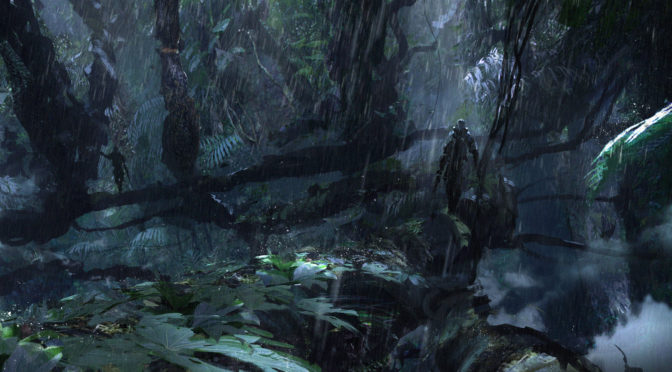
Featured Image: “Tropical Rain” by Wadim Kashin via Artstation

Shatner

Fiction Week

By Major Brian A. Kerg, USMC

December, 2050
The Pacific Ocean

Ensign Bean, U.S. Space Force, laid back in his coffin rack aboard the USS America, staring at the roof of his stateroom. Hammering blows and the buzzing of power tools echoed through the room as the paint chippers worked on maintaining the flight deck. His head pounded with a migraine, and he fought off waves of nausea; four weeks into deployment and he still hadn’t found his sea legs.

“I’m in the goddamn Space Force,” he said. “How did I end up on a boat?”

“Ship,” Tilly said. The Marine lieutenant looked up from his tablet and gave Bean a grin. “You’re on a ship. And you’re here because the green weenie is joint in nature.”

“This is garbage,” Bean said. “My classmates are living the good life at SPACECOM in D.C., or getting their PhD’s at Wright Patterson Air Force Base and engineering the next generation of satellites. Of all the places they could have put me, I got shoved into one of the oldest tin cans in the fleet.” He rubbed at his eyes. “I should have run for the hills when they cut me orders for a Marine Expeditionary Unit.”

“Well buddy, it’s a shame that you’re not back at Star Fleet, or Space Camp, or wherever the hell they put the rest of you Shatners, but I feel safer knowing you’re on our team.”

“Really?” Bean rolled over in his rack, looking at Tilly with cautious hope.

Tilly laughed. “No, of course not. You’re dead weight. But at least you get to see the world, even if you’ll never see the stars.”

“But the recruiting commercial said I’d get to see the stars!” Bean cried. He pointed to the patch on his flight suit. “Ad astra!” he said, reading the Space Force slogan. “To the stars!”

Their phone rang, and Tilly answered, shouting over the noise. “You need me and the what? The stack?”

Bean’s ears perked up. “That’s me. The Space Tactical Controller. I’m the STAC.”

“Got it.” Tilly hung up, and nodded at Bean. “They need us in the SACC.”

Bean looked at Tilly quizzically.

Tilly rolled his eyes. “Yeah, there’s a joke in there. Don’t hurt yourself trying to make one.”

“No, I mean, why do they need me?”

“Great question. Maybe because you’re part of the Fires cell? Grab your tablet. Let’s get there and we’ll find out what the hell is going on.”


***********************************


After getting settled in the Supporting Arms Coordination Center, Major Sarah Avery, the Fires Officer-In-Charge, started to brief the cell.

“Alright folks,” she said, “its game day, and we don’t get any warm-up time before kick-off. Here’s the skinny: The Communist Party of Thailand just launched their own version of the Tet Offensive.” The few sidebar conversations immediately ceased, and the entire shop fell silent. Avery pressed on.

“Most of the Thai government’s forces have been tied up in their border provinces for years, fighting the communist insurgents in the jungle. So last night, when the communists activated sleeper cells all across Bangkok, they caught the Thai military on their back foot. The government is barely holding onto the capital. A Joint Task Force is being thrown together, but there’s no time to wait, and our MEU got the mission to reinforce Bangkok, now.”

Excited murmurs filled the room. Tilly slapped Bean on his shoulder. “This is it, Shatner! We’ve got ourselves a war!”

Bean looked at Tilly, his eyes wide. “Why do we want that?” Then, more quietly, “And will you please stop calling me Shatner?”

“Not a chance,” Tilly said, smiling ear to ear.

Major Avery waved her hands, settling the room down, and continued. “Worse yet, the communists seized Bangkok port, and all the Anti-Access/Area Denial systems the U.S. put in place in 2030 to help the Thai government deter Chinese aggression are now in the hands of the enemy. The S-900 is an over-the-horizon, surface-to-air and surface-to-surface missile system that out-ranges all of our organic capabilities. We can’t get close enough to hit them before they’re close enough to hit us.”

Tilly raised his hand. “Aren’t there any sea control teams already in the area? I thought persistently deployed expeditionary advanced bases were supposed to give us a foot in the door for situations like this.”

Avery snorted. “Bully for you. You paid attention at The Basic School. Yeah, we had sea control teams in the region until about a decade ago. They were our lynchpin to containing Chinese regional expansion, and our allies across the Pacific loved them. But after Chinese ascension popped like a bubble in the 40’s, most got defunded or re-assigned to EUCOM. Can I finish?”

Tilly cleared his throat and looked away. “Yes, Ma’am.”

“So where do we fit in?” Avery asked the room. “We’re not looking to blow the hell out of a friendly city, and the CO is more concerned with getting us to the fight in one piece. Our first job is to use our fires to best support the Amphibious Ready Group’s ability to land the landing force and get the MEU ashore intact at Bangkok.”

Tilly blanched. “We’re going to do an amphibious landing into a mega city? Jesus, are we looking for another Gallipoli?”

“What’s Gallipoli?” Bean asked, looking from Tilly to Avery. He was gravely concerned that even Tilly’s excitement had suddenly been blunted as the details of the plan emerged.

Avery shook her head. “No. We’re looking for another Inchon. Let’s stop admiring the problem and figure out a way through this mess. We owe a fire support plan in thirty minutes. And if we get through this in one piece,” she pointed at Tilly, “you can give a lesson on the history of amphibious warfare to your buddy, Shatner.”

Bean’s face reddened. “Ma’am, can you please not call me-”

Tilly grasped Bean’s shoulder, cutting him off. He said nothing, simply shaking his head in warning.

The fires cell went to work, floating plans as diverse as an in-flight release of their drone swarms and using them to kamikaze the S-900’s, to using their offensive cyber operations team to take control of the firing platforms. Each plan was premised on a whole lot of hope, and the cell was growing frustrated.

“None of these are going to be perfect,” Avery told the group. “We lost the edge for a problem like this when we put the Expeditionary Advanced Base Operations Manual back on the shelf to gather dust. We don’t get to establish sea control before we land the landing force. We have to go ashore through the weapons engagement zone, and then establish sea control. Things are different now. The boss is going to have to assume a lot of risk. Our landing forces will be as distributed as possible to maximize survivability. But no matter what we do, some of our people are probably going to get hurt.”

Ensign Bean sat there on his own for a moment, flummoxed by the dizzying jargon of amphibious fires. Plugging his STAC tablet into a port on the classified network, he downloaded the technical specifications of the S-900’s, and matched them against the offensive space capabilities available within the region’s satellite footprint.

Bean sat back, his face lighting up. “I think we’re making this a lot harder than it needs to be.” He waved his hand frantically at Major Avery. “Ma’am, I’ve got an idea.”

Avery listened. She wanted to believe it would work. But Avery hadn’t exactly been an advocate for the boot Space Force officer that her higher headquarters had forced on her; the MEU hadn’t even exercised a space fires plan during their pre-deployment work-up.

Bean tapped at the data on his tablet, insistent. “The S-900s conduct targeting over the Pan-Asia Positioning System. It’s their version of GPS. No PAPS, no threat. It’ll work, we just have to get the fires approved by the Space Operations Squadron.”

“And that kind of approval takes, what… weeks?”

Bean shook his head. “It used to, but that’s why no one used space fires; by the time approval came down, the need had passed. To stay relevant, the Space Force had to streamline the approval process. For an event like this, I bet we’ll get the nod within the hour.”

Avery frowned. “That’s hard to believe. I’ll brief it as an option. But I think the boss will see it as the throw-away course of action.”


***********************************


In the Landing Forces Operations Center, Bean wiped at the beads of sweat rolling down his brow. Even with the air conditioning at full blast, the heat from the plethora of command and control systems and the bodies of the battle staff was overwhelming.

The main screen showed the Common Operational Picture, a live drone feed of the Amphibious Ready Group floating in the Gulf of Thailand. One section of the aging Osprey squadron was in the air, each aircraft escorted by a pair of fighter drones. Farther afield, a swarm of micro-drones flew as a picket for the afloat force. Only two of the squadron’s eight F-35’s were prepared to take off the America’s flight deck; the rest were still down for the notorious maintenance issues that made them the joke of the entire aviation community.

A second screen showed a satellite feed of the Bangkok Port and surrounding area, with red overlays placed on the locations of the S-900’s.

Tilly leaned over Bean’s shoulder. “I hope this works, Shatner. If it doesn’t, our ass is going to be hanging out in the wind.”

Bean looked at his computer again, checking the targeting interface. “We’re going to be fine. Space Ops approved the strike package, and their cyber guys already did their recon; we’ve got this in the bag. All I have to do is push a button, and we’re golden.” He gritted his teeth. “And stop calling me Shatner.”

“When you get out of the Space Force, I’ll call you whatever you want. Until then, you’re Shatner to me.”

Avery stepped between the both of them. “Bean says it works. So does the old man,” she said, looking at the MEU Commander, Colonel Lloyd. “It’ll work.”

Colonel Lloyd stood in the center of the watch floor. A drone operator pin clung to his chest, right above his jump wings. His left hand was stuffed in a trouser pocket, while his right held a steaming cup of coffee. He was the only relaxed person in the room.

He took his hand out of his pocket, glanced at his watch, and nodded at Major Avery. “Launch it.”

Avery slapped Bean’s shoulder. Bean hit the key.


*******************************************


The command to attack bounced from Bean’s ship in the Gulf of Thailand to the Space Operations Squadron in D.C. Immediately authenticated, it was transmitted into orbit, where it shot from satellite to satellite around the earth.

Thousands of miles over the America, a constellation of U.S. satellites sat in geosynchronous orbit. For years, they had served only as a surveillance asset targeting the Southeast Asia region, while keeping a seemingly sleepy eye on the Thai military satellite system that was its neighbor. They hadn’t yet had a reason to use the full range of their capabilities.

Receiving Bean’s command, the U.S. constellation oriented on the Thai satellites, acquired their targets, and fired their jammers.


*******************


“Direct hit,” Bean said. “They should be dark.” He looked up at Major Avery, then to Colonel Lloyd. “I think we’re good.”

Colonel Lloyd nodded again. “Great.” Then, to the battle staff: “Press on.”

With that one keystroke, the MEU’s plan was set in motion. Pro-words were launched over radio nets, initiating actions across the MEU-ARG team, along with supporting actions at every echelon of command. The F-35’s launched from the flight deck.

With their teamed drones flying over-watch, the Ospreys flew to the limit of advance, lowered their rear loading doors, and dropped a load of suicide-drones into the air. After tumbling a few feet, the swarms took flight and expanded into a cloud formation. They swiveled back and forth like electrons around a nucleus, then pushed inland, seeking their targets. Behind them, the next stick of Ospreys, full of infantry Marines and war-bots, were ready to land once the drones had secured the landing zone.

Flashes of light and puffs of smoke scattered across the video feed as the S-900’s fired. Missiles rose into the air, their targets unknown to those watching on the America; were they coming for the unmanned drone swarm? The Ospreys full of landing troops? The America and all the embarked forces?

“Oh shit, they’re still online!” Tilly said, grasping Bean’s shoulder.

“I only hit their navigation system! I can’t stop them from firing!” Bean said, pushing Tilly away.

Tilly pointed at the main screen, and the dozens of missiles rising into the sky. “Well I hope they taught you to swim at Space Camp, because if you screwed this up, we’re all going for a dip.”

The Marines and sailors on the watch floor held their breath in a long, pregnant pause, watching the screens, and waiting.

In the bay, one red missile struck the water, miles off target. Another misfired entirely, destroying the system itself on the shore. The S-900 systems, completely reliant on satellite positioning to track their targets, could only fire blind. One after another, the enemy missiles impacted without effect. Soon after, the America’s drones swarmed the landing zone, destroying every enemy weapon system they could identify.

A strong hand slapped Bean’s shoulder. He looked up to see Colonel Lloyd peering down at him, a devious grin spreading across his face. “Good job, Shatner.”


*********************


Days later, Bean and Tilly were standing in the Port of Bangkok, watching the sun set.

“It’s still mind blowing,” Bean said. “I can’t believe the bad guys just took off when the S-900’s couldn’t keep us from landing.”

“We sure didn’t plan for it. ‘Catastrophic success’ — we did so well we couldn’t capitalize on it. But, hey, if I didn’t have a way to stop a thousand Marines and a battalion of their murder-bots from coming ashore, I’d probably turn tail and run, too.” Tilly handed Bean a cigar.

“I’ve never smoked before,” Bean said, eyeing the cigar with suspicion.

“If you have a baby or win a battle, you smoke a cigar,” Tilly said, offering a lighter.

Bean lit the cigar, took a deep drag, and had a massive coughing fit.

“Is this supposed to be fun?” he said through choking gasps.

Tilly slapped him on the back. “It’s an acquired taste.”

“You keep saying that. About ship life, about working out of a tent city, about sleeping on the ground.” With each complaint, Bean pointed his cigar like an accusing finger, first at the America floating in port, then at the green tents comprising the MEU’s combat operations center ashore, and finally at the ground. “Bangkok’s right there. I can walk to a five star hotel. And we’re sleeping in the dirt like idiots. It’s 2050, not 1950.”

Tilly grinned and stuck a pinch of dip in his mouth. “Yeah, some things don’t change. It’s the way of our people,” he said, pointing to the “U.S. Marines” nametape on his blouse. “But hey, at least we finally unscrewed our awards system. The CO got that medal on your chest within days of the action. When my dad was coming up in the Corps, guys waited months to years to see a medal, depending on the award.”

Bean reached into his pocket and fished out the Navy and Marine Corps Commendation Medal. “That was a nice surprise. Hey, what’s the little gold ‘C’ for?”

Tilly rubbed his temples. “It’s for ‘combat’, man. The ‘C’ is for ‘combat.’”

“Really? This counted? I thought combat would be different. You know, more blood and guts.”

“You and me both. But it’s your world, now, Bean. Space and cyber effects at the tactical edge, and routing the enemy without killing a single man — friendly or enemy. You got me sold. If you guys get around to making Space Marines, I’ll become a Shatner in a heartbeat.”

Bean grinned. “You called me Bean.” He tried another drag of his cigar.

Tilly slapped Bean on his back again, forcing Bean to inhale, subjecting him to another coughing fit.

“Don’t get used to it,” Tilly said with a smile. The two watched the sun disappear into the ocean, smoking their cigars, until the sky faded to black. They stared up into darkness of space, trying to discern the stars from the satellites, struggling to guess to which blinking pin of light they owed their lives.

Brian Kerg is a Marine Corps officer and writer currently stationed in Norfolk, VA. His professional writing has appeared in War on the RocksProceedingsThe Marine Corps Gazette, and The Strategy Bridge. His fiction has appeared in The Deadly Writer’s Patrol, Line of Advance, and The Report. Follow or contact him @BrianKerg.

Featured Image: “Lonely Orbiter” by Simonard Theo via Artstation

Screaming Justice

Fiction Week

By Rob Carter

Imagine if you will a time in the future when nations are willing to work together to stop the actions of those who undermine and disregard basic human rights. No longer only employing military force solely as an instrument of military power to reinforce a single nation’s diplomatic or economic agenda, but now working together to assemble a quick reaction force until multinational peacekeeping forces can be employed. Nations are willing to use military power to halt genocide, border expansion/incursions, and terrorist group expansion in unstable regions of the world. Members of this force draw on the models from Greek and Irish mythology for the justice that they bring. In Greek mythology, Harpies were seen as personifications of the destructive forces of the wind. They were viewed as the servants of Zeus who would swoop down and steal food from those who have done wrong, and punish those whom Zeus was unhappy with or had killed a member of their family. In Irish tradition a banshee, a wailing and shrieking woman, comes to let a family know that one of them will die. In this time our military is able to come screaming in and help restore order in certain places…

Half asleep I roll over, hand reaching up to my head as if that will bring the answer to mind more quickly. “Think, think, think…” What do I do to answer the call as I can hear it in my head even though the words are not “out loud”?  Running through the process as I just received the message as it travels from the embedded transmitter, sending the sounds though vibrations in my cheek bones to my still asleep brain. Memory engaged, I go through the motions to be able to respond through the other surgical implants added to my face. Slide upper muscle up under nose forward, begin to speak, and my words are transmitted to the Command Post, CP. “Here, message received, will be in for brief in 30 minutes.”

“Response verified, roger, out.”

Looking over at my spouse still sleeping or appearing to, I marvel at how easy that call was once I woke up and remembered what to do. I move over to the closet to pull out my duty uniform wishing yet again that I would get smart enough to just put everything on one hanger.

“If you are trying to be quiet it’s not working.”

“Got it, have to head in, we have an alert.”

“Once you get the whole being quiet down I will be able to appreciate you being able to answer people speaking in your head.”

“Ha, technically it is through my bones, but I get what you are saying.”

“Where to, can you say?”

“Not yet, once I know and I can let you know, will share, though you may catch it on the news first.”

“That’s what they say about you Banshees, we know where you are after the screaming has begun.”

Bending over, always wondering if my next view will be of his head greeting me with a kiss because I am waking up from time in the healing sphere, and the mission went south. I give John a light kiss and squeeze his shoulder before I head out. “See you soon, love you.” He rolls over, “Love you to, make it back soon as you can.”  Turning around, I grab my boots and head out to the lift. I program in where I need to be and sit back and start to scroll through messages. Looks like the whole team has been alerted and we are all heading in for the Mission Brief at the CP.

We were supposed to be HARPIES, or the High Altitude Rocket Propelled Internal Engagement System, a force sent by the government to go and make things better on short notice anywhere in the world. But the technology that placed us on the field, the noise from our chutes and silos deescalating have given us the label Banshee, and that is what I have painted in the side of my command column and how most everyone referred to the unit. We are the new definition of the best of the best, a level of engagement and selection even higher than those serving in the Navy SEALS, Air Force Pararescue, Ranger battalions, Special Forces, and Delta Force back in my grandfather’s day. As hard as women had to struggle to get their chance there, we rule in the silos since our bodies are more compact and have been proved to be able to operate better in the high-g environment. The focus it takes to execute all of the tasks necessary to deploy the assets that have loaded into the columns that come together to build each deployable silo just seems to be something women have a knack for. Unfortunately, we are still heading to the same places, and trying to keep the conflicts that have been simmering for years from spilling over and bringing us to another world war since the days of conventional deployments of special forces and large numbers of ground troops.

Getting to the room for the mission brief I am glad to see everyone else is already there. I move up to my seat before the podium after a quick glance at my number two and get the thumbs up.

“All present and prepared for the brief Commander.”  I

It all goes by in a blur, much of it I will review as we are traveling in the silo to be deployed, this time along the Turkey-Syria border. We grew from the idea of having mobile towers along the U.S. Mexican border, then someone added having us be deployable by air, and the next logical addition was to send us by rocket. Our current configuration is a combination of air and rocket delivery systems.

As soon as we heard what we had to from the command brief we all shook out the last vestiges of sleep, texted our goodbyes and moved out to get what we needed from our lockers and head to the airfield to link up with the teams who made the final adjustments to assemble our silos, making them ready for launch. I was so glad that so much of what used to be required for logistical and mission support is now automated. Only four hours to prep, and then 14 hours of travel, and we would be descending into our positions and defending those who are not able to themselves. The politics have swung all the way from only engaging the military when there were resources needed at risk, to being willing to use our silos to set up defensive perimeters to readily defend those who were at the mercy of terrorists, warlords, and rogue nations. We just needed to get there, use our deployable armaments to create a zone where peace was enforced and stay until the UN and or NATO forces were able to deploy and help reestablish a government reflecting the will of the people.

Moving out from the locker room to the loading area I am always amazed as the docks roll up over each of the preloaded compartments, what we called columns, and pick them up so they are ready to be assembled into a silo and dropped into position on the cradle for their “plane” to pick them up and carry us into the upper atmosphere where we launch and travel to our target reference points for the mission. Seeing them roll out the columns is always something that makes me feel like a kid. Each silo is made up of a Command Module that takes up position 3, we have choices about what can be in 1 or 2, and 5, or 6. 4 is always filled with life support. Each of us gets to decide what the mix of items will be, 90 percent of the column is food and water, 10 percent is what we put in for comfort items. Mine is all chocolate. It’s always interesting to see what mix my husband has packed for me in the box that goes there, it is one of the ways he stays with me while out on the mission. For this mission I am loading out Column 1 with Arial, 2 with antipersonnel drones, 5 is reloads for ammunition, and 6 is a mix of antipersonnel mines and additional missiles for the Arial drones. They say one silo is the equivalent of the firepower that used to be projected by an entire brigade and can cover the same area that used to be secured by a full infantry division. Which is really only true when you factor in the fear our presence brings.

Americans are tired of seeing the same bad people able to do the same bad things in the same places all over the world. With the payload that we can carry the Banshees are part of the solution our government is now willing to pay to help bring peace to the world, and we are not having to see so many refugees come to our shores as the only hope they have for a better way of life. Getting contributions from other nations to help pay for the payload has helped the American people more easily swallow the responsibility that comes with the cost of being the global cop. As our nation has continued to draw refugees from the places we fought there are now second and third generation citizens in our country who would like to see change and peace back in the nations that they have come from. There are the children of immigrants who came here after the U.S. pulled out of Syria in 2019, some now elected to Congress, and who have been lobbying to see us reengage with the region. The descendants of these war refugees do not want to see a repeat of the lack of engagement or interest.

Knowing the coordinates for the mission are already loaded, and everything we need is in the columns, we each shake hands and climb into our command columns before the silos are set for takeoff and delivery. Each column locks together, is lifted and carried over the aircraft using a monstrously huge system similar to that used to move containers off of a ship and around the shipyard. Once bought over to the airframe it clicks into the fuselage, really just a nose, tail, and wings, and we are just a passenger until we reach the elevation and location for the drop and the rockets kick in for the last leg of the journey before we reenter the atmosphere and slow down for emplacement on the ground.

“Banshee 1, release point reached, prepare for drop”

“Carriage 4, Ready, see you when we get back to base.”

“Banshee 1, counting on it, you can let us know what winter along the Syria Turkey Border looks like, and if that is a future vacation destination spot we should be considering.”

“Carriage 4, probably not, but I will let you know.”

Always a slight jerk and pull back into the gyro harness as the jet kicks in and we make the journey up. I start to click through the screens and look at the tactical layout. All coordinates were in, and it looks like we are landing in a standard diamond pattern. I’ll be right in a bend of the Euphrates River, hoping that the engineers have the soil pattern right and that I will be able to level out the silo as it digs in, really hoping that their maps and satellite images are accurate and that I am on the ground and not in the water. That happened once and it was not a fun time.

I have never been on the receiving end of a Banshee deployment, but I have seen the tapes, and ridden in the silos twice now so I can imagine the fear they bring to the battlefield. At night, like today, we start as a burning spot in the sky, then there is the screeching of reentry and the vibrations that push the sound down as we tear through the sky and begin to glide so we can deaccelerate. As we slow down and come into the range where we will be emplaced the rocket section on our tail begins to flower out and act as an additional break, creating even more noise, and then the rocket and fuel disengage. Then the pack with all of the chutes opens, but this can be the most dangerous time when we are slow enough now to be hit by anti-air fire. Next comes the most nerve wracking part, engaging the drill and ensuring we maintain an upright position. The noise outside ratchets up again as the gears grind the column into the earth pushing out the soil and building a berm around the silo as it gets planted into the overwatch position for the mission.

“Horizon Control this is Banshee 1, downward descent started, chute deployed and preparing to target security position for initial deployment. Coordinates are green, over.”

“Banshee 1, this is Horizon Control, Banshee 2 and 4 are in position, 3 still airborne you are cleared for emplacement. Out.”

Looking up at the screen I verify that we are still on the trajectories and plan from the mission brief. I see the target is aligned for a clear patch, off to the East I see Manbij and to my right the Euphrates River as I continue to deaccelerate upon reentry. I cut the cables and ignite the parachute, screaming back to earth ensconced in silken flames.

The initial crunch from impact subsides, and then the drill burrows into the earth until only the last stage is barely above ground. While this is happening I release six of the 14 aerial drones within my payload to begin their sweep along my area of responsibility which runs from the border from the Euphrates to just outside Aleppo. My primary mission is to eliminate any armed threats between M4 highway and the border, and then ensure that we have a secure route along M4 to Latakia. Once there, our resources will be picked up after the mission, containerized, and shipped back through the Mediterranean and across the Atlantic back home to the U.S.

“Horizon Control, Banshee 1 in position, prepared to assume control from the ground, 2, 3, and 4 locked in and beginning to secure their Zulu Charlies.”

“Roger Banshee 1, cleared to fire upon all armed elements that engage your assets, leaflets dropped 12 hours ago, so both picture and written descriptions for your forces and intent have been distributed to local nationals. Anticipate UN peacekeepr forces arriving in six to eight hours from African nations, and forces from our NATO partners will be landing in Aleppo within the next four. They will secure the airfield and then you can begin to focus on your egress route. Anticipate your control of the area secured at Splash + 12, egress prep NET Splash + 36. Priority 1 eliminate armed hostile targets Priority 2 ensure Medical, Industrial, and Cultural sites protected, Priority 3 egress route choke points. All known anti-aircraft locations strafed and destroyed prior to you entry. Be prepared to engage portable surface-to-air missiles we did not have knowledge of. Acknowledge, over.”

“Horizon 1, Roll Call acknowledge, Banshee 1, out.”

“Banshee 2, out.”

“Banshee 3, out.”

“Banshee 4, out.”

I rotated the aerial drones out twice, engaged several targets, set the mines up around the silo, and then began to secure the industrial areas that were on my priority target list. Sometimes it seems like a video game, switching views between the eyes from the aerial cameras to those on the Rack drones crawling cross country to ensure M4 is clear for transport. Each Rack features three turrets with a belly full of ammunition on a tracked chassis. They run off compressed solid fuel and all of the munitions are inert until fired. This allows them to take a real beating during transport and while conducting missions. I generally pair one rack with an aerial drone, keeping the drone in a race track pattern to be able to serve as eyes above the hilltops and horizon and provide overwatch if engaged. In my column I use the screens in the same orientation as where I have sent them to keep track, which keeps my gyro moving as I get alerts either because of the country they are crossing, or as they are engaged by hostiles.

The willingness of the UN to support our employment here, and the force we are capable of generating made this mission less of a force-on-force affair than we had expected. Most of those engaging us seem to be at the tail end of a withdrawal, they must have started pulling back as soon as they had reports the UN had sanctioned our use and that we were on the way in response to their crossing the border in violation of the Accords that had reestablished the borders back to 2018 lines.

Banshee 3 is reporting that they are seeing a buildup South of Killis Merkez and Banshee 4 sees those in her vicinity pulling back to beyond Mardin.

“Banshee 1, to Horizon Control, we have cleared all marked vehicles out of our ZC, working now for consolidation and elimination of unmarked and local forces that supported the incursion.”

Moving across the controls, the drones identify targets, fly in to receive reloads, or get recharged before they go back out again to be my eyes. The Racks move through the villages, and over the countryside ensuring that there are no surprises, weapons caches, hidden troops, or sites that need to be checked for Law of Armed Conflict violations. Hard to believe that just 28 hours ago I was sleeping back home with my husband. The next 30 hours go by in a rush as we clear our AC, coordinate with Horizon 1, and prepare to hand off the mission to the UN forces who will be the boots on the ground to help them begin the process to rebuild while the UN works through the consequences of this incursion.

“Banshee 1 this is Horizon Control, Airfield Secure, I repeat Airfield Secure, begin to program for pickup and departure, Acknowledge, over.”

“Horizon 1, Roll Call acknowledge, Banshee 1, out.”

“Banshee 2, out.”

“Banshee 3, out.”

“Banshee 4, out.”

46 hours, not 46 Days, or 46 Months, gratefully not 46 years and we have ensured a peaceful resolution to the border incursion. If we had existed back in the day there would have been no need for a Desert Storm build up. We could have halted the expansion of Russia into the Crimea, but we probably would not have had that much effect on China’s Taiwan invasion. But at least this mission today is a win. Getting an aggressor to back down, and no loss of life on our side, is a win.

I check the screen so I can see when the hook will arrive, and I start the process to move the assets I brought in the silo to the seaport of debarkation, Latakia. I bring in all the birds, reload them with what armaments I still have on hand. Whatever is left is moved onto sleds and those get hooked behind the Racks and they start their journey down M4.

Watching the screen I can see as the hook draws closer, I pull the switch and the floor and ceiling of Column 1 and 2 blow up an out and the command column begins to slide up towards the top. It is an agonizing sound, like the scraping of nails on a chalkboard, some say that is the revenge of the engineers who designed this system, and then found out they could never be considered to use it, as the command column moves up through those now empty and hollow columns and moves above ground to be grabbed by the hook that comes to retrieve us. Looking off to the North East I can see it coming in, and feel my heart beating faster as it comes down and hovers above my position for pick up.

“Banshee 1, Hook 1 prepare for retrieval”

“Hook 1, this is Banshee 1, released from Silo, ready for lift.”

A short jerk then a pause and then the command column lifts off of the silo. I click the internal destruction switch and as we pull off and out to the container ship waiting for our team off in the Mediterranean. There is a flame up and then implosion as the charges blow the silo, and then the wracking of the earth as the mines deployed around the silo all go off  The earth churns around in the area and collapses to erase evidence that the silo had ever been there. In a few years as nature reclaims the now churned up ground nothing but the personal memory of those who saw us come will mark that we were ever there, so long as other nations do their part to maintain the stability we earned.

I look out the port side screen as we pass through the airspace around Latakia. As Hook 1 moves over the water to the ship where we will all land, I see the Blue Beach off on a peninsula and  imagine how much better of a world it would be if some rest and relaxation is what had brought me here. When I get back Stateside, I think that is what we will do. John and I will head to the Beach, and I will take some leave and sit out by the ocean, sipping drinks off the drink cart, and alternating between napping and spending time in the ocean to rest and recharge until the next time we are needed.

Rob Carter serves as a chaplain for Montefiore Nyack Hospital, Nyack, New York, leads Lutheran Worship at the Old Cadet Chapel, USMA, and serves in the Army Reserve as the Command Chaplain for the 377th TSC.

Featured Image: “Rocket Launch” by Stefan Kreller via Artstation

At the Moral Level

Fiction Week

By Major Ian T. Brown, USMC

25 March, 20XX
D-day, H-hour
01:00 am China Standard Time
Coastline of Eastern Theater Command

The soft nudge of the hull against sand was the only thing that made Sergeant Sammie Clegg certain that her squad had landed at the objective. She looked back at the shadows huddled in the small compartment behind her. They’d been there for six hours, not talking, barely moving. At any point during the ride in, she could have blinked their faces into the false illumination of her sub-derm, but that would have required a kick-start from the residual charge in her kinetic batteries. She wouldn’t waste those batteries when she’d have no opportunity to make the body movements that automatically replenished them. Instead, she periodically looked back in the darkness at the lumpy shapes swaddled in the unnatural slickness of their squid skin jumpsuits and hoped they didn’t share her nervousness.

When she looked back this time, however, she did blink, in the one-two-one sequence that switched her sub-derm from passive to active mode. Though the Futures Group guys always told her she was imagining it, she swore she felt a thrum in her skin as the sub-derm went active. Imaginary or not, suddenly she could see through the squid skin face-mask covering her eyes. Calming her mind, she sent out a single thought: squad, up and out.

Wordlessly, the twelve men and women behind her hit the release buttons next to their seats. She heard a few muffled clicks, then the walls and ceiling of the compartment unlocked and fell away, exposing the squad to the cold night air. Sammie and her squad hooked their legs over the sides and slid into the water. With six soldiers on each side and Sammie at the bow, her squad quickly pulled the drone boat out of the water and onto the beach. She reached inside and touched another button. More clicks followed, and the boat seemed to sag a little as, piece by piece, it efficiently disassembled itself. Soon, all that remained of their landing craft was a jumbled collection of panels lying in the sand.

Two of Sammie’s fire teams had already set up security in a rough semi-circle. As those teams kept their weapons pointed outward and scanned the tree line, the third team began methodically picking up panels and sliding them into the backpacks of the other two teams. When about a third of the panels were gone, Sammie heard—felt? Saw? God, it was weird what the squid skin and sub-derm did to your senses—her third fire team leader, Corporal Donnie Ramirez, flash third team complete, team two up.

Again, without a word spoken, Ramirez’s fire team replaced Corporal Grace Pasquale’s second fire team in the semi-circle, and Pasquale’s team fell back to grab more panels and slide them into more backpacks. Half a minute later, Corporal Mike Girard’s first fire team switched with Pasquale’s team and repeated the process with the last of the panels. Sammie reflected on the mechanics going on inside the backpacks each time one of her soldiers slid a panel in. Intellectually she understood it, but in practice it still amazed her. Each pack contained a two-way additive manufacturing or 3D printer, and each panel was made from a bizarre soup of synthetic compounds whose formal names she’d never learned. But the names were not as important as what the panels provided. They were her logistics train. The two-way 3D printers broke down the panels to their constituent compounds, and then reassembled them into whatever her squad needed: food, water, ammunition, first aid gear, even nano-drones. For their insertion, Sammie had instructed her squad to use the default setting, which gave each soldier a little of everything and stored the remaining goop in an unprocessed state to be reassembled based on future need.

Squad, bump to the tree line and set up security for comm and nav link-up, flashed Sammie. Her squad moved forward, and in seconds they were off the beach and into the forest beyond. Stopping, the fire teams formed a loose circle with her at the middle. Catching her breath, she deliberately opened and closed her eyes in a three-one-two sequence. This activated her sub-derm’s entangled particle communication and navigation linkages to her battalion command post thousands of miles away. Then, tensely, she waited.

Her tension came from the uncertainty that—despite the field exercises designed to build confidence in the sub-derm and other science experiments her squad wore—there hadn’t been time to test the equipment’s limits before the simmering tensions between China and Taiwan boiled over into the invasion of the latter by the former. China had, in recent years, emerged as the near-equal of the United States in its military capabilities, and in some respects had a clear edge. It was an open question whether this new gear, combined with an untried strategy, would close that gap.

But a few months ago, her battalion had been told that they would try. They, along with a Marine Corps infantry battalion, were the test-bed for some new ideas generated by the long-ignored Close Combat Lethality Task Force. Their commander then introduced a Colonel Ellis, head of some innovation department she’d never heard of. Ellis laid out what their battalion was about to do.

“We used to say that the American military could dominate any battlespace,” the colonel began. “Today we know that’s nonsense. China and half a dozen other competitors match us on some or all of those battlespaces. They have sought to become us, mirroring our weapons, our force structure, you name it. We could dump billions more into our defense budget and it’d buy us a few percentage points of superiority. Our competitors would then hack and steal it for a fraction of the cost and regain parity in a few months. We don’t have billions to dump, so we won’t. Instead, we have you.” The colonel scanned the audience to make sure he had their attention. He did; certainly he had Sammie’s.

“You and your brothers and sisters over in 1st Battalion, 7th Marines, will become our nation’s asymmetric advantage, and it won’t cost us billions. We’re past the time of buying our way to victory. Let China do that. We’ll do the last thing our adversaries expect: we’ll stop being us. We’re not buying crap that’s overpriced, which our adversaries can shut off with their keyboards for pennies on the dollar. Instead, we will train and equip you to hit our enemies where it hurts the most: in their minds. In their very souls. You’re not going after the enemy’s weapon systems, you’re going after the shooters. China has fracture lines—social, economic, environmental—like any other nation. We’ll rip those fractures open. And you’ll do one more thing our adversaries don’t expect: operate with minimal networking to higher. You will exercise mission command to a degree never before seen in American warfare. You won’t radiate on all spectrums across the battlefield. You’ll be silent, you’ll come at our enemies sideways, you’ll shred their fighting spirit without touching their bodies. I’ll show you how.”

It was a weird speech. Sammie wasn’t sure if she was supposed to cheer or clap. She did neither, and the rest of the audience shared her uncomfortable silence. So, she thought, we’ll kill their minds? And you’re not going to buy any gear to do this? Colonel Ellis, you’re insane.

She’d been wrong on the gear part. The day after the bizarre colonel had told them they’d be—what? Soul stealers?—the gear showed up. The backpack-sized 3D printers were definitely cool, and her jaw dropped when she watched Ellis shove a drab square panel into the backpack, which then spat out thirty rounds for their rail rifles, two tourniquets, a cloud of nano-drones, and a balanced meal’s worth of food cubes. The kinetic power system was neat, too. It was like wearing lightweight long underwear: you didn’t notice it, but it could power almost everything a soldier carried, including the voltage-hungry rail rifle and 3D printer.

What the kinetic batteries couldn’t power, the squid skin did, along with answering a question that had long bedeviled innovators: how can you communicate without emitting an electromagnetic beacon for any semi-capable adversary to find? When one think tank after another came up empty, someone finally did what humanity often does in seeking to solve unsolvable problems: shamelessly steal from nature.

The humble squid provided the answer. The skin cell structure of these creatures baffled and inspired scientists. Squid could camouflage themselves to match their environment, communicate in a rudimentary language by altering the colors of their skin, all without conscious thought. One military think tank sought an artificial version of this natural miracle, and finally cracked the code to provide Sammie’s battalion with a wearable uniform called—in line with the standard creativity the military exercised in naming things—“squid skin.” Worn like a one-piece flight suit, its artificial “cells” generated electricity from the sun, changed color (and infrared signature) to match its environment, and enabled non-electromagnetic communication.

The sub-derm controlled that communication. Communicating without talking was part of the tough problem that squid skin partially solved. Squid skin was the medium; the sub-dermal implant each soldier had buried in their brain generated the message. The sub-derm’s inner workings were a mystery to Sammie and her squad, but they got the basics: by developing the right mental focus, a soldier could form commands in their mind, which the sub-derm picked up and passed via entangled particle linkage to the squid skin. The squid skin instantly changed part of itself to form a color pattern that adjacent squid skins picked up, sent via their own entangled particle linkages to those soldiers’ brains, and then their sub-derms translated the pattern into a conscious thought. Voila: instant and silent communication. They called it “flashing,” as the messages suddenly appeared in their consciousness like a light switch turned on.

Ellis had told Sammie’s battalion that once researchers cracked the initial problem, they had a much easier time adapting the sub-derm/squid skin combination to do other things. They developed nano-drones that fed information to soldiers via color codes that the squid skins could pick up. They buried entangled particle linkages in the sub-derm allowing over-the-horizon information sharing between soldiers and higher headquarters, again by the simple act of focusing and thinking about the message. The researchers tied additional tangled particles to navigational base stations located far away from the battlefield, so soldiers could still find their way around even if an adversary destroyed local satellite coverage. And the whole sub-derm control routine was tied to a basic set of eye-blink sequences. You could shift among intra-squad communication, over-the-horizon updates, navigational fixes, and managing the power output of your squid skin and kinetic batteries, all in the literal blink of an eye.

The gear was good but as Colonel Ellis repeatedly emphasized, equipment wasn’t the end state. It was an enabler, to help position them where they could open the fight at the “moral level,” as Ellis called it. Once Sammie’s battalion mastered the equipment, they trained to their real purpose: sowing discord and mistrust inside an adversary’s organization. They were to turn enemy soldiers against each other; against their leaders; even against their loved ones. They would bypass the weapons and focus relentlessly on poisoning the minds and souls of the shooters.

Despite Col. Ellis’ ominous talk about Chinese capabilities, Sammie had considered her battalion’s preparations largely academic; and then China moved against Taiwan. That invasion, on its own, would have roused the United States to aid its long-time ally. But China meant to prevent American intervention, and so it combined its plunge into Taiwan with a debilitating cyber attack on America’s military. The military’s computers—from laptops to the Autonomic Logistics Information System that kept the F-35 flying—went down and didn’t come back up. China temporarily knocked out civilian power grids and communications networks to make a point, and when they came back online, every screen displayed a simple message: AMERICA—STAY HOME.

And America did, at least officially. Aside from her battalion’s special training, Sammie knew that the most contentious part of the plan to strike back at China was the official narrative that America couldn’t. Colonel Ellis claimed this wasn’t a hard sell; there was no denying that everything from photocopiers to F-35s had gone down. But, he insisted, America must play dead to make the Chinese government think its response would take weeks, if not months. The Defense Secretary agreed with Ellis. The Secretary sold the plan to the president, who ordered the other secretaries to harmonize their public pronouncements with the military’s message. The party line was that a state of war now existed between America and China; but Chinese treachery meant that America would not be coming for some time. Meanwhile, in secret, America—represented by Sammie’s battalion and 1/7—came.  

Squatting amidst the trees, two thoughts suddenly flashed themselves into Sammie’s mind: comm established. Nav established. She relaxed a little, then flashed back: secure at objective Broncos. Moving to Colts. She waited the requisite ten seconds for any updates; when none came, she blinked one-one-two and then closed her eyes to verify that their position, validated via entangled particle from the ground station thousands of miles away, matched where they were supposed to be. The sub-derm did its work, stimulating her optic nerves to create a virtual map with their position highlighted on the insides of her eyelids. She steadied herself against the vertigo that always washed over her when the sub-derm hijacked her visual sense. Her squad was in place, with objective Colts highlighted a few miles away. She opened her eyes, flashed squad, move to Colts, and they went.

25 March
D-day, H+4
04:00 am China Standard Time
3 miles from the coast of Eastern Theater Command

            “Colts” was a logistics hub near the coast. It wasn’t large, nor did it house particularly critical supplies. But it did have what Sammie’s squad needed: PLA soldiers, and more importantly, their personal electronic devices or PEDs. Time for round one, she thought. She flashed, Girard, Pasquale, set security. Ramirez, PED seekers on Colts. Give me control when embedded.

            Her squad was in defilade behind a long, low hill near the base. First and second fire teams spread out on either side to control the avenues of approach. Near her, Ramirez took a knee and began blinking an eyeball sequence. His backpack hummed faintly as the 3D printer got to work. Two minutes later, a slot on top of his backpack opened, and a small, dark cloud wafted out like a puff of smoke. Ramirez’s face took on a look of intense concentration, and Sammie knew he was flashing the nano-drone swarm its target and desired flight pattern. The dark cloud rose, headed toward the PLA supply base, and then dispersed as each drone found a target and let air currents move it closer. This flavor of drone had passive sensors that locked on to the unique electromagnetic signature of PEDs and dropped entangled particles into their processors, which linked back to the squad for their hacking commands. Ramirez flashed her periodic updates on the percentage of drones that had landed on their targets until it reached one hundred. When that happened, he flashed, PED control to Clegg; the command repeated itself in a neutral tone inside her brain to tell her she now owned the drones.

            PEDs, deepfake routine. Adults only. Spread up one command level and two adjacent units. Her instructions delivered, Sammie flashed her squad to re-assemble for movement to their next objective. As they collapsed into a loose patrol column, she peeked over the low hill at the PLA base. Outwardly, nothing had changed. Soon, however, those PLA soldiers would have their lives turned upside down. She felt a twinge of regret that she couldn’t stick around to see it. Blinking her eyes, she activated the communication link to higher, and flashed, Colts complete. Moving to Eagles.

25 March
D-day, H+15
04:17 pm China Standard Time
10 miles from the coast of Eastern Theater Command

            Their route paralleled the highway leading to objective Colts, so Sammie had Girard throw up a surveillance swarm to watch the road for movement. Girard went through the same launch sequence Ramirez had a few hours ago, with one small difference. Part of the drone swarm would establish itself over the highway, soaking up ambient sounds to paint a sonar picture of the area. The rest of the swarm acted as repeaters, mirroring the color codes of the first swarm so that squid skins in Sammie’s squad could pick them up and translate the codes into a live feed through the squad-members’ sub-derms. Sammie had blinked her sub-derm setting to display the feed inside an eyelid when she closed it for longer than two seconds.

Thirty minutes ago, Girard had reported a military convoy coming south along the highway. It was a large convoy, which meant lots of PEDs, which meant lots of targets of opportunity. She’d flashed her squad to establish a hasty ambush site west of the road, then told her best marksman, Specialist Brady, to put a rail rifle round through a wheel of the lead vehicle at her command. When the lead vehicle drew in range, Sammie flashed Brady, and Brady fired. He made a beautiful shot, rupturing the tire without damaging the wheel. It looked like a normal blowout, leaving no evidence for anyone in the convoy to think otherwise.

            The PLA soldiers dismounted and began setting up security. Sammie could tell from their uniforms and equipment that these weren’t top-tier PLA – probably more used to suppressing domestic dissent than combat duty. But China was using everyone they had. Still, they set security in a respectable time as their recovery vehicle came forward to effect repairs. Yet Sammie wasn’t worried about their convoy security. She wasn’t going down there. Her drones were, however, and she flashed Pasquale to send up a cloud of PED seekers. Once the drones had embedded their particle payloads, she flashed a different order: PEDs, bank routine. Spread three command levels up. Fifteen percent increase with each level. Blinking over to her to communication link, she flashed the brevity code for a PED target of opportunity attack—Maker’s Mark—and went through a separate set of blinks to provide a navigational fix of the attack’s location to higher. Finally, Sammie signaled her squad to resume their route, leaving the PLA soldiers to mend their vehicle in unsuspecting peace.

26 March
D+1, H+23
00:04 am China Standard Time
20 miles from the coast of Eastern Theater Command

            Her squad was exhausted but in place. An hour after encountering the convoy, battalion headquarters flashed her an order to push to objective Eagles before 1:00 am local time. A storm cell had been building in the area all day, and would provide the perfect cover for what Sammie needed to do at Eagles anyway.

            The squid skin face-mask over her eyes provided a grayish near-infrared picture of the world around her from the ambient light hitting the squid skin’s artificial cells. She could see Pasquale and one other member of Pasquale’s fire team; the rest of her squad was dispersed beyond her line of sight along the forest’s tree line. Ramirez’s team had it the hardest, as the order to push to Eagles meant Ramirez’s crew had sprinted eleven miles to reach the reservoir control station three miles from here. The two fire teams that stayed with her had also needed to fight their way through thick overgrowth to find the ranger station—and its cellular link—which was a mile off from where pre-mission intelligence said it should be. Still, they’d done it. Black clouds boiled overhead, and a flash of lightning temporarily dimmed the infrared picture. Perfect timing, she thought with satisfaction.

            Sammie had already used a PED seeker to embed a delayed hostile media routine in the tablet she’d found at the ranger station. Now, she flashed the rest of the orders: teams one and two, incendiary swarms, all stores. Incendiary rail rounds, hold ten for self-defense only. Fire at will. Team three, waterworks routine. Then she blinked to tell her backpack to use whatever it had left inside to crank out incendiary drones. The pack hummed for ten minutes before flashing that it was ready. She responded, launch incendiaries, heading 130, 2 miles, 1 meter dispersion. The swarm puffed out of her pack and headed east. She’d left the launch distances and dispersal plans to each squad member’s discretion. That way, no one examining the pattern of fires that was about to break out would think they were anything but accidents of nature. Battalion’s order to get her squad here before the storm meant they now had the ideal cover story: Chinese responders would assume the fires came from lightning strikes and investigate the cause no further.

            At two miles, Sammie knew she wouldn’t see her drones’ impact and subsequent conflagration, so she didn’t bother looking. She set about following the second part of her own order. Adjusting a setting on her rail rifle, she put it to her shoulder and fired. The only sound she heard was the faint thrumming of the electromagnetic rails inside her weapon as they energized and spat the rifle’s rounds into the forest. She swept the weapon back and forth, each bullet blossoming into incandescent flame as it hit a tree or shrub or dead growth on the forest floor. Once she was down to ten rounds, she lifted her finger off the trigger and took a moment to admire the myriad small fires burning in front of her. As she did so, she felt the first strong breath of wind from the storm overhead. Good, she thought. The winds would fan her fires, push them into each other, then drive them roaring through the old, dry forest. The same would happen with the hundreds of other fires her squad had set. With some regret, Sammie flashed her teams to fall back to rally point Patriots. There, they’d hole up until extraction, letting China reap the harvest her squad had sown. Just like that, only a day after landing, their war was over. Meanwhile, once they hunkered down, she’d pop some aspirin. Her head was throbbing.

She turned to look at Pasquale. Then everything went black.

15 April

3:45 pm Eastern Standard Time

Walter Reed Medical Center, Bethesda, Maryland

            Colonel Ellis visited her the day after she woke up. He felt she deserved to hear, from him, what her squad had accomplished along with the rest of the special battalions. The war had lasted through D+12. By then the PLA occupation force in Taiwan, and Chinese society itself, was in such turmoil it had lost the will to resist. The special battalions had done what Ellis said they would: ripped the heart and soul out of their adversary.

The deepfake attack had crippled supply movements in Sammie’s sector, with the added bonus of jumping to a mobile anti-ship ballistic missile unit nearby. Once her squad’s PED seekers embedded their entangled particles in the PLA’s devices, and Sammie uploaded the deepfake algorithm, the quantum hacking AI inside had gotten to work. First, the AI burrowed through all the photographs, social media applications, and emails on each device to build a picture of the individual’s network of family and friends. Based on that data set, the AI figured out which were the soldier’s civilian friends, fellow servicemembers, children, and lovers. The AI placed children and minors off-limits. The rest were fair game.

Reading calendars to calculate when significant others would have been out of town, the AI generated fake pictures with fake people in compromising positions at fake events and spread them around social media under fake accounts. It pulled photos of wives and best friends, used its video deepfake algorithm to mesh them over adult film stars, and sent them across hacked text threads where husbands were sure to stumble on them. The AI built troll accounts to share, forward, and otherwise amplify every message exchange and video. Forty-eight hours after Sammie embedded the routine, Ellis told her, PLA provost marshals were dispatched to quell a rash of violence across the supply unit.

“We tracked five murders, three dozen aggravated assaults, and countless acts of vandalism that those logisticians inflicted on each other before the provost marshals got things under control,” Ellis said. “It took the unit commander only a few hours to suspect that bogus messages and pictures were floating around. But once your brain sees your wife and best friend in flagrante delicto, you can’t unsee it, even if intellectually you know it’s fake. At the ballistic missile unit, the AI didn’t even fake anything. It came across an actual affair between the executive officer and the commanding officer’s husband. All it did was put some damning pictures in front of the CO, and her rage did the rest. She murdered her XO and husband before killing herself. Boom, chain of command wiped out, and we paralyzed a key piece of China’s local A2/AD system.”

Ellis said the bank AI routine proved equally effective. The convoy Sammie had ambushed were grunts heading to embark for Taipei and replace another battalion. Second-tier troops, trained to suppress domestic dissent, not really well suited for occupation duty. The grunts arrived in Taipei to find their personal bank accounts empty. The accounts of enlisted soldiers, anyway. Their officers, on the other hand, were unexpectedly richer. The battalion commander reported the anomaly to regiment, where the colonel and other senior staff members were inexplicably richer too. Sammie knew from their pre-mission briefings that the PLA had experienced a rash of scandals in the last year, with high-ranking leaders embezzling money and using it to pay for wild booze-and-sex parties. The AI routine waited until PLA officers started sending internal emails raising questions about the mysterious account transfers. Then the AI leaked those emails to the public, generated accusations on social media accounts, and ghostwrote articles on legitimate news sites alleging that the generals were up to their old tricks.

“Half the grunts flat-out mutinied,” stated Ellis. “They were sent right back to China under guard and locked in the brig. The local PLA commander made the mistake of sending the other half, enraged as they were, on a presence patrol downtown. Some kids threw bottles at them. The patrol responded by shooting every person they saw on the street and burning down half the buildings on the block for good measure. The AI routine self-activated some of the PLA soldiers’ phones, got good video, then blasted it out across every Taiwanese feed it could find. The other half of that PLA battalion then got sent home under guard too, and forty-eight hours after you implanted the routine, PLA soldiers couldn’t patrol the capital in anything less than battalion strength. That’s one hell of a manpower commitment, and it still couldn’t quell all local resistance.”

Ellis talked about the fire. She’d understood why her squad had ignited it: to tie up first responders and military resources that China might otherwise direct to Taiwan. Her mission planners had picked that specific forest because it was not well-maintained, having lots of old growth to provide kindling. Climate change made that summer historically dry. The fire also reinforced a narrative. Those living near the forest had long complained that the Party did not sufficiently manage the forest to reduce the fire risk. This included simmering resentment at the local Party apparatus’ neglect in keeping the nearby reservoir full to fight a fire if one ever broke out. Sammie’s fire touched on the first fear. Ramirez’s sabotage of the reservoir—dumping its contents down the spillway in the opposite direction of the fire—touched on the second, and made the Party appear not only neglectful but incompetent.

“But forest conditions were even worse than we thought. It burned uncontrolled for three days. The helicopters the PLA normally used for firefighting were national guard assets sent to Taiwan as part of the occupation. By the time the Party sent them back, the fire wiped five towns off the map and displaced 100,000 people. Emergency supplies came in a trickle, because the military trucks intended for disaster relief were also in Taiwan. The locals rioted and overwhelmed law enforcement. Our AI routines picked up the details and ghostwrote stories about the incompetent government response, how PLA generals were stealing money from their own soldiers while their homeland burned, and the like. When you were extracted, that entire province was in open revolt and regular units were already being pulled from Taiwan to suppress it.” Ellis paused and gripped her arm. “Your actions, combined with those of the rest of your battalion and 1/7, won us the war,” he said earnestly. “Collectively, you unhinged China’s military and government. And we lost so few, but …” He trailed off.

“But the sub-derms,” she whispered.

“I am truly sorry. The sub-derms … we just didn’t have the long-term data, and we knew a war was coming …” Ellis sighed and avoided her gaze. “The doctors here told me Pasquale may never wake up. They can probably restore the sight in Ramirez’ left eye but the right … and you’ll have the seizures—”

“Forever,” she replied. Ellis nodded slowly and looked back at her. He opened his mouth and closed it again. He looked like he wanted to say more, but the seconds of silence stretched to a minute and no other words came. After a moment he simply nodded to her, dropped his eyes to the floor, and left the room.

Her head throbbed.

Major Ian T. Brown is a Marine Corps CH-53E Super Stallion helicopter pilot. He is currently the operations officer at the Brute Krulak Center for Innovation and Creativity at Marine Corps University in Quantico, VA. The views expressed here are presented in a personal capacity and do not necessarily reflect those of the Marine Corps, Defense Department, or U.S. Government.

Featured Image: “Sketch Soldier” by Mark Kolobaev via Artstation