All posts by Chris O'Connor

USNS Dreadnaught: A Combat Logistics Force for 21st Century Warfare

By Chris O’Connor 

The Future Capital Ship

During a recent CIMSEC topic week, the idea of the “Future Capital Ship” was discussed. This hypothetical asset was depicted several different ways that week. Transplanting the idea of the twentieth century battleship or aircraft carrier to the near future, this conceptual combatant could be bristling with railguns and directed energy weapons, in lieu of an “all big gun” dreadnaught’s armament. It could also be the mothership to many cross-domain unmanned systems, an update to the aircraft carrier archetype. Some viewed “capital ships” of the future as swarms of unmanned systems operating autonomously, a complete disruption in naval warfare akin to the first dreadnaught – eliminating the need for a manned vessel entirely. 

Taking a different route, the organizational investment that was put into the capital ships of the past could be applied in a way that transcends the idea of physical warfighting platforms. The CNO Strategic Studies Group 35 used that thought experiment to point out that the Navy of the future should treat the “Network of Humans and Machines” as the future capital ship. The argument was also well-made that investments in information warfare and cyber capabilities should be at the forefront, even to the extent that the U.S. Navy will eventually evolve into a cyber force with a maritime component.

These concepts are all deserving of consideration, and the future Navy will most likely be a combination of many of them, but the major foundation of naval power is usually an afterthought. The dominant Navy of the future will be the one with the most robust and adaptable logistics support structure needed to succeed in the future high-end fight as well as maintain command of the seas in peacetime through sustained global presence. 

Death of a Salesman

Aggressive recapitalization of the Combat Logistics Force (CLF) is needed because the Navy’s current logistics force structure is unprepared to support a distributed fleet in a fight against a peer competitor. There are fewer than 40 hulls in the CLF, a mix of oiler (AO and AOE) and dry cargo (AKE) supply ships of differing types. It is impossible employ them all at once, so the effective number of usable hulls is in fact lower for they require upkeep like every other vessel. They are incapable of defending themselves from anything other than limited numbers of lightly-armed small boats. This leads to the unfortunate conclusion that a limited number will be available to replenish shooters in the fight – if they can survive an area denial battlespace. In a high-end fight, they will become prime targets, and providing escorts to CLF assets only takes shooters away from the fight. But given the logistically-intensive nature of naval power projection, CLF ships will take on capital-ship value in a tightly contested conflict.

The force structure of CLF ships we have today is based off of their employment in the older model of hub-and-ferry routing, centered on specific ports in overseas Areas of Responsibilities (AORs). As the Navy moves toward fighting as a distributed fleet, it creates a complex variant of the travelling salesman problem (TSP). Familiar to anyone who has taken an operations analysis business course, TSP looks for the optimization of a route that passes through a set of points once each. Cities or houses in a neighborhood are often the problem set. In a disaggregated environment, a replenishment asset must do the same (if its customers have to stay in the fight), but the difficulty is compounded by the fact that the delivery locations will be moving targets and the distances between them will stretch around threatened areas and land masses. The academic TSP problem seldom includes the possibility of the salesman getting killed and never reaching the destination. In addition, naval assets are going to be limited to external lines of communication in some future conflicts. Ships will travel farther distances than their peers in the opposing force, leading to longer transit times between shore support and afloat customers.

CONOPs and Force Structure for Distributed Naval Logistics

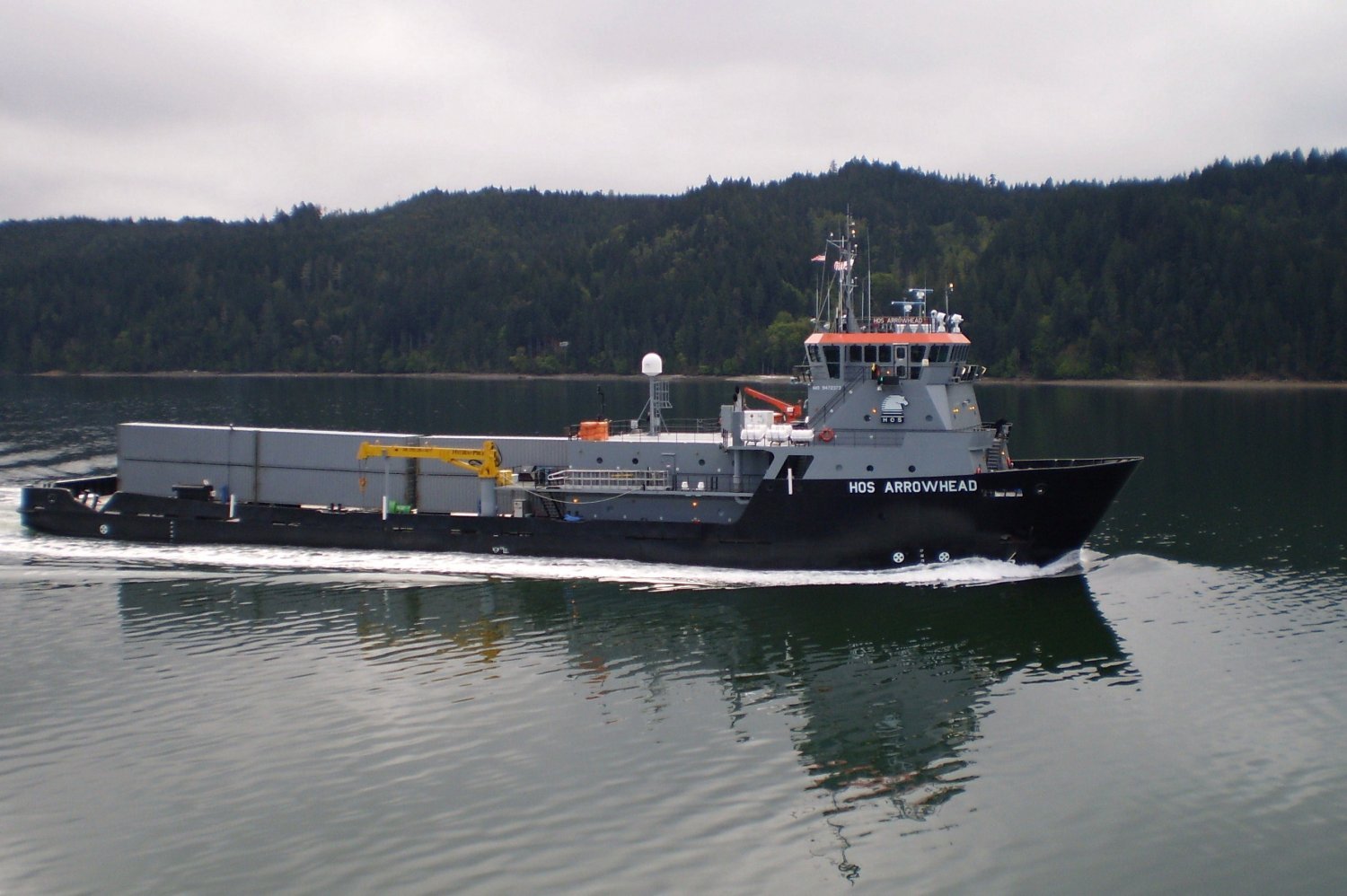
Distributed naval warfare needs more “salesmen,” working together as an interconnected web of logistics assets. An enlarged fleet of combat support vessels is the base of this new support schema. Practically, this is easier done than asking for more warships. As we build a larger number of warships for the future, our military shipyards are going to reach capacity, especially if they continue to build platforms using conventional methods. New replenishment ships can be acquired in a number of ways, apart from dedicating some military shipyards to building replenishment vessels (which will take away from warship building capacity), or building them in foreign countries (which is politically unfeasible). There is a surplus of offshore support vessels (OSVs) that could be purchased and put into Military Sealift Command (MSC) service, along with other commercial vessels that could be modified for CLF purposes. Modified in smaller civilian shipyards instead of military ones, they could create work that would please the constituents of a number of decision-makers on Capitol Hill. Under new CONOPs, vessels such as OSVs could be employed in shorter range replenishments to independent deployers on missions such as antipiracy and ballistic missile defense.

HOS Arrowhead under way, date and location unknown (U.S. Navy photo via Navsource)

These additional CLF vessels will still be vulnerable, especially if kept in the current MSC construct as unarmed USNS assets. Risk of enemy attack will have to be built into the calculus of how these ships are employed. But giving them sufficient self-defense weapons and damage control resilience to survive being set upon by enemy platforms would be prohibitively expensive. A larger number of our vessels would create a targeting problem – they can service more combatants, operate from more ports, and inject uncertainty into the situational awareness of an adversary. In the current model, there are only a couple of CLF vessels operating in an AOR, and watching select ports will give plenty of indications of U.S. Navy presence. 

These ships can be augmented with automation to the level that is currently employed on commercial vessels, allowing MSC to man more ships with the same number of personnel. An AKE in current MSC service has approximately 130 personnel onboard, while there are thousands of commercial vessels afloat with crews numbering less than 30. At-sea replenishment creates demands for more personnel during alongside evolutions, but this could be mitigated with updating the CONREP (connected replenishment) stations with new equipment.  The receiving ship could guide the delivery ship’s systems remotely with short-range remote operation systems, supervised by a few merchantmen on the delivery ship. A fly-away crew could attend to this equipment only when needed, and not ride for long transits, or into harm’s way.

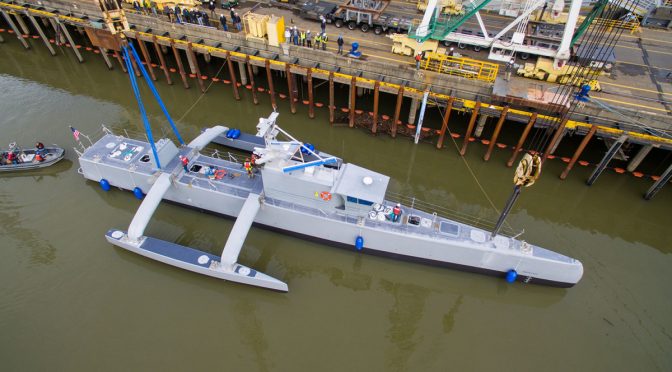
To reduce the threat profile of the manned CLF hulls, a system of smaller unmanned systems would create a web of logistical support. Cargo unmanned aerial systems (CUAS) will travel hundreds of miles point-to-point to deliver critical parts, instead of sailing entire vessels closer to get within VERTREP (vertical replenishment) range. They could carry parts for multiple customers and use aviation-capable ships as lily pads to get to others. Heavier lift CUAS could carry out VERTEP from unmanned CLF vessels to delivery ships, obviating the need for sailing alongside to transfer parts in a connected replenishment with a robotic vessel. These systems would be augmented by small unmanned surface vessels, possibly based off of the Sea Hunter Unmanned Surface Vehicle (USV), that could blend into surface traffic and make deliveries in battlespaces that are not conducive to aerial vehicles.

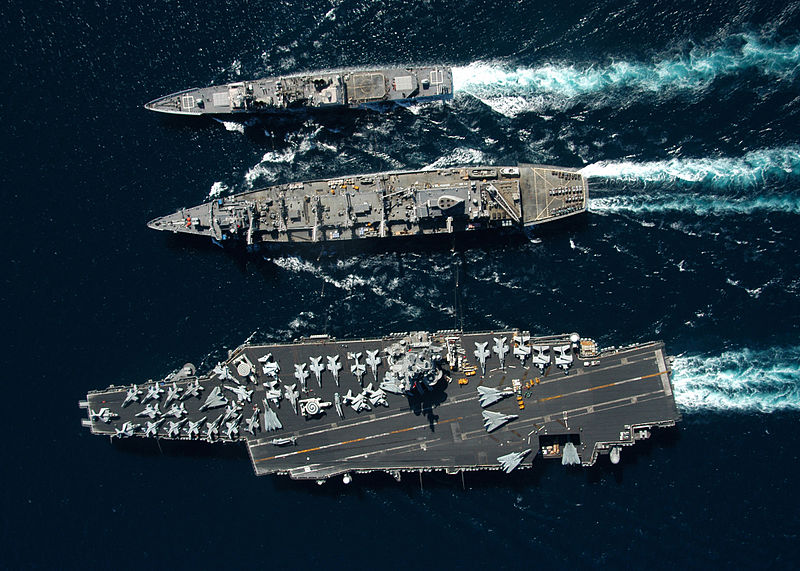
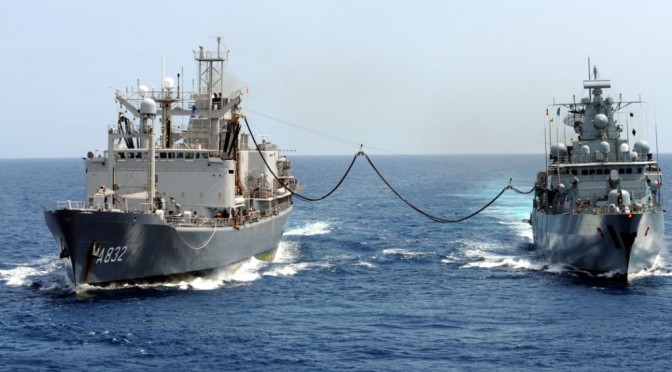
Arabian Sea (Nov. 11, 2003)  The guided missile cruiser USS Gettysburg (CG 64), top, and the aircraft carrier USS Enterprise (CVN 65), bottom, underway alongside the fast combat support ship USS Detroit (AOE 4) during a replenishment at sea. (U.S. Navy photo by Photographer’s Mate 2nd Class Douglas M. Pearlman)

There are a number of solutions to support problems that will also be needed in the Navy of the future. Digital investments will be needed to improve our logistics IT structure to create a more resilient and adaptable family of systems. Taken to the farthest extent, this would lead to Vertical Expert Systems (specialized AI), predicting demand through data analytics and optimizing the use of delivery assets. Additive Manufacturing will allow parts sourcing from many more locations than are currently available. Underway ships could eventually have the ability to make complex parts for their use or for other vessels that lack the technology. Fuel production from bacteria and “grow-tainer” produce farms could bring commodity sourcing much closer to the fight. Adoption of these technologies is important, but they do not eliminate the need for support to be physically delivered to our combatants anytime in the near future. 

Recognizing Priorities

The counterargument to a larger fleet of CLF hulls deserves to be heard. The Navy is looking toward a 355-ship force, and most of that plus-up number would be in warships. We want a lean Navy- with as little tooth-to-tail as possible, and the idea of buying more replenishment assets seems to be anathema to that. But the Navy must recognize it is unable to fight a long-term shooting war, especially in a disaggregated manner, with the current CLF force structure. A larger fleet of combatants only complicates this problem, especially since a majority of these shooters will be powered by liquid petroleum products that have to be brought to them.

To placate these concerns, these new vessels do not have to be single mission vessels, dedicated only to logistics. They could act as routers for line-of-sight transmissions, or even couriers of data packages between other platforms when they carry out their supply missions in a communications-restricted environment. They could seed sensors or deploy and recover unmanned systems in their transits. These missions could reduce the burden on warships and dedicated survey ships in peacetime and in war. 

A Worthy Investment

A successful future U.S. Navy will be comprised of innovatively designed combatants, with arsenals of new weaponry, employing cyberwarfare and unmanned systems to an extent that we can barely conceptualize now. They will still need a capital-ship level of investment in an interconnected web of logistics assets to fight against a peer adversary. The toilet paper, Diet Pepsi, and turbolaser parts have to come from somewhere.

Chris O’Connor is a Supply Corps officer in the United States Navy and a member of the CIMSEC Board of Directors. The views expressed here are his own and do not represent those of the United States Department of Defense.

Featured Image: (Feb.12, 2015)  USNS Guadalupe (T-AO-200) delivers supplies to the amphibious assault ship USS Makin Island (LHD-8), not pictured, during a nighttime vertical replenishment. (US Navy photo by MC1 Ronald Gutridge)

Operation ALTRUISTIC CENTAUR

The following is an entry for the CIMSEC & Atlantic Council Fiction Contest on Autonomy and Future War. Winners will be announced 7 November.

By Chris O’Connor

[Begin VRcast]

[1022 EDT, Location of VRcast unavailable]

[Bthere functionality unavailable]

                The VRcast opens to a view flying low over debris-strewn blue-green water, illuminated by late day sun. The view plans upwards to show a flat beach, punctuated by a single collapsed dock surrounded by small fishing boats. The horizon behind it is broken with the outlines of trees and the low buildings of a fishing village, all of which show earthquake damage. Some are completely destroyed. Smoke rises in several areas around the buildings, creating a haze over the island. The view zooms into a man standing on the rubble of a fallen wall. He is wearing a camera vest, cargo pants, and hiking boots. He has a bandage on the right side of his head.

                As he speaks in an educated British accent, he makes it a point to climb through the rubble, turning towards the camera on occasion to make a point.

                “Good evening from the South China Sea. I’m Wallis Barnes with an exclusive report. I apologize in advance for the latency of this recording… and the lack of Bthere functionality. So there will be no walking around inside this VRcast. This is a recording with no streaming capability, unlike most of our broadcasts. More on that later.”

                “It has been a momentous ten hours here, and most of the outside world has not heard anything of it, apart from official releases from the People’s Republic of China, the United States, and the Red Cross. At 9:24 local time, a shallow earthquake, measuring 8.7 on the Richter scale, rocked this small island and its approximately three thousand inhabitants. The death toll is over two hundred and rising, as this island is not supposed to have any seismic activity nearby- the buildings are not built to withstand the shaking.

                “I travelled here to talk to the inhabitants about how their lives have been changed by the recent fishing wars and the collapse of the nearby fisheries. As we all know there has been heated talk on the international scene for decades about this and other islands, inhabited by people of one nation but claimed by several others, including China.”

“I was indoors when the quake struck, and was lucky to make it out alive. Sadly, my VRshades did not. Fortunately for this report, my camBot did.”

                The VRcast point of view shifts to a shaky first person perspective of someone running down a dark hallway towards the light of an open door, as debris falls from above. Screaming can be heard coming from the left and the right. Just as it gets to the aperture of the door, a dark abject falls from the right, and the view goes dark.

                The point of view switches to a shot a hundred feet over the beach, panning across the destruction. Villagers are picking through the rubble, assisted by day-glow orange tracked robots with manipulator arms, as small legged ground robots act as stretcher carriers. Overhead, quadcopter drones are passing through the rubble, occasionally pausing at buildings to tag them with different color paint pellets. Off in the distance, at a low point in the island by the water, cargo tiltfan drones rise quickly from the surface and speed off to points unknown. Others return to that area and descend out of sight briefly, before rising to follow their peers.

                “As you can see, the rescue and relief operation is underway, it is a lean one- most of the Red Cross, USAID, and US Military presence is in drone form,” the reporter continues as a voiceover.  “It seems unusual out of context; normally efforts such as these would involve hundreds of people, but politics have gotten in the way. The local government has requested aid, but most of the world did not know about the cry for help because they didn’t hear it.

                “Ten minutes after the quake, all communications to the outside world were shut off or became completely unreliable. This included the high altitude internet router drones, communications satellites, and even global positioning systems. That is why this report does not have a geo-tag. The spoofed GPS signals make the systems here think we are in southern Australia. None of the surface radio and cell towers here work. Not only were many of the means to reach the outside world physically destroyed by the earthquake, but there was also a coordinated network attack that shut everything else down. The only communications that surviving islanders received were from the People’s Republic of China, saying that they were coming to their rescue and that Chinese efforts will bring enduring prosperity to the island.”

                The VRcast shows a muted recording of a world famous Chinese actor standing on the island’s beach, smiling as he talks and gestures towards the blue line of the western horizon, from which a massive Red waving flag is stretching across the sky, with a centered yellow large yellow star shooting four streams of smaller stars outward. The tops of dozens of ships can be seen coming over the horizon, as waves of Y-8 and Y-20 cargo planes fly towards and overhead the viewer.

                “It was a slickly produced broadcast, apparently created just for a situation such as this, most probably the aftermath of one of the typhoons that regularly pass through this region. We only found out later that the Chinese declared a maritime exclusion zone around this island and an Air Defense Identification Zone above it. This was to ‘deconflict aid efforts’ and was ‘for the safety of all surface vessels and aircraft’ in the area. Twenty-one minutes later after that broadcast started, the PLAAF made an appearance, with a special delivery.”

                The view changes to a surface perspective of a pair of sleek fighters, flying at high speed seven hundred feet over the surface. A caption overlay keeps the text [Chengdu J-21 (PLAAF)] next to the aircraft as they pass the island with an earsplitting roar. Two long pods separate from each. Drag chutes open, slowing the pods down. A scores of small drones of mixed types fan out from the pods as they fall, dropping close to the surface before racing off to different points over the island. Some of the VTOL variants take position on the ground, while the fixed wing ones start orbits. The pods land upright on the ground and open up like a flower, becoming base stations for the swarm UAS.

                “This was not a welcome development for the locals here, who would have little means to resist a swarm, even if they were not fighting for their lives against Mother Nature.  Chinese personnel were expected next, along with other unmanned systems, but something was keeping them away, a small comfort to the people here who do not identify themselves as part of the Middle Kingdom. They know that once the Chinese arrive, they will never leave- a scenario repeated a number of times in the past. Luckily for them, forces unseen seem to be testing the exclusion zone, keeping the PLAN and PLAAF busy. ”

                A compellation of short videos start. One is of smoke trials reaching something unseen high in the sky, leading to a puff of dark smoke. The next is of flashes in high in the sky. The third depicts several columns of smoke merging into one cloud from sources burning below the seaborne horizon. The final is of a massive fireball thousands of feet up from which flaming objects tumble. They leave streaks of black smoke they falls into the water not too far from the shoreline.

                “It is a reasonable expectation that rescue personnel would arrive via air first, either Chinese occupiers under the guise of helping the people here, altruistic forces from other nations, or unaffiliated aid organizations. After all, the island is a few hundred miles from major airports. But as it turned out, the first human rescuers came by sea.”

                The view changes to two hundred feet in the air, facing out to sea. Through the haze and smoke a grey catamaran vessel is seen bow on to the camera. It is travelling at high speed, evidenced by a boiling white wake behind it. On the center of its flight deck is a pair of large angled missile launchers on wheels. It is accompanied by two small angular vessels, keeping station to each side as escorts. The center vessel has the text [USS Bremerton (T-EPF-14)] over it, while the smaller ones are labeled [‘Fiberclad’ medium Unmanned Surface Vehicle]. A large panel can be seen on the side of the EPF flashing QR codes to the USVs; the black and white shapes are a gray blur, transmitting faster than the human eye can register.

                “This view from the camBot shows the approach of a United States Navy transport vessel with robotic escorts. I was told later what these vessels are, and added their identification to the VRcast. Some of Chinese drones attempted to damage or distract it as it approached the island, but they were ill-equipped to deal with the limited defenses of the American force. This swarm was probably not intended to keep shipping away from the island, but it gave it a try.”

                Over a dozen of the fixed wing drones, flying in an ever-changing swarm formation, pass the camera’s perspective and dive towards the oncoming ship. Tracers reach out from the trapezoidal USVs and strike some, while others burst into flames as they are hit by unseen laser beams. A few lose control and tumble into the water. In less than a minute, they have all been shot down.

                “My camBot kept its distance. To identify it as a journalism asset, it is painted in bright colors so that it is not mistaken for security or military piece of hardware. I imagine that is why it was spared. It was able to capture the transport ship deploying amphibious vehicles, only about a half mile from shore.”

                The video elapses a few minutes. The EPF, now much closer, appears to decelerate slightly, and a ramp extends from a lower deck over the stern of the vessel.  Spaced thirty seconds apart, ten small wheeled vehicles splash into the water, only to partially resurface in the wake, with sensor blisters clearly visible above the water.  The VRstream labels them as [Leatherback scout vehicles]. They fan out as they head towards the shore, leaving deceptively small wakes. They are followed by an eleventh and twelfth vehicle (captioned as [Squad Control Vehicles]) that are larger than the others, and beeline straight into the shore.

                The perspective changes to a view facing the water from the top of one of the destroyed buildings. In the foreground, a small crowd of locals can be seen hiding behind a partially collapsed wall. Two of the scout vehicles, each no larger than an ATV, emerge from the water riding on six low wheels. Their shell-like domes folding open to extend the sensor blister and employ a weapons mount. A small UAS with counter rotating propellers jumps into the air from the rear of each vehicle and climbs away from view.  As the Leatherbacks move toward the camera, sweeping the area, one of the two larger vehicles drive up on the beach, the size of a small SUV. There is a pause before a hatch opens on top of the SCV and the top half of a human emerges, wearing a dark combat suit with a breather mask and a bug like set of goggles.

                An audio broadcast in several local languages and English is heard coming from the SCV. “We are Americans, here to help the local government take care of their people.” The figure waves his gloved right hand, and then uses it to pull the mask off of his face, he keeps the top half of his face obscured behind the goggles. He smiles and continues to wave as the audio rebroadcasts. The SCV continues up the beach as the Leatherbacks advance towards the camera.

                “This is when we first encountered Captain Ellis of the United States Marine Corps.” The voiceover continues, “He is the local commander of the US military forces, which encompass only two humans and their accompaniment of ground and air robots. The transport that delivered the Marines had to depart the area, for it was in danger of being sunk by ballistic missiles as long if it spent too long in one place, allowing long range sensors to cue to it.”

                Cut to a long distance shot of the Bremerton, stern to the camera. It is pumping a dark cloud of obscurants into the air as it churns through the waves in a zigzag pattern. Columns of angry water erupt around it and an explosion appears off to its port, as something hits one of its escorts. It disappears into the afternoon haze. Smaller bursts of airborne explosions can be seen above it as it fades.

                The shot switches to the reporter standing next to the SCV, with Capt Ellis next to the dismount ladder of the vehicle. It is late afternoon. The Marine is wearing Oakley AR ‘shades and a soft cover instead of his full helmet system, but is obviously alert and not relaxed. Gesturing at the amphibious vehicle and the Marine, Barnes continues.

                “Captain Ellis is operating under a pseudonym and will keep his face partially obscured so that he is not easily identified. I have also modulated his voice so that it cannot be used for the same purpose. He will now talk us through what happened after he arrived on the island. It gives us valuable insight into the footage my camBot took. Please go ahead, Captain.”

                “Thank you, Sir.” Ellis begins, looking away from the camera, towards some distant activity.  “It is good to be part of this relief effort. We are here to provide security assistance and aid relief efforts during this difficult time.”

                “Why are you the only outside forces here?” Barnes asks.

                “My Marines were the only unit nearby when the earthquake hit and found ourselves inside the new exclusion zone. My Centaur platoon [US Military term for human-machine team] was just on its way back to Subic on the Bremerton after a COIN [Counterinsurgency] mission in Indonesia. It appears that the PLAN lost track of us among the commercial traffic around here, and when the shooting started, they had bigger fish to fry, anyway. So we were the first to respond and keep the Chinese away until follow-on forces arrived.”

But the Chinese did arrive, in albeit in small numbers. Tell us how you countered that.”

                “Well, the swarm they dropped off was not a very robust one, so we hijacked it and co-opted it.”

                “Co-opted?” Inquired Barnes.

                “Yessir. My platoon now controls the swarm now as if it is ours. My team has network intrusion capabilities with us, and we weakened their resistance by taking over their pod base stations. We convinced the Chinese through their own swarm that the island was covered in US forces, so that they would leave it alone. They still sent a team to be sure… Excuse me. Go ahead, Gunny. Roger. South end sentry? Copy all.”

As he speaks, he reaches up to the air with his right hand. Jabs his index finger out, rotates his wrist in a counterclockwise motion and then moves it downward a half a foot in an arching motion. He then closes his fist, and brings it back down to his side.

“I apologize Sir,” says the Captain. “Still have business to attend to.”

“The Chinese team?” the reporter asks, helpfully.

The VRcast switches to a rooftop view of a small clearing with a floor of low scrub that seems to be away from the residential structures of the island. It has bushes and trees around it. Two blurs (outlined in red by the VRcast) are seen descending from the air, as they touch the ground, they materialize into a pair of soldiers in full wingsuits. The suits change color from the color of the sky to that of the local foliage. They raise rifles in an alert posture.

The Marine continues as a voiceover, “Two infiltrators were sent in about two hours after we arrived. We knew their insertion methods- active camo wingsuits, and they hadn’t changed their tactics since the Malay insurgency. So we lured them with the co-opted drone signals, and dropped them on an EMP mine.”

The two soldiers in the VRcast drop their rifles and try to take off their helmets. They lose balance and fall to the ground, one face first, the other to its side. Two fully combat suited Marines emerge from behind the low buildings. They shrug off faraday blankets and point rifles at the prone insertion team, as a Leatherback emerges from the foreground. The Leatherback begins broadcasting audio in English and Mandarin that is garbled in the recording. One of the Marines lowers his rifle and strides over to the Chinese soldiers. He rips large objects out of the back of their suits, pulls off their helmets, and yanks earpieces out of each of their ears. Covered by the Leatherback and the other Marine, he then handcuffs both of the now helpless opponents. The VRcast cuts back to the interview.

 “They are now in the custody of the local police, for they are trespassing on sovereign territory of another country. We are here to assist with law and order, as part of providing assistance and relief the earthquake. ”

“It seems you were equipped to encounter such a team.”

“In part. My platoon carried some of the standard COIN and network intrusion components with us, but we had to build some items. A cover for the exterior of the mine had to be made so that it would be masked from their sensors and would blend into the environs around the ambush. We also made several types of special handcuffs so we could immobilize whatever model of ‘wingnut’ suit they arrived in. The SCVs have AM systems that can do the job.” Ellis says, as he lovingly pats the vehicle next to him.

“The islanders at this point still had no outside assistance… tell us what you did next.”

“There are Centaur teams that have an engineering capability, but this Raider team is not one of them. The Gunnery Sergeant and I tried to help with some of the rubble, but we need dedicated rescue suits and better drone coverage. Standard HA/DR [Humanitarian Assistance/Disaster Relief] response involves airship delivery if an airfield is not available, so I had the robot platoon members find and clear a suitable field. I had no idea if anyone would arrive with the ADIZ [Air Defense Identification Zone] and exclusion zone up, but it looks like USAID [United States Agency for International Development] and the Red Cross decided to risk it with commercial air carriers. They took a gamble that the Chinese would not shoot down civilian flagged aid deliveries.”

A field that leads to a large flat beach appears in the VRcast. Two Leatherbacks can be seen in the distance. The view pans to two closer ones- they are positioned in a rectangle, marking a clear landing area. A deep hum fills the air. The top part of the view disappears behind a large dark object descending towards the field. The camBot pans back as a massive hybrid airship in FedEx livery descends on a shallow slope. Fifty feet below above the landing area, two shipping containers with “USAID” markings begin to lower to the ground on cables. Just as they touch the ground, they detach from the cables and the airship accelerates up and away from the field, unencumbered by cargo.

The view pans back to where the airship came from as a second FedEx airship approaches. The recording follows it as it drops off two more containers. These are labelled with Red Cross and Red Crescent emblems. As the second airship ascend away from the landing area, the Leatherbacks drive out of away from the field, their assigned roles complete.

The sides of one USAID container open up, issuing forth the legged and tracked recovery bots seen in earlier clips of the recording. Scan and marker UAS launch from the far end of the container. The other container extends launch tubes and launches dozens of small objects in multiple directions. The VRcast captions this as [First Responder Mesh Network deployment].

Captain Ellis provides a voice-over. “This is the standard unmanned first responder package. The USAID boxes carry rescue and recovery systems, and will employ ad hoc network hubs for the whole island. Once those hubs are set up, the drones will distribute low-cost AR glasses so that people on the island can communicate with each other. This will help me with my mission, I don’t have the capability with this team to aerial seed my own nodes, so I can use this network.”

The Marine continues, “The Red Cross boxes carry ‘food flies’ and enough food for thousands of people, for a short period of time…”

“’Food flies?’” Barnes interjects.

“I apologize, sir. That’s the slang for food aid drones. They swarm through the airspace and look like they are buzzing around food sources, when they are in fact picking up the food for delivery to aid points. They can be an annoyance in a war zone, where they complicate our battle picture.”

A small tracked vehicle emerges from the side of the far Red Cross container and drives across the beach into the water, trailing a suction hose for water collection. The top opens up, and packages rise into view on individual platforms. The shot pans to a top down view of the near Red Cross container as the top slides open, creating a series of ledges akin to an open cereal box. Scores of bug like eyes come into view, the sensor systems of small drones pointing upward. The drones move upward and out onto the newly deployed launch platforms, seemingly shaking with anticipation as liftfans fold from their wasp-like fuselage and rotate into a horizontal flight position. The “food flies” lift from the platforms in quick sequence, pick up packages from the other Red Cross container, and fly away at high speed.

“As you can see,” Barnes says, “HA/DR operations no longer involve food lines and people handing out food, the newer Red Cross containers deliver the supplies where they are needed. The food one desalinates its own water and packages it for the drones to deliver, and contains thousands of meals…”

“Excuse me Sir.” Ellis interrupts, “I need to end this interview. The south sentry saw two more cargo ‘zeps coming and we don’t know what they are carrying. I’m hoping it is a MSF [Médecins Sans Frontières] mobile hospital and a rescue team in power suits, but I can’t be too sure. Could be a PLAN Trojan horse.”

The Marine climbs up onto the SCV and puts on his helmet. He looks down at the reporter. “Do you want to send out this VRcast? It would be good to get the word out.”

“You can do that? How can you transmit this off the island?” Barnes asks, pleasantly surprised by this development.

“Yessir. If I told you how, the Chinese would know, wouldn’t they? Anyway, when you are done with post, NFC transmit it to any member of my team and we will get it to your news agency.  Format it so that it is just one way, so no VRstreaming. Have to go.” He folds himself forward into the SCV as it drives off.

                Wallis Barnes turns towards the camera, the expression of a serious reporter returning to his face. “There you have it. This small island, already reeling from a record earthquake, has now become a pawn in the great power competition in Asia. The international community is trying to help while the people here cling to survival. Thank you for joining me for this special report, hopefully the first of many. Have a good evening.”

                The camera zooms back from the reporter, showing the island in the background and the aid efforts. The SCV can be seen rushing off towards the south, where airships can be seen approaching at low altitude. The view centers on the sun, low over the western horizon.

[End VRcast]

[View more on this topic?]

Chris O’Connor  is a Supply Corps officer in the United States Navy. He was a member of the CNO Rapid Innovation Cell and CNO Strategic Studies Group Director Fellow. The views expressed here are his own and do not represent those of the United States Department of Defense.

Featured Image: DARPA’s Anti-Submarine Warfare (ASW) Continuous Trail Unmanned Vessel (DARPA photo)

Distributed Leathernecks

Distributed Lethality Topic Week

By LCDR Chris O’Connor 

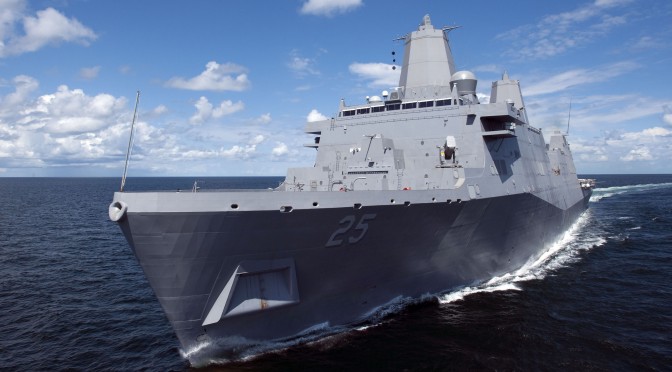
This year, the Navy plans to send out a surface action group (SAG) comprised of three DDGs in order to test distributed lethality CONOPS. This is an important first step, but the next SAG deployed should include a completely different unit. A San Antonio-class LPD. One LPD-17 class ship in the mix will considerably change the capabilities of a SAG across the warfare spectrum, making it a true Adaptive Force Package (AFP) that is more lethal in a number of different ways.

[otw_shortcode_button href=”https://cimsec.org/buying-cimsec-war-bonds/18115″ size=”medium” icon_position=”right” shape=”round” color_class=”otw-blue”]Donate to CIMSEC![/otw_shortcode_button]

Why an LPD? It is a large littoral combat ship. The LCS classes were designed to have mission bay space so that capabilities could be swapped out as the mission required. LPD-17 class ships, if loaded with a specialized set of MAGTF (Marine Air-Ground Task Force) equipment, have room for equipment that no DDG or CG could dream of carrying, at a greater volume than an LCS. While serving on the USS BUNKER HILL (CG-52), the author recognized that the guided missile cruisers in the US Navy have been built for specific weapon systems, sensors, and engineering equipment. A modification to add more systems that are significant departures from the original design will be at the expense of the baked-in warfare capabilities. More unmanned systems or connectors can be put on a surface combatant, but they will be limited to the constraints of the torpedo magazine, hangar, or boat deck space, and will take away from the important uses those shipboard locations currently have.

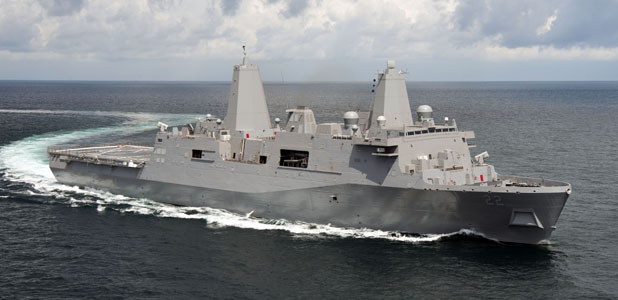
LPD 22 Sea Trials
LPD 22 Sea Trials, Huntington Ingalls photo. 

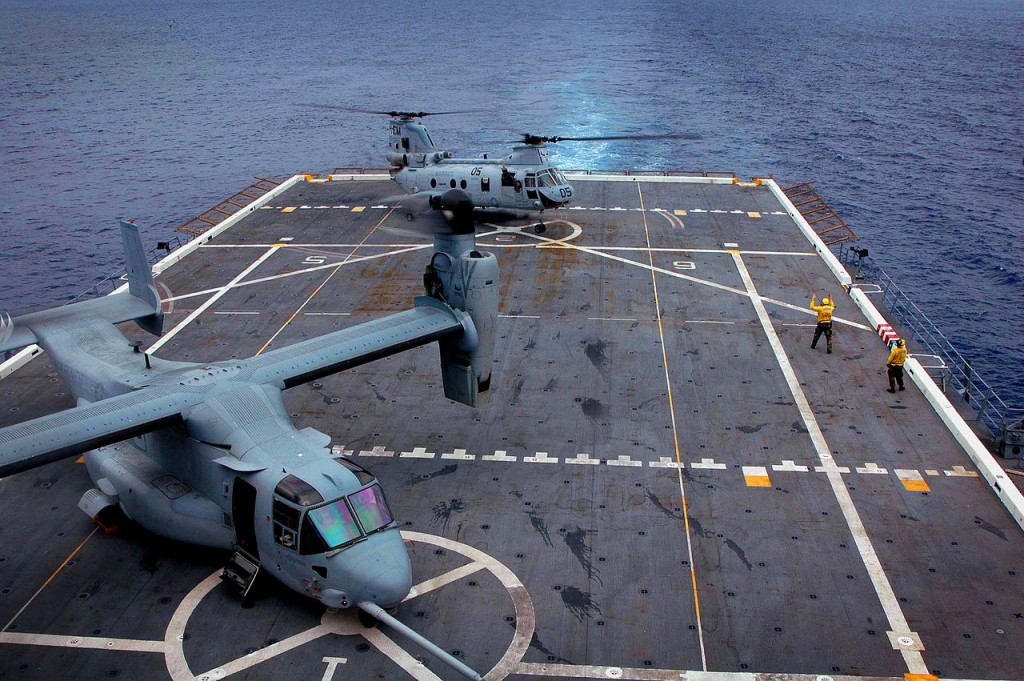
On top of the “open concept” interior (so in vogue these days), the LPD also has a flight deck that dwarfs that of any surface combatant; it can launch or recover two V-22s simultaneously. It has massive potential to carry more aviation systems due to the aircraft storage space in the large hangars and deck tie-downs. Not to mention that if a DDG wants to put something in the water, it has to lower it with the boat davits or other limited means. A LPD has a well deck that can splash LCACs, LCUs, and unmanned systems that use the sea interface.

During a recent distributed lethality wargame (of which the author was part of), game participants were given objectives and a choice of AFPs to use towards those aims. The choices included a mix of DDGs, LCSs, America-class LHAs, and “Hughesian” (the author is taking liberties with that word) small missile combatants a la “streetfighter.” We then employed these mixed forces against a red force that was trying to reach an objective, break a blockade, or put troops ashore on an island. The decision-making process was constrained to a surface picture, speed/capability/weapons employment solution set. This was the explicit purpose of this game, being early in the distributed lethality wargame process.

Early in the game a different way of meeting the same goals came to the author, and they involved using Marines with surface or aviation connectors. For example, we can deter an island invasion with the proper positioning of surface ships, but what if that island already had US forces on it? If a red force landing craft was able to get through, it would have to contend with defenders on the island. It is much less politically tenable for red forces to land on an occupied island than to occupy an island that is not populated (or at least has no security or military forces on it) with the guise that it is helping or providing unasked-for security assistance. Blue landing forces would enhance the maritime security exclusion zone around an island or completely obviate it. V-22s can get to the objective a lot faster than surface ships. In the recent DL wargame, if the blue forces chose to use America-class LHAs as part of their a la carte AFPs, V-22s were not an option, they and landing forces from the LCSs were adjudicated from the game for aforementioned reasons.

Flight deck loaded with V-22 Ospreys, defenselink.mil photo.
Active flight deck , defenselink.mil photo.

An LPD can be part of a disaggregated ARG and be used as part of a DL task force. An LPD loaded with MEU equipment that can be quickly employed and join up with an LHA and LSD would be especially useful if needed to create a larger landing force. A red force that wants to land troops to provide “security assistance” or “fight terrorists” would have to contend with LCAC delivered and V-22 delivered vehicles with TOWs, Marines with Javelins and Stingers, and in a longer time period, LAVs, AAVs, and MPCs that have swum ashore from the LPD’s well deck. At the least, the LPD will be a sea base lily pad for long-range V-22 missions, such as non-combatant evacuations or special operations strikes. All three ARG ships do not have to be present for this capability to be delivered.

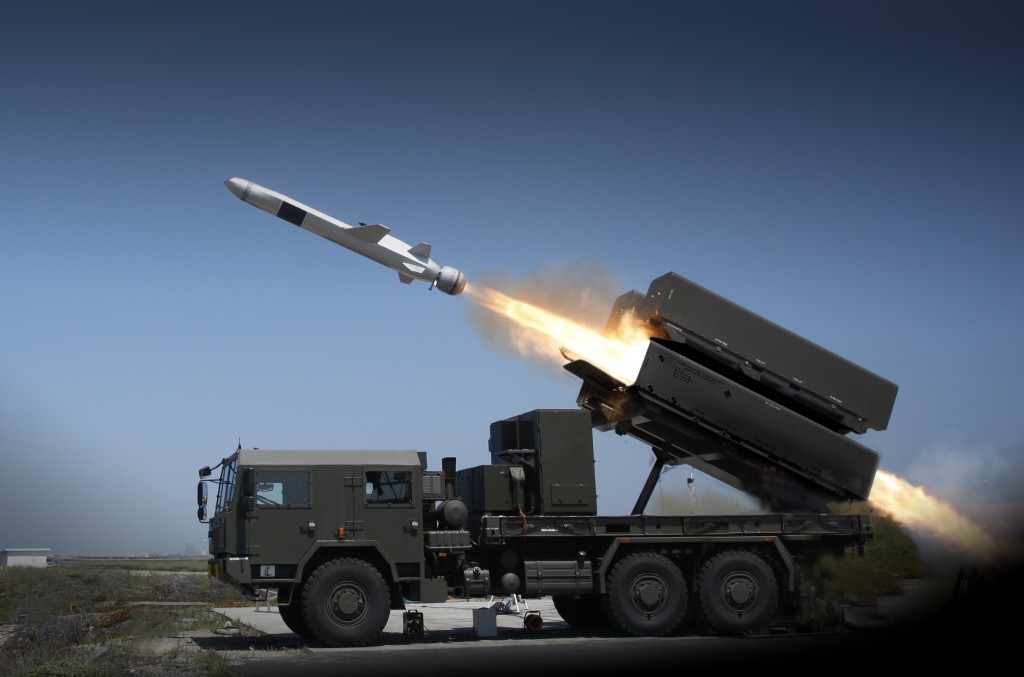
The future brings even more options. A DL MAGTAF assigned to a LPD could be specifically modified to perform specialized deterrent landings at short notice, or bring ashore capabilities we do not currently use. TOW and Javelin missiles would make landing craft think twice, but there are truck mounted Naval Strike Missiles and other antiship and surface-to-surface missiles. A lot of those systems, including HIMARs, are too large to be delivered by an LCAC as they are currently fielded. These weapons, or other systems such as Hellfire or JAGM, could be modified and put on smaller vehicles that are purpose built to provide anti-access/area denial capabilities. On top of this, the flight deck of the LPD can launch and recover even larger UAVs than the surface combatants can employ. The hangars can support USMC aircraft such as the AH-1Z and UH-1Y that can carry out different mission sets than the H-60 variants that deploy on current surface combatants. New capabilities could use up some of this non-skid real estate, such as strike missile box launchers, additional communications and EW equipment. Not to be forgotten, the well deck could be used to put UUVs and USVs in the water, creating defensive swarms around contested geographic points or high-value units. Being a Supply Corps officer, the author is obliged to point out the additional logistics capability that an LPD brings to the fight; more storage for supplies, mothership capability for smaller units, and space for new capabilities that can be bolted on such as additive manufacturing.

Norweigan Strike Missile (NSM) launched from a truck, Kongsberg photo.

The new E-series ships such as the EPF, ESB, and ESD can all do parts of these missions, but would not survive as well in a contested environment as an LPD-17. That class has EW, communications, self-defense, and logistics endurance capabilities that the newly minted expeditionary classes do not have. This is not discounting them, but they just cannot play in the same environment as the other members of the DL SAGs can; there is a place for them in other parts of the littoral arena.

This is not an original idea. If you have heard this all before, it is because many people saw the potential from the very beginning of the LPD-17 class. James H. Cobb wrote a series four novels from 1997-2002 that were the closest thing for the Navy to Dale Brown was for the Air Force. In his books, then-experimental technology was used to fight battles in new ways. The third novel Seafighter (2002) exhibited the gonzo awesome idea of armored LCACs armed with chain guns, hellfire missiles and even SLAM missiles (as a “streetfighter” concept). The linchpin of the Navy task force that employed these systems was an amphibious warship used to the fullest extent of its capabilities- supporting the battle hovercraft, launching helicopter strikes, and the like. When the author was a member of the CNO Strategic Studies Group, one of the areas of investigation was new uses for current classes of ships, and there were already think pieces out on the LPD-17. These ideas should be used in the distributed lethality concept to bring Marines to that fight.

The Navy-Marine Corps team is at its most lethal when each naval service uses its unique capabilities to the utmost. And the best way to cohesively bring them together for the good of distributed lethality is with an LPD in the fight, part of a Surface Action Group. This will certainly make our potential adversaries sit up and pay attention.

LCDR Chris O’Connor is a supply corps officer in the United States Navy and a member of the Chief of Naval Operations Rapid Innovation Cell. The views expressed here are his own and do not represent those of the United States Department of Defense.

[otw_shortcode_button href=”https://cimsec.org/buying-cimsec-war-bonds/18115″ size=”medium” icon_position=”right” shape=”round” color_class=”otw-blue”]Donate to CIMSEC![/otw_shortcode_button]

Distributed Endurance: Logistics and Distributed Lethality

The following is a submission by guest author Chris O’Connor for CIMSEC’s Distributed Lethality week.

Distributed lethality is a concept that harkens back to the glory days of the US Navy in the age of sail: small groups of ships with operational autonomy fighting the enemy with their organic firepower and capabilities. Operational autonomy was the default state for ships  until Marconi’s radio set- the lack of instantaneous communication meant that commanders had to make decisions by themselves. Concerning distributed lethality, the lack of communications is imposed upon our ships by enemy communications denial in an A2/AD environment. The parallel does not work in the logistics domain as well- warships then had to fend for themselves logistically, while today, we will have to force a new mode of supply on our ships in order for them to operate independently.

There are some lessons we can learn from how we supported our ships in the past, but there is a big difference in the sustainment modality of the 64-gun USS Bonhomme Richard of Revolutionary War legend and the modern namesake of her captain USS John Paul Jones (DDG-53).

First of all, those ships of sail operated with what is now called an “expeditionary mindset.” They operated with austerity, for threplenishment opportunities were few and far between. Most of our surface combatants are replenished from MSC ships with such frequency that fresh fruits and vegetables are a part of the staple on Carrier Strike Group (CSG) deployers and hard pack ice cream is not uncommon. Life on-board the hunter killer Surface Action Groups (SAGs) will be less comfortable, but it does not have to regress to the days of hard tack and picked herring. Instead, austere life on a modern surface ship life will be closer to that of how submariners live on nuclear attack subs. More canned and from scratch food could be served and valuable storeroom space that is now used for ship’s store items and soda vending could further extend the endurance of a vessel as food storage. Our refrigeration units could be converted to only carry frozen items, yet another adaptation for better food autonomy that sacrifices the comfort of salads and perishable fruit for several more days between replenishment hits.

Ships in the age of sail had carpenters in their crew and bosun’s mates that could repair a large part of what we would call ‘Hull, Mechanical, and Electrical’ systems on today’s warships, using materials that could be collected from almost any port- or from captured enemy ships, for that matter. Shot out rudders, rigging, sails- the prime movers of a ship of the day- could be at least “jury rigged” with organic capabilities on-board. The bridge that modern warships need to come even close to this capability is a suite of additive manufacturing systems that can build replacement parts of many shapes and materials, to include systems that can repair parts by building directly on their surfaces with an additive manufacturing (AM) system. Sailors will need to be able to repair their own systems with these new technologies, introducing an organizational level repair suite that can fix far more than the currently installed machine shops. In the near term, AM will not be the solution to all of our shipboard repair problems, especially on space constrained surface combatants. The state of the technology means that our ships will still depend on logistics assets for at least some of their repair parts, which will tend towards the complex in design, and will be most likely vital for the operation of our critical systems.

The delivery of high priority parts to ships at sea necessitates a solution that departs from our historical parallels. If we are to provide logistical supports to distributed assets in a emission-restricted or denied environment, a family of autonomous replenishment assets needs to be developed. In the “distributed lethality” environment, large, exquisite MH-60 helicopters should not be used to deliver small packages of critical parts (a situation that the author has personally experienced a number of times). These multi-mission aircraft are better utilized prosecuting targets, providing ISR, and acting as communications relays. The crews of the helicopters should also not be put to risk delivering parts where detection in contested airspace would have a fatal outcome. Vertical take-off and landing UAVs (VTUAV) lend themselves perfectly to this mission, but there is not currently a platform in the Navy that is suited for this mission.

The Navy needs to fill this capability gap by changing how VTUAVs are operated from ships and advancing existing technologies to a level that allows for a mature autonomous capability. We have to

VTUAVs like this CybAero design could enable robotic replenishment

operate these systems without flight following; controlled assets are no use to us an environment where communications are not guaranteed. To enable this, such a robotic replenishment asset would have to have “sense and avoid” systems so that they do not collide with other aircraft, ships, or oil platforms as they fly point to point from ship to ship or ship to shore. In addition, these aircraft will have systems that use a combination of EO/IR, LIDAR, and INS to first get in the vicinity of the receiving ship and then land on it without any outside input or control. This is an important difference from our current CONOPs, for there is no UAV that can land on any ship in our inventory by itself; they all require UCARs (UAV Common Automatic Recovery System), SPN radars, or man-in-the-loop input. To be truly useful, logistics missions should be able to be flown to and from any surface ship, as they are with manned helicopters. The all of the above technologies needed for an autonomous logistics UAV currently exist but have not been combined into one dedicated platform. When proven, a family of systems ranging from Fire Scout to optionally manned H-60s to hybrid airships could be employed, stretching a flexible sustainment chain that can leapfrog from asset to asset out to our hunter killer SAGs.

Austerity, additive manufacturing, and robotic replenishment can only take sustainment endurance so far without dealing with the five hundred pound gorilla of energy supply. At sea fuel replenishment will be much rarer if combatant ships operate in environments that make MSC ship operations difficult due to distance or enemy threats. In addition, these oilers might be occupied in other future missions as missile shooters with bolt-on launchers or adaptive force package elements. To start, a greater tolerance for lower levels of shipboard fuel bunkerage needs to be embraced operationally. Fuel cells and batteries need to be added to existing platforms to share the electrical generation burden from the gas turbine generators, so more fuel can be conserved for ship propulsion. The end solution to this problem could be much more radical and needs to be examined in great depth. Unmanned fuel tugs in concert with underwater fuel stations could service our ships, but the full implications of using such systems are far from certain.

“Distributed Lethality” will prove a sea change to how naval forces employ surface assets with significant implications for tactics, command and control methods, and platform employment means. In order for it all to work, we need to be as innovative with our sustainment methods we are in all the other enabling warfare disciplines. The sooner we get started, the more seamless the final package will be.

Chris O’Connor is a supply corps officer in the United States Navy and is a member of the Chief of Naval Operations Rapid Innovation Cell. The views expressed here are his own and do not represent those of the United States Department of Defense.

CIMSEC content is and always will be free; consider a voluntary monthly donation to offset our operational costs. As always, it is your support and patronage that have allowed us to build this community – and we are incredibly grateful.

Select a Donation Option (USD)

Enter Donation Amount (USD)