
By Major Joseph Potter, U.S. Army
Taiwan’s ability to independently support itself is integral to its survival but also clearly aligns with America’s national interests. Arming Taiwan is an America First policy; the reinvigoration of American global power is enhanced by enabling Taiwan to defend itself. It is an explicit “end” mandated by the National Security Strategy and a key “way” identified in the Defense Strategy. The United States has maintained relations with Taiwan since 1949. While the nature of these relations has varied over the years, from official recognition in 1949 to a derecognition in 1979 and unofficial relations since that time, two things have been constant. The People’s Republic of Chinas’ (PRC) and American support for the pro-western government in Taipei. To advance American interests in Asia, the United States must continue its longstanding support of Taiwan by providing it military aid through Foreign Arms Sales (FAS) and Foreign Military Financing (FMF) while maintaining strategic ambiguity regarding whether or not the United States would intervene militarily to defend Taiwan. This policy helps the United States defend its homeland, enhance prosperity, and reinvigorate American power. The United States can succeed in Asia by deterring Chinese aggression, increasing burden-sharing with allies, and reindustrializing its defense base in a critical sector, maritime manufacturing. These strategic ways can be pursued by providing military aid to Taiwan while mitigating the chances of escalating competition.
Fomenting a “porcupine” or “hellscape” strategy deters the PRC by creating a series of cost prohibitive dilemmas and strengthens American security. Containing China within the First Island Chain preserves a balance of power that secures America’s peripheries, maintains sea control, and protects global power projection. Military aid to Taiwan enhances the unfavorable conditions facing any Chinese invasion by increasing the costs of war and decreasing the probability of success. In combat modeling, success in a kinetic scenario favors the side with a numerical advantage in troops and the quality of forces, with situational variables (weather, surprise or fortification) playing a lesser role. Destruction of 20-40% of an enemy’s combat power has historically made them ineffective. Equipping Taiwan with lethal aid (Army Tactical Missile Systems, Javelins, or anti-ship missiles) will deter Chinese aggression by enabling the defenders to diminish invading forces before they reach their beachhead, limiting the likelihood of a successful invasion. Center of Strategic and International Studies (CSIS) wargames confirm that American aid in arming Taiwan is critical in defeating a PRC invasion, and that only through vigorous Taiwanese resistance and their capability to act independently can China be defeated. To ensure its interests in Asia the United States must deter aggression in the Strait, and continue arms sales to Taiwan. This also shares the burden of defense with U.S. partners.
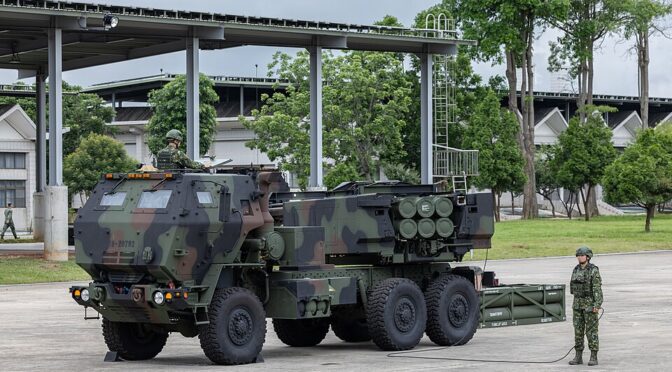
In an era of strategic consolidation, the U.S. can no longer support the robust military footprint of the 20th century, instead it must share the burden of defense with its allies. America holds mutual defense arrangements with approximately 68 countries, offers extended deterrence to over 30, and maintains the freedom of navigation for the world. Amid escalating tensions with the PRC, Russia, Iran, and North Korea, providing lethal aid to partners like Taiwan sustains a global stabilizing presence with reduced strain on American power. Selling interceptors to the UAE, F-35s to Norway, or assorted arms (HIMARS, ATACMS, Harpoon, Javelin missiles) to Taiwan empowers those allies to share the burden of security with the United States Following the annexation of Crimea, successive American presidents provided Ukraine the ability to defend itself through arms sales, transfers and material support. While this ultimately did not deter Russia it did enable the United States to protect its interests in Europe while avoiding direct conflict. Sharing the burden of defense with partners by equipping them through FAS/FMF creates a sense of ownership for one’s own defense while still achieving American interest abroad. At the 2026 Shangri-La Dialogue Secretary of War Pete Hegseth reaffirmed this point when he stated that “America first does not mean America alone, but it means realist engagement with a clear eye toward defending our most vital national interest.” For the United States to compete effectively and efficiently in the 21st century it must reinvigorate its defense industrial base and strengthen its alliances. Sharing the burden of defense with Taiwan provides it with the means of self-defense while also empowering the United States to remain prepared militarily to respond where needed and for it to reinvest.
Lastly, competition with the PRC requires a robust defense industrial base (DIB). Domestic consumption alone cannot sustain the DIB requirements, we need allies to facilitate the expansion. According to CSIS, in wargames with the PRC the United States is expected to expend 5,000 long-range missiles in the first three weeks. As a subcomponent of these numbers, it will fire an average of 450 anti-ship missiles, requiring 24 months to produce a single replacement. For the United States to effectively compete, it must leverage the sale of American defense material through programs like FAS to Taiwan. FAS and FMF provide dual capacity by first, ensuring that our allies are well-armed while also increasing DIB capacity, offsetting costs to American taxpayers by using foreign capital. The F-35 program provides an example of this argument. From 2018-2020 the sale of F-35 aircraft to partner nations for specified lots resulted in approximately $2.1 billion in savings.
Aid and military sales to Taiwan is not new. Since 1949 the U.S has sold over $50 billion in equipment to Taiwan and since 2022 alone the U.S. has authorized the sale of almost $20 billion in military hardware, ranging from munitions to helicopters. The equipment sold has, as it should, change as the threat from the Peoples Liberation Army (PLA) and China has changed. For years, Taiwanese defense procurement prioritized legacy, high-visibility, high-end equipment such as M1A2T Abrams main battle tanks and advanced tactical fighters like the F-16. But with the PLA modernization, symmetry may no longer be appropriate. This has led to changes in what Taiwan wants and buys. Today Taiwan needs less tanks and more stopping power in the Strait. However, when looking at the sector where the greatest mutual benefit can be realized to both the United States DIB and Taiwanese security one domain is the clear outlier, maritime.
From the Middle East to Europe American air, cyber and ground capabilities all provide value in this fight, but each sector is already in globe spanning demand. The wars in the Middle East and Ukraine have led to a backlog of orders by both the United States and its partners within these industries and created the necessary demand signal to the producers. Less demand however exists within the unmanned surface and subsurface naval sectors. Naval defense coordination between the United States and Taiwan offers a novel avenue to each states’ desired end state. Of the approximately $20 billion authorized defense packages since 2022 only 0.7% of equipment is related to maritime operations and that consists mainly of antiship missiles and 30mm gun mounts for vessels. This is inadequate for Taiwan and an opportunity for the United States. Borrowing from renowned and foundational naval strategists, Alfred Thayer Mahan and Julian Corbett, naval power is core to economic prosperity and sea control is foundational to defending the homeland. To defend the homeland the United States needs to master unmanned naval power alongside conventional power. Likewise, the best way to deter a Chinese invasion by the Taiwanese would be to be able to sink as many vessels as possible in a sea denial strategy. Employing lethal American unmanned systems and munitions to destroy invading PLA forces before they can secure a beachhead.
The state of Americas maritime DIB is well recorded. Described as being on the cusp of a “national emergency” the Trump administration has renewed its efforts to revitalize the Maritime Industrial Base (MIB) in pursuit of “America’s Maritime Dominance”. Cooperating with Taiwan and leveraging FAS/FMS in maritime munitions and capabilities provides new markets for U.S. firms. Companies such as Huntington Ingalls Industries (HII), BlackSea Technologies, or Anduril would see increasing demand for these systems and provide them with the opportunity to scale production for what is already a very contested domain. The U.S. Navy is actively accelerating the deployment of unmanned systems into its arsenal as it prepares for the changing character of war the future promises to bring. The PLA Navy is actively seeking to overturn American naval dominance; selling equipment to Taiwan expands domestic manufacturing capacity, enhances cross-strait interoperability, and shortens production timelines but it also provides America with a historic opportunity to reinvigorate its maritime character.
The defense of Taiwan is geostrategically indispensable to Americas overall interests. Providing military aid to Taiwan deters Chinese aggression, strengthens burden sharing with allies, and increases American defense production. Embracing the role as the “Arsenal for Democracy” means the U.S. needs to ensure it is providing value in every domain. Further, expanding DIB production capacity and sales also increases Taiwan security. To produce at the scale necessary to compete, the United States needs to revitalize its defense industrial base. FAS and FMF to states like Taiwan reduces the overall cost of the platform to the United States while increasing production output and security. This make it clear that the defense of Taiwan and arming the island is ultimately and clearly an America First strategy. Following Presidents Trump and Xi’s recent American summit, the United States must continue providing military aid to Taiwan; it is symbiotic. It enables Taiwan and America to achieve their interests while confounding those of America’s primary adversary, China.
Major Joseph Potter is an Instructor and Course Director within the Defense and Strategic Studies (DSS) Department at the United States Military Academy. He is a 2015 graduate of the University of California, Santa Barbara and holds a Master of Science degree in Geological Engineering from Missouri University of Science and Technology and a Master of Science degree in Political Science from Utah State University.
Major Potter has previously served as an Infantry Officer in the 101st Airborne Division (Air Assault), the 75th Ranger Regiment (Fort Benning, GA), and the 2nd Infantry Division (Joint Base Lewis–McChord, WA). His military service has taken him to the Philippines and Taiwan, and he has deployed in support of NATO missions in Germany and Romania, as well as combat operations in Afghanistan as part of Operation Freedom Sentinel.
The views presented here are those of the author and do not represent the views of the U.S. Army, the Department of Defense, or any other organization with which the author is affiliated.
Featured image: Taiwanese soldiers with a High Mobility Artillery Rocket System. (Wikimedia Commons)
Discover more from Center for International Maritime Security
Subscribe to get the latest posts sent to your email.