

By Brandan R. Schofield
Introduction
In the realm of navies and sea power, communications capabilities are one of the cornerstones of effective command and control (C2). Alfred T. Mahan, one of the most significant naval strategists of the last two-hundred years, defined sea communications as “… a line of movement by which a military body is kept in living connection with the national power.”1 Today, effective lines of movement are only enabled through shared lines of connection (living connections) across the electromagnetic spectrum (EMS). In planning for tactical communication networks across the EMS, there are lessons to be learned from today’s Cloud-based as-a-service (aaS) models.
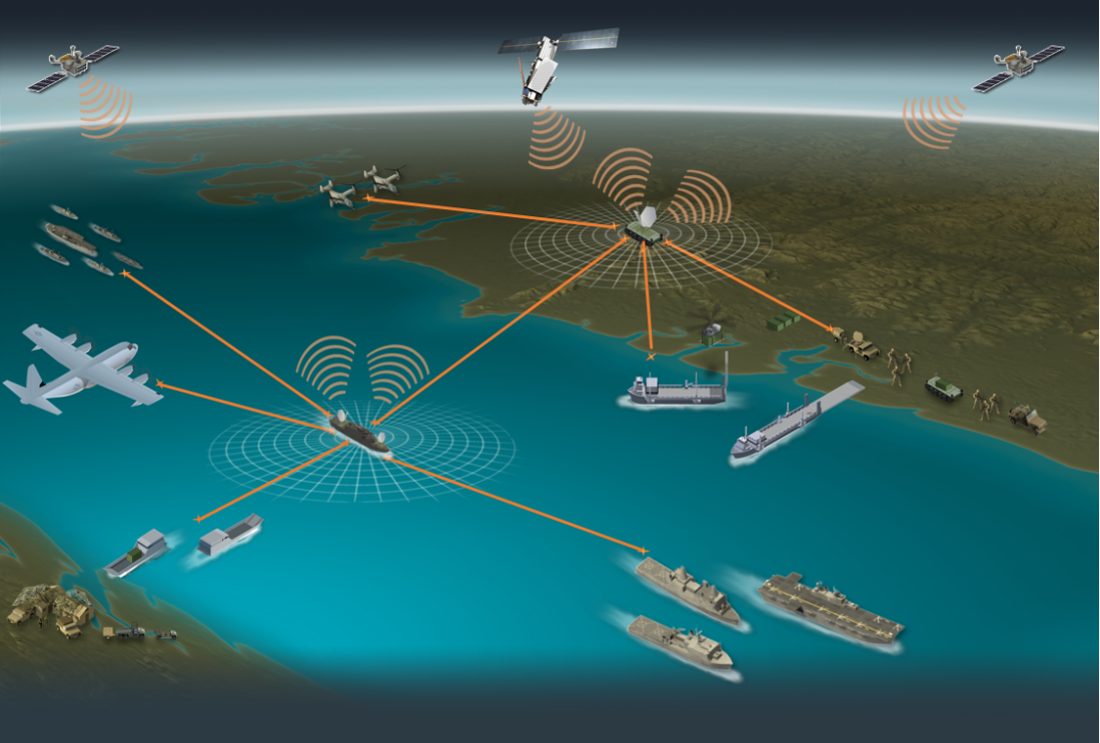
The three most common aaS models are software-as-a-service (SaaS), platform-as-a-service (PaaS), and infrastructures-as-a-service (IaaS). To use a business analogy, Mahan’s national instruments are the enterprise, and the naval tactical formations are the customers who require service. Understanding these models could yield new ways of thinking in flexible and redundant communications methods. The last 30 years of relatively communication-permissive environments are no more, especially in the era of great power rivalries, artificial intelligence (AI), and the pervasiveness of information technology EMS detection tools. This strategic struggle is driving a host of changes across the naval services.
The U.S. Navy, Marine Corps, and Coast Guard are cognizant of this glaring issue with communications availability and access across the EMS in high-risk anti-access aerial denial (A2AD) environments playing out in real-time in the Russian-Ukrainian conflict and in other conflicts. In such areas, adversaries use EMS signatures to find, fix, track, and disrupt operations across the competition and conflict continuum. This targeting paradigm stresses the importance of C2 for closing kill chains.2 New warfighting concepts call for naval forces, both seaward and landward, to use low-signature emitters to evade adversary detection.3 Unfortunately, there is a paradox between the way the military services approach fielding new, network-enabled capabilities to enable effective C2 and the strategic concepts outlining requirements for naval forces to be low signature. Future platforms will require a substantial increase in living connections. This creates a contradiction—limit emissions to survive but maximize emissions to accomplish the mission. To wholly address this problem, the naval force needs to diversify its communications modalities to field truly living connections, enable new distributed formations with increased communications capabilities, and leverage a new operating model for off-loading EMS through naval bandwidth-as-a-service (BaaS).
Understanding the Issues and Current Efforts
The Marine Corps’ overarching concept of Expeditionary Advanced Base Operations and Stand-in-Force outlines a few critical military integration problems associated with naval operations in an A2AD environment. Notably, “naval forces require a common tactical command and control doctrine for integrated Navy and Marine Corps operations in a unified maritime battlespace.”4 Joint Publication (JP) 3-0 outlines related challenges facing a joint force in the modern area of great power rivalries: “the rapid advances in EMS technologies over the last few decades have led to an exponential increase in commercial and military EMS-enabled/dependent capabilities…This proliferation, coupled with the U.S. military’s heavy reliance on the EMS and the low entry costs for adversaries, poses significant military challenges to the [Joint Force Commander].”5 The unifying idea among these concepts is that all modern naval formations are extremely reliant on integrated EMS-enabled technologies to effectively operate across the spectrum. Look at both sides of the Russian-Ukrainian conflict where each week there is a new effort to find enemy forces through the EMS, whether via cell-phone signals, global positioning receivers, satellite communication, drone, or radios.
Naval forces have a host of methods of propagating voice and data information to provide situational awareness and communications. Simple omni-directional systems like very high frequency (VHF)/ultra-high frequency (UHF) radios, high-frequency (HF) radios, space-based capabilities like military satellites, and other emerging optical medium transmission methods are a few of the major modalities of transmitting voice and data communications.
Table 1 outlines some common modalities, uses, benefits, and limitations. To attempt to synergize compatibility and internetworking across the military services, the U.S. Department of War (DoW) is taking an enterprise approach through the Joint All-Domain Command and Control (JADC2) initiative, with some defense primes and joint planners calling for JADC2 to be a combined (allied nation) initiative to enable coalition kill chains/webs at the tactical edge.
| Modality | Use | Advantage | Limitation |
| HF radio | Long range, beyond-line-of-sight | No satellite required | Low bandwidth, interference |
| VHF/UHF radio | Tactical voice/data (line-of-sight [LOS]) |
Portable/simple | Easily detected, LOS only |
| Military satellite communications (SATCOM) | Global secure comms | High bandwidth/global | Jamming, satellite/ weather dependent |
| Commercial SATCOM | Augment bandwidth at sea/ashore |
Scalable, rapidly available | Less secure, targeting risk |
| Optical/free space | High-rate, point-to-point link | Low EMS signature | Weather/LOS dependent |
| Fiber cable | High-bandwidth port/ base link |
Very high bandwidth | Infrastructure dependent |
| Cellular/Wi-Fi | Civilian areas, high data rates | Blends into civilian communications | Security risks, exploitable |
Table 1. Emission Modalities, Uses, and Advantages/Limitations
JADC2 is a “concept to connect sensors from all of the military services—Air Force, Army, Marine Corps, Navy, and Space Force—into a single network.”6 This approach will put further strain on the EMS. Without novel operating application, internetworking, and routing, it may become a large target or threat surface to adversary or irregular threats. This will further complicate the paradox of limit emissions to survive but maximize emissions to accomplish the mission.
Uncrewed or autonomous systems, Cloud service applications, and machine learning (ML) or AI applications/networks will additionally increase the requirement for living connections across the spectrum. The DoW was allotted ~$$13.4 billion in fiscal year 2026 for unmanned and robotics systems.7 While these systems may only require periodic human interaction, operators and maintainers will need to check these platforms intermittently, requiring a real-time or near-real-time data pipe. There are a host of emerging concerns when it comes to enabling C2 on the seas and in the littorals, and there may be a few business lessons to learn.
A Business Lesson
In the Cloud business world, deploying high bandwidth hardware, applications, and communications networks is par-for-the-course because bandwidth is cheap and easy to allocate. Consequently, commercial Cloud providers deploy three approaches to as-a-service models: SaaS, PaaS, and IaaS. SaaS provides customers a complete “pay-as-you-go” Cloud service where the customer only pays for what they need at any given time.8 Readers may be familiar with the SaaS application Office 365. SaaS is good for customers that do not want to own their own servers, update their software, or deal with renting office space to host their own hardware. PaaS is used when a customer wants to manage and deploy their own software and some applications but host on someone else’s Cloud network infrastructure (leasing someone else’s servers and hardware). IaaS is the barest bones of the aaS’s and essentially provides a customer with Cloud infrastructure without any support for software or applications. Table 2 outlines some aaS models with a commercial and associated naval parallel.
| Model | Commercial Example | Naval Parallel |
| SaaS | Microsoft (MS) Office 365/Google docs | Navy/Marine Corps MS Teams/ leased commercial internet |
| PaaS | Hosted apps on Cloud/MS Azure app service | Hosting Navy/Marine Apps on commercial infrastructure |
| IaaS | Cloud infrastructure lease/Amazon web services/Google Cloud | Contracting commercial satellite bandwidth/contracting AWS servers |
Table 2. aaS Models
When it comes to tactical and strategic communications, navies already buy into some of these models by leasing time on commercial satellites, buying internet from the local commercial internet providers while in port, and utilizing Microsoft Teams or Office 365. Most of the connections enabling these aaS’s are done over optical-fiber and sea-based cabling unless remote access is required.
A Potential New Model to Energize Naval C2
New naval communication paradigms could leverage a similar aaS model both to provide reliable, dynamic, and flexible communications and potentially enable all the new capabilities required to support C2 across the naval landscape. A bandwidth-as-a-service (BaaS) model could potentially field networks to help alleviate the need to be a completely low signature by offloading large EMS signatures to smaller, more mobile and attritable platforms.
There are three areas where a BaaS enterprise model could potentially increase EMS living connections. First, future naval systems demand a broad range of options for the naval force to propagate EMS waves to their internal formations and external formations to increase transmission flexibility and redundancy (refer to Table 1 for propagation modalities). This means increasing the number of physical EMS modalities in one communications network by increasing the number of channels available for transmission and reception. Systems must propagate waves effectively and limit the adversary’s ability to detect those waves. Second, those systems need to understand the EMS environment and effectively propagate communications over appropriate channels. Third, these systems need to be fielded en masse to provide network-effect-like capabilities to naval forces. In the BaaS sense, customers are the naval formations buying into the bandwidth being offered through an additional connection medium by offloading EMS signatures to less-targetable platforms. The value proposition to the BaaS customers is an increase in living connections.
Arguably, the concepts of BaaS are nothing new. Naval communicators typically establish multimodal communications plans with primary, secondary, tertiary, and sometimes quaternary (emergency) communications channels. However, BaaS is not so much about setting up stand-alone communications channels internally but more about fielding networks of less targetable forces/platforms operating across multiple frequencies. The organization providing BaaS could be thought of as a network gateway. Another way to imagine BaaS is as a simple edge-computing internetworking protocol or an internet that is EMS informed.
In high-threat EMS environments, individual network gateways are useless if they are destroyed or disrupted. However, the BaaS concept employs an entire network of these systems spread throughout the environment. The distributed nature of the network increases the adversary’s EMS targeting calculus. Wayne Hughes describes a similar communications model, albeit from a single naval platform, based around the littoral combat ship (LCS) in his work Fleet Tactics: “LCS [could act] as the network’s hub because the vessel can carry an adaptable array of bridges, routers, and gate technologies of mesh-networking.”9
In today’s environment, a naval or littoral force could act as the network hub providing the required multimodal communications access to the naval force. This could potentially be a naval unit’s primary mission, providing bandwidth to the larger naval force. The U.S. Marine Corps is well positioned to provide BaaS with some of its new Marine Littoral Regiments and Marine Expeditionary Units. Uncrewed platforms also seem to be well suited for providing such a capability to the naval force. Floating network hubs could provide EMS-informed modalities. The Navy’s future amphibious ships, large uncrewed surface vessels, or uncrewed air platforms are other potential options for operationalizing BaaS. To see the perceived value of operationalizing a BaaS network, the following vignette is provided:
While deployed in a contested maritime area amidst escalating tension, a dispersed Marine and Navy formation executes a critical mission requiring low EMS emissions and high operational situational awareness (an increase in living connections). Leveraging the BaaS model, the formation strategically positions uncrewed and crewed network gateways across key maritime locations, ensuring continuous living connections with the strategic enablers. By utilizing varying EMS bandwidths, they camouflage their communications within the cacophony of maritime traffic, effectively evading detection by hostile forces. Each node, meticulously placed and interconnected, efficiently offloads electromagnetic signatures to smaller, more agile platforms, guaranteeing operational secrecy. As the network springs to life, the unit operates with seamless coordination, their presence shrouded amidst the expanse of the contested region, poised to execute their mission with precision and stealth.
Conclusions
Communications are an essential element of projecting and maintaining sea power throughout the competition continuum. Mahan gave us the concept of living connection, which enables C2 from the national instruments of power to tactical naval formations. Today, these living connections are EMS links critical for operating within a high-threat environment. Increasing these links for higher situational awareness is vital for making sense of chaos in an increasingly complicated and risk-prone operating arena. The naval services’ concepts and plans have identified a need for naval forces to limit emissions to survive but maximize emissions to accomplish the mission in their technology investment strategies. To effectively bridge the gap between limiting emissions and fielding enhanced C2 capabilities, novel communications employment concepts should be adopted and experimented with under the BaaS model. Table 3 outlines the benefits. BaaS does not revolutionize technology used to conduct C2 in the naval arena, but it could revolutionize the way naval formations employ C2 resources.
| Benefits | Benefit Description |
| Operational security | BaaS could enable forces to hide communications in plain sight for certain emissions modes. |
| Resilience and survivability | Networks of distributed gateways could complicate enemy targeting. |
| Flexibility | BaaS could provide multiple transport layer pathways to communicate. |
| Scalability | Scalability could be accomplished through unmanned/ attritable gateway platforms. |
| Integration with emerging tech | Increases available bandwidth for leveraging tactical edge AI/ML. |
| Resource efficiency | Optimizes use of limited naval bandwidth by agile/novel routing. |
Table 3. BaaS Benefits
Brandan R. Schofield is a Marine Corps Ground Acquisition Officer serving at Portfolio Acquisition Executive Marine Corps.
The views are those of the author and do not represent those of the Department of War, the U.S. government, or any other organization with which the author may be affiliated.
References
1. Vego, M. “Naval Classical Thinkers and Operational Art.” Naval War College, https://apps.dtic.mil/sti/pdfs/AD1014479.pdf, 2009.
2. Brose, C. The Kill Chain: Defending American in the Future of High-Tech Warfare. Hachette Books, 2020.
3. S. Marine Corps (USMC). “Expeditionary Advanced Based Operations (EABO).” https://www.marines.mil/News/News-Display/Article/2708120/expeditionary-advanced-base-operations-eabo/, 2 August 2021.
4. “Littoral Operations in a Contested Environment.” https://www.mca-marines.org/wp-content/uploads/Littoral-Operations-in-a-Contested-Environment.pdf, 2017.
5. S. Army. “Joint Publication 3-0: Joint Operations.” Joint Chiefs of Staff, https://www.jcs.mil/doctrine/joint-doctine-pubs/ , 17 January 2017.
6. Congressional Research Service. “Joint All-Domain Command and Control.” https://fas.org/sgp/crs/natsec/IF11493.pdf, 21 January 2021.
7 . Brandi, V. “Billions for new uncrewed systems and drone-killing tech included in Pentagon’s 2026 budget plan.” https://defensescoop.com/2025/06/26/dod-fy26-budget-request-autonomy-unmanned-systems/, 2026
8. “What Is SaaS?” Azure Microsoft, https://azure.microsoft.com/en-us/overview/what-is-saas/, 2021.
9. Hughes, W., and R. Girrier. Fleet Tactics and Naval Operations. Third Edition, Naval Institute Press, 2018.
Featured image: A satellite orbits the earth. (Wikimedia commons)
Discover more from Center for International Maritime Security
Subscribe to get the latest posts sent to your email.