
By Brian J. Dunn
Drawing a White-Hull Line in PACOM
The United States Navy seeks to prevail over a potential Chinese military threat before 2027 as the naval component of a joint force.1 Passing through the “Davidson Window” of China’s maximum military threat without China initiating a war could be interpreted as a victory of deterrence.2 The reality could be that the Navy focused on the expanding People’s Liberation Army Navy (PLAN) instead of China’s actions to relentlessly expand its influence and control in the South China Sea through non-military means. To halt China’s subliminal war through use of non-military, civilian entities, the United States Coast Guard (USCG) should build the Mother of All Cutters (MOAC) based on a container ship with deck-mounted mission modules in standard shipping containers. MOAC will function as a very large cutter and power projection platform, adding joint, interagency, and allied and partner capabilities to U.S. Pacific Command (PACOM) for a full range of law enforcement missions.
This article will discuss China’s territorial claims and the problematic nature they pose; America’s objectives in the region; the nature of China’s subliminal war relying on the China Coast Guard (CCG) and the China Maritime Militia (CMM); military activities that have failed to halt China’s gradual advances; the risk of relying on military power to stop China; and how the USCG can use MOAC to contribute to PACOM plans and exercises in the non-military realm.
The South China Sea Tinderbox and China’s Dashed-Line Sparks
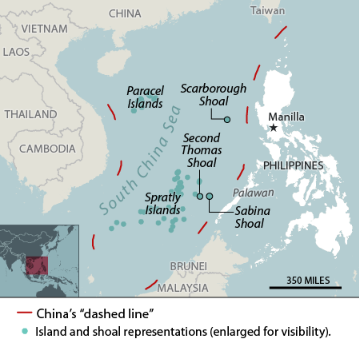
America does not recognize China’s “dashed line” which is China’s claim of territorial ownership and encompasses most of the South China Sea.4 China uses its dashed line to justify its subliminal war to challenge the U.S. principles of freedom of the seas and settling territorial disputes between parties “without coercion and on the basis of international law.”5 America rejects excessive maritime territorial claims that are “unlawful and sweeping” or that advance “incoherent legal theories of maritime entitlement” undermining the rules-based international system.6
China distorts the 1982 United Nations Convention on the Law of the Sea (UNCLOS) Exclusive Economic Zone (EEZ) provisions to justify treating the internationally recognized sea as an internal issue for China to define and resolve.7 Notably, China rejected a 2016 international tribunal ruling in favor of the Philippines seeking relief under UNCLOS from China’s illegitimate territorial claims.8
China asserts core interests—so vital that they are “not subject to negotiations or compromise”—in the South China Sea, as well as for Taiwan and territory administered by Japan and India.9 Although the Philippines bears the brunt of China’s aggression, Indonesia, Malaysia, and Vietnam increasingly defy China by asserting their own South China Sea territorial claims.10
The National Security Strategy declares America’s commitment to “preserving freedom of navigation in all crucial sea lanes” as “core, vital national interests”.11 The National Defense Strategy declares America’s commitment to “a decent peace in the Indo-Pacific, where trade flows openly and fairly.”12 On the ten-year anniversary of the international tribunal ruling, the Philippines was joined by the U.S., Japan, and 11 other countries to affirm the ruling as “final, legally binding, and definitive between China and the Philippines.”13
The South China Sea is “an arena of U.S.-China strategic competition.”14 Admiral Samuel J. Paparo, commander of PACOM, stated to Congress that “our strategy is clear: we must deny China the ability to achieve its objectives through military aggression while strengthening the network of alliances and partnerships that constitute our greatest asymmetric advantage.”15 Admiral John Aquilino, then commander of Indo-Pacific Command (now PACOM), told a U.S. House of Representatives committee that if China’s aggression “resulted in the death of a Philippine service member”—even with water cannons used by the CCG—the Philippines could trigger the U.S.-Philippines mutual defense treaty.16 China warned America to keep out of the dispute and refrain from “stirring up trouble.”17
If China controls the South China Sea, America’s military deployments in the western Pacific will be constrained. American allies and partners might then “reexamine their own defense programs and foreign policies” that support the U.S. in ways that weaken America’s security network and accelerate China’s goal of regional hegemony.18
China’s Subliminal War: “Fishermen” Versus FONOPs
Admiral Paparo stated that his command embraces the need to address “a broad range of factors outside of the military realm” in its plans and exercises, including a “broader group of interagency partners.”19 Without addressing the perils of over-analyzing the useful shorthand term “DIME” (diplomatic, information, military, and economic),20 PACOM would benefit from other instruments to more effectively resist China’s subliminal war that relies on non-military means to methodically expand and entrench its unlawful South China Sea territorial claims.21
To reinforce international norms the U.S. conducts Freedom of Navigation Operations (FONOPs) through international waters and air space that China unlawfully claims.22 These overt actions are part of information operations through military means within the current DIME strategy. China’s subliminal war continues despite more countries deploying military forces to signal their rejection of China’s claims.23 China typically advances South China Sea objectives by using its CCG to confront foreign vessels, purportedly for “law enforcement” while the PLAN provides overwatch, deterring foreign military escalation.24
China’s naval strength includes the PLAN, the CCG, and the CMM. China has expanded the PLAN massively in size and sophistication. It is the largest navy measured by numbers and deploys modern multi-mission ships.25 The non-PLAN component of China’s naval strength includes the CCG and CMM.26 The CCG is the largest coast guard and includes newer ships with better armament and longer endurance than most CCG ships, plus numerous regional patrol combatants and coastal patrol craft.27 The CMM standing force mobilizes civilian fishing vessels that can be massed for months-long deployments, and trains with and supports the PLAN and CCG. China may have 1,000 fishing vessels available in the South China Sea alone, in addition to the standing component of the CMM.28
China employs DIME means to assert control in the South China Sea.29 While its military supports the effort, China keeps its actions “below the threshold of open warfare” but beyond the “boundaries of normal diplomatic and economic interaction.”30 The most innovative line of attack has been creating islands in the South China Sea from sea features that do not confer territorial claims. China describes its island-building as “routine domestic governance.”31 Admiral Paparo stated that China “uses coercive behavior and overt aggression to exert its excessive claims, including harassing the Philippines, Japan, and other Southeast Asian partners.”32
The CCG and CMM exploit “China’s significant maritime force advantage” to intimidate its targets in territorial disputes.33 Using non-PLAN ships for overt aggression makes it difficult for targeted states to define effective rules of engagement without giving the appearance of escalation.34 Advancing slowly spreads out the harm in small doses, none of which seems worthy of escalation by targets.35 China’s framing of their actions as its internal affairs promotes a favorable narrative about any clashes.36 China has focused on the Philippines to erode their ability to exercise sovereignty in its South China Sea territory and EEZ. The CCG has a massive ship that overpowers what the Philippines can deploy.37 In a trend already evident with its “monster ships” with superior crew size, weapons, and fuel capacity that dwarf USCG cutters, China decided to build a CCG mothership that may carry aircraft or drones.38
America and its allies resist China’s subliminal war
Over the past few years, the U.S. and it’s allies have taken deliberate actions to counter the Chinese narrative and reaffirm the legal precedents. These include:
- The Philippines launched a media information campaign using journalists aboard its vessels to document Chinese aggression.39
- America conducts FONOPs that prevent unlawful claims “from becoming accepted customary international law.”40
- Allies from outside the western Pacific participate in FONOPs.41
- Military activities in the region continue, such as the United States, Japan, and Canada joining Philippine forces in anti-ship exercises to defend the Philippines against military attack.42
- The Philippines and its allies and partners have reminded China for ten years that their territorial claims violate international law.
- The USCG expanded its presence to supplement the Navy in the western Pacific.43 This includes the 2026 transfer of the USCG “expeditionary cutter squadron” of six 154-foot fast response cutters to operate out of the Philippines and Singapore.44
Yet China has not restrained its claims or behavior:
- China is not deterred by the information campaign.45
- Periodic American FONOPs and displays of military power have not blunted China’s drive to intimidate neighbors.46
- FONOPs have not stopped China’s island-building.47
- Allied FONOPs have not stopped China, as its aggressive response to a Dutch frigate’s operation made clear. A China Southern Theater Command spokesman justified its actions couched as lawful territorial defense, saying Chinese forces used “necessary measures” that were “in accordance with laws and regulations.”48
- China rejects FONOPs that undermine what China characterizes as its sovereignty and security.49
The U.S., Japan, and the Philippines view China’s actions with concern.50 U.S. Secretary of State Marco Rubio called China’s actions inconsistent with international law, accusing China of undermining regional peace and stability.51 The American and Philippines defense secretaries jointly reaffirmed the importance of the U.S.-Philippines alliance “for upholding a free and open Indo-Pacific region.”52 Because even a victory through a traditional military war could be ruinously costly, PACOM’s focus has been deterring China’s growing military power in the western Pacific.53 In this environment, China’s subliminal war raises the risk of Great Power War.
The U.S. seeks to deter aggression and ensure that force or coercion are not used to settle territorial disputes. America needs to “draw a balance between doing nothing and doing too much.”54 America is seemingly trapped between risking war by using military power to directly confront China’s civilian-led advances or seeing U.S. alliances fray as China advances without overt military aggression. The U.S. clarified the broad extent of its defense pact with the Philippines, but noted it has options short of shooting under the treaty.55 The missing piece in PACOM’s DIME effort is strengthening the capacity of the Philippines and other targets of China’s subliminal offensive to exercise sovereignty over their territory with civilian regulatory and law enforcement agencies. Recent expansion of USCG presence begins to provide the means to accomplish that.
The USCG is “a more relevant model for partner nation maritime forces than any [Department of Defense] branch and more effective than them in executing a host of international missions.”56 The service has the appropriate power and authority to defy China’s efforts to expand de facto control of the South China Sea to match its unlawful claims. The USCG seeks to be “bold, innovative, collaborative, and willing to act in new ways” to overcome challenges.57 A USCG line in the South China Sea would give America more options below the Navy threshold. Just as the PLAN provides overwatch for the CCG and CMM, PACOM’s objective of denying China escalation options could keep PACOM’s DIME campaign in the sub-military realm. The USCG remains ready for evolving missions, recognizing that it may need to develop new assets.58 MOAC can be the critical force multiplier for USCG and allied civilian agencies to exercise administrative and law enforcement powers in their recognized South China Sea territory.
MOAC, the Missing Piece of America’s Line in the Sea
The USCG must strengthen its primary lines of effort of “persistent presence, meaningful engagements, and maritime governance” in the Indo-Pacific.59 The USCG describes itself as America’s only multi-mission, military maritime service, bridging gaps between law enforcement, diplomacy, and defense capabilities. It provides a full spectrum of options in the gray zone world of China’s subliminal war.60 The USCG is the best service for employing non-shooting options in the broad spectrum between doing nothing and doing too much. In May 2026, the USCG cutter Midgett joined a maritime cooperative activity with the Philippine navy and coast guard. That joint patrol near Scarborough Shoal moved beyond mere presence or FONOP to active “law enforcement activities, including maritime interdiction of vessels and boarding actions.”61
Without sufficient USCG assets in the Western Pacific, instead of being a non-military force multiplier, the USCG could remain insignificant or even counter-productive if China’s subliminal war persists.62 A MOAC flagship would support formalizing persistent USCG deployments for law enforcement activities.63 Such a strengthened USCG would, as one analyst explained, “allow the U.S. to play on a broader spectrum” than the Navy can.64 By complementing fleeting FONOPs and military exercises, the USCG would establish itself as the “Global Coast Guard” it seeks to be.65
MOAC is modeled on the modularized auxiliary cruiser described in Military Review.66 Such a ship relies on a modified civilian container ship hull equipped with weapons and systems in standard shipping containers mounted on the deck. MOAC would require a flight deck for manned and unmanned operations. It would have flexibility in the design to allow capabilities to be added or removed as the mission and scenario dictates. MOAC would resupply and provide overwatch for smaller USCG patrol boats and cutters which have difficulty operating far from support infrastructure in America.67 Unmanned surface vessels (USVs) could be deployed and sustained from MOAC using containerized systems, building on Navy experience integrating a Medium USV into a Carrier Strike Group.68 Joint and interagency vessels and aircraft plus allied and partner law enforcement assets could be sustained and supported by MOAC.
MOAC’s very size will convey power to reassure allies and partners who routinely face “monster” CCG vessels, and could sail alongside allies and partners in the South China Sea to bolster the rules-based international order founded on freedom of the seas.69 The following missions will strengthen capacity to assert sovereign maritime governance while raising the price China would pay for escalating to force with the CCG and CMM:
Humanitarian first responders. When natural disaster strikes, MOAC could initiate relief operations using onboard supplies and UAVs providing intelligence on devastated areas. It would conduct rescue missions, deliver supplies, and evacuate the injured.
Safety of life at sea. MOAC would conduct rescues at sea with helicopters or forward-deployed USCG vessels. Onboard medical facilities could provide emergency care.
Environmental stewards. Surveillance would identify and record evidence of actors threatening the sea environment. MOAC personnel could intervene alongside regional allies and partners.
Protecting natural resources. MOAC would help regional states protect their EEZs from poaching or illegal resource extraction. One mission could be to support the Philippine Kadiwa initiative to escort and resupply their fishermen operating near the Scarborough and Salina shoals.70 Whether the offender is a state or non-state actor, MOAC could support prompt diplomatic, law enforcement, or armed responses.
Law enforcement. Piracy, other crimes, or state interference in international maritime trade and civil air traffic would be more difficult with a well-armed MOAC “cop on the beat” identifying threats. 71 Increasing the capabilities of other nations to police their own waters strengthens maritime governance.72 The USCG has established a precedent away from the South China Sea.73
Securing maritime borders. International law provides standards to define maritime boundaries. Powers like China can ignore them if unopposed. MOAC would work with regional states to protect allied and partner territorial integrity, including support for outpost resupply missions. One PACOM commander stated that escorting supply ships is “an entirely reasonable option” under the U.S.-Philippines defense treaty.74
Promoting rule of law. MOAC would exercise with allies and partners to build collective law enforcement capacity that promotes a “free and open Indo-Pacific.”75 Allied law enforcement agencies deployed on MOAC could conduct “visit, board, search, and seizure operations” against what could be deemed privateers doing China’s bidding behind a façade of civilian status.76
Preventing terrorism. Terrorists threatening life and property from the sea may be thwarted with a persistent USCG armed presence, including its planned special operation organization, Special Missions Command.77 MOAC could be bolstered by intelligence personnel, regional assets, and other American military forces, including Marine Corps and Special Operations Command detachments.
Enhancing cyber and critical infrastructure security. MOAC could host training that shares best practices with regional partners and allies to harden defenses and preempt malign actors in the maritime domain.
Military force. As an armed service, the USCG would be the first line of defense if a crisis escalates beyond water cannons. MOAC would act as a deterrent to all but the most deliberate armed escalation.
Intelligence gathering and sharing. The USCG is an intelligence partner with other American armed services and friendly nations. All of the missions would be assisted by and contribute to joint and international intelligence on regional threats to the rules-based order.
These missions—and more as the USCG evolves to meet new challenges—will strengthen alliances and partnerships to defend the principles of freedom of the seas and settling territorial disputes without use of force or coercion.
A White Hull Line in International Waters
The USCG’s value was validated with a nearly $25 billion “historic investment” that then-Acting Commandant, Admiral Kevin Lunday, said “marks a new era for the Coast Guard.”78 Defending a “white hull” line in the South China Sea will be a bold demonstration of the U.S.’s “commitment to a free and open Indo-Pacific” and will protect the U.S.’s “powerful ties of commerce, culture, technology, and defense.”79 To hold the line against and roll back China’s subliminal DIME war before United States Navy “gray hulls” must intervene, the United States Coast Guard must build and deploy to the South China Sea the Mother of All Cutters to embark on its new era in PACOM.80
Brian J. Dunn holds an AB in political science and history from the University of Michigan and a MA in history from Eastern Michigan University. He retired from his job as a nonpartisan research analyst for the Michigan State Legislature, and served in the Michigan Army National Guard for six years. He has written articles for publications such as Proceedings, Army, Military Review, and Joint Force Quarterly, and writes about defense and national security issues on Substack in The Dignified Rant: Evolved.
References
1. Sam LaGrone, “CNO Franchetti War Plan Preparing Navy for Pacific Conflict by 2027 With Flat Budgets, Static Fleet Size,” USNI News (September 18, 2024).
2. Mallory Shelbourne, “Davidson: China Could Try to Take Control of Taiwan in ‘Next Six Years’,” USNI News (March 9, 2021).
3. Ronald O’Rourke, “China Primer: South China Sea Disputes,” In Focus No. 10607 (Congressional Research Service, Updated December 22, 2025), 1.
4. 2024 Worldwide Threat Assessment (Defense Intelligence Agency), 5.
5. Ronald O’Rourke, “China Primer: South China Sea Disputes,” In Focus No. 10607 (Congressional Research Service, Updated December 22, 2025), 1.
6. Department of Defense Report to Congress: Annual Freedom of Navigation Report Fiscal Year 2023 (United States Department of Defense), 2.
7. U.S.-China Strategic Competition in South and East China Seas: Background and Issues for Congress (Congressional Research Service, Updated May 1, 2025), 5-6.
8. Annual Report to Congress: Military and Security Developments Involving the People’s Republic of China (2025), 45.
9. Annual Report to Congress: Military and Security Development Involving the People’s Republic of China (U.S. Department of Defense, December 2025), 1.
10. Annual Report to Congress: Military and Security Development Involving the People’s Republic of China (U.S. Department of Defense, 2023), 125.
11. National Security Strategy of the United States of America (The White House, 2025), 5.
12. 2026 NDS: National Defense Strategy (United States Department of War, 2026), 18.
13. Kiyoshi Takenaka and Beijing Newsroom, with editing by Emelia Sithole-Matarise and Mark Potter, “South China Sea joint statement says China’s maritime claims have no basis,” Reuters (July 12, 2026).
14. U.S.-China Strategic Competition in South and East China Seas: Background and Issues for Congress (2025), 1.
15. “Statement of Admiral Samuel J. Paparo, Commander, U.S. Indo-Pacific Command, U.S. Indo-Pacific Command Posture” (April 2026), 2.
16. Parker Miller, “Pacific coalition tightens as China pressures the Philippines and Taiwan,” Washington Examiner (April 4, 2024).
17. Liz Lee, et al., Ed. Muralikumar Anantharaman and Gerry Doyle, “China tells US to not take sides on South China Sea issue,” Reuters (March 20, 2024).
18. U.S.-China Strategic Competition in South and East China Seas: Background and Issues for Congress (2025), 3.
19. Paparo, 10.
20. Matthew O’Connor, “The Problem With Thinking in DIME,” The War Room (April 10, 2025).
21. U.S.-China Strategic Competition in South and East China Seas: Background and Issues for Congress (2025), 11.
22. Report to Congress: Annual Freedom of Navigation Report: Fiscal Year 2022 (United States Department of Defense).
23. Miller; “JOINT STATEMENT: Australia-Japan-Philippines-United States Maritime Cooperative Activity,” (United States Department of Defense, April 5, 2024); and Aaron-Matthew Lariosa, “Warships from the Philippines, Australia, New Zealand, U.S. and Japan Sail in Joint South China Sea Patrol”, USNI News (September 29, 2024).
24. Matthew Sperzel, et al., Special Report: Surprise PRC Military Exercise Around Taiwan (Institute for the Study of War, December 31, 2025).
25. Military and Security Developments Involving the People’s Republic of China (2023), 52.
26. Military and Security Developments Involving the People’s Republic of China (2025), 31-32.
27. Military and Security Developments Involving the People’s Republic of China (2023), 79-80.
28. “China is using civilian ships to enhance navy capability and reach,” Associated Press (September 25, 2022).
29. U.S.-China Strategic Competition in South and East China Seas: Background and Issues for Congress (2025), 9.
30. Todd C. Helmus, et al., “Understanding and Countering China’s Maritime Gray Zone Operations” Research Report RRA2954-1 (RAND, November 20, 2024), 1.
31. Jill Goldenziel, “China Seizes An Island While the World is Watching Iran,” Forbes (April 11, 2026).
32. Paparo, 4.
33. Military and Security Developments Involving the People’s Republic of China (2025), 45.
34. “China is using civilian ships to enhance navy capability and reach.”
35. U.S.-China Strategic Competition in South and East China Seas: Background and Issues for Congress (2025), 9-10.
36. Goldenziel.
37. Aaron-Matthew Lariosa, “Philippines Challenges ‘Monster’ China Coast Guard Cutter, U.S. Carrier Vinson Drills with Philippine Forces in South China Sea,” USNI News (January 20, 2025).
38. Matthew Loh, “China shipbuilders are teasing a new coast guard ‘mothership,’ and there’s talk it could be an aircraft or drone carrier,” Business Insider (August 19, 2024).
39. Joeal Calupitan and Aaron Favila, “China coast guard flexes its might against the Philippines in disputed waters as journalists watch,” Associated Press (March 7, 2024).
40. Report to Congress: Annual Freedom of Navigation Report: Fiscal Year 2022 (United States Department of Defense), 2.
41. Aaron-Matthew Lariosa, “Chinese Use Electronic Warfare Attacks on Dutch Warship in South China Sea, Says PLA,” USNI News, May 27, 2026.
42. “Sinking Ships in the South China Sea,“ USNI News (May 12, 2026).
43. Dan Lamothe, “To help counter China, U.S. turns to the Coast Guard,” The Washington Post (April 20, 2019).
44. Mike Cherney, “China aggressively patrols disputed waters. Now the US Coast Guard is moving in,” The Wall Street Journal (July 14, 2026).
45. Aaron-Matthew Lariosa, “China Attacks Philippine Ship, Injures Crew in Latest Escalation of South China Sea Standoff,” USNI News (March 23, 2024).
46. James Holmes, “Why the U.S. Navy Needs To Be In The South China Sea,” 1945 (July 16, 2022).
47. Goldenziel.
48. Lariosa, USNI News (May 27, 2026).
49. “China opposes any country using freedom of navigation to undermines its sovereignty,” Reuters (May 29, 2026).
50. Jeff Mason, Trevor Hunnicutt, and Michael Martina, “U.S., Japan, Philippines condemn Beijing’s South China Sea moves in summit,” Reuters (April 12, 2024).
51. U.S. Department of State, “Secretary Rubio’s Call with Philippine Secretary of Foreign Affairs Manalo” (January 22, 2025).
52. U.S. Department of Defense, “United States-Philippines Joint Statement on Secretary Hegseth’s Inaugural Visit to the Philippines (March 28, 2025).
53. Paparo, 3.
54. Chad de Guzman, “Why the U.S. Faces a Delicate Balancing Act on Countering China in the South China Sea,” Time (March 27, 2024).
55. Mallory Shelbourne and Sam Lagrone, “China’s Attacks on the Philippine Resupply Missions Test 70-Year-Old Defense Pact,” USNI News (March 29, 2024).
56. Commander Kevin Duffy, U.S. coast Guard (Retired), “Getting Real About the ‘Global Coast Guard’,” Proceedings Vol. 149/10/1,448 (October 2023).
57. United States Coast Guard Strategy, 1 JUN 2022 (Washington, D.C.: United States Coast Guard), 11.
58. United States Coast Guard Strategy, 3.
59. U.S. Coast Guard: Indo-Pacific Strategic Intent (U.S. Department of Homeland Security, November 26, 2024), 2.
60. United States Coast Guard Strategy, 3-4.
61. Aaron-Matthew Lariosa, “U.S. Coast Guard Patrols Near Scarborough Shoal with Philippine Forces Amid Concerns of Potential Chinese Build-Up,” USNI News (May 31, 2026).
62. Michael D. Armour, Ph.D., “The U.S. Coast Guard in the South China Sea: Strategy or Folly?” CIMSEC (November 6, 2017).
63. Petty Officer Third Class Merrill A. Magowan, “Create ‘Patrol Forces Indo-Pacific’?” Proceedings Volume 146/08/1,409 (August 2020), 32-35.
64. Cherney.
65. Commander Kevin Duffy, U.S. Coast Guard (Retired), “Getting Real About the “Global Coast Guard,” Proceedings Vol. 149/20/1,448 (October 2023).
66. For the basic concept of a power projection platform based on civilian container ships, see Brian J. Dunn, “The AFRICOM Queen,” Military Review, May-June 2016 (Fort Leavenworth, Ks.: US Army Command and General Staff College), 50-61.
67. Commander Craig Allen Jr., US Coast Guard, “Expeditionary Cutter Deployments Should Not Be a Mission to Mars,” Proceedings Volume 148/8/1,434 (August 2022), 22.
68. Diana Stancy, “A Navy carrier is about to deploy with a robot ship. Could it change the service forever?” Breaking Defense (June 04, 2026).
69. United States Coast Guard Strategy, 3.
70. Aaron-Matthew Lariosa, “U.S. Wants to Construct Philippine Coast Guard Maintenance Facility, Repair Fuel Depot in Palawan,” USNI News (May 20, 2026).
71. Captain Joshua Taylor, US Navy, “A Campaign Plan for the South China Sea,” Proceedings Volume 148/8/1,434 (August 2022), 38-39.
72. United States Coast Guard Strategy, 4.
73. Kevin Knodell, “US Agrees to Expand Samoa and Coast Guard Cooperation,” The Honolulu Star-Advertiser (April 8, 2024).
74. Chris Panella, “US ally says it expects America to intervene if China tries to take a rusting World War II warship in the South China Sea,” Business Insider (September 16, 2024).
75. National Security Strategy (2025), 19.
76. Cadet Jeffrey W. Jaeger, U.S. merchant Marine, “One Nation’s Fishing Fleet, Another Nation’s Pirates: Countering China’s Maritime Militia,” Proceedings Volume 150/4/1,454 (April 2024), 66.
77. Eve Sampson, “Coast Guard to stand up special force command, “Military Times (May 6, 2026).
78. United States Coast Guard, “U.S. Coast Guard receives historic investment to rebuild under President Trump’s One Big Beautiful Bill,” Press Release (July 4, 2025).
79. 2025 National Security Strategy, 19.
80. Lieutenant Commander Trevor Phillips-Levine, et al., “Use the Coast Guard for Freedom of Navigation Operations,” Proceedings Vol. 147/12/1,426 (December 2021).
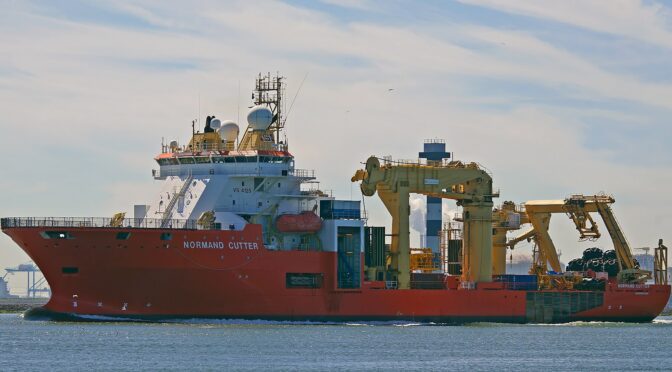
Featured image: The Normand Cutter, a Norwegian-flagged offshore construction and subsea support vessel. (Wikimedia Commons)
Discover more from Center for International Maritime Security
Subscribe to get the latest posts sent to your email.