
By Morgan Bazilian and Jahara Matisek
Just as oil fueled the mechanized warfare of the 20th century, electricity is becoming the foundational resource for militaries of the 21st century. Echoing First Lord of the Admiralty Winston Churchill’s historic decision to switch the Royal Navy from domestic coal to imported oil, today’s energy transition means the ability to generate, store, and deliver electricity will increasingly dictate national power. In order to meet this urgent challenge, the United States government and military must treat grid expansion as a national security priority by creating “Defense Energy Security Zones” to expedite federal permitting, intentionally and aggressively leveraging the Defense Production Act (DPA) to secure critical grid components, and integrating power resilience into how the Pentagon chooses to fund firms that produce munitions and weapon systems.
After two decades of flat demand, U.S. consumption is projected to rise 20% by 2030, driven by a boom in data centers and advanced manufacturing. Yet the physical grid cannot keep up. Transmission projects often take a decade to permit and build. New generation projects face grid interconnection queues lasting around five years, with over 2.6 terawatts of proposed capacity – that’s more than double the existing power fleet – just waiting for a connection. And now, political issues are compounding these technical bottlenecks. From Virginia to Arizona, local communities are increasingly pushing back against the construction of new data centers and the gas-fired power plants required to run them, citing concerns over noise, land use, tax breaks, and environmental impact. The result is $64 billion worth of data center projects being blocked and delayed. The entire digital age system is under strain from every direction.
Growing electrical bottlenecks also challenge American military power. For the Iran war, the Pentagon utilized Anthropic’s tool Claude and Palantir products like Maven, which used AI to process vast amounts of sensor data for multi-domain awareness and to identify targets. Successful AI targeting use, however, was predicated on an enormous, and largely invisible, expenditure of electrical power in the data centers that trained and ran the models.
This reveals a new reality: the military’s power dependencies operate on very different time scales. At the tactical level, the hour-by-hour management of peak load dictates whether radar networks, command centers, and various weapon systems can function without rolling brownouts. At the strategic level, precision munitions, advanced materials, and microelectronics all depend on electricity-intensive sites that take years to plan and build. Worse, their production of these cannot be surged during a crisis without a reliable baseload of power.
The technologies driving the modern civilian economy (e.g., AI, advanced computing, semiconductors, etc.) also enable warfighting advantages. This constraint is not just domestic. The power grid in Guam is falling critically short, putting U.S. bases there at risk and undermining military readiness in the Pacific.
Herein lies the central paradox of digital-age military power: America’s relentless pursuit of technological overmatch has created a profound and overlooked vulnerability. The military is becoming highly dependent on the very energy-intensive technologies, such as AI-enabled military systems, that are straining the national grid to its breaking point. The data center boom in Virginia and Arizona is now in direct competition for power with the industrial base needed to build weapons, maintain air defense, and collect real-time multi-domain awareness. America’s economic might and military power are both being constrained by an infrastructure that cannot meet the demands of the present, let alone the future.
Strategy is Outrunning Infrastructure
Historically, achieving military advantage depended on technological sophistication and industrial production. More recently, this has translated into developing stealthy aircraft and faster missiles, alongside trying to mass produce drones, with energy infrastructure being treated as a background concern. That hierarchy is reversing. Modern military power is an energy-intensive ecosystem, and three systemic shifts explain this transition.
First, computational power has become a foundational military resource. AI is not a niche capability, but is being embedded across everything from logistics to targeting. While training a single frontier AI model requires tens of megawatt-months of electricity (mainly due to dual-use commercial applications), the military challenge is trying to deploy these models. Running continuous AI inference across thousands of distributed battlefield nodes for Joint All-Domain Operations (JADO) creates a persistent, high-volume electrical demand on local grids. Because military operations are increasingly dependent on processing substantial amounts of data in real-time, warfighting capability is now directly constrained by grid capacity at the tactical and operational levels.
Second, modern weapons production is electricity-intensive. From the advanced metallurgy needed for hypersonic weapon systems to the high-temperature processing for ‘old’ artillery shells, manufacturing at every level relies on continuous, high-reliability power. Recent experience demonstrates this defense industrial base link. During Iran’s April 2024 attack on Israel, U.S. Navy destroyers fired substantial numbers of advanced interceptors to defend against ballistic missiles. This single engagement consumed a significant number of missiles from a limited stockpile, while annual production rates for these complex systems remain low. The munitions shortfall has only worsened since the 2026 Iran war, where 5 weeks of munitions expended may take up to 5 years to replace. The expenditure-refill gap reflects the physical limits of specialized, energy-bound production lines. Surge capacity is thus a function of power availability, not just funding and minerals.
Third, this energy demand is creating fierce competition for foundational materials across the entire military-industrial complex. No material illustrates this challenge better than copper. The entire energy transition, from grid expansion and electric vehicles to the data centers powering AI, all runs on copper, where the gap between supply and demand is rapidly widening. Estimates show that global demand for copper is set to double by 2035, creating a massive supply gap – and an obstacle to future economic growth. Yet this demand surge is colliding with a rigid supply chain. New copper mines take an average of 18 years to develop globally and nearly 30 years in the United States. The refined copper needed for the electronics in a missile or a fighter jet is the same copper sought for a new data center.
These shifts mean military effectiveness depends on an integrated supply chain: from mineral extraction to electrical generation, to industrial processing, and finally to operational power. If any link in that chain is constrained (i.e., lack of copper or congested grid) the entire system slows. The decisive question is no longer simply who invents the most advanced technology, but who can secure the materials and power to manufacture and operate that technology at scale.
America’s Structural Power Vulnerability
The United States enters this new era of energy competition with an electrical grid designed for a different century. The energy landscape is changing rapidly. After two decades of flat demand, U.S. consumption will rise 20% by 2030, driven by major growth in data centers, electrified industry, and advanced manufacturing. Forecasts show data centers alone consuming 9% of total U.S. electricity demand by 2030 – roughly 75% of Texas’ power generation. Now, with demand skyrocketing, the grid is being asked to accelerate after years of standing still.
Unfortunately, this demand crashes against a highly balkanized system. The U.S. electrical grid is heavily fragmented into regional interconnects (like ERCOT in Texas or PJM in the Mid-Atlantic) that struggle to share power across state lines. Because power cannot easily flow from regions with a surplus to regions facing brownouts, the physical location of defense manufacturing facilities becomes a critical vulnerability. An ammunition plant in a power-constrained region cannot surge production, regardless of national security needs.
While permitting delays and interconnection queues are well-known problems, the physical expansion of the grid is also hampered by critical hardware shortages driven by booming global demand for power. For example, in the Global South, electricity demand is rising due to growing basic electrification and air conditioning, not AI usage. Worse, the market for high-voltage transformers is straining the ability of countries to build new power plants. The procurement lead time for these essential components has ballooned from months to several years. This not only delays new generation projects but also creates a severe national security risk, as it limits the ability to recover from major storms or a physical attack on the grid.
This challenge is magnified when contrasted with China. While the U.S. grid struggles with fragmentation and inertia, China is executing a centrally planned, state-funded strategy to dominate the energy landscape. Beijing has built a network of over 30,000 kilometers of Ultra-High-Voltage transmission lines to move massive amounts of power from its energy-rich interior to its coastal industrial hubs.
This is not just an energy policy; it is a geopolitical strategy designed to underwrite industrial and military power. This “tale of two grids” creates a grim picture: China is building the electrical foundation for 21st century capabilities for advanced tech and manufacturing for mass, while America remains mired in regulatory and physical gridlock. The result is a dangerous structural mismatch: U.S. strategic ambition is outrunning the very infrastructure required to sustain it.
Conclusion: Power is the new bottleneck for the Economy and Military
The defining strategic constraint is now electrical capacity, not technological innovation. Economic growth, industrial output, and military readiness now depend on America’s ability to build, permit, and deploy the physical systems that generate and move power. Without that expansion, economic ambition and military strategy outrun infrastructure. Allowing any further grid stagnation is essentially a “geopolitical tax” that directly undermines American national security.
Military power faces this constraint immediately. Joint all-domain operations (JADO) need an unbroken chain of energy-intensive data fusion, satellite networks, AI-driven targeting, precision manufacturing, and advanced chips. JADO is what the Pentagon is betting on to ensure warfighters can out-fight near-peer threats, an approach paired heavily with AI during the 2026 Iran war. A resilient and capable electrical grid is needed for JADO and AI to function properly. To win the global AI race, the United States must first harden its grid. Electricity now sets the speed, reach, and endurance of the U.S. military.
To prevent domestic infrastructure from undermining military effectiveness, the United States government must proactively intervene with policies that treat grid expansion as a national security imperative. While the April 2025 White House executive order on grid security and the Department of Energy’s commitments in 2026 are steps in the right direction, they need more ‘industrial teeth’ to be effective in the era of great power competition.
First, Congress must move beyond half-measures. While the House Energy and Commerce Committee holds hearings and debates grid reliability bills, industry experts are right to call out that permitting reform is not a ‘silver bullet’. Market structures must be reformed to properly value and compensate firm, dispatchable power that can survive crises, ensuring a resilient grid that is valued like a strategic asset rather than letting it be dictated by the whims of the free market. Furthermore, the Pentagon should be granted statutory authority to designate specific manufacturing hubs as “Defense Energy Security Zones,” granting them expedited federal permitting under the FAST-41 framework to override local gridlock.
Second, the administration must aggressively leverage the Defense Production Act (DPA) to secure the domestic supply chain for critical grid components. Relying on state-level energy emergency policies to manage shortages is a reactive, losing strategy. Growing lead times for high-voltage transformers are a national security crisis. Utilizing the DPA to incentivize domestic manufacturing and stockpiling of grid parts is a crucial ‘insurance plan’ to ensure the United States can surge when needed and rapidly recover from an attack against the grid.
Third, the Pentagon must integrate power availability into its acquisition approach. The Pentagon cannot award massive contracts to defense firms that host AI data centers or make munitions and weapon systems without assessing whether their facilities (and their suppliers) are connected to a regional grid that is capable enough to sustain surge periods. Power resilience must become an important metric to consider for future defense procurement programs.
The arsenal of the future is becoming increasingly dependent on electricity. If the United States fails to treat grid expansion as a national security priority on par with funding the next submarine or fighter jet, it risks an era where military capability is decided by domestic infrastructure failures rather than adversary action. If America cannot generate and deliver that power at scale, it will lose the next war before the first shot is fired.
Morgan D. Bazilian is the director of the Payne Institute for Public Policy and professor at the Colorado School of Mines, with over thirty years of experience in global energy policy and investment. A former World Bank lead energy specialist and senior diplomat at the UN, he has held roles in the Irish government and advisory positions with the World Economic Forum and the International Energy Agency. A Fulbright fellow, he has published widely on energy security and international affairs.
Lt. Col. Jahara “Franky” Matisek (PhD) is a U.S. Air Force command pilot, senior fellow at the Payne Institute for Public Policy, and a visiting scholar at Northwestern University. He is the most published active-duty officer currently serving, with 2 books and over 200 articles on the defense industrial base, strategy, and warfare. Views are his own and not those of the U.S. Air Force, Department of War, or the U.S. Government.
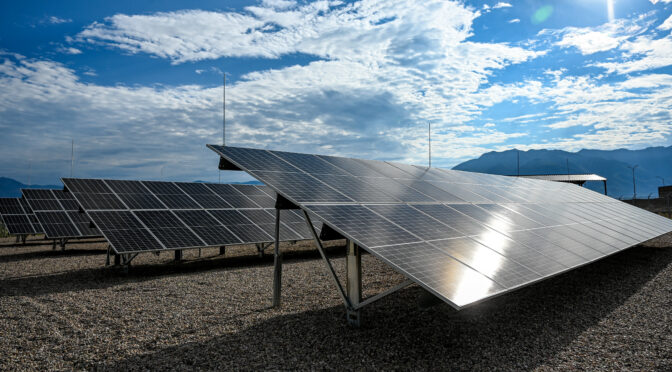
Featured Image: The new 350 kilowatt-hour solar array located near the Hill Aerospace Museum at Hill Air Force Base, Utah. (U.S. Air Force photo by Cynthia Griggs)
Discover more from Center for International Maritime Security
Subscribe to get the latest posts sent to your email.