Tag Archives: featured

Desert Storm Made the PLA. What is the Iran War Making?

By Commander Ander S. Heiles, USN

In January 1991, Chinese military officers watched CNN footage of the United States dismantling the Iraqi Army and experienced what one People’s Liberation Army (PLA) analyst later called a psychological nuclear attack.” Desert Storm displayed every capability the PLA lacked, and China had no choice but to begin remaking its military from the ground up.

Two years later, China’s Central Military Commission codified these lessons in the Military Strategic Guidelines centered on “Local Wars Under High Technology Conditions” and acknowledged the PLA had been preparing for the wrong war. The Gulf War didn’t just scare China, it gave it direction.

Thirty-five years later, the classroom has reopened. The United States and Israel are engaged in a military campaign against Iran, and the Persian Gulf is once again the center of a maritime crisis. The Strait of Hormuz is effectively closed. Not by minefields or naval blockade, but by the withdrawal of maritime insurance and the cascading commercial decisions that followed.

Tanker traffic dropped first by approximately 70% with almost 150 vessels loitering outside the Strait. Transit has since collapsed to nearly zero within the first week, disrupting roughly 20% of the world’s daily oil supply and significant volumes of liquefied natural gas. Roughly 750 vessels are now stranded within the Persian Gulf, and the PLA is paying very close attention.

The instinct is to assume Beijing is enjoying the bedlam: a distracted America, its military tied down in the Middle East, and precision munitions being expended far from the Pacific. That instinct is wrong.

What the PLA’s most attentive analysts are likely doing is war-gaming a Taiwan scenario in real-time using the Hormuz crisis as a live stress test for assumptions they have been modeling for decades. Some of what they are finding is deeply uncomfortable. The tactical lessons are significant but broadly familiar. However, the deeper strategic lessons, the ones that will reshape Chinese planning for the Taiwan Strait and South China Sea, are maritime.

The Chokepoint in the Mirror

In 1991, China’s Desert Storm lesson was almost entirely about its capability gap. The maritime domain barely registered because the Gulf War was largely a land-air campaign. The 2026 crisis is fundamentally a maritime crisis, and China is learning a new lesson: chokepoints do not just threaten an enemy, they threaten anyone who depends on them.

Approximately 84% of the oil transiting through the Strait of Hormuz flows to Asian markets. China alone imported roughly five million barrels per day through the Strait, representing approximately 40%-45% of its total crude imports. The Hormuz closure does not primarily threaten Houston or Rotterdam. It throttles Tianjin, Qingdao, and Zhoushan.

Prolific naval strategist Alfred Thayer Mahan understood this. He spent much of his seminal work, The Influence of Sea Power Upon History, explaining not just how navies project power but how dependence on sea lines of communication creates strategic vulnerabilities. A nation that does not control its own supply lines does not truly control its own strategic fate.

The PLA absorbed this lesson from Mahan and filtered it through the lens of Desert Storm’s demonstration of American power projection. In response, China has been building a blue-water navy and acquiring global port access in response.

However, the Hormuz crisis is forcing Beijing to confront a gap that was not illuminated by Desert Storm nor discussed in any specificity by Mahan: China remains critically dependent on chokepoints it cannot protect and does not control. The Strait of Hormuz is the immediate problem, but the Strait of Malacca, through which 80% of China’s oil imports transit, is the permanent one.

Beijing’s Foreign Ministry has been reduced to urging all parties to “keep the shipping routes in the Strait of Hormuz safe,” and reports that China has opened direct talks with Iran to negotiate safe passage for energy shipments underscores that vulnerability. A nation that must ask permission to use a chokepoint does not command it. For PLA planners gaming a Taiwan contingency, the lesson is immediate: any conflict that triggers a disruption at the Malacca Strait could strangle China’s economy before a single shot is fired.

The Insurance Blockade

If the chokepoint lesson is uncomfortable, the insurance lesson may be worse. Within 72 hours of the start of Operation Epic Fury, multiple members of the International Group of Protection and Indemnity (P&I) Clubs, which collectively insure roughly 90% of the world’s ocean-going tonnage, issued formal cancellation notices for war-risk coverage in the Gulf. Major container lines suspended operations. Lloyd’s Market Association confirmed that roughly 1,000 vessels with a hull value of over $25 billion sat anchored in the area.

The chokepoint was not closed by missiles. It was closed by spreadsheets.

The PLA is likely studying this closely because it maps directly onto a Taiwan scenario. Beijing has long assumed that the critical question in a cross-strait contingency would be whether the People’s Liberation Army Navy (PLAN) could establish sea control. The Hormuz crisis suggests a different question entirely: would commercial shipping continue to flow through the Strait of Malacca and South China Sea once insurers withdraw coverage and container lines suspend service?

The same insurance mechanism that shut Hormuz in 72 hours could shut the commercial sea lanes on which China’s economy depends. Unlike a naval blockade, an insurance withdrawal cannot be stopped by force. No navy can compel an underwriter to write a policy.

China has been building state-backed maritime insurance mechanisms and positioning its commercial fleet to operate under sovereign-risk coverage precisely to insulate itself from the kind of Western-backed market dependency that has strangled Gulf shipping. The Hormuz crisis validates that investment.

On the other hand, it also reveals how far Beijing needs to go. China’s maritime insurance ecosystem does not yet have enough depth or international credibility to underwrite the scale of coverage that a Taiwan-related disruption would demand. A harder problem still is even if China can insure its own flag vessels, it cannot compel foreign-flagged ships to continue sailing into a warzone.

The roughly 750 vessels stranded in the Persian Gulf are a preview of what the South China Sea could look like 48 hours into a Taiwan crisis. Commercial shipping frozen, supply chains severed, and the PLAN unable to restart them regardless of how many ships it deploys.

The Fleet Behind the Fleet

The Hormuz crisis is also teaching China a lesson about commercial shipping as a military instrument. When the United States declared a maritime warning zone in the Persian Gulf, it came with an unusual public admission: it could not guarantee the safety of merchant shipping. The major container lines made their own risk calculations and suspended operations. The financial architecture of global trade enforced a blockade more completely than any naval minefield.

Sinokor, a South Korean shipping conglomerate, began asking the equivalent of roughly $20 per barrel to transport oil to China. This is an extraordinary premium compared to the nominal $2.50 per barrel, and this illustrates how quickly commercial sealift becomes a strategic weapon when maritime risk spikes.

China has been preparing for exactly this scenario. Over the past two decades, Beijing has expanded its merchant fleet to over 4,000 internationally trading ships, captured over 46% of global commercial shipbuilding, and invested in the mariner training pipeline to crew those vessels. Critically, the PLA has also been integrating commercial shipping into military logistics planning. China’s national defense mobilization laws allow the requisitioning of civilian vessels, and its merchant fleet has been designed with dual-use capability in mind.

The Hormuz crisis is validating China’s investment in a state-linked merchant marine fleet while simultaneously demonstrating the cost of America’s failure to maintain one. However, it is also exposing a gap in China’s own planning: a fleet that can be mobilized for war is also a fleet that can be commercially paralyzed by insurance withdrawal, sanctioned by coalition financial instruments, or stranded at foreign ports. In a Taiwan contingency, the PLAN’s ability to move troops across the Strait may matter less than whether China’s commercial fleet can continue to feed, fuel, and supply the mainland economy under wartime conditions. The Hormuz crisis is the first live demonstration of how quick commercial architecture can collapse.

What This Means

Desert Storm inspired China spend 35 years building the military it now has. Operation Epic Fury will not trigger the same kind of wholesale structural overhaul – the PLA has already done that work. What the 2026 crisis is doing is stress-testing China’s maritime strategy against live data and finding specific, uncomfortable gaps: chokepoint dependency that blue-water naval investment has not yet solved, an insurance architecture that can impose a blockade no navy can break, and a commercial fleet that can be mobilized for war but paralyzed by the financial instruments.

Each lesson applies directly to the Taiwan Strait and South China Sea. PLA planners are not watching the Hormuz crisis as a distant curiosity. They are watching it as a dress rehearsal, and they are taking notes on themselves as much as on the United States.

Mahan argued that sea power rests on two pillars: naval force and commercial maritime enterprise. China has been absorbing both halves of that doctrine. The Strait of Hormuz crisis is revealing that even both halves may not be enough. The question is whether the United States, which builds less than 1% of the world’s commercial ships, fields fewer than 80 vessels in international trade, cannot crew the sealift fleet it already has, and had no war risk insurance mechanism ready when the crisis broke, is learning it too.

Commander Ander Heiles is a student at the Joint Advanced Warfighting School in Norfolk, VA. He commanded USS Monsoon (PC 4) and is the Prospective Executive Officer (P-XO) for the Naval Talent Acquisition Groups (NTAG) Empire State. The views expressed here are those of the author and do not necessarily represent the official positions or opinions of the U.S. Navy, the Department of Defense, or any part of the U.S. government.

Featured Image: Cosco Shipping Lines ultra-large container vessels at Rotterdam. (Photo via Kees Torn/Creative Commons)

The Sicilian Expedition: Lessons from an Ancient Disaster

By Austin McLaughlin

The world’s preeminent naval power launched a vast armada west to secure distant allies from a threatening rival. It underestimated the enemy’s resolve. The rival rallied, repelled the invaders, and left the naval power reeling—its fleet shattered, alliances frayed, and homeland stunned.

This isn’t a U.S.-China clash in the Taiwan Strait, but Athens’ 415 BC Sicilian Expedition–a misstep that doomed it to Spartan domination. Losing over 100 warships and 5,000 troops, Athens’ strategic blunder marked the tipping point of the 431-404 BC Peloponnesian War.1

Today, the U.S. can learn from Athens’ failure–intelligence gaps and tactical errors–as a strategic warning to a rising China, sidestepping a modern parallel.

Introduction – Alcibiades’ and Nicias’ Leadership Preludes Disaster

Pericles’ death in 429 BC left lesser men at the helm of the ancient world’s naval hegemon: the cunning general Alcibiades and the cautious statesman Nicias. Alcibiades drove Athens’ reckless Sicilian gamble, but Nicias spearheaded its destruction. The two willfully ended a six-year peace guaranteed by the 421 BC Peace of Nicias.2

Athens aimed to subdue Sicily for “glory and tribute,” eyeing a base for future incursions against Carthage and Mediterranean Africa.3 Alcibiades sold his plan to a willing assembly infected with “Alcibiades syndrome,” a toxic combination of capability and egotism.4 His charm convinced the assembly to deploy 60 ships. Upstaged by his junior, Nicias opposed this front far from Sparta, insisting Athens could win only by doubling the size of its force in a quixotic attempt to dissuade decisionmakers.5 Nicias’ bluster unintentionally worked – the assembly “far from being scared, eagerly agreed,” mustering 5,100 hoplites aboard 134 triremes and organizing command between Alcibiades, Nicias, and Lamachus.

Alcibiades was slated to spearhead the armada, but the Affair of the Herms in June 415 BC forced his recall–busts of Hermes, symbols of Athenian patriotism, were defaced across Athens and Alcibiades became the chief suspect. Rather than stand trial, he defected to Sparta and advised stationing the general Gylippus in Syracuse to meet the expedition.6

Nicias now headed an expedition he once opposed. Athens, intertwined with its leaders, leapt from foolhardy confidence to trepidation. While personality differences do not presage inferior performance–as exemplified by Admirals Halsey and Spruance in the Pacific Theater during the Second World War–they can alter intelligence assessments and operational planning. Alcibiades’ arrogance engendered overconfidence in the assembly’s assessment of Sicilian affairs and capability, while Nicias’ indecisiveness led to the fleet’s rotting in Syracuse’s harbor and his force’s routing ashore.7

Intelligence Gaps – Hermocrates of Syracuse Outplays Athens’ Assessments

Syracusan general Hermocrates believed Athens was using specious alliances to aggravate existing hostilities and wear out Sicily’s defenses until they could “one day come with a larger armament and seek to bring all of [Sicily] into subjection.”8 In accord with Hermocrates’ argument, Sicily united at the 424 BC Congress of Gela and issued a doctrine of self-determination. In Athens, Sicily had a common enemy.

In 415 BC, Athens misjudged Sicily’s unity, assuming its cities, divided along Ionian and Dorian lines, would not resist en masse. The 416 BC call for aid from Segesta, a Hellenized city, against Selinus, a Dorian city, likely bolstered this belief – Athens expected support from Sicilian Ionians as Greek diaspora and their sympathizers. Athens thus justified the invasion under a pretense of protecting the island’s Ionians from Dorians, concentrated in Syracuse. However, the city state’s assessment of Sicily was overly simplistic, relying on a notion of shared heritage to overcome any local rivalries. Worse, Athens underestimated Sicily’s wariness of Athenian expansionism.

Athens was oblivious to Sicily’s own security assessments. In 415 BC, the Syracusan assembly held debates on whether the Athenians were coming to invade. The prescient Hermocrates claimed “a large Athenian force was sailing on the pretext of helping allies,” but intended to subjugate them.9 He foresaw the invasion, warning of Athens’ intent to subjugate Sicily under the guise of aid. To prepare, Hermocrates advised sending envoys across Sicily, Italy, and Carthage for aid, as well as to Sparta and Corinth to instigate a distracting conflict on Attica. He further urged a forward offensive: an open water attack near the Iapygian peninsula (modern day Apulia) to intercept a weary Athenian armada.

Hermocrates heard of Nicias’ fabled uncertainty, that the “‘most experienced of the Athenian generals’ was reluctant to make the expedition and might seize on evidence of resistance to abandon the project.” Despite public efforts to adhere to the “officially limited purposes” of the expedition, Sicily aptly assessed Athens’ intent.10

Athens had a limited understanding of the Syracusan order of battle. Encountering by fortune no fleet in the harbor, Athens was unprepared for an army at parity with its own.11 During the First Battle of Syracuse, the defenders’ front line was twice the weight of Athens’: sixteen-deep to Athens’ eight-deep phalanxes.12 Most importantly, Syracuse’s cavalry numbered approximately 1,500 to Athens’ 30.

Athenian intelligence gaps on Sicily’s unity, grasp of their true intent, and order of battle set up the expedition for failure. The astute leader Hermocrates had preempted the worst of Athenian aggression through shrewd argumentation and decision making. In the war for information dominance, Syracuse knew its adversary far better than Athens.

Tactical Errors – Nicias Squanders Opportunities and Misapplies Forces

Athens’ defeat in the First and Second Battles of Syracuse stemmed from critical errors: assuming Syracuse’s surrender, neglecting cavalry, and failing to counter Spartan head-on trireme ramming.

At Syracuse, the Athenian general Lamachus envisioned a decision tree with three major branches of action.13 Most optimistically, he hoped to intimidate Syracuse into surrendering without fighting. Failing surrender, Lamachus would challenge Syracuse’s forces to battle outside the city’s walls. And if they refused to fight, he would stage an amphibious landing in the outlying farms, pinning Syracusans and establishing supply lines to feed and quarter his own troops. This last option, Lamachus hoped, would impress Sicilian cities and win their allegiance.

From Catana to the south, Nicias staged the First Battle of Syracuse. Hoplites from Argives pierced Syracuse’s left phalanx while Athens split the center. A thunderstorm caused inexperienced Syracusans to break ranks and flee, fearful of the bad omen. But Athens could not capitalize on victory: with just 30 cavalrymen, Athens could not pursue its helpless enemy.

Nicias clung to Lamachus’s fantasy of winning without fighting. With winter approaching, he sailed back to Catana, making no effort to request cavalry reinforcements. Historian Donald Kagan posits this was “more a failure of purpose than of judgment, that it resulted, at least in part, from his original disinclination for the expedition, from his hope that it would never be necessary to fight at all.”14 Plutarch affirmed Nicias’ delay after victory “destroyed the opportunity for action… in getting up the nerve to act, he was hesitant and timid.”15

For two years, Athens’ army made no progress sieging Syracuse. Its fleet languished, “rotting in the stagnant waters of the harbor, their crews inactive for over a year, had passed their peak of readiness.”16 Spartan ships fortified with stray-beams attacked the ill-prepared Athenian triremes head on, preventing the Athenians from ramming broadside, their preferred method. Covering their decks with animal hides, the Spartans repulsed Athenian grappling hooks. Deprived of room to maneuver, Sparta trapped Athens’ fleet in the harbor, driving oarsmen to beachheads where inland forces routed them on arrival.

Rather than escape and fearing he would be “put to death on a disgraceful charge,” Nicias heeded superstition surrounding a lunar eclipse and delayed withdrawal. Syracuse and Sparta exploited this opportunity to finish the trapped fleet. With no ships on which to return, Nicias and his men fled to Catana and were routed by cavalry. With survivors enslaved, the Second Battle of Syracuse came to a disastrous end.

Nicias “had let slip the time to action.” He was “slow and wanted assurance to engage,” misusing assets available to him while hoping to win the fight without fighting. Unlike Nicias, the U.S. Navy must use its forces as intended.

Two Lessons for the U.S. Navy Today

During the Peloponnesian War, Athens reignited a great power conflict rather than maintain an uneasy peace, sacrificing sea control because war was seen as foregone. It is incumbent now that the U.S. must not succumb to this same fate–looking back on the Sicilian Expedition reveals two major lessons for U.S. naval intelligence and operations today.

For naval intelligence, assess intent separately from capability. Athens misread Sicily’s will to fight despite a smaller, nominally divided force, predisposing itself to rash action. Athens’ superficial view of Sicilian politics and overreliance on shared values with partners missed Hermocrates’ machinations toward Sicilian unity. Further, despite an initial naval overmatch, Athens grossly underestimated Syracuse’s capabilities on land.

Taiwan’s political divisions today, particularly with the Kuomintang’s status quo orientation, cannot be mistaken for a lack of willingness to fight should an invasion occur. Russia recently repeated this mistake in Ukraine, possibly causing China to delay forceful reunification with Taiwan in the near term. Analysis in the years ahead must focus on changes in tactics, techniques, and procedures as indicators for intent, like shadowing or pressurization behavior and amphibious rehearsals, rather than fleet size and capability. U.S. naval intelligence should emulate Sicily, not Athens, to gauge aspirations hidden behind Chinese posturing.

For naval operators, use forces as they were intended. During the siege of Syracuse, Athens’ navy was misused operationally and tactically. Operationally, its triremes were intended for fast maneuvering in the littorals, not blockading ports in an exposed forward position. Tactically, their concentration in Syracuse’s harbor deprived the triremes freedom of maneuver and thus their preferred method of assault: broadside ramming. Applying the perspective of Jomini, Athens had “invert[ed] the natural order” of its arms.17 The trireme fleet distributed across the Mediterranean Sea, then the global commons, led to Athens’ naval preeminence. Concentrating the force immediately outside Syracuse misapplied this purpose-built utility.

Similarly, U.S. Navy platforms equipped for maritime cooperation and green-water engagement like the Littoral Combat Ship (LCS) are not best-suited for sea denial and blue-water conflict. Ideal application of the LCS, for example, might be as a presence multiplier further from conflict zones. In the last few decades, mission creep led U.S. service branches to extend their capabilities beyond their original purposes. Corrective efforts like the Marine Corps’ Force Design 2030, adjusting “from inland to littoral, and from non-state actor to peer competitor,” are the vanguard.18 The U.S. Navy must also direct present resources around their intended mission.

A Strategic Warning… for China

Themistocles, father of Athenian seapower, stated “he who commands the sea has command of everything.”19 In a generation, the arrogance of Alcibiades and the indecision of Nicias destroyed Athens’ fleet and Themistocles’ legacy. Beyond major losses in ships and manpower, Athens lost prestige and morale. In disbelief, the city’s archons and general assembly branded news of their defeat “false intelligence” and discredited or tortured those who spread word of it.20 But they could not stop the internal revolts and Spartan-Persian alliance, eager to “overthrow Athenian seapower in the Aegean,” to follow.21

In 2015, Xi Jinping dismissed the Thucydides Trap, stating there was “no such thing… [but]  should major countries time and time again make the mistakes of strategic miscalculation, they might create such traps for themselves.”22 With the Thuycidean dynamic at play, rather than imitate Athens’ reckless abandon, the U.S. must purposefully send its Navy forward to maintain maritime superiority without allowing heightened operational tempo and requirements to reduce readiness. China must engage transparently about its regional ambitions without needlessly antagonizing our nation or its partners throughout the Indo-Pacific.

Athens and Sparta serve as parables for the U.S. and China. While Athens offers lessons to the U.S. as a historic precursor, ultimately it was a foolhardy rising power that collapsed following a disastrous invasion of an island hundreds of miles offshore. Perhaps while the Taiwan Strait is no Ionian Sea and technological advances have long rendered triremes obsolete, this strategic warning is more relevant to China. Sparta, a status quo power like the U.S., simply had to await its adversary’s fatal misjudgment to invade Sicily–the rest is history.

Lieutenant Austin McLaughlin is currently assigned to the U.S. Pacific Fleet in Pearl Harbor, Hawaii. He previously served as intelligence officer for Destroyer Squadron 1 aboard the USS Carl Vinson (CVN-70) in San Diego, California. Before naval service, he was a presidential writer at the White House. He graduated cum laude from Cornell University in 2018.

Notes

1. Strauss, Barry S., and Josiah Ober. The Anatomy of Error: Ancient Military Disasters and Their Lessons for Modern Strategists. St. Martin’s Press, 1992, pp. 61.
2. Strauss and Ober, pp. 66.
3. Strauss and Ober, pp. 60.
4. Strauss and Ober, pp. 51.
5. Strauss and Ober, pp. 61.
6. Strauss and Ober, pp. 63-65.
7. Potter, E.B. “Halsey and Spruance: A Study in Contrasts.” U.S. Naval Institute. April 2016.
8. Thucydides, A History of the Peloponnesian War, 4.58-65.
9. Kagan, Donald. The Peace of Nicias and the Sicilian Expedition. Cornell University Press, 2013, pp. 220.
10. Kagan, pp. 245.
11. Thucydides, 6.52.
12. Kagan, pp. 235.
13. Kagan, pp. 211-216.
14. Kagan, pp. 252.
15. Plutarch, 16.8.
16. Strauss and Ober, pp. 63-65.
17. Jomini, Antoine-Henri. The Art of War. Translated by G.H. Mendell and W.P. Craighill. Philadelphia: J.B. Lippincott & Co., 1862.
18. Berger, David H. Force Design 2030. Department of the Navy, United States Marine Corps. March 2020.
19. Cicero, Letters to Atticus, X, 8. c. 391.
20. Plutarch, Life of Nicias. c. 75. 30.2.
21. Strauss and Ober, pp. 65.
22. Allison, Graham. “The Thucydides Trap: Are the U.S. and China Headed to War?” The Atlantic. September 24, 2015.

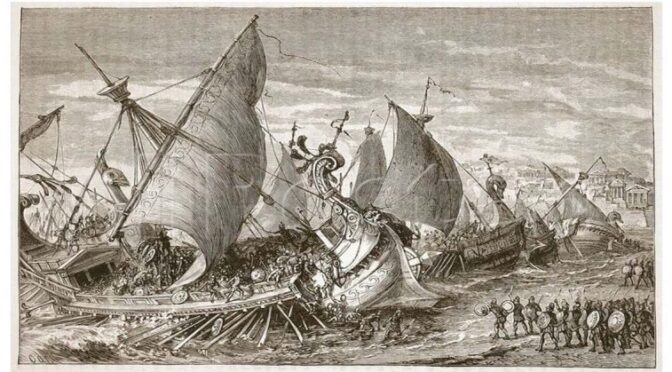
Featured Image: Artist rendering of the Sicily Expedition (Courtesy of War History Online)

Defending Global Order Against China’s Maritime Insurgency – Part 2

By Dan White and Hunter Stires

Dan White:

China’s behavior in the South China Sea, along with efforts to highlight it such as the Philippines Transparency Initiative, and deter it such as the Maritime Counterinsurgency Project do appear to be changing public opinion. This year 51.6% of respondents to the State of Southeast Asia 2025 Survey ranked China’s aggressive behavior as their top geopolitical concern, the highest level recorded since the survey started in 2019.

But China is learning as well. How has China’s behavior in the region evolved over the past few years of encountering resistance from the Philippines and changes in U.S. strategy?

Hunter Stires:

China is certainly learning and innovating at the tactical level. At the same time, I tend to think that China’s problem is that it is not learning and they are instead doubling down on this maritime insurgency strategy.

They are going to fail if they continue this strategy. This is a fight about who governs in a particular space. If you’re having a fight about who governs, you’re really having a fight about whose laws are enforced. Laws need to be accepted, and more importantly, adhered to in practice by the substantial body of the population that law aspires to govern. The laws civilians follow are both a metric of success as well as a mechanism of victory. Right now, Filipino mariners, both government and civilian, are still getting out on the water in defiance of Chinese actions. That is a bad sign for China.

Think of the billions and billions of dollars that China has sunk into this campaign. They have built numerically the largest Coast Guard in the world. They have spent approximately $13 billion constructing each of the three major island air bases they built in the Spratly Islands. These bases are also proving difficult to sustain due to the nature of the environment on a fake island so close to saltwater. They are also fixed assets that are highly vulnerable to attack in the event of war. They are helpful for supporting their maritime insurgency by helping to sustain Coast Guard and maritime militia forces but are less useful than investment into their broader navy. They could have bought Ford-class aircraft carriers for the money they spent constructing these islands.

After all this time, after all this effort, 51.6% of respondents, as you said, list China as the problem. And that is China’s greatest weakness here—no one likes them.

China is clearly banking that they can kind of cow everybody into compliance with their will by coercing them. But Beijing doesn’t understand that as long as the local Southeast Asian civilian mariners keep sailing, China will lose. China can keep on building ships but there are always going to be more civilian ships than there are Naval or Coast Guard forces. They will run out of money and people before they can impose their will on every civilian economic actor in the South China Sea where half the world’s fishing fleet resides.

The Philippines and other Southeast Asian states just have to stay in it. As long as they don’t give up they will ultimately prevail. The task of the United States and our allies and partners is to continue to reassure those countries’ governments and civilian maritime populations that we are with them and the rules of the freedom of the sea haven’t changed.

The U.S. also does not need to be everywhere Filipino fishing boats or other civilian mariners are either. That is what the Philippine Coast Guard is there for and has done an incredibly good job at. The U.S. is a key enabler that raises the effectiveness of local forces. Think of the Combined Action Program model that the Marines pioneered in Vietnam and which we then put to work very successfully in the Counter-ISIL campaign ten years ago. We bring heavy artillery, we bring air support, we bring helicopter medevacs, we bring logistics. And then the local force brings the commitment to defend their home, they bring local knowledge, and they bring mass. When those two things, military might and local resolve, come together they provide a very efficient economy of force for the U.S. and much more effective operations by that local home defense force than it would otherwise be able to accomplish on its own.

As the Philippine Coast Guard and Navy continues to grow and strengthen capability, it takes more and more of a leading role. The U.S. Navy is then able to remain in standby and deter Chinese aggression by conveying that an attack on one will bring the intervention of the whole group.

Dan White:

A criticism of this approach is that it is a side show that distracts from the fight China is really preparing for, which is an invasion of Taiwan. China might abandon its maritime insurgency in exchange for prioritizing all its resources for an all-out attack on Taiwan. In which case America’s naval resources will have been focused on the wrong fight. How would you respond to that?

Hunter Stires:

You absolutely have to be ready for that high-end fight. But the high end is not the only way that China could get its way.  If China is successful at overturning the freedom of the sea, it will position itself to secure control over the Eurasian continental heartland while shutting out America from access to the overwhelming majority of the world’s population and markets.  This is what Napoleon tried and failed to do to Britain during the Napoleonic Wars. France created a continental system to mobilize the resources of Europe for France’s purposes and deny Britain trade, but Britain was able to survive because they had an overseas empire and other people they could trade with.

China is similarly trying to create a continental system across Eurasia and Africa with its One Belt, One Road initiative. That is most of the world’s population. If they also succeed in balkanizing the world’s oceans they could shut the United States out of Eurasia. Seas that are no longer free become obstacles to trade and influence. China could then relegate the U.S. to the world’s economic and geopolitical periphery unless we submit to its dictates. Looking at the logical end-point of China’s actions if successful, we can deduce that this is probably Beijing’s desired end state.

Dan White:

It sounds like what you are saying is that the broader Chinese strategy is to turn its much weaker maritime geography, where it is enclosed by chains of large islands, into a geopolitical advantage by weakening open access to those seas. By getting local actors to bend the knee, China makes its unfavorable geography into a moat that it can use to seal off the world island of Eurasia, and use it as a springboard for projecting power outward. Once China controls the South China Sea it can more safely attack Taiwan and then put pressure on the U.S. across the broader Indo-Pacific. At this point the U.S.’s distance from the region becomes more of a liability than an advantage. It then becomes much harder for the U.S. to match the amount of power it can project at a distance in the Indo-Pacific than China is able to project closer to its shores. Is that a fair characterization?

Hunter Stires:

I think you got it exactly. China’s approach here is inherently continentalist. Its maritime strategy involves land-centric thinking. I would argue that’s actually a weakness of their strategy, because you can’t permanently occupy the ocean.

Think about the nature of China’s strategy here, as an insurgency, in the context of China’s strategic canon. Sun Tzu and Mao are the two most important figures. Of course, there are others, but these are the two principal writers that everybody reads. They’re both land commanders.

Sun Tzu advocates the indirect approach of winning without fighting or winning before the other side gets a chance to form ranks. Mao is the most successful insurgent in history. As a result, insurgent strategies permeate everything that China does. Insurgency is fundamental to the DNA of the Chinese Communist Party, because that’s how they came to power.

The fortunate news for us is there are a lot of different ways that we can cause that strategy to fail. Most of the targeted countries have a lot of incentives to reject Chinese domination. China has looming internal issues that will test the compact the Chinese Communist Party has with the people: how it continues to deliver prosperity while maintaining control over innovation; how it contends with upholding the social safety net while its population declines.

The key question is, will China become more outwardly aggressive once it faces these headwinds and perceives its window of opportunity to assert its power to be closing?

Certainly, there’s a lot going on here in the United States that also concerns me greatly. Developments in the United States are going to have a significant impact on China’s own calculus. But if I had to choose between America’s problems versus China’s problems. I would pick our problems every time. Ours are inherently solvable. We just have to choose to solve them. That is often hard, because we’re a big country, we’re a fractious country, and we love to argue about things. But we are generally a good, reasonable group of people and we also have the benefit of the greatest geography in the world.

There is really no reason that we could not choose to solve the major problems that we have. China’s problems are much more structural. They are going to be a lot harder for them to solve.

Dan White:

This summer, China constructed new dual-use aquaculture facilities in Yellow Sea waters shared with South Korea—complete with helicopter pads and watchtowers—then imposed unilateral closures of those waters. In September, according to the Center for Strategic International Studies, the Coast Guards of China and South Korea engaged in a 15-hour standoff in the region, as China sought to impose further restrictions on South Korean movement within the Yellow Sea. Do you see this as an early sign that China is exporting its South China Sea playbook to the Yellow Sea, or is China’s behavior in the region motivated by another set of interests?

Hunter Stires:

That’s a really good way of putting it, that they are looking to export and expand that maritime insurgency into the Yellow Sea. And getting back to China making this profound set of mistakes in terms of antagonizing all its neighbors, it’s completely in keeping with their modus operandi. They’re needlessly antagonizing South Korea.

I think people throughout the region are also connecting China’s behavior to the Taiwan conversation. People are starting to see that if China decides to go to war in Taiwan, that it is not going to be an isolated thing. Japan and South Korea are dependent on sea lines of communication that pass by Taiwan. They are increasingly of the opinion that there is no way that they could stay out of a conflict. Same with the Philippines. This behavior reinforces that belief to some extent.

I think targeting South Korea will prove to be a mistake by China. While it may be challenging for South Korea, it has the means to hold its own. They have one of the world’s most formidable shipbuilding industries, which is an element of our broader Maritime Statecraft strategy, and key means of countering China’s maritime insurgency. The South Koreans are playing an important role in rebuilding our commercial and naval shipbuilding capability in the United States, as well as for other allies. South Korea is likewise playing an enormously important role in the development of the Philippines Navy.

I would not be surprised, by the way, if China were using some of these techniques to try and pressure South Korea or at least impose costs on it for its temerity in helping the United States and Philippines to stand up to Chinese aggression.

China’s present leadership has an instinct to escalate matters, which I think is frequently counterproductive to their broader diplomatic relationships. Look at the Wolf Warrior diplomacy, or as my mentor at the Naval War College, Jim Holmes, likes to call it, “jackass diplomacy.” Being a jerk to everyone is actually not a good foreign policy. Obviously, the U.S. is in the middle of finding that out the hard way for ourselves.

God willing, our political system retains the ability to change course. Self-correction is one of the most important strengths of democratic political systems and the great weakness of authoritarian political systems. China has less capacity for self correction, and they’re going to have a much harder time than we will.

So China’s behavior in the Yellow Sea could push South Korea to play an increasingly important role in maritime counterinsurgency. South Korea is effectively an island. They have a closed border to the north that cuts them off from the rest of the continent. Their trade can’t go by land. It has to go by sea. They must be a maritime power. This prompted them to create one of the most formidable maritime industries in the world. South Korea now has a highly capable navy and coast guard. We should not hesitate at the opportunity to engage them more directly across the theater, not just in the Yellow Sea and the East China Sea, but in the South China Sea as well.

The prospect of bringing South Korea in to join this broader coalition to implement a maritime counterinsurgency campaign, not just in the South China Sea, but across the entire breadth of the theater, I think this has the potential to be a very positive development for us and an unforced error by China.

Dan White:

I would be remiss not to connect Japan into all of this. Over the past couple months there’s been a huge rift in Sino-Japanese relations. This was prompted by Japanese Prime Minister Sanae Takaichi suggesting that a military invasion and blockade of Taiwan would constitute an existential threat to Japan. Do you think that’s been informed by Japan just watching this creeping expansion of Chinese maritime territorial claims?

Hunter Stires:

I wholeheartedly agree, this is an especially timely conversation. Japanese Prime Minister Takaichi is just telling the truth. If you look at the strategic geography, and you envision what Chinese control of Taiwan actually means for Japan, it very quickly becomes existential for Tokyo.

Japan is an island power. It is completely dependent on sea lines of communication for its survival. To have a hostile air and naval base just off its shores, bestriding those critical sea lines of communication, that is a big problem for Japan.

Japan is also a direct target of China’s broader maritime insurgency, with China’s challenge to the Japanese administration of the Senkaku Islands.

The Chinese clearly have a tendency and a preference t target one opponent at a time. They will escalate against the Philippines in a big way, and then they’ll potentially back off a bit, then they’ll escalate against Japan. Like a classic schoolyard bully, China tries to make everybody feel like it’s just them, that they are alone.  But of course, they are not alone.

This is again, a major opportunity for the U.S. and a major strategic liability for the Chinese. They are effectively horizontally escalating their maritime insurgency across their entire maritime periphery. They are now actively antagonizing the U.S. and this set of our allies and partners. If we can sustain the engagement and the commitment among our allies to continue pushing back on Chinese encroachment this will put China in a position where it is effectively fighting a five front war.

The bigger risk is that China gets wise and goes back to the previous strategy, of trying to appeal to countries one at a time, and isolate and peel them off individually. That worked really well for them for a long time. Thankfully, the region has really wisened up to China’s bad faith in its dealings, so a return to that previous strategy might very well be unsuccessful. The best thing that China could do for itself is moderate its positions, end the maritime insurgency and develop genuine win-win relationships with its neighbors. The United States should continue to do the same and be good friends and allies and uphold international law.

As Jim Mattis liked to put it, “be strategically predictable, be operationally unpredictable.” The U.S. should be a country everyone can rely on. The last year has not been particularly healthy on that score and we should not be antagonizing so many of our friends and allies. Ideally, Congress should start to take a more active role in the conduct of our foreign policy to ensure we remain strategically predictable.

Thankfully, the foundations of these relationships for the United States are very strong. I love the expression that Kisun Chung, the CEO of HD Hyundai, one of South Korea’s leading shipbuilders, used to describe the South Korea-U.S. relationship when the Chief of Naval Operations came to a few weeks ago. He put it very eloquently that the United States and South Korea are “blood allies.” We have shed blood together. That is powerful.

Notwithstanding the political ups and downs of any given moment, that bond endures. It endures with South Korea, it endures with the Philippines. It endures with Taiwan and Japan too. We have shed blood together. We have stood alongside each other. We would be making an enormous mistake if we harm those relationships.

I think that the foundations of our bonds, of our alliances, of our strategy are much stronger than China’s.  If we continue working together to grow our shipbuilding capability with South Korea and Japan; if we continue working with the Philippines, with Taiwan, with Korea and Japan and their world-class navies, and coast guards to protect and empower civilian mariners; if we support our friends in standing up for their sovereign rights against China’s maritime insurgency, I have great confidence that we are going to prevail.

Dan White is an independent foreign policy analyst based in the New York Metro Area. Dan is a former member of the The Wilson Center and The Kennan Institute, and a veteran of the War in Afghanistan. Dan maintains a newsletter, OPFOR Journal, which analyzes strategic competitions with Russia, China, Iran and North Korea.

Hunter Stires served as the Maritime Strategist to the 78th Secretary of the Navy, where he was recognized for his work as one of the principal architects of the Maritime Statecraft strategy. He serves as the Project Director of the U.S. Naval Institute’s Maritime Counterinsurgency Project, a Non-Resident Senior Fellow with the Navy League’s Center for Maritime Strategy, and the Founder and CEO of The Maritime Strategy Group. 

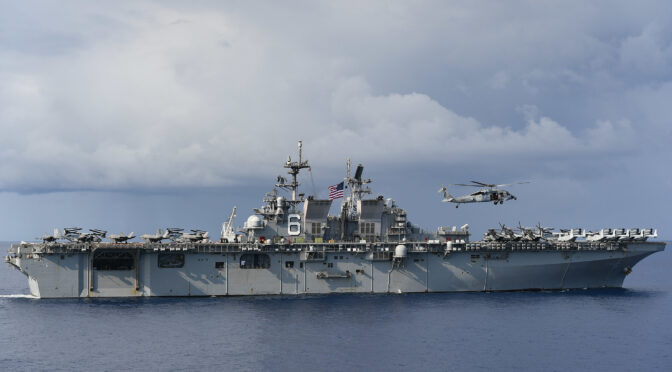
Featured Image: The amphibious assault ship USS America (LHD 6) transits in formation March 24, 2020.  Courtesy: U.S. Navy

Hedge with Non-Kinetic Defense

By Connor Keating

In April 2025, Admiral Samuel Paparo delivered his annual posture statement to the House Armed Services Committee, arguing that the United States must invest in several capabilities to remain competitive in the Indo-Pacific: command, control, computing, communications, cyber, intelligence, surveillance, reconnaissance, and targeting (C5ISRT); counter-C5ISRT (C‑C5ISRT); fires; integrated air and missile defense (IAMD); force sustainment; autonomous and AI-driven systems; and maritime domain awareness and sea control. According to Admiral Paparo, space, AI, and IAMD are critical enablers for reducing risk to U.S. forces in a conflict with China. These capabilities offer exquisite performance for roughly 95 percent of the missions the United States might face short of full-scale war, but they may not be the most cost‑effective way to reduce risk in a high‑end fight with China.

In “C-Note” #3 and in his address at the Surface Navy Association’s 38th National Symposium in January 2026, Chief of Naval Operations Admiral Daryl Caudle outlined a new “hedge strategy.”1 He explained that the Navy will build a general-purpose force—the 95 percent solution—while pursuing “tailored offsets” that augment the general-purpose force and cover the high-intensity 5 percent beyond it. Examples of hedge capabilities in his C‑Note include special operations forces to counter terrorism, ballistic-missile submarines (SSBNs) for nuclear deterrence, and the “Hellscape” concept to defeat a Taiwan invasion force.2 Taken together, Admiral Paparo’s requests and Admiral Caudle’s strategy suggest a gap: the Navy is investing heavily in the 95‑percent, general‑purpose force but underinvesting in simple, low‑cost hedge capabilities tailored to the most dangerous 5 percent of scenarios. This article focuses on one particularly dangerous contingency within that 5 percent—a high‑end conflict with China—and argues that the Navy should rapidly field a set of low‑cost, non‑kinetic hedge capabilities that improve platform survivability by stressing the entire Chinese kill chain and driving up adversary salvo requirements.

A Non-Kinetic Hedge Strategy

To be effective, hedge strategies must be relatively low‑cost in peacetime, sustainable over time, and quickly fielded when a high‑end scenario occurs. This makes kinetic and non‑kinetic drone‑ship solutions appealing for increasing magazine capacities and survivability. In practice, this means pairing manned surface combatants with unmanned platforms that can either shoot (kinetic) or sense, jam, and deceive (non‑kinetic). By adding more platforms that an adversary must detect and target—and by using some of them as decoys or stand‑in targets—the manned ships themselves become harder to find and kill. However, while potentially potent, drones’ rapid obsolescence and continuous upgrade cycle can drive up peacetime costs—especially if the Navy must sustain multiple bespoke designs—demanding a robust and affordable sustainment ecosystem.3

A more cost‑effective hedge for this high-end contingency is a set of modular non-kinetic defense systems that can be stored in peacetime and rapidly deployed in crisis. For the Navy, these could include an improved passive countermeasure system (PCMS) and radar reflectors for surface ships; inflatable decoys and radar reflectors for aircraft; and small-footprint jammer and dazzler packages that enable theater-wide deception. This article proposes three such hedge strategies: one for surface ships, one for aircraft, and one centered on small, mobile jammer and dazzler packages.

Surface Ship “Hedge Strategies”

The surface Navy could be at substantial risk from Chinese anti-ship ballistic missiles (ASBMs) in a high-end conflict. Missiles such as the DF-26 and soon, the DF-27 can engage ships at ranges of more than 2,000 nautical miles.4,5 Some might argue that U.S. ballistic‑missile defense (BMD) is sufficient to counter these threats. It is not, for both performance and capacity reasons. U.S. BMD has struggled against Iranian threats in defense of Israel, Qatar, and in the recently launched U.S. war with Iran, allowing multiple leaks through and expending billions in interceptors.6, 7 This experience highlights not only the operational and strategic implications of interceptor shortages, but also the tactical implications of finite shipboard magazines: every missile fired in defense cannot be used in offense.8 If U.S. and allied systems struggled to stop a limited number of Iranian missiles, they are unlikely to keep pace with large-scale salvos from the People’s Liberation Army Rocket Force (PLARF). Even if they could, U.S. and allied BMD systems and ships are likely to exhaust their inventories faster due to the shot doctrine employed. The solution lies in exploiting inherent weaknesses in missile seekers and ballistic missile kill chains.

Missile seekers—specifically ASBM seekers—must search a significant area from a top-down angle to find a target. This forces the seeker to deal with substantial sea clutter and requires significant onboard processing.9 U.S. surface combatants help adversary seekers by presenting large radar cross sections (RCS), and existing measures to mitigate this—such as treatment with PCMS tiles—only modestly reduce RCS. Further, more seekers are incorporating multiple modes, including not only an active radar but also a passive sensor and Infrared (IR) Imaging sensors.10 Advances in radar‑ and IR‑absorbing materials—such as carbon‑nanotube (CNT) tiles and polyaniline (PANI) or vanadium dioxide (VO₂) paint coatings—could yield significantly improved PCMS, with open-source studies suggesting potential reductions in RCS on the order of more than 15 dBsm and IR signatures by roughly 20 percent.11, 12, 13 A smaller RCS and lower IR signature directly translates into a shorter detection range for an ASBM seeker and a smaller search area.14 That, in turn, forces the adversary to provide more precise targeting data or accept a higher risk of missing.15

Reducing RCS and IR signature alone, however, might not be enough to minimize the risk to surface forces. Open-source reporting indicates that China can field ASBMs equipped with both synthetic-aperture radar (SAR) and conventional radar seekers.16, 17, 18 SAR provides all-weather, fine-resolution imagery and can distinguish targets by shape, allowing a carrier to be distinguished from a destroyer. To counter this, the Navy could pair RCS‑reducing tiles with radar reflectors designed to distort a ship’s apparent shape and size in SAR imagery, making it harder to distinguish high‑value units from escorts and to achieve precise aimpoints.19 Radar reflectors have long been used as test aids for U.S. radar systems and weapons.20 By distorting the apparent size and shape of test targets to resemble adversary equipment, they help assess and improve U.S. weapon effectiveness against realistic radar signatures.21 Together, these measures would not make ships invulnerable, but they could significantly stress the entire Chinese kill chain at relatively low cost compared with hard-kill missile defenses—exactly the kind of hedge capability the Navy needs for the most dangerous 5 percent of scenarios.

Implementing these changes could be relatively straightforward because PCMS has existed as a program of record since 1998, with no significant updates. Rather than invent a new system from scratch, the Navy could reinvigorate PCMS by incorporating new CNT, PANI, and VO₂ tiles and adding several radar‑reflector configurations, delivering updates to the fleet in months rather than years. Because the new tiles would be stored and only applied in crisis or conflict, they would function as a true hedge capability—largely invisible to adversary peacetime collection yet immediately available once a conflict begins. A PANI and VO₂-based paint could also be incorporated into ship coatings moving forward, providing some degradation to seekers during routine, 95-percent, general-purpose operations. The most expensive part of the program would likely be the modeling and simulation needed to determine the correct number of tiles and their optimal placement. A similar analysis effort would be required for the radar reflectors. Even with this modeling requirement, all other parts of the implementation chain are already in place. PCMS tiles are already used in the fleet, and ship crews are trained in their employment, which removes the need for starting a new training pipeline or schoolhouse, a process that normally costs the Navy years in fielding time; the new system would be taught by existing schoolhouses and phased into the fleet’s current electronic warfare training.

Aircraft “Hedge Strategies”

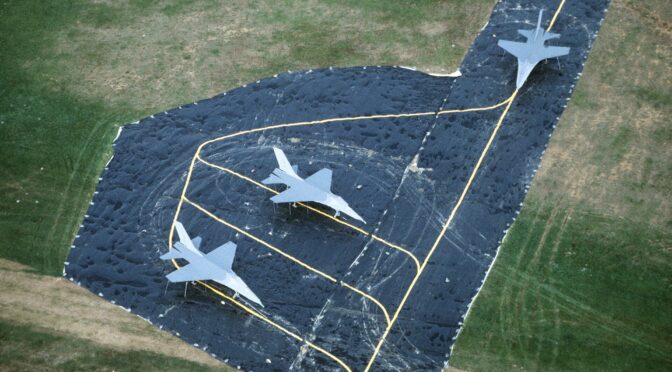
Aircraft hedge strategies should mirror the surface‑ship approach in stressing the entire enemy kill chain to increase survivability: use inflatable decoys and radar reflectors at airfields to saturate adversary sensors, complicate PLARF targeting and fire distribution, and preserve high‑value air assets by stressing the entire enemy kill chain, vice relying solely on counterforce solutions to defeat attacks. Properly employed, these decoys could flood Pacific airfields with false targets, helping to preserve high-value assets such as tankers, bombers, jammers, and command-and-control (C2) aircraft.

Use of decoys as an element of deception is not new. During World War II, the United States employed a so‑called “Ghost Army” to convince German commanders that the Allied landing would occur at Calais rather than Normandy.22 More recently in Ukraine, decoys have helped protect critical air defense, artillery, and C2 assets from Russian fires.23 These examples of successful decoy use also show that decoys work best when paired with convincing signatures—radar, infrared, and electromagnetic—that can deceive modern intelligence, surveillance, and reconnaissance (ISR) systems, including SAR satellites. For the Pacific, inflatable decoys and radar reflectors should be tailored to replicate a range of aircraft types, with particular emphasis on the scarce, high‑value enablers—airborne tankers, long‑range bombers, stand‑off jammers, and C2 platforms—that are operationally decisive.

Pairing inflatable decoys with radar reflectors and signal deception is essential to ensure that adversary intelligence is credibly deceived; an inflatable decoy alone will not fool sophisticated SAR satellite imagery.24 Further, decoy and radar reflector configurations should cover a wide range of aircraft platforms while focusing on the assets most important to the mission, such as tankers, bombers, jammers, and C2 aircraft. The benefit of investing in and creating these decoys now is that they can be stored at critical nodes in the theater and rapidly fielded in times of conflict. The use of decoys should be integrated into regular training to keep units proficient and ready for conflict, but also to complicate adversary intelligence collection during competition by revealing a credible deception capability, which in turn supports deterrence.

Some critics might argue that overt decoy use would “reveal” U.S. capabilities and allow the PRC to develop tactics, techniques, and procedures (TTPs) to distinguish real targets from false ones. Yet this revelation is, in many ways, a desired feature of a system designed to increase platform survivability. If Beijing believes U.S. and allied forces can rapidly flood key airfields with convincing decoys, it must either invest heavily in improved discrimination or plan to fire larger salvos at a much larger target set. Even with improved TTPs, however, finding, fixing, and tracking hundreds, if not thousands, of decoys would remain a significant challenge for any military, and would still consume time, collection assets, and munitions.

This trade-off is especially important because PLARF can fire from sanctuary on the mainland, while U.S. strikes against that sanctuary may be constrained by political decisions. Decoys and radar reflectors give the U.S. a low‑cost way to impose confusion and delay on PLARF’s targeting cycle, forcing it either to accept faster depletion of critical munitions or to slow its fires while it refines targeting. In either case, U.S. and allied forces gain time to maneuver, rearm, and reposition.25

Jammers and Dazzlers “Hedge Strategy”

Jammers and dazzlers are powerful non-kinetic devices that can act as force multipliers for the passive systems described above. In this article, “jammers” refers to small, mobile systems—such as the Space Force’s remote modular terminal (RMT)—that can degrade or deny satellite ISR.26 “Dazzlers” denotes systems that temporarily blind or degrade electro‑optical and infrared (EO/IR) sensors on adversary satellites.27 Fielded in sufficient numbers, such packages could saturate Chinese ISR coverage over key ports and airfields, forcing the PLARF and PLA Navy to guess, delay, or expend additional assets to confirm targets. In doing so, they would function as a classic hedge: relatively inexpensive in peacetime but highly effective at complicating adversary targeting in a high‑end fight.

The benefit of small, mobile jammer/dazzler packages is that they allow the United States to saturate adversary ISR and lower the risk to U.S. forces. For example, if the United States deployed roughly 100 jammer/dazzler packages across the Western Pacific—each capable of covering one‑nautical‑mile square—the U.S. could cover every major U.S. and allied airfield and port with at least one system. This could materially complicate Chinese ISR and battle-damage assessment of key nodes, or dramatically delay targeting decisions by forcing collection through human intelligence (HUMINT) rather than relying solely on satellite imagery, buying valuable reconstitution time for U.S. forces located at these key nodes. Additional units mounted on barges or ships could protect maneuvering forces at sea. In such an environment, the adversary might know the general location of U.S. forces but not their exact identity or value, a state of ambiguity that would force additional ISR sorties or demand greater acceptance of risk for fires on low‑confidence targets. Pairing ships and airfields with the non-kinetic defenses outlined above—RCS and IR reduction, reflectors, and inflatable decoys—could further enhance survivability against inbound munitions, even those equipped with sophisticated multi-mode seekers.

Ultimately, this places the adversary on the horns of a dilemma: either expend significant munitions to address every potential target, thus lowering risk to U.S. forces as exquisite munitions are depleted, or expend time and assets identifying each target, thereby allowing U.S. forces to maneuver into position to employ their own ordnance and putting Chinese forces at risk.

Why – Anecdote from a recent Halsey Alfa Wargame

In a recent iteration of the Naval War College’s Halsey Alfa China wargaming series—a campaign‑level analytic game focused on a Taiwan invasion—I served as the BLUE force commander. The game assumed a highly compressed timeline and, because of initial probabilities (rolls of chance made before game start), BLUE did not receive Japanese support. The RED commander chose a conservative “fleet in being” approach, relying on PLARF’s firepower, magazine depth, and reach to attrit BLUE while preserving his fleet for follow‑on operations.

To survive long enough to deliver munitions into the Taiwan Strait, BLUE employed layered passive deception at the land–sea interface. We used ship configurations designed to distort radar images and pulled critical air assets—tankers and bombers—out of PLARF range while strengthening air defenses at key airfields. This approach did not prevent losses, particularly among cruiser–destroyer (CRUDES) platforms, but it forced RED to expend more than a quarter of his missile inventory in a few days of fighting. Non-kinetic defenses increased the required salvo size against BLUE ships by almost an order of magnitude. The lesson was clear: had the United States possessed the layered non-kinetic capabilities outlined in this article—deception, target distortion, and ISR degradation—it could have stressed the entire Chinese kill chain, forced the adversary to expend munitions far faster, and preserved enough combat power to sustain offensive operations over a longer period of time.

A simplified example illustrates the effect. Suppose an adversary missile has a 90‑percent chance of detecting and killing a ship that lacks passive defenses. Now assume that layered passive measures—decoys, jammers, dazzlers, RCS and IR reduction, and radar reflectors—each reduce that effectiveness by about 80 percent at different points in the kill chain.28, 29 Unclassified sources suggest such reductions are realistic estimates for individual links, and when combined, they dramatically increase the ship’s probability of survival and force the adversary to fire many more missiles to achieve the same expected damage. In practical terms, if it originally took 12 missiles to have high confidence of at least one hit, after layered passive measures, it might take four times as many to achieve the same effect. Adding soft‑kill electronic attack increases this requirement even further, without the radiating signatures that hard‑kill defenses often create. In other words, layered non‑kinetic defenses substantially increase the required salvo size for the attacker.

Another way to apply this logic is to tailor passive defenses to areas threatened by specific PLARF systems, such as installations and facilities within the DF-26’s effective range. The United States could deliberately design a posture that drives up Chinese expenditure of these critical munitions. This creates a dilemma: either fire at low-confidence targets and accept faster magazine depletion, or spend more time and assets refining targeting. Either choice creates seams the United States can exploit. If China shoots early and often, U.S. forces can move in sooner as inventories fall. If China delays, BLUE can use time and maneuver to bring forces into the weapons engagement zone on favorable terms.

Conclusion

As Admiral Caudle has argued, the Navy needs hedge strategies that keep the force relevant in high‑end conflict without breaking the bank in peacetime—ways to augment the general purpose force and cover the most dangerous scenarios, which specifically includes a potential war with China. Layered non-kinetic defenses—employed as a combined system—offer one such hedge. For surface forces, the Navy should update the PCMS program with a new tile‑and‑paint system and pair it with radar reflectors that distort imaging seekers. For air forces, it should field decoys and radar reflectors, as seen in Ukraine, to cast doubt on the precise location of U.S. air assets. Finally, the Navy and joint force should combine small, mobile jammers and dazzlers to saturate adversary ISR and degrade battle damage assessment, preserving operational surprise.

None of these ideas are technologically exotic. They are relatively low-cost, can be stored in peacetime, and can be rapidly fielded in a crisis. Together, layered non-kinetic defenses would not make U.S. forces invulnerable inside the weapons engagement zone, but they would impose steep costs on Chinese targeting and munitions inventories while materially improving platform and asset survivability—precisely the kind of hedge the Navy needs for the most demanding, high-end scenarios.

Lieutenant Connor Keating commissioned from the Virginia Tech NROTC and served aboard a forward-deployed destroyer in Yokosuka, Japan. On shore duty, he was a protocol action officer to the Chairman and Vice Chairman of the Joint Chiefs of Staff. He is an integrated air-and-missile defense warfare tactics instructor and participated in the Naval War College’s Halsey Alfa Advanced Research Project as a resident student. 

Endnotes

1. Caudle, Daryl L. “C-NOte #3: World Class Fleet.” Message to the Fleet from the Chief of Naval Operations, United States Navy, December 1, 2025. https://www.mynavyhr.navy.mil/Portals/55/Messages/NAVADMIN/NAV2025/NAV25241.pdf.

2. Caudle, Daryl L. “C-NOte #3: World Class Fleet.” Message to the Fleet from the Chief of Naval Operations, United States Navy, December 1, 2025. https://www.mynavyhr.navy.mil/Portals/55/Messages/NAVADMIN/NAV2025/NAV25241.pdf.

3. “The Impact of Drones on the Battlefield: Lessons of the Russia-Ukraine War from a French Perspective.” 2025. Hudson Institute. October 21, 2025. https://www.hudson.org/missile-defense/impact-drones-battlefield-lessons-russian-ukraine-war-french-perspective-tsiporah-fried.

4. “DF-26.” n.d. Missile Threat. https://missilethreat.csis.org/missile/dong-feng-26-df-26/.

5. Lariosa, Aaron-Matthew. 2025. “Chinese Forces Fielding Intercontinental Anti-Ship Ballistic Missiles Capable of Reaching U.S. West Coast, Pentagon Says – USNI News.” USNI News. December 26, 2025. https://news.usni.org/2025/12/26/chinese-forces-fielding-intercontinental-anti-ship-ballistic-missiles-capable-of-reaching-u-s-west-coast-pentagon-says.

6. News, PBS. 2025. “Pentagon Acknowledges Iran’s Attack on Qatar Air Base Hit Dome Used for U.S. Communications.” PBS News. July 11, 2025. https://www.pbs.org/newshour/world/pentagon-acknowledges-irans-attack-on-qatar-air-base-hit-dome-used-for-u-s-communications.

7. Cancian, Mark F, and Chris H Park. 2026. “Iran War Cost Estimate Update: $11.3 Billion at Day 6, $16.5 Billion at Day 12.” Csis.org. 2026. https://www.csis.org/analysis/iran-war-cost-estimate-update-113-billion-day-6-165-billion-day-12.

8. Rumbaugh, Wes. 2025. “The Depleting Missile Defense Interceptor Inventory.” Csis.org. 2025. https://www.csis.org/analysis/depleting-missile-defense-interceptor-inventory.

9. “Active Radar Homing.” Grokipedia. xAI. Last fact-checked January 14,2026. https://grokipedia.com/page/Active_radar_homing.

10. Bronk, Justin. 2020. Review of Russian and Chinese Combat Air Trends: Current Capabilities and Future Threat Outlook. RUSI. RUSI. October 30, 2020. https://www.rusi.org/explore-our-research/publications/whitehall-reports/russian-and-chinese-combat-air-trends-current-capabilities-and-future-threat-outlook#:~:text=China%20has%20developed%20J%2D11,20B%20having%20begun%20in%202020.

11. Kim, Seong-Hwang, Seul-Yi Lee, Yali Zhang, Soo-Jin Park, and Junwei Gu. 2023. “Carbon-Based Radar Absorbing Materials toward Stealth Technologies.” Advanced Science (Weinheim, Baden-Wurttemberg, Germany), September, e2303104. https://doi.org/10.1002/advs.202303104.

12. Zhang, Deqing, Xiuying Yang, Junye Cheng, Mingming Lu, and Maosheng Cao. 2013. “Facile Preparation, Characterization, and Highly Effective Microwave Absorption Performance of CNTs/Fe 3 O 4 /PANI Nanocomposites.” Journal of Nanomaterials 2013 (5): 1–7. https://doi.org/10.1155/2013/591893.

13. Jiang, Changhao, Liangliang He, Qi Xuan, et al. “Phase-Change VO₂-Based Thermochromic Smart Windows.” Light: Science & Applications 13 (2024): 255. https://doi.org/10.1038/s41377-024-01560-9.

14. To illustrate with an example: Consider the basic radar range equation, which describes the received power (Pr) at the seeker:

  • : Transmitted power
  • : Transmit and receive antenna gains
  • : Wavelength of the radar signal
  • : RCS of the target
  • ( R ): Distance (range) to the target

For the seeker to detect the target, Pr must exceed a minimum detectable signal threshold (accounting for noise and other factors). If all other parameters are fixed, Pr is directly proportional to σ and inversely proportional to R⁴.Suppose a conventional aircraft has an RCS of 1 m², detectable by a given seeker at a range of 10 km. If stealth technology reduces the RCS to 0.0001 m² (a factor of 10,000 reduction, common in advanced designs), the maximum detection range drops significantly. Since range R is proportional to the fourth root of σ (R ∝ σ^{1/4}), reducing σ by 10,000 (10^4) cuts R by a factor of 10 (since (10^4)^{1/4} = 10). Thus, the new detection range might be only 1 km, allowing the aircraft to approach much closer before being detected.

15. Grant, Rebecca. The Radar Game: Understanding Stealth and Aircraft Survivability. Arlington, VA: Mitchell Institute for Airpower Studies, 2010. https://secure.afa.org/Mitchell/reports/MS_RadarGame_0910.pdf.

16. Erickson, Andrew S. Chinese Anti-Ship Ballistic Missile (ASBM) Development: Drivers, Trajectories, and Strategic Implications. Washington, DC: Jamestown Foundation, 2013.

17. Kreisher, Otto. “China’s Carrier Killer: Threat and Theatrics.” Air & Space Forces Magazine, December 1, 2013. https://www.airandspaceforces.com/article/1213china.

18. “CM-401 Anti-Ship Ballistic Missile.” GlobalSecurity.org. Accessed January 16, 2026. https://www.globalsecurity.org/military/world/china/cm-401.htm.

19. Naval Air Warfare Center Weapons Division. Electronic Warfare and Radar Systems Engineering Handbook. 4th ed. Point Mugu, CA: Naval Air Warfare Center Weapons Division, 2013. https://apps.dtic.mil/sti/tr/pdf/ADA617071.pdf.

20. Smith, Mark , Lokesh Saggam, and Shashi Saggam. n.d. Review of Trihedral Reflectors for Radar Applications. Millimeter Wave Product Inc. Mi-Wave© (Millimeter Wave Products Inc.). Accessed March 15, 2026. https://www.miwv.com/trihedral-reflectors-for-radar-applications/.

21. Leone, Dario. 2021. “How Luneburg Lens Radar Reflectors Are Used to Make Stealth Aircraft Visible on Radar Screens.” The Aviation Geek Club. June 11, 2021. https://theaviationgeekclub.com/these-devices-make-stealth-aircraft-visible-on-radar-screens/.

22. Murphy, Brian John. 2018. “Patton’s Ghost Army – D-Day Deception – America in WWII Mag.” Americainwwii.com. 2018. http://www.americainwwii.com/articles/pattons-ghost-army/.

23. Bonsegna, Nicola. 2024. “The Strategic Role of Decoys in the Conflict in Ukraine.” TDHJ.org. October 31, 2024. https://tdhj.org/blog/post/decoys-conflict-ukraine/.

24. SAR. “Detecting Russian Inflatable Decoys with SAR.” Synthetic Aperture Radar, July 31, 2017. https://syntheticapertureradar.com/detecting-russian-inflatable-decoys-with-sar.

25. Bonsegna, Nicola. 2024. “The Strategic Role of Decoys in the Conflict in Ukraine.” TDHJ.org. October 31, 2024. https://tdhj.org/blog/post/decoys-conflict-ukraine/.

26. US Space Force. “US Space Force to Use Three Weapons To Jam Chinese Satellites Via Remote Control.” Bloomberg, November 4, 2025. https://bloomberg.com/news/articles/2025-11-04/us-space-force-to-use-three-weapons-to-jam-chinese-satellites-via-remote-control.

27. Tingley, Brett. 2024. “Space Force Tests Small Satellite Jammer to Protect against ‘Space-Enabled’ Attacks.” Space.com. April 24, 2024. https://www.space.com/space-force-ground-based-jammer-electronic-warfare.

28. Smith, Ryan M. “Using Kill-Chain Analysis to Develop Surface Ship CONOPs to Defend Against Anti-Ship Cruise Missiles.” Master’s thesis, Naval Postgraduate School, 2010. https://apps.dtic.mil/sti/tr/pdf/ADA524758.pdf.

29. Cadirci, Semih. “RF Stealth (Or Low Observable) and Counter Low Observable Technology.” Master’s thesis, Naval Postgraduate School, 2009. https://apps.dtic.mil/sti/tr/pdf/ADA496936.pdf.

Featured Image: An aerial view of F-16 Fighting Falcon aircraft mockups parked on a fake flight line during Exercise SALTY DEMO’85. SALTY DEMO’85 is an air base survivability exercise evaluating passive and active defenses, aircraft operation and generation, and base recovery systems. (Photo via National Archives)