Escalating Threats to Maritime Security in the Western Indian Ocean Region

African Maritime Forces Week

By Brigadier General John M. Waweru (Ret.), IMO Consultant

Introduction 

The Western Indian Ocean Region (WIO) holds substantial geopolitical and economic importance due to its location along vital international sea lanes, facilitating maritime trade between Asia, Africa, and Europe. Approximately 80% of the world’s seaborne oil trade transits through these waters, underscoring their global relevance.1 Key chokepoints such as the Bab el-Mandeb Strait enhance this strategic importance. However, the region faces escalating maritime threats, including kinetic attacks on shipping, illegal, unreported, and unregulated (IUU) fishing, illicit trafficking, piracy, and terrorism.2 These challenges compromise economic stability and pose broader threats to regional and global security.

Salient Threats to Regional Maritime Security 

Kinetic Attacks on Merchant Shipping in the Red Sea 

Kinetic attacks in the Red Sea, often attributed to the ongoing conflict in Yemen, have significantly threatened global maritime trade. Armed groups such as the Houthis have targeted commercial vessels with missiles and drones, endangering crew safety and destabilizing global energy supplies.3 These incidents have increased shipping insurance premiums and triggered route deviations, inflating global trade costs. 

Illegal, Unreported, and Unregulated Fishing (IUUF) 

IUU fishing severely affects economic and ecological systems in the WIO. Coastal African states—including Kenya, Tanzania, Somalia, and Mozambique—report annual losses in the billions due to illegal fishing practices.4 These activities deplete marine stocks, disrupt food security, and exacerbate unemployment and migration pressures. The environmental degradation caused by IUUF also threatens long-term sustainability of the blue economy.5

Illicit Trafficking 

The WIO is a conduit for various forms of illicit trafficking, including narcotics, weapons, human smuggling, and wildlife trafficking. The region’s porous maritime borders allow transnational criminal networks to flourish, undermining governance and fueling corruption.6 Illicit trafficking also enables the financing of insurgencies and extremist movements, further destabilizing coastal and inland regions.7

Terrorism and Piracy 

Although Somali piracy has declined since its 2011 peak, emerging incidents suggest a possible resurgence.8 Moreover, terrorist groups have reportedly leveraged maritime spaces for logistical support, recruitment, and attacks—especially in regions around Lamu and the Gulf of Aden.9 The fusion of terrorism and piracy heightens risk for both commercial vessels and regional maritime governance. 

Comparative Salience and Extended Impact 

Kinetic attacks and IUU fishing are particularly impactful due to their economic consequences and global spillover effects. Strategic chokepoints such as the Bab el-Mandeb amplify the risks of kinetic threats, while IUUF contributes directly to ecosystem collapse, economic displacement, and regional instability.10 These phenomena also contribute to migration crises, fuel maritime militarization, and alter trade patterns—creating ripple effects in Europe, Asia, and beyond.11 

Strategic Response and Mitigation Approaches 

Direct Responses 

IUU fishing can be curtailed through capacity-building, improved monitoring, and the use of satellite surveillance technology. Strengthening legal frameworks and investing in regional fisheries governance are also critical steps.12

Multilateral Approaches 

Due to their cross-border nature, threats like piracy and terrorism necessitate collective action. Regional cooperation through the Djibouti Code of Conduct and global coalitions like the Combined Maritime Forces has improved information sharing and joint patrol capabilities.13 Diplomatic solutions addressing political drivers of conflict—especially in Yemen and Somalia—are equally crucial. 

Threat Mitigation 

Illicit trafficking is best addressed through enhanced maritime domain awareness, harmonized regional legislation, and anti-corruption initiatives. Developmental interventions targeting root causes—such as poverty, unemployment, and institutional weakness—are essential for long-term security.14

Conclusion

The Western Indian Ocean Region remains a critical hub for international trade, energy transport, and ecological resources. Yet it faces multifaceted maritime security threats that demand urgent and coordinated responses. A balanced strategy combining direct enforcement, multilateral diplomacy, and developmental initiatives is essential. Regional stakeholders, supported by international partners, must adopt an integrated approach to secure the blue economy, foster peace, and promote sustainable development across the WIO.

Brigadier General John Waweru (Ret.) is a seasoned security strategist, educator, and conservation advocate with over three decades of distinguished service. He is currently a Fellow at the African Leadership University (ALU) and serves as Adjunct Faculty at the ALU School of Business, where he develops and teaches curriculum on security, leadership, and governance. A retired officer of the Kenya Defence Forces, General Waweru previously served as the Director General of the Kenya Wildlife Service, where he led national conservation efforts and advanced cross-sector partnerships for environmental security. Waweru holds a Master of Management in Security and is due to graduate in 2025 with a PhD in International Studies, reflecting his deep academic engagement with global security and governance issues. His areas of expertise include strategic leadership, crisis management, maritime security, and organizational transformation. He is widely respected for his contributions to regional security dialogue and for integrating conservation into national security frameworks. Waweru continues to mentor emerging leaders and contribute to thought leadership across Africa’s security and governance landscape.

Endnotes

1. Christian Bueger, “Who Secures the Western Indian Ocean? The Need for Strategic Dialogue” (Center for Maritime Strategy, September 19, 2024), https://centerformaritimestrategy.org/publications/who-secures-the-western-indians-ocean-the-need-for-strategic-dialogue/

2. Christian Bueger and Timothy Edmunds, “Blue Crime: Conceptualizing Transnational Organized Crime at Sea,” Maritime Policy 119 (2020), 104067; Laura C. Burroughs and Robert Mazurek, “Maritime Security in the Indian Ocean: Perceived Threats, Impacts, and Solutions,” (One Earth Future Foundation, June 14, 2019), https://oneearthfuture.org/en/secure-fisheries/publication/maritime-security-indian-ocean-perceived-threats-impacts-and-solutions

3. Francois Vrëy and Mark Blaine, “Red Sea and Western Indian Ocean Attacks Expose Africa’s Maritime Vulnerability,” (Africa Center for Strategic Studies, April 9, 2024), https://africacenter.org/spotlight/red-sea-indian-ocean-attacks-africa-maritime-vulnerability/ 

4. WWF, “US $142.8 Million Potentially Lost Each Year to Illicit Fishing in the South West Indian Ocean,” May 4, 2023, https://www.wwf.eu/?10270441%2FUS1428-million-potentially-lost-each-year-to-illicit-fishing-in-the-South-West-Indian-Ocean; Oceans 5, “Ending destructive industrial fishing in Madagascar and the Western Indian Ocean,” (Oceans 5, n.d.), https://www.oceans5.org/project/ending-destructive-industrial-fishing-in-madagascar-and-the-western-indian-ocean/ 

5. Margherita Camurri, “Maritime Security in the Indian Ocean: The Practice of Illegal, Unreported and Unregulated (IUU) Fishing (Mondo Internazionale, February 10, 2022), https://mondointernazionale.org/focus-allegati/maritime-security-in-the-indian-ocean-the-practice-of-illegal-unreported-and-unregulated-iuu-fishing

6. Blue Ventures, “A Shared Vision to Tackle Illegal, Unreported and Unregulated Fishing in the Western Indian Ocean,” June 16, 2023, https://blueventures.org/a-shared-vision-to-tackle-illegal-unreported-and-unregulated-fishing-in-the-western-indian-ocean/

7. Bueger and Edmunds, “Blue Crime.” 

8. “Piracy off the coast of Somalia,” Wikipedia Foundation, accessed April 21, 2025, https://en.wikipedia.org/wiki/Piracy_off_the_coast_of_Somalia

9. Adeniyi Adejimi Osinowo “Combating Piracy in the Gulf of Guinea,” Africa Security Brief No. 30 (Africa Center for Strategic Studies, February 28, 2015); J.W. Mwangi, Maritime Terrorism in Kenya: Threats and Responses. (Nairobi: KeMU Press, 2021). 

10. G. Macfadyen and G. Hosch, The IUU Fishing Risk Index: 2023 Update (Poseidon Aquatic Resource Management Limited and the Global Initiative Against Transnational Organized Crime, 2023), https://iuufishingindex.net/downloads/IUU-Report-2023.pdf.

11. Abhishek Mishra, “Maritime Security Architecture and Western Indian Ocean: India’s Stakes,” IDSA Comments, January 18, 2024 (Manohar Parrikar Institute for Defence Studies and Analyses), https://www.idsa.in/publisher/comments/maritime-security-architecture-and-western-indian-ocean-indias-stakes/.

12. U.S. Embassy Antananarivo, “United States Partners with Western Indian Ocean Countries to Tackle IUU Fishing (U.S. Embassy in Madagascar, June 5, 2023), https://mg.usembassy.gov/united-states-partners-with-indian-ocean-countries-to-tackle-iuu-fishing/

13. Djibouti Code of Conduct, “Combating Maritime Security Threats in Western Indian Ocean and Gulf of Aden (n.d.), https://dcoc.org/combating-maritime-security-threats-in-western-indian-ocean-and-gulf-of-aden/; International Maritime Organization, “Indian Ocean and Gulf of Aden States Push Coordinated Action on Maritime Security,” December 4, 2024, 

https://www.imo.org/en/MediaCentre/Pages/WhatsNew-2193.aspx 

14. Bueger, “Who Secures the Western Indian Ocean.”

References 

Blue Ventures, “A Shared Vision to Tackle Illegal, Unreported and Unregulated Fishing in the Western Indian Ocean,” June 16, 2023. https://blueventures.org/a-shared-vision-to-tackle-illegal-unreported-and-unregulated-fishing-in-the-western-indian-ocean/

Bueger, Christian, “Who Secures the Western Indian Ocean? The Need for Strategic Dialogue. Center for Maritime Strategy,” September 19, 2024. https://centerformaritimestrategy.org/publications/who-secures-the-western-indian-ocean-the-need-for-strategic-dialogue/

Bueger, Christian and Timothy Edmunds, “Blue Crime: Conceptualizing Transnational Organized Crime at Sea,” Marine Policy 119 (2020), 104067. 

Burroughs, Laura C. and Robert Mazurek, “Maritime Security in the Indian Ocean: Perceived Threats, Impacts, and Solutions,” One Earth Future, June 24, 2019. https://oneearthfuture.org/en/secure-fisheries/publication/maritime-security-indian-ocean-perceived-threats-impacts-and-solutions 

Camurri, Margherita, “Maritime Security in the Indian Ocean: The Practice of Illegal, Unreported and Unregulated (IUU) Fishing.” Mondo Internazionale, February 10, 2022. https://mondointernazionale.org/focus-allegati/maritime-security-in-the-indian-ocean-the-practice-of-illegal-unreported-and-unregulated-iuu-fishing

Djibouti Code of Conduct, “Combating Maritime Security Threats in Western Indian Ocean and Gulf of Aden,” (n.d.). https://dcoc.org/combating-maritime-security-threats-in-western-indian-ocean-and-gulf-of-aden/ 

International Maritime Organization, “Indian Ocean and Gulf of Aden States Push Coordinated Action on Maritime Security,” December 4, 2024. https://www.imo.org/en/MediaCentre/Pages/WhatsNew-2193.aspx 

International Maritime Organization. Djibouti Code of Conduct. London: IMO, 2009. 

Macfadyen, G. and G. Hosch, “The IUU Fishing Risk Index: 2023 Update.” Poseidon Aquatic Resource Management Limited and the Global Initiative Against Transnational Organized Crime, 2023. https://iuufishingindex.net/downloads/IUU-Report-2023.pdf

Mishra, Abhishek, “Maritime Security Architecture and Western Indian Ocean: India’s Stakes,” IDSA Comments, Manohar Parrikar Institute for Defence Studies and Analyses. January 18, 2024. https://www.idsa.in/publisher/comments/maritime-security-architecture-and-western-indian-ocean-indias-stakes/

Mwangi, J. W. Maritime Terrorism in Kenya: Threats and Responses. Nairobi: KeMU Press, 2021. 

Oceans 5, “Ending Destructive Industrial Fishing in Madagascar and the Western Indian Ocean,” Oceans 5, n.d. https://www.oceans5.org/project/ending-destructive-industrial-fishing-in-madagascar-and-the-western-indian-ocean/

Osinowo, Adeniyi Adejimi, “Combating Piracy in the Gulf of Guinea,” Africa Security Brief no. 30 Africa Center for Strategic Studies, February 28, 2015. 

“Piracy off the coast of Somalia,” Wikipedia Foundation, accessed April 21, 2025. https://en.wikipedia.org/wiki/Piracy_off_the_coast_of_Somalia 

U.S. Embassy Antananarivo, “United States Partners with Western Indian Ocean Countries to Tackle IUU Fishing. U.S. Embassy in Madagascar, June 5, 2023. https://mg.usembassy.gov/united-states-partners-with-indian-ocean-countries-to-tackle-iuu-fishing/

Vogel, Augustus. “Investing in Science and Technology to Meet Africa’s Maritime Security Challenges.” Africa Security Brief, No. 10. Africa Center for Strategic Studies, 2011. https://africacenter.org/publication/investing-in-science-and-technology-to-meet-africas-maritime-security-challenges/

Vrëy, Francois and Mark Blaine, “Red Sea and Western Indian Ocean Attacks Expose Africa’s Maritime Vulnerability.” Africa Center for Strategic Studies, April 9, 2024. https://africacenter.org/spotlight/red-sea-indian-ocean-attacks-africa-maritime-vulnerability/ 

WWF, “U.S. $142.8 million Potentially Lost Each Year to Illicit Fishing in the South-West Indian Ocean,” May 4, 2023. https://www.wwf.eu/?10270441/US1428-million-potentially-lost-each-year-to-illicit-fishing-in-the-South-West-Indian-Ocean 

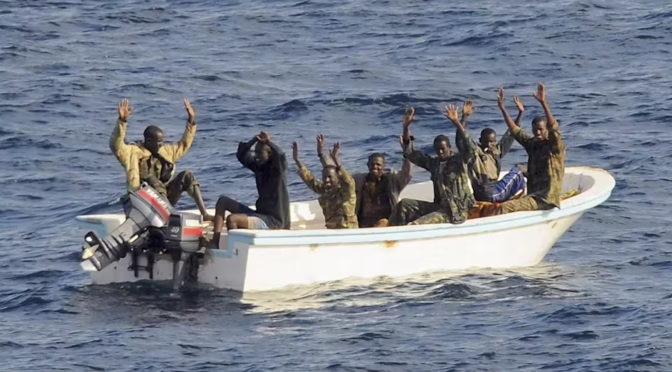
Featured Image: Suspected pirates surrender to a multinational naval force in 2009. (Photo via Reuters/Jason R. Zalasky/U.S. Navy)
CIMSEC Launches African Maritime Forces Summit Topic Week

By Dmitry Filipoff

From June 16-20, CIMSEC will feature a series of articles written for the African Maritime Forces Summit (AMFS) 2025.

The summit, hosted in Mauritius from June 23-26, addresses African regional maritime security through the lens of the Western Indian Ocean. AMFS seeks to enhance regional maritime security by convening key maritime leaders to frame collective problems, coordinate strategies, and strengthen regional maritime cooperation. U.S. Naval Forces Europe and Africa (NAVEUR/NAVAF) and U.S. Marine Corps Forces Europe and Africa (MARFOREUR/AF) jointly sponsor the event, which is co-hosted this year by the Mauritius Police Force.

Editors from the Africa Center for Strategic Studies, the U.S. Naval War College, and the U.S. Naval Postgraduate School solicited articles from distinguished maritime experts to prepare an event conference book that would foster robust dialogue at the summit. By permission of the authors and editors, CIMSEC is pleased to host these final conference articles for a wider audience.

Theme 1: Threats to Regional Maritime Security

Escalating Threats to Maritime Security in the Western Indian Ocean Region,” by Brigadier General John Waweru (Ret.), IMO Consultant.

Diversifying Threats to Maritime Security in the Western Indian Ocean Region,” by Captain Harifidy A. Alex Ralaiarivony, Director of RMIFC.

Direct and Indirect Maritime Security Threats in the Western Indian Ocean,” by Captain Mark Blaine (Ret.), SIGLA Stellenbosch and SA Navy.

Theme 2: The Connecting Ocean: The Role of Non-African States in African Regional Maritime Security

Connecting Ocean: The Role of Non-African States in African Regional Maritime Security,” by VADM Ignacio Villanueva Serrano, Operation Commander, EU NAVFOR ATALANTA.

Africa’s Maritime Security Relations and the Global Responsibility to Protect the Sea,” by Dr. Christian Bueger, University of Copenhagen.

India’s Evolving Role in Supporting African Maritime Security Architecture,” by Dr. Abhishek Mishra, Associate Fellow, Manohar Parrikar Institute for Defence Studies and Analyses (MP-IDSA), New Delhi.

Theme 3: Developing Robust Regional Maritime Security Mechanisms

Developing Robust Regional Maritime Security Mechanisms for the WIO,” by Major Raj Mohabeer, IOC and Mr. Kiruja Micheni, Djibouti Code of Conduct/Jeddah Amendment, International Maritime Organization.

Rebuilding SADC’s Maritime Security Architecture,” by Mr. Timothy Walker, Institute for Security Studies, South Africa.

From Fragmentation to Framework: The Evolution of Regional Maritime Governance in the Western Indian Ocean,” by Ms. Pascaline Alexandre, Africa Center for Competitive Intelligence (ACCI).

The views presented are those of the authors and do not necessarily represent the official views of any government or organization with which they may be affiliated.

Dmitry Filipoff is CIMSEC’s Director of Online Content. Contact him at Content@cimsec.org.

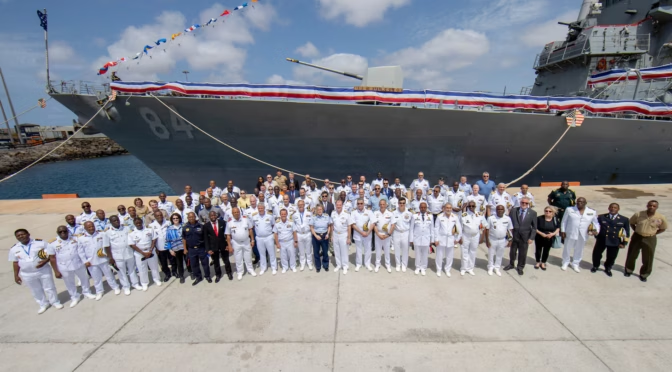
Featured Image: Leaders attending the African Maritime Forces Summit (AMFS) pose for a photo in front of USS Bulkeley (DDG 84) while moored in Sal Island, Cabo Verde, Mar. 21, 2023. (U.S. Navy photo)

Sea Control 577: Reconceptualizing War with Ben Zweibelson

By J. Overton

Dr. Ben Zweibelson joins the program to talk about his new book, Reconceptualizing War.

Dr. Zweibelson has over three decades of service to the U.S. Department of Defense, retiring as an Infantry Officer with 22 years combined service, multiple combat deployments to Iraq and Afghanistan, and awarded four Bronze Stars. Author of two other books, Understanding the Military Design Movement (Routledge, 2023) and Beyond the Pale (Air University Press, 2023), Ben lectures at numerous war colleges and universities around the world. He holds a doctorate in philosophy, has three master’s degrees, and graduated U.S. Army Ranger School among numerous other demanding military courses. Ben resides in Colorado Springs with his wife and three boys.

Download Sea Control 577: Reconceptualizing War with Ben Zweibelson

Links

1. Reconceptualizing War, by Ben Zweibelson, Helion & Company, 2025.

2. Understanding the Military Design Movement, by Ben Zweibelson, Routledge, 2024.

3. Beyond the Pale: Designing Military Decision-Making Anew, by Ben Zweibelson, Air University Press, 2023.

4. War Becoming Phantasmal: A Cognitive Shift in Organized Violence beyond Traditional Limits, by Ben Zweibelson, Marine Corps University Press, May 2024.

5. “Breaking the Newtonian Fetish, by Ben Zweibelson, Journal of Advanced Military Studies, Vol. 15. No. 1.

J. Overton is Co-Host of the Sea Control podcast. Contact the podcast team at Seacontrol@cimsec.org.

Choking the Artery: The Naval Dimension of a Future India–Pakistan Conflict

By Slade Woodard

The Line of Control still dominates the nightly news, yet war between India and Pakistan could spill seaward. In early May 2025, the two nuclear‑armed neighbors again traded strikes, suspended bilateral trade concessions, and placed elements of their fleets on alert.1 Nearly one‑third of Pakistan’s import bill, and, critically, 16 percent of its food supply, arrives by sea.2 With roughly 60 percent of that traffic funneling through the single port complex of Karachi, the question is no longer whether the coast matters, but how maritime leverage could shape the next crisis.

One should reassess the naval dimension of an Indo‑Pakistani conflict through four lenses: the historical template set in 1971, the present force balance at sea, the operational concepts that give teeth to an Indian blockade and the tools Pakistan can use to blunt the embargo, and the policy consequences for regional stability. The analysis rests on the premise that maritime intertwined with nuclear deterrence is the defining strategic feature of the subcontinent in 2025. The sea, once a sideshow, is again a principal theatre.

1971 Revisited: A Night of Burning Bunkers and Enduring Lessons

Present tensions harken back to the early 1970s. On December 4-5, 1971, three Indian Vidyut‑class missile boats, shepherded by two Petya‑class corvettes, dashed south of the International Maritime Boundary Line and launched P‑15 Termit (Styx) missiles into Karachi Roads. Within minutes, the destroyer PNS Khyber, the minesweeper Muhafiz, and the ammunition barge Venus Challenger were aflame. An oil tank farm at Keamari terminal burned so fiercely that RAF crews flying in the Gulf spotted the glow 500 kilometers away. A second raid (Operation Python) followed on December 8, showing how Pakistan’s naval center of gravity proved vulnerable. 

Five operational lessons from 1971 remain relevant. First, surprise is easiest to achieve at sea when geography compresses logistics into a narrow front; Karachi’s approaches in 2025 are no less predictable than in 1971. Second, tactical actors with modern missiles can deliver strategic effects. Third, shore‑based surveillance systems are brittle under sudden attack, a vulnerability that has grown with the advent of satellite‑guided weapons. Fourth, the psychological impact of flames on the waterfront far exceeds the material loss of hulls or fuel dumps. Finally, limited naval strikes can alter the broader political tempo of a war than in December 1971, when Pakistan sued for a UN‑backed cease‑fire five days after the first attack on Karachi.

Inventories in Detail: From Carriers to Coastal Batteries

The Indian Navy dwarfs its Pakistani counterpart, but the advantage is more than a matter of hull counts. India now operates two aircraft carriers, INS Vikramaditya (Kiev‑class, STOBAR) and the indigenously built INS Vikrant. Embarked MiG‑29K/KUB fighters armed with Kh‑35 and upcoming BrahMos‑NG missiles give Delhi a potent over‑the‑horizon strike capability. Three Kolkata‑class and four Visakhapatnam‑class destroyers field the Barak‑8 surface‑to‑air missile, while 13 Shivalik‑, Talwar‑, and Nilgiri‑class frigates provide area air‑defense out to 70 kilometers. The submarine arm comprises one Arihant‑class SSBN, a leased Akula‑II SSN (INS Chakra), eight diesel‑electric Kalvari (Scorpene) boats, and four Kilo‑class units slated for mid‑life refit. The centerpiece of the Maritime patrol is 12 P‑8I Poseidon aircraft, supplemented by MQ‑9B SeaGuardian drones capable of 24‑hour persistence over the Arabian Sea.

Visakhapatnam-class destroyer INS Imphal launches an extended-range supersonic BrahMos anti-ship missile during a test in November 2023. (Indian government photo)

Pakistan remains a green‑water force focused on coastal denial, but the last decade saw qualitative modernization. Four Chinese-built Type 054A/P frigates (Tughril class) entered service between 2022 and 2024, carrying 32‑cell VLS for LY‑80N surface‑to‑air and CM‑302 (YJ-12) supersonic anti‑ship missiles. The older but upgraded F‑22P Zulfiquar class retains eight C‑802 missiles, while three forthcoming Jinnah‑class frigates under Turkish design will mount Atmaca SSMs and Gökdeniz CIWS from 2027 onward. Fast‑attack craft are numerous, with 19 Azmat and Jalalat‑class boats, each with two to four anti‑ship missiles, providing a swarm option inside 100 nautical miles of the coast.

PNS Tughril, the lead ship of Pakistan’s Type 054 A/P frigates. (Pakistan Navy photo)

Below the surface, Pakistan operates two Agosta‑90B submarines fitted with Air‑Independent Propulsion and one older Agosta‑70. Pakistan has ordered eight Hangor-class (improved Yuan-derivative) AIP boats from China, set to arrive in 2028. Each vessel is assembled at Karachi Shipyard, providing a hedge against wartime attrition of imports. The cruise‑missile portfolio is similarly layered: U.S.‑sourced Harpoon Block II; the indigenous Harbah with an estimated 450‑kilometre reach; ship‑and‑shore‑launched CM‑302; and the 290‑kilometre SMASH supersonic ballistic missile that can be fired from truck‑mounted canisters.

On land, Pakistan compensates for smaller tonnage—Coastal Defence Regiments now field four CM‑302 batteries near Sonmiani and Ormara. In addition, they operate a network of over‑the‑horizon surface‑wave radars supplied by CETC of China. ZDK‑03 (Karakorum Eagle) and Saab 2000 Erieye AEW&C aircraft provide airborne early warning, though limited in numbers. Naval aviation includes ATR‑72 Sea Eagle patrol planes and Sea King helicopters, soon to be augmented by Turkish‑built Anka‑B armed drones flown from Gwadar.

Blockade Mechanics: Rings of Pressure and the Anatomy of Resistance

India would likely pursue a graduated blockade rather than a quick quarantine if Delhi chose to sever Pakistan’s maritime lifelines. Phase 1 could consist of diplomatic maneuvers: notifying shipowners’ associations, protection and indemnity clubs, and energy traders that vessels bound for Pakistani ports risk inspection or diversion. Phase 2 could establish interdiction rings. At roughly 200 nautical miles, the outer ring near the convergence of Gulf tanker lanes would be policed by Kalvari‑class submarines cued by P‑8I radar tracks, forcing commercial traffic into corridors covered by Indian surface escorts. The middle ring, 50–100 nautical miles off Karachi, could include carrier air patrols and destroyer screens armed with BrahMos. The inner ring inside the 12‑nautical‑mile territorial sea could see the most aggressive action: helicopter‑borne commandos fast‑roping onto suspect freighters, while Vidyut‑class successors (the indigenously built Veer‑class corvettes) and UAVs like the SeaGuardian interdict smaller drones and coasters.

Pakistan’s likely playbook could mirror Iran’s strategy in the Strait of Hormuz: layered denial, attrition by swarm tactics, and strategic messaging aimed at third parties. Diesel‑electric submarines could loiter near Indian picket lines and ambush isolating units. Azmat‑class missile craft, operating at night and drawing on land‑based coastal radar cueing, could fire salvos of CM‑302s before ducking into the maze of fishing dhows off the Indus Delta. Shore batteries at Ras Muari and Ormara would aim to saturate Indian air‑defence systems, while mobile truck‑launchers disperse into the Makran High­lands to complicate targeting. Cheap, explosive‑laden unmanned surface vessels adapted from Ukrainian designs reverse‑engineered in Karachi could strike blockading frigates, generating viral images and political pressure in New Delhi.

Mines remains an under‑appreciated equalizer. Pakistan possesses Italian‑made MANTA bottom influence mines and Chinese EM 52 rocket‑propelled rising mines, effective in depths under 60 meters. Even a modest field could compel India to assign scarce mine‑countermeasure vessels or risk delaying merchant inspections long enough to nullify the embargo’s coercive intent.

Unmanned and cyber domains will permeate every phase. Indian forces could attempt to blind Pakistani over‑the‑horizon radars via cyber‑enabled spoofing and directed‑energy jamming from P‑8I escorts. Islamabad could reciprocate by hacking Automatic Identification System (AIS) transponders to generate phantom merchantmen, sapping Indian fuel and attention. Both sides demonstrated the political appetite for drone attrition over the Himalayan border. At sea, where attribution is harder, the threshold for unmanned engagements is lower still.

Policy Implications Beyond the Gun Line

The escalatory ladder in the Arabian Sea is shorter than it appears. Cross‑border ground offensives risk tripping nuclear red lines. Political leaders may perceive naval interdiction as a lower‑risk coercive tool. However, that perception makes the maritime domain a likely first‑strike arena. Thus, the maritime domain is a potential catalyst for rapid horizontal escalation if a high‑value unit suffers losses. A single viral image of an Indian frigate listing, or a Pakistani tanker aflame, could harden the resolve of domestic audiences and eliminate political exit ramps.

Humanitarian optics matter no less than hard power. Pakistan imports roughly 46 percent of its wheat and 70 percent of its cooking oil. A blockade constraining food inflows would invite diplomatic condemnation and the practical possibility of third‑party naval escorts, as seen during the 1987–88 “Tanker War.” Delhi would face the legal dilemma of intercepting neutral‑flag vessels under the shadow of UNCLOS (The United Nations Convention on the Law of the Sea) and customary freedom of navigation norms. 

Finally, the contest will be won or lost in the electromagnetic spectrum. The Black Sea conflict has demonstrated that affordable drones and USVs can penetrate even modern ship‑borne defenses when cued by persistent ISR and protected by electronic warfare. India’s Project 75I submarines and the Vikrant carrier group must, therefore, incorporate organic drone‑defense architecture from the outset, hard‑kill lasers, and soft‑kill jammers linked through a common data backbone if the blockade is to remain sustainable past the first week.

Conclusion: Leveraging History Without Re‑fighting the Last War

A maritime blockade of Pakistan is no longer the low‑cost option as it was in 1971. While India retains decisive tonnage, operational reach, and sophisticated strike options, Islamabad’s acquisition of supersonic missiles, AIP submarines, and unmanned swarms raises the military and political price of choking Karachi. History suggests that even limited naval actions can recalibrate a conflict’s trajectory. The next Indo‑Pakistani crisis may carry a distinct maritime signature, in which sea control, humanitarian consequences, and nuclear signaling intersect. Strategists on both sides should recognize that the leverage offered by the sea is inseparable from its liabilities. Managing escalation in the Indian Ocean may prove as delicate as defusing tensions on the Himalayan frontier.

Slade Woodard serves as a Technical Engineer and consultant at RegEd, a leading fintech firm, where he leverages deep expertise in technical operations. His research interests center on the application and historical evolution of coercive sea power in the Indo-Pacific, as well as the practice of open-source intelligence (OSINT).

References

Reuters, “India and Pakistan Exchange Fire Despite Cease‑fire Agreement,” 10 May 2025.

World Bank, “Pakistan Food Imports (% of Merchandise Imports),” accessed 9 May 2025.

The Guardian, “Pakistan Accused of Launching Wave of Drone Strikes on India,” 9 May 2025.

Indian Navy Historical Branch, “Operation Trident A Retrospective,” 2021.

International Institute for Strategic Studies, The Military Balance 2025, 271–74.

International Tribunal for the Law of the Sea, “United Nations Convention on the Law of the Sea (UNCLOS) – Full Text,” accessed 23 May 2025.

Oxford Research Encyclopedia of Asian History, “Line of Control (LoC) – Definition and Context,” accessed 23 May 2025.

Center for European Policy Analysis, “Ukraine’s Marauding Sea Drones Bewilder Russia,” accessed 23 May 2025.

Cambridge Dictionary, “horizontal escalation,” accessed 23 May 2025.

Featured Image: Indian Navy destroyers sail in formation during exercise TROPEX 2025. (Indian government photo)

Fostering the Discussion on Securing the Seas.