Wargaming at the Academy: Why Invest in NHWL and Building A Culture of Wargaming 

By M. Scott Bond

The reemergence of peer competition suggests the naval services may not operate in the same manner or with the same freedom as they have in recent decades. In response, the Navy and Marine Corps are developing new operational concepts which embrace distributed warfare, which pushes command and capabilities down the organizational chain. As such, junior officers may need to learn combat decision-making skills earlier in their careers than their predecessors. Combat decision-making, like all critical thinking, requires time and practice to develop. As Sebastian Bae notes in the July 12th edition of the Preble Hall podcast, just as “reps and sets” in physical training provides the foundation for athletic performance, wargames provide mental reps and sets for military decisionmakers. Wargames are effective because, as Peter Perla and Ed McGrady note, they provide a space for students to make decisions and deal with the consequences. The Navy, Marine Corps, and Joint Chiefs have also recognized wargaming’s educational value by designating it a leadership development tool. Yet, the professional military education (PME) pipeline only has so much compressibility. As such, there is a growing demand to teach junior officers the basics of combat decision-making. The Naval Academy can try to meet this need by leveraging its nascent Naval History Wargaming Laboratory (NHWL) to give midshipmen the opportunity to think through tough tactical problems before the lives of Sailors and Marines are on the line.

Some may argue that, despite demand signals, classroom constraints make wargaming a poor fit for the academy. It is true that classroom time and space constrains may limit game effectiveness Additionally, educators often must design, procure, execute, and adjudicate a game without any support to offset costs, in both time and money, or ensure quality. That said, these barriers to educational wargaming are not insurmountable. Jim Lacey and Philip Sabin have separately written about adding wargames to their seminars, and noted increased student preparation, participation, and comprehension of the subject matter as positive results. Institutions such as the Naval War College (NWC) or Army Command and General Staff College have mitigated the above constraints through funding trained wargaming staffs, effectively underwriting wargaming costs for educators. While it is true that the NHWL is already providing curricular and extracurricular wargames under its own funding, its capacity to expand may be limited. The NHWL’s current staff consists only of a part-time director and a part-time adjunct. This minimalist structure likely has little capacity to expand beyond this proof-of-concept stage and could be vulnerable to future personnel changes. The academy will need to invest more in the NHWL to reap the maximum benefits wargaming has to offer.

Equally important is creating a culture of wargaming. The set of shared attitudes, values, goals, and practices that make up academy culture play a critical role in setting priorities for midshipmen and educators. If academy culture does not value wargaming as a worthwhile educational tool, then the overall benefit to the academy will be limited. The NWC’s oft cited success during the interwar period was in part due to student and educators’ culture which placed a strong emphasis on wargaming. A similar trend can be found at other PME institutions with records of wargaming excellence. The NHWL and broader wargaming’s benefits may be limited without broader cultural buy-in from midshipmen and educators.

Options for Investment 

There are many ways the academy can invest into the NHWL and foster a culture of wargaming, each with its own costs and benefits. There are five options in particular which might maximize the academy’s return on investment while also fulfilling its mission

Option 1: Explore Creative Funding Options  

It is important to recognize the zero-sum nature of the academy’s budget. Top-down cuts to add funding to the NHWL may hazard budget fights, which could create inter-departmental tensions that undermine the lab’s effectiveness. While some reallocations may prove necessary, the academy could explore alternative funding. For example, the academy could choose to add a “Wargaming Lab” fee to the amount withheld from midshipmen pay, such as has been done for necessities like laundry and haircuts. Along similar lines, the academy could adopt a “pay to play” methodology, with departments paying a fee to the lab for access to game design and execution support. 

Another option is to mimic the success of USNA athletics. The Naval Academy Athletic Association (NAAA) is a 501c3 whose mission is to “promote, influence, and assist in financing the athletic contests of the midshipmen of the United States Naval Academy.” Navy athletics owes much of its success to the NAAA’s ability to secure funding for quality staff and facilities. The academy could set up a similar wargaming association to help find and generate funds for the NHWL, decreasing the need to adjust internal budgets. True, NAAA benefits from the high visibility of sporting events. Yet, the rise of e-sports seems to indicate that wargaming could have similar levels of visibility. 

Option 2: Leverage the NHWL to Incorporate Educational Games into other Subjects 

If the academy wishes to maximize its return on investment and foster a culture of wargaming, it could work with the lab to develop targeted wargames which augment current academic programs. Wargames have educational utility outside of combat decision-making. Educational research indicates that student information retention and comprehension increase when traditional classroom methods are augmented with educational games. As such, the NWHL could be leveraged not only to provide quality games directly to the students but also to assist educators in other departments in enhancing their own curricula. For example, the professional knowledge (or ‘ProKnow’) curricula could be augmented with targeted wargames for each warfare module. The NHWL’s inaugural wargame coincidentally coincided with the players’ surface warfare ProKnow module. While unplanned, most players found the opportunity to apply the professional knowledge to be a valuable experience. Other academic fields can equally benefit. For example, the University of the City of London’s Marine Engineering and Naval Architecture programs use a modified version of the game Harpoon to teach engineering trade-offs in warship design to naval architecture and maritime engineering students.  

Option 3: Embrace Distributed Gaming

COVID restrictions on gathering size have renewed interest in distributed wargaming. Distributed play through digital media, either via digitized tabletop games or combat simulations, may hold special value for the academy. Collocating enough people for enough time to play a manual wargame limits the possible number of iterations, and thereby constrains learning outcomes. Distributed wargames remove the need for collocation and reduce playtime by automating rules adjudication and thereby increase the amount of possible game iterations. Digital wargaming platforms such as OSD’s SWIFT, the open source VASSAL engine, or Command: Modern Operations (C:MO) could allow educators to assign games as homework. It should be noted that there seems to be little reason for the academy to accept tailored game development costs given the breadth of games within the Department of Defense wargaming ecosystem and across commercial platforms. Leveraging these games in assignments could be combined with a player-written analysis of game events and outcomes to leverage traditional educational techniques. Granting midshipmen access to these tools outside of assignments could also foster a culture of wargaming by allowing students to enhance their personal interest in their education.

Option 4: Teach Midshipmen How to Play

The NHWL has already added a wargame design course. This could be an important first step both for developing capable future officers and building a culture of wargaming on campus. Equally important is teaching students how to play wargames. A major hurdle for an analytical wargame’s referee team (or white cell) is shepherding non-gamers through the learning curve while also running the game. A course dedicated to introducing and playing DoD wargames, such as the Marine Corps Warfighting Lab’s Assassin’s Mace or NWC’s War at Sea, would not only give the mental reps and sets required to succeed in future naval operations, but also could equip students to use the same analytical tools that are already being used in the fleet. This effort might also strengthen the academy’s own connections with the fleet and help integrate it with the wider naval wargaming community

Option 5: Connect with the Greater Wargaming Community

The NHWL has already noted its desire to host inter-academy events. If this becomes a reality it could represent an important start to integrating with the wider wargaming community. Such a program could be expanded to include NROTC or international teams, perhaps in a similar fashion to the Army’s Ranger Challenge competition. Such a program could leverage existing competitive spirits to build interest in wargaming. The academies of several U.S. allies already include wargaming within their curricula, thus this could be an easy sell. Joint events using mixed teams could be used to build joint understanding and camaraderie between future combat commanders.  

Knowing the Limitations

Marcus Jones noted in the same Preble Hall podcast that wargames cannot teach the realities of combat. While wargaming helps prepare students to make the most of their own and their senior officer’s experiences by reinforcing the fundamentals, real-world experience and combat exercising is more likely the master educator. Neither can wargaming replace the time-tested educational techniques at the heart of the academy’s academic traditions. Rather, they complement and enhance each other. Rex Brynen pointed out in 2016 the benefits of educational area function of the games’ design, implementation, curriculum integration, and educational requirements. If any one of these factors is missing, the benefit of the game diminishes. The time and space constraints of the classroom also impose both opportunity costs and limits to game effectiveness. Balancing the expected game benefits against sacrificed lecture material or other teaching methods could be a critical step in safeguarding the academy’s investment.

Conclusion 

It is important to keep in mind why wargaming and warfighting education at the academy seems necessary. The naval environment is undergoing systemic changes which have undermined the assumptions upon which the current officer warfighting educational pipeline is built. The Navy and Marine Corps’ new operational concepts could demand that officers be schooled in tactical and joint thinking much earlier in their careers. The days of officers slowly acquiring tactical and operational knowledge in preparation for command appear to be coming to an end. Rather, the fleet will need young officers ready and able to operate jointly in a rapid, lethal, and complex maritime warfighting environment. Creating such officers could necessitate pushing warfighting education down to more junior levels as early as possible.

The Naval History Department and Museum’s announced NHWL could give the academy a valuable new tool to meet this need. The maritime threat environment is changing, and the Navy and Marine Corps are evolving in stride. Military educators – including those at the academy – would do well to embrace this transformation.

M. Scott Bond is a Technical Analyst researching emerging warfare concepts and East Asia with the nonpartisan, nonprofit RAND Corporation. He also services as the Junior Analyst Ambassador for the Military Operations Research Society’s Wargaming Community of Practice.

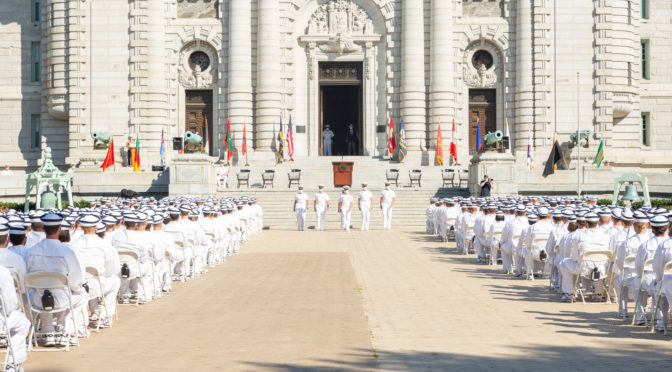
Featured Image: ANNAPOLIS, Md. (July 18, 2020) The United States Naval Academy holds an Oath of Office Ceremony for the members of the Class of 2024, Companies 16-30. (U.S. Navy photo by Stacy Godfrey/Released)
Sea Control 220 – On Contested Shores with B.A. Friedman & Timothy Heck

By Walker Mills

Tim Heck and Brett Friedman join the podcast for a great discussion about their new book, On Contested Shores: The Evolving Role of Amphibious Operations in the History of Warfare. Heck and Friedman talk about historical and future amphibious operations and provide a glimpse into the future of amphibiosity in the Marine Corps.

Download Sea Control 220 – On Contested Shores with B.A. Friedman & Timothy Heck

Links

1.On Contested Shores: The Evolving Role of Amphibious Operations in the History of Warfare, edited by Tim Heck and B.A. Friedman, Marine Corps University Press, 2020.
2. 21st Century Ellis: Operational Art and Strategic Prophecy for the Modern Era, by B.A. Friedman, Naval Institute Press, 2015.
3. Tactics: A Theory of Victory in Battle, by B.A. Friedman, Naval Institute Press, 2017.
4. From the Cold War to ISIL: One Marine’s Journey, by Jason Q. Bohm, Naval Institute Press, 2019.

Walker Mills is a Co-Host of the Sea Control Podcast. Contact the podcast team at Seacontrol@cimsec.org.

A Holidays 2020 Reading List

By the CIMSEC Sea Control Podcast Hosts

Aloha Shipmates! We at the CIMSEC Sea Control Podcast have put our heads together to come up with a “Holidays 2020 Reading List” or perhaps more appropriately named  “What We Were Able to Read This Year…” reading list. We’ve each chosen a few books that we read and loved this year and are at least tangentially related to international maritime security. We’ve also included a few that either we didn’t get to in 2020 or we’re looking forward to in 2021.

Walker Mills

Missionaries, by Phil Klay, Penguin Press, 2020. 

Missionaries is veteran author Phil Klay’s second work, coming after his award-winning collection of short stories Redeployment (2014). Well-received by U.S. and Colombian critics, Missionaries is a wrenching story about several characters coming together in Colombia as the government was finishing a peace agreement with the FARC in 2015-2016. Klay uses his characters and their lives to explore violence at the human, community, and system levels and its impact on the human soul. 

Feeding Victory: Innovative Logistics from Lake George to Khe Sanh, by Jobie Turner, Kansas University Press, 2020. 

Feeding Victory is an eminently readable book about logistics in war. Jobie Turner, an Air Force colonel, breaks down five different case studies in logistics – all unique in their own way. The history is mixed with analysis and takeaways for the contemporary practitioner. Perhaps most interesting to CIMSEC readers will be the Guadalcanal case study where Turner compares and contrasts Japanese and American expeditionary logistics in the months-long struggle for the island. 

Cod: A Biography of the Fish the Changed the World, by Mark Kurlansky, Penguin Books, 1997.

Though over twenty years old, Cod is still a riveting introduction into the world of commercial fishing through a deep dive into the history of a single fish: Atlantic Cod. Fishing is more relevant than ever – in 2020 the United States Coast Guard released an Illegal, Unregulated and Unreported Fishing Strategic Outlook,” massive Chinese fishing fleets off the Galapagos attracted international attention, and the United Kingdom has threatened to use naval vessels to protect its fisheries in the event of a no-deal Brexit. Kurlansky’s book is a quick read and each chapter includes a recipe for cod to help deal with the inevitable craving. Listeners can check out Sea Control 206 about the “Cod Wars” between Iceland and the UK or Sea Control 219 to catch a conversation with USCG Commandant Karl Schultz about the IUU Fishing Strategic Outlook. 

To-be-read:

The Kill Chain: Defending America in the Future of High-Tech Warfare by Christian Brose, Hachette Books, 2020.

Adaptation Under Fire: How Militaries Change in Wartime, by David Barno and Nora Bensahel, Oxford University Press, 2020.

Both of these are books came highly reviewed and despite the fact that I pre-ordered them I still have not managed to read them yet. But I’ve followed the authors’ work at War on the Rocks and intently listen to their podcasting. I’m sure these books won’t disappoint.

2034: A Novel of the Next War, by Elliot Ackerman and James Stavridis, Penguin Press, 2021.

Can’t overstate how excited I am for this one. Ackerman is a former Marine who has written several very good books, including the award-winning Dark at the Crossing, and Stavridis has written several previous books about leadership (including another book on this list) and his extensive Navy experience including serving as former Supreme Allied Commander at NATO.

Jared Samuelson

Learning War, by Trent Hone, Naval Institute Press, 2018.

Selling Seapower: Public Relations and the U.S. Navy, 1917-1941, by Ryan D. Wadle, University of Oklahoma Press, 2019.

These books are paired because they address the question “how did we get here?” for two different communities in the Navy. If you are a surface warfare officer, you have undoubtedly spent hours in the darkened cold of your ship’s Combat Information Center. How did that space come to be, why is it designed the way it is, and what problems was the Navy trying to solve? Learning War addresses all those questions and, if that weren’t enough, you get a graduate-level discussion of the evolution of the officer corps and some early 1900s ship design. Listen to Sea Control 209 with author Trent Hone to learn more. I thought Selling Seapower did much the same for today’s public affairs community, from its birth in the Office of Naval Intelligence, the development of the collateral duty Public Affairs Officer, and the Navy’s relationship with mass media (spanning early radio to film). 

The Alice Network: A Novel, by Kate Quinn, William Morrow Paperbacks, 2017.

The best possible endorsement I can give this book is that I read it in less than 48 hours while co-parenting an infant and doing my day job. It was that good. The pace is incredible and the historical setting will have you picking up your phone to Google “did X really happen” multiple times. The author’s follow-up, The Huntress, is sitting on my to-be-read pile.

The Riddle of the Sands, by Erskine Childers, Modern Library, 2002.

Originally printed in 1903, The Riddle of the Sands was a recommendation from an old friend and former CO that took me completely by surprise. The book is the story of two friends ostensibly on a late summer sailing expedition in the Baltic and North Seas who stumble onto a sinister plot whilst being pursued by German agents. No less than Winston Churchill cited the novel as a reason the British ultimately established multiple naval bases on the North Sea prior to World War I.

To-be-read:

Grey Dawn: A Tale of Abolition and Union, Balance of Seven, 2020, by Sea Control 163 guest and now host of her own podcast, Friday Night History, Dr. Nyri Bakkalian. 

How the Few Became the Proud, Naval Institute Press, 2019 by Sea Control 184 guest Dr. Heather Venable. I have a literal signed copy just waiting to be cracked open. Massive personal failure on my part.

Wargaming Experiences: Soldiers, Scientists and Civilians, by Natalie Wojtowics, J10 Gaming, 2020.

Battle in the Baltic: The Royal Navy and the Fight to Save Latvia & Estonia, 1918-1920, by Steve R. Dunn, Naval Institute Press, 2020.

This book seemed like a logical successor after reading Michael B. Barrett’s Operation Albion: The German Conquest of the Baltic Islands in preparation for Sea Control 168. Cautiously optimistic the author will be coming to a podcast near you in 2021!

Anna McNeil

Can’t Hurt Me: Master Your Mind and Defy the Odds, by David Goggins, Lioncrest Publishing, 2018.

If talks about resilience and hope are ringing empty in your ears this holiday, or you feel depression and disempowering thoughts setting in, this is the book I suggest you begin with. Cultivate the knowledge that you can and will get through to a brighter future. Then, move forward with intention for the new year ahead.

Honor Harrington series, by David Weber, 2002-2017.

Science Fiction. Space Navy. Military-Industrial complex. Vast sprawling strategic positioning and tactical level skirmishes. Personal assistant on the Commander’s shoulder and in her ear. A female protagonist who lives up to the name Honor. The first of this series, On Basilisk Station, was given to me by my grandfather, a retired U.S. Navy Electronics Technician. It was a large part of the reason I considered joining the Navy. The best fiction is that through which we can more clearly imagine possibilities for ourselves in the real world. Fiction lovers can check out the wrap-up of CIMSEC’s Fiction Week in Sea Control 216 with an interview of the winning authors Mike Burke and Nick Nethery. 

The Good Shepherd, by C.S. Forester, reissue by Penguin Books, 2018.

Yes, Hollywood made a movie of this already, but the discussion on social media about the proper use of helm commands doesn’t even scratch the surface of how much justice is done to the seagoing service. Read the first ten pages and you’ll see why I was suddenly inspired to write Steering Casualty and Tactical Signals drill cards.

To-be-read:

Navigating the Seven Seas of Leadership: Leadership Lessons of the First African-American Father and Son to Serve at the Top in the US Navy, by MSCM (ret) Melvin G. Williams Sr., and VADM (ret) Melvin G. Williams, Naval Institute Press, 2011.

Wisdom direct from the experiences of one very special military family, written down and offered to the benefit of anyone willing to read it. This book was written with such generosity and goodwill toward all mankind that it simply must be on my holiday reading list.

The Military Lens: Doctrinal Differences and Deterrence Failure in Sino-American Relations, by Christopher P. Twomey, Cornell Studies in Security Affairs, 2010.  

I suppose this could be considered a book about peace on Earth. Or rather, understanding how to use the military to lead options other than shooting wars.

Icebound: Shipwrecked at the Edge of the World, by Andrea Pitzer, Scribner, 2021.

Get ready to be transported out of your own struggles into the tale of the famous polar explorer William Barentz’s year-long fight for survival in the Arctic. Out in January 2021! 

Jonathon Frerichs

Fleet Tactics and Naval Operations, Third Edition, by Wayne Hughes and Robert Girrier, Naval Institute Press, 2018.

 A Brief Guide to Maritime Strategy, by James R. Holmes, Naval Institute Press, 2019.

During a month-long temporary duty assignment to Naples, Italy, I recognized that I utterly lacked an understanding of how the Navy operates (despite having deployed on three different Marine Expeditionary Units, or MEUs). Seeking answers, I picked up Fleet Tactics and Naval Operations from the Navy Exchange on base. With nothing else to do in the evenings but eat Napoli pizza, I quickly devoured the book and found it immediately valuable in expanding my knowledge of naval operations. Upon completion, however, I found myself thirsting for a better understanding of how naval forces have contributed to obtaining national strategic objectives. 

Enter A Brief Guide to Maritime Strategy – a perfect complement. This short, digestible book is power packed with historical examples and an easy-to-apply framework through which to look at the application of naval forces from competition to crisis to conflict. For either the military historian or the naval practitioner, this book is guaranteed to be a great read and valuable resource. 

The Art of War: A New Translation by Michael Nylan, Sun Tzu, W. W. Norton and Company, 2020. 

I have digested bits and pieces of various translations of The Art of War over my career, but never sat down and read it cover to cover. When I saw @teaandtactics recommend the book, I decided I would bite and resolve my academic shortfall. Combining a depth of Chinese history and a nuanced fluency of the Chinese language, Nylan has created a translation that is easy to read, cover-to-cover. Additionally, in her introduction she provides an opportunity to apply the ideas of strategy and conflict to life outside of war. 

To-be-read:

To Rule Eurasia’s Waves: The New Great Power Competition at Sea, by Geoffrey Gresh, Yale University Press, 2020.

Just received my copy of this book. Upon a quick scan, I am excited to digest the multinational look at great power competition in the maritime domain. Many recent books have focused on looking at great power competition through a bipolar lens (Russia/United States or China/United States) but this book appears to take a much more expansive and systemic look at how great powers compete in the maritime domain. If you’re interested in To Rule Eurasia’s Waves, be on the lookout for a future Sea Control episode. 

The Pacific War trilogy, by Ian Toll, W. W. Norton & Company, 2011-2020.

I continue to see these recommended from military history scholars and servicemembers alike.

Andrea Howard

If 2020 did not provide enough existential fodder for society, The Master Algorithm: How the Quest for the Ultimate Learning Machine Will Remake Our World  Basic Books, 2018, by Pedro Domingos serves as one of the best introductions on how machine learning – and the prospective development of a unifying master algorithm – will forever alter the world. Unsupervised learning algorithms can structure and illuminate meaning from raw data, and the naval-oriented mind will see the innumerable applications from fire control systems to underwater mapping. 

Shifting over to a work that explicitly discusses the impact of cyber developments in the warfare domain, I recommend Cyber Security and Cyberware: What Everyone Needs to Know by P.W. Singer and Allan Friedman, Oxford University Press, 2014. While exploring the ramifications of the Stuxnet virus and cyber units within the American and Chinese military structures, the authors outline how future conflicts will touch every individual via cybercrime in the financial realm and attacks on infrastructure. 

To round out the two above choices, the Commandant of the Marine Corps’ top choice for 2020 is a strategic must-read. The Kill Chain: Defending America in the Future of High-Tech Warfare by Christian Brose, Hachette Books, 2020 explores the emerging technologies that present disturbing threats to American military superiority, but he also advocates for the development of a battle network of systems (a “kill chain”) to uphold deterrence and ultimately prevent war. 

To-be-read:

For my upcoming deployment, I’m intending to bring along The Leader’s Bookshelf by Admiral James Stavridis and R. Manning Ancell, Naval Institute Press, 2017 to consume the lessons learned from the active and retired four-star military officers’ habits and favorite books. The promised efficiency will be necessary for the small bits of time afforded before hitting the rack and awaking for watch.

Readers and listeners can get to know the podcast team better by listening to Sea Control  214 “Meet the Team!” or finding us on Twitter at @jwsc03@AndreaR_Howard, @WDMills1992, @2BAtSea, and @hoplitemarine

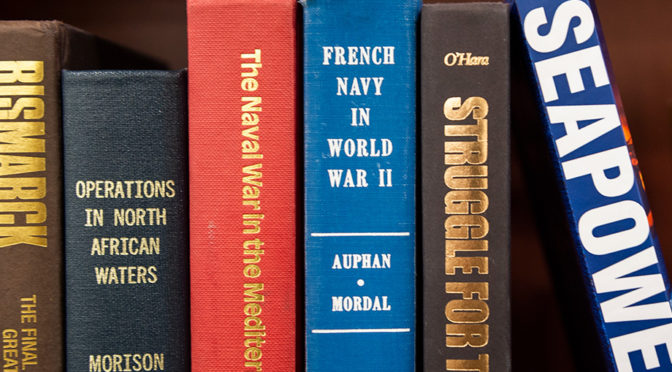
Featured Image: Book collection, photo via the U.S. Naval War College.

Bilge Pumps Episode 30: Christmas Special with Cmdr. Michael Clapp & Maj Gen. Julian Thompson

By Alex Clarke

Bilge Pumps, Episode 30. This is it, the Christmas Special you have all been waiting for! The regular Bilge Pumps Crew is joined by Commander Michael Clapp (ret.) and Major General Julian Thompson (ret.) – the command from the Amphibious Task Group, the Inshore Squadron, and 3rd Commando Brigade during the Falklands War. We hope you enjoy the conversation and have as much fun listening to it as we did making it.

For those interested in taking part in our competition, please send your PDF submissions to Bilgepumpsofcimsec@gmail.com by January the 10, 2021.

#Bilgepumps is still a newish series and new avenue, which may no longer boast the new car smell, in fact decidedly more of pineapple/irn bru smell with a hint of jaffa cake and the faintest whiff of cork. But we’re getting the impression it’s liked, so we’d very much like any comments, topic suggestions or ideas for artwork to be tweeted to us, the #Bilgepump crew (with #Bilgepumps), at Alex (@AC_NavalHistory), Drach (@Drachinifel), and Jamie (@Armouredcarrier). Or you can comment on our Youtube channels (listed down below).

Download Bilge Pumps Episode 30: Christmas Special with Cmdr. Michael Clapp & Maj Gen. Julian Thompson

Links

1. Dr. Alex Clarke’s Youtube Channel
2. Drachinifel’s Youtube Channel
3. Jamie Seidel’s Youtube Channel

Alex Clarke is the producer of The Bilge Pumps podcast.

Contact the CIMSEC podcast team at Seacontrol@cimsec.org.

Fostering the Discussion on Securing the Seas.