
Perspective

Fiction Week

By Daniel Lee

The following takes place between the hours of 1000-1100 SMT on the surface of the planet Jyrmfür. Dominion forces occupy a heavily-fortified research complex under a large mesa, designated Tango 419.

Union forces are directed to capture it intact at all costs.

THE ANT

A shell impacted not more than five meters from Line Private Michal “Stef” Stefanovich’s head as he lay face down in the mud. Luckily, a shallow berm shielded him from most of the shockwave, but it was still close enough to bounce his grey matter around. He shielded his head with his arms as bits of fragmentation, rain, and mud rained down on him.

“FUCK!” he heard someone yell. “Stef, ya good?!”

Stef coughed out a ball of mud before rasping out, “Yeah, bell’s just rung.” He did a quick check for blood—arms, legs, pits, and most importantly, groin—and once he was reasonably satisfied, grabbed for his rifle. It was a simple weapon: the R21A2 Trecoran Union Marine Corps standard issue rifle, designed to fire ultramax caseless 85 grain 6.5x30mm chemically-propelled rounds at 1,200 meters per second. It had fancy recoil-dampening pods and holographic sighting systems, sure, but it was basically the same rifle his grandpappy used. The unrelenting rain made the grip slick in his hand, so he quickly used his sleeve to wipe down the weapon before scrambling up the last few meters of hill to rejoin his squad.

Once at the top, he quickly slid into the crater where his squad was taking cover, his S-LINK lighting them up with green outlines on his helmet HUD. He landed close to where Line Private “Yip” Buckley and squad newbie Private Oskar Ramirez were going cyclic with their R60 machine guns. Unlike the R21, R60s were designed for cased rounds to aid heat dissipation. This was not lost on Stef as he received a face-full of hot thermalloy. He swiftly rolled away and got to his feet as the senior gunner yelled at the junior to watch his fire rate. “You’ll burn out the fucking barrel, dumbass!” Yip yipped.

Stef shoved himself past the Doc, who was busy applying biofoam to the stump of Private Pete Nakahara’s right arm, and took a firing position next to the squad leader, Corporal Jenn “Hick” Tennyson. She was attempting communication with the platoon commander in her thick Yolloran countryside accent: “Nah, WRAHNG, I nee’ to talk to Lew-tenan’ Helman! No, naht— god-DAMN this weather, man! Comms’ shot to shit!”

“Need a runner, Hick?” Stef offered.

Hick waved him down. “Nah, Doms an’ tinskins pushin’ us. Kill somethin’!”

Stef poked his head out of cover just in time for a flash of lightning to illuminate the battlefield. Tango-419 stood tall, menacingly, off to the north. The base of the mesa had to be at least a kilometer away, but it was hard to tell through the downpour. Opposing forces were dug in tight, artillery and laser emplacements all along the sheer face of the mesa. The guns were firing at such intensity that the entire mesa appeared as one, long, continuous firework. Angry storm clouds swirled into dark peaks above, disgorging a constant barrage of sparks and moisture. A loud shriek overhead and a brief green flicker indicated the passage of a pair of friendly Albatross gunboats. They unleashed a torrent of 25 mike-mike on the mesa and swooped away. Even if the squids in orbit had their thumbs up their ass, at least they sent the flyboys to help out.

Stef looked down at the plain descending from the mesa. An angry mess of red outlines popped in and out of focus as S-LINK fought through hostile jamming and weather. Dominion forces had deployed drone combatants, humanoid in form but almost spider-like in movement, to flush them from cover and provide a buffer for the mesa. These served to augment the human combatants who also acted as local drone controllers. Stef spotted a few of these controllers scrambling through the mud behind their metal puppets.

He sent rounds downrange as quick as his finger would let him. He took down a few clankers as they scrambled down a muddy slope barely 100 meters away. The drones’ controller fell out of cover behind them—having maybe slipped on the mud—and Stef put three rounds in him, center mass. He emptied the rest of his mag at vague red outlines farther away, hunkered down to reload with the practiced hands of a Marine infantryman, and resumed fire.

Stef and his squad laid down the hate, taking out bot after controller after bot. However, the mass of red outlines only seemed to get larger and his ammo count smaller. As he felt his bolt lock back once again on last round fired, he reached down for another mag and found only empty pouches. “Need a spare mag!” he yelled. Before anyone could answer, he felt something slap him in the face, throwing him back into the mud.

On instinct, he immediately crawled back as far as he could in the crater. He put a hand up to his face and felt something warm trickle down. Hopefully just a graze. He started feeling around for his rifle, and through the gunfire he could hear Hick yelling into her helmet comm, “We’re bein’ overrun! Are there any available assets tha’ can provide assistance…”

Before she could finish her sentence, an ear-splitting crack far louder than any lightning bolt resonated through the air. Stef then saw multiple fireballs emerge from the clouds above, followed by a cloud of small dark objects that acquired a green S-LINK outline on approach. One of these objects cohered into the shape of a man as it descended, slowing on final approach until he landed before Stef like some sort of heaven-sent angel. The man was clad head-to-toe in armor, torso and limbs encompassed in a sinewy exoskeleton, and he carried a rifle Stef had only seen on the net.

Stef stared. “Holy shit,” he exclaimed. “They sent HERA.”

THE BEETLE

Staff Sergeant Vitas “Vee” Lundy grunted as the Disposable Reentry Vehicle was thrust out of the launch bay, forcing his stomach into his throat. Once the DRV was free of UNS NEW PRINCETON and began its plummet towards the planet below, weightlessness overtook him.

He took a moment to survey 2nd platoon, his people, through the dim red interior lights. They were harnessed into their shock seats around the outer perimeter of the drop pod, 36 in total. They were all clad head-to-toe in pressurized armored suits capable of handling both bullets and vacuum. On their backs were displacement packs, or d-packs: essentially miniaturized reactionless warship thrusters that enabled them high mobility in both zero-g and on the surface of a planet. A sinewy exoskeleton extended from their chest rig to all four limbs, giving them enhanced strength and endurance. While older models might have used clumsy pistons and hydraulics, these newer ones utilized artificial muscle for maximum range of motion and fidelity of movement. On each of their shoulders was a patch: a sword thrust vertically into a star, backed by spread eagle wings, encircled by their moniker – Hazardous Environment Reconnaissance and Assault.

Vee thought back to the day he made it through six months of hellish training at the Special Operations Training Course, two months of special tactics and demolitions school, and four months of the hazardous environment assault course to finally stand in front of Marshall Angelopoulos to receive his HERA star. He was proud. Proud to be the only force trained to fight in every environment, from sulfuric acid rain-soaked moons to the cold of deep vacuum. Sure, the Navy SPALS claimed to do that too, but they were only visiting. Marine HERAs lived in it.

And now they were plummeting at celestial speeds into a thunderstorm.

“Alright boys,” 1st Lieutenant Ben Milas yelled from beside him, attempting to maintain his equilibrium through the increasing turbulence. “Attention to brief! As always, the regs down below need our help. Dominion forces are pushing out from Tango 419 and stalling the assault. Our company will be reinforcing weak points along the line. We have no armor support, but we do have a few Trosses providing close air support. Comms are shot to shit from the storm, so we’ll be relying on IR poppers to call in airstrikes. We also won’t be able to talk to each other past shouting distance, so once you land, regroup on my IR beacon, and then we kill everything in between the LZ and Tango 419. Oorah?”

“Rah, sir,” Vee responded. The platoon also erupted into a chorus of “Rah!” and “Kill!” in acknowledgement. Only moments later, the red interior lights snapped to green.

“To hell!” Vee roared as his seat was abruptly yanked backwards and into the atmosphere. The seat harness blew loose and soon he was freefalling towards the surface below. All around him he could see the rest of his HERAs scattering from the pod almost like dandelion fluff. The DRV had done its job shielding them on reentry, and now each individual HERA would maneuver themselves the rest of the way. Pods were easy to track and shoot down; individual humans flitting around with d-packs, not so much.

To aid them in their landing, the DRV ejected its three supply pods—each jetting towards pre-determined landing sites—then rapidly deconstructed into a cloud of metallic chaff and fireballs to confuse anti-air targeting systems. The decoys continued to bloom in intervals as the remains of the DRV fell, leaving a trail of cover for the drop. It continued into the sea of dark clouds, and the HERAs followed.

The upper cloud layer hit Vee like a brick wall. He couldn’t see much at all as the howling wind buffeted him and the moisture saturated his visor. He breathed slowly and deeply, calming his nerves and keeping an eye on his altimeter. At a bit less than a kilometer above the ground, he broke through the last layer of clouds and tried to survey the battlefield below. Unfortunately, an Albatross gunboat abruptly screeched past him, sending him tumbling. He used his d-pack to steady himself, cursing. Goddamn flyboys.

The ground came up quickly; he maneuvered his feet downwards and rapidly decelerated. With a loud squelch, he landed inside a crater next to a squad of Marine regs. One of them was on the ground with a bloody cheek, looking straight up at him. “Holy shit,” the reg exclaimed. “They sent HERA.”

“Glad to be of service,” Vee grunted through his helmet’s voicebox, and helped the Marine to his feet. “Supply pod landed 200 meters east. Move!”

The Marines followed him without question. Alternating covering fire, they pushed towards the supply pod. Vee managed to tag at least a half dozen clankers with his XR-5 coil carbine; 25 grain ferro-tungsten projectiles magnetically accelerated to 3,400 m/s had enough oomph to put them down with a single shot each. Thankfully, the carbine’s displacement compensators reduced the recoil to a polite suggestion.

Once at the supply pod, he left the regs behind to rearm while he looked for his platoon commander. Using the mobility and strength his kit afforded him, he sprinted through the rain and leapt over entire hills until his HUD obtained a visual on Milas’ IR beacon. On final approach to his platoon commander, he landed next to a Dominion controller fumbling with his rifle. Without hesitation, he slammed his armored fist into his chin, snapping his neck instantly. One more leap and he was by Milas’ side. At least half the platoon was already gathered.

“Lundy, glad to see ya. Take the left flank. We’re pushing!” Milas ordered. The lieutenant then leapt away, his men following. They circled and weaved around the battlefield, providing staggered covering fire, dodging the hardened defenses and poking into small weaknesses in the enemy line. As they advanced, they came across a pocket of regs encircled by drones. Coordinating with wordless fluidity, Vee took a squad to the left while Milas took the rest to the right to flank the assaulting bots. They were quickly decommissioned, and their controllers were rooted out and similarly dispatched.

“Hell yeah, absolute badasses!” one of the Marine regs yelled.

Vee wasted no time. Rallying the regs, he formed a line for the final 200-meter push to the foot of the mesa. Once they had collected to some semblance of a battle line, he turned to Lieutenant Milas—who was crouching by the crest of a nearby berm—and gave him a thumbs up. Milas responded in kind, stood up to lead the charge, and immediately evaporated into red mist.

“Fuck!” The curse escaped Vee’s lips reflexively as he hit the deck. The other Marines did the same. Just in time, too, as a barrage of cannon fire tore across the top of the berm where Milas used to be. A reg next to him split in two. The upper half had enough air in her lungs to let out one last excruciating scream before exsanguinating and going quiet.

A HERA close to the top of the berm, Corporal Blanchard, slid down next to Vee. “ADP, between us and Tango-419,” she reported. “Must’ve just climbed down the mesa. It’s got the whole area locked down.”

Vee grimaced. Area Denial Platforms were nasty work. Basically, an armored disk on four legs covered in MGs, cannons, and mortars, they couldn’t move fast but anything short of a Breacher tank wasn’t getting past it.

Time for some heavier ordnance.

“Corporal, get a popper on that sumbitch. Full ordnance, whatever’s available.” Blanchard nodded, pulled a small cylindrical object from a pouch, typed something into it, and leapt to the top of the berm. Once at the top, she threw it with all her might towards the ADP; her powered suit let it fly much farther than any ordinary human could throw, and the IR beacon landed directly underneath the four-legged behemoth.

THE SPARROW

Lieutenant Commander Raella “Beans” Adebayo adjusted her craft’s HUD brightness for what seemed to be the hundredth time today. The rain streaking across the canopy and cameras coupled with the occasional lightning flash made it a less-than-ideal environment for sight. Her G/A-17D Albatross gunboat was equipped with top-of-the-line sensors, radars, and lidars, but vision was still a nice thing to have. Not to mention the fact that she had almost splattered a deploying HERA not twenty minutes beforehand.

She and her wingman, Lieutenant Robert “Tin Man” Fumbernickel, had been on station and dropping ordnance for the last forty minutes. Beans did a quick status check: battery and heat sinks were good, but she only had a few hundred rounds left on the 25 mike-mike. Nothing on the bomb racks.

“Nimble 2-2, this is Nimble 2-1, ammo check, over,” she queried.

“Nimble 2-1, Nimble 2-2,” Tin Man responded, full of static, “I’ve got two MK33’s and about…uh… 17 rounds of 25. Over.”

So two 500kg bombs and essentially winchester on the gun. Beans started considering pulling back to orbit to rearm when her HUD caught something near the surface. The gunboat’s sensors had picked up a friendly IR beacon, holographically displayed as a pillar of red light emanating from near the foot of the mesa. The computers decoded its message: URG-AAO.

An urgent request for all available ordnance on the beacon.

“Nimble 2-2, we’ve got a fire request. Fall in behind. I’ll lead with a gun burst then you drop the MK33’s.”

“Nimble 2-1, wilco.”

Beans nudged the vector stick to the left and pushed up slightly on the scalar stick, banking to port and gaining airspeed. She lined up her craft with the beacon to get a good targeting solution. Not that she needed it; the target was readily apparent by the presence of the 20-meter tall 4-legged behemoth spitting hot death.

On the approach she switched to gun mode. The computer made its calculations and, once in range, changed her HUD’s gun pip to red while nagging into her helmet: “GUN. FIRE. GUN. FIRE.” She squeezed the trigger on the vector stick, causing her entire airframe to vibrate with the violence of magnetically accelerating 276 25mm cannon shells downrange in less than three seconds. A line of impacts erupted on the ADP’s armor.

She pulled up as soon as she was dry and witnessed Tin Man do the same, sans two Mk33 bombs. A moment later, two bright flashes. Another moment later, a shockwave.

Beans pulled around to do a quick BDA. The remains of the ADP lay motionless on the ground, and she could already see HERAs leaping over the wreckage towards the mesa. Their job was done.

“All wings, this is Nimble. We’re RTB to rearm and recharge.” With that, the two gunboats disappeared up into the storm clouds.

THE EAGLE

Aboard the amphibious assault ship UNS NEW PRINCETON, in the dim blue light of CIC, Captain Ronald Bailey stood with his hands clasped firmly behind his back. He stared intently at the large tactical viewscreen dominating the center of the room. On it, he saw…nothing. Static. Error codes. A camera view of the source of all his frustrations: a freak electromagnetic storm that none of the xeno-METOCs had predicted.

Flank Admiral Isaiah Varnum, the Commander of the Amphibious Task Force, approached him. “Captain. Status report.”

Captain Bailey suppressed a sigh. “Nothing yet, sir. We deployed HERAs about thirty minutes ago. We’ll debrief any pilots that return.”

“Hmph. Well, find me in my ready room when you decide to be useful,” the Admiral harumphed, and departed.

The Captain released his sigh and continued to observe the screen.

Daniel Lee commissioned as a surface warfare officer, nuclear (SWO(N)) in 2016. He served on USS ASHLAND (LSD-48) out of Sasebo, Japan as first deck division officer. After qualifying in nuclear power school, he spent two years on USS GERALD R. FORD (CVN-78) in Norfolk, VA. He has previously worked in the International Surface Warfare Officers school in Newport.  He has honorably discharged from the U.S. Navy and is now working as an engineer at Palisades Nuclear Power Plant in Covert, Michigan to assist in its historic restart effort. He is the author of SWOES, a weekly comic based on life as a junior SWO.

Featured Image: Art created with Midjourney AI. 

Fit to Print

Fiction Week

By Ben Van Horrick 

15 April 2027, 2354 EST
620 Eighth Avenue, New York, NY

“Who else has this picture?” said Abe Collins, the Times‘ senior-most editor tonight.

“The Teddy is sinking. Everyone has this — it’s everywhere on X and Telegram,” said Nora Nelson.

“Yeah…and?” Collins shot back.

“People will see it if they want to.”

“This is a fucking aircraft carrier sinking, not snuff film footage. Do people need to see this?”

“Do we want the parents to see it first on social media?” Nora countered.

“Better in print than on X,” Collins replied.

The USS Theodore Roosevelt was struck and sinking. Flash reports on X provided little detail, but then images appeared from a Japanese fishing vessel. The Starlink connection beamed the images of fire and smoke from the South China Sea.

Collins went quiet, staring at the screen.

Nora looked away.

Midmorning sun draped the ship in a haunting glow as black smoke rose from the deck, swallowing the carrier’s gray hull. The bridge remained intact, jutting into the sky like a cathedral steeple, resolute against ruin. The ocean’s blues framed the metal gray and billowing black, colors locked in merciless contrast. At first, the shapes on deck appeared no more than specks, but they were flesh and bone, animated by terror. Some scattered across the flight deck. Some rushed to their stations above. Others hurled themselves into the sea, bodies rigid as arrows, human prayers cast to the whims of the waves, escaping the creeping inferno that consumed the carrier.

“How can we verify this?” Collins demanded.

“Fuck if I know,” Nora said, typing a message on Slack to summon anyone left in the art department.

In front of Nora and Abe was a screen powered by a Times AI writing program named Turner, in honor of the paper’s former editor Turner Catledge. The program had already written the first draft of the carrier’s sinking. Sentences appeared every few seconds as the program scraped social media for details, combining fragments into narrative. Abe and Nora were supposed to supervise, ensuring the algorithm generated the story and correcting its missteps.

Abe toggled left to shut down Turner.

“We write history’s first draft. Not fucking machines.”

Abe had covered Kabul’s fall as a freelance reporter before The Times rehired him.

When Nora’s series on the destabilizing effects of Chinese debt deals in Africa had been dismissed as too nuanced and dense, Abe fought for it.

“Who else will tell the story?”

Abe won the argument. The series ran, and Nora won the Pulitzer for the story.

When Nora got kidnapped in Africa, Abe led the effort to raise money and awareness of Nora’s plight. Upon her return, Abe recruited Nora to work on features, offering relief from the tyranny of the daily deadline.

“It’s not Africa, Nora. Take a knee.”

When war broke out with China, the editors needed steady hands, turning to Nora and Abe. The flurry of news wilted the newsroom staff. For Abe and Nora, it was a rebirth. For the past 96 hours, Nora and Abe had remained in the office and napped where they could. Staffers checked on them with a mix of concern and intrigue.

Rolling blackouts and internet outages choked the once torrential news coverage to a trickle. The Times generators and Starlink kept the paper running as best it could. The physical copies of the paper became prized once again, an authoritative truth in a landscape of rumor, speculation, and darkness.

Abe and Nora had culled their contacts over the past four days — spies, aid workers, operators, journalists, academics, and profiteers. War attracts the best and worst of humanity. Abe and Nora’s notifications came from across the globe with varying motives, ranging from noble to nefarious.

War extracted its toll on Nora and Abe, leaving ghosts for each to wrestle with, but the events of the past week kept their ghosts at bay. In fact, they felt much happier because, in this instance, they felt needed again.

Nora and Abe possessed a tolerance for risk and pain that others did not and likely would never possess. Here they both thrived, calm and direct as the news cycle spun out of control.

Abe and Nora were the final line of defense in the newsroom as AI and inexperienced reporters jeopardized coverage and the paper’s credibility.

“I knew the parade would start again,” Abe said longingly.

“You seem happy about this,” Nora accused.

“Happy? No. Surprised? No. Glad to be here when it happened? Yes.”

Nora nodded.

“Job security for us, Nora.”

Nora and Abe compared notes and shared contacts. They thumbed through Signal looking for a Pentagon public affairs officer or trusted contact who could or would confirm the picture.

“Do you think we need a source?”

“We do. It might be accurate, but do you want this paper to be co-opted by the CCP?”

“Half the nation thinks we already are.”

“Fair enough.”

“Who can we call?”

“Marcus Riordan?”

“Yeah, is he still alive?”

Colonel Marcus Riordan, a MARSOC Marine who made his name in every war zone. A man not made for his time, Riordan’s talents, sensibilities, and personality made him a lightning rod within the community. A peer called him, “Ollie North on meth.”

Now marooned at the Pentagon, Riordan might have information. But more than anything, he always took Abe’s calls.

Riordan’s team had provided security when Nora was released. The image of his linebacker frame and lip full of tobacco was a welcome sight for Nora.

Abe dialed Riordan on Signal and placed the call on speaker.

It rang before cutting to dead air.

Thirty seconds of silence passed. Then the phone buzzed ­— Riordan called back.

“AC, what is happening? Little busy, hombre.”

“Colonel, we got a picture we think is the Teddy.”

“Yeah…”

“Marcus, Nora here.”

“Jesus, Nelson. You okay?”

“Is the picture of the Teddy?”

“You printing this?”

“Is it the Teddy?”

“You answer mine first.”

“If it is, we will run it.”

A pregnant pause.

“It’s the Teddy. It’s real. In an hour, it will sink.”

The line went silent.

Abe stared at the screen showing the burning carrier. In an hour, those specks on the deck would be gone. The parents Nora had mentioned would learn their children’s fate from a newspaper photograph rather than a knock on their door.

Nora closed her eyes.

“Abe…”

Collins turned his back to the screens. His voice was quiet.

“Run it. Front page.”

Major Benjamin Van Horrick, USMC, serves at the Department of Defense Inspector General.

Featured Image: Art created with Midjourney AI.

The Henry Protocol

Fiction Week

By LCDR Joe Huskey

He leaned against the table, bent over at the waist. His breathing ragged, his heart raced, beads of sweat ran down his face, dripping from his chin and nose. Small pools began to form on the various charts and notes spread out before him. This was the production table, filled with battle schemes, strategy diagrams, and binders filled with standard responses to a variety of warfare scenarios. They were all a blur to A.J. now as he blinked in arrhythmic successions.

The battle simulation was like a marathon. There were rows and columns of television screens that spread around him in a semi-circle displaying visual battle cues and problem-sector scenarios. Bright light glowed from the screens, the only source for that dark space with the exception of the low-level blue work lights overhead. The screens all faded in unison into a common message. Now on screen were bright white text set on a black screen. “Blue Victory,” it said.

“Fourteen hours and thirty-five minutes,” the proctor said in a plain voice as he entered the tactical operations center. This is where A.J. had just finished his commanding a simulated joint force against a computer-generated adversary. “Very good, Colonel Roark,” he continued while scribbling notes onto a digital work-pad with a little plastic pen tipped with a rubber nub, a stylus of sorts.

A.J. stood up from his leaning rest and looked around the room. It was all black, ceiling to floor, the lights from the semi-circled monitors cast a dull glow on everything around them. There was the large production table in the middle and two rows of long tables in front which had numerous computers on them. Seven operators in unmarked uniforms sat at those consoles. During the simulation, they would swap out regularly, ensuring they did not fatigue while taking orders in rapid succession from A.J. Now, they were all turned in their chairs, focusing their collective attention on the colonel, anticipating the debrief.

The proctor was an Army Major General named Womack. He had two stars on his collar and a ruddy, stoic grimace on his face. He flipped a switch which shifted the blue-lights overhead into bright, white lights, washing the room in brilliant fluorescence. The new illumination made his demeanor appear even more grim. In fact, he had shown little-to-no emotion whatsoever over the past three days of in-briefing.

He tapped a sequence on his tablet with his stylus. The screens around the room changed their text from the victory message to a Battle Damage Assessment. “Please refer to the forward screen for your results,” Womack said.

New words flashed onto the screen in the same white text, black background format. A.J. read them faster than the Womack could announce them, but he paid close attention to the debrief all the same.

The general began, “Blue Force Casualty rate: 47%. Adversary Casualty Rate 51%. 12 billion dollars in Blue Force equipment damage. Loss of 62% Blue Force logistical capability. 92% loss of adversary logistical capability.” He droned on, reading out selective figures from listed results from the scenario.

“That’s very good?” A.J. asked with a respectful tone.

“We would like to see less Blue Force casualties and a better protection of friendly equipment,” Womack replied, “but the adversary casualty rate is the highest we’ve recorded yet.” He broke eye contact with A.J. and jotted another note down on his tablet.

Sweat continued to roll down A.J.’s face. Despite being winter in Virginia, the simulation required things to be as close to a battlefield environment as practical. This meant that the temperature was cranked up above 100 degrees to force the subject to manage not only a battlefield, but also endure dry, hot, and loud stimuli. Although A.J. barely moved from the perimeter of the production table, he had likely paced miles moving back and forth throughout the long day, all in an artificially stressful environment.

Using his sleeve, A.J. wiped his forehead. “So, the real question is, did I pass?” He asked. There was no smile on his face or in his eyes. He was physically and mentally exhausted. The scenario required his complete attention for its duration. With every problem he solved, every complication he overcame, and all creative counter-tactics that he employed, a fresh wave of increasingly difficult opposition followed.

“It doesn’t work like that,” Womack answered. “There is no rubric here: only win or lose. In this scenario, you won. Your victory didn’t come without sacrifice, but you decidedly chose the right losses to take in order to overcome the adversary.”

“Forgive me, sir,” A.J. started, “but it is hard to quantify a level of success without understanding the rubric. The in-brief provided very little in the way of battle metrics.” He took a deep breath and tried to slow his heart rate before his next statement. There was a second of pause for him, unsure if he should push the envelope. However, nearly fifteen hours of uninterrupted decision making and constant stressors had worn away most of his decorum. “I think I’m owed a little more of an explanation for what I was just tested on.”

The request was intended to hold the timbre of discipline and respect, but it nonetheless came out with an obvious note of venom. There was another beat of silence, and then he remembered something important that he forgot to say: “Sir.”

“Colonel, your understanding is not important to the outcome of the simulation,” Womack said. He had raised his voice a little, the first real sign of emotion. “If you knew everything then it wouldn’t be a real test.”

“Again, forgive me,” A.J. said, wiping sweat from under his nose and chin, “but that sounds like bullshit.”

The general let out a refrained sigh. “Gentlemen,” he said in a plain tone, holding unwavering eye contact with A.J., but speaking to the other men in the room, “give me and the Colonel the room.”

The seven console operators all stood up and shuffled out of the one door of the simulation room. No one spoke, they barely breathed. They did not want to draw any undue attention from the two men who were attempting to stare each other down.

The door to the room had closed behind the operators, leaving the colonel and general alone with oppressive tension. Their staring match continued for a moment more, neither blinking.

The General huffed, tapped his pad with his stylus while still staring directly into A.J. The screens changed again. Each displayed a different image: Some outlining lines of information, others displaying pictures of A.J. at various stages in his career.

A.J. was the first to break his glare, distracted by so many monitors detailing a very specific storyline of his life. “What the fuck is this?” he asked with zero bearing, turning his gaze from the monitors back to Womack.

“Andrew John Roark, Colonel, United States Marine Corps,” he began. “Enlisted in 2003 as an Infantryman but picked up Infantry Unit Leader M.O.S. 0369 very quickly. Recognized for your capabilities, you were recommended and then accepted into a commissioning program, excelling at strategy and assigned as a Marine Air-Ground Task Force Intelligence Officer. Serving in collection and planning roles in Iraq and Afghanistan, and then assigned in special, clandestine combat roles in Eastern Europe.”

“Wait,” A.J. broke in, “the Europe Op was sealed. How did you…”

Unmoved, the General continued. “Volunteering for combat whenever able, however being assigned duties as staff planner and strategist despite your eagerness for continued groundwork.”

“What’s your point?” A.J. asked again but was ignored.

“Post graduate education at Princeton and the Naval War College, both focusing on Strategy, Technology, and Advanced Warfare. Fellowships in both the Naval Institute and Marine Corps University, as well as working with Joint Tactical Allied Forces designing various wargames.”

A corresponding picture and file appeared on the center screen with each point of information the general was making. A.J. watched it all occur seamlessly, as if on verbal cue. The general continued to list his various jobs and accomplishments including his time at NATO, the Pentagon, and MARFORPAC.

There was a pause. A.J. scanned the screens, studying a story that seemed foreign but was so unmistakably his own. “What does any of this have to do with…” he began to ask. Again, he was cut off.

“The short of it is that you’re qualified to be here,” the general stated, ignoring A.J.’s attempts at questions.

“Point taken, sir,” A.J. replied. “But, if I may ask,” and in this he slowed his breath and focused on the most respectful tone he could muster, “what the hell is going on here?” He gestured his hands around the room. “I received temporary duty orders with an indefinite date. I get pulled out of Japan and flown here to Quantico with no explanation. I was given three days to ‘study’ as much documentation and procedure as I could, thrown into this room with no context and told to ‘fight the problem.’ Why am I here and what was I fighting?”

“I’m not going to read your record again. I’ve proven that I know who you are,” the general said, “but you’ve obviously been recognized throughout your career for dynamic responses to exponentially complex problems. That’s why I have chosen you. What we are facing now should be common knowledge to you regarding our adversaries.”

The general raised his stylus again and changed the screens in the room. They displayed various photos and videos. They displayed a menagerie of uniformed violence, technologically advanced demonstrations of warfare, and matrixes of coding expressed in alpha-numeric symbols.

“The world is getting smarter, and worst of all, our adversaries are getting smarter faster than we are,” the general said in a grim voice. “They have always been one step behind us regarding warfare and technology. We’ve held the top of this hill since World War One. Very seldom have we even felt the competition getting close. Even when the Soviets appeared to be keeping up, they were just bluffing.

“Today, this very moment, our enemies are surpassing us. They have embraced technology in ways we have eschewed for decades. We were caught behind in the unmanned vehicle race, we’ve focused on outdated platforming at least two decades too long, and now artificial intelligence is increasing our adversaries’ performance in exponential ways – ways in which we are woefully outmatched.

“Those who would see us toppled from the top have spent innumerable hours painstakingly devising ways to steal our technology and root out our vulnerabilities. The U.S. military has been mired in less-than efficient platforms and weapons systems that are still failing to meet their designated potential. Our enemies are stealing and buying the specs on those systems and instead of building their own, they are designing ways to neutralize them, all while moving forward with more future-minded technologies.”

A.J. was processing the general’s statements while attempting to reconcile how they corresponded to the screens in the room. He didn’t have to say anything because his blank face broadcast his continued confusion.

“A.I., as they say, is king,” the general continued his explanation. “What you have been fighting for the last fourteen plus hours is an A.I.-generated battlespace. Our team here has tirelessly worked to program it with the best parameters we can discern to match axis oppositional forces made up of the most likely strategies and tactics an A.I.-led assault from our adversaries would entail.

“Their technology has far outpaced ours. We are behind the curve. Our systems do not yet match that of the adversary’s. We have developed a plan for this, however. And you, Colonel, are the subject of that plan. We call it the Henry Protocol.”

The Henry Protocol? A.J. thought. “I’m sorry, sir, but I’m still a little unsure how I fit into this.”

Womack looked visibly annoyed. He let out a breath and started explaining, but with an exaggerated slowness, “With your pedigree in combat, strategy, and planning coupled with your experience across our most challenging theaters, you have been selected to test the machine.”

It made sense now. Test the Machine. Henry Protocol. John Henry and his Challenge. But didn’t Henry die? He thought about the connections and staggered for a moment. “So, I was just fighting A.I?” he asked.

The general thought for a second. “In a way, yes,” he replied. “But it is more of an A.I. model based on our best estimates of our opposition’s capabilities. We know that our enemies have already procured incredibly advanced A.I.-generated warfare designs. It infiltrates all forms of warfare, sees the entire battlefield in real time, and seamlessly integrates the sensor and visual cues with real-world applications perfecting the overall battlespace concept. It’s nearly unstoppable.”

Womack’s words wafted into A.J.’s ears, barely overcoming the throbbing he felt in his head. His heart was still beating fast and heavy. He felt that he was oxygen starved despite all the deep breaths he was taking due to artificially heated air of the room. Sweat continued to roll down his face.

“Nearly is the key word, though, Colonel,” the General said. He tapped his stylus on his handheld screen and the monitors changed again. The debriefing results were redisplayed. “You beat it. It took you almost fifteen hours and it damn-near killed you, but you beat it.”

“Almost killed me?” A.J. asked. He still felt unusually short of breath but was doing his best to stand firm as if unbothered by the chaos in his chest.

There was another momentary pause as the general looked down at his screen and tapped in a sequence. The monitors shifted to display diagnostics. They showed different readings to include heart and respiratory rates, blood pressure, body temperature, etc.

“This is you,” the general said. “You were, and continue to be, extremely close to myocardial infarction, Colonel Roark. The simulation tested you right back, and it almost killed you.”

This affected A.J. more than he wanted it to. He clutched his chest and focused even harder on slowing his breathing. In his moment of doubt, he felt vulnerable and weak. “But what is all this for? Why have me fight a fake battle? I’m just playing a video game? Shouldn’t we be doing more?”

“You are well aware of how late to this dance we are,” the general said. He didn’t seem to care that A.J. was showing signs of physical distress. “We put our best military and civilian minds to this problem, and the Henry Protocol is their answer, its test. We’ve recorded all the battle data. Our plan is to continually put the Adversary Model up against our best available strategists and develop a hybrid man-in-the-loop program that interfaces A.I. solutions but keeps our military leaders at the helm.

“We’re behind the curve on the technology alone, but our greatest strength has always been dynamic leaders. We’ve combined our most advanced battle problems with self-learning A.I. systems and then stimulated exponential battlespace evolution. Through you as a human interface challenger, we aim to catch up.”

Pain radiated through A.J.’s jaw. He stretched it out as he attempted to push through it. His left arm alternated between sore and cold as he listened to the general’s speech. He leaned against the table again and surveyed its contents. The last fifteen hours seemed to be years ago now. He was already struggling to remember every decision he made.

Now tacitly aware of his circumstances, he pondered the severity of where he was. Their adversaries had snuck up on them while their attentions were elsewhere. A.J. had spent no small part of his career studying these competitors and determining the best ways to avoid conflict while at the same time making his best efforts to assess and prepare to overcome them. He knew better than most the difficulties that the U.S. would have in direct conflict with its newly minted peers.

These deep thoughts coupled with this obvious leap forward in efforts to catch up to their competitors inspired a new fear in A.J. “Things are bad, aren’t they?” he asked.

“Colonel,” the general replied, “you haven’t even scratched that surface yet. This is us doing our best to stay ahead. The best time to start this process was ten years ago. The next best time is right now. We have a lot of ground to make up.”

“So, you’re using my battle data to train an A.I. to get smarter about fighting our enemies?” A.J. said, more as a recap than a question. “But I beat it. So, what’s next? That can’t be the endgame.”

“Well, that’s how the whole thing works, Colonel,” the general said, “you beat it, it learns, it evolves, then you have to test it again.”

“Test it again?” A.J. asked. He was feeling better a little bit at a time. “How many more times?”

“Until it learns everything from you,” the general stated. “As you’ve seen, we not only record your battle data, decisions, etc., but we are also monitoring your vitals, your stress levels, endocrine and hormone spikes. We are recording your physiological responses as you face increasingly capable threats. We have to learn more than just how you fight. If the interface is to be successful, we must also learn your physical limits. This is to ensure we re-overtake our peers.” The word peers was stressed in a way that showed the general’s discomfort with its proximity.

“Colonel, you are part of the Henry Protocol now. You’re not going home, not until this is done. We have a duty, you and I. We must do whatever we can to make up the lost time on this. You battle the machine again tomorrow. I hope you’re ready.”

Joe Huskey is a Surface Warfare Officer who has served in various capacities onboard USS Iwo Jima (LHD 7), USS Indianapolis (LCS 17), and with Coastal Riverine Squadron 3 (CRS 3). He served as a Naval Science Instructor at Texas A&M University’s NROTC unit and is currently assigned as a Permanent Military Instructor of English at the U.S. Naval Academy. He holds a MPA in Homeland Security from Texas A&M and a MA in Language and Literature from the University of Maryland. He is an amateur Speculative Fiction writer published on Kindle.

Featured Image: Art created with Midjourney AI.
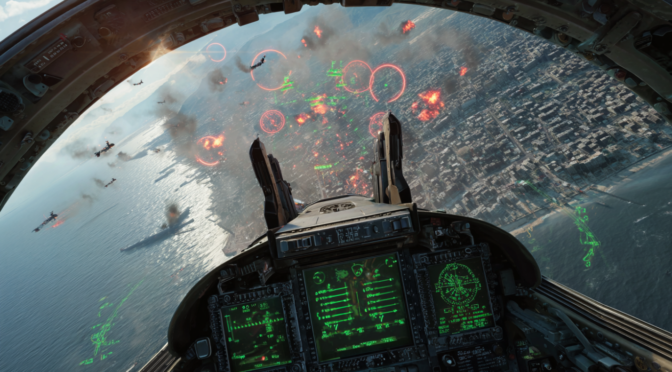
No Fly Zone

Fiction Week

By Bryan Williams

RAMONA, CALIFORNIA.
1416R hours. 25 MAY 2029.

Go figure, it all starts when he’s in the shower.

He’s standing there in the cold water washing off the stink when the lights quit. Ah, nothing unusual. Just a freak power outage. Someone probably crashed into a utility pole or something, right?

Right.

So, he continues, still trying to clear his mind when the ground shutters, then rumbles in succession. Earthquake? Maybe that explains the lights.

“What the hell?”

Since when did earthquakes feel like that?

There’s a shimmy. Then a jolt, a big one. Then another one, the repetition getting faster as the shampoo tumbles off the shower rack. No freakin’ way this is ‘normal,’ and if anything, his stepdad confirms it by banging on the bathroom door.

“Hey, Shawn!” Tom shouts. “SHAWN!”

“What’s going on?”

“I think we’re being bombed or something! Get out here!”

No one has to tell him twice. He’s dried and dressed in seconds, nearly falling down the moment a bright flash beams through the small window. Instinct has him hit the deck, waiting, and waiting, and waiting until an enormous thunderclap strikes the house, the overpressure wave nearly shattering the windows.

“Did they nuke us?”

“I don’t know.”

“You okay?”

“What the hell was that?”

“I don’t know.”

Cellphone. It still works. No EMP equals no nuke, so his first thought is to call Nicole.

NO SERVICE.

Of course not. Then he tries the Maps app.

NO GPS SIGNAL. 

Internet? He tries the news.

NO INTERNET CONNECTION. 

Same problem on Tom’s phone. They hear slews of police sirens now as if every emergency vehicle in California was summoned simultaneously, but one grows close as the Sheriff neighbor pulls up, passenger door flung open, and not an ounce of hesitation to take Shawn to the burgeoning fight.

“Where we headed?” he asks. “Miramar?”

“No. Ramona Airport.” Shawn says, piecing it all together himself. “We finished moving stuff there yesterday morning.”

“Well, good thing. Radio says Miramar’s toast. San Diego International. North Island. The whole naval base is hit. Got every squad in San Diego headed down there.”

They’re stunned by the sight of the New Ramona Oil Refinery burning, itself a moment interrupted by the whine of a little jet engine overhead, Shawn looking up to instantly identify a cruise missile in its terminal phase, diving down to explode amid the new construction.

Emotions mix. Fear. Disbelief. Rage.

Emergency alerts flood the radio. Traffic gridlocks. People panic. No telling what’s going on nationwide, but at the very least, Ramona Airport is still running as they pull up to the gates.

“Do me a favor.” says Shawn as he opens the door.

“Yeah, anything.”

“Tell mom, Mitch, and Tom that I love them. Okay?” he extends his right hand, shaking the Sheriff’s firmly. “If I don’t make it back, please—”

“I’ll tell them! Don’t worry! Go get em’!”

Shawn nods, opening the door, savoring the very last moment he wasn’t at war.

________________________________________


There’s his jet, a leftover hand-me-down 40-year-old Legacy Hornet, flaky paint and all, but it’s armed and ready.

He’s up the ladder and in the cockpit, helmet fastened, strapped into the seat as the engines whine, their turbines spooling up as he runs through the startup sequence and closes the canopy. Then he gives a thumbs up to the ground crew, who either heroically or suicidally guide him out into the open, yelling for him to go as the AA guns in the distance open fire towards the west.

Shawn gets the point and rolls onto the taxiway just as another Hornet pulls up into the sky, both engines belching smoke as the canopy pops and out shoots its pilot.

“Holy shit.”

It crashes in the distance.

Finally on the right comms channel he hears the tower screaming, “FOD on the runway! FOD on the runway!”

He stops, watching in stupor as two pickup trucks ram away the wreckage.

Shawn judges the distance. Maybe a half mile. Maybe more.

Can I make that? Dammit, can I make it?!

Thirty minutes in and the taxiway is all we got? Shit.

Full flaps. He stands on the wheel brakes and says a prayer. This is it. Do or die. Two choices: get bombed on the tarmac, or die trying to fly. He’s no hero, but he’s going with option two.

Afterburners.

The F404s roar. He’s gaining speed, but that blown up hangar at the end of the run seems mighty close. Too close. So close in fact that Shawn debates whether ejecting is a better idea.

Make a choice! Make a choice! MAKE A CHOICE!

150 knots. Should be enough, right?

Rotate! ROTATE!

He pulls the joystick and the nose rises sharply, the wings buffeting, the fuselage pogoing as the wheels leave the ground, the damn stall warning beeping away.

Too hard on the stick! Shit!

Then, at maybe 50 feet of altitude, he ignores his instincts and lets the ole Hornet eat, nose back at high alpha just after the stick release as he pulls hard again. He crosses over a group of soldiers beneath him, all looking up at him as they run, the peak of that damaged hanger approaching in slow motion.

Oh, god, he’s not going to make it.

Not enough altitude. He tried, but it’s not enough!

All this, and he’s going to clip the roof!

Eject, or ride this out?

Now or never. Now or never, Shawn!

All he can do is close his eyes, just waiting for it all to end right here. He sees the obituary now: “First Pilot on Scene of World War III Dies During Takeoff.”

What a shameful way to go. Even for a subpar pilot like him.

But it isn’t the end, because with no more than 10 inches of clearance between the rear wheels and the hangar roof that they barely clear, Shawn opens his eyes surprised to be alive, looking back as he climbs away, just as a trio of cruise missiles open up their cluster munition warheads and pulverize the area he occupied just seconds ago.

He screams aloud, “Hooooooly shit!”

And at 2:36PM Pacific Standard Time, May 25th, 2029, Lieutenant Shawn Paxson, the ‘failed’ prodigal child of his soon-to-be Joint Chief father Admiral James Paxson, takes to the sky in his DoD surplus F/A-18C Hornet.

History is made here. He just doesn’t know it yet.

________________________________________


Gear up. Flaps retracted.

He settles at 390 knots.

Is that too fast? Or too slow?

Where’s my kneeboard?

What channel—HOLY F–!

Just like that, he’s pulled a last-second barrel roll atop a twin-engine airliner.

Quick sitrep: No Air Traffic Control. No ILS or MLS. No GPS. Nothing.

He sees at least six more flying blind through the airspace less than a mile apart, wings banked and noses hunting for somewhere to go.

Just don’t shoot one down!

He has to wait for orders and targets, but what if, considering the radio silence, he never gets any? He flies in circles, seeing Ramona Airport ablaze, the tower blown to bits as fires bloom, but he sees another Hornet in the mirror hot on his four-o-clock trail. It closes quickly, tipping side to side to wave its wings amidst the radio silence until the pilot briefly pops his visor up.

Ah, yes. That’s Jamie. Weird guy, but decent pilot. No better or worse than Shawn. He points and waves, but Shawn points west, trying to direct him that way.

Thirty minutes into World War III and they’re down to hand gestures, at least until he hears the first friendly voice through the static since Ramona Airport’s tower was hit.

“All players, all players on this emergency channel, this is MOP 1-0-0-5 on Guard for Emergency Combat Air Patrol! Any CAP-capable flights report to MOP 1-0-0-5 on Bravo-Six-Zuu! Say again—”

Don’t have to tell Shawn twice.

He switches to the Mission Operator’s channel, trying to hear through the clicking and beeping sounds, all evidence of enemy jamming from an unknown source.

“This is—” shit, what the hell is his callsign? Check the kneeboard, “—SPIFF 46-3 and 4, two Hornets up, flying north! Requesting, uh, Bogey Dope.”

A pause, then, “Thank god! SPIFF 46, be advised. Bandits! Bandits! LACMs (Land Attack Cruise Missiles) and PALMs (Precision Attack Loitering Munitions) inbound battlespace BRA 2-7-0 for, uh, wait. SPIFF 46, right?”

What the hell?

This guy sounds like he’s barely holding it together on the other end, “Yeah, SPIFF 46 to MOP 1-0-0-5. Bogey Dope on bandits. You said—”

“—SPIFF 46, I’m showing you merged!”

WHAT!?!

Shawn’s eyes hunt around, first to the radar, then left and right outside of the canopy. He sees nothing. Plus, how the hell isn’t Jamie on the comms yet? What the hell is he doing? He looks over at him, ready to gesture when his voice suddenly breaks in.

“3! Look down! LOOK DOWN! NINE-O-CLOCK LOW! LOW!”

His head cranes left as the jet rolls, his eyes hunting around until he sees one little glint. Then three. Then seven. Holy hell. It’s a swarm of them flying by, slinking around the hills below as he peers up and gauges the surroundings before he commits.

It’s different with the overhead view, his eyes panning to the horizon out west, seeing the billowing smoke from San Diego and the port, the contrails of surface-to-air missiles rising from the air defense batteries and the ships still stuck in the San Diego Bay.

Oh my god. Oh my god.

Master Arm switch toggled.

Radar in BORESIGHT mode.

The Hornet flips inverted, its nose aiming square for the ground, Shawn squeezing his legs to keep the blood going to his head. He’s got the armament for this. Sure, months and years ago it seemed pretty dumb to be relegated to a shitty old jet for drone swarm and cruise missile killing, but off the Hornet’s wings hang a set of four LAU-61 rocket pods, each one packing a jerry-rigged kit of AGR/AAR-30s, little mini-rockets repurposed to lower interception costs in these predicted situations. 76 in total, all laser-guided from an empennage fixed to the leading edge of the pod, these little makeshift air-to-air missiles are among the only things able to push back against Southern California’s overwhelmed air defenses.

“SPIFF 46,” Shawn’s got the JHMCS visor ready to roll, “we got a group of uh, unknown TOIs heading 0-9-2. They look like small drones or cruise missiles. Request—”

“SPIFF 46, you are cleared to engage! Engage any and all hostiles in battlespace!”

Well, that clears it up.

The Hornet rolls left, then right around the hillside, the smoke rising from Ramona ahead as he lines up the jet, nose filling in behind the group of little black planforms.

Radar slews to them, cueing the lasers. He can lock up to eight at once, but they’re varying their headings, acting much like a flock of migrating birds versus the hapless duds he’s seen in training ops, but he isn’t surprised that cruise missiles, drone warfare and loitering munitions have come a long way since Ukraine, Israel, and Yemen.

“Ramona, you’ve got incoming! Another group of bandits inbound 0-2-2!”

What was once eight cruise missiles is now two groups of four, and then three groups now, two in one, three in another, two diving into the ridgeline behind the hills, and wait, is that last one climbing towards him?!

What the—?

 There’s no time for shock. He hears the blinking acquisition tone, waiting for it to ring solidly until he hears Betty,

SHOOT! SHOOT!

He hits the uncage button like God almighty possessed him to do so. Eight times in quick succession, rockets spew from beneath the Hornet’s wings, alternating left and right, each little missile popping out its fins and streaming to the target like hyenas heavy for a meal as Shawn holds his breath to watch.

The first five AAR-30s detonate dead center of their targets, igniting the cruise missile warheads in spectacular fashion. He pulls up instinctively, hearing debris pelting the jet’s belly, praying he doesn’t FOD an engine or two, but he’s okay, nosing down to reassess.

Five kills, but three misses. That’s a failing score since he was in grade school, but it’s surely better than nothing.

“SPIFF 46-3, splash five!”

The combat cameras are rolling, recording every move he makes. They’ll have all his data. They’ll tell him what he’s doing wrong, but until then, he sends five more rockets to finish the last three with overkill.

God, rookie shooting over here. Clean it up, man!

 “Splash three!”

Then he hears Jamie, “—SPIFF 46-4, engaging bandits 2-9-1, inbound Ramona from the east. Group of twelve!”

The EAST!?! What the hell?

Shawn looks in that direction, his JHMCS highlighting his wingman just three miles away as he follows the little enemy missiles, all slinking away at a two-story home’s height above the ground.

Could it be? Are people launching missiles and drones from inside the United States? Or maybe they’re flying pre planned routes? Maybe, in the logic of their AI hivemind, they’re adjusting to avoid air defenses, but that doesn’t matter right now. He has just has to kill them.

“SPIFF 46-3 to MOP,” he says, “I’m still tracking six more bandits headed north off my nose, following Interstate 15. FOUR, do you see them?”

Then Jamie says, “Got em! Just passed Costco!”

“SPIFF 46-4, is that the—what road?”

“Scripps Parkway!” Jamie yells. “Fox Three! Fox Three times five! Splash!”

“Okay,” Shawn rolls the Hornet left, right above a parking lot filled with onlookers, his altitude so low that he swears he can see their individual faces, “I’m taking three more! They’re terminal! Hold on—Fox Three! Shit!”

He can’t fire. The little cruise missiles are already in their final dives, risking collateral damage if one of the AGR/AAR-30s either misses or hits its mark too late.

Still, he’s got an idea, a bold one like he’s John-freakin’ Wayne. Shawn flips to GUN, kicks the rudder and with a deep breath he squeezes the trigger and holy hell, he’s splashed one! Add a little nose up pitch at the last minute, a quick 7.5g pull and he’s taken down another. It’s spiraling now, exploding into a trail of flames as he tail-slides back towards the ground below, helplessly watching as the other enemy missiles hit their marks straight into a handful of buildings.

“MOP we got buildings hit! Buildings hit!”

“Did they bomb the fucking Costco?!”

Later reports will clarify that these are corporate offices and laboratories belonging to General Atomics filled with employees that are just going about their daily routines. Just another Friday until it isn’t. . . aka when a Chinese Tomahawk equivalent detonates its warhead dead center of the structure.

And what does he do? Watch in horror as ole’ Betty bitches at him.

ALTITUDE! ALTITUDE!

PULL UP! PULL UP!

Shit. He’s going to nosedive into the fucking ground, so he’s straining against the g-limiter override, hearing the fuselage creaking around him as his vision fades for a moment, joystick pulled to a point where it could castrate him.

This is the beauty of the Hornet, the ancient, ‘unsexy,’ busted and tired old jet that it is. It forgives so well, saving even the most moronic of pilots like Shawn Paxson by pulling such a high alpha that the vapor clouds later find their way on local television when they cover him as a hero.

On a normal day, nearly flying his jet into a goddamn Costco car wash would be a guaranteed grounding, but today? Shawn’s the hero as he somehow pulls out of it like he’s leading the Blue Angels in a local airshow, forming up right next to Jamie who’s peering over out of his canopy like he’s seen a ghost.

To those on the ground either dumb enough, or bold enough to whip their phones out and record what they’re seeing, he’s the man. He’s the soon-to-be legendary fighter pilot that faced overwhelming odds and opened up the M61 cannon as a last-ditch effort to save lives, and mostly succeeded.

They’ll never forget him. They’ll never chastise him.

Because even in the opening hours of America’s darkest day, he represents something that until now had faded away into a distant memory.

The fight. The perseverance. The coming rebuke of defeat from a country so bitterly divided that its newly sworn enemies played their hand in a decapitation strike and seriously thought it would work.

And for a few minutes it did, but to Shawn’s pleasant surprise, Miramar’s not entirely gone. He hears the status call of SHADOW 77, a flight of four Legacy Hornets rushing to engage a new line of bandits inbound from the ocean, each hauling their own set LAU-61s all the while. Blasting towards the Pacific, he passes by Miramar’s giant smoke plumes, spotting his new Hornet friends, talking with them and Jamie as they watch the US Navy’s surviving vessels unleash their air defense ordnance on the second onslaught.   

The sight alone gives him a new wind, a hopeful contrast versus the sight of San Diego burning below as a voice breaks in, more frantic than ever,

“MOP to SPIFF 46, attack warning! Attack Warning! Bandits! Bandits! Group of one hundred forty-five plus inbound B-R-A 2-2-5 for—uh—57.”

Did he say 145?! One?! Hundred?! Forty?! Five?!

Yep. Sure did, but he’s not alone. Not anymore.

After all, he’s nothing to write home about, eh?

Just a run-of-the-mill Marine fighter pilot, eh?

Proudly, and with great emotion, he looks side to side, filling into formation with the other Hornets, banking left until the blue abyss of the Pacific covers the span of his view.

“SPIFF 46, SHADOW 77,” he directs, “turn 2-2-5 for CAP! SPIFF 46 will take the southern targets, SHADOW 77, you take north! Copy?”

“Copy!”

“Okay.” Shawn takes a deep breath. “Let’s go!”

Afterburners. . . .

Bryan Williams is a mechanical engineer who previously worked in the automotive industry before moving to upstream materials and packaging development as a senior scientist. He is an aviation and combat aviation fan, still chasing his dream of becoming a successful novelist. He is the author of The Underground Kings, and has recently finished two novels, including the military thriller Bandit that includes the full story of what is depicted in this excerpt.

Featured Image: Art created with Midjourney AI.

Fostering the Discussion on Securing the Seas.