Category Archives: Readiness

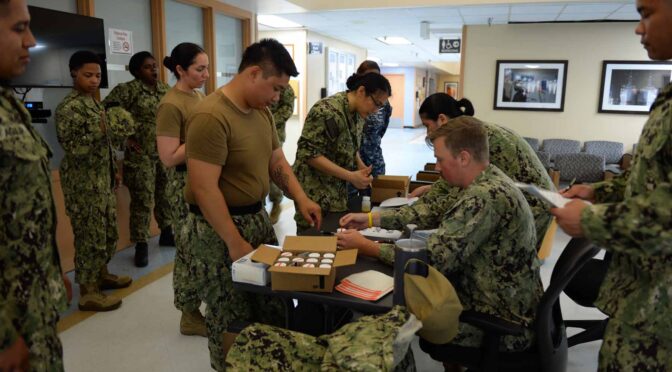
Ditch the Cup: End the Navy’s Random Urinalysis Program

By Roger Misso

We all know the drill. It is 0700 on a Tuesday. The command has been secured. Your division officer, perhaps slightly sheepish, hands you the slip. Your name is on it. You, a trusted technician, a decorated watchstander, a pilot trusted with a hundred-million-dollar aircraft, are now required to march down to the command’s makeshift collection facility.

There, you will wait. Perhaps for two minutes, perhaps for two hours. You will wait alongside Chief Petty Officers, junior Ensigns, and seasoned maintainers. You will wait until your body cooperates with the demands of a computer-generated random selection process, overseen by a fellow Sailor – the Urinalysis Program Coordinator (UPC) – whose primary duty today is to watch their shipmates urinate into a plastic cup.

The Navy’s commitment to a “drug-free force” is noble in concept. But in practice, the random urinalysis program has become a hollow ritual – an immense, quantifiable drag on warfighting readiness, and, most critically, a systemic outsourcing of command judgment. With active hostilities across multiple theaters today – and as we prepare our forces for the unforgiving realities of Great Power Competition in the Pacific and beyond – we must ruthlessly evaluate any program that takes Sailors away from their primary warfighting duties.

The argument for keeping the status quo is simple: deterrence. We are told that the omnipresent threat of the cup is the only thing standing between good order and discipline and a fleet compromised by narcotics. But if we are truly honest with ourselves about the cost-benefit analysis of this thirty-year-old artifact of the “War on Drugs,” the equation doesn’t hold water. It is time to dismantle the random urinalysis program for active and reserve Sailors and return to a Navy built on trust and command accountability.

The Accession Filter

Before the screams of “zero tolerance” begin, let us be clear about what is not being advocated. This is not a proposal to turn a blind eye to illegal substance abuse in the ranks. We must absolutely continue to perform urinalysis testing for all new accessions. Boot camp, Officer Candidate School, and the Naval Academy are filters. They are the gateways through which we invite civilians into the lifelines of the military profession. When a new person walks into a Military Entrance Processing Station (MEPS), we know very little about their history beyond what they report. It is entirely appropriate and necessary to ensure that those entering the service are not bringing substance abuse issues with them on Day One. Testing at Great Lakes, Newport, or Annapolis must remain.

But once a Sailor crosses that threshold, once they have been trained, vetted, security clearance granted, and assigned to a unit, the dynamic must shift from suspicion to trust.

Consider that the Navy invests tens of thousands of dollars into background investigations to grant high level security clearances, and entrusts these Sailors with cryptographic material, maintenance of nuclear reactors, and the lives of their fellow shipmates. Yet, paradoxically, our administrative posture suggests that we do not trust them to make basic, lawful decisions over a liberty weekend. This cognitive disconnect undermines the very foundation of mutual respect and accountability required for a lethal, professional, and ready force.

The Quantifiable Drain

The single greatest operational argument against random urinalysis is its cost – not in dollars, but in the most precious resource we have: time.

We are a Navy that is perpetually overworked, undermanned, and struggling to meet its maintenance and training cycles. Yet we deliberately impose a mass-casualty event on productive work hours several times a month in every command in the Fleet.

The current system doesn’t just waste the time of the Sailor selected, it wastes the time of the UPC, usually a Petty Officer First Class or Chief, who must secure their actual job – the mission-critical job they were trained to do – to manage a logistical nightmare. It wastes the time of the observers as well, who are required to support the evolution and perform no other task but to “observe.” It requires complex shipping logistics, documentation tracking, and legal hours to manage the inevitable procedural disputes.

If a typical unit conducts random testing twice a month, pulling twenty Sailors away for an average of ninety minutes each, that command is losing three thousand productive manhours a year to the collection facility alone. This does not account for the administrative overhead of the UPC, the supply costs of the kits, or the legal resources. Across the entire Navy, we are talking about millions of manhours sacrificed on the altar of a bureaucratic process.

For the Reserve component, the situation is even more dire. A drilling Reservist has roughly sixteen hours per month to achieve readiness. Those sixteen hours are already cannibalized enough by medical and dental readiness appointments, mandatory general military training (GMT), and other administrative tasks. Dedicating two, three, or even four hours of a single drill weekend to a urinalysis cattle-call is a dereliction of leadership. It directly harms retention by signaling to Reservists that the Navy does not value their limited time or their professional civilian lives. We are driving away highly skilled talent because we insist on treating them like parolees instead of partners.

The Ground Truth

If we step back from the PowerPoint slides and Navy instructions to speak candidly with unit leaders, a different reality emerges. Many of the commands I have been in have been filled with high-performers, and the feeling on the deckplates is clear: the program is simply a bureaucratic box to check. The number of illicit drug users who “pop positive” on a urinalysis are absurdly small – less than 1% out of over 2.5 million urine specimens annually. When a program is universally recognized as a performative administrative burden rather than a genuine security measure, that program is ripe for elimination.

This brings us to a complex reality regarding the UPC Program and our true priorities. What if someone is a high performer and taking a non-prescribed drug, like Ritalin or Adderall, to maintain or increase performance? The cognitive load on the modern warfighter – whether they are an intelligent analyst poring over satellite imagery for twelve hours, or a staff officer managing a crisis action team in a Sensitive Compartmented Information Facility (SCIF) – is immense. The military itself has a history of utilizing “go pills” in specific, tightly controlled operational contexts.

If a high-performing, overworked Sailor is self-medicating with stimulants to meet the punishing demands of their billet, is a punitive, random drug test the appropriate intervention? By relying on a randomized cup, we treat a potential medical, mental health, or command-climate issue as a purely criminal one. We lose the opportunity for intervention, medical support, and leadership counseling. We strip the nuance from the situation, preferring an outdated, binary, automated punishment over engaged leadership.

Outsourcing Command

The deepest, most insidious cost of the program, however, is cultural. The random urinalysis program is a symptom of a command structure that has lost faith in its commanders.

We tell Commanding Officers they are responsible for everything that happens within their hull or unit passageway – except, apparently, for whether their Sailors are abusing substances. For that, we rely on a randomized algorithm and a lab technician a thousand miles away.

This is a failure of leadership.

A Commanding Officer should know their people. They should know if a Sailor’s performance is slipping, if their appearance is declining, or if they are suddenly making “destructive or questionable decisions” on or off duty. If a Sailor is abusing drugs, those behaviors will manifest. They will manifest in missed watches, failed physical fitness tests, sloppy maintenance, and fractured domestic relationships.

A CO does not need a random lab test – they need to empower their Chief Petty Officers and Division Officers to lead.

If a commander suspects drug use, they already have the authority to order a “for cause” drug test based on probable cause. The mechanisms exist. We need to trust COs to use them.

By automating this process through randomization, we have created a leadership crutch. We are allowing commanders to defer the hard work of monitoring their unit’s health to a lab report. We are teaching junior officers that good order and discipline come from a computer program, not from knowing the Sailors under their command.

Bias and Safeguards

Critics will rightfully point out the potential for the abuse of power from COs on “for cause” testing, or the risk of a biased CO unfairly targeting specific individuals. These are valid concerns. The military justice system must always guard against unlawful command influence and targeted harassment. But shifting to a probable-cause-only model does not eliminate oversight – it actively demands it.

A “for cause” test requires legal justification. It requires a paper trail. It requires consultation with the Staff Judge Advocate (SJA) to ensure that the suspicion is rooted in articulable facts – erratic behavior, physical evidence, or credible reports – rather than personal animus. If we cannot trust a Commanding Officer to exercise legal, unbiased judgment in ordering a drug test in consultation with the JAG, why do we trust them with Non-Judicial Punishment (NJP)? Why do we trust them to write evaluations and fitness reports that determine careers, or to order Sailors into harm’s way? If a CO is fundamentally biased or abusive, that toxicity will manifest in far more destructive ways than a drug test. The solution to toxic leadership is to hold toxic leadership accountable and fire them, not to burden the entire Fleet with prophylactic, randomized bureaucracy instead.

Reclaiming the Watch

The future fight demands a Navy that is leaner, more agile, and built on trust. We cannot afford the logistical and cognitive drag of a system that treats every Sailor as a suspect.

To senior leadership, the task is clear: Reclaim that authority. Reclaim those manhours. Have the courage to trust the commanders you have placed in charge of your multi-billion-dollar assets. End random urinalysis for the active and reserve Fleet.

Ditch the cup and get back to the mission.

CDR Roger Misso is a Commanding Officer in the Navy Reserve with multiple deployments, mobilizations, and assignments across both the active and reserve force. The views expressed here are his own.

Featured Image: Navy Operational Support Center North Island conducts a monthly urinalysis test, July 14, 2019, on Naval Air Station North Island. (U.S. Navy/Mass Communication Specialist 1st Class Shannon Chambers)

Archers Need Arrows: Deficiencies in U.S. Submarine Munitions

By Alana Davis

In 2023, the Center for Strategic and International Studies (CSIS) wargamed a conflict between the United States of America and the People’s Republic of China (PRC). Reflecting 24 iterations of the wargame, the study weighed if China could succeed in invading Taiwan in 2026 and examined the variables affecting the outcome. Although CSIS concluded that China is unlikely to succeed, it found the result to be highly contingent on posture, weapons, and platforms. Crucially, one of the most determinant factors is U.S. submarine dominance in the undersea domain.

The report recommended prioritizing full-spectrum undersea warfare in planning for a potential large-scale, cross-ocean military conflict. This prioritization reflects the potency of the submarine force: Fast Attack Submarines (SSNs) torpedoing adversary commercial shipping and naval forces as Guided Missile Submarines (SSGNs) strike key adversary infrastructure with long-range cruise missiles.

But what happens when the archers run out of arrows – when submarines expend their weapons in the first battle of the next war? Does the U.S. have the inventory to support necessary reloads? Are the ports, vessels, and personnel ready to conduct the rapid reloads required to maintain pressure through a protracted war? If the current munitions stagnation continues, the answer is no. The Navy should work with the Department of War (DoW) and Congress to increase weapons supply and reinforce the means to conduct expeditionary submarine weapons transfers.

Recent Weapons Production and Expenditure

The Fiscal Year (FY) 26 Defense Budget prioritizes revitalizing the defense-industrial base with a notable increase in ship and weapons production. The National Defense budget request rose 13% from last year, topping $1 trillion, while the President has called for a $1.5B topline. In December 2025 the DoW announced an expansion of an existing RTX contract to order 219 Block V Tomahawk Land Attack Missiles (TLAMs) – the largest order in years, and a nearly 10-fold increase from the 22 planned for purchase in FY25.

Unfortunately, this sharp increase barely covers recent expenditures. The Eisenhower Carrier Strike Group alone expended 125 TLAMs against Houthi targets in Yemen. SSGNs conducted multiple strikes against Houthi Targets and enabled the B-2 Bomber strikes on Isfahan, Iran. Assuming a TLAM stockpile of roughly 4,000, U.S. naval forces in the Middle East depleted this missile’s inventory by 3% in relatively limited strikes against Iran and its proxies. This is a frightening statistic when contemplating the expenditures from all-out war with a near-peer adversary like the PRC. This troubling consideration is not limited to land attack missiles: A House-commissioned CSIS simulation estimates that in a Chinese invasion of Taiwan, the Navy could run out of long-range anti-ship missiles in less than a week of fighting.

Weapons production and delivery holdups reflect 1990s production halts after the end of the Cold War, unstable procurement continuing into the 2000s, and an increasing scarcity of U.S.-based manufacturing of certain critical parts like rocket motors and processors due to obsolescence challenges. The limited missile inventory is not the only problem. Diminishing submarine weapons on-load readiness stems from aging submarine tenders (ASes), which were commissioned in the 1970s, and the logistical complexities of loading weapons in foreign submarine ports.

What should the DoW and the Navy prioritize to ensure continued lethal armament of the submarine force? Action should include a two-pronged focus: one, creatively and efficiently increasing TLAM and torpedo supply, and two, investigating and investing in the ports and support vessel ability to conduct submarine weapons transfers.

Action 1 – Advance Submarine Munitions Supply

Military leadership and civilian defense experts agree that submarines are a key asset enabling U.S. victory in future naval conflicts. Instead of throwing money broadly towards munitions production, the DoW should prioritize making weapons that the bulk of both U.S. naval forces and U.S. allies can deploy.

The U.S. should focus on TLAMs because they are versatile – launched from SSNs, SSGNs, Ticonderoga-Class cruisers (CGs), and Arleigh Burke-class destroyers (DDGs) – totaling approximately 55 submarines and 83 surface ships. The United Kingdom, Japan, Australia, and the Netherlands all use TLAM – greatly increasing weapon production efficacy through scale. For similar reasons, the U.S. should also focus on Mk-48 ADCAP production, utilized by all 69 submarines in the U.S. fleet plus many Australian, Canadian, and Dutch vessels.

Additionally, efforts must be made to expedite weapons stockpile growth through manufacturing contracts and partnerships that encourage “close enough” component solutions rather than perfection. The Navy should be allowed to make minor compromises on weapon specs without compromising safety or viability. In November 2025, the DoW’s Strategic Capabilities Office announced open solicitations for a new, affordable SSN heavyweight torpedo called the Rapid Acquisition Procurable Torpedo (RAPTOR) to augment the Mk-48 ADCAP. Producing a torpedo at $500,000 per weapon vice the current $4 million per weapon is certainly enticing, given the many potential targets, but it does not mean production efforts and methods should slow on parts for the Mk-48 ADCAP. Promoting newer, cheaper technology is key, but continuing production of the tried-and-true ADCAP is also essential.  

Furthermore, if compromises must be made between TLAM and ADCAP production investment, the Navy should prioritize the Mk-48 ADCAP because of its greater efficiency in sinking enemy ships and reinforcing a strategy of deterrence by (sea) denial.

Another production avenue worth investigating is shared weapons production with allies. The U.S. continues to lean on co-manufacturing partnerships with Australia and South Korea to re-supply depleted 155-millimeter artillery shells from the Russo-Ukrainian war. Similar co-production agreements should be signed with Australia and the UK as part of the AUKUS submarine partnership, as well as with Japan for manufacturing of parts for the TLAM and/or the ADCAP. Production of critical weapons and weapons components in strategic foreign locations strengthens U.S. logistics networks and shortens operational timelines. Weapons stockpiling in strategic locations improves deterrence, as allied power projection becomes more credible with the proximity of weapons – though this forward staging must incorporate defense, dispersal, and deception to mitigate against enemy strikes.

Action 2 – Strengthen Submarine Munitions Re-Supply Capability

In the Western Pacific, the U.S. maintains three bases capable of submarine weapons handling of TLAMs and ADCAPs: Yokosuka and Sasebo, Japan and Apra Harbor, Guam. Additional foreign port reload sites may include Subic Bay, Philippines; Souda Bay, Greece; Sterling, Australia; and Diego Garcia. These reloads are aided by the two remaining Guam-based submarine tenders, the USS Frank Cable and the USS Emory S. Land, which were specially designed to travel to submarines and assist in conducting weapons transfers, repairs, and nuclear-level maintenance. This small but mighty AS fleet continues to demonstrate its utility, such as in 2022 when the Frank Cable supported the first TLAM reload conducted by a U.S. submarine in Australia on the USS Springfield (SSN-761).

But these tenders are over 45 years old. They have outlived their intended lifespan and their ability to deploy safely comes into greater question with each passing year. As of July 2025, the Pentagon awarded $72.6 million to General Dynamics-NASSCO to continue developing up to three “AS(X)” class submarine tenders. With both existing tenders slated to decommission by 2030, time is quickly running out to replace these unique and valuable assets. Still, a net of only one additional tender by 2030, assuming production deadlines are met, is not enough given that by 2028 the Navy aims to boost submarine production to three SSNs a year (one Columbia Class and two Virginia Class). Further, one must carefully consider where to homeport these assets, focusing on Japan and/or Australia for maximum operational flexibility.

Besides investing in the rapid production of the new AS(X) class, the Navy should invest more in the infrastructure of the submarine bases themselves – namely Apra Harbor, Guam. Apra Harbor relies on the island’s public power authority which supplies energy via import-reliant petroleum plants with 50-year old generators susceptible to natural disaster, not to mention deliberate attacks. The unreliable power supply alone threatens the likelihood of efficient weapons transfer and maintenance stops for submarines on their way to a fight in the Pacific. Additionally, concerns over adequate equipment like heavy-lift cranes and trained personnel to conduct efficient submarine weapons reloads also remain.

The Navy should thoroughly investigate the real capacity of its overseas submarine ports to conduct efficient and safe submarine weapons transfers in a simulated wartime scenario. This analysis should answer the questions: How long does it take to move weapons inventory, re-load equipment and crews, and a submarine tender as applicable to various ports? Which ports lack critical equipment or trained personnel to conduct short-notice reloads? What is each port’s and each tender’s maximum reload ability and fastest reload pace? The last publicly documented transfer of a Mk-48 training shape to a submarine was in 2021 between the Frank Cable and the USS Hampton (SSN 767). Five years may as well be ancient history when facing today’s emerging adversary threats. There must be steady effort to test these vessels and ports in wartime conditions and pace, but compromises can also be made. For example – the Navy may be able to withstand AS(X) delays by ensuring all foreign submarine port call locations have heavy-lift cranes.

Conclusion: Make More of What Works and Make What Works Better

U.S. submarines remain a dominant and lethal force, but in the 21st century, their lethality is jeopardized by two weapons concerns: rapidly depleting TLAM and Mk-48 ADCAP inventories, and inadequate weapons reloading facilities. The solution is not just to throw more money toward the problem. Since FY24 the DoW has invested hundreds of millions into weapons development and submarine tender design. The DoW and U.S. Navy must make more of what works by continuing production of versatile and battle-proven weapons. The United States should make what works better by improving how allied foreign ports and strategic assets can perform in wartime.

For the U.S. submarine fleet to dominate in naval conflict, it must have ample weapons stockpiled in strategic locations with all enabling infrastructure ready to support time-sensitive reloads. The first steps in ensuring continued dominance include: acknowledging the submarine force has critical weapons-related shortfalls, and studying which inventories, which bases, and which production lines are most vulnerable.

Submarines can operate within Surface Weapons Engagement Zones and conduct long-range tactical fires. In a target-dense environment, submarine munitions will deplete rapidly. In a conflict with the PRC, some estimates suggest an SSN will expend its inventory of 20 to 50 torpedoes within two weeks on station, and an SSN or SSGN will launch all their 12 or 154 TLAMs, respectively, within three weeks. At such rates of fire, it is easy to see how weapons inventory and reload pace become critical to continuing, and winning, the future fight.

Archers need arrows. If Congress and the U.S. Navy do not act now to ensure submarines stay armed and ready for battle, munitions problems will only worsen – leaving the force, the fleet, and country more vulnerable.

Lieutenant Alana Davis, U.S. Navy, is a submarine officer serving as a Force Manpower Planner under OPNAV N1 in Arlington, VA. She is a graduate of Harvard University (BA ‘19) and The University of Florida (MBA ‘26). The views presented are hers alone and do not necessarily represent the views of Department of War or the Department of the Navy.

Featured Image: Conceptual drawing of the Virginia-class attack submarine from 2004. (Photo via Wikimedia Commons)

Optimizing Reactor Plant Maintenance: The Case for Shipboard SLMs

By LT P.J. Greenbaum and LT Vince Freschi

Introduction

Operational availability is the Nuclear Navy’s bread and butter, yet shipboard technicians are currently prevented from improving maintenance outcomes by an archaic data bottleneck.  Scheduled maintenance to prevent system degradation or failure is planned years in advance and kept up-to-date utilizing detailed records boards which meticulously track maintenance completion.  When a system fails or is degraded, corrective maintenance often requires hours of reading, symptom elaboration, and troubleshooting, before a component can be repaired.  Fatigued watchstanders burn critical man-hours sifting through static technical libraries and disjointed databases to isolate casualty root causes – a complex, time consuming process akin to utilizing a card catalog to search tens of thousands of pages for a single sentence.      

Consider an MMN2 (Machinist’s Mate, Nuclear) conducting a troubleshoot and repair of a noisy coolant pump.  Currently, this Sailor must spend hours manually cross-referencing decades worth of material history logs with historical maintenance records, send manually-collected vibration analysis data off-ship for analysis by pricey contractors, and flip through multiple volumes of tech manuals, all to diagnose a possible problem that may or may not lie at the root cause of the issue. Generating a quality control package to repair the pump takes several hours, and generating the work authorizations and safety protocols (i.e. “tag-outs”) takes several more – all of which delays the time to repair for the pump, leaving critical propulsion plant components offline longer than needed. From the authors’ experience leading Sailors in the maintenance of nuclear systems, finding the right part alone can take hours, with many times a successful search becoming futile due to the part number turning obsolete.  This results in an asset unavailable for tasking, reducing the operational force posture.

The solution to this issue is to incorporate existing technology to equip Sailors with the tools necessary to keep ships in the fight.  Fortunately, the technology exists to provide locally hosted, air-gapped Small Language Models (SLMs) to enhance the nuclear propulsion plant troubleshooting process.  By implementing a Retrieval-Augmented Generation (RAG) framework, Naval Reactors can transform its massive repositories of procedures, technical manuals, and material history into a live, up-to-date database of Reliable External Knowledge (REK).  This approach will reduce manhours required for fault investigation, improve the accuracy of system troubleshooting, and result in reduced downtime for propulsion plant components.

The Structure: Coupling Small-Language Models with Retrieval Augmented Generation

Much attention has been garnered since the release of ChatGPT in late 2022 regarding the use cases for large language models (LLMs) – models that possess between 100 billion and 2 trillion parameters – which are able to digest large volumes of disaggregated data and generate human-like text in response.1  While extremely powerful in their ability to synthesize and process loosely structured datasets, these machines require a high bandwidth connection to an off-ship data center – a non-starter for warships that frequently operate at EMCON in signal-denied environments.  Even the Department of War’s release of GenAI.mil – a well-intentioned attempt at bringing generative AI capabilities directly to the warfighter – has limited applicability on a warship, where bandwidth and EMCON restrictions prevent its widespread use.  Furthermore, LLMs can also be prone to “hallucinating” – irrelevant, incorrect, or misleading responses to queries – with potentially catastrophic consequences in a nuclear propulsion plant.2

The development and refinement of small language models (SLMs) possessing orders of magnitude fewer parameters (1 billion to 10 billion), however, allows for highly specialized, localized air-gapped models, capable of running on a single, high-functioning workstation – like a high-performance gaming laptop – which would be perfect for a rugged shipboard environment.3 These small-parameter SLMs would be most effective when coupled with a Retrieval-Augmented Generation (RAG) framework.4  This architecture replaces the model’s reliance on static, pre-trained memory with a dynamic system.5  By utilizing a local vector database to index every page of the ship’s electronic technical manuals – Reactor Plant Manuals (RPMs), Steam Plant Manuals (SPMs), machine-specific technical manuals, maintenance logs, and material history entries – the SLM no longer has to recall every answer from its training.  All it has to do is find the answer within the verified, pre-uploaded documentation.  RAG will enable it to return responses on the semantic meaning of queries and not the word-by-word match currently available with a “CTRL+F” search.  This shift ensures that even a “small” 10 billion parameter model could deliver hull-specific, nuclear-grade technical guidance with a level of accuracy that matches or even exceeds its larger, data center-bound counterparts, all without the danger of hallucinations.6 

The Nuclear Reliable External Knowledge Database

Key to the development of the vector database will be compiling and maintaining – with proper version control – a database of reliable external knowledge (REK) that the SLM can draw from when responding to Sailor queries.  The widespread use of interactive electronic technical manuals (IETMs) like the Reactor Plant Manual and Steam Plant Manual onboard nuclear powered naval vessels simplifies the process of indexing the Nuclear Navy’s relevant data into a machine-readable format, but a machine which sees and understands procedural context – via the IETMs – without a thorough understanding of the system design bases – present in component technical manuals and procedural front-matter – runs the risk of providing inaccurate and incomplete recommendations.  Therefore, in addition to the IETMs, legacy manuals for all propulsion plant components – like pumps and valves – as well as procedural guidelines – like the Joint Force Maintenance Manual (JFMM), the Radiological Controls for Ships, and the propulsion plant preventative maintenance system (PMS) – must be included in the REK database as well, allowing SLM recommendations to be pre-filtered through Nuclear Navy maintenance rules and regulations prior to arrival at the technician. 

But the REK database cannot be static; it must be periodically updated to incorporate the latest feedback reports, Naval Reactors technical bulletins, and CASREPs , ensuring that the SLM maintains current  hull and platform specific information.  A monthly maintenance check, accomplished by uploading a “refresh” library – centrally created and made available via the Naval Reactors local area network – would allow for periodic updates in all but the strictest EMCON conditions.  A critical advantage of incorporating fleet‑wide data is that equipment casualties encountered on one hull are often repeat iterations of known failure modes across other ships‑in‑class. By enabling Sailors to leverage prior diagnoses and corrective actions on sister platforms, the system reduces redundant troubleshooting, supports failure‑rate trending, and ultimately shortens equipment downtime.

Onboard the modern Ford-class engineering plant, the pre-existing automation and smart sensors open the doors to even more AI applications.  Integrating the SLM with data log sets, vibrational analysis data, and material history, would allow the plant to be not only monitored through the eyes of its highly trained nuclear operators, but also through AI powered by the latest Silicon Valley advances.  Coupling the SLM with Eulerian Video Magnification and installing fixed cameras on vital pumps and turbines would allow for early detection of failure on a minute-by-minute basis. The efficacy of preventative maintenance can be audited based on failure frequency and down time, empowering Sailors to continuously preserve the plant in the most efficient manner possible.

The Use Case

Consider once again the MMN2 from the introduction and the noisy reactor coolant pump.  With a shipboard SLM co-pilot, the MMN2 could input the symptoms seen in a natural language prompt, accompanied by the equipment logs that preceded the failure along with the vibration data analysis for the pump.  After a few seconds of “thinking,” the SLM would utilize its RAG framework to instantly pull the relevant drawings, scrape the log data for trends, and analyze the vibration data for potential failure mechanisms.  But utilizing its live-updated REK library, the SLM could also flag CASREPs from other ships-in-class which noted similar failure modes.  After a few more seconds, a quality assurance package could be generated in the ship-specific format, complete with all tools, parts, and materials required, required isolations for the work to be conducted, a step-by-step procedure for repair drawn from the relevant tech manual.  But perhaps most importantly, each reference the SLM pulls its material from can be displayed on an adjacent window, with the MMN2 checking the SLMs recommendations each cited tech manual. 

The Way Forward

The first step in deploying a shipboard RAG-equipped SLM at-scale must be accelerating the conversion of legacy technical manuals and drawings into machine-readable formats suitable for the creation of a vector database.  Once all relevant technical publications, procedures, and best-practices have been compiled into a singular database (no small feat considering the Navy’s notorious compartmentalization), the data must be “chunked” into smaller sub-sections and embedded into a high-dimensional (due to computing restrictions, likely in the low hundreds of dimensions) numerical vector for retrieval by the model.  Ensuring the model remains free of “data poisoning” – the injection of corrupted or incorrect data into a model’s training – will require a centralized organization, like Naval Reactors, to manage the training and development of the vector database.  For optimal utility, shipboard technicians must be able to add data – like material history entries – into the vector database, although care must be taken to ensure that the model does not incorporate this potentially flawed shipboard data into its training phase.  Fortunately, the recent establishment of the Propulsion Plant Local Area Network (PPLAN) technician school provides an avenue to train designated technicians on the procedures required to maintain the REK database.  Designating these Sailors with a Naval Enlisted Classification (NEC) and designating those NECs as “critical” for billet-based distribution would ensure that ships have the requisite knowledge to always support their shipboard AI nodes onboard.

Next, the Navy must define the technical hardware specifications for a “Shipboard AI Node” that meets MIL-SPEC requirements for shock, vibration, and EMCON security.  The Navy must prioritize maximizing video random access memory (VRAM) to maximize the processing power (the “intelligence”) of the SLM.  Utilizing a laptop client already approved to handle classified information would save time and speed delivery of the system to the fleet.

Once the software and client have been paired together, the Nuclear Navy can utilize its already-existing training pipeline to begin integrating the system into maintenance and troubleshooting workflows.  The Nuclear Power Training Units in Charleston, South Carolina and Ballston Spa, New York function as the perfect “proving ground” for the SLM in a fleet-like scenario.  Treating the prototype rollout as a dynamic test – experimenting with model size, tokenization, chunking, and retrieval methods – would improve model performance and validate system functionality prior to fleet-wide deployment. 

Lastly, and perhaps most importantly, Naval Reactors must establish a “Human-in-the-Loop” certification framework, ensuring that AI-assisted troubleshooting remains an advisory tool that works within the rigorous standards of the Nuclear Navy.  Just as the SWO community still teaches its navigators paper charting at SURFNAV, despite the existence of well-proven Voyage Management Systems (VMS), the Nuclear Navy must work to ensure that any AI troubleshooting co-pilot utilized by its Sailors enhances their understanding of integrated plant operations, not replaces it.  While some may argue that using such a co-pilot bypasses the deep-dive traditionally required to build system-wide expertise, a shipboard SLM acts as a learning accelerant, not as a crutch.  By removing manual document searches, the tool allows technicians to spend more time synthesizing plant information and conducting high-level analysis – tasks that truly build systemic understanding – as opposed to spending hours searching through manuals for the “NIIN in a haystack.”  When integrated into a “Human-in-the-Loop” framework, this technology ensures that a Sailor’s learning is grounded in the most accurate, cited technical data available.  The stakes in nuclear reactor plant operations are simply too high to outsource critical thinking.  This technology must be viewed as a force multiplier that sharpens a nuclear technician’s judgment and reinforces the culture of procedural compliance that defines the program.

Conclusion

The integration of SLMs equipped with RAG architecture into the nuclear propulsion environment represents a significant upgrade to the maintenance capabilities of the individual nuclear operators.  Incorporating AI into the shipboard troubleshooting and maintenance workflow is a fundamental shift designed to reduce equipment downtimes.  In a future conflict characterized by denied communications and long stints at sea, a ship’s ability to remain self-sufficient – by diagnosing and repairing its primary propulsion and electrical generation capacity without racing back to stateside contractors – could mean the difference between sustained operability and taking a capital ship out of the fight.  Ultimately, the goal is clear: a propulsion plant where easily accessible, machine-readable data works as hard as the Sailor.  The technology exists already; the Nuclear Navy’s leadership must just deploy it.  By embracing SLMs and RAG architecture, the Navy’s most valuable and complex nuclear assets will remain mission-ready, even in the most contested environments. 

LT Vincenzo Freschi was born in Olbia, Italy, to an American Navy Officer and an Italian chef, where he enjoyed life in the countryside with his Border Collies until he attended Penn State University. There he earned a degree in Nuclear Engineering with a minor in Military Studies, and commissioned as a Naval Officer in 2020. Following commissioning, he served aboard the USS Stockdale (DDG-106). In 2023 he completed the Navy Nuclear Power School and Prototype training pipelines before reporting to the USS Gerald R. Ford (CVN-78), the world’s largest aircraft carrier, where he worked as the RE DIVO. Now he serves as an NROTC instructor at Carnegie Mellon University while pursuing a master’s degree in Artificial Intelligence.

LT Paul (P.J.) Greenbaum grew up in Boiling Springs Pennsylvania and attended Princeton University on an NROTC scholarship, where he studied international relations, public policy, and African studies.  He commissioned and pursued a follow-on Master’s degree at Tsinghua University in Beijing, China as a Schwarzman Scholar, where he studied international relations and Chinese language.  He served onboard the USS Benfold (DDG-65) homeported in Yokosuka, Japan as the Electronic Warfare Officer, and he completed his follow-on nuclear propulsion training in Charleston, South Carolina.  He reported to the USS Abraham Lincoln (CVN-72) in October 2023 and served for two years as the Reactor Mechanical division officer.  He currently serves as an NROTC instructor at the University of California, Berkeley while pursuing a degree in nuclear engineering.

References

  1. “A Comprehensive Survey of Small Language Models in the Era of Large Language Models: Techniques, Enhancements, Applications, Collaboration with LLMs, and Trustworthiness | ACM Transactions on Intelligent Systems and Technology.” Accessed December 21, 2025. https://dl.acm.org/doi/full/10.1145/3768165.
  1. Agrawal, Prof. Pallavi. “Running LLMs Locally on Consumer Devices.” International Journal for Research in Applied Science and Engineering Technology 13, no. 4 (2025): 5433–41. https://doi.org/10.22214/ijraset.2025.69433.
  1. Kandala, Savitha Viswanadh, Pramuka Medaranga, and Ambuj Varshney. “TinyLLM: A Framework for Training and Deploying Language Models at the Edge Computers.” arXiv:2412.15304. Preprint, arXiv, December 19, 2024. https://doi.org/10.48550/arXiv.2412.15304.
  1. Lewis, Patrick, Ethan Perez, Aleksandra Piktus, et al. “Retrieval-Augmented Generation for Knowledge-Intensive NLP Tasks.” arXiv:2005.11401. Preprint, arXiv, April 12, 2021. https://doi.org/10.48550/arXiv.2005.11401.
  1. Ruiz, Daniel C., and John Sell. “Fine-Tuning and Evaluating Open-Source Large Language Models for the Army Domain.” arXiv:2410.20297. Preprint, arXiv, October 27, 2024. https://doi.org/10.48550/arXiv.2410.20297.
  1. Shuster, Kurt, Spencer Poff, Moya Chen, Douwe Kiela, and Jason Weston. “Retrieval Augmentation Reduces Hallucination in Conversation.” arXiv:2104.07567. Preprint, arXiv, April 15, 2021. https://doi.org/10.48550/arXiv.2104.07567.

Featured Image: Sailors make repairs aboard the destroyer USS Halsey in the Arabian Sea in 2021. (U.S. Navy photo)

If the U.S. Navy can’t Repair Ships in Peacetime, how will it do so in War?

By Michael Hogan

Introduction

The Navy has well-documented issues with building warships. Less discussed, but equally important, are issues with repairing the ships it already has, which jeopardizes its ability to meet its own goal of sustaining a across all platforms. As the Navy focuses on preparing for a great power conflict potentially, the Navy needs to improve not just its peacetime ship repair capability but also expand its capacity to account for wartime repair requirements. While the issues facing the U.S. shipbuilding industry are complex, and it will take time to expand shipbuilding capacity for large combatants, the U.S. shipbuilding sector does have a robust capacity to build smaller vessels that can improve the U.S. Navy’s repair capabilities. In fact, there are 125 private U.S. shipyards that are capable of building small vessels needed for repair and salvage. The United States needs to prepare now for battle damage repair by investing in repair ships, and learning lessons from recent emergent repairs and the last major war it fought at sea.

Historical Precedent: World War II

A potential war with China will be fought mostly in the Pacific theater, which forces the United States into a major logistical challenge due to the tyranny of distance from the homeland. During the last great power naval conflict, the U.S. Navy learned the importance of battle damage repair for sustaining a distant fight. One important component of victory in the Pacific was the work of naval auxiliaries that supported combatants, generally organized in Service Squadrons. Initially equipped with just oilers and other logistics platforms to replenish warships, fleet commanders realized the importance of deploying repair assets, especially fleet and salvage tugs, with these service squadrons to provide at-sea capabilities for recovering damaged vessels.

Fleet tugs, often cited in historical accounts, were essential in rendering salvage services. These tugs towed damaged vessels to areas where repairs could be made, often preventing the permanent loss of ships. The absence of fleet tugs at the Battle of Midway likely foreclosed the fate of the precious aircraft carrier USS Yorktown, as the Navy had not yet fully grasped the vital importance of salvage tugs in saving battle-damaged ships. Similarly, the carrier USS Hornet, destroyer USS Porter, and cruiser USS Atlanta were lost largely due to inadequate salvage capabilities.

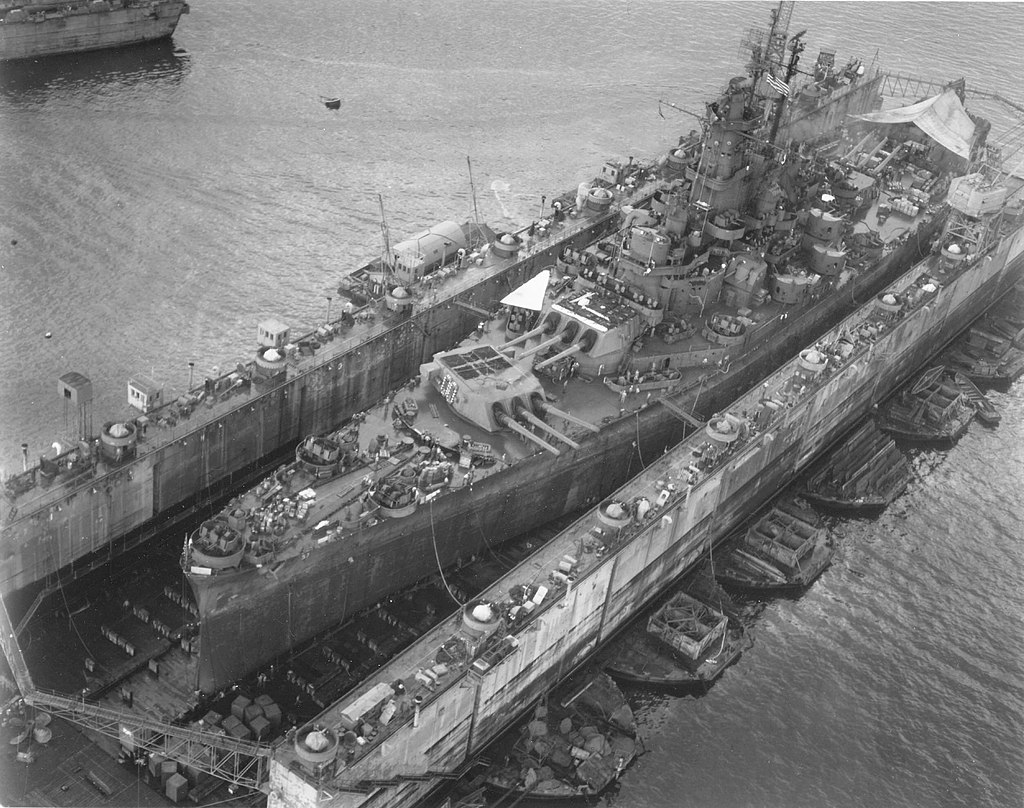
As the importance of tugs became clear during the war, they were used extensively throughout the Pacific campaign to save ships, allowing temporary repairs and enabling them to return home for more permanent fixes. The United States invested heavily in this capability during the war, building more than 200 tugs and over 40 rescue and salvage ships. Floating drydocks also played a crucial role, enabling the Navy to make the repairs necessary to restore ships to seaworthiness—even if only temporarily—so they could return to the United States for more extensive repairs. When ships could not be saved, salvage vessels stripped valuable repair parts, ensuring that forward-deployed ships had access to critical resources. The ability to recover damaged ships and clear sunken vessels from ports was vital to maintaining momentum in the American island-hopping campaign, extending the time that ships could remain on station.

USS ABSD-6 repairing USS South Dakota (BB-57) in Guam after an accidental explosion on May 6, 1945, while rearming from USS Wrangell (AE-12). (U.S. Navy photo)

Current State of the Salvage Fleet

Today, the U.S. Navy’s salvage fleet is far less robust than the one that was essential to winning the Pacific campaign. After the Cold War, the Navy dramatically downsized its auxiliary ship fleet, reducing the number of vessels from 113 in 1994 to 52 in 1997, including the decommissioning of nearly all tenders. Currently, Military Sealift Command (MSC) operates only three ocean-going tugs, two rescue and salvage ships, and two submarine tenders, with the newest of these vessels commissioned in the mid-1980s. In contrast, China, the pacing threat of the United States, has 30 tugs, 46 rescue and salvage ships, and 12 tenders between its navy and rescue and salvage bureau.

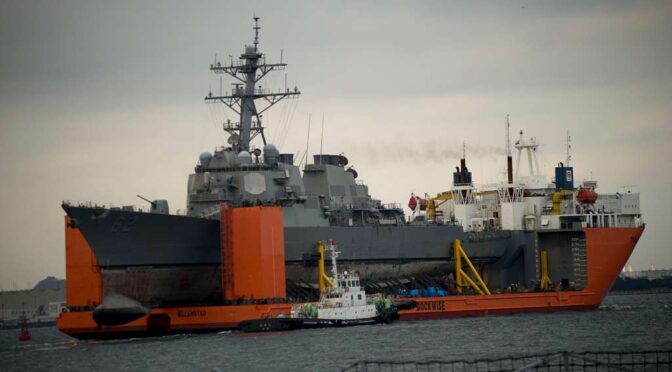
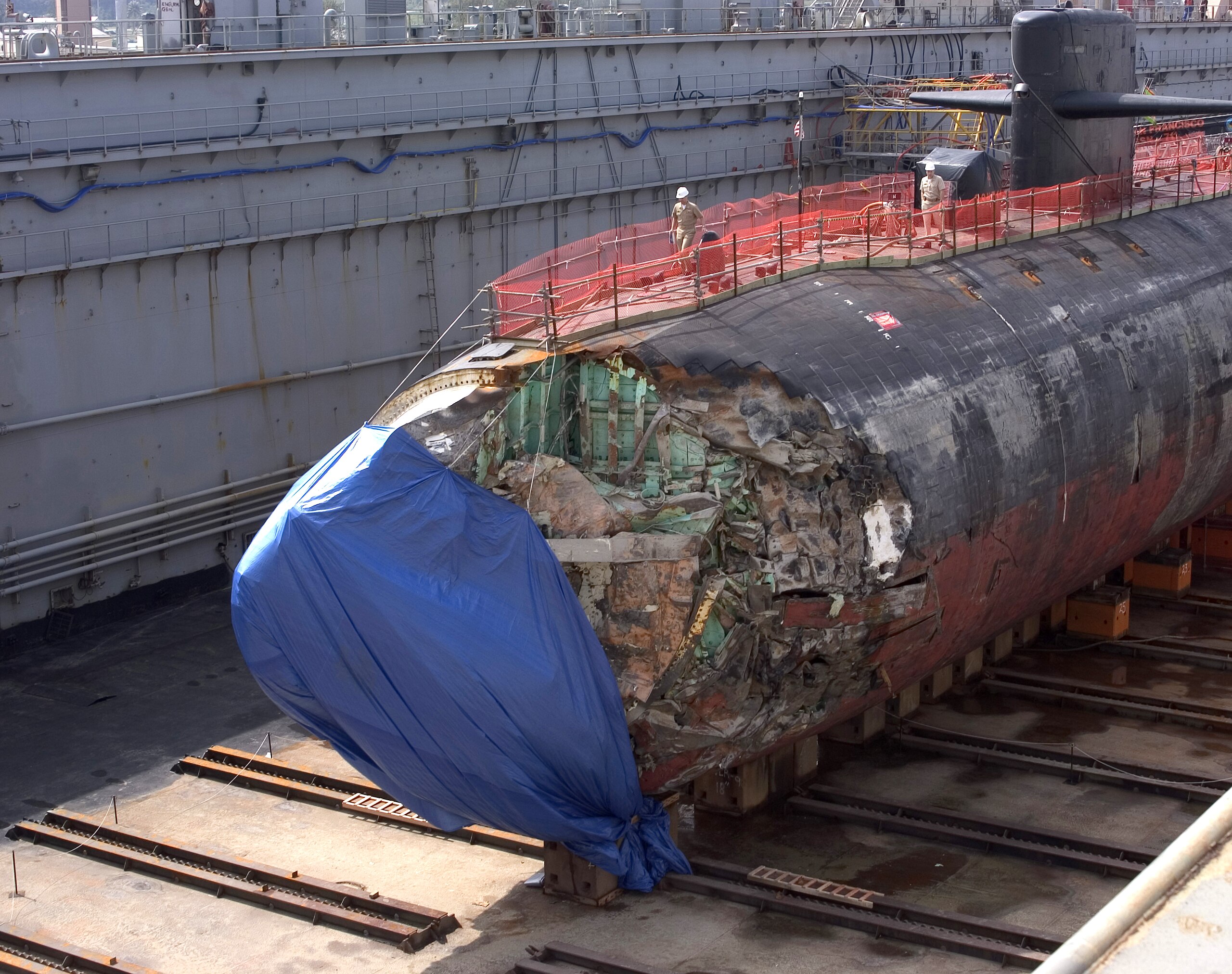
As analyst and retired naval officer Brent Sadler notes in U.S. Naval Power in the 21st Century, there are no large floating dry docks capable of repairing Ohio-class submarines and large surface combatants—despite their critical role in post-accident recovery, such as the repair of the USS San Francisco after its grounding in 2005. Floating drydocks provide a mobile repair capability, allowing significant repairs to be conducted in locations where permanent infrastructure does not exist, such as forward deployed bases during a regional conflict. This results in the US Navy either needing to bring the damaged vessel back to one of the homeland drydocks, which are already at capacity with modernization and maintenance, or lease a floating drydock from private industry. The Navy must also rely on chartered commercial heavy-lift ships to move damaged vessels, such as when the USS Cole had to be transported to Pascagoula for repairs after the 2000 terrorist bombing.

(Jan. 27, 2005) Apra Harbor, Guam:  USS San Francisco (SSN 711) in dry dock to assess damages sustained after running aground approximately 350 miles south of Guam. (U.S. Navy photo by Photographer’s Mate 2nd Class Mark Allen Leonesio)

Recent Incidents and Issues

The U.S. Navy has not faced significant battle damage repairs since the 2000 terrorist bombing of USS Cole, the closest a U.S. Navy ship has come to combat damage in the last 30 years. Nevertheless, repair issues during recent forward-deployed collisions, allisions, and groundings mark a good approximation of what to expect, albeit on a smaller scale. Minor repairs following a collision, such as USS Jacksonville in 2013, can be made pier side, even in foreign ports, with the assistance of a submarine tender. Although, as noted above, the tender capacity has been drastically reduced in recent years. With public shipyards operating near capacity, however, more significant collision repairs require trade-offs.

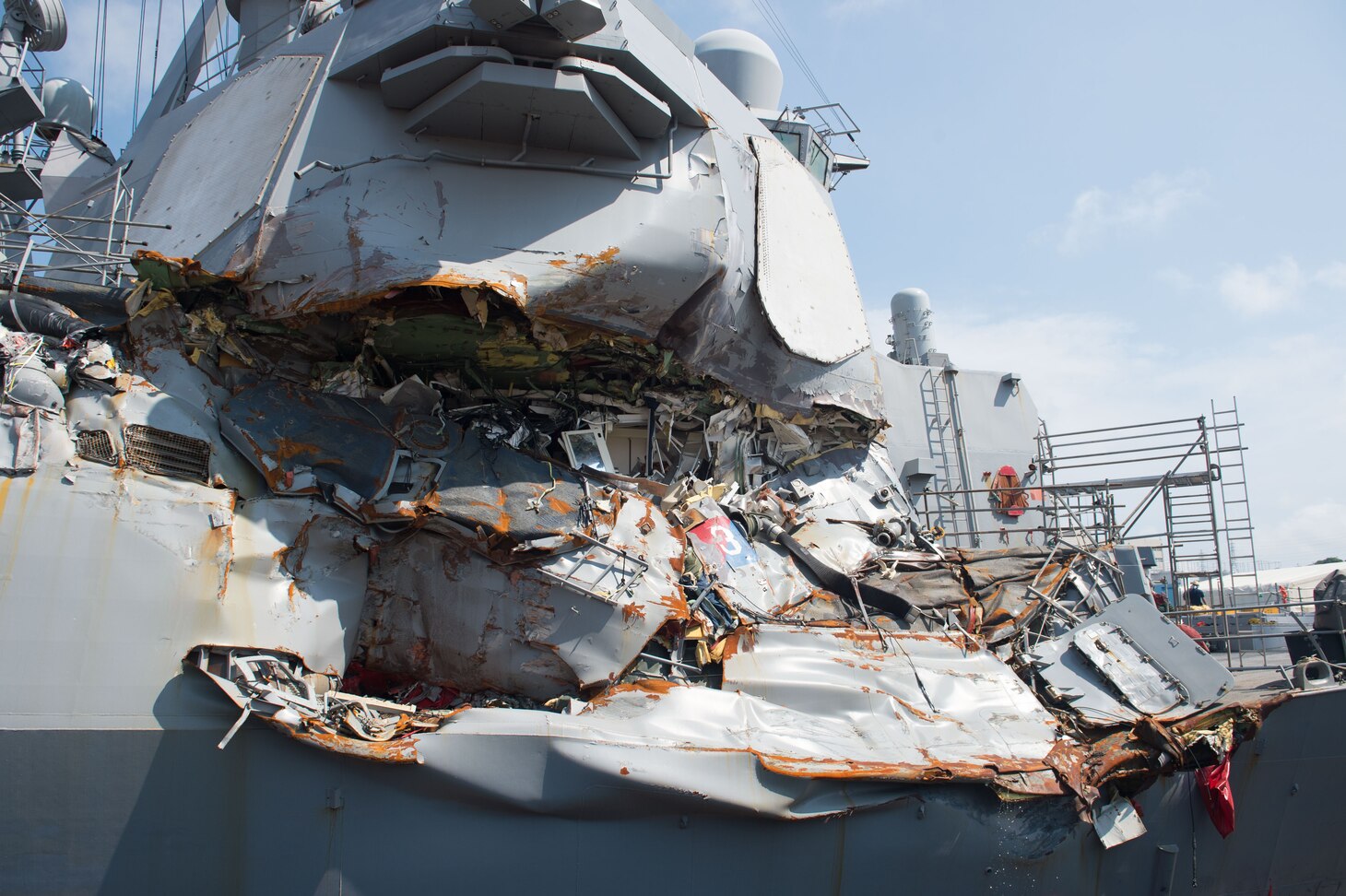
Following two 2017 surface collisions in the Pacific, USS John McCain and USS Fitzgerald both required extensive repairs prior to their return to service. McCain was repaired in Yokosuka at Ship Repair Facility-Japan vice bringing it back to the U.S. for repairs. Fitzgerald, on the other hand, was contracted out to Huntington Ingalls Industries shipyard in Pascagoula, MS. Both ships required leasing a heavy lift transport to their repair destination, like Cole. The grounding of the USS Connecticut in 2021 offers a different trade-off. After colliding with a seamount, the submarine remained at Puget Sound Naval Shipyard from December 2021 to July 2023, until entering dry dock for her previously scheduled Extended Dry-docking Selected Restrictive Availability (EDSRA), where the repairs would be made. In this case, Connecticut was “lucky” that the incident occurred close to a scheduled maintenance period.

The guided missile destroyer USS Fitzgerald sits in Dry Dock 4 at Fleet Activities Yokosuka, Japan, for repairs and damage assessments, July 13, 2017. The USS Fitzgerald sustained damage during a June 17 collision with a merchant vessel, resulting in the deaths of seven Sailors. (U.S. Navy photo by Petty Officer 2nd Class Christian Senyk)

Even if the U.S. Navy added the recommended salvage tugs and floating drydocks, the navy’s shipyards are already stretched beyond their limits with planned modernization and maintenance. For example, faced a prolonged and costly repair timeline when the submarine’s fiscal year (FY) 2016 overhaul was canceled to accommodate ballistic missile submarine and aircraft carrier maintenance, losing its dive certification in 2017. Only in early 2024 was a contract signed to begin the overhaul, nine years after its last deployment, with expected completion in 2029 at the cost of $1.17 billion. The loss of operational capability, crew experience, and the daily upkeep costs over almost 15 years could add up to be more detrimental than the price tag itself, especially when the fleet is already straining to meet operational demands.

At a time when Congress is focused on getting newly built submarines delivered promptly, the inability to use one that the U.S. Navy already owns is unacceptable. These types of delays will only become more commonplace in a conflict without expanding our salvage and repair capabilities.

Congress has shown that it is willing to address such shipyard issues, for example, allocating, but this is focused on producing new construction submarines for the U.S. Navy and the AUKUS agreement. The 2018 investment in the Shipyard Infrastructure Optimization Plan was important but it is over budget and behind schedule, and the chronic delay in ship repairs remains. In FY21 and 22, less than 40 percent of ships completed maintenance availabilities on time.

All these shortfalls come during planned, peacetime maintenance periods. If the U.S. Navy needs to make repairs to battle damage in a major conflict, they do not have the salvage capabilities to conduct repairs at sea or forward deployed, they do not have the industrial base to support the additional work, and they do not have the open shipyard space to put the damaged ships. To make U.S. ship repair shortcomings worse, China has more than 200 times more capacity for shipbuilding, including a large commercial capacity, that can likely be repurposed in time of conflict for repairs.

(October 31, 2000) The semi-submersible ship M/V Blue Marlin carrying the damaged USS Cole. (U.S. Navy photo)

The Way Ahead

To address these deficiencies in repair and salvage capabilities, the U.S. Navy, Department of Defense, and Congress must learn from recent incidents and the lessons of World War II. First, the Navy should implement the recommendations from the recent Government Accountability Office (GAO) report on ship repair, such as “developing a ship industrial base strategy that aligns with the National Defense Industrial Strategy.” As part of this, the Navy needs to examine all emergent repairs spurred by modern incidents starting with USS Cole to identify gaps in planning and capabilities, and the root causes of delays. This should include where salvage and repair ships were needed and unavailable. Any needed infrastructure or platform investments, such as forward-deployed floating drydocks, should be forwarded to Congress for supplemental funding. Immediate investments in these capabilities will bolster the U.S. Navy’s ability to better perform peacetime maintenance while building capacity to absorb battle damage repair in future conflict.

Second, Congress should pass the bipartisan SHIPS for America Act, providing 10 years of funding to boost the commercial shipbuilding industry and the merchant marine. This will help to provide more shipbuilding and repair capability and capacity throughout the United States in the event of future conflicts, and train qualified personnel for the MSC that mans and operates the Navy’s repair and salvage fleet. The combination of short- and long-term investments will turn the tide on the U.S. Navy’s repair capabilities before ships are lost, while sustaining them for decades to come.

Third, the Department of Defense needs to recognize ship repair as equal to shipbuilding when prioritizing funding. Ship repair is a subset of some of the Secretary of Defense’s 17 FY26 budget priorities, and a priority of the CNO’s Navigation Plan. Repairing ships already in Navy service reduces the effect of problems in shipbuilding. Finding ways to repair ships quicker increases public shipyard capacity, but this alone is not enough. The Department of Defense needs to create its own surge capability for the desired increase in naval fleet size and invest in private industry surge capability that can be optioned in case of added battle damage repair. Allocating the requisite funding to improve capacity and capability now will better prepare the U.S. Navy for great power conflict.

Conclusion

The U.S. Navy faces a growing challenge in maintaining a combat-ready fleet. It was lucky when a recent collision between the USS Harry S Truman and a merchant vessel outside the Suez Canal required only minor repairs before the carrier could return to sea. If the Navy is to meet the demands of a major conflict, it must prioritize not only shipbuilding but also ship repair and salvage capabilities. The lessons of the past are clear—effective battle damage repair and salvage can mean the difference between victory and defeat. This means not just adding to the capacity to repair current ships but also building capacity for the larger fleet of the future and creating a surge capacity for times of conflict. By addressing these gaps now, the United States can ensure the Navy is prepared for whatever the future holds.

Michael Hogan is a Commander in the United States Navy and a career submarine officer with tours aboard both fast attack and ballistic missile submarines, most recently as Executive Officer of USS Nebraska (SSBN 739) (Blue). He is currently the Senior U.S. Navy Fellow at the Atlantic Council.

The opinions expressed are those of the author and do not necessarily reflect the official views or policy of the U.S. Defense Department, the Department of the Navy, or the U.S. government. No federal endorsement is implied or intended.

Featured Image: The Arleigh Burke-class guided-missile destroyer USS Fitzgerald (DDG 62) departs Pier 9 at Fleet Activities (FLEACT) Yokosuka, Dec. 1, 2017 to proceed to anchorage in Yokosuka Harbor aboard heavy lift transport vessel MV Transshelf in order to make underway preparations. (Photo by Petty Officer 1st Class Benjamin Dobbs)