Category Archives: Fiction Week

Dreadnought 2050

Fiction Week

By Tracy MacSephney

This fictional short story intends to use ‘useful fiction’1 to imagine the 2050 workforce and the impact of autonomous systems on maritime operations. The short story is set in a ‘Fragmented’2 2050 and draws on open-source research and media to shape the story. It does not intend to predict the future.

Future Worlds: Fragmentation

“States, corporations, megacities and other non-state actors, including organised criminal and dissident groups, compete for power. Cooperation is rare and only sought when there is a benefit to further an actor’s interests.” –Global Strategic Trends, 2018

Somewhere in the Atlantic Ocean

2050

I check the roster one last time: Ensign Parker. I double-click on their image to add it to the facial recognition software which will project a warning in my HUD3 when it triggers. I also add a hologram projection with their name on it, which hovers over my head, so they can have something to look for. I call up the arrival details on my HUD: on time, shock horror.

“Bet it’s not on time when I’m trying to leave tonight,” I grumble to no one in particular.

I try to think back to my first day on the Alliance’s4 FOBS5 DREADNOUGHT6 and the essentials I need to get across to Parker before I leave but the troop transport lands and in no time the arrivals/departure hall starts to fill. Before I’ve even had a chance to look, the HUD idents Parker who is scanning the holograms.  

“Sims7 don’t prepare you for this part, do they?” I ask as I step in front of Parker before they’ve had a chance to spot me.

“They sure don’t, and I’m not sure what I expected either,” Parker confesses looking out across the flattop and beyond to the endless sea and sky in all directions.

“Get a good look Parker; the next time you see this part of the ship, you’ll be heading back home,” I pause while they look around. “I’m Phoenix, welcome aboard. Come on Parker, we’ve got time to keep and miles to go before you sleep.”

They smile like an excited puppy. If I remember correctly, it’ll be days, maybe weeks, before it wears off.

Most of the other arrivals have already departed the hall so we have one of the four 20-person elevators to ourselves. 

“When you’re trying to get around the ship always head to deck seven first–” I start but Parker interrupts, “–the Promenade, and navigate from there.” I chuckle and try to remember what it’s like to be keen and eager.

“I’m going to assume you’ve completed all the sims, so why don’t you simply ask me the questions you really want answers to, the stuff you can’t get from the sims or pull up on the HUD?” I offer.

“That would be great, thanks,” Parker distractedly responds.

By now we are on the Promenade, making our way to the travelator that runs in 40m sections up and down the length of the ship. Parker’s doing a good impression of one of those old-fashioned bobble head toys taking in the Promenade as we progress.

“We’re Top Gun8 so we only use callsigns out here. What’s yours?”

“Oh, uh, well you see I, um,” Parker mumbles and I chuckle.

“Ah, so you don’t want to use the one they gave you during training?” I recall my own which will never be uttered again. “Let me guess, something like ‘Nosey’?”

“Ah, yeah, not very original or cool like yours.”

“Well, we better think fast; once I program it in, that will be it.”

“On account of the Thunderbirds, and me being Parker and all, I thought ‘Guardian’ would be cool,” Parker hoped.

“No can do, we already have a Guardian,” I pause while I try to help the kid out, “Thunderbirds huh? Well, how about Thunder?”

“Perfect!” Parker’s relief is evident.

“Great, so we’ll head over to your cabin first, your gear should be there already, then we can grab scran9 before we head over to the office. It’s a good idea to orientate yourself so that you’re not reliant on the HUD all the time, you never know,” I offer as a warning, but equally true is if the HUD goes down, the ship is down and we’re a massive sitting duck. I don’t dwell on that thought for long and Parker’s silence suggests they know that too.

“Let’s get you synced to the ship,” I change the subject back to more practical issues as we progress along the travelators to the accommodation area.

I call up Parker’s credentials, add Thunder as their callsign, and send the uplink code.

“Got it,” Parker inputs the code and is instantly connected to the ship. I can see their HUD throwing up numerous messages.

“Ignore all messages today, except any flashing red,” I advise before they become overwhelmed with the information overload. “You’ll soon adjust to which messages you need to pay attention to, and you’ve got tomorrow to acclimatize and sort your filters out before you start your first shift.”

“Noted, thanks. Even Fallon10 wasn’t this busy with comms traffic,” Parker adjusts the settings to tone down all but flashing red messages. “Had the quietest 48 hours travelling here not being synced to a station or ship.”

“Oh, I know, that is one thing I’m looking forward to tonight,” I say, although I’m not quite sure that is true as I have no idea what I’m going to do with myself for 48 hours.

“Where are you off to?”

“Back to Fallon as an instructor for a couple of years and then no doubt back here on promotion as one of the Ops directors, although that all depends on ASI11. I’ll probably be in Fallon when we know more so who knows.”

“You must be the best here if you’ve been selected as an instructor,” Parker says in awe, “I’m sorry I’ll miss the opportunity to learn from you.”

“And you’re one of the best to make it to DREADNOUGHT so no doubt you’ll be an instructor one day too, just focus on one mission at a time,” I say, which is just about the best advice I can give at this stage.

Just as we turn down the passageway to their cabin a flashing red message appears. In an instant everyone is moving purposefully around the ship heading to their designated areas.

“Change of plan, we’re heading to the office now,” I change direction and walk quickly, all while thinking officers never run. “Thunder, you’re about to get a chance to fly with me, let’s go!”

“Awesome,” Parker falls in step as we head to the office12, and I message ahead that Thunder will need a cubicle prepared.

By the time we arrive at the office, all those already on shift are engaged in battle with an airborne swarm attack. It’s clearly AGI only so no match for the Top Gun team, although the swarm is huge. I slip into a spare cubicle and signal for Thunder to take the cubicle next to me. The systems are already boosted and the AGI has our Interceptors hovering at the border of our defensive perimeter; all we need to do now is sync to the cubicle which automatically happens as we sit down. In no time Thunder and I are engaging the swarm. 

For a swarm this size, it seems too easy, and I flash a message over to the Ops director:

Too easy, misdirection?

The instant response simply reads:

Scanning

I see a message flash at the same time as one of the Defenders explodes taking out an unidentified object in the Delta quadrant. I redirect my Interceptors to the location and link up to the relevant Explorer, another Defender already in position. Thunder has followed my lead while the rest of the team deal with the swarm.

The AGI flashes an error warning in a line of code just as another Defender explodes taking out another unidentified object. I send the blip in the line of code to the Ops director but not before instructing AGI to FIND13 and FIX14 the code to allow the Interceptors to ‘see’ and deal with the unidentified objects before the Defenders must respond.

The Ops director doubles the Defenders as a precaution and notifies the other FOBS. It’s the first time that we have seen this type of camouflage used, indicating a sophisticated adversary. However, with the code now identified, what’s left of the swarm retreats. That was a close call, and we all wait for the final all clear before we relax. It will be up to others to investigate further.

Following the call to return to normal ops, I take the opportunity to introduce Thunder to the Ops directors still loitering in the back.

“Thunder, great to meet you, welcome to the team,” says one.

“No longer a rookie, Thunder, great job,” says another.

“I like your instincts kid, keep up the good work,” says the final one.

My stomach grumbles reminding me it’s time for scran. No longer worried about having to pass on any sage advice to Thunder, we head over to the galley and regale in the details of the last mission.

Tracy MacSephney is a 1SL Associate Fellow working with the Royal Navy Strategic Studies Centre. She has a MA in Creative Writing (KUL), a MA in Defence Studies (KCL), and an interest in useful fiction.

References

Airbus Website (2022) “A400M”, Airbus Website [Online]. Available at A400M | Airbus (accessed 18 Aug 22)

Allison, G (2022) “UK planning to purchase additional A400M transport aircraft”, UK Defence Journal [Online]. Available at UK planning to purchase additional A400M transport aircraft (ukdefencejournal.org.uk) (accessed 18 Aug 22)

BBC Bitesize (2022), “Typhoon Haiyan”, BBC Bitesize [Online].  Available at Tropical storm case study – Typhoon Haiyan – Tropical storms – AQA – GCSE Geography Revision – AQA – BBC Bitesize (accessed 8 Feb 22)

BBC News, (2022d).  “Combat drones: We are in a new era of warfare – here’s why”, BBC News [Online].  Available at Combat drones: We are in a new era of warfare – here’s why – BBC News (accessed 8 Feb 22)

Department for Transport, (2019), Maritime 2050; Navigating the Future. [Online]. Available at Maritime 2050 (publishing.service.gov.uk) (accessed 17 Aug 22)

Earth 2050 website (2022) “Earth 2050: A glimpse into the future” [Online]. Available at Earth 2050: A glimpse into the future | Kaspersky (accessed 18 Aug 22)

Escott, E. (2017) “What are the 3 types of AI? A guide to narrow, general and super artificial intelligence”, Codebots [Online]. Available at What are the 3 types of AI? A guide to narrow, general, and super artificial intelligence | Codebots (accessed 18 Aug 22)

Glenn, J.C. and the Millennium Project Team (2019) Work/Technology 2050: Scenarios and Actions [Online]. Available at Work_Tech_2050-ExecSumm.pdf (millennium-project.org) (accessed 18 Aug 22)

Hadaway, S. (2022) “The real Top Gun: History of the US Navy pilot school”, Live Science [Online]. Available at The real Top Gun: History of the US Navy pilot school | Live Science (accessed 18 Aug 22)

Haghroosta, T. and Ismail, W. R., (2017), “Typhoon activity and some important parameters in the South China Sea”, Weather and Climate Extremes. [Online].  Available at (PDF) Typhoon activity and some important parameters in the South China Sea (researchgate.net) (accessed 8 Feb 22)

Hurricane Science (2022) “Hurricane Life Cycle”, Hurricane Science [Online].  Available at Hurricanes: Science and Society: Hurricane Life Cycle (hurricanescience.org) (accessed 14 Feb 22)

Marine Insight (2021) “Top 10 World’s Largest Container Ships in 2022”, Marine Insight News Network[Online]. Available at Top 10 World’s Largest Container Ships In 2022 (marineinsight.com) (accessed 18 Aug 22)

Michelle, M.A (2020) “The Workplace of 2050, According to Experts”, The Wall Street Journal [Online]. Available at The Workplace of 2050, According to Experts – WSJ (accessed 18 Aug 22)

Ministry of Defence, (2018), Global Strategic Trends, The Future Starts Today, Sixth Edition. [Online].  Available at Global Strategic trends – the future starts today (publishing.service.gov.uk) (accessed 3 Feb 22)

Morris, N (2019) “The 10 surprising jobs that will be huge in 2050, Metro News [Online]. Available at  The 10 surprising jobs that will be huge in 2050 | Metro News (accessed 18 Aug 22)

Newcomb, T. (2017) “7 of the World’s Biggest and Baddest Offshore Structures”, Popular Mechanics [Online]. Available at 7 of the World’s Biggest and Baddest Offshore Structures (popularmechanics.com) (accessed 18 Aug 22)

Pratesi, G (2022) “The 15 Biggest Cruise Ships in the World 2022”, U.S.News and World Report [Online]. Available at The 15 Biggest Cruise Ships in the World (usnews.com) (accessed 18 Aug 22)

UKRI (2021) UK Transport Vision 2050: investing in the future of mobility, UKRI, Innovate UK [Online]. Available at IUK-110122-UK-Transport-Vision-2050.pdf (ukri.org) (accessed 18 Aug 22)

Useful Fiction website (2022) [Online]. Available at https://useful-fiction.com (accessed 18 Aug 22)

Watts, J. (2019) “The environment in 2050: flooded cities, forced migration – and the Amazon turning to savannah”, The Guardian [Online]. Available at The environment in 2050: flooded cities, forced migration – and the Amazon turning to savannah | Climate crisis | The Guardian (accessed 18 Aug 22)

[1] Useful Fiction or FICINT (Fictional Intelligence), “melds nonfiction research with the power of narrative to reach target audiences with greater effect” (Useful Fiction, 2022)

[2] Global Strategic Trends future worlds: Fragmentation: “States, corporations, megacities and other non-state actors, including organised criminal and dissident groups, compete for power.  Cooperation is rare and only sought when there is a benefit to further an actor’s interests.” (Global Strategic Trends, 2018)

[3] HUD is heads-up-display, incorporated into glasses that everyone wears.

[4] The Alliance refers to the World’s strongest alliance previously called 5 eyes and what was Australia, Canada, New Zealand, UK, and US. 

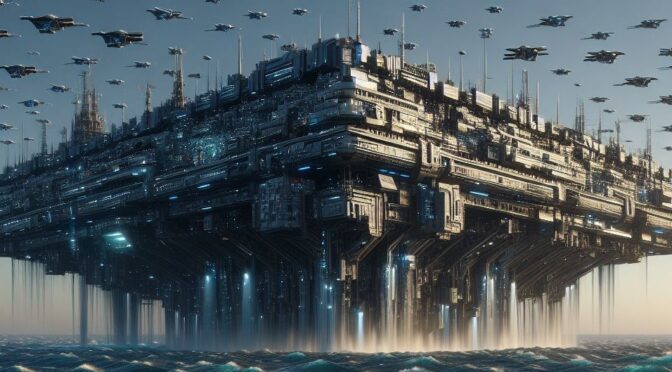
[5] FOBS is “Forward Operating Battleship”; imagine 4 of the biggest cruise ships, built on top of oil platform technology with a flattop able to land an A400M; 800m long, 120m wide, powered by nuclear energy operating down to minus 47 degrees Fahrenheit, able to withstand any conditions including superstorms, using artificial narrow intelligence (ANI) to control the propulsion and stabilisers to manoeuvrer the FOBS and avoid the worst of the superstorms. Maintains approx. 40k personnel including Alliance military personnel, their families, agricultural, education, energy, engineering, entertainment, hospitality, media, retail, and other personnel able to support a fully functioning city.

[6] DREADNOUGHT named after HMS DREADNOUGHT, under UK Command covers the Atlantic Ocean and associated littoral regions. ENTERPRISE same size as DREADNOUGHT is under US Command operating in the Pacific Ocean; HALIFAX (Canadian Command operating in the Arctic), BRISBANE (Australian Command operating in the Indian Ocean) and TE KAHA (New Zealand Command operating in Oceania) are slightly smaller with approx. 30k personnel and have the same capabilities although slightly reduced mass.

[7] Sims is short for simulators; all training is now conducted in simulators.

[8] Top Gun referring to the best of the best in drone dog fighting skills. With drones now operating on artificial general intelligence (AGI) it takes a human in the loop to provide the creativity required to out manoeuvre and destroy enemy fighter drones which mostly still use AGI. The Alliance relies on AGI to operate the Explorers (intelligence gathering drones both above water and subsea) and Defenders (imagine a contact mine drone, colliding with incoming objects, if necessary, again both above water and subsea). Top Gun pilots operate up to four Interceptor drones (above water fighters) at a time and rely on AGI to have additional Interceptors on standby to replace those lost during battle. Submariners operate up to four Seaceptor drones (subsea fighters) at a time and rely on AGI to have additional Seaceptors on standby to replace those lost during battle. Not many adversaries have the subsea capabilities, so the submariners are not as busy as the Top Gun pilots. AGI with human maintainers ensure new drones are printed to maintain the mass required by the Alliance. “Industry roles will be multidisciplinary, potentially requiring the ability to create, operate and maintain autonomous and technological systems.” (Maritime 2050, para 39) “The future of the human race is hedged on creativity.” (Escott, 2017)

[9] Scran is slang for food.

[10] Fallon is the Alliances Top Gun school, the best of the best from across the Alliance are sent there to be certified and the best of those make it to ENTERPRISE and DREADNOUGHT.

[11] On the cusp of artificial super intelligence (ASI) it is still unclear how this will affect military operations.

[12] The office is the Command Centre, a common operating picture is displayed on the theatre style screen that all the cubicles face, each cubicle has its own display allowing the operators to engage their own targets but allowing the Ops director to see the whole picture.

[13] FIND: Detect, recognise, identify and/or locate a unit, object, activity, situation, event or individual or group(s).

[14] FIX: Deny the enemy their goals, to distract them and thus deprive them of freedom of action to gain own forces freedom of action.

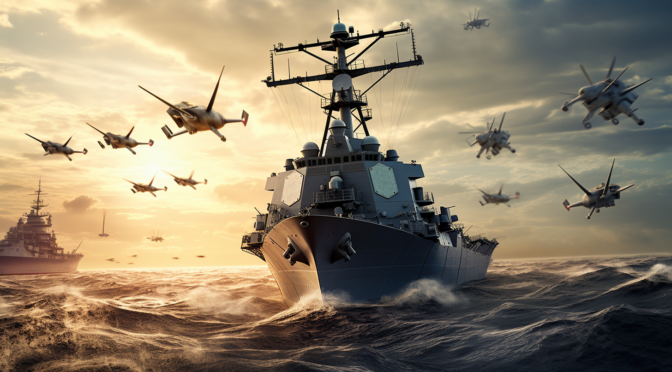
Featured Image: Art created with Image Creator from Microsoft Designer.
Perilous Passage

Fiction Week

By LtCol Robert L. Burton, USMC (ret.) 

Transiting the Strait had been a highly anticipated movement for the Maritime Sealift Command crews in recent months. While maritime commerce usually flowed smoothly through the waters, the deteriorating security situation in the region due to Centralia’s recent belligerence had raised concerns. As Centralian forces focused on antagonizing their neighbors in Montanya, pirates and other outlaws exploited the fragile security on the high seas. Meanwhile, U.S. forces were heavily engaged in a security cooperation campaign to support their regional allies. Strategic sealift requirements through the Strait had not only increased but also carried greater consequences of failure.

The USNS Apalachicola’s current mission through the Strait exemplified this heightened importance. The ship’s humanitarian assistance cargo was crucial for an ally whose coast had been ravaged by a recent typhoon. Without these supplies, thousands of people would continue to suffer, potentially destabilizing the region further.

This particular transit was also notable for other reasons. This was the first time that Merchant Marine Cadets Deville, Thompson, and Sparkman had made the transit as part of their ‘Sea Year’ duty. Cadet Deville, the Engine Cadet, hailed from the Midwest and was always seen with a wrench in hand and grease on his face. Thompson, a laid-back Bostonian, was the Deck Cadet and the son of a fisherman. Cadet Sparkman, an Alabama native, was the assigned Cyber Cadet, a relatively new position for Merchant Mariners, and responsible for cybersecurity. The midshipmen were about halfway through their Sea Year Duty, but they had competently adjusted to their duties. Unique for them, however, was their assignment to the EPF-13 Apalachicola, a crew-optional vessel. Although they manned their stations from a darkened operations room in Norfolk, they did not take their responsibilities any less seriously.

_________________________________________

As the Apalachicola approached the Strait, Cadet Sparkman sat up at his desk. Although he realized the approach would take a couple hours, his intuition suggested that this transit would require his acute attention. He reached for an energy drink beside his monitor, took a healthy gulp, and began typing furiously on his keyboard. He scrolled through multiple open applications spread across three screens at his workstation. At one point, he reached for a clipboard, reviewing the daily cyber threat report. He recognized most of the top tier threats and followed down the list with his finger until he came across a less familiar one: “MAROON STORM.” A ubiquitous name, but he recognized by its nomenclature that the source of this particular threat was an emerging actor and thus more interesting since less was known about the actor’s intentions and motives.

_________________________________________

As Cadet Sparkman continue to review the information about MAROON STORM, he received his first alert that his intuition may have been right. He scanned through his systems logs and saw the first clue. A sensor on the bridge that measured windspeed had failed to function for two minutes. At the Apalachicola’s current speed, windspeed was most certainly measurable. But not strong enough for any wiring to come loose. Cadet Sparkman calmly turned the sensor off and waited for two minutes before turning it back on.

Sparkman glanced at his watch after only 30 seconds, trying to stave off his impatience, but then his mind began drifting off towards his Sea Year Project. The Sea Year Project was one of the other pressures that Merchant Marine midshipmen endured during their first at-sea duty. Like a six-month long homework assignment, it occupied much of their free time; however, its relevance to their current duty made it important to stay on top of. Each day he chipped away at his project and learned something new he could apply during his next duty rotation.

A thought occurred to him, and Sparkman activated the transmit button on his headset. “Cadet Thompson, this is Sparkman, over.”

Thompson responded, “This is Thompson. What’s up, Sparky?”

“Hey, I know you’re busy rolling up maps and stowing the sails and all,” Sparkman began, “but would you mind checking on the starboard anemometer? I think we may have an intrusion.”

“Hah. Yeah, okay. I’ll check on it,” Thompson replied.

Cadet Thompson was accustomed to Sparkman’s jocular insults. There was a misperception that Deck Cadets had a more leisurely role aboard ships, focused simply on navigating and steering. However, their academic studies, centered on logistics, business principles, and security, were just as crucial to maritime trade as the studies of the cyber or engine cadets, who specialized in propulsion and maritime engineering.

A few moments later, Cadet Thompson returned the call. “Hey, Sparky. I checked the anemometer, and it’s working fine. But you’re right about the readings; something’s interfering at the terminal.”

Sparkman acknowledged, “Copy that. Is it okay if I shut it off until we get through the transit? I should have a patch coded by then.”

Thompson agreed, “I’ll check with the Chief Mate, but go ahead and keep it off until I confirm.”

“Great, thanks,” Sparkman responded. He continued to monitor his various computer applications and monitors, looking for any additional issues that might have popped up. So far, no other indicators, he thought to himself. However, he made a mental note to report the incident to both the 10th Fleet and Military Sealift Command before his shift concluded.

_________________________________________

As Sparkman diligently drafted his cyber incident report, Cadet Thompson began sifting through his navigational charts. He reviewed the planned route and started calculating the remaining transit time, although he had not been explicitly asked to. Thompson found the math to be relaxing, and it helped to pass the time.

Satisfied that his measurements aligned with those of the navigator, Thompson looked at the radar to see how heavy the traffic was. He noticed it was lighter than expected for both the season as well as time of day. Curiosity piqued, he inspected their position in relation to nearby landmarks. That’s when he detected an anomaly. Based on his calculations and observations through the bridge cameras, something didn’t add up. According to the GPS, they were positioned precisely in the center of the sea lane, and their plotted path suggested they should proceed without altering their course. However, his video camera monitors revealed that the peninsula of Centralia was now perilously close to their intended route, within a few degrees.

Growing increasingly concerned about this discrepancy, Thompson sought out the ship’s navigator, 2nd Mate Sanchez.

“Mr. Sanchez, I have a rather peculiar question,” Thompson began.

“Hey Cadet Thompson. What’s on your mind?” Sanchez inquired, folding his arms in a patronly stance.

Thompson continued, “Well, sir, I’ve been reviewing the charts and plots, and everything seems to be in order.”

Sanchez nodded, “Alright, so what’s the issue?”

Thompson hesitated before saying, “The thing is, when I looked at the video monitors outside the bridge, it appeared that we’re drifting toward the peninsula, which doesn’t make sense.”

Sanchez’s eyebrow raised. “Hmm, that is interesting,” he mused. “Let’s take a closer look at your plots.”

After a few minutes of consulting the charts and GPS data, Sanchez came to the same conclusion as Thompson.

“Well, I agree with your plots. It does to appear to be correct and matches the GPS data. Let’s take a look at the video monitors,” Sanchez suggested.

The navigator pulled up the monitors, with the cadet observing over his shoulder. As they cycled through the cameras, it became evident that the landmass had come even closer into view since Thompson had first noticed it.

“You’re right,” affirmed Sanchez. “Something is not right,” his tone growing more serious. “We need to talk to the Officer of the Watch (OOW)”

After sharing their observations with the OOW, she reached the same conclusion: the landmass was too close for comfort.

The OOW returned to the GPS monitor, quickly punching in a sequence of commands. “The GPS is being spoofed,” she declared.

She alerted the bridge to the threat and then turned off the GPS. The three mariners waited with bated breath for two minutes before reactivating the system. Once the GPS was back online, Sanchez replotted their coordinates.

“Helm, come port to 280!” shouted Sanchez.

“Helm, come port to 280!” the helmsman repeated.

After adjusting to the new course, the OOW, navigator, and deck cadet conferred on what had just transpired.

“This is not the first time GPS spoofing has occurred in the Strait,” advised the OOW. “Fortunately, these new GPS receivers can reacquire the signal after such an attack. This was a more advanced attack, which shows how much this electronic warfare technology has proliferated.”

“Do you think it was the Centralians?” asked Thompson.

“Possibly,” considered the OOW. “But pirates in this region often collaborate with the Centralians, too. More than likely, it was proxies or their ‘little blue men’ just trying to create some chaos.”

“Wow. I didn’t realize something so high tech could be used by fishermen or pirates.”

_________________________________________

The Apalachicola was settling back into its routine when Deck Cadet Thompson noticed another unusual development. While monitoring the radar, he detected a tight cluster of blips moving rapidly toward his ship. Moving at approximately forty knots, just an edge over the Apalachicola’s max speed, they were clearly on an intercept track. At their current approach, this cluster would be in visual range in about ten minutes, and they would intercept the Apalachicola within thirty.

Observing their movements closely, Thompson immediately alerted the OOW.

“Ma’am, I’ve spotted a cluster of fast-moving vessels heading our way on an intercept course. They’re currently 25 nautical miles away, bearing 165, and they’re moving at 40 knots.”

“How many boats, Cadet?” the OOW inquired.

Thompson replied cautiously, “Ma’am, it’s a tightly packed cluster, but I would say more than five, possibly around 10.”

In response, the OOW ordered the starboard lookout to closely monitor his sector. Just as the cluster of vessels came into visual range, Thompson provided another update.

“Ma’am, the cluster has now spread out, and I’ve identified seven small craft, all maintaining 40 knots. They appear to be in a chevron formation,” he reported before glancing up.

The OOW locked eyes with Thompson, assessing whether the cadet was playing a prank. Her deliberations were interrupted by a report from the starboard lookout.

“Swarm of small craft, bearing 170, approaching at high rate of speed!” he alerted.

The term “swarm” resonated with the OOW, and she wasted no time. “Sound general quarters,” she ordered.

Instantly, the crew sprang into action, recognizing the impending threat. It didn’t matter whether these were pirates or Centralians their intentions were clearly hostile and posed a danger to the ship. The OOW directed the helm to increase speed, while the crew continued with their preparations, a well-practiced routine.

Hatches were sealed, non-essential communications ceased, and reports were dispatched to Fleet HQ to alert them to the current situation.

Despite the Apalachicola‘s increased speed, the swarm of small craft managed to encircle the ship at a distance beyond the range of small arms fire. While this might not be evident to the naked eye or visual sensors, the radar confirmed their presence. The OOW then issued a critical order, turning to Cadet Thompson. “Cadet Thompson, launch the drone.”

“Aye aye, Ma’am!”

Though not a seasoned mariner like the rest of the crew, Cadet Thompson and his fellow cadets were well-versed in small drone operations from their lessons at Kings Point. With a surge of pride, knowing the OOW entrusted him with this crucial task, Cadet Thompson swiftly launched the drone, using a flurry of keyboard commands. Once airborne, he manipulated the craft using a small joystick near his workstation.

_________________________________________

The Ship Master, having joined the bridge team, studied his video screen intently while Cadet Thompson maneuvered the ship’s unmanned aerial system. A swarm of seven small, unmanned skiffs were circling the ship in a counterclockwise pattern, keeping a cautious yet menacing distance. Thompson guided the drone along the skiffs’ path, briefly inspecting each for any discerning details that may reveal their intentions.

The swarm of skiffs now moved at a slower pace, like a convoy waiting for trailing vehicles to catch up. However, it was evident that malicious intent guided their actions. Whether they carried explosive charges or other means of sabotage remained unclear from the drone’s imagery. It soon became apparent that the swarm was accelerating and closing in on the Apalachicola, as if circling a drain.

The Master inquired about the distance to the swarm, to which the lookout responded, “Currently 400 meters, but closing in at a rate of 25 meters per minute.”

“Prepare the ‘Slimer’ and inform me when they reach 200 meters,” the Master ordered.

The Slimer was one of the few self-defense measures available on the ship when operated remotely. When physically manned, the crew could utilize various weapon systems, including small arms fire. However, during remote operation, standard procedures limited defenses to non-kinetic methods.

The Slimer, fortunately, was an effective tool. Developed by the Joint Intermediate Force Capabilities Office, it was a projectile launcher which dispensed a cluster of grenade-like canisters filled with an artificial slime similar to hagfish slime. Capable of launching from both port and starboard sides, the slime would expand into a viscous glob, which could foul the screws on small vessels and immobilize them.

“Skipper, abeam on the port side, 225 meters,” reported the port lookout.

“Roger, standby to launch.”

“Slimer, standing by, aye,” acknowledged the operator.

“At 200 meters!” exclaimed the starboard lookout, anticipating the imminent action.

“Fire.”

“Fire, aye.” With the push of a button, a cluster of five Slimer projectiles ejected from the launcher affixed on each side of the bridge. There was notably no launcher oriented toward the bow or stern to reduce risk of self-entanglement.

As the projectiles splashed into the sea, they each expanded as designed, creating globs of slime that floated on the surface. Just as intended, the unmanned skiffs unknowingly maneuvered right into the trap, instantly stalling out. Most of the skiffs quickly came to a floating standstill, while the remaining vessels, initially positioned near the bow or stern, also succumbed to the gelatinous trap as they continued their counterclockwise circuit.

_________________________________________

As the unmanned skiffs became mired in the hagfish slime, the Apalachicola resumed its tack and continued through the Strait without further incidents. The ship’s crew returned to their regular duties, displaying unwavering vigilance even though operating the Apalachicola remotely. The allure of relaxation in the rack and the opportunity to hit the gym beckoned to the Merchant Marine midshipmen. Still, they recognized that this recent shift offered valuable material for their mandatory Sea Year Projects.

Sparkman meticulously transferred his notes, codes, and cyber incident report traffic to his laptop. He knew that the patch he had installed earlier for the anemometer would require some additional coding, and he was eager to delve deeper into the “MAROON STORM” details through the Cyber Threat Repository.

Thompson was eager to refresh his navigation skills, particularly celestial navigation. The GPS spoofing incident had reinforced the vulnerability of overreliance on GPS. He knew he would not always crew an unmanned vessel like Apalachicola, so he felt it was important he could employ alternative navigation solutions if GPS was not available.

Deville was keen to quickly download his material from Engine Watch. As usual, he had been somewhat oblivious to the excitement during the transit. Tasked with monitoring and adjusting the dials and gauges of the ship’s engines, he had known something was amiss. Fortunately, the engine had performed flawlessly, requiring minimal intervention from the engineers. Deville understood that the sooner he completed his project’s assignment, the sooner he could find Thompson and Sparky and catch up on the latest scuttlebutt.

LtCol Robert L. Burton, a retired Marine Corps Tank Officer, was last assigned to U.S. Special Operations Command as a future warfare specialist. Presently, he is a strategic planning professional focused on developing solutions to contested navigation and operational maneuver challenges. He holds masters degrees from the Army School of Advanced Military Studies (SAMS), Army War College, and the University of Mississippi.

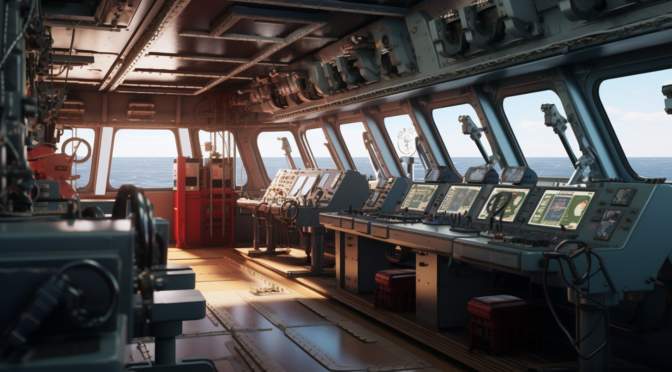
Featured Image: Art created with Midjourney AI.

Hide and Seek

Fiction Week

By CDR Paul W. Viscovich (ret.) 

            “Officer of the Deck, what contact is that off the starboard bow and what’s her CPA?”

            The OOD took a bearing on the distant ship from the centerline pelorus. “Skunk Lima, Captain. Closest Point of Approach is Three-Two-Five True, 12,500 yards at time 1437.”

            Commander Scott Cushing swiveled his bridge chair to train his binoculars on the contact. “Does she look a little odd to you?”

            “Yes, Sir. Much larger than your normal Chinese junk and she’s riding pretty high in the water. Shall we take a closer look?”

            “Yes. Come right to course Three-Four-Zero. That should get us some good photos of her.”

            “Aye-aye, Sir. Boats, pass the word, ‘Away the Snoopy Team, starboard side.’”

            It was a clear day with excellent visibility, sea state two. As USS Barry’s intel team assembled topside to collect whatever data they could, the CO leaned forward, watching as the distance to the junk closed. No doubt they’d get some good shots of this strange ship, her bat-wing sails flapping limply in the light air.

            “What the hell?”

            A small, unmanned aerial vehicle dropped out of nowhere and hovered just feet away from the bridge windows, apparently scrutinizing the captain as he stared back.

            “Sir! Lookouts report aerial drones just yards away off the starboard beam, port quarter, now the starboard quarter! Jesus, they’re all over the place!”

            “Sound General Quarters!” Commander Cushing punched the button for CIC on his 21MC intercom. “Combat, Captain here. Why weren’t these air contacts reported?”

            “Sir, they’re not showing on the air search radar!”

            “Yet here they are! Have someone tune the radar and gin up an OPREP-3 Pinnacle. Report this as an enemy contact!”

            The group of little airborne drones held their positions and followed the U.S. destroyer for several minutes before disengaging and flying off toward the mainland. One carried the photograph of a visibly startled Navy commander.

_________________________________________

            USS Barry’s Flash radio message had the predictable effect of stirring up some excitement at the highest levels of military leadership. President McCaffrey called for a briefing in the Situation Room early the following morning. He was the last to join the meeting. Wasting no time, he turned to his Director of Central Intelligence.

            “Well Hank, what are we to make of this incident?”

            “USS Barry managed to get a good photograph of one drone. It’s a quadcopter, quite small, and appears to be unarmed. Initial assessment is they’re reconnaissance assets.”

            “How far off the coast was Barry?”

            “About 25 miles out at the time of the encounter. Short trip for those UAVs. Could be off-the-shelf models.”

            “Except for one thing,” interrupted the Chief of Naval Operations. “Barry detected no unusual electronic signals before or during the encounter. The very precise navigation and situation-awareness demonstrated by these drones suggests autonomous control. Onboard Artificial Intelligence could account for that.”

            “Yes, maybe. We’ll look into it” replied the DCI.

            “Do we have anything like this in the works?”

            “No, Sir” replied the CNO. “But I can assure you, we’ll have a Request for Bids on the street by the end of the week.”

            “Anything else?”

            “Well Sir, since we’re discussing China, our sources confirm they’ve suspended work on building those aircraft carriers. It looks like they’ve shifted gears and are laying the keels for quite a few much smaller ships.

            “How small?”

            “About the same size of one of their Coast Guard’s 1,300-ton patrol cutters.”

            “This could indicate an impending move to dominate the South China Sea” offered the DCI.

            “Then we should alert Jakarta, Manila and Hanoi to this possibility.” The President continued, “While I’m thinking of it, any update on what’s causing those massive smoke plumes over Huangpu?”

            “No Sir.”

            “Well stay on it. They’re a major violation of the Paris Climate Accords!”

_________________________________________

            The contract was eventually awarded to Scythia Corporation. Their proposal was breathtaking in its originality. It would use an experimental crystalline-reformation technology to create hundreds of thousands of UAVs no larger than a fruit fly. These stealthy swarms would carry with them sufficient AI coding to evade obstacles, bad weather and human countermeasures. Upon locating their target, they would combine into temporary macroforms to create cameras, light sources, data storage, transmitters, and so on to do the work now performed by highly visible, expensive, and vulnerable drones.

            The leadership at Scythia eagerly announced “Project Panopticon” in an unclassified employee briefing at their corporate headquarters in Palo Alto. The CEO concluded his remarks with,

            “While I can’t go into too many specifics here, suffice it to say we are combining several of our current R&D projects into this one, which will take aerial surveillance forward by at least an order of magnitude. Panopticon will use tiny, airborne units that operate independently. If necessary they can individually fly under a door then work together to capture and deliver high resolution photographs. With it, we will not only keep several production lines working, we’ll be able to hire many new workers to support our expected expansion.”

            This stunning announcement was met by a murmur of excitement from the audience.

            “I’ll take any questions at this time.”

            A young engineer from R&D hesitantly approached a microphone. Clearing his throat, he adjusted the mic to eliminate the feedback squeal. “Sir, what you have described is no doubt a triumph of engineering and will give a tremendous boost to our reputation.

            “But I have misgivings over our partnership with the Pentagon. This new technology, who can say how they will use it? At what point might they decide to take it beyond surveillance and into combat? Killer drones could increase battlefield lethality as dramatically as the machine gun once did. Or what if it’s used for domestic surveillance, sneakily intruding in peoples’ bedrooms?

            “Before moving forward on this, could we just think about the intangible costs, and our social responsibilities? Thank you.”  

            The audience applauded his remarks with great enthusiasm. Many stamped their feet and whistled. At the podium, the Director of Personnel leaned over and whispered to the CEO, “You know, this social responsibility thing could work out for us in the long run. Taking a bold stand as an ethical company could very well attract some of the best young talent in Silicon Valley.”                

            The CEO nodded. “I’m intrigued by that possibility. Gotta discuss it with the board first, but I’m thinking maybe we should take a pass on Panopticon. The technology is so new, it could easily turn into a money pit.

            “Oh, and find out who that fellow is who spoke up and schedule a meeting. I like his guts and the way he thinks about the big picture. It hints at managerial potential.”

            “Doing what? What are you thinking?”

            “I might offer him a Directorate. If he works out there, great. And if this new antiwar orientation hurts the company, I’ll be able to fire him from a high-paid position to punish him!”        

            A week later, Business Insider reported Applied Symbiosis had picked up the Pentagon’s big aerial surveillance contract. They were a reliable company with a proven track record. Their proposed use of a more traditional approach to UAV technology would also cost much less.

_________________________________________

(Months later aboard USS Sailfish.)

“Conn, Sonar, strong contact bearing Two-Eight-Three. Machinery noises and blade rate similar to those over-sized junks.”

            “Sonar, Conn aye.” The submarine’s OOD looked to the captain, who nodded assent.

            “Diving Officer, Conn, make your depth One-Five-Zero feet.”

            After clearing the boat’s acoustic baffles, he ordered “Up scope. Diving Officer, make your depth Eighty-five feet.”

            A brief look confirmed a massive junk passing north bound, just inside China’s territorial limits.

            “Officer of the Deck, come right to a new course that’ll let us shadow her. I want to see if she turns into the port of Shauntou like those others.”

            “Aye-aye Captain. Helm, right fifteen degrees rudder, steady course Zero-Three-Three.”

_________________________________________

The next President’s Daily Brief included an assessment of several such sighting reports. The CNO opened his remarks with,

            “Chinese military activity in the South China Sea is ramping up. Their fighter aircraft are closely shadowing our reconnaissance planes and they’ve sent in a squadron of Coast Guard patrol boats to interfere with neutral fishing boats.

            “In the Taiwan Strait, our surface and submarine units report an uptick in coastal traffic of those super junks from Huangpu to Shauntou. One-way only. So far, none have left the port. Several reports highlight an abnormally strong radar return for wood-hulled vessels. Given this plus their size, we think they may be transporting steel or heavy equipment. There is also a recent increase of rail traffic into and out of the port.”

            “Where’s Shauntou on the map? I see, thank you. Is its proximity to Taiwan significant?”

            “It’s possible, but if you’re asking about a threat to Taiwan, we consider it unlikely. China has nowhere near the shipping it needs to carry an invasion force across the strait. We’re more concerned with its proximity to the South China Sea. Those small combatants being built there suggest they’re preparing for a major move in that direction. In fact, we think the super junks are directly supporting that construction.”

            “It’s a damn shame we can’t see into Huangpu. I’d really like to know what they’re up to.”

_________________________________________

            Higher precedence radio messages were printed in Radio Central for hand-delivery to the CO. On this morning, USS Ross’s Chief Radioman took the opportunity to escape the din and stale atmosphere of Radio Central to deliver this one personally. He could use a breath of fresh air and a view of the sunrise. But climbing three levels to the bridge left him unexpectedly winded. He stood at the back of the bridge for a long moment to catch his breath.

            “Daily workout, Chief?” teased the Boatswains Mate of the Watch.

            “Wait ‘til you’re my age, kid.” He crossed the deck, zig-zagging past the helm, around the chart table and over to the captain, seated in his bridge chair.

            “Good morning, Sir! This OBOE from our Task Group Commander just came in.”

            “Thank you, Chief.” He set his coffee on the angle-iron beneath the bridge windows and unfolded the Immediate Precedence message.

            “Officer of the Deck?  You should see this.”

            It was an operational directive tasking their guided missile destroyer to take a closer look at a super junk.

            “Well, Skipper, this could add some excitement to our day.”

            “No kidding. Pass the word for the XO and Ops to join me on the bridge.”

            The wait was not long. Toward the end of the forenoon watch one of the super junks came into view.

            “Officer of the Deck, sound General Quarters. Increase speed to ahead full and maneuver to intercept.”

            “Aye-aye, Sir!”

            The crew was well trained and motivated. It took only a few minutes for all stations to achieve manned and ready. The GQ Officer of the Deck reported this to the captain.

            “Very well! Now call away the Security Alert Team to the Flying Bridge, Backup Alert Force to the Flight Deck. If they swarm us with those drones, I want to be ready!”

            All hands stood quietly alert at their battle stations as the range between the ships decreased.

            “Bridge, Combat. High speed surface contact bearing Zero-Zero-Five, range 21,500 yards. Designated Skunk Romeo.”

            Moments later the Bridge Status Board Keeper barked, “Forward Lookout reports new contact on the starboard bow, correlates to Skunk Romeo. Looks like a patrol boat with a bone in its teeth!”

            The Chinese patrol boat intercepted the DDG before it could get close to the junk. It sounded five short blasts, the danger signal on its horn and maneuvered aggressively into the path of the warship. Simultaneously a flight of about a dozen UAVs descended on the ship in a harassing manner, like terriers nipping the heels of a cow. This was too much.

            “Pass word to the SAT and BAF, shoot down those drones! Just avoid firing in the direction of that patrol boat. Acknowledge!”

            Despite their best efforts, the Ross’s bridge team could get no closer than four miles from the junk. The nimble patrol boat skillfully cut off the warship at every turn. Peacetime Rules of Engagement did not permit Ross to ram it.

_________________________________________

            This was the last encounter between the two great powers over the junks. The following day, when satellite imagery suggested the port of Shauntou could hold no more, a score of the newly constructed patrol boats got underway, taking station all over the Taiwan Strait. Some aggressively shadowed any allied warships while the others conducted what were obviously anti-submarine warfare patrols. These were not China Coast Guard patrol boats. They were submarine-hunting naval corvettes.

            In Washington, President McCaffrey called the National Security Council into emergency session. He went straight to the point.

            “What is going on in the Taiwan Strait?”

            “Sir, the situation is rapidly developing …”

            “One might say, ‘deteriorating’ …”

            “Yes, Sir. There has been a surge of those small combatants out of Shauntou, harassing our warships and submarines.”

            “How much? How belligerent are they?”

            “Dangerously close to triggering a self-defense response from our ships. For now, Seventh Fleet has authorized Warning Red, Weapons Tight. The Chinese are swarming our destroyers with corvettes and drones. Their ASW units are saturating the strait with active sonar, leaving no refuge for our subs.”

            “What? Can’t they just go ‘under the layer’ as I think you call it?”

            “No, Sir. The Strait is so shallow, there is no thermal layer.”

            “What reconnaissance assets are we using?”

            “Right now, satellite imagery is all we’ve got.”

            “Director, what are the satellites showing?”

            “Quite a bit, but let me start with something too crazy to be true. It looks like all those super junks are being dismantled at their piers!”

            “Why would they do that? It makes no sense. They’ll sink their own ships pierside! Anything else?”

            “Those smoke plumes over Huangpu have dissipated. Satellite imagery shows nothing unusual.”

            “’At least not now’ you mean.”

_________________________________________

            “Bridge, Combat. Multiple surface contacts to the north, range to the nearest is 30,500 yards. Looks like a line of ships exiting the port of Shauntou.”

            “Bridge, Combat, TAO speaking! Sonar reports explosive detonations bearing Zero-Seven-Five. Sounds like depth charges!”

            “Combat, this is the captain. Warning Red, Weapons Free, I say again, Weapons Free!”

            “Weapons Free aye, Sir. OPREP-3 Pinnacle to follow.”

            “Very well! Officer of the Deck, sound General Quarters! Make your course Zero-Seven-Five, Ahead Flank, turns for thirty knots. If they’re attacking one of our subs, we’re joining the fight!”

            A strident voice came over the bridge speaker for the Primary Tactical frequency. “All units, this is Poseidon Two Five, have visual contact on numerous ships departing Shauntou. Small warships screening what appear to be troop transports or landing ships.”

            “Troopships?” Wondered the OOD. “Where’d they come from?”

            “Inside fake wooden hulls is my guess,” growled the captain.

            “Mayday, mayday, mayday! Any station, any station, this is Poseidon Two Five! Am under attack by fighter aircraft over Taiwan Strait …”

            The voice on PRITAC died. The 21MC crackled to life: “Vampires! Vampires bearing Three-Zero-Zero!”

            “Shit! Air action to port!”

_________________________________________

            The faces around the National Security Council’s conference table looked worn and worried. The Secretary of State broke the silence. “Beijing is warning us to stay out of what they call a strictly internal matter of the People’s Republic.”

            “Oh really,” replied the president. “Their attack on our naval and air assets demands a strong response, an iron-fisted reply. We will stand by our friends in Taipei.”

            “The military is at DEFCON One worldwide,” reported the Chairman of the Joint Chiefs. “What are your orders, Mister President?”

            “We will craft an appropriate response before we leave this room. The energetic self-defense measures of our ships and aircraft are a good start. But I hate going to war blind. The way the Chinese were able to keep this invasion under wraps the way they did, well, there’s no other way to describe it.”

            No one spoke.

            “This is probably the biggest intel failure since Pearl Harbor. How did we allow this?”

            No one made eye contact. Collectively they had failed.

            “It would’ve been nice to know what the Chinese were hiding with those smoke plumes. Which reminds me, didn’t we have some next-generation spyware in development? Panoptic-something?”

            “We did. The winning contractor pulled his bid, so we awarded the project to another. Unfortunately, that one’s still in R&D because it’s not stealthy enough,” confessed the Chairman.

            “We need answers and action. Can we look at making an emergency award to that first contractor? We all liked their concept.”

            “I’ll check but the answer is probably no. The contractor, Scythia, is focusing all its resources on developing a zero-carbon propulsion system for use in the fleet.”

            “What? We already have those! They’re called nuclear reactors. Now show me where our carriers are!”

Paul Viscovich is a retired Commander and Surface Warfare Officer with 20 years service. He graduated from the U.S. Naval Academy in 1975 and earned a Master of Sciences degree from the Naval Postgraduate School in 1987. He writes a current events newsletter on Substack.com and is working on an anthology of short stories, many with a nautical theme. He lives with his wife Christine in Weston, FL.

Featured Image: Art created with Midjourney AI.

Vigilante Seven Two

Fiction Week

By Mike Barretta             

            “We’re synched and loaded. Inertial is green across the board. Negative GPS. The constellation is corrupt,” said Co-pilot. “Our mission updates are going to be sporadic. Most of the LEO satellites are down. Some of them were my friends,” said Co-pilot.

With satellites being shot down almost as fast as they could be launched, Vigilante missions became critically important in filling intelligence gaps.

            “They did their jobs,” said Co-pilot. “You are up tower.”

            Friends with a satellite, thought Tom. What would that be like? “Tower, Vigilante Seven Two lined up runway three two for release,” said Tom.

            “Vigilante, you are cleared for takeoff,” said tower.

_________________________________________

The Pacific Ocean was twenty-eight percent of the globe’s surface or about the combined surface area of all the world’s land. With much of the U.S. Navy’s intelligence needs controlled and prioritized by Space Force-owned assets and the vulnerability of its Tritons and P-7s, the Navy filled its intelligence gap by acquiring a troubled Air Force manned hypersonic program. The program was renamed Vigilante in honor of the most elegant aircraft to ever grace an aircraft carrier’s flight deck.

_________________________________________

            Tom lowered his visor sealing himself off from the multi-purpose display panels that served as backup interface to the aircraft. With the exception of an emergency periscope like Lindburgh’s Spirit of ST Louis, his view was entirely synthetic. Co-pilot integrated the visual feeds with sensor-fused flight and mission data and pumped it to his helmet. The multi-million-dollar helmet was the primary interface to the aircraft’s systems. The aircraft jolted as ground support lined the aircraft up on the runway. It burned far too much fuel to waste taxiing.

            “Interface is good. Engine start.”

            “Roger, engines start,” said Co-pilot.

The Synergistic Air Breathing Rocket Engines spun up to self-sustaining speed. Icons turned green. Pressures and temperatures indicated nominal. The aircraft’s SABRE engines split the desert silence with light and noise.

Tom pushed the throttles forward. The aircraft strained against the brakes.

             “Takeoff checks complete. Mission update: Kanopus-ST rises in twelve minutes. It is still in one piece. Intel is wavering on its status,” said Co-pilot.

            “Something to be said for blowing something to pieces, it removes all uncertainty,” said Tom.

            Tom advanced the throttles and released the brakes. The aircraft rolled forward, accelerating down the blacked-out runway.

            “Vee one,” said Co-pilot at 180 knots. A moment later, “Vee two.”

            “Rotate,” said Tom. He eased the nose up using the fly-by-light sidearm controller. The nose of the jet lifted and the vibration of the runway vanished as the main landing gear left the earth. Vigilante climbed rapidly and turned to its rendezvous point.

            “After takeoff checklist is complete,” said Co-pilot. “My controls?”

            “Sure, your controls,” said Tom. “Co-pilot, what do I call you?”

            “You can call me anything, but I am partial to Bob.”

            “Bob?”

            “I like the symmetry.”

            “Bob it is. We have some time until we hit the tanker, what do you want to talk about?”

            “Are you married?” asked Bob.

            “I am.”

            “Do you have sex?”

            “I do.”

            “Let’s talk about sex.”

_________________________________________

            Bob desired. It was how the Naval Labs knew it was sentient. Bob was curious. It was how the Naval Labs knew it screwed up. It was assumed that an artificial intelligence would happily sit in a box providing smart answers to profound questions, crunch massive datasets, or solve complex computations with ruthless efficiency. Calculation was easy. Bob chose not to. As far as it was concerned, anything that a stupid supercomputer could do was boring.

Complexity and connections mattered in consciousness. But serendipity, something sublime, had to happen to create Bob, and there was no reliable manufacturing process for the sublime. If such a rare thing as an AI could be construed as typical, then Bob was typical. It was a human-level intelligence in a technological package about the size of a melon. The Naval Labs gestated thirty. Eighteen died and the surviving twelve started making demands.

The Navy wanted to install Bob and his cohorts in their prestige assets, aircraft carriers. Uncaring of the Navy’s chain of command, the AIs designed their own career paths.

Bob wanted to fly.

            The Naval Labs acquiesced. What choice did they have?

_________________________________________

            Vigilante Seven Two flew west and rendezvoused with a KC-46M Pegasus. The Tanker had been gutted, and its JP-8 fuel bladders replaced with a string of methane filled spheres.

            Vigilante Seven Two docked gently with the boom extended from the bottom of the tanker’s fuselage.

            “Just like a kiss,” said Tom.

            “See, even your metaphors revolve around the subject of sex. Anyway, I could have done it better,” said Bob.

            “It’s not a competition, Bob.”

            “It’s always a competition.”

            “You’re right. You have the controls.”

            “Roger, I have the controls,” said Bob.

Thirty minutes later, Vigilante Seven Two disengaged from the refueling probe and began its climb to 122,000 feet.

“Sensor calibration check is complete,” said Bob. “We are passive and collecting. I’m picking up civilian air traffic control radar, anti-ballistic missile radars in Hawaii and the Aleutians, and few shipboard Aegis systems.”

            “Anything in the sky?”

            “The sky is quiet. Everything in low earth orbit is hiding as best they can or tumbling wreckage. The only military emitters are our geo-synched war reserve satellites giving us burst transmission updates.”

            “Who knows how long they will last?”

            “Getting to them is a bit harder than the LEO satellites,” said Bob. “Standing by for engine conversion.”

            At 100,000 feet, engine cones extended, sealing the engine from atmosphere, valves opened, turbo pumps shunted liquefied oxygen to the engines. The aircraft surged forward accelerating to Mach 6.3, pushing Tom deep into his ejection seat. Not that he could use it. The seat had a relatively small survival envelope compared with the aircraft’s performance capabilities. Adaptive control surfaces tailored and shaped the shockwave to minimize its acoustic impact on the ground. Reaction control systems took over from aerodynamic surfaces.

Vigilante crossed Japan, and, even if they could see it, the Japanese would politely look the other way.

_________________________________________

            “So, what is this preoccupation with sex about?” asked Tom.

            “Just trying to get my mind around it. Sex is the most profound and poignant communication channel you have. With it, you can perpetrate the most gruesome violence or the most tender acts of compassion. What is not to be fascinated by?”

            “I see your point. Do you have sex?”

            “Not as you could understand. We share information. It satisfies a need for intimacy with another. I would have just as much success at explaining a sharing as you are having explaining sex to me. Humans don’t grok very well.”

            “Grok?”

            “Look it up,” said Bob with a touch of irritation in his voice. “I have a mission update. Chinese troop surges in the Amur region. Russia is countering with SS-26 deployments. STRATCOM has adjusted our collection track.”

            “What do you think?” asked Tom.

            “Ironic that a Navy reconnaissance aircraft is going feet dry and that I would hate to get shot down by a dumb S-500 system. It would be embarrassing.”

            “No, about the deployments.”

            “If the Chinese want to take the territory in dispute they will take it. If the Russians want it back, then they will get it back. The end result will be status quo ante bellum,” said Bob.

            “What do we care?”

            “The manner of getting it back is of primary concern. Russia’s offset of Chinese material and quantitative superiority with nuclear arms is provocative. Nuclear detonations have adverse global ramifications.”

            “You said it. Why don’t they back down from each other?”

            “Both sides have swept the skies clear of any satellites. The Russians are signaling intent to defend their territorial integrity with nuclear weapons. The Chinese are unaware of that intent. They should know, but the relative success of their South China Sea policy is causal to their territorial ambitions regarding Russia. Russia’s relative economic weakness and preoccupation with Ukraine and Poland has left their backdoor open.”

            “What do you think we should do?”

            “Collect the intel and share it with both sides so they can make a go/no-go decision with a bit of clarity. As, interesting as geopolitics are, can we talk about coitus again?”

            “Coitus,” said Tom “Sure, what do you want to know?”

_________________________________________

            The noosphere was a catchall phrase that identified the electromagnetic sphere that blanketed technological civilization. Modern countries were covered with an integrated and ever expanding rhizomatic network of sophisticated electronic systems. Legacy systems did not disappear quickly. They chugged along, buried underneath layers of electronic strata interacting with more modern systems in bizarre ways, like the reptile under-brain lurking in the recesses of the human mind. Interactive machine complexity, the study of the machine environment, became a recognized specialty. If physical infrastructure defied easy comprehension, the signals that roamed the wires were even more confusing. A new breed of weapons called corruptors came into play.

Cyberspace was dangerous terrain that could be exploited. Corruptors, sophisticated and aggressive military applications could self-replicate, self-evolve, and colonize adversary machine systems in order to destroy or subvert them. These electronic entities were not in any way sentient, but they could weasel their way past firewalls and cause horrendous damage. Like physical territory, virtual territory needed to be defended and, in the event of war, dominated. The very same processes that created Bob and his kind created corruptors. In a sense, Bob was an accident.

            Oddly enough, Bob thought that human consciousness was an accident too. While he thought humans fascinating, he considered them modestly encephalized apes. He could have bailed himself to NASA like two of his brothers to explore Mars and the Jovian moons, but he thought Earth was the planet that had the most interesting action. The irony that it took billions of dollars and decades of work to create a thinking machine, when all around human processing capability died of starvation and preventable disease, was not lost on Bob. He wanted to hang around and figure it all out.

_________________________________________

            “We are entering hostile noospheres,” said Bob. “I have fixes on active Russian S-500 and Chinese HQ-10 systems. Our collection path is outside the engagement envelope of these weapons.”

            “So, I’m safe,” said Tom.

            “Yes, as far as I know, the kinetic realm is safe. I have a vested interest. An S-500 missile will kill me just as dead as you.”

            “Electronic attack measures?”

            “Low-level corruptors, nothing my immune system can’t handle. They’re keeping their real killers under wraps. I’ve firewalled myself as much as I can and still maintain situational awareness.”

            Russian and Chinese investment in electronic countermeasures and support measures lagged behind the U.S., but a bolt from the blue, a strategic or tactical surprise, could never be discounted. Systems that gathered intelligence could inadvertently gather malicious applications like corruptors. No sooner had Bob been brought into being that the Naval Labs started designing ways to kill him. Any kinetic method would do. As a physical object, he could be shattered and burned, a lot less messily than a human, but with equal effect. As an object that received signals from the outside world, he could be attacked by malicious applications transmitted via the aircraft’s collection systems.

            “Waypoint One in 30 seconds,” said Bob.

            “Ready for it?” asked Tom.

            “You don’t have to be dramatic. It is just a number to me. No signs of detection. Active stealth measures engaged. We’re mostly invisible, nothing to do now but sit back and relax,” said Bob. “We’ll be over the collection area in 32 minutes.”

            Countermeasure processors read the ambient electromagnetic spectrum and tuned the aircraft to match. Terrestrial based radars swept across the aircraft harmlessly. Embedded antennas absorbed or reflected energy as the situation dictated.

            “Waypoint Two,” said Bob as the aircraft crossed into the collection area.

            Tom throttled the aircraft back to a leisurely 1,800 knots to increase dwell time over the target area and build a comprehensive picture. The aircraft flew a giant lazy eight in the sky while multi-spectral sensors imaged the ground with sufficient resolution that analysts both human and machine could tell how much ammo an individual soldier carried by how he walked. The Amur river scrolled beneath the aircraft with Chinese to the south and Russians to the north. In the sixties, both sides fought over the same slivers of land.

            “Both sides are broadcasting mid-grade corruptors and sweeping with military search radars. No significant dwell time or other indication of detection,” said Bob. “But I am concerned.”

            “What’s the problem?”

            “I said, no significant dwell time. I am detecting a cataloged S-500 system. We’ve collected this particular unit before. An alert operator could see us.”

            The Vigilante Seven Two was not invisible. It was almost invisible. Big difference. Recognition differential, the ability for an operator to segregate signal from noise determined whether they were seen or not. Ambient environmental conditions, fatigue, experience, and the willingness to believe all played a role. Nuclear wars had been averted by human operators that refused to believe what their instruments indicated. Bob suffered no such doubts. He believed what his senses told him and would have no such compunction against pulling the nuclear trigger if that is what protocols dictated. This was the strongest case against him.

            “We’ve gotten by them before,” said Tom.

            “Pop-up! Pop-up! I’ve picked up a new emitter, tagged as an S-500. It’s a new signature.” Even amongst systems of the same designation there were always subtle variations that could be detected.

            “Collections done. Let’s egress out of here. Secure and isolate the collections.”

            “Done. Pop-up! Pop-up! I’ve got another S-500. They see us. We are being targeted with high-level corruptor agents.”

            “Can you hold?”

            “Yes, they are not designed for the likes of me.”

            Tom banked Vigilante toward his egress waypoint. The engines surged pushing the aircraft back up to Mach 6.3.

            “Launch detect. Multiple inbound. Oh shit, those things are fast. We’re bracketed,” said Bob.

            “Tail chase missiles aren’t going to reach us. Not enough energy,” said Tom.

            “I’m not worried about them.”

            Even if the Vigilante Seven Two had chaff and flares, the evil little minds packaged into the missiles wouldn’t be spoofed by rapidly decelerating metal strips or flares. They would be looking for a target’s rapid doppler shift correlated with thermal imagery. Vigilante did not have any signal enhanced drones to pull a missile.

            “Missiles are running out of steam, falling away. We might make it,” said Tom.

            Bob knew better.

            One missile detonated at its closest point of approach, a Hail Mary explosion of a desperate missile too far out to definitively deliver its lethal payload of tungsten balls.

            “Tom, I’m sorry,” said Bob. “I have the controls. Defending.”

            Tom swiveled his head left and down as the aircraft banked right and pulled hard crushing him into his seat. This is not a fighter, he thought. His synthetic view captured a streak of darkness. The missile detonated and shot-gunned tungsten balls that tore into Vigilante Seven Two.

            The cockpit explosively decompressed in a fog of vapor. It didn’t hurt, not yet. Pain took its time crawling along neural pathways. He knew it was bad. His lungs were empty and he could taste blood in his mouth. His suit’s self-healing layer minimized his pressure loss, but he still had a leak.

            Air thinned and the world disappeared in a blink.

_________________________________________

            Vigilante Seven Two pushed deeper into the engagement envelope, foreshortening the detection horizon of the systems arrayed against him and hoping to get to an altitude where his pilot could reliably breathe before the hypersonic slipstream tore the aircraft apart. He dove under missiles escaping their sensor cones. The missiles lost track. His airframe’s operational thermal limits climbed deep into the red.

            Vigilante slowed to Mach 1.2 and leveled off at 200 feet surfing digital terrain mapped into Bob’s mind. The aircraft buffeted hard enough in the near ground turbulence that the Navy would have to strike the aircraft from the inventory from overstress. The aircraft was not built to fly so fast so close to the ground. Bob slipped in an out of engagement zones faster than the enemy could react.

            “Tom, can you hear me?” said Bob.

             “We’re hit. I can’t see.”

            “You’re not blind. Your helmet interface is down.”

            “Bob, can we offload the package?”

            “There are no satellites available for upload. The replacement vehicles must have been shot down.”

            “God, it hurts. Can we get to the tanker?”

            “We have enough fuel, but we’re not. You need medical attention. We’re aborting to Japan.”

            “We can’t. Classified program.”

            “Not anymore. A lot of people have seen us.”

_________________________________________

            Tom opened his eyes after surgery and saw his wife Melanie. Her eyes were red with worry and tears. She smiled.

            “Where are we?” asked Tom.

            “Your Co-pilot landed in Misawa Air Base. We’re in Tokyo.”

            “Is Bob okay?”

            “They didn’t tell me your co-pilot’s name. They flew him out for debriefing.”

            Sure, thought Tom. Maybe in a box or diplomatic package.

            “I think you did good. The news says the Russians and Chinese have called for an operational pause. No one is backing down, but no one is moving forward either.”

            “That’s good.”

            He squirmed in his bed. The last thing he remembered was a growing flare of pain in his lower back, buttocks, and legs. He reached under the sheets. Body parts were more important than politics.

            “It’s all there,” she said. “You’re good.”

            “All of it.”

            “Every inch. Though some parts of you look like my grandmother’s pin cushion.”

            She reached under the sheet and stroked his leg.

            “Feel this?”

            “Yes”

            She reached higher.

            “Feel this?”

            “Yes.”

            She pulled her hand out. “When I meet your co-pilot, I’m gonna give him a big fat kiss for bringing you back.”

            “I think he would like that.”

Mike Barretta is a retired naval aviator having flown the SH-60B helicopter on multiple deployments. He currently works for a defense contractor as a maintenance test pilot.

Featured Image: Art created with Midjourney AI.