
By Robert C. Rubel
On November 9th, 2026, Secretary of War Pete Hegseth delivered an address to the students and faculty of the Naval War College (NWC) located at Newport, Rhode Island. In it he called for a wholesale redirection and restructuring of the curricula at the nation’s professional military education (PME) institutions. The schools have not, he asserted, aligned and adapted to the 2026 National Defense Strategy. Moreover, he further asserted that they have become too heavily civilianized and have imported the worst pathologies from contemporary civilian academia; i.e. the ideology of DEI, the philosophies of the Frankfurt School and critical [race] theory. He announced he is issuing a memorandum directing the schools to revamp their curricula to focus on warfighting and “victory;” using wargaming to evaluate students’ decision making ability. In this, he is following an earlier indictment of PME by former Secretary of Defense and retired Marine general James Mattis, who, in the 2018 Summary of the National Defense Strategy, proclaimed that PME had “stagnated,” having focused more on the delivery of required credentials than on imbuing officers with lethality.
I hasten to say at this point that the Naval War College is a high performing institution with top-notch faculty who are hard-working and motivated. I am proud to have been a member of that faculty. The issue is not whether the College is doing what it does right, but rather whether, at this time, doing the right thing.
Hegseth’s speech was clearly a grenade tossed into the PME system; a needed shock to overcome institutional inertia. As a professor emeritus of the Naval War College with over twenty years of service on the faculty, I have come to think that the College has failed to adapt to emerging geopolitical conditions. The curriculum structure is such that only a direct order from higher authority would serve to overcome the organizational inertia that has so far inhibited adaptation. Hegseth’s call for making wargaming a key element of the curriculum is precisely what is needed. Other of his directed changes, especially for the Naval War College, constitute simply replacing one presumed ideology for another. I also have concerns, as a former instructor in planning and decision making and director of wargaming, with the way Hegseth intends for wargaming to be used. Wargaming should be used as an exploratory mechanism, not for winnowing officers based on pressure. I have, in years past, recommended curriculum changes to the intermediate course at Newport that mirror, at least superficially, those recommended by Hegseth, and been resolutely ignored by College leadership. The Naval War College curriculum structure has been in place for more than fifty years (!) and now impedes the needed shift in the College’s institutional relationship with the Navy. The College must no longer be only a schoolhouse; it must reestablish its former position as the Navy’s incubator of warfighting strategy and concepts.
The Naval War College has a legendary reputation as an institution that prepared the U.S. Navy to fight and win World War II in the Pacific. Admiral Chester Nimitz, Commander of the Pacific Theater, said that the war had been gamed so many times at the Naval War College that nothing the Navy encountered in the war was a surprise except the kamikazes. In fact, the contributions of the Naval War College to the Navy went well beyond such anticipatory gaming. The institution was founded by Rear Admiral Stephen B. Luce, a forward-looking officer who was impressed by the strategic thinking of General William Tecumseh Sherman during the Civil War. Luce saw that the world of the late nineteenth century was changing with the rise of Germany and other great powers, including the United States itself. Naval technology was undergoing a fundamental change with the emergence of steam-powered, armored ships packing major caliber long range guns. He determined that the U.S. Navy needed officers that could think strategically and help the Navy transform itself to deal with the new conditions. Thus, he defined the Naval War College he founded in 1884 as “A place of original research on war, the statesmanship connected to war or the prevention of war.”
The Navy was initially skeptical of the value of such an institution and attempts were made to disestablish it. But one of its initial faculty members, Captain Alfred Thayer Mahan, published what turned out to be the definitive book on the utility of sea power that influenced none other than future President Theodore Roosevelt, thus cementing the College’s place in the Navy. The College adopted wargaming as a method of exploring future warfare and strategic scenarios, and gained a voice within the Navy. Student participation in exploratory wargaming was a central element of the curriculum. For a time, the College was in charge of Navy strategic planning. The institution was distant from the political dynamics of Washington, D.C. but connected to the Navy in various ways, including the College president being a member of the Navy’s influential General Board.
The critical characteristic of the College was its intrinsic function of looking forward. Among its accomplishments was discovering the underlying logic of aircraft carrier operations before the Navy’s first carrier, USS Langley, was commissioned. The College’s Tactics Department director, Captain Joseph Reeves, was subsequently one of the key developers of the Navy’s aircraft carrier operational doctrine. The series of wargames exploring a potential war with Japan, stretching over two decades, was instrumental in revealing the necessity for a sequential logistic strategy via the Mandated Islands, and contributed to the development of Marine amphibious doctrine. Critically, all but one of the flag officers in the Pacific during the war were graduates of the Naval War College, so they had a profound basis for communicating with and understanding each other.
The U.S. victory in World War II had the effect of pulling the rug out from under the Naval War College. In a sense, it was the dog that caught the car; the U.S. Navy emerged from the war with virtually absolute, unchallenged global command of the world ocean. The advent of nuclear weapons shifted the locus of strategy to deterrence and the development of new technologies such as radar, missiles, jet aircraft and others made the kind of operational and strategic research that had been conducted by the College seemingly irrelevant. Thus, the College drifted in the post-war era, unsure of its mission and being avoided by top performing officers. John Hattendorf, the College’s historian, said in his centennial history of the institution Sailors and Scholars, that the College was in a “quandary.” One of the effects of this quandary was that research became divorced from the teaching curriculum, which focused on the lessons learned from the war. Independent research organizations within the College were established to respond to tasking from the Navy Staff and the fleets, among others. Wargames became an attachment to the tactics and later operations curriculum and used to reinforce concepts introduced in class rather than explore future scenarios.
When activist Admiral Elmo Zumwalt ascended to Chief of Naval Operations one of his projects was to revitalize the Naval War College. To do this he selected Rear Admiral Stansfield Turner, a Rhodes Scholar and Oxford graduate to be President of the College. Turner promptly shifted the functional basis of the College to academically rigorous teaching, especially in the realm of national strategy and policy. Part of the reason for this was to heal the wounds to the officer corps’ institutional ethos caused by Vietnam. He recruited top-notch civilian academics to teach the course, and the College quickly attained a reputation for academic excellence. While apparently consonant with Luce’s original vision of the College, with its focus on statesmanship connected to war or the prevention of war, it in fact abandoned a key aspect; original research by students. Original research was still conducted, but by full-time faculty in a separate deanery within the College. This fundamentally altered the College’s relationship with the wider Navy. Whereas prior to World War II learning via original research on warfighting was integrated with fleet experiments by the College’s graduates, learning was now inwardly focused on preparing students for higher responsibilities in the Service, and in conjunction with subsequent joint education requirements, constituted a shift to a bureaucratic focus.
The 1986 Goldwater-Nichols Defense Reorganization Act included a requirement for officers to receive instruction in joint matters at the war and staff colleges. The Naval War College incorporated this requirement in its curriculum without much disruption. On the basis of its recognized academic rigor, it received accreditation to award a masters degree from the New England Association of Schools and Colleges. As the Department of Defense tightened its policies on joint qualifications for officers, the Navy made attendance at the College, either in residence or via non-resident programs, mandatory. A masters degree became more relevant for officer promotion competitiveness. Thus, the College’s educational focus became more completely anchored to delivering career-required credentials.
The problem with the curriculum, developing over the decades was that it was based on teaching by experts rather than by student research. The one wargame was used to reinforce concepts introduced in seminar rather than to explore future warfare. By the 2000s the game had decayed into a joint planning exercise. The Naval War College was still famous for its wargaming, but that technique, as well as research in general, had been divorced from teaching and sequestered into a separate organization, the Center for Naval Warfare Studies, in which full-time research faculty responded to external sponsors such as the Navy Staff or the fleets. The Naval War College became a schoolhouse in which faculty determined what students studied, and the process based on seminar discussions, reading and writing. While Luce’s original vision could be interpreted to call for just such a focus, the College found it necessary, in its first half century, to work out tactical issues as a prerequisite to effective strategic thinking. The Bureau of Naval Personnel (BUPERS), always reluctant to send career viable officers to NWC as students, ordered them there to obtain the joint education credential necessary for promotion and a masters degree.
Today, with China building a huge navy and evidently harboring the strategic intent of displacing the United States as global leader, and with the U.S. Navy struggling to adapt to changed strategic conditions, it is critical that the Naval War College again become the Navy’s “frontal cortex” to produce the warfighting concepts needed and the graduates that will spawn innovations in the fleet. The College already possesses the kernel of the needed change. In 2002 we established the Halsey Groups, small seminars of students that conducted rigorous research in warfighting via iterative wargaming. Structured as an optional advanced research program, students took it as an elective during two of the three core course trimesters and then full time in place of the third trimester, their elective being a condensation of what that core course trimester covered. The graduates of these programs (Halsey Alpha looking at war in the Western Pacific, Halsey Bravo focusing on the Middle East and the Gravely Group dealing with integrated air/missile defense and antisubmarine warfare) were imbued with deep and extensive warfare expertise, including characteristics of both U.S. and adversary weapons and systems, and an understanding of future warfare dynamics based on repeated wargaming. Unfortunately, in the aggregate, these programs only produced about forty graduates a year. The Navy needs several hundred, which is why these courses should be scaled up to constitute the intermediate level core course, which would likely satisfy most of Hegseth’s provisions. The senior course should be left as it is.
The obvious question is why, with so many Washington think tanks and the College’s own Center for Naval Warfare Studies, is it necessary to replace the current, well regarded academic curriculum at Newport? The answer is that, based on the experience of World War II, it is the Navy officer corps that ought to be the engine of innovation and adaptation, not contractors or external agencies. Officers operating at sea, with the preparation of intensive research and gaming, can see where new technologies and concepts are needed and understand how they would affect the operational and strategic levels. Moreover, the Naval War College, as an institution, is distant from the political vortex of Washington, D.C. and can, if history is any indication, connect the dots among the levels of war, producing the kind of leadership that emerged to fight World War II. There are many elements and details that would have to be worked out, including how joint credit and masters degrees would be handled, and how foreign students would continue to attend. A few years back I crafted a detailed point paper for College leadership on how all this might be done, but was consistently ignored. The organizational inertia at Newport is strong, and the Hegseth grenade is probably the only way it can be overcome. That said, his provisions must not be instituted whole cloth but mediated in a way that will avoid the College becoming a political football.
Robert C. Rubel is a retired Navy captain and professor emeritus of the Naval War College. He served on active duty in the Navy as a light attack/strike fighter aviator. At the Naval War College he served in various positions, including planning and decision-making instructor, joint education adviser, chairman of the Wargaming Department, and dean of the Center for Naval Warfare Studies. He retired in 2014, but continued to serve as a special adviser to the Chief of Naval Operations Admiral John Richardson. He has published over sixty journal articles and several book chapters.
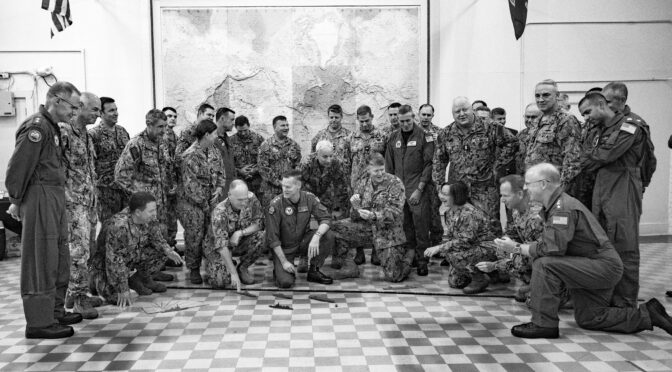
Featured image: Flag and general officers at the CNO Futures Wargame at the Naval War College in Newport, RI. (U.S. Navy photo by Chief Mass Communication Specialist Amanda R. Gray)
Discover more from Center for International Maritime Security
Subscribe to get the latest posts sent to your email.