
By Paul Del Rosario
Introduction
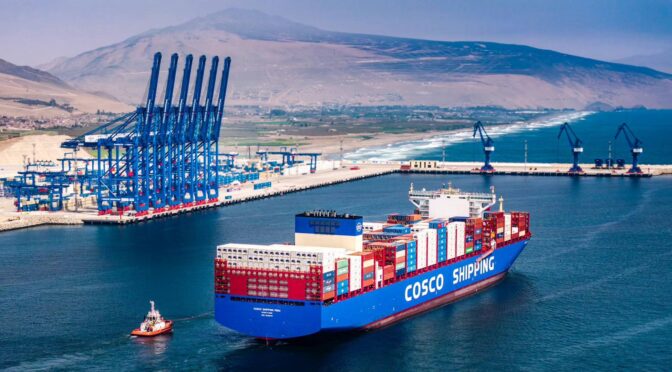
The Peruvian Port of Chancay located just north of Lima is a Chinese-developed and controlled deep-water megaport that was inaugurated in November of 2024. The port has transformed Peru into a strategic logistics node between South America and Asia. China Ocean Shipping Company (COSCO) Shipping Ports, a Chinese State-Owned Enterprise (SOE), controls the project by virtue of a 60 percent majority stake in a joint venture with Peru’s Volcan Mining Company (eventually transferred to Inversiones Portuarias Chancay S.A.A). As one of China’s most ambitious Belt and Road Initiative (BRI) projects, Chancay expands Peru’s container capacity by approximately 1 million Twenty-foot Equivalent Units (TEUs) annually at design capacity, while establishing a direct maritime link between South America and Asia that bypasses traditional transit hubs such as the Panama Canal. The port also expands China’s access and influence over critical infrastructure that significantly impacts regional commerce. As with other BRI projects, China’s investment in the Port of Chancay establishes more than a commercial logistics hub in Peru; it creates an economic, political, and potential dual-use foothold on South America’s Pacific coast with strategic implications for U.S. interests in the Western Hemisphere.
The Strategic Implications
On January 14, 2026, President Trump officially designated Peru as a major non-NATO ally of the United States, therefore providing a formal basis for higher levels of defense cooperation privileges and bilateral integration. Before Congress in March 2024, General Laura Richardson, Commander of U.S. Southern Command, identified the Port of Chancay as a strategic concern. General Richardson warned that PRC-controlled critical infrastructure could generate latent military access. Furthermore, General Richardson described that many PRC-backed facilities “serve as points of future multi-domain access for the PLA and strategic naval chokepoints,” then identified Chancay as the Western Hemisphere’s first case of a Chinese SOE holding majority ownership and control of a country’s critical port infrastructure.
Take another example: China’s experience in Djibouti demonstrates how commercial infrastructure can evolve into strategic access over time. Beijing did not begin with a traditional overseas base in Djibouti; it first built a broader ecosystem of ports, logistics corridors, free-trade zones, SOEs, and transportation infrastructure that eventually supported PLA presence in the form of a military support base constructed in 2017. While it is unlikely that the PRC seeks to establish a military base in Peru, Chancay creates a revenue-generating access point that could possibly serve as a contingency base if required. Chancay is certainly not Djibouti, but the comparison demonstrates what is in the realm of possibility and how a strategically located PRC-operated deep-water port can remain commercially legitimate while creating the physical access, logistical networks, and political leverage necessary for future dual-use activity.
According to China’s State-owned Assets Supervision and Administration Commission of the State Council (SASAC), Chancay Port has demonstrated early success of a PRC state-owned enterprise investment in Peru with the port handling $603 million in exports and $984 million in imports during the first nine months of 2025. SASAC further claims that 62 percent of Peru’s agricultural exports to China moved through Chancay, generating approximately $210 million in sales, a figure it uses to frame the port as both an economic growth engine for Peru and a China-centered logistics corridor.
This economic success narrative reveals that as Chancay becomes more central to Peru’s trade with China, its commercial value simultaneously increases the port’s utility as a PRC-controlled logistics platform with latent dual-use potential. Additionally, Universidad del Pacífico’s first-year assessment found that Chancay Port exceeded its initial 200,000-TEU target, moving 286,255 TEUs from November 2024 to November 2025. The same assessment also shows a strategic tradeoff: imports exceeded exports, monthly truck flows strained local roads, and key territorial investments remained untendered. The university’s conclusion that Peru’s institutional response has been “reactive and fragmented” reinforces the broader concern that Chancay’s commercial growth is outpacing the state’s ability to regulate, integrate, and fully control the infrastructure ecosystem developing around it.
As a PRC state-owned deep-water commercial hub, the Port of Chancay could support civilian maritime trade while also furnishing the access, sustainment, and logistics functions that Beijing’s Military-Civil Fusion (MCF) strategy seeks to leverage for military purposes. It is no secret that “Chinese leaders, particularly Xi Jinping, are using MCF to position the country to compete militarily and economically in an emerging technological and strategic competition with the U.S.” Chancay does not operate solely as Peruvian critical infrastructure, but also as a part of COSCO’s Chinese-controlled system that could align port access, shipping frequency, cargo movement, and route architecture under a single corporate network. This risk aligns directly with MCF’s emphasis on building military requirements into civilian infrastructure and using civilian construction, services, and logistics capabilities for competition or war. In written testimony to the House Homeland Security Committee Subcommittee on Transportation and Maritime Security, Dr. Ryan Berg argues that growing PRC involvement in regional ports presents “a serious challenge to U.S. maritime supremacy, freedom of navigation, data security, and supply chain security.” Berg further states that PRC-operated ports “exemplify China’s goal of leveraging economic investment as an anchor to support military engagement” and that such dual-use facilities can enable “military logistics and intelligence gathering in peacetime” while potentially supporting naval operations in wartime.
In its current state, Chancay Port has four berths, a 17.8-meter draft, capacity for ultra-large container ships up to 18,000 TEUs, and has already received vessels of over 300 meters in length. These specifications place the port within physical specification ranges that would be needed to receive major People’s Liberation Army Navy (PLAN) surface combatants and large auxiliary vessels or aircraft carriers such as the Fujian, China’s Type 003. Strategic risk increases as the port expands. Planned full-capacity development includes a future 15-berth deep-water complex that is able to support multiple large ships simultaneously. These capabilities matter because the PLAN is no longer a coastal defense force. According to the Department of War, it has become the world’s largest navy, fielding modern multi-mission combatants, operating large amphibious assault ships and transport docks, and continuing to expand replenishment capacity for long-distance deployments. To be clear, the strategic problem posed by Chancay Port is not that it guarantees a PLAN deployment, but that a PRC-operated, deep-water, automated port on South America’s Pacific coast could reduce the logistical friction required for PLAN port visits, replenishment, staging, emergency repair, or wartime sustainment.
A recent legal dispute concerning regulation and oversight of the Port of Chancay exacerbates concerns for some over its future potential. In a February 2026 ruling, the First Specialized Constitutional Court of Lima ordered Peruvian regulator Ositrán to refrain from supervising, auditing, or sanctioning Chancay’s operations, prompting the regulator to appeal. Ositrán, the Peruvian state regulator, would normally oversee concessioned transport infrastructure, including port operations, tariffs, service standards, and compliance obligations. COSCO argues that Chancay should be excluded from Ositrán supervision because the port was privately financed, while Ositrán maintains that any public-use transportation infrastructure operating in Peru must remain subject to state regulation regardless of ownership. As of a July 2026 appellate court reversal decision, this matter remains unsettled. Peru’s dispute with COSCO Shipping over Chancay Port illustrates the sovereignty risk created when strategic infrastructure is controlled by a foreign state-owned enterprise but shielded from host-nation oversight. The U.S. State Department Bureau of Western Hemisphere Affairs has lamented on social media that it was “concerned about latest reports that Peru could be powerless to oversee Chancay, one of its largest ports, which is under the jurisdiction of predatory Chinese owners.” If Peru cannot exercise routine oversight over the port, there is increasing risk that Chinese direct investment becomes a mechanism for regulatory exemption, strategic leverage, and diminished Peruvian control over critical infrastructure.
The Way Forward for U.S. and Peru Relations
The way forward is not to force Peru to choose between the U.S. and China, but to help Peru preserve the freedom to choose for itself. The Port of Chancay demonstrates that PRC infrastructure and economic investment can deliver legitimate economic gains, but can also create strategic dependencies, regulatory disputes, and latent dual-use access. A U.S. response should therefore pair strategic warning with practical alternatives that support Peru’s sovereign oversight of critical infrastructure, expand maritime security cooperation, strengthen port security and logistics capacity, and invest in Peruvian naval capability. A January 2026 Defense Security Cooperation Agency (DSCA) press release revealed that U.S. policy toward Peru is not limited to warning against PRC influence; it also seeks to strengthen Peru’s own maritime capacity through security cooperation. By announcing a possible $1.5 billion Foreign Military Sale for design and construction at Callao Naval Base, the United States signals investing in Peru’s ability to support current and future naval and logistical operations, improve port infrastructure, and reinforce Peru as a stable security partner in South America.
The United States can compete most effectively in Peru by offering what China cannot: a security partnership that strengthens Peruvian sovereignty rather than diluting it. The U.S. advantage lies in persistent security cooperation, maritime interoperability, resilient diplomatic and military relationships, and respect for host-nation control. A prime example of effective security cooperation was this year’s military exercise UNITAS 2026. Hosted by the Peruvian Navy, UNITAS is the premier annual multinational naval exercise in the Western Hemisphere. Over 5,700 personnel from 24 countries were involved in this year’s iteration. Among the operating locations was Peru’s Callao Naval Base.
Policy Recommendations
Chancay is more than a commercial port; it is a test case for how the United States should compete across the full diplomatic, informational, military, and economic spectrum in its own hemisphere. The 2025 National Security Strategy’s “Trump Corollary” to the Monroe Doctrine states that the United States will oppose non-hemispheric competitors that seek to position forces, control threatening capabilities, or own strategically vital assets in the Western Hemisphere. The Port of Chancay fits uneasily within this framework. COSCO’s control of a deep-water logistics node in Peru does not constitute a Chinese military base, but it does create a PRC-controlled platform with economic leverage, informational access, and latent dual-use potential.
The appropriate U.S. response should not be an attempt to force Peru to choose between China and the United States, but to make every effort to remain Peru’s partner of choice. Security cooperation should be aligned to Peru’s national security priorities, which can be mostly tied to curtailing corruption, illicit mining and cocaine markets; and combating criminality within its territorial borders. Combined with the proposed U.S. investment at Callao Naval Base, this approach offers a practical alternative to PRC influence. Future security cooperation, foreign military sales, and intelligence sharing should largely be contingent on transparent Peruvian regulatory oversight. Ositrán supervision, Peruvian National Port Authority access, customs visibility, cyber-security standards, and clear procedures for foreign naval access at Chancay Port would preserve Peruvian sovereignty while mitigating strategic risk.
The Port of Chancay illustrates a broad U.S. security challenge–the PRC is competing diplomatically and economically in ways that may set conditions for a military advantage in the Western Hemisphere. Significant progress is underway. Peru has recently joined the Shield of the Americas, a United States-led initiative to strengthen resilience in the Western Hemisphere. In today’s global competition with China, the United States ultimately wins by remaining Peru’s most reliable partner for sovereignty, security, and economic cooperation.
Captain Paul Del Rosario is a U.S. Marine Corps Officer currently studying Spanish at the Defense Language Institute in Monterey, California. He most recently served with the 1st Marine Aircraft Wing in Okinawa, Japan. Throughout his 14 years of military service, he has participated in numerous operations and exercises across the Western Hemisphere, Middle East, and Western Pacific.
The views in this article are those of the author and not those of the Marine Corps, the Department of Defense, or any part of the U.S. government.
Featured image: Port of Chancay. Source: https://coscochancay.pe/#/home. 07 November 26.
Discover more from Center for International Maritime Security
Subscribe to get the latest posts sent to your email.