
By Dr. Stephen DeCasien
Nearly a century ago, Rear Admiral William A. Moffett, U.S.N., wrote in the foreword to Arthur M. Shepard’s seminal work, Sea Power in Ancient History, that “Readers of this work cannot but be impressed by the similarity between the problems of sea power in ancient times and problems of sea power which are engaging the attention of maritime nations today.”1 Practitioners of naval power have long looked to the past for warnings, lessons, and insights that might inform the challenges of the present and future. This post follows in that tradition by considering what antiquity might offer for understanding one of the most enduring applications of naval power, the blockade.
The British naval theorist Julian Corbett distinguished between commercial blockade, intended to restrict an enemy’s maritime trade, and naval blockade, directed against an enemy’s fleet. The latter could itself serve different purposes, either keeping an enemy fleet confined to port or watching it closely while encouraging it to put to sea, where it could be brought to battle.2 Although Corbett developed these categories from the experience of more recent naval warfare, their basic purposes would have been readily recognizable in antiquity. Ancient fleets likewise sought to restrict maritime commerce and supplies, contain hostile naval forces, or compel an adversary’s fleet to come out and fight.
The relevance of these forms of blockade is hardly confined to the past. At the time of writing, the United States is enforcing a blockade against Iran, restricting maritime traffic to and from Iranian ports as part of the ongoing conflict.3 At the same time, across the Indo-Pacific, the possibility of a Chinese blockade of Taiwan remains a central concern in discussions of a potential cross-Strait conflict. Chinese military planning considers blockade operations as one means of isolating and coercing Taiwan, alongside the considerably more demanding possibility of an amphibious invasion.4 Despite enormous differences in political circumstances, technologies, and scale, these situations underscore a common problem. Establishing control of the sea is one thing, but maintaining that control long enough to achieve a political or military objective is another.
There are, of course, many examples of naval blockade in the ancient Mediterranean, but four cases highlight particularly well the different challenges such operations presented: Samos in 440–439 BCE, Syracuse in 413 BCE, Rhodes in 305–304 BCE, and Roman operations around Lilybaeum and Drepana in 250–249 BCE. Each exposes a different problem associated with blockade, including maintaining forces on station, preserving or contesting command of the sea, restricting or sustaining access to supplies, and protecting the forces involved.
Samos, 440–439 BCE: The Challenge of Maintaining a Blockade
The Athenian campaign against Samos in 440–439 BCE provides a clear example of both the effectiveness and fragility of naval blockade. After an earlier Athenian intervention on the island, a group of Samian exiles returned, overthrew the Athenian-backed government, and revolted.5 Athens responded by sending sixty ships under the command of Pericles and other generals. After defeating a Samian fleet of seventy vessels near Tragia and receiving additional ships from Athens, Chios, and Lesbos, the Athenians landed troops and surrounded Samos with three walls while simultaneously blockading the city “from the sea at the same time” (ἐκ θαλάσσης ἅμα).6
The blockade quickly revealed a problem that remains fundamental to such operations, as forces maintaining a blockade may also be required to respond to threats elsewhere. Reports reached Pericles that a Phoenician fleet was approaching to assist the Samians. He therefore took sixty ships from the force stationed around Samos and sailed toward Caunus and Caria to meet the anticipated threat.7 His departure weakened the blockade at precisely the moment the defenders needed.
The Samians exploited the opportunity. They attacked the inadequately protected Athenian naval station, destroyed the guard ships, and defeated the vessels sent against them. For fourteen days they “controlled the sea in their area” (τῆς θαλάσσης τῆς καθ᾽ ἑαυτοὺς ἐκράτησαν) and, as Thucydides puts it, “brought in and carried out whatever they wished” (ἐσεκομίσαντο καὶ ἐξεκομίσαντο ἃ ἐβούλοντο).8 When Pericles returned, however, the Athenians reestablished the blockade by land and sea. Further reinforcements arrived from Athens, Chios, and Lesbos, and after a nine-month siege the Samians surrendered, demolished their walls, surrendered their fleet and hostages, and agreed to repay the costs of the war.9
For fourteen days, the diversion of part of the Athenian fleet was enough to reopen Samian access to the sea, demonstrating the importance of persistence in maintaining a blockade. For those under blockade, even a temporary weakening of the forces on station could provide an opportunity to restore maritime access.
Syracuse, 413 BCE: The Reversal of a Blockade
When the Athenians arrived at Syracuse in 415 BCE, seeking to conquer the city and extend their power into Sicily, their overwhelming superiority at sea was one of the expedition’s greatest advantages. Over the course of the campaign, however, they gradually lost that advantage and ultimately found themselves trapped in the Great Harbor.10 By 414 BCE, the campaign had developed into an effort to isolate Syracuse by land and sea. The Athenians occupied Plemmyrium at the entrance to the Great Harbor, using it to protect their ships and store equipment, while their army attempted to complete a wall of circumvallation around the city. Thucydides emphasizes how far the Athenian works had progressed by the time Spartan support for Syracuse arrived under the command of Gylippus. Much of the wall toward the Great Harbor was already complete, while materials had been prepared to extend the line toward the opposite coast.11
Gylippus’ intervention changed the strategic situation. Syracusan counter-walls prevented completion of the Athenian circumvallation, while the capture of Plemmyrium deprived the expedition of its principal position at the mouth of the Great Harbor and cost it substantial stores and naval equipment.12 The Syracusans also refused to remain blockaded within the Great Harbor, continuing to contest Athenian control of its waters. In 413 BCE, they modified their triremes for its confined waters, strengthening and shortening their prows for direct, head-on, prow-to-prow attacks (ἀντιπρῴροις), rather than the maneuvering attacks (ἐκ περίπλου) for which the more lightly constructed Athenian prows were designed.13
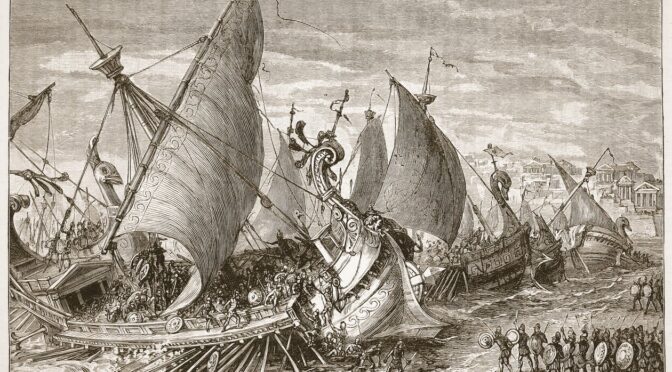
After defeating the Athenians at sea, the Syracusans closed the mouth of the Great Harbor with merchant vessels, warships, and other crafts moored across the entrance. The fleet that had arrived with overwhelming maritime superiority now had to fight its way out of the harbor it had once helped control. In the final naval battle, the Athenians attempted to break the Syracusan blockade, attacking the barrier across the harbor entrance, but the Syracusan and allied fleet prevented their escape.14 The surviving Athenians abandoned their ships and attempted to retreat overland, ending in the destruction of the expedition.
Syracuse demonstrates that a blockade depends on continued control of the surrounding maritime space. As Athenian control weakened through setbacks ashore, the loss of key positions, Syracusan tactical adaptation, and defeat at sea, the Athenians went from attempting to cut off Syracuse to being trapped themselves. For a force under blockade, contesting control rather than simply accepting isolation can fundamentally alter the strategic situation.
Rhodes, 305–304 BCE: The Limits of a Blockade
Few commanders in antiquity possessed a reputation for naval siege warfare comparable to Demetrius Poliorcetes, yet his enormous effort against Rhodes in 305–304 BCE failed to isolate the city completely. Maritime commerce was fundamental to Rhodian wealth and strategic power. Diodorus Siculus describes Rhodes as possessing considerable naval strength (ἰσχύουσα ναυτικαῖς δυνάμεσι) and notes its particularly close economic relationship with Ptolemy I of Egypt.15 When Antigonus and Demetrius attempted to force Rhodes away from its relationship with Ptolemy, separating the city from outside support became a central part of the campaign.
Demetrius arrived with a formidable fleet. He attacked the Rhodian harbor defenses from the sea, deployed ship-mounted artillery and siege machinery, and later shifted much of his effort ashore.16 Yet his fleet could not make the waters around Rhodes impermeable. Rhodian warships continued to operate, and outside powers repeatedly sent assistance. Ptolemy, Cassander, and Lysimachus supplied the city, with Diodorus describing major shipments of grain and other provisions.17 Their importance was reflected in the honors Rhodes later granted its benefactors.
Every successful entry weakened the coercive purpose of Demetrius’ effort to isolate the city. So long as Rhodes retained sufficient maritime access to receive supplies and outside assistance, time did not necessarily favor the attacker. After roughly a year of fighting, Demetrius accepted a settlement. Rhodes preserved its autonomy and its relationship with Ptolemy, while agreeing to support Antigonus except in conflicts against Ptolemy.18
Rhodes illustrates the difficulty of maintaining a fully effective blockade. A blockade does not need to stop all traffic to exert pressure, nor does every successful passage render it ineffective. Its effectiveness ultimately depends on whether enough traffic is restricted to achieve its strategic purpose, while even limited access may be sufficient for the defender to sustain resistance.
Lilybaeum and Drepana, 250–249 BCE: The Costs of Maintaining a Blockade
By 250 BCE, during the First Punic War, Roman successes in Sicily had narrowed the Carthaginian position to a handful of strongholds in the west, but the effort to blockade Lilybaeum exposed the Roman fleet to risks that would ultimately threaten the operation itself. Polybius notes that the Romans believed its capture would open the way for attacks against North Africa, while Carthage resolved to hold it at virtually any cost.19 The Romans therefore invested Lilybaeum by land and sea.
The harbor proved exceptionally difficult to blockade effectively. Carthage exploited local knowledge, favorable winds, and skilled seamanship to penetrate the Roman blockade. A force under Hannibal, son of Hamilcar, carried approximately 10,000 troops and supplies into Lilybaeum despite the Roman presence.20 Hannibal “the Rhodian” later repeatedly sailed between Carthaginian territory and Lilybaeum, running the Roman blockade until the Romans captured a sufficiently fast Carthaginian vessel to intercept him.21 These episodes demonstrated the difficulty of transforming naval superiority into complete control of a contested area.
The blockade also imposed costs on the Romans. Combat, siege operations, and disease depleted the fleet’s manpower, requiring 10,000 replacement sailors.22 In 249 BCE, the Roman consul Publius Claudius Pulcher used the reconstituted fleet to strike the nearby Carthaginian naval base at Drepana, apparently hoping to surprise the Carthaginian commander Adherbal and eliminate the threat to Roman blockade operations around Lilybaeum.23 Instead, Adherbal brought his ships into open water. The Romans, caught close to the coast with less maneuverable ships and inexperienced replacement crews, suffered a devastating defeat. Polybius reports that ninety-three Roman vessels were captured while Claudius escaped with about thirty.24 Carthaginian forces subsequently returned to the vicinity of Lilybaeum and attacked Roman ships there.25
Lilybaeum and Drepana reveal the sustained costs of blockade. Maintaining pressure exposes the forces involved to attrition, crew exhaustion, enemy action, and competing operational demands. As these pressures accumulate, they can create opportunities for the opposing force to challenge the blockade and reshape the balance at sea.
Ancient Blockades and the Problem of Sea Power
Ancient and modern blockades operate with radically different technologies. Samos, Syracuse, Rhodes, and Lilybaeum offer no tactical prescriptions for fleets operating with submarines, aircraft, missiles, satellites, or unmanned systems. Their relevance lies instead in the strategic problems they expose.
Taken together, the four cases suggest that blockade should be understood as a continuing contest rather than a condition established simply by achieving maritime superiority. Samos demonstrates the demands of persistence, as even the temporary removal of part of the blockading force created an opportunity to reopen access to the sea. Syracuse shows how control can be reversed, as the Athenians went from attempting to isolate the city to being trapped within the Great Harbor themselves. Rhodes demonstrates that a blockade need not be broken completely to fail; sufficient access may allow a defender to continue resisting. Lilybaeum and Drepana show how the accumulating costs and vulnerabilities of maintaining a blockade can create opportunities for it to be challenged.
These cases raise several enduring strategic questions about blockades. How difficult is a blockade to impose, sustain, resist, or break? How much force does it require, and for how long? How complete must it be to achieve its political or military objectives? How much traffic can continue to pass through before its effectiveness is undermined? What outside powers might intervene or provide support? And what forces, bases, or geographic features might strengthen, weaken, or threaten a blockade?
The central question is therefore not simply whether a blockade can be imposed, but whether it can be maintained long enough to achieve its purpose in the face of resistance, changing circumstances, and the costs of sustaining it.
That broader lesson returns us to Moffett’s observation nearly a century ago. The instruments of sea power have changed beyond anything an ancient commander could have imagined. The underlying strategic problem has not changed. Control of the sea is only valuable insofar as it can be translated into lasting political or military results.
Dr. Stephen DeCasien is the Henry A. Kissinger Visiting Scholar Postdoctoral Fellow at Yale University’s Jackson School of Global Affairs. His research integrates archaeological and historical evidence to examine ancient warships, naval warfare, and the exercise of maritime power. He is currently co-editing, with William M. Murray, “The Naval Rams from the Battle of the Egadi (Aegates) Islands in 241 BCE”, a volume presenting archaeological evidence from the first securely identified ancient naval battlefield and examining Roman and Carthaginian naval warfare, technology, and logistics.
Notes
1. Moffett, William A., foreword to Arthur M. Shepard, Sea Power in Ancient History: The Story of the Navies of Classic Greece and Rome. Boston: Little, Brown, and Company, 1924, p. vii.
2. Corbett, Julian S. Some Principles of Maritime Strategy. London: Longmans, Green, and Co., 1911, pp. 183–85.
3. U.S. Central Command, “U.S. Forces to Resume Naval Blockade Against Iran,” July 13, 2026.
4. U.S. Department of Defense, Military and Security Developments Involving the People’s Republic of China 2025: Annual Report to Congress (Washington, DC: Department of Defense, 2025), pp. 38–40.
5. Thucydides, History of the Peloponnesian War, 1.115.3–5.
6. Thucydides, History of the Peloponnesian War, 1.116.1–2.
7. Thucydides, History of the Peloponnesian War, 1.116.3.
8. Thucydides, History of the Peloponnesian War, 1.117.1.
9. Thucydides, History of the Peloponnesian War, 1.117.2–3.
10. Thucydides, History of the Peloponnesian War, 6.43–44.
11. Thucydides, History of the Peloponnesian War, 7.2.3–4.
12. Thucydides, History of the Peloponnesian War, 7.22–24.
13. Thucydides, History of the Peloponnesian War, 7.36–40, especially 7.36.2–5; cf. Diodorus Siculus, Library of History, 13.10.2–3.
14. Thucydides, History of the Peloponnesian War, 7.59.2–3; 7.70–71.
15. Diodorus Siculus, Library of History, 20.81.2–4.
16. Diodorus Siculus, Library of History, 20.82.1–4.
17. Diodorus Siculus, Library of History, 20.96.1–3.
18. Diodorus Siculus, Library of History, 20.99.1–3.
19. Polybius, Histories, 1.41.4–6.
20. Polybius, Histories, 1.44.1–10; cf. Diodorus Siculus, Library of History 24.1.
21. Polybius, Histories, 1.46.4–47.10.
22. Polybius, Histories, 1.49.1–2.
23. Polybius, Histories, 1.49.3–7.
24. Polybius, Histories, 1.49–51, especially 1.51.10–12.
25. Polybius, Histories, 1.52–53; cf. Diodorus Siculus, Library of History 24.1–4.
Featured image: The Naval Battle in the Harbor of Syracuse, 1890 (Artist unknown).
Discover more from Center for International Maritime Security
Subscribe to get the latest posts sent to your email.