
By Eleanor Gaudion and Michael Posey
American maritime strategy in the South China Sea often starts by counting ships. Planners must keep enough hulls forward to contest Beijing’s constant pressure and its excessive maritime claims. The number of ships matters because a Navy that is too small, too strained, or too delayed in maintenance cannot meet the demands of a global maritime power. Still, ship counts, or a fleet’s volume of tonnage, can pull the conversation in the wrong direction. In 2005, Admiral Michael Mullen, then the Chief of Naval Operations, argued for a 1,000-ship navy. However, the basis of his call was not “more hulls.” Instead, he envisioned a multinational “fleet-in-being” that leveraged international cooperation to achieve maritime domain awareness, mobility, and access.
Strategists often reduce Alfred Thayer Mahan to the apostle of fleets, commerce, bases, and command of the sea. His framework also emphasized the human element. In The Influence of Sea Power upon History, Mahan lists six principal conditions affecting sea power. The list includes geographical position, coastline accessibility, extent of territory, and population size, as well as the “character of the people” and the “character of the government.” Sea power cannot be pigeonholed as simply hulls and military strength afloat. It also depends on national habits, political will, maritime culture, institutions, and the human systems that allow ships to achieve strategic effects.
Mahan’s principles remain relevant in the South China Sea. The number of ships the United States has must be considered alongside where those ships can go, how long they can remain forward, and whether partners want them there. Access drives that problem. Access constitutes a range of possibilities, from overflight rights to permanent garrisons. It also includes the permissions and practical support that allow forces to enter, operate, replenish, repair, and work with partners. While basing gives a navy staying power, access enables presence.
The U.S. Navy does not need to match the People’s Liberation Army Navy’s local presence ship for ship in the South China Sea. Instead, the U.S. Navy needs access that links lawful operations at sea to port visits, exercises, repair arrangements, and partner relationships ashore. The human element of sea power, built on trust, access, and routine cooperation, turns ship presence into influence. The decisive factor in the South China Sea is not ship numbers or capabilities alone, but the human infrastructure of access, repair, and partner trust that allows ships to operate with purpose and endurance.
Port visits, recurring exercises, maintenance agreements, professional exchanges, or staff talks at a partner-nation headquarters may seem modest compared with carrier strike group operations or a shipbuilding plan. Yet routine interactions hold quiet, practical meaning, such as helping port authorities learn what a U.S. ship needs, helping commanders from different navies understand one another, and making a partner government more comfortable agreeing to future American requests. Though day-to-day formalities may seem insignificant, they can shape possibilities in the South China Sea in crisis or in conflict.
Naval campaigning blends hard and soft power, but the better frame for the South China Sea is the human element of sea power. Joseph Nye defines soft power as the ability to get desired outcomes through attraction and persuasion rather than coercion or payment. Smart power, an integrated strategy and toolkit that draws on both hard and soft power, aids planners in framing naval campaigning most effectively. While the concept helps, it should not distract from the practical maritime point: naval power works best when ships, ports, repair facilities, embassy teams, and partner navies reinforce one another through cultivated and sustained relationships.
The South China Sea Problem and Freedom of Navigation Operations
The South China Sea links the Pacific and Indian Oceans through vital trade routes. Roughly one-third of global shipping passes through it. China uses excessive legal claims, coast guard operations, maritime militia pressure, and the militarization of South China Sea features to routinize its presence and justify its claims. Although the 2016 arbitral tribunal rejected China’s expansive maritime claims, Beijing continues to press its position, as reflected in the Department of Defense’s 2024 China Military Power Report and CSIS reporting on Chinese coercive tactics at Second Thomas Shoal.
In the South China Sea, the United States does not need to chase every Chinese patrol. It needs to appear often enough, with enough purpose and enough partners, to render Chinese coercion ineffective. Freedom of navigation operations (FONOPs) remain necessary. These operations challenge excessive maritime claims, preserve legal positions, demonstrate operational access, and reassure partners that the United States will not treat coercive claims as settled facts. FONOPs matter for strategy and alliance politics, as they are lawful and legitimate, resting on treaty law, customary international law, and long-standing U.S. legal positions.
A recent example shows how they support the narrative of a “Free and Open Indo-Pacific.” In August 2025, USS Higgins conducted a freedom of navigation operation near Scarborough Shoal. Beijing claimed it had expelled the destroyer; the U.S. 7th Fleet rejected that claim and said Higgins operated in accordance with international law before continuing normal operations. USNI News, Reuters, and the Associated Press captured the ambiguity: a U.S. warship asserted navigational rights, while China sought to recast the same event as a sovereignty narrative.
Freedom of navigation operations do not build partner capacity on their own. They cannot repair ships or make access automatic. They work best when they are not one-off events. A legal challenge at sea should connect to the next port visit, the next exercise, the next repair arrangement, and the next conversation with a partner navy. When port partnerships are grounded in the human element of sea power, the logistics, operations, and wartime readiness of both navies stand to benefit.
Port Visits Are Strategic Acts
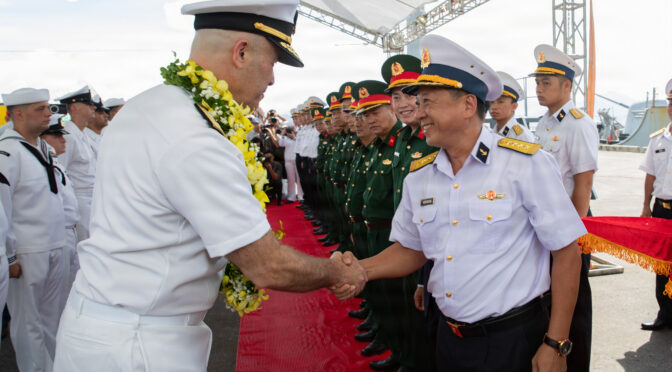
When new sailors visit a port, their leaders remind them that they are ambassadors. Some may hear that as a warning to behave ashore. Most understand that port visits also build relationships and continue service in another form. With timeless ceremony, liberty, public affairs, and diplomatic theater, port visits remind hosts that U.S. naval power arrives with people, expectations, and presence, not only steel. A 1921 Proceedings article described foreign port visits and official calls as routine duties involving courtesy, ceremony, and relations with foreign officials. Likewise, a warship entering port by invitation shows that the host government has chosen to cooperate with the United States.
A port visit alone, even to a country with close ties to Beijing, will not deter China. Port visits, however, can make deterrence more politically sustainable. A ship in port gives visible proof that the United States is welcomed and able to operate with partners. Port visits also create human contact that a communique cannot replicate. Commanders meet their counterparts. Supply officers and port authorities learn requirements and test procedures. Defense relationships become personal.
Vietnam and Malaysia show how cautious partners can still create room for maritime cooperation. The USS Carl Vinson’s 2018 visit to Da Nang marked the first U.S. aircraft carrier visit to Vietnam in more than forty years, and the USS Ronald Reagan Carrier Strike Group visited Vietnam in 2023. The USS Abraham Lincoln’s 2024 port call at Port Klang was the first U.S. carrier visit to Malaysia in 12 years. These visits did not transform Vietnam or Malaysia into U.S. allies. Their contribution is more modest, and more useful: they make cooperation visible and routine without forcing partners into a binary choice.
Port visits to the Philippines convey a different message. As a U.S. treaty ally directly exposed to Chinese pressure, the Philippines is increasingly vital to the U.S. posture in the South China Sea. The U.S.-Philippines Bilateral Defense Guidelines describe the importance of alliance coordination, including access to agreed locations under the Enhanced Defense Cooperation Agreement. Even in the Philippines, U.S. Navy access depends on domestic politics, public trust, alliance management, and a shared sense that American presence contributes to Philippine security rather than simply serving American requirements.
The Philippines also illustrates why access must be handled carefully. After a port call and fuel stop in Subic, USS Guardian ran aground on Tubbataha Reef in 2013, damaging a protected site and forcing the Navy to dismantle the ship in place. The United States later paid the Philippines nearly $2 million for damage to the reef. Access is a privilege sustained by discipline, local awareness, and strategic empathy for the host nation.
Relationships Become Access
Access, basing, and overflight do not appear automatically when a crisis begins. They are built over time through trust, repeated contact, legal arrangements, mutual benefit, and political confidence. Security cooperation helps build trust conditions that contribute to access, basing, and overflight outcomes. Military access to allies and partners in the Indo-Pacific could shape the outcome of a conflict, and lower-level peacetime access, such as overflight and logistics, can matter even if combat access remains politically sensitive.
In a crisis, governments rarely grant access to strangers. They are more likely to grant it to people and institutions they already know, and to forces they trust will act with discipline. That trust is built through exercises, exchanges, port calls, staff talks, coast guard engagements, logistics planning, and professional military relationships. The relationships built now shape which access decisions are politically possible in a time of crisis.
This is where the human element of sea power matters most. The United States should not treat naval operations, diplomacy, economic cooperation, and sustainment as work done in separate rooms by separate people. A port visit can open the door for a multinational or bilateral exercise. Exercises can reveal logistics requirements and test assumptions. A logistics agreement can facilitate future access for repairs. Repair cooperation can generate economic benefits. Political support can create access during a crisis.
The Indo-Pacific will not follow a NATO template anytime soon. Instead, each relationship must be nuanced and bilateral to deliver the best outcomes for both countries. Vietnam and Malaysia may offer political access and maritime diplomacy. The Philippines may provide operational access, geography, and alliance-enabled logistics. Meanwhile, Japan, Singapore, South Korea, and Australia are stronger candidates for maintenance, repair, replenishment, and industrial support. The United States must continue to work with each partner on what they can actually support.
Japan’s value to this network could extend even further. In a Foreign Affairs interview, Oriana Skylar Mastro argued that Japan fighting alongside the United States in a regional conflict from the start rather than shifting to a later supporting role could strengthen deterrence. Japan’s geographically forward-positioned ports enable a much shorter response timeline. The speed advantage would not be a function of hull numbers, but instead a function of years of exercises, staff talks, and routine interactions that have facilitated Japan’s response rather than requiring negotiation in a time of crisis. Routine human interaction leads to familiarity, which leads to fast, credible ally responses.
Maintenance Enables Maritime Influence
Presence breaks down when ships cannot be repaired, replenished, or politically sustained. A ship that can be repaired forward returns to operations faster. A ship that must transit long distances for maintenance pays a tax in time, fuel, and availability. A fleet tied to a few fixed facilities becomes easily targetable and narrows its own options. Delayed maintenance imposes real readiness costs.
The Navy already relies on forward repair in several places. Naval Sea Systems Command describes the Ship Repair Facility and Japan Regional Maintenance Center as keeping the Seventh Fleet mission-ready from Yokosuka and Sasebo. At the same time, its Singapore detachment supports repair work across the region. Australia is developing the Henderson Defense Precinct to support naval shipbuilding and sustainment. In South Korea, the Navy reported that USNS Wally Schirra completed major maintenance in 2025.
Forward sustainment already exists in pieces. The Navy already thinks in terms of refuel, rearm, resupply, repair, and revive, and it already uses forward repair facilities, allied shipyards, and partner access. But the Western Pacific demands a more integrated approach to logistics, resupply, and sustainment than the current system provides.
History reinforces the point. Mahan is sometimes reduced to a “more ships” (or bigger fleet) thinker. Still, The Influence of Sea Power Upon History was also about commerce, bases, maritime infrastructure, and national systems that enable fleets to operate over long distances. World War II offers an even more practical example. In the early 1940s, Service Squadron Ten performed many functions of an advanced naval base in the Pacific, supporting voyage repairs and helping return ships to service without sending every damaged vessel back across the ocean. But that access did not appear by magic. At Ulithi, survey work, pontoon piers, repair ships, floating dry docks, tenders, welders, carpenters, electricians, shipfitters, and command and control arrangements turned a lagoon into a functioning forward base. Although the contemporary Indo-Pacific differs, the lesson still holds: maritime power depends on forward sustainment, and forward sustainment depends on relationships, access, skilled people, and political preparation.
Economic Cooperation Makes Presence Less Extractive
Partners cannot see themselves as being taken advantage of, as it neither serves them nor American interests. Ship repair, port infrastructure, workforce development, technical training, logistics contracts, maritime domain awareness support, and industrial partnerships can help partners build capacity while improving American endurance.
The Indo-Pacific Maritime Security Initiative supports partner maritime security and human capital development. In the Philippines, the U.S. Embassy’s transfer of mobile energy systems to Palawan demonstrates how partner-capacity efforts can connect infrastructure, resilience, and maritime access in a contested area. Allied participation in maintenance, repair, overhaul, and shipbuilding cooperation offers one path for strengthening endurance. Japanese shipyards could serve as forward maintenance hubs, improving readiness and creating stable demand for Japanese industry. These initiatives enable shared maritime endurance: more repair options for the United States, more work and capacity for partners, and fewer single points of failure for everyone.
The Human Infrastructure of Maritime Power
The United States should think of relationships as maritime infrastructure. Ports, drydocks, logistics hubs, legal agreements, and maintenance facilities matter. Behind each of them are people: port officials, shipyard workers, diplomats, logisticians, naval officers, coast guards, local political leaders, embassy teams, and sailors who have interacted with one another before a crisis. This kind of infrastructure is easy to miss because it does not appear to be a source of combat power and does not appear in fleet-size comparisons or shipbuilding plans. However, in a crisis, it may determine whether ships can enter port, whether repairs can be made, whether logistics can flow, whether partners accept political risk, and whether American presence is seen as legitimate.
Some of the great strategic thinkers can help us understand the importance of the human element of sea power. Clausewitz reminds us that military action remains connected to political intercourse, not divorced from it. Mahan reminds us that sea power depends on commerce, bases, national systems, and the ashore infrastructure that allows fleets to operate across distance. Corbett reminds us that maritime strategy is about communications and movement, not simply occupying ocean space. James Cable’s theory of naval diplomacy reminds us that navies are political instruments below the threshold of war, using limited naval power to secure advantage or avert loss. In sum, maritime presence is not created by hulls alone. It is created by relationships, permissions, habits, and support networks that allow hulls to have political effects.
China’s advantage in the South China Sea is proximity and persistence. The United States draws its advantage from a network of allies and partners, global mobility, operational experience, and legitimacy when it acts in defense of lawful maritime use. The U.S. advantage must be cultivated as the competition for the South China Sea remains a contest over whose presence is more legitimate, sustainable, and politically useful.
China understands the logic of employing the human element of sea power. In Cambodia, Beijing has financed the expansion of the Ream Naval Base, rotating Chinese ships through its pier, and framing the arrangement as a mutual-benefit partnership rather than a foreign outpost. This comparison is instructive rather than reassuring. Cambodia’s government insists that Ream remains open to any friendly navy, yet years of opacity about the terms of access open a door to Beijing and Phnom Penh familiarity that could prove impactful in wartime. That uncertainty, or strategic ambiguity, can be useful to China, yet also points to an opportunity for the U.S. While China’s version of relationship building runs through dependency and quiet leverage, the American version depends on a wider set of partners who retain the standing and political space to say no. The United States does not win the human element of the sea by default. It wins by ensuring its access is transparent, consensual, and reciprocal in ways that Beijing’s arrangements are not.
While these behaviors reflect diplomacy and logistics, they also constitute sea power. Ships cannot exercise influence where they cannot enter, repair, or remain. The U.S. Navy does not lack port visits, exercises, or repair arrangements, but sometimes these activities are treated as separate events rather than as parts of the same maritime campaign.
Implications for Maritime Planners
Navy and joint planners should plan port visits as campaign events rather than courtesy calls. The Navy sets a theater by increasing its access to key terrain, such as ports near a chokepoint. Therefore, a port visit should do more than put sailors ashore and generate photos. It should test access, build relationships, support public diplomacy, reveal logistics friction, and set conditions for the next engagement. It should create relationships across ranks and functions to encourage a port-wide familiarity that can be called upon in times of uncertainty.
Planners should also map access by function. Some locations may support port visits and replenishment. Others may support exercises, crew rest, voyage repair, emergent maintenance, drydock work, or contracted sustainment. Not every partner is a base. Not every port is a repair hub. Nevertheless, many can still contribute to the overall campaign.
Finally, planners should integrate operations, diplomacy, economics, and sustainment into a single maritime campaign. Freedom of navigation operations, exercises, port visits, repair agreements, senior-leader engagements, and partner-capacity efforts should build on one another rather than stand alone.
Conclusion: Ships Need People
The United States needs a ready fleet, a stronger maritime industrial base, and enough ships to meet global commitments. Shipbuilding, maintenance reform, and industrial revitalization still anchor U.S. maritime power, as the Department of Defense’s National Defense Industrial Strategy also makes clear. Ships alone, however, will not secure American influence in the South China Sea.
The future of U.S. maritime presence will depend on where ships can go, how long they can stay, whether partners welcome them, and whether they can be repaired and sustained forward. Those conditions are built through people. Port visits, exercises, maintenance cooperation, and professional exchanges may seem ordinary, but they build trust, test assumptions, and enable future operations.
Mahan’s “character of the people” was not a decorative phrase. It points to the habits, confidence, discipline, and political will that allow maritime power to endure. In the South China Sea, that character will not be measured only by the number of ships the United States builds. It will also be measured by whether the United States can build the trust and access that allow those ships to matter.
The United States cannot match China’s proximity-driven presence ship-for-ship in the South China Sea. It does not need to. The better task is to show up consistently, operate lawfully, sustain forward, and do so alongside partners who see American presence as legitimate and useful. The human element of sea power begins with a simple recognition: ships need ports, ports need trust, and trust begins with people.
Eleanor Gaudion is a graduate of the University of Virginia with a B.A. in Foreign Affairs with a focus in intelligence and military relations. She previously served as an intern at the U.S. Army War College, revising national security wargaming scenarios for students.
Michael Posey is an active-duty Naval Flight Officer. He holds business degrees from Carnegie Mellon University and the University of Florida. He is a doctoral candidate in education at Pennsylvania State University. Currently, he serves as an assistant professor and the Admiral William F. Halsey Chair of Naval Studies at the U.S. Army War College.
The views expressed in this article are those of the authors alone and do not necessarily reflect those of the U.S. Army War College, the U.S. Army, the U.S. Navy, or the Department of War.
Featured image: Rear Adm. Eric Anduze, commander, Task Force 70 and Carrier Strike Group 5, shakes hands with a member of the Vietnamese military during Nimitz-class aircraft carrier USS George Washington’s (CVN 73) regularly scheduled port visit in Da Nang, Vietnam, July 30, 2026. (U.S. Navy photo by Mass Communication Specialist Seaman Anthony Vilardi)
Discover more from Center for International Maritime Security
Subscribe to get the latest posts sent to your email.