
By Adam Reiffen
Working afloat and ashore, the U.S. Navy’s Information Warfare Officers engage adversaries, create plans, connect circuits, and drive operations around the world every day. In May 2026, the Information Warfare Community was directed by the Chief of Naval Operations (CNO) to reorganize itself within the Pentagon, a large-scale change to the manning, funding, and authorities required for global operations. When taken with the December 2025 creation of the Information Warfare Line designation, the current moment marks a generational opportunity for broader community to make the changes necessary to take its hard-earned and permanent place among the Navy’s elite warfighting communities. The Navy’s Information Warfare community will need clear focus, strong leadership, and decisive action to make best use of the new paradigms wrought by administrative change, starting at the highest echelon of Navy command.
On May 21, 2026, the Chief of Naval Operations released Naval Administration Directive 123/26, “Realignment of OPNAV N2N6 Responsibilities,” a title which perhaps undersells the importance of its contents. The directive is the first major realignment of the Navy’s Information Warfare Officers and their roles on the Navy’s top Pentagon staff since 2009 and lays out a series of significant changes in the short and long term across every community designator. The message begins with a useful discussion of the community’s history that ties its past orientation to the present day. In 2014, Navy Information Forces was established as the Type Commander tasked with administering community training, manpower, tactics, readiness, and fleet integration within a constantly evolving number of fields. Left unsaid in the message is the community’s raison d’être: The ability to consolidate and streamline the man, train, and equip missions across subspecialities as varied as intelligence, cryptology, oceanography, communications systems, and cyber warfare.
Operationally, each discipline benefits from the skills of the others, and the community is stronger by virtue of its size, resourcing, and impact. The composite structure of the former Naval Operations (OPNAV) for Information Warfare (N2N6) reflected this reality, if imperfectly in spots, and the community’s early identity benefitted from OPNAV and the Navy Information Forces working together to promote and professionalize the newly formalized community. For example, OPNAV resourced the Warfare Tactics Instructor program, giving the Information Warfare community their own professional tacticians to develop tactics, techniques, and procedures for the Fleet. And when Navy Information Forces was given responsibility for overseeing Maritime Operations Center resourcing across all numbered fleets, OPNAV worked in tandem to expedite resourcing. The previously mentioned new administrative changes fundamentally upend that structure, and senior leaders must be attuned to historical approaches to resourcing requirements.
After establishing the background of Navy Information Warfare, the Chief of Naval Operations’ (CNO) message sets two principal directives for the OPNAV staff. Taken in order, the first change is the separation of intelligence functions, including support to plans, policy, and strategy, from Information Warfare requirements and capabilities. Under the previous construct, the three tenets of Navy Information Warfare–battlespace awareness, assured command-and-control, and integrated fires–were collectively housed under a single OPNAV staff code. A newly-created position, Assistant Deputy CNO for Information Warfare (IW) Requirements and Capabilities, “…will serve as the principal advisor to the CNO on IW policy and lead policy matters pertaining to information technology, space, and cyber and will serve as the Department of the Navy, Deputy Chief Information Officer Navy.”
More technically oriented functions like cryptology, oceanography, and information technology shared common cause within the Information Warfare community, bound by their shared emphasis on technology, natural sciences, and history within the Navy. Therefore, moving these technical fields into their own section within the Naval Operations (OPNAV) staff flows logically; it bins the complementary skills and interests of their practitioners in a dedicated lane to work on critical issues unique to their communities. For instance, senior leaders have directed the force to roll out artificial intelligence tools and speed the adoption of other digital technologies. The technical experts within Information Warfare are on the front lines of those critical changes; integrating and streamlining their work within the new directorate will hopefully provide the best circumstances to expedite progress.
Intelligence professionals rely on the technical acumen of these Information Warfare communities for collection, processing, and dissemination of information, but do not themselves necessarily possess the same technical mastery over the disciplines in question. For its part, the Intelligence component of the community will now report to the Deputy CNO for Intelligence, Operations, Plans, Strategy, and Warfighting Development for “operational intelligence support, intelligence production prioritization, and policy clarification and changes.” As the old adage goes, “intelligence drives operations, and operations inform intelligence.” We see this in the Fleet and Joint Force increasingly, as space-based systems, cyber effects, and electronic warfare have played central roles in recent and ongoing campaigns. OPNAV’s new structure now affirms this at the highest levels of Navy decision-making. Furthermore, integration with the Plans, Policy, and Strategy directorate ensures Intelligence is integrated directly into strategic planning for future operations. The Plans, Policy, and Strategy Directorate’s output directly informs and begets requirements, which are needed to generate authorities and funding. If operational relevance is the goal, Naval Intelligence only stands to benefit from this reorganization.
Still, for the first time in nearly two decades, there will be an administrative division between Information Warfare officers on the OPNAV staff, and the community must avoid creating conflict by failing to clarify mission, functions, and tasks. A schism within senior Information Warfare leadership at the OPNAV level would run counter to the increasing degree of the community’s integration and prominence in the Fleet today. After the Navy released message 094/24 that broke Information Warfare officers out of their previous Restricted Line status, a designation for technical specialties who officers are precluded from command at sea, Navy Information Forces has worked to define what it now intends IW officers to be. Notably, these efforts include establishing opportunities for IW officers to command at sea. The Information Warfare Squadron concept is in pilot right now with the first community’s officers serving as independent warfare commanders afloat vice holding staff positions. If successful, this would mark the beginning of a future in which the Information Warfare realizes its decades-long goal of operational autonomy. Rearranging OPNAV staff Information Warfare functions seeks to align the highest echelons of Navy strategic decision-making with operational and tactical objectives, not the least of which being resourcing and sustaining Information Warfare squadrons across the Fleet. Senior leaders must promote that unity of effort as personnel transition to new roles, responsibilities, and workflows within the Pentagon to ensure that the community’s capabilities, personnel, and effects are synchronized and deployed to maximum efficacy across the Fleet–especially if the community’s individual specialties are well served by splitting up across the OPNAV staff. The organizational rearrangement brings danger that OPNAV and Navy Information Forces can run in opposite directions. Mitigations must be put in place to ensure operational requirements continue to be captured and reflected in program development, even if the requirement is from an Intelligence analyst and the program is “owned” by another directorate.
The second directive in the new administrative guidance has the greatest potential to change Navy Information Warfare’s capabilities and standing within the service. Unrestricted Line communities–traditional naval operators in surface ships, aviation, subsurface, expeditionary forces, and special warfare–have dedicated branches within the office of the Deputy Chief of Naval Operations for Warfare Systems, or OPNAV N9. OPNAV N9 is the resource sponsor and requirements manager for each of these warfare areas, essentially determining what the Navy needs, how much money will be required to meet those needs, and serving as a central node for coordinating and integrating all of the analysis and oversight needed to turn spreadsheets into ships and memos into missiles. Each warfare area is broken out into a subordinate element—Expeditionary Warfare is N95, Surface Warfare is N96, Undersea Warfare is N97, Air Warfare is N98—and collectively they are known as the “High Nines” on the OPNAV staff.
Previously, similar functions for Information Warfare communities were performed within the now-defunct OPNAV N2N6. Information Warfare is now split between OPNAV Intelligence (N2) and Information Warfare Requirements and Capabilities (N6N9). These entities are focused on resourcing and requirements for each of Information Warfare’s distinct specialties. Following this year’s administrative realignment, Information Warfare has its own dedicated resource sponsorship and requirements office: N99. This marks a promotion for Information Warfare, putting the community and its portfolio—Tactical and Enterprise Networks, and Nuclear Command, Control, and Communications (NC3); Oceanography and Navigation; IW Resources and Manpower; Intelligence Capabilities; Integrated IW Fires; and IW Future Capabilities—on as close to an equal footing as it has ever been to its Unrestricted Line peers. The new N99 office will not report directly to the OPNAV Warfighting Requirements and Capabilities (N9) office like its sister branches do, which does keep Information Warfare somewhat siloed from other communities. But when taken together with new opportunities for command at sea, Information Warfare Officers and their mission areas have never had so much visibility or influence within the Navy. A major issue for now, however, is that the number of billets available for Information Warfare requirements officers on the OPNAV staff remains largely unchanged. This means that in the near term, the newly-established N99 will likely perform the same job as its previous incarnation but in a different part of the org chart. This means a bigger pool of officers hunting for resources but with the same number of IWOs. Without significant manpower changes from Millington that realign the operational and staff rotations in officer careers, IW is liable to lack firepower in these resourcing fights.
Less heralded but no less important are the professional development and career progression opportunities now available for Information Warfare Officers. In the long term, this change may prove among the most profound of the whole realignment effort. There is a tongue-in-cheek aphorism that appropriation is governed by the Golden Rule: Whoever has the gold makes the rules. Unrestricted Line communities have built their officers’ career progressions with requirements officer and financial management tours. These key roles are delineated in official career path guidance promulgated by Navy Personnel Command, called out in promotion board precept language, and reserved for high performers who are often recruited and talent managed. The net effect is that trained personnel bring their critical expertise to the Navy’s seemingly endless stream of key requirements and resourcing discussions, ensuring their communities are best represented when budgeting. The Information Warfare community will stand to gain from prioritizing the billets and officers that fight for these resources.
By carving out its own “High Nine” within the OPNAV staff, Information Warfare can push to achieve parity in both job execution and career trajectory with Unrestricted Line for officers assigned to N99 billets. Navy Information Forces and Personnel Command must first address inventory problems for Information Warfare officers at the O-4 to O-6 ranks, where numbers thin out dramatically. A retention bonus would surely help, but a more cost-effective solution would be to fix the billet structure for a career trajectory that better balances operational and staff roles. Information Forces and Personnel Command should then begin to call out requirements officer and financial management positions by name in board precepts to ensure upwardly mobile and successful officers are assigned to them. Subsequently, they should expect those officers to both excel in their work and be competitive for future promotion to positions of authority. This could begin to look more like the “golden path” that defines traditional officer careers. Common career markers like requirements, financial management, and OPNAV staff jobs bridge the cultural and operational differences between officers in otherwise separate communities and provide a common framework to build leaders in the Fleet. For their part, N99 officers should integrate into the rhythm and pace of their directorate counterparts, using that organizational parity to give Information Warfare programs their best shot in budget battles. Also, the new N99 can and should create its own culture internal to the organization to both breathe life into its daily tasks and project an image of unity and identity out to the rest of the Navy staff.
NAVADMIN 123/26 affords the Information Warfare Community a once-in-a-generation chance to overhaul its officer career paths and shift attention to resourcing and requirements, changes that would yield significant long-term benefits for both the community and its personnel. Information Warfare remains a growth industry within the Navy, and for good reason. As the Fleet generates, processes, analyzes, and demands more information to plan and execute operations worldwide, Information Warfare personnel are poised to meet those needs and innovate to fight and win our nation’s wars at sea. The challenge now is ensuring we continue to modernize resourcing, requirements, and mission sets without losing the advantages the community gained by forging a unified effort over the past two decades. The threat of intra-community drift is real and requires proactive leadership, clear guidance, and consistent cross-specialty engagement to ensure that administrative separation does not lead to operational and cultural divorce. The realignment of responsibilities outlined by the Navy’s recent administrative updates has extraordinary potential to both facilitate and make permanent those changes, but Information Warfare must strike while the iron is hot to build the kind of weapon system it can wield with great skill and confidence for years to come. If Information Warfare’s many communities can remain united through these changes, they–and the Navy–will be stronger than ever.
Lieutenant Commander Adam Reiffen is an Intelligence Officer currently serving in the Wargaming Department of the Naval War College. He previously served as a Federal Executive Fellow at Brown University’s Watson School of International and Public Affairs, as well as a Requirements Officer at OPNAV N2N6.
The opinions expressed are those of the author and do not reflect the views or policy of the U.S. Department of War, the Department of the Navy, or the U.S. government. No federal endorsement is implied or intended.
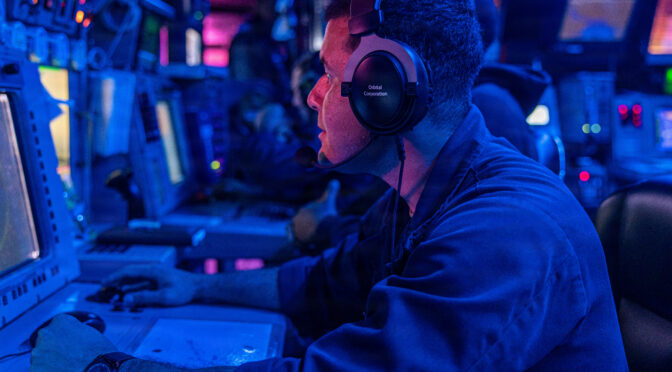
Featured image: A U.S. Sailor stands watch in the combat information center aboard Arleigh Burke-class guided-missile destroyer USS Donald Cook (DDG 75), June 8, 2026. (U.S. Navy photo)
Discover more from Center for International Maritime Security
Subscribe to get the latest posts sent to your email.