
By Dmitry Filipoff
In the last two weeks, CIMSEC featured writing submitted to our Call for Articles on maritime conflict with Iran.
Authors covered a wide range of topics, including strategic differences between allies, new paradigms in warfare, and underappreciated yet decisive dimensions of the conflict. The maritime domain has prominently featured in this conflict and exerted a major influence over the terms of war termination. The broader impacts of the war still remain to be seen, but could include a wider degradation of freedom of the seas and lesser readiness for great power conflicts. This war deserves the most careful examination from navies and maritime forces to better understand how the changing character of warfare and global connectivity is evolving the security maritime domain.
Below are the articles and authors that featured in the series. We thank them for their contributions.
“The Price of Doubt: Sea Control in the Strait of Hormuz,” by James Jackson
“The strait was open when the bombs fell. On March 4, Iran closed the strait in response to the strikes. What had been a campaign against Iranian military power became, by consequence, a campaign to reopen a waterway the United States had helped shut.”
“Hormuz and the Era of Asymmetry: Sea Mines, Unmanned Systems, and the Redefinition of Naval Power,” by Admiral Massimo Vianello (Ret.) and Master Chief Petty Officer Giovanni Giorguli (Ret.)
“These threats, once categorized as one-off tactics employed in isolation, are now weighted by indigenous industrial capacities and employed at scale by Iran and its proxy networks. They are systematically integrated with cyber operations and strategic disinformation campaigns designed to destabilize financial markets, energy security, and global communication architectures.”
“The Insurance Chokepoint: War-Risk Pricing as an Instrument of Maritime Coercion,” by Bruce Randolph Tizes
“Most analysis of the U.S.-Iran maritime war will focus on carrier strike group positioning, IRGC small-boat tactics, Marine Corps Stand-in Forces, and the operational lessons of contested chokepoints. Those analyses are necessary. They also miss a dimension Iran has built as deliberately as its mine and drone programs, one that will outlast any ceasefire: the commercial and insurance layer through which maritime trade is priced and governed.”
“The Hormuz Closure and the Limits of Sanctions: How Russia Benefited from Iran’s Chokepoint Weapon,” by Rustam Taghizade
“When the Trump administration granted India a 30-day waiver on March 5 to purchase Russian oil, the formal justification was straightforward: stabilize global energy markets after Iran effectively closed the Strait of Hormuz. Yet beneath the surface, a deeper story unfolded. The waiver revealed a tension between two pillars of contemporary U.S. strategy—the use of maritime power to secure global chokepoints and the use of economic sanctions to punish adversaries.”
“Asymmetric Alliance Strategy: An Israeli Maritime Perspective on the Iran War,” by Ehud Eiran
“For the United States, however, the restoration of maritime order gradually became an objective in its own right. This did not produce an open alliance dispute, but it did create different hierarchies of priorities. Israel viewed the sea primarily as another theater through which Iran could be weakened. The United States viewed the sea as both a theater of war and a strategic system whose disruption could undermine wider political and economic interests.”
“Chokepoint Hormuz: Epic Fury and Italy’s Mediterranean Strategy,” by Rear Adm. Roberto Domini (Ret.)
“The closure of Hormuz must be read through this framework — not as a regional crisis to be observed from a safe distance, but as a challenge that ‘cannot be delegated to others.’ This analysis traces the evolution of the conflict, assesses its geopolitical and operational consequences, and highlights Italy’s maritime vulnerabilities, which if left unaddressed, could lead to the loss of its relevance in the Mediterranean.”
“The Iran War Highlights New Realities and Changing Paradigms,” by Paul Viscovich
“To effectively impact Iran’s ability to launch similar attacks in the Strait of Hormuz, the U.S. would have to seize and hold the coastline from where these strikes originate. If the landings are successful, occupation of these coastal regions would force Iran to move its drone and ASCM launch sites further inland, increasing the reaction time for forces to target and engage, while exposing Iranian weapons to ground fire enroute to their targets at sea. However, this carries significant risks of its own.”
“The Hormuz Strait Crisis Confirms Nodal Control Will Dominate Maritime Geopolitics,” by Ludvico Domini
“The 2026 Strait of Hormuz crisis exposes the inadequacy of some classical geopolitical frameworks. Alfred Thayer Mahan’s sea power, centered on blue-water naval supremacy, and Halford Mackinder’s land power, which focuses on Eurasian continental hegemony, are framed in a dualistic tension with one another. This framing proves insufficient in an era of advanced globalization and asymmetric warfare.”
“Convert Merchants into Unmanned Ships to Manage Risk in the Strait of Hormuz,” by Alexander Lott, Kristjan Tabri, and Angela Sooba
“Would it be possible for ships to undertake the passage through danger zones, such as the Strait of Hormuz and the Persian Gulf, autonomously via shore-based control centers? Could crew members disembark for the inbound transit and then board the outbound ships in the ports far from the theater of war? Such a method could substantially change the risk calculus affecting commercial shipping and the safety of navigation in dangerous waters.”
“American Naval Mines Can Be Decisive Against Iran,” by Ronald Stewart and Scott Truver
“The conventional bombs carried by the Navy’s aircraft carriers could easily be converted to unconventional ‘Quickstrike’ naval mines to be planted in water as well as on dry land for offensive and defensive requirements, generating strategic, operational, and tactical implications.”
Dmitry Filipoff is CIMSEC’s Director of Online Content. Contact him at Content@cimsec.org.
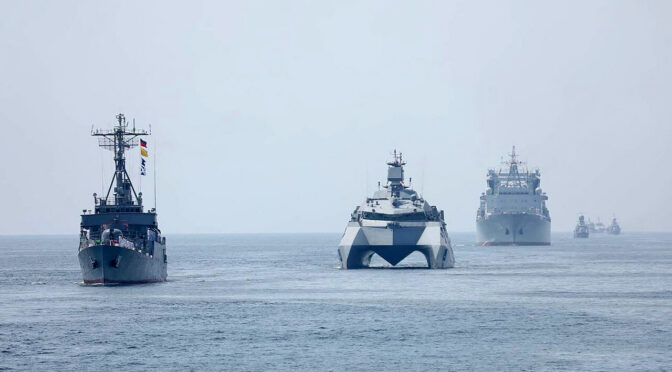
Featured Image: March 12, 2025 – Naval vessels take part in a joint Iranian-Russian-Chinese military drill in the Gulf of Oman. (Iranian Army photo)
Discover more from Center for International Maritime Security
Subscribe to get the latest posts sent to your email.