
By Dr. David Soud and Dr. Ian Ralby
Law enforcement officials are accustomed to interdicting shipments of precursor chemicals used in drug production. The chemicals used for illegal fishing, however, tend to go unchecked. This is partly because those substances, from bleach to cyanide to fertilizers, have no immediately obvious links to fishing. Yet maritime authorities need to attend more closely to the dangers posed by chemical fishing. The practice is extremely hard to detect, and it inflicts lasting damage on marine environments, both to specific species and to coral reefs. To understand this dynamic, one might begin with the lobster.
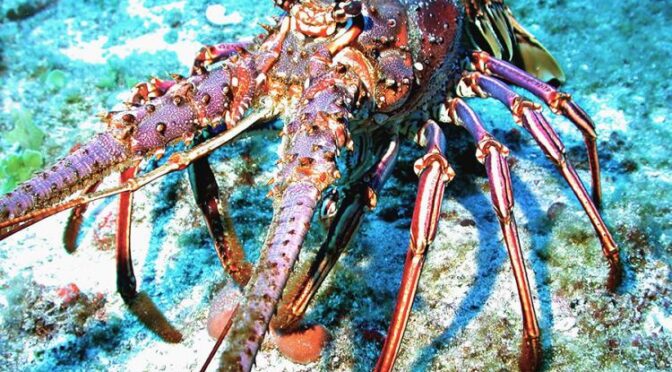
The spiny lobster, also known in various places as the rock lobster, Florida lobster, langosta or langostino, sea crayfish, or crawfish, is one of the premier high-value seafood catches in the Caribbean. In the Bahamas alone, the spiny lobster industry is worth nearly USD 100 million, providing employment for thousands of fishers.1 Extrapolate that across the region, and the incentives for illegal, unreported or unregulated (IUU) lobstering become obvious.
Though there have been efforts at conservation and management, numerous indicators suggest that pervasive overfishing of Caribbean spiny lobsters occurs throughout the region. One recent study identified the spiny lobster as “fully exploited in The Bahamas, Saint Vincent and the Grenadines, Antigua and Barbuda, Belize and Anguilla…[and] overexploited in Grenada, Haiti, Jamaica, and Saint Lucia.”2 Another found that in Jamaica, gaps in reporting and enforcement had led to overfishing.3 And a 2019 OPESCA/CRFM/COPACO report concluded that “IUU fishing is one of the major factors contributing to unsustainable fishing of spiny lobster. However, IUU fishing has not been systematically and reliably quantified in the region.”4
Within this larger issue, a particular form of lobstering merits heightened vigilance: using noxious chemicals to subdue lobsters or force them from hiding and make them easier to collect. While other chemicals have been identified, including a blend of household detergent and gasoline, the most common chemical used in illegal lobstering by far is bleach.5 If one can use chemicals to stun lobsters or force them into the open, one’s catch rate, and hence profits, will grow. Prolonged dipping of lobsters in bleach solution is also used to remove eggs from illegally harvested female lobsters.6 The practice of using chemicals to increase yield appears to have been found nearly everywhere lobsters are harvested and is not limited to the Caribbean. In 2022, the governor of North Carolina issued a proclamation banning the practice, but given the uncertain health of lobster fisheries in the Caribbean, the practice poses a particular challenge in that region.7
Although this technique has been used by poachers for quite some time, the range and scale of bleach lobstering in the Caribbean is impossible to calculate from available data. Certainly, this issue has been deemed significant enough to warrant specific legal measures since the 1980s, as with the Bahamas’ 1986 Fisheries Resources Regulations.8 A 2003 study pronounced the use of bleach and detergent to harvest lobsters in Turks and Caicos as “widespread” but offered no granular data.9 Unfortunately, the activity itself is extremely hard to detect, as only small quantities of bleach or other chemicals, often deposited from small plastic bottles into reef crevices where lobsters den, are sufficient to force the crustaceans into the open or stun them for easier capture.10 Cases in recent years include the 2021 arrest of three Haitian fishers caught using bleach in Turks and Caicos waters. They were fortuitously caught in the act by Fisheries officers who were taking the Minister of Tourism, Environment, Heritage, Maritime, Gaming and Disaster Management for a tour of the country’s lobster fisheries.11 Social media, however, provide sometimes alarming anecdotal accounts, such as a 2019 Facebook group post by a Florida boater who claimed to have seen bleaching activity in the waters around Bimini: “Another year, another 50 bottles of bleach floating around the ocean during lobster season….we saw about 5 mother ships and dozens of small boats all over Bimini and no BDF (Bahamas Defense Force) to enforce the laws. All our usual spots cleaned out before the season started.”12 Though uncorroborated, anecdotal accounts such as this paint a concerning picture of unchecked illegal lobstering.
Bleach lobstering has negative impacts beyond the detrimental effects it causes on lobster populations and the ability of Caribbean nations to regulate lobster harvest. While bleach has been used fraudulently to conceal spoilage in seafood, placing consumers at risk of potentially deadly bacterial infections, the residual amounts of the active ingredient in liquid bleach, sodium hypochlorite, in a lobster caught using bleach are below that threshold, and well below the levels required for human toxicity.13 Far more problematic is the effect of even modest amounts of bleach on marine environments.
Bleach is devastating to the coral reefs that form the main Caribbean habitat of spiny lobsters. It kills coral and other crucial organisms in reef systems, leading to takeover by algae in what is called a coral-algal phase shift.14 The vibrant, colorful life of a flourishing coral reef gives way to suffocating algae blooms. Worse yet, the effects tend to be long-lasting. One fisheries officer in the Bahamas said that, in 18 years of work with marine ecosystems, he had never seen a reef recover from being chemically bleached.15
It is for this reason that some Caribbean nations have taken steps to dissuade the practice. For example, the Bahamas and the Turks and Caicos Islands (TCI), the two Caribbean jurisdictions where bleaching lobsters has historically been most pervasive, have instituted identical, and steep, penalties for the practice: a fine of USD 50,000 and/or one year in prison, or both. In the Bahamas, Fisheries Act 2020 categorizes bleach as a “noxious substance” that requires written permission from authorities to even possess aboard a boat, while in TCI the possession of bleach while in a fishery, with any intent to use it for capturing marine life, is expressly illegal. Given that lobsters can be field-tested for bleach quickly and reliably, fishers using bleach in particular can be caught after the fact rather than in the act.16 Yet bleaching still occurs.
Despite the efforts of the Bahamas and TCI to address this unlawful practice, these are merely two jurisdictions among many throughout the Caribbean region. Spiny lobsters inhabit the entire Caribbean. The question therefore becomes whether using bleach, a technique known to generate a higher success rate, is limited to only these fisheries where it has gained some attention, when it could be practiced in any area in the region. Jurisdictions such as Venezuela, which far outranks any other state in Latin America and the Caribbean in the IUU Fishing Index and has reportedly hosted rapacious fishing of protected marine species, largely remain opaque.17 Heightened vigilance for instances of bleach lobstering is therefore warranted. But indicators and evidence of this practice can be challenging to discern.
The reality that coral reefs in the Caribbean are succumbing to a different sort of bleaching due to rising seawater temperatures is one such challenge. Thus, global warming can serve to conceal the traces of chemical fishing. Another challenge is that the ingredients for this practice are ubiquitous. Tracing supply chains of bleach or gasoline will uncover nothing; nor is a bottle of bleach on a boat likely to draw unwanted attention when relatively few authorities think in terms of its possible use on lobsters. After all, boats need cleaning and disinfecting, too. As a result, the use of bleach, detergent, or gasoline is distinct from other forms of destructive chemical fishing, such as the use of cyanide to stun tropical fish for capture, which kills not only fish but coral, or of phosphates and nitrates to make explosives for “blast fishing,” which kills marine life indiscriminately.18 The latter two are also practiced in the Caribbean, but cannot be easily concealed.
In an ideal scenario, there would be no bleaching of lobsters in the Caribbean. The next best option would see the practice of bleaching limited to one or two fisheries, where competent authorities are aware of the practice and trained to identify and stop it. That appears to be the consensus on the current status of the practice. But given the poor state of monitoring and data collection throughout Caribbean lobster fisheries, the potential profits involved for fishers facing depleted stocks, and the difficulty of catching perpetrators, we cannot truly be sure of the extent of bleach lobstering, any more than we can be certain of the extent to which other forms of illegal chemical fishing are devastating marine ecosystems throughout the Caribbean. Stakeholders in monitoring, enforcement, and conservation across the region should keep this type of destructive fishing activity on their radar screens, and, in consultation with those jurisdictions whose fisheries have already suffered from bleach lobstering, develop effective measures to track and counter its practice.
Dr. David Soud is Head of Resource Responsibility at Auxilium Worldwide, a charitable nonprofit focused on good and just governance, sustainable development, resource stewardship, and human security. He is a leading expert in the criminal exploitation of natural resources, with special expertise in countering illicit activities linked with extractives and fisheries.
Dr. Ian Ralby is President of Auxilium Worldwide and head of its Ocean Governance arm. He is a globally recognized expert in maritime law and security with particular expertise in identifying and countering threats at sea.
References
1. Marine Stewardship Council. 2025. “The Bahamas Spiny Lobster Fishery.” https://fisheries.msc.org/en/fisheries/the-bahamas-spiny-lobster-fishery/
2. FAO. 2019. Western Central Atlantic Fishery Commission/FAO Comisión Central de Pesca para el Atlántico Centro-Occidental. 2019. Report of the second meeting of the OSPESCA/WECAFC/CRFM/CFMC Working Group on Caribbean Spiny Lobster, Santo Domingo, Dominican Republic, 21–23 March 2018/Informe de la segunda reunión del Grupo de Trabajo de OSPESCA/COPACO/CRFM/CFMC sobre la Langosta Espinosa del Caribe, Santo Domingo, República Dominicana, 21-23 de marzo 2018. FAO Fisheries and Aquaculture Report/Informe de Pesca y Acuicultura. No. 1264. Bridgetown. 68 pp. Licence: CC BY-NC-SA 3.0 IGO.
3. Sharon Hutchinson and Alexander Girvan, ‘Jamaica Caribbean Spiny Lobster Value Chain Analysis Report’, CANARI, 2021, https://canari.org/wp-content/uploads/2019/10/Jamaica-CbeanSpinyLobsterVCA_StewardFish_Final.pdf
4. Joint Report on Ecosystem Approach to Fisheries for the Caribbean Spiny Lobster, June 2019, https://www.fao.org/fi/static-media/MeetingDocuments/WECAFC/WECAFC2019/17/Ref.35e.pdf
5. Wilson, David T., et al. 2006, “A Preliminary Assessment of the Efficacy of a Chlorine Bleach Detection Method for use in Spiny Lobster (Panulirus argus) Fisheries,” 57th Gulf and Caribbean Fisheries Institute, https://proceedings.gcfi.org/wp-content/uploads/2015/01/gcfi_57-61.pdf
6. Ibid.
7. North Carolina Department of Environmental Quality, Proclamation Re: Spiny Lobster – Commercial and Recreational, April 1, 2022, https://www.deq.nc.gov/marine-fisheries/fisheries-management-proclamations/2022/spiny-lobster-commercial-and-recreational/open
8. Government of the Bahamas, Fisheries Resources (Jurisdiction and Conservation) Regulations, Section 19, 1986, https://laws.bahamas.gov.bs/cms/images/LEGISLATION/SUBORDINATE/1986/1986-0010/1986-0010.pdf
9. Rudd, Murray A. “Fisheries Landings and Trade of the Turks and Caicos Islands,” Fisheries Centre Research Reports (2003), https://www.seaaroundus.org/doc/CatchReconstruction/EEZ/TurksCaicos-Rudd-2003.pdf
10. Wilson et al.
11. Hamilton, Deandrea, “Three local fishermen caught bleaching coral reef by Minister & Deputy Premier,” Magnetic Media, August 9, 2021, https://magneticmediatv.com/2021/08/three-local-fishermen-caught-bleaching-coral-reef-by-minister-deputy-premier/
12. Bahamas, Land and Sea, “Ocean pollution during lobster season in Bimini,” Facebook, August 5, 2019, https://www.facebook.com/groups/bahamlandsea/posts/1349017365280115/
13. Chung et al., “Health effects of sodium hypochlorite: review of published case reports,” Environmental Analysis Health and Toxicology 2022; 37(1): March 2022, https://eaht.org/journal/view.php?doi=10.5620/eaht.2022006
14. Ibid.
15. Hamilton.
16. Wilson et al.
17. IUU Fishing Risk Index, “2025 Results,” n.d., https://iuufishingindex.net/ranking; Byrd, Nicole, et al. Operation STELLA MARIS: Investigating Shark Fin Trafficking Networks in Latin America and East Asia Through the Lens of Environmental Crime Convergence, Investigative Report, Earth League International, 2024, https://earthleagueinternational.org/wp-content/uploads/2024/04/ELI-Operation-STELLA-MARIS-Investigative-Report-22-April-2024-1.pdf
18. Waddell, J, and A. Clarke, The State of Coral Reef Ecosystems of the United States and Pacific Freely Associated States: 2008, 2008, NOAA/NCCOS Center for Coastal Monitoring and Assessment, https://coastalscience.noaa.gov/data_reports/the-state-of-coral-reef-ecosystems-of-the-united-states-and-pacific-freely-associated-states-2008/
Featured image: A Caribbean spiny lobster. (NOAA Fisheries)
Discover more from Center for International Maritime Security
Subscribe to get the latest posts sent to your email.