
By Frank Bell
The Strait of Hormuz does not need to be made safe to reopen global shipping. It only needs to be made governable. Even as the United States has begun striking selected Iranian military targets—including recent operations against military facilities on Kharg Island—the fundamental challenge in the Gulf remains unchanged: restoring predictable commercial transit through a contested maritime chokepoint without triggering a broader regional war. Attempts to eliminate every Iranian capability that could threaten shipping would require a prolonged campaign across the Persian Gulf. A more practical approach is to establish a temporary defended transit corridor, concentrating naval escort, airborne surveillance, shipborne helicopter protection, and a limited southern-shore defensive node into a narrow and defensible passage through the strait.
For months, analysts have treated the Strait of Hormuz as if it were either completely safe or completely impassable. In reality, maritime chokepoints rarely function in such absolute terms. Shipping does not require a perfectly safe ocean. It requires a corridor that is predictable, defensible, and credible enough for commercial operators and insurers to accept the risk.
The debate surrounding the Strait of Hormuz often assumes that the only way to restore shipping is to eliminate Iran’s ability to threaten the waterway. That assumption leads immediately to the
prospect of a large regional war—air campaigns against coastal missile batteries, naval battles across the Gulf, and months of escalation.
But history suggests a different path. During past maritime crises, naval powers have frequently restored commerce not by eliminating every threat but by establishing managed transit systems
that compress risk into a narrow and controllable space.
The solution for Hormuz may therefore lie not in dominating the entire Persian Gulf but in creating a temporary defended corridor through the chokepoint.
Such a corridor would rely on a layered structure of naval escort, airborne surveillance, close maritime protection, and a small defensive presence on the southern side of the strait. The goal
would not be to make the Gulf harmless. The goal would be to make passage governable.
A surface escort layer would provide command and air-defense protection for merchant vessels approaching the chokepoint. Overhead surveillance aircraft and supporting fighter coverage
would maintain a continuous operational picture, allowing rapid response to emerging threats. Shipborne helicopters would monitor the corridor closely, investigating suspicious vessels and countering small craft or unmanned surface threats.
One of the most important—and most overlooked—components of such a system would be a small but visible defensive node on the southern side of the strait, operating in cooperation with regional partners. Positioned near the tip of the chokepoint, this element would provide persistent radar coverage, counter-UAS capability, and rapid-response support for the corridor.
Such a presence would serve not only operational purposes but also political ones. It would demonstrate that the coalition physically holds the non-Iranian side of the chokepoint, reinforcing the legitimacy of the corridor and strengthening deterrence.
A defended corridor strategy would also emphasize scheduling. Instead of allowing ships to transit independently at random times, merchant vessels would move through the chokepoint in controlled waves under escort. This approach concentrates defensive assets during the moments of greatest risk while reducing operational costs and exposure.
The corridor would not eliminate Iranian capabilities. Mobile launchers, drones, and small craft would still exist. But the layered defensive structure would compress the time and space available for attacks, raising the probability that hostile actions would fail.
Most importantly, the corridor strategy would be temporary.
Rather than establishing a permanent naval security regime, the mission could be designed with a fixed six-month duration. During that period, repeated successful transits would restore commercial confidence and stabilize insurance markets. If the corridor proves effective, the operational burden could gradually shift toward regional partners and routine commercial practices.
The alternative to such a strategy is a choice between paralysis and escalation: either accept the disruption of global shipping or embark on a large military campaign aimed at destroying Iran’s entire coastal defense network.
A temporary defended corridor offers a third option. It acknowledges that the Gulf will remain dangerous while demonstrating that danger does not automatically translate into closure.
The Strait of Hormuz does not have to be perfectly safe. It only has to be open.
Francis J. Bell is a graduate of Temple University’s Fox School of Business. He works as a private consultant with interests in strategy and international security. His writing focuses on maritime doctrine, deterrence, and emerging operational concepts.
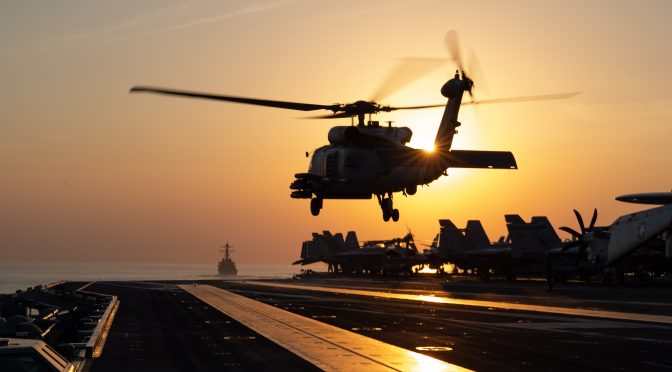
Featured Image: MH-60 supporting Strait of Hormuz transits in 2018. (U.S. Navy photo by Mass Communication Specialist 3rd Class Grant G. Grady/Released)
Discover more from Center for International Maritime Security
Subscribe to get the latest posts sent to your email.
That’s a really interesting perspective – focusing on governance rather than outright security is a key point that’s often overlooked in these discussions.
Your posts always feel like breath of fresh air in my social media feed
The only long-term solution to the strait is to take Kharg Island, control the loading of the tankers, and have all funds paid in USD to an account the US controls.
That is the only sure way to have Iran NEVER again attack tankers. Where they have skin in the game and the US controls the operation and the money.
The Venezuela system, if you will, is now proven and working well for both countries. We know where the money is going and if there ever is an issue with the Venezuela government, they know the money stops.
Except from the nonsensical statement “… without triggering a broader regional war”, a very astute observation, and one which would be easy to implement for large and small vessels alike.
A temporary corridor is a bad idea. Why would a Gulf Arab state use it when it can, as some nations do today, pay a toll to Iran to allow free passage of Hormuz any time it wants at zero risk its ships might be attacked outbound or inbound? Iran would continue to earn significant foreign exchange and to pass through the Gulf at will. The regime of the mullahs would remain in de facto control of the Strait, and could not be defeated or dislodged from power. It would be far better to adopt a U.S. naval mine blockade strategy which would cut off Iran’s economy from exports and imports by sea and put significant pressure on the regime to comply with U.S. war goals. China and Russia would be powerless to help, and the U.S. could end its naval blockade operations against Iran.
Thank you for a well written article that makes complete sense. We can only hope President Trump and advisors have access to the article, take it into consideration, and act accordingly.
On balance, a temporary corridor is a bad idea. First, it would leave the Mullahs in control of Hormuz. Only ships they approve will be allowed to pass. They earn significant hard currency (said to be $2 million a ship, split with Oman.). It is highly unlikely they can be removed from power s long as they control Hormuz . They know Hormuz is for them existential.
Second, the USN must continue to enforce a naval blockade on Iran. The mission is time and resource consuming, ties the fleet to specific locations, exposes it to risk from asymmetric threats, and is completely unnecessary. Preventing ships from using Iran’s ports can be achieved by U.S. naval mines – which are at hand and can be deployed by air at minimal risk to deploying aircraft.
The U.S. should adopt a naval mine blockade strategy. It would not be a temporary measure but would offer the promise of definitive victory.
Captain Dismukes raises a valid point regarding the potential effectiveness of a more coercive approach. However, the objective of a temporary corridor was not to resolve the conflict outright, but to manage its immediate economic and political effects while preserving longer-term options.
A full maritime blockade—particularly one involving mine warfare—would impose significant costs on global energy markets and allied economies, while carrying clear escalation risks. Those factors do not invalidate such an approach, but they do affect its practicality as an initial course of action.
A corridor strategy accepts a less decisive short-term outcome in exchange for maintaining commercial flow, limiting market disruption, and preserving coalition cohesion. In that sense, it is best understood not as an alternative to coercion, but as a preliminary step that stabilizes the system and creates conditions under which more sustained pressure can be applied if required.
The question is not whether more coercive measures exist, but whether they can be applied in a manner that is both effective and sustainable over time.
I also appreciate the broader discussion in the comments, which highlights the range of views on how best to approach the problem.
written 4/24/26 from the author.
Captain Bradford Dismukes argued for decisive coercion through maritime denial—specifically a mine blockade designed to isolate Iran economically and force compliance. The appeal of that concept is obvious: it is direct, coercive, and strategically legible. But recent events in and around the Strait of Hormuz have highlighted the practical limitations of such an approach while reinforcing the logic behind a corridor strategy.
Iran’s behavior has not centered on conventional fleet operations or large-scale naval maneuver. Instead, it has relied on ship seizures, harassment, asymmetric maritime pressure, and persistent uncertainty—the very kind of distributed, low-cost disruption that broad denial tools such as mine warfare do not neatly solve. A minefield may close water to structured commercial shipping, but it does not necessarily eliminate the ability of small craft, dispersed coastal launch sites, and irregular maritime actors to continue shaping risk in the battlespace.
That matters because the principal effect of indiscriminate denial is often economic shock to the wider system rather than concentrated pressure on the asymmetric actor itself. Energy markets tighten, insurers retreat, allied economies absorb higher costs, and coalition politics become more difficult—all while the disruptive actor retains some ability to harass, seize, or threaten commerce through nontraditional means.
The recent pattern in Hormuz underscores a different lesson:
The problem is not merely one of access, but of control over risk perception and commercial behavior.
That is where the corridor concept aligns more closely with events on the water. By concentrating maritime traffic into protected lanes, reducing background clutter, and improving attribution of hostile activity, a corridor approach does not seek to eliminate Iranian capability overnight. Instead, it seeks to reduce the effectiveness of disruption, maintain commercial flow, and preserve coalition cohesion while building the surveillance, enforcement, and legitimacy architecture needed for longer-term pressure.
The distinction is important:
A blockade seeks decisive pressure immediately.
A corridor seeks managed stability first, then leverage over time.
Recent events suggest that Iran’s preferred operating model thrives in broad disorder and ambiguity. A protected corridor, by contrast, narrows that space, makes hostile behavior more visible, and shifts uncertainty away from global commerce and back onto the disruptive actor.
In that sense, the events in Hormuz do not invalidate coercive options. They do, however, reinforce the argument that system stabilization is often the necessary first step before decisive pressure can be sustainably applied.
FYI While no full public doctrine paper on the “Maritime Freedom Construct” appears to have been released, reporting from Reuters and statements by US Central Command provide clearest public outline of it’s operating concept.
In addiction to the temporary corridor ; mining the iranian coast of the Strait?
from USNI News. Sea Scroll #125
“Operations in U.S. Central Command took an unexpected turn on Wednesday when President Donald Trump announced the U.S. had been secretly protecting merchant tankers transiting the Strait of Hormuz during the tentative ceasefire between Washington and Tehran over the past month.
“I directed our Great U.S. Military to execute a secret mission to support Oil Tankers and other Commercial Ships through the Strait of Hormuz. Today, I am pleased to announce that this effort has resulted in more than 100 MILLION Barrels of Oil making its way through the Strait, and into the Open Market. More than 200 Commercial Ships have safely traveled through the Strait,” Trump wrote in a Truth Social post.
The announcement follows the crash of a U.S. Army AH-64 D Apache attack helicopter over the Strait of Hormuz after it was hit by an Iranian drone.
“I have just been informed by our Great Military that last night the Iranians shot down one of our highly sophisticated Apache Helicopters while patrolling over the Strait of Hormuz,” Trump wrote on Truth Social on Wednesday. “There were two pilots involved, both are safe and uninjured. Nevertheless, the United States must, of necessity, respond to this attack.”
In a Wednesday press conference at CENTCOM headquarters in Tampa, Fla., Defense Secretary Pete Hegseth said the short-lived “Project Freedom” that was designed to protect ships sailing through the Strait of Hormuz had continued.
“Project Freedom, the idea of running ships through the Strait of Hormuz, it never stopped, it just went underground,” he told the reporter.
Following the announcement from Trump, U.S. forces retaliated against Iranian targets on the northern shore of the strait near the Iranian city of Bandar Abbas.”
FYI. US finally says the quiet part out loud “Trump says US will blockade Iran in the Strait of Hormuz and will charge ships for safe passage
JON GAMBRELL and JOSH BOAK (REUTERS)
Updated Sun, July 12, 2026 at 10:45 PM EDT
https://www.yahoo.com/news/politics/articles/us-ends-latest-round-airstrikes-024503851.html