Category Archives: Strategic Outlook

Predictions and forecasting.

Maritime Janus

As_janus_rostrum_okretu_ciach


January is named for the Roman God Janus, the two-faced deity of the doorway or the threshold.  With one face looking toward the future, and the other contemplating the past, Janus inspires the annual reviews of naval affairs  as well as the predictions for the future that we see in the naval blogosphere.  New Years 2013 in the maritime world is no different than in years past.

Over at Information Dissemination our favorite China shipyard-watcher Feng has a great post summarizing where the People’s Liberation Army Navy has been in the past year.  Two things caught our eye in reading through Feng’s summary.  First, seeing it all laid out in one place really emphasizes the capacity that is being developed by Chinese shipyards.  For all the discussion of a dwindling industrial base in the United States, it is interesting to watch the pace of work in the Chinese shipbuilding industry.  Second, we shouldn’t miss the massive construction underway for the maritime policing and Coast Guard equivalents in the People’s Republic.  USCG cutters routinely deploy globally, sailing with USN ships in the Arabian Gulf and Pacific as well as the regular patrol of our backyard in the Caribbean.  As China continues to build cutters and grows the size of their maritime security forces, we should expect them to develop interoperability with the PLAN in the same way the USCG and USN have developed their concept of The National Fleet.  This melding of law enforcement patrol with military operations (based on a model provided by the Americans) in the South and East China Seas will continue to complicate the issues there.

Also at ID, CDR Bryan McGrath gives us a quick look at some highlights for I&W to watch for in 2013.  We were glad to see him place the Blue/Green Team as his top item to keep an eye on.  The Marines need to get over their fears of another Guadalcanal and return to their historic roots as an integrated part of naval forces.  The Navy needs to overcome their self-consciousness about their comparative lack of recent combat experience and learn to look to the Marines for ideas and help in developing new concepts.  It is time that both forces genuinely came together as an integrated, hybrid force rather than a pair of brothers constantly arm wrestling over who side is “supported” and who is “supporting.”  We also note that discussions about the future of the Air Wing are on CDR McGrath’s list.  That’s easy for a former SWO to say, but he’s right.  The Naval Aviators amongst us are going to have to realize that there need to be some serious changes.  Hard thinking, innovative ideas, and practical experimentation and testing will be required…humming “Highway to the Danger Zone” and quoting Goose and Slider will only give our adversaries more time to realize our weaknesses and take advantage of them.  Maverick told us that you don’t have time to think up there…unfortunately today’s challenges require us to have people who are practiced and capable thinkers.

Elsewhere online the sometimes genial, sometimes grumpy, CDR Salamander takes a broader view toward the future at his blog.  Strategy is the matching of ends, ways, and means.  Sal points out that the United States must figure out the last part, with an honest and genuine assessment of the national financial status.  Without it, developing “the ends” of national policy, and “the ways” of a sound Naval policy and shipbuilding plan, is impossible.  That honest assessment…it isn’t going to be pretty.  It has some very serious ramifications for the Department of the Navy, but also for every single part of American society.

We encourage you to follow the links and read the posts.  There is some serious thinking here, some deep analysis, and some quick ideas that can help us frame the coming year – all worth your time.  Janus is the namesake of the first month of the year and serves as a symbol of our New Year’s passion for self-assessment.  He also serves as a fantastic symbol for naval analysts in general as we attempt to clarify the lessons of the past to illuminate our way into the future.  If you’re still feeling a need for speed though, check this out to get your 2013 off to the right start.

The Firm of Maynard, Cushing, & Ellis does not represent the opinions of anyone that matters.  Formed by Lieutenant Robert Maynard RN, Lieutenant William Cushing USN, and Captain Pete Ellis USMC, the firm doesn’t speak for the US Government, the Department of Defense, The Foreign Office, the Department of Housing and Urban Development, or the Department of Silly Walks.
The Royal Canadian Navy in NATO

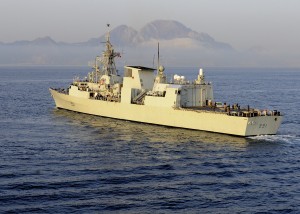
HMCS Vancouver and "The Rock"
HMCS Vancouver and “The Rock”

By Tomasz Trembowski

On August 16, 2011, the Canadian government announced the re-naming of Canada’s naval forces from “Maritime Command (MARCOM)” to its original designation, the “Royal Canadian Navy (RCN).” The last time Canada’s naval forces were known as the RCN was in 1968, when Lester B. Pearson amalgamated the three branches of the Canadian military under one command, named the “Canadian Forces.” Whatever name they operate under, Canada’s naval forces will continue to prove their importance in decades to come by playing a key role within NATO in increasingly critical waters.

Canada is proving its maritime mettle in a number of NATO operations around the world. Canadian vessels have played an active role in the NATO operation Active Endeavour. The operation was initiated on October 6, 2001, as a response to the September 11th attacks, which invoked NATO’s collective-security defence clause – Article 5. The aim of Active Endeavor is to keep the Mediterranean trade routes open and safe from pirates or terrorists, and to track and control vessels suspected of transporting weapons of mass destruction (WMDs).

Among the Canadian vessels that have participated in Canada’s portions of Active Endeavour, operations Sirius and Metric, are the Halifax-class frigates HMCS Charlottetown (FFH 339) and HMCS Vancouver (FFH 331). Most recently, Charlottetown returned to the Mediterranean in January 2012, continuing to patrol the area for suspect vessels until re-tasked to join Operation Artemis in April as part of Combined Task Force 150 (CTF-150) in the Arabian Sea. To date, Active Endeavour operations have hailed over 100,000 vessels and boarded some 155 suspect ships. Continued RCN participation in this operation not only gives Canada the capability to respond to crises in the immediate region but offers security to a region where a tremendous amount of world trade is conducted.

Another recent Canadian effort has been as part of Standing NATO Maritime Group One (SNMG1). SNMG1 is an integrated maritime force, consisting of four to six destroyers and frigates from different NATO Member and Partner countries, that plays an important part in maritime security. It normally operates in the eastern Atlantic Ocean during peace time. However since August 17, 2009, SNMG1 has been operating in and around the Gulf of Aden, a body of water that lies between the southern coast of Yemen and Somalia. The current operation, Ocean Shield, has made significant contributions to international efforts aimed at combating piracy off the Horn of Africa.

Within Ocean Shield Canadian vessels  have played crucial roles. Among them, Charlottetown helped disrupt the movement of illicit cargo off the coast of Yemen. On May 5, 2012, for instance, Charlottetown successfully intercepted 600 pounds of hashish.  Speaking at the changeover of Charlottetown with HMCS Regina (FFH 334) on August 19, Canadian Minister of National Defence, Peter Mackay stated, “Regina’s deployment continues our strong tradition of participation in overseas operations with our allies, while making meaningful contributions to international security and stability.” Ocean Shield is expected to end in 2014, but until then the Canadian Navy will no doubt continue to take an active role in the operation.

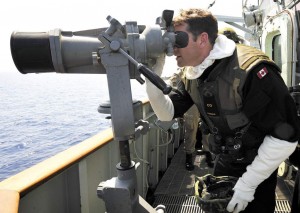
CDR Craig Skjerpen, commanding officer of HMCS Charlottetown, uses the "Big Eyes" binoculars to look for small boats crewed by Libyan pro-regime forces.
CDR Craig Skjerpen, commanding officer of HMCS Charlottetown, uses the “Big Eyes” binoculars to look for small boats crewed by Libyan pro-regime forces.

On March 23, 2011, NATO initiated Operation Unified Protector, under the command of Canadian Lt. General Charles Bouchard, to enforce UN resolutions 1970 and 1973 concerning Libya. The resolutions authorized NATO forces to maintain a no-fly zone and arms embargo against the Libyan government.

Both Vancouver and Charlottetown participated in the operation. On May 12, 2011, Charlottetown, along with French and British warships, engaged several Qadhafi regime small boats involved in an attack against the port of Misrata, and 18 days later came under fire from BM-21 rockets launched from shore. Meanwhile Vancouver worked alongside NATO allies to enforce the arms embargo placed against the Libyan government until its fall. As shown, Canada can and does play a leading role in NATO operations on the seas and oceans of the world.

NATO’s Arctic Future
In addition to its involvement in NATO operations abroad, Canadian vessels can perhaps play a key role in shaping NATO’s Arctic policy. As the Arctic becomes more navigable, there will be much more traffic in the region, commercial and military, which will necessitate a stronger RCN presence. On June 3, 2010, the Canadian government announced its new National Shipbuilding Procurement Strategy (NSPS). This strategy will see $35 billion dollars spent to construct both large and small combat vessels. Among the first batch of vessels slated for delivery are the Arctic Offshore Patrol Ships in 2018. These vessels are seen as fundamental to securing Canada’s security and sovereignty in the Arctic.

The Canadian government was initially quite bellicose in its rhetoric regarding Arctic sovereignty, but more recently that stance has softened. The number of speeches mentioning new science and economic endeavours are outnumbering those proposing military bases, for example. However, in leaked US cables dating from 2010, Canadian Prime Minster Stephen Harper apparently cautioned NATO Secretary General Anders Fogh Rasmussen that NATO had no role in the Arctic and any such moves would only serve to increase tensions with Russia. According to the cable the PM commented that there is, “no likelihood of Arctic states going to war, but that some non-Arctic members favored a NATO role in the Arctic because it would afford them influence in an area where they don’t belong.”

In fact, there are plenty of reasons to get NATO involved. While a war among Arctic nations is indeed a far-fetched and unlikely event, there are other considerations to take into account. First, as the Northwest Passage becomes more easily navigable, experts predict the route may become the busiest waterway in the world. As the passage sees increased commercial traffic, a greater military presence will be required to inspect passing vessels for illicit or dangerous cargo, and to enforce possible environmental regulations.

Furthermore, Russia, the other major player with a massive interest in the Arctic, is already militarizing the region. Over the past few years, Russian air and submarine activity in the Arctic has reached levels not seen since the Cold War. It has even re-opened its old airbases on frozen archipelagos located above the Arctic Circle. Since Canada’s Arctic forces at current can’t hold a candle to Russia’s, a simple solution would see Canada include all NATO allies in current discussions taking place in the Arctic Council. This would be followed by working closely with all NATO allies to establish a new force primarily dedicated to the Arctic. This new force would naturally include the new Canadian vessels being built to operate specifically in the region. Such a move would no doubt give Canada a leading role in the matter considering the country’s proximity and forward position in the region. Why wait until Russia has moved deeper into the region and takes advantage of slow-moving talks in the Arctic Council?

Canada has already proven that it is a power on the oceans and seas of the world by aiding in counter-terrorism operations, anti-piracy operations, and naval warfare operations. It can be proud of its RCN and the contributions and leadership it provides to both past and present NATO operations. Now, however, is the time to codify a new role for the RCN for the new century – the Arctic. This of course, is solely in the hands of the Canadian government. All it has to do is reach out and include its NATO allies.

This article appeared in its original form and was cross-posted by permission from The Atlantic Council of Canada.

Piracy in West Africa: Preventing a Somalization of the Gulf of Guinea, Pt. 1

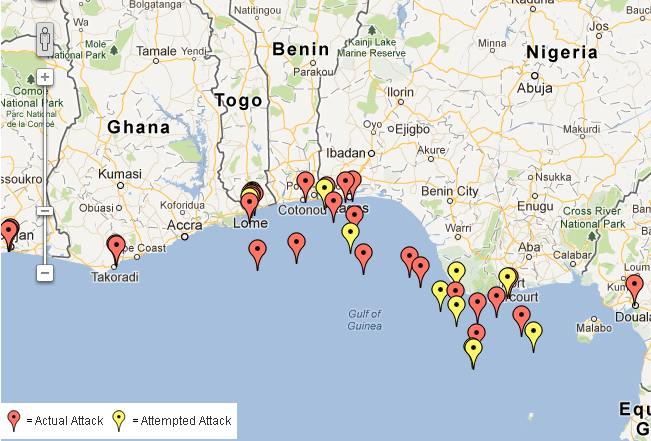
Locations of attacks in the Gulf of Guinea in 2012 (Source: IMB)

Gulf of Guinea Pirate Attacks in 2012. Source: IMB

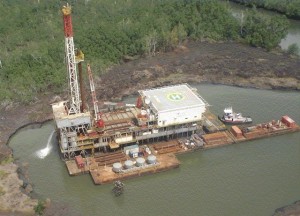
On August 4, 2012, pirates attacked an oil barge, killing two local security personnel and kidnapping four foreign workers. Two weeks later, pirates hijacked and held for five days a British-managed oil tanker as they unloaded its cargo, a style of attack that repeated the following fortnight on a much larger Greek owned tanker.

While such events were routine of late off the coast of Somalia, these attacks occurred on the other side of the continent, in the West African territorial waters of Nigeria and Togo. Piracy has now declined in the Indian Ocean—a trend attributed to international naval patrols, the increased use of armed guards aboard ships, and political developments in Somalia—but in the Gulf of Guinea it is on the rise. The region reported 47 incidents of piracy (it is estimated that up to 60% of attacks go unreported) to the International Maritime Organization (IMO) in 2010, a number which rose to 61 in 2011 and will likely be surpassed by 2012 figures.

Highlighting this growing danger, Lloyd’s Market Association, a London-based group of insurer representatives, recently added the Gulf of Guinea to its “Hull War, Strikes, Terrorism and Related Perils Listed Areas,” placing the waters of Nigeria and Benin in the same category as those of Somalia and Iraq. Seeking to examine the intricacies of this oft-overlooked security threat, this article intends to do three things in three posts: chart the evolution of West African piracy, assess whether or not a “Somalization” is occurring, and evaluate regional and international plans to combat the mounting crisis.

From Fishermen to “Freedom Fighters”

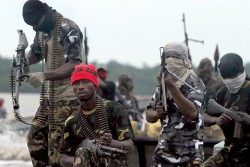
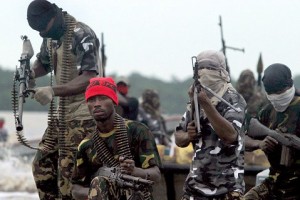
MEND Pirates/Militants. Likes: Walks along the beach; oil.

The problem of piracy in the Gulf of Guinea extends from Senegal in the north to Angola in the south, and affects over a dozen countries in between. The historical epicenter is Nigeria, where pirates have parasitically fed off the country’s oil boom since the 1970s. During Nigeria’s first iteration of piracy, the crime began as simple economic opportunism. Ransacking docked ships was common, while bolder pirates—equipped with little more than canoes and machetes—ventured slightly further from port in attempts to board and rob slow-moving vessels. The theft of crude oil from refueling or anchored ships, referred to as “bunkering,” also brought a tidy profit through resale on a black market that spans the continent.

In the early 2000s, a drastic change occurred as piracy, while remaining an economic-minded crime, became infused with politics. The basic grievance was that the federal government in Abuja had taken too great a share of Nigeria’s petroleum wealth, while distributing little back to the oil-soaked communities of the Niger Delta. A plethora of militant groups emerged to “reddress” the oil issue during this period, the most significant of which was the Movement for the Emancipation of the Niger Delta (MEND).

Seen by its practitioners as an effective tool for the “redistribution” of oil wealth, pirate attacks increased dramatically at the turn of the century. From 2000 to 2005, Nigeria’s waters were more pirate-prone than those of Somalia. By 2006 an estimated $1.5 billion in annual revenues for the country was lost through a combination of piracy, bunkering, and militant attacks on oil infrastructure.1

Politically motivated attacks on offshore platforms, the kidnapping of oil workers, and the theft of crude oil has challenged the traditional definition of piracy, as the crime is only recognized under international law if it is committed “for private ends.” Certain incidents are clearly socio-political in nature. In 2000, for example, militants stormed a Royal Dutch Shell oil storage platform, taking 165 employees hostage before releasing them in exchange for talks with the government.2

Piracy expert Martin Murphy concludes that in West Africa, the “line between the political and the criminal is hard to draw.”3 In Somalia, pioneering pirates first made claims of “restitution” for illegal foreign fishing and toxic dumping before expanding into indiscriminate hijacking and hostage taking, driven solely by profits. Similarly in the Gulf of Guinea, bunkering began as a form of economic protest but has grown into a multi-million dollar industry as oil tankers’ valuable cargos are robbed and resold.

Go Forth and Multiply

Not at all a tempting target...
Not at all a tempting target…

Attacks off the coast of Nigeria have ebbed and flowed in recent years. Intensified naval patrols and a 2009 government amnesty offered to Delta militants resulted in a decline in reported attacks – from a high of 42 in 2007 to 10 in 2011.4 Nigerian piracy has increased in 2012, however, with 23 incidents already reported in the first three quarters.

According to piracy expert J. Peter Pham, the gangs now operating across the Gulf of Guinea are “composed mainly of, and certainly led by, Nigerians, with perhaps a smattering of other nationalities.” They have shifted their operations into neighbouring states as the authorities there lack the capacity to survey and patrol their own waters.

Piracy is but one symptom of the lack of maritime order in the region, as endemic drug smuggling; human and weapons trafficking; and attacks against oil infrastructure have threatened to turn West Africa’s seaways into a criminal super-highway. These manifestations of maritime insecurity are linked, speculates Bronwyn Bruton, as international criminal syndicates previously involved in weapons and drug trafficking “[jump] on the pirate ship” as a new source of revenue. This claim was reiterated by Abdel Fatua Musah, Director of Political Affairs for the 15-member Economic Community of West African States (ECOWAS), who reported to the UN Security Council that piracy has dovetailed into other forms of transnational organized crime.

Piracy and theft are believed to cost Nigeria 7% of its annual oil revenues. Benin’s port of Cotonou—taxes from which account for 40% of the country’s GDP—is witnessing a reported 70% decline in shipping activity due to piracy.5 In total, it is estimated that piracy costs the littoral states of the Gulf of Guinea an annual $2 billion in stolen cargo, rising insurance premiums, and other security costs. As the menace expands, the export of metals, cocoa, and agriculture products—vital to both local development and world markets—will also come under threat.

James Bridger is a Maritime Security Consultant and piracy specialist at Delex Systems Inc. He can be reached at jbridger@delex.com. This article is a modified form of James’ work with the Atlantic Council of Canada’s Maritime Nation Program publication “From Sea to Sea: The Search for Maritime Security“.


1. Martin Murphy, Small Boats, Weak States, Dirty Money: Piracy and Maritime Terrorism in the Modern World, London: Hurst and Company, 2009, pg. 117

2. Ibid, pg. 119

3. Ibid, pg. 122

4. International Maritime Bureau, “Piracy and Armed Robbery Against Ships: Report for 2011,” International Chamber of Commerce, January 2012.

5. “An Emerging Threat? Piracy in the Gulf of Guinea”.

More Than Words: Australia-Indonesia Strategic Relations

Australia-Indonesia Joint Patrol

By Natalie Sambhi

Australia’s leaders from both sides of politics have been paying greater attention to Indonesia; there’s been more official engagement, as well as new diplomatic and defence initiatives in the past year. And we’ve been describing Indonesia, as our Defence Minister has during his Jakarta visit last week, in more important terms like ‘strategic partner’.

But it looks like that there’s some way to go before ‘strategic partner’ becomes more than just a term of endearment. If we look at the 2009 Defence White Paper (for the time being still the government’s defence strategic policy), we find a curious ambivalence towards Indonesia. According to the White Paper, we have a ‘fundamental interest in controlling the air and sea approaches to our continent’ (paragraph 5.5). But in reference to a secure immediate neighbourhood, it says we should prevent or mitigate ‘nearby states [from] develop[ing] the capacity to undertake sustained military operations within our approaches’ (paragraph 5.8). There’s a contradiction there; as Hugh White notes in his Security Challenges essay (PDF), it may very well be those same capabilities Indonesia requires to ensure its own security in its northern approaches that could be instrumental in both Indonesia and Australia securing their strategic interests.

In short, the language of the 2009 Defence White Paper simply doesn’t match our statements of Indonesia as a strategic partner. And although there are asymmetries in our capabilities, a strategic partnership means allowing and encouraging Indonesia to grow in a way that complements our strengths and compensates for our weaknesses so that we can work together; if Indonesia is to play an important role in our strategic future, then actively mitigating or preventing particular capacities isn’t the way to go.

This position might have been justifiable in white papers released after Konfrontasi (during which Australia and Indonesia found themselves on opposing sides of the conflict) or shortly after the 1999 East Timor intervention, during which relations with Indonesia were more fractious and the military (TNI) was only just exiting Indonesian politics. But times have changed.

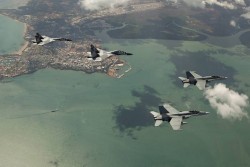
On the domestic front, Indonesia is a much more stable, democratic state. In economic terms Indonesia is now starting to flex its muscle. Its GDP grew by an annualised 6.4% in the second quarter of 2012, its economy is now larger than Australia’s in purchasing power parity terms, and its middle class is larger than Australia’s population. TNI no longer exerts the same level of direct influence on politics and there’s a greater commitment to crack down on corruption. In regional terms, Indonesia enjoys greater clout and has attracted the attention of international partners such as the United States, the United Kingdom and China. Recent participation in RAAF-hosted Exercise Pitch Black 2012 (see image) shows Indonesia’s willingness to engage with partners such as Australia by sending their newest aircraft to build person-to-person ties and to dispel doubt as to their military intentions.

Barring a significant change in Indonesia’s trajectory of growth and domestic transformation, this is likely to become an enduring externality for Australian policy. Nonetheless, it’s worth thinking through the factors that could cause problems for Indonesia down the track: these include slowed growth, a change of leadership to one that is more internally focused, and deteriorating domestic stability. The question is whether these eventualities would adversely affect the Indonesia–Australia relationship in the long-term or would merely slow the engagement temporarily. That said, the relationship between Indonesia and Australia seems to be on an unstoppable path of growth. A nationalist President of Indonesia would be a concern but wouldn’t necessarily require a radical rewrite of Indonesia’s place in our strategic interests. In any case, as one RSIS commentator notes (PDF), nationalism at present is not a call for concern.

Likewise, Australia can cause ructions over livestock, people smuggling or the incarcerations of Australians, but the fundamental shared interests should ultimately prevail. In terms of shifting regional geopolitics, Australia and Indonesia might have more in common in the future Asia as we both navigate China’s rise and the US rebalance. A Defence Cooperation Agreement signed recently between Australia and Indonesia provides a framework for practical cooperation on common security matters, but it’s time to work together as well on bigger, long-term strategic questions about the region.

Indonesia demands different handling in the next Defence White Paper, which is as much an opportunity as the Asian Century White Paper to correctly recognise Indonesia’s place. Language matters, because it sends a strong signal to both the Australian and Indonesian people about how we see each country’s place in the region. And while the majority of everyday people in each country may not delve into the pages of the White Paper, setting the tone for political interaction as well as doing away with ambiguous language remains important. Hopefully the 2013 White Paper will articulate Indonesia’s importance and elevate it to partner status rather than a subordinate. That sort of constructive language would remove the disparity between language of the 2009 White Paper and the increasing importance of close defence relations and alignment of strategic interests between the two nations.

The White Paper might start by recognising the complementarity across our capabilities, strengths and weaknesses. Or it could, as Hugh White suggests, create a heading for Indonesia separate from the rest of ‘our neighbourhood’ to recognise the important role it plays in our strategic environment. While there’s no prospect of an alliance between our countries in the foreseeable future, it would provide a more robust basis in our national policy to give a broader context to initiatives such as the recently signed Defence Cooperation Agreement.

Defence Minister Smith assures us that he is ‘committed to regular, open and transparent discussions with Indonesia on the development of Australia’s 2013 Defence White Paper’. Let’s hope the final cut pays them the same due respect.

Image courtesy of Department of Defence.

Natalie Sambhi is an analyst at the Australian Strategic Policy Institute, editor of The Strategist and co-editor of Security Scholar. She is also a Hedley Bull Scholar and graduate of the Australian National University.

This article appeared in its original form and was cross-posted by permission from The Security Scholar.