
By Jonathan Compton, David Sampson, and Joseph Mroszczyk
Introduction
The U.S. Naval War College (NWC) recently hosted Global 21, the largest and most sophisticated wargame in its history in support of Commander, U.S. Pacific Fleet. Over 700 participants descended upon our facilities in Newport to execute a complex game that ran over nine, 20-hour days. This game integrated advanced modeling and simulation (M&S) as the heartbeat of the adjudication process, increasing fidelity and accuracy of combat outcomes. The game objectives required this fidelity and accuracy in its adjudicated outcomes to support player decisions and help derive information “applicable to real world situations” – a key element in Frank McHugh’s definition of a wargame.1 It also experimented with the use of super intelligence (SI) tools for wargame in-stride analysis. From these experiences we identified several lessons.
The growing availability of SI and modeling and simulation (M&S) tools presents an attractive opportunity to improve the rigor, speed, and analytical value of military wargaming. Yet integrating these capabilities into large-scale wargames is not simply a matter of adding better technology to existing adjudication and analysis processes. Increasingly sophisticated M&S tools can create friction with traditional move-step game mechanics, generating demands for near-continuous or running-time adjudication. SI tools can struggle to identify the operational significance of individual player decisions, synthesize information distributed across data sources and types, and distinguish consequential developments from the background noise of a complex combat environment.
In Global 21, we incorporated the Virtual Wizard (VW) suite of simulation tools for the first time in a major wargame. VW uses high-fidelity entity and environment models to assist in adjudicating the find, fix, and track process of a subset of maritime surface tracks in the game environment. Adjudicators had the ability to react to dynamic changes in the battlespace during the simulation based on player-generated orders, products, and pre-planned responses. Following the game, the VW suite stores information useful for reporting and analysis.
In Global 21, we also experimented with the Multi-Agent Generative Engine (MAGE) SI system, developed by the Air Force Wargaming Institute, to assist with in-game analysis as the moves played out over several days. Wargame analysts uploaded various game data streams into MAGE, which then helped identify key findings related to the game’s objectives and research questions. These findings were kept separate from other analyst-generated findings and then compared. We also used various large language models (LLMs) on our gaming network to assist with analysis of wargame data.
Both VW and SI capabilities required significant increases in computing infrastructure, technical integration expertise, subject-matter expertise, additional personnel, and physical space. Taken together, these challenges suggest that the integration of SI and M&S into wargaming should be understood not as a technological enhancement layered onto an existing methodology, but as a fundamental change to the wargaming enterprise itself—one that requires organizations to reconsider how games are designed, staffed, adjudicated, analyzed, and resourced.
We have identified several key lessons from this experience.
- Integrating M&S tools forces reconsideration of how time is managed within the game.
The integration of M&S tools into the game introduced a problem that is less technical than organizational: the traditional move-step construct was not designed for computationally-intensive adjudication. In our traditional wargames, players write orders for their forces, adjudicators playing both Blue and Red “competent subordinate commanders” carry out the orders, experts determine the outcomes of combat interactions, and the game advances to the next turn. The process deliberately creates pauses in which adjudicators can assess outcomes and provide new information to players for the next move. M&S tools can disrupt this rhythm, particularly as model outputs require human decision-making to advance. As more computational models are incorporated into adjudication, the game increasingly depends on running those models between moves, validating their outputs, resolving unexpected results, and translating model-generated data into information that players can digest and act upon. The adjudication process therefore begins to look less like a series of discrete moves and more like a continuous or running-time simulation. This evolution is only valuable if required by the game objectives and the player decision space.
Running-time games can create a mismatch between the speed of the game and the speed of the models supporting it. A relatively simple model may be run quickly enough to support traditional move-step design and adjudication, but increasingly sophisticated simulations require substantial processing time and human decisions during the model run. The problem compounds as we advance this capability in our wargames to employ multiple models simultaneously to assess various aspects, such as fires, logistics, force attrition, air defense, and information effects. The control team can quickly become responsible for managing a complex simulation architecture in the gaps between player moves that infringes on the players’ decision space.
The implication is that incorporating M&S into wargaming may require a fundamental reconsideration of how time is managed within the game. Traditional move-step games assume that adjudication can occur during a relatively predictable pause between turns, usually overnight. More sophisticated M&S-enabled games may require adjudication to begin before a move is complete, potentially requiring players to make decisions in “real time” as the model progresses. In some cases, this could create demand for running-time adjudication: adjudicators and model operators working continuously throughout the game to ensure that computational outputs are available when players need them. That requirement has significant implications for manpower. A game that previously required a relatively small adjudication cell may instead require model operators, data managers, technical specialists, and analysts working in parallel. The Global 21 design managed this problem by requiring a small number of players to serve as Battle Watch officers to act as competent subordinate commanders and make any required tactical decisions during the adjudication process.
There is also a danger that the technologies begin to dictate the design of the wargame rather than support it. If a particular model requires an hour to execute, designers may be tempted to structure turns around the model’s processing time. If data must be entered according to a model’s predefined schema, player decisions may have to be translated into formats that the simulation can accept. The result can be a subtle inversion of priorities: rather than designing the game around human decisions and the analytical questions it is intended to answer, designers begin designing the game around what their models can efficiently process. The challenge, therefore, is developing an adjudication architecture in which computational tools accelerate and enrich human judgment without allowing the requirements of the models to become a constraint on the wargame itself.
- M&S tools require tactical-level of war detail, which may be inconsistent with game objectives.
Most NWC games abstract the tactical details of warfare to examine human decisions at the strategic and operational levels. However, M&S systems generally require tactical-level decisions of precise locations, timing, course, speed, salvo size, formation geometry, and other factors. Global 21 addressed this challenge by employing adjudicators at the tactical level and teaming them with trusted agent players. During running-time adjudication utilizing VW, the Red and Blue “Battle Watch” monitored the minute-by-minute situation on the battlefield and made tactical decisions within the limits of the moves players submitted during the move-step period. This provided the model with required data and gave players the agency required by game objectives while the commander’s intent played out.
Importantly, analysts had to distinguish between delegated tactical decisions that Battle Watch made during adjudication, and decisions that commanders and their staffs made during the planning and order-writing processes. Several analysts in the adjudication cell helped to discern decision attribution during the game.
The requirement for tactical details to feed the M&S tools also comes at a cost in terms of personnel, time, training, space, and other resources. When wargame objectives are at the operational level of war, this focus on tactical details risks drawing attention away from the game’s key research questions. Wargame designers must strike a balance between generating the required tactical-level details of combat to feed into the various M&S tools while also keeping commanders focused on operational-level decisions.
- SI tools are getting better, but are not yet sufficient to handle the complexity of wargame data.
The promise of SI in wargame analysis is straightforward: rapidly ingest large volumes of qualitative and quantitative data, identify patterns that human analysts might miss, and transform observations from a complex game into actionable insights related to game objectives. The reality is considerably more difficult in execution, as we discovered using SI tools in Global 21.
A wargame can generate an enormous volume of information and data, but the most consequential observations are often buried in the details. Current SI tools that we have available on our secure gaming network can synthesize information using data in the form the game produced it, but they remain inconsistent at distinguishing the signal from the noise in the context of a complex operational environment.
This problem is particularly acute when attempting to identify and interpret important actions during a game. Wargame data rarely arrives in a clean, machine-readable sequence of events. Instead, analysts must reconstruct what happened from adjudication notes, situation reports, player decisions, data collector notes, player-generated insights or products, and plenary discussions. Adjudicators frequently report on the same combat interaction from multiple points of view and using a variety of naming conventions (ship hull numbers, trigraphs, etc.) further complicating SI’s interpretation.
An SI model may recognize that a particular action occurred without understanding why it mattered. More importantly, it may fail to recognize that an action was consequential because of its interaction with events occurring elsewhere in the game. The significance of a decision may only become apparent several turns later, or only when considered alongside an adversary’s response. In this respect, SI can be remarkably good at describing a wargame while remaining unreliable at analyzing one.
The problem becomes even more difficult when wargame information is distributed across multiple formats. A typical game may produce PowerPoint slides containing operational graphics, Excel spreadsheets containing adjudication results or expenditure rates, Word documents containing data collector observations, and separate files containing player assessments and plans. Human analysts routinely move between these sources, mentally constructing a common operational picture and determining which pieces of information belong together. SI tools are considerably less reliable at performing this synthesis, at least according to our experimentation. Even when SI can process individual files successfully, connecting information across them requires understanding chronology, organizational relationships, operational context, and the meaning of acronyms and other specialized terms. The result can be a collection of individually accurate summaries that nevertheless fails to produce an accurate understanding of what comprehensively happened across the game.
Ultimately, the central challenge is one of contextual prioritization rather than information extraction. A complex combat environment contains thousands of interactions, but only a small number are likely to drive meaningful operational conclusions. An experienced analyst understands that the destruction of one unit may be less important than the loss of a particular capability, that a tactical success may create an operational vulnerability, or that an apparently minor decision could expose a critical dependency several turns later. These judgments depend on an understanding of relative importance that is difficult to encode in prompts to SI agents. SI can assist by organizing evidence, identifying recurring themes, and accelerating portions of the data-processing burden. But without a robust mechanism for understanding operational context and assigning relative significance, there is a risk that SI will produce something that looks like analysis without performing the analytical work that makes wargaming valuable.
Some of these difficulties, the synthesis problem in particular, originate in how the game recorded what happened. Several adjudicators may describe the same engagement using hull numbers, trigraphs, and unit names. The record of a single decision may be divided among an operational graphic in a slide deck, a line in an adjudication spreadsheet, and a data collector’s notes. Under those conditions, reconstructing events becomes an interpretive task before analysis can begin. Experienced analysts do that reconstruction with tacit knowledge of the scenario, the forces, and the people who wrote the notes. An SI tool has that knowledge only if the data supplies it.
The remedy is to structure game data at the point of capture. That means a common identifier for each unit and platform, used by every cell; a time-stamped record of each player decision that links its stated rationale to the adjudicated outcome; and metadata showing who recorded each observation and in what role. The same structure lets analysts trace any finding surfaced with SI assistance back to the records that support it, so that machine-generated synthesis remains distinguishable from participant data and analyst judgment. None of this depends on further progress in SI. Structured capture makes human analysis faster and more reliable now, and it gives future tools a fair test. Our own results and experiences reflect particular tools we used, operating within the security constraints of a gaming network, applied to data in the form Global 21 produced it. They should be read as findings about those conditions only and not other SI tools available to analysts in other gaming environments.
Nevertheless, MAGE is making important strides forward as a useful SI tool for wargame analysis. We plan to continue integrating MAGE into NWC’s analysis workflow as it develops.
- Technological advancements in wargames create resource burdens.
The appeal of incorporating M&S tools into wargame adjudication can obscure a less glamorous reality, which is that more sophisticated adjudication requires more resources. M&S tools introduce additional technical infrastructure that must be acquired, operated, maintained, and integrated into the game. High-fidelity models can require substantial computing power, specialized software, secure networks, data infrastructure, and technical support. As the number and complexity of models increase, so too does the infrastructure required to run them reliably. The result is that a wargame designed to produce better analytical fidelity can become substantially more expensive and resource-intensive to execute.
The personnel requirements may be even more significant. Effective M&S-enabled adjudication requires individuals who understand not only how to operate and integrate the models, but also what the models are actually representing. A technical specialist may know how to configure a simulation, manage its inputs, troubleshoot an interface, and interpret its outputs without necessarily understanding whether those outputs make operational sense. Conversely, a subject-matter expert may understand the employment of a particular weapons system or combat function but lack the technical expertise necessary to translate that knowledge into the model. Meaningful adjudication therefore requires personnel who can bridge both worlds. In practice, this often means assembling teams that combine simulation engineers, data specialists, analysts, operators, and subject-matter experts across multiple warfighting domains.
This creates a particularly difficult resource problem because expertise is often highly specialized. A game examining the interaction of air defense, long-range fires, logistics, electronic warfare, and maritime operations may require expertise in each of those systems to properly configure and interpret the relevant models. The personnel requirements can therefore grow faster than the number of models being employed. A model may technically produce an answer without the appropriate expert in the room to determine whether that answer is operationally credible. The more consequential the adjudication result, the less acceptable it becomes to treat the model as a black box. Progress in using M&S to follow player orders and adjudicate complex kinetic combat requires an enterprise-wide effort to build models that accurately reflect present and future weapon system capabilities and behaviors based on the latest tactics, techniques, and procedures.
The physical requirements of M&S-enabled wargaming also deserve consideration. Traditional seminar-style or move-step wargames can be conducted in relatively modest spaces, with participants, adjudicators, maps, and presentation equipment. Integrating multiple M&S tools can transform that environment into something closer to a small technical operations center. Computers and networking equipment require additional workspace; model operators need dedicated workstations; analysts need access to displays and data; and technical personnel need room to troubleshoot systems without disrupting the game. Secure computing environments can impose additional infrastructure requirements. These demands may appear marginal individually, but they become significant when multiplied across a large operational-level wargame involving hundreds of participants and a sizable adjudication cell.
The broader implication is that M&S dramatically increases the costs associated with conducting wargames. A traditional wargame may accept some loss of fidelity in exchange for speed, flexibility, and relatively low overhead. A model-enabled game can potentially improve the rigor of adjudication, but it does so by shifting resources toward computing infrastructure, technical integration, specialized personnel, and physical space. This creates an important tradeoff for organizations investing in advanced wargaming. The question should not simply be whether a particular model can improve adjudication, but rather whether the additional fidelity generated by that model is worth the personnel, infrastructure, time, and expertise required to incorporate it into the game. In many cases, the most effective solution may not be to model everything, but to identify where additional computational fidelity will materially improve the analytical value of the game—and concentrate resources there.
Conclusion
In 2025, two of us, with Matthew Tattar, argued in War on the Rocks (“Too Much Tech Can Ruin Wargames“) that adding technology to a wargame does not by itself make the game more rigorous. We argued that models earn a place in adjudication where outcomes are governed more by physics than by judgment, such as which sensors detect which platforms. Global 21 put that argument into practice. Virtual Wizard adjudicated find, fix, and track for a subset of surface tracks, a problem of exactly that kind. It improved the fidelity of detection outcomes in a part of the game where player decisions depended upon certain detection criteria.
The game also showed what that fidelity costs. Model-enabled adjudication changed how the game managed time and pushed more tactical detail into an operational-level game. It required compute, secure infrastructure, physical space, and people able both to run the models and to judge whether their outputs made operational sense. Each of these was a condition of using the model at all.
The practical question for the Navy is where computational fidelity is worth that price. Our experience suggests it is worth paying where a game’s research questions depend on outcomes that a human adjudication cell cannot credibly produce. It should not be the default elsewhere. Where it is worth paying, it has to be paid for. An organization resourced for traditional move-step adjudication cannot absorb these costs as routine overhead. If the Navy wants model-enabled wargames as a regular capability, the people, infrastructure, and space must be programmed for that purpose. Asking for the capability without the resources invites one of two failures. The first is models used without the expertise to interrogate them, which is the automation bias two of us warned about in 2025. The second is game designs that bend to what the models can process, which limits the viable analytic questions.
Part of the investment lies outside any wargaming organization. A model is only as useful as its representation of current and future weapons, sensors, and tactics. Keeping those representations current is enterprise work, and it belongs with the communities that own the systems and write the tactics. Wargaming organizations can integrate validated models into adjudication, but they cannot be the only source of validation.
SI-assisted analysis follows the same logic. The tools we used were better at describing the game than at judging what mattered within it. Part of that gap belongs to the tools and part to the data we gave them. Investment in how games capture and structure their data will improve human analysis now and will determine how much SI can add later.
Analytic design should come first. The research questions of a game should determine which tools it needs, and a tool’s requirements should not reshape the game. We offer these observations from Global 21 to other organizations weighing the same choices.
Jonathan Compton, Ph.D., is Chair of the Wargaming Department at the U.S. Naval War College.
David Sampson is an associate professor in the Wargaming Department at the U.S. Naval War College and served as Game Director for Global 21.
Joseph Mroszczyk, Ph.D., is an assistant professor in the Wargaming Department at the U.S. Naval War College and served as Lead Analyst for Global 21.
The opinions and views expressed are those of the authors alone and do not necessarily represent those of the U.S. Government, U.S. Department of War or its components, to include the Department of the Navy or the U.S. Naval War College.
References
1. McHugh, F. (1966). Fundamentals of War Gaming. The United States Naval War College.
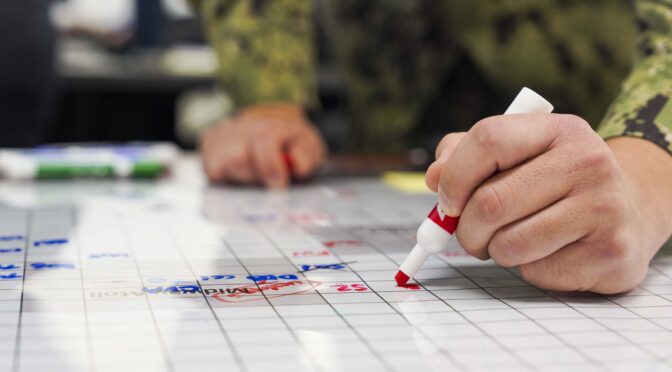
Featured Image: NEWPORT, R.I.— Operations Specialist 1st Class Harold Gomez, U.S. Naval War College (NWC) Wargaming department, facilitates a wargame during the college’s 13th “Wargaming 101” introductory course onboard Naval Station Newport, Jan. 15, 2025. (U.S. Navy photo by Mass Communication Specialist 2nd Class Connor Burns)
Discover more from Center for International Maritime Security
Subscribe to get the latest posts sent to your email.