
By Paul Viscovich, CDR, USN (Ret.)
After four months into the conflict, Iran is defiantly refusing to capitulate. This “four week war” now threatens to become another drawn-out conflict. Despite American tactical successes, Tehran has seized control of the Strait of Hormuz and holds the strategic upper hand. Closing the Strait has severely restricted the flow of critically needed oil and agricultural fertilizer, threatening an economic crisis and worldwide famine. Allies, friends, and opponents alike are losing confidence in American leadership and are applying increasing pressure on Washington to resolve this crisis one way or another.
Reopening the Strait of Hormuz poses formidable challenges. It is approximately 90 nautical miles long and 21 nautical miles wide across at its narrowest point. Transiting ships are exposed to mining, close-range missile, fast patrol boat and drone swarm attacks from roughly 130 degrees throughout their course. On March 10, Tehran effectively closed the Strait by announcing it had mined the shipping channels. Whether or not they did, or how extensive these minefields were, is less important than the threat itself and how effectively it shaped behavior. Iran has also fired on and damaged merchant shipping attempting to run the gauntlet.
In early May, as many as 2,000 merchant ships were reported trapped in the Persian Gulf. This number has decreased in recent weeks, reportedly because some nations are obtaining diplomatic clearance from Tehran for their ships to transit unmolested. The Trump Administration directed the Navy to assist tankers in departing the Persian Gulf, and about 200 have reportedly made the transit as of this writing. In either case, it certainly appears these transits have depended on Iranian restraint during the recent ceasefire. Any future resumptions in hostilities will prompt Tehran to close the Strait again, as happened on June 11.
Anticipating this, U.S. Central Command previously announced its intention to restore freedom of navigation through the Strait. In view of Iran’s previous attacks on vessels attempting this transit, shippers and their underwriters are unlikely to accept anything less than armed naval escorts. But this level of support is unlikely for the simple reason that the risk of losing one or more $2.5 billion guided missile destroyers to attack at close range, while restricted in their ability to maneuver, is too high. Enemy strikes would logically concentrate on the naval escorts, since without these, shippers will decline attempting the passage. Even close air support will be affected, as weapon payloads would likely have to be reduced to accommodate the additional weight in fuel required to fly from carriers stationed far out to sea – safely beyond the range of Iranian drone swarms and anti-ship cruise missiles (ASCMs). And ultimately there are likely far too few military escorts given the volume of commercial shipping, and escort operations cannot be maintained indefinitely.
The problem is that Iran has met America’s great power forces and methods with asymmetric tactics the U.S. Navy and Marine Corps were unprepared to counter. The remedy is to fight fire with fire, balancing conventional warships and aviation squadrons with inexpensive and expendable unmanned systems better adapted to the threat environment.
Iran’s Houthi allies in Yemen effectively contested the Bab al-Mandab strait in 2024 and heavily influenced the flow of shipping despite repeated attacks from carrier strike groups. The Houthis subsequently denied this chokepoint to two American carrier strike groups in the Iran War, with one remaining in the northern Red Sea, and the other being forced to transit around the entire continent of Africa. This is the definition of asymmetric warfare.
To effectively impact Iran’s ability to launch similar attacks in the Strait of Hormuz, the U.S. would have to seize and hold the coastline from where these strikes originate. If the landings are successful, occupation of these coastal regions would force Iran to move its drone and ASCM launch sites further inland, increasing the reaction time for forces to target and engage, while exposing Iranian weapons to ground fire enroute to their targets at sea.
However, this carries significant risks of its own. The initial landings would be confined to beaches along the Gulf of Oman, since a forced transit into the Persian Gulf is too dangerous and would forfeit the element of surprise. It would also require the landing force to maneuver north to control the coast at least as far as Bandar Abbas. And the threat posed by ASCMs, drones, and fast attack boat swarms will limit naval gunfire support against counterattack by Iran’s massive army and the Iranian Revolutionary Guard Corps. These landing sites would also create major standing logistical demands to ensure their sustainment and reinforcement, especially as Iranian ground forces seek to eject landing forces back into the sea. This option demonstrates the extreme challenges the U.S. would have to accept in order to truly contest Iranian littoral anti-access area-denial (A2/AD) capabilities with existing force structure.
It is time to take a serious look at how the Navy allocates its resources in responding to the threats of both peer adversaries like China, and regional powers like Iran that control important chokepoints. Drones, whether surface, subsurface, or airborne are not “impressive” in the same way conventional warships are. But the reality is that inexpensive, mass-produced systems have closed off the Persian Gulf and checked U.S. naval forces in their attempts at reopening it. The U.S. industrial base can no longer build warships or munitions at the pace needed to quickly replace the losses that might be incurred in landing forces on the Iranian coast, forcibly transiting the Strait, and continuing the fires campaign.
None of this is meant to say the Navy should immediately focus all its resources on procurement of inexpensive, uncrewed drones. Rather, these should be introduced as a crucial complement to traditional warships with their sophisticated weapon systems, for use in asymmetric threat environments. Instead of dedicating too much new construction funding to building new battleships, the Navy should pursue an aggressive program to acquire inexpensive, expendable, but highly capable offensive platforms to challenge enemy A2/AD operations and support power projection by the traditional fleet.
In view of this and other threats, the U.S. must treat emerging re-armament paradigms with a sense of urgency. The industrial base can still mass produce simple, inexpensive yet lethal weapons at scale, and far more quickly than the years it takes to design, build, crew, and train the complement of a warship. Likewise, drone maintenance, operation and operator training requires a tiny fraction of the resources consumed in keeping warships and aviation squadrons battle ready.
The longer the Strait of Hormuz remains closed, the greater the chances of a world energy crisis and famine become. Allies and once-friendly nations are turning away from American leadership and building independent strategic and economic coalitions in matters of mutual defense and free-trade agreements. Alfred Thayer Mahan once argued that British control of the seas, and a corresponding decline in the naval strength of its European adversaries paved the way for Great Britain’s emergence as the world’s dominant military, political, and economic power. Unless the U.S. learns from today’s strategic failures and economic limitations, the inefficient development and employment of the U.S. Navy may pave the way for the emergence of a new naval power as its own declines.
Paul Viscovich is a retired Surface Warfare Officer with 20 years’ service, twelve of that on sea duty. He is a frequent contributor to CIMSEC and publishes a current events newsletter, From Center Field, on paulviscovich.substack.com.
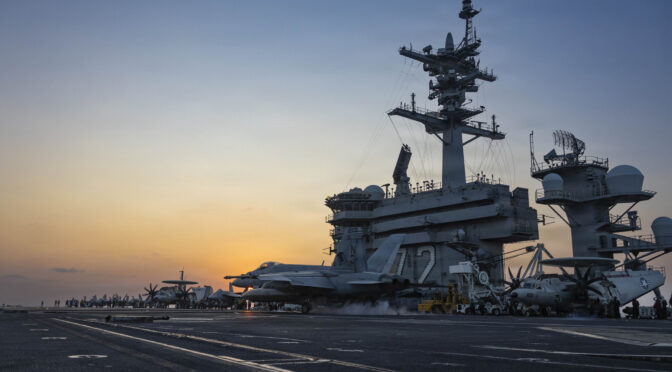
Featured Image: An F/A-18E Super Hornet, attached to Strike Fighter Squadron (VFA) 14, makes an arrested landing on the flight deck of Nimitz-class aircraft carrier USS Abraham Lincoln (CVN 72) in support of Operation Epic Fury, March. 4, 2026. (U.S. Navy photo)
Discover more from Center for International Maritime Security
Subscribe to get the latest posts sent to your email.
It’s definitely a shifting situation with the Hormuz Strait. The long-term implications of Tehran’s control are going to be incredibly complex to analyze.
Paul,
All points are right on and cogently expressed. We have the best capability by far to achieve tactical success against any other country that might deserve engagement. I’m afraid though, by engaging Iran, we have exposed our own weakness: the sheer amount of assets needed to achieve strategic victory is more than we currently have and the cost of the quantity of those assets, to achieve the objectives is prohibitive. We have know this all along up until this administration. We have known this but refused to say it out loud, so here we are.
We need to curtail this adventure and internalize the long term lesson. In the 80’s, Carter’s failed attempt to rescue our embassy staff was the first clue. But instead of strategically changing the playing field, we fixed the tactics by developing interoperability, quite successfully I think on a tactical level. What I mean by changing the playing field is to extract ourselves from the need of an open Strait of Hormuz. The strategic move isn’t specific to Iran. It’s a fundamental change in the needs of this country, reduce the need for oil to propel our cars and run electric plants. Though we don’t import much oil, we should make a major shift in our power production. Other nations will follow, compounding the effect of the strategy. Those that have held strategic non-military sway over us are sent back to the dugout trying to figure out how to keep their populations from economic starvation. Little else we need flows thru that Strait…. fertilizer can be produced anywhere. This will be a dynamic economic blow to all in that region, and they all deserve it.