
Articles Due: June 1, 2026
Week Dates: June 15-19, 2026
Story Length: 1,5000-3,000 Words
Submit to: Content@cimsec.org
The United States and Iran are at war, with a vital waterway dominating strategic concerns. A fight over the Strait of Hormuz has been a prominent naval scenario for more than 40 years since the U.S. and Iran fought in the tanker wars of the 1980s. Now this scenario has become reality, with the U.S. and Iran attempting to reestablish the flow of seaborne commerce on their own terms.
Despite a significant presence of U.S. naval forces in the region, Iran has effectively contested control of the Strait with asymmetric means. The distributed forces of the Islamic Revolutionary Guard Corps Navy have posed a persistent threat, while a wide variety of drones and munitions have helped Iran make its presence felt in the waterway. These methods may be demonstrating new facets of the evolving character of naval warfare and hinting at the future.
Another vital waterway has exerted major influence on the operational maneuver of forces. The circuitous route of the George H.W. Bush Carrier Strike Group around the entire continent of Africa, and the Ford strike group’s confinement to the northern reaches of the Red Sea, mark critical strategic effects reaped by the the Houthis. U.S. carrier strike groups have been effectively deterred from transiting the Bab El Mandeb strait, allowing the Houthis to inflict a major logistical price against U.S. naval forces.
Despite considerable tactical success and relatively few losses, the U.S. has struggled to translate combat outcomes into strategic results. The linkage between tactics and strategy has proven tenuous in this war, with the Navy’s contributions being subsumed under questionable strategy. It is also questionable how well the U.S. Navy can help secure vital sea lines of communication, a strategic role that has dominated its mission set for generations. The Navy’s challenges in controlling two major waterways against third-world adversaries may cast doubt on how well it can fulfill its strategic purpose.
At the same time, the operational effects of the war offer significant insights for the employment of Marine Corps forces in contested maritime terrain. Iran has been achieving disproportionate operational effects by using lethal, low signature, mobile forces operating within contested maritime spaces to disrupt U.S. plans and deny the U.S. freedom of maneuver. This is the Marine Corps’ Stand-in Forces concept made manifest, and potential lessons for refinement of this concept abound. As speculation continues about the seizure of key maritime terrain such as Kharg Island, the war compels the Marine Corps to look at its own concepts from and determine how to conduct amphibious operations in a highly contested maritime environment. As two amphibious readiness groups remain present in the region, the role and viability of the USMC in this war and modern conflict writ large could be put to the test.
The Iran war offers a rich set of lessons on the exercise of maritime power and naval force. How are combat operations highlighting changes in the character of warfare? How else may the fight over the maritime domain unfold? What does this war reveal about controlling the maritime domain with force and for strategic effect? Authors are invited to consider these questions and many more as this war unfolds.
Send all submissions to Content@cimsec.org.
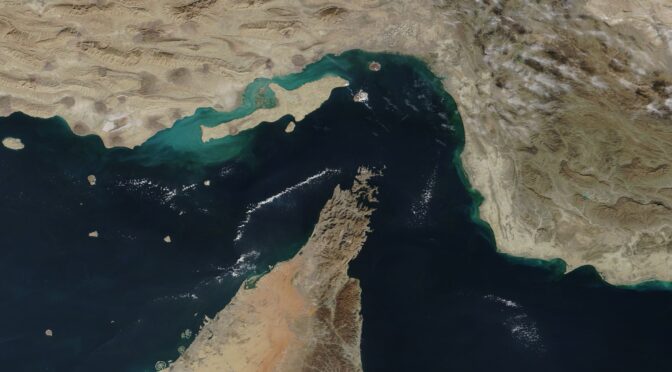
Featured Image: The Strait of Hormuz as viewed from space. (NASA photo)
Discover more from Center for International Maritime Security
Subscribe to get the latest posts sent to your email.
That’s a really interesting angle to explore, focusing on the Hormuz Strait’s long-standing significance. It seems like a complex situation with a lot of potential for narratives.
Nah, the United States in 2026 is Japan in 1941. Attacking Iran without first having clear objectives and a strategy was a fatal error. Wallpapering over this by retroactively crowdsourcing a plan will not help one bit.
The USN is done as an effective fighting force. It has lost all credibility and, more importantly, its moral authority.