
As the recent Israeli shootdown of a Hezbollah UAV reminded us, it is relatively easy to destroy an unmanned aircraft. But what about the proliferating numbers of unmanned undersea vehicles? The growth in these systems for naval applications will inevitably result in the requirement to counter an adversary’s underwater drones. Detection of a small man-made object moving underwater is not trivial, but also becoming easier with the advent of technologies such as high-resolution imaging sonars and Light Detection And Ranging (LIDAR) systems.
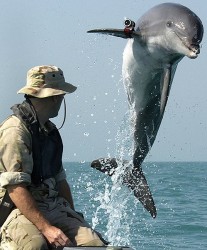
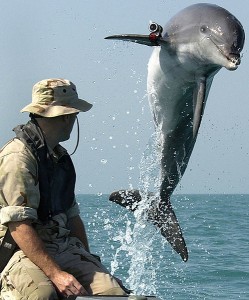
However, once an AUV is detected, how can it be destroyed? This problem set isn’t new. Mini-subs and combat swimmers have threatened ships in port since World War II. The old school way of dealing with frogmen is to drop a concussion grenade over the side of a boat. Alternatively, some navies have experimented with dolphins to counter swimmers. These sorts of mammal-based systems could conceivably be trained to work against AUVs. Other advanced technology developments will allow mammals to stay out combat.
Super-cavitating bullets, like those produced by US-based PNW Arms and Norway-based DSG Technology (see video) offer a potential weapon for defeating AUVs. According to PNW Arms, “supercavitation is the use of cavitation effects to create a bubble of gas inside a liquid large enough to encompass an object traveling through the liquid, which greatly reduces friction drag on the object and enables the achievement of very high speeds.” DSG Technology’s Multi-Environment Ammunition allows ordnance ranging in size from 4.5 mm through to 155 mm to transit from air to water or vice versa. Conceivably, AUVs could be detected and engaged from the air. The U.S. Navy’s AN/AWS-2 Rapid Airborne Mine Clearance System (RAMICS) technology demonstrator used a helicopter equipped with a blue-green LIDAR to locate mines near the surface, then a 30 mm super-cavitating round to neutralize them at depths of up to 60 meters. The program was cancelled in 2011 due to technical and budgetary issues.
Super-cavitating rounds also open up the possibility of hunter-killer unmanned undersea vehicles, guarding a port from other AUVs, mini-subs, and swimmers. Submariners often remind other sailors that the best ASW weapon is another submarine and the same may be true with AUVs. However, discriminating between an AUV and a similarly sized fish or marine mammal before pulling the trigger might be difficult without some sort of corroborating data, or image recognition algorithms.
This article was re-posted by permission from NavalDrones.com.
WWI, the Italians managed to sink an Austrian battleship in port. Several ships sunk in port by divers and mini-subs, including two British battleships and several cruisers. CVE was sunk in Vietnam by VietCong sappers.
Second sentence referred to WWII.
Thanks Chuck. Underwater sabotage is definitely an enduring threat to ships in port.